

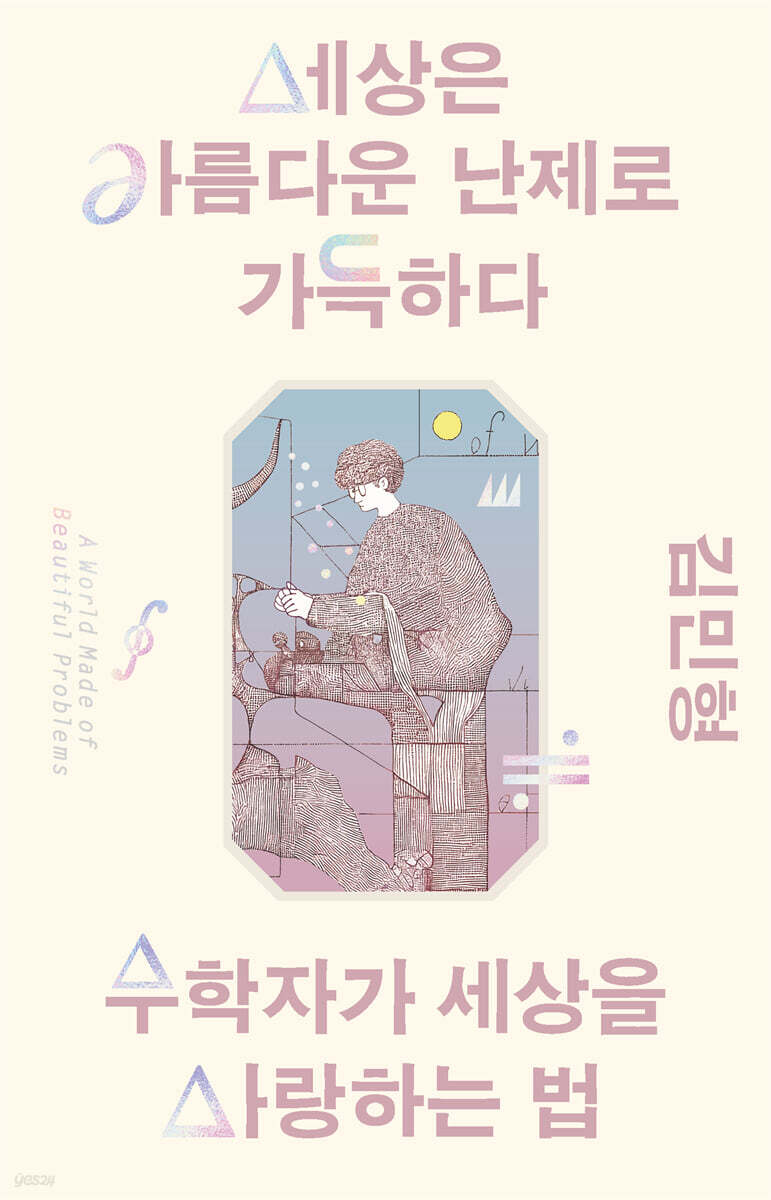
The world is full of beautiful challenges.
 |
Description
Book Introduction
- A word from MD
-
A mathematician's solution to the world's problemsAn essay by mathematician Kim Min-hyung.
It tells the story of the world through the eyes of a mathematician, crossing eras and cultures, prejudices and common sense, and humanity and academia.
Faced with the world's seemingly intractable problems, he asks questions.
Is there a right answer in the world, and is there really a need for one?
October 14, 2025. Essay PD Lee Ju-eun
Good prejudices and strange common sense that cannot be proven
On praising mistakes and tolerating uncertainty
How can critical thinking contribute to learning? Has fake news really become so prevalent? Can democracy be quantified? Can beliefs be tested? Everyday events, familiar figures, and ordinary practices appear differently to a mathematician.
What we consider a problem can sometimes be a solution to a mathematician.
A story about a mathematician's world without correct answers, who alternates between teaching and learning, mainstream and non-mainstream, optimist and pessimist, who fantasizes outrageously, is surprised like a child, and rejoices at small realizations.
- You can preview some of the book's contents.
Preview
index
preface
1.
Between Complaint and Joy: Belonging to a Time and Culture
Penrose, a singularity reached a little late
The Sputnik Vaccine and the Soviet Mathematical Tradition
Are universities subject to quantitative evaluation?
Edinburgh, Maxwell's City
Equilibrium of Hardy-Weinberg equilibrium
A step forward in Korean mathematics
War, a Ukrainian mathematician's appeal
The identity of a European mathematician
Is fascism a product of ignorance?
The complementary relationship between quantity and quality
Time measurement varies with time
Rallies, stable riots
Daegwallyeong Music Festival: Enjoying and Owning Culture
Is there an origin of mathematics?
Mathematics for Humanity
The best of times and the worst of times
The illusion of a perfect textbook
The Queen's Death and the Value of Remembrance
2.
Between Regression and Progress: Misunderstandings for Understanding
The Century of Crisis, the Century of Innovation
Praise the mistakes
Are races classifiable?
A Korean Nobel Prize in Chemistry?
Artificial Intelligence as a Tool for Exploration
Longing for a lost world
The power of simple ideas
What can artificial intelligence do?
Why Rome Had No Mathematicians
Does scholarship develop from rigor?
3.
Between Exclusion and Connection: The Harmony of Things Were Believed Incompatible
Descartes, the first modern meteorologist
Atomism, making the invisible visible
The Voyage of 20 Living Vaccines
Migration of medieval scholars
Fundamentalism and Pragmatism
Immigrant Stories These Days
Skin color created by geopolitics
A play for the weakest
How to tolerate uncertainty
The Value of Science on the Bandwagon
Human intelligence to control artificial intelligence
White roses blooming on the borders of Europe
Are religion and science in opposition?
Communication in the Age of Information Overload
Math, a story to be continued
4.
Between Coolness and Passion: The Studying Mind in the Age of AI
Mathematics understood with the heart
Awe for all intelligence
Cultural margin of error in mathematics
Is mathematical thinking innate?
How to Study Math in the Internet Age
Studying to realize ignorance
Britain's war on mathematical illiteracy
The trap of liberal arts knowledge
A student without passion smiles
What is a bad math problem?
Are grades and sociality inversely proportional?
The Inconvenient Truth About Academic Background
Exploring Mars for less than the cost of making a science fiction movie
Explain and Show
The Critical Thinking Dilemma
Detailed image

Into the book
Writing is obviously a good thing for everyone.
This is because you can secure time to specifically meditate on various aspects of daily life and the world, and you can also study a lot in the process of justifying your arguments.
So, for me, the time spent preparing and writing the column was mostly enjoyable.
--- p.8
The obsession with exams naturally leads to excessive competition.
Hardy also doesn't hide the fact that his motivation for studying hard was "to beat other kids in exams."
Therefore, professors live in an atmosphere where they are conscious of who is smarter than whom, whether they know it or not.
--- p.37
It can be assumed that Atiya felt the division of a large cultural sphere firsthand and sympathized with the pain of the various conflicts that division brought about.
His childhood experiences show that the borders and regional distinctions we take for granted are not only impermanent, but often not very old.
--- p.49
It is easy to see that the conflict between quantity and quality is a discourse with little realism.
Because scholars who write high-quality papers are generally also productive.
More importantly, the process of academic development cannot be entirely efficient.
Before a good result is achieved, a scholar creates many practice works, makes many mistakes, and 'wastes' a considerable amount of time.
--- p.57
How accurately will we measure and perceive time in the distant future? Will errors be completely eliminated? Everyone will need to measure their age down to the minute, and the technology to easily recognize this will become commonplace. We may even need to somehow deal with the time differences introduced by space travel.
Of course, some people might worry that it would be a very bleak world.
But isn't it true that all these changes are just a matter of getting used to them?
--- p.62
It is said that students who win a lot of competitions when they are young often fail to become outstanding adult athletes.
This is because in games involving younger players, a cautious style that avoids mistakes has a better chance of winning.
In such an environment, if you focus on winning strategies, you will naturally reduce your risky play and become accustomed to playing tennis in a way that makes you feel intimidated even when you win.
--- p.98
There is a joke-like adage that says, “The better a mathematician is, the more wrong his proofs are.”
This observation suggests that a scholar's influence must be strong for his or her mistakes to be discovered by others, but it also suggests that outstanding mathematicians often engage in risky thinking.
--- p.99
There is a scene in the beginning of the movie where Na-young is talking to her friends in the classroom.
They ask quite persistently, 'Why are you immigrating?'
Koreans of a similar generation to me are likely to have difficulty understanding that question.
My parents' generation grew up in an environment where they were unable to overcome the trauma of the Japanese colonial period and the Korean War, and many of my friends also admired the United States or Canada.
--- pp.156-157
Among the many legends surrounding Einstein, who is considered the greatest scientist of the 20th century, there is one that says he wrote only a few papers.
However, he published more than 300 papers during his lifetime.
His publications number 25, particularly in 1905, the "miracle year" in which he wrote four groundbreaking papers on special relativity and quantum mechanics.
Of course, most of them were not read.
--- p.173
What can a great novel teach us about the world? It certainly doesn't have the quantitative precision of Newtonian mechanics.
But no one can deny that great novels infinitely deepen and broaden our wisdom.
(.…) Literary understanding is as essential to the intellectual development of mankind as scientific theories.
--- p.192
It doesn't seem like a stretch to compare the experience of not understanding something while studying mathematics to dissonance.
However, the process of tension and its release is often much more intense than when listening to music, so it may be more appropriate to express it as pain and joy.
The pain of difficult logic is the same for young students and mathematicians alike.
--- p.198
Is "mathematical thinking" innate? As far as I know, no research on genetic influences has yielded reliable results.
Of course, it would be possible to gather evidence in a specific direction depending on one's prejudice.
However, no theory has yet survived a critical examination.
--- p.210
While teaching in the US and UK, I have often encountered attitudes within universities that belittle knowledge that could be called "liberal arts."
I've even heard from some math education experts that keeping unnecessary knowledge is like collecting cars you don't need.
(.…) From the perspective of the pleasure that comes from a deep and broad understanding of the world, it is okay to ignore these opinions.
--- p.226
Publisher's Review
★★★ A new essay by mathematician Kim Min-hyung! ★★★
It's more beautiful because it doesn't come off
Good prejudices and strange common sense that cannot be proven
On praising mistakes and tolerating uncertainty
“If there is a lesson I learned from studying mathematics,
“The truth is that it is very difficult to draw conclusions about world affairs.”
How much does critical thinking contribute to learning? Has fake news really increased so much? Can democracy be quantified? Are the criteria for demarcating national borders reasonable? To which country does a classic belong? Can beliefs be tested? Everyday events, familiar figures, and ordinary practices appear differently to a mathematician.
What we consider a problem can sometimes be a solution to a mathematician.
“Although the theory of numbers and number systems has been studied for three thousand years, not many theories have actually been created.
Anytime someone does something in a truly novel way, it's a big deal.
Kim Min-hyung actually did it.” Professor Kim Min-hyung, who rose to the ranks of world-renowned mathematicians by developing an innovative theory that combines cutting-edge topology, quantum field theory, and classical number theory, is back with another challenging problem.
The author, who previously served as a professor of mathematics at Oxford University and as a professor of popular mathematics at Warwick University, and is currently serving as the Whitaker Professor and Director of the International Institute for Mathematical Sciences at the University of Edinburgh, where he is promoting the 'Mathematics for Humanity' project, takes as his topic the world's challenges rather than the challenges of mathematics in his new book, 'The World is Full of Beautiful Problems'.
Mathematics, which mathematician Kim Min-hyung has studied throughout his life, has a human face.
These achievements, which we take for granted, were repeatedly followed by two steps backward, through countless mistakes, countless hours, misunderstandings, and misuse, before a theory was established and put into practice.
In the process, we were able to make great strides.
This is also true in mathematics; it would be impossible to solve a more complex world problem in one go.
In 'Wrong Answer Note' and 'Foreign Language Class', the aesthetics of mistakes and imitation were discussed; in 'Age in Full', the relative length of absolute time that was different in each era was discussed; in 'Corona', episodes of past vaccine transport and atomic and germ theories were discussed; in 'Academic Background', what cannot be known from university rankings and the differences in entrance exam culture in each country were discussed; and in 'Artificial Intelligence', a sense of awe for human intelligence was brought out. The series, which continued for nearly five years, was a place to reveal the confidence that problems can be solved with mathematics and the humility that there are too many problems that cannot be solved with mathematics.
Beyond mathematics, the book covers education, politics, society, and culture. It tells the story of a mathematician who, as a teacher and a learner, mainstream and non-mainstream, optimist and pessimist, imagines absurd things, is surprised like a child, and rejoices at small realizations, exploring a world without correct answers.
A record of Kim Min-hyung's thoughts surrounding the world's difficult problems that seem unsolvable.
“Why are you not me?”
Why Boundaries and Either-Ors Are Dangerous
There is one question that runs through the challenges the author addresses in this book.
For those who believe there are answers to the world's problems, it's a question of whether those answers are really the right ones and whether the problem is the kind that requires an answer.
The author questions what defines a person's identity, as he shows how the countries in which he grew up, some of the most recognized mainstream 'British' mathematicians in academia, are now divided into different cultural spheres.
Can the cultural sphere surrounding the Mediterranean be divided into Europe, Asia, and Africa? Is such a boundary truly beneficial, or does it have negative consequences? The author argues that anti-immigrant sentiment and the Israeli-Palestinian conflict stem from this very division.
The views on race are also the same.
The people the author observed in Britain did not fit the black, white, and yellow classifications common in the United States.
I saw a variety of skin colors between the extremes of white and black.
Thus, the author emphasizes the need to widely publicize the fact that the criteria for distinguishing races are more vague than the criteria for distinguishing cultural spheres.
Because when discrimination becomes rampant, a culture of hate also grows.
In addition, he shows through his own experience and history that individuals and groups, ability and effort, quantity and quality, religion and science are not completely opposites, nor are they completely distinguishable.
For example, the quality of a paper is somewhat correlated with its quantity, and there is no need for scientists to reject religion.
“Don’t ask why, just shut up and do the math!”
The Usefulness of Imitation and Culture in Learning and Scholarship
The author also has a lot to say about our common sense.
They say that the more you know, the better, that is, the broader your knowledge of basic knowledge in your field of expertise and general knowledge related to your field of expertise.
We cannot deny this statement.
The author also believed this even when he was a professor in the United States.
He was shocked to discover that British students had never even heard of Tolstoy's novel War and Peace, and then discovered that a textbook on natural philosophy, first published over a century ago and never out of print, was steeped in obscure philosophy, unable to escape the influence of ancient Greek and Roman classics. He realized that essential liberal arts knowledge actually hindered the depth of scholarship.
On the other hand, it also points out the reality that physicists, who are preoccupied with the fundamental question of 'what is existence', have difficulty contributing to practical scientific discoveries.
That is, fundamental questions rarely yield fundamental answers.
And it points out the dilemma of critical thinking.
When learning a foreign language as an adult, the question "why?" can sometimes hinder learning.
The episode of an American student who couldn't make progress because he kept asking why English and Spanish were different during Spanish class shows that learning should be a process of gradually becoming familiar with patterns.
This is also true for physics researchers: if we focus solely on clear logic, we may stifle creativity.
We also say that interaction is better than isolation.
However, as seen in the case of Russia, which quickly developed a vaccine, Russia continued to conduct in-depth research with state support even at a time when there was little vaccine research worldwide.
The author argues that exchange alone is not the right thing to do, as 'nerds' who only cared about their school friends and focused on what they liked could bring about innovations that would change the world.
“I will gaze in wonder and find peace of mind.”
Studying in the Age of Artificial Intelligence
The author also shares his own experiences regarding education and thinks about a slightly better way.
But, as expected, the process of acquiring knowledge was difficult to explain even for the author who had taught mathematics at a university for decades.
It wasn't easy to find common ground between the feedback that "you only show how to solve problems without explaining them" and the feedback that "you only explain the theory without providing examples."
Even if a common ground is found, another difficulty is that the mix of explanation and demonstration must be varied depending on the personality and aptitude of each student.
But how can we be confident in human educational methods when we don't even know for sure how AI learns knowledge? The author's simple conclusion is that "education in the age of AI must be based on a concrete methodology, predicated on a mind that respects nature, humans, and human-made machines with awe and the ability to handle them with care."
Finally, as a mathematician, I say this about 'understanding':
“There are actually quite a few people, even among scientists, who consider mathematics to be a realm of ‘inhuman reason.’
I want to tell them.
Mathematics is something that is understood with the heart, not the brain.
And ‘understanding’ is the process of finding balance between our minds and the rest of the world.”
GOODS SPECIFICS
- Date of issue: October 2, 2025
- Page count, weight, size: 256 pages | 352g | 126*196*16mm
- ISBN13: 9791173323669
You may also like
카테고리
korean


korean


