

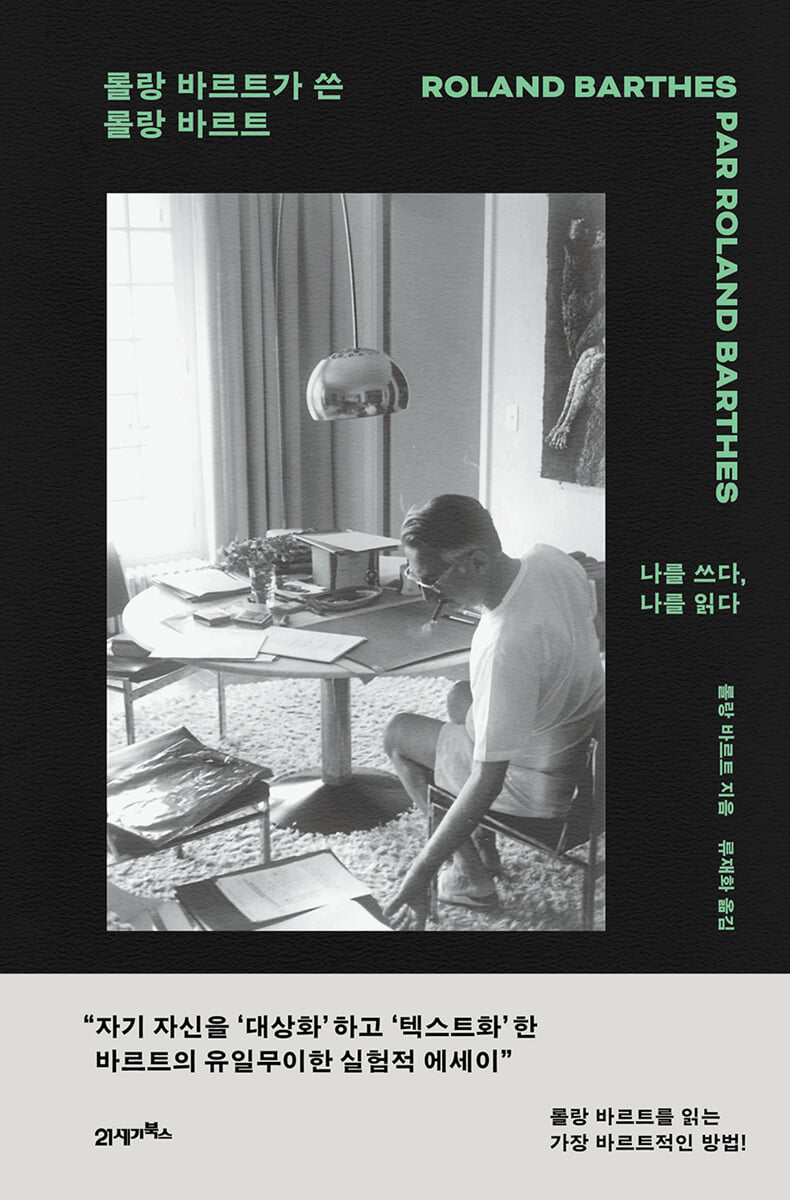
Roland Barthes written by Roland Barthes
 |
Description
Book Introduction
★ In an era where writing and creation are being redefined, a poststructuralist master is gaining renewed attention ★
★ An innovative, autobiographical experiment that blurs the boundaries between self and language ★
★ A classic of 20th-century literary criticism praised by intellectuals worldwide ★
“I write one text.
And that's R.
“It’s called B.”
In an age where AI writes novels and draws pictures, what does human creativity entail? French philosopher Roland Barthes's "Roland Barthes by Roland Barthes" offers a fascinating answer to this question.
In this book, Barthes attempts a surprising experiment.
Even when writing about himself, he refers to himself in the third person as 'RB (Roland Barthes)' or 'he', as if observing others, and objectively observes himself and depicts him piece by piece in short pieces.
Typically, autobiographies present a consistent self-image, stating, "I am this kind of person," and adopt a linear narrative style.
But Barth made the exact opposite choice.
He broke traditional writing conventions and blurred the line between author and work, demonstrating that 'a nation cannot be defined by one thing.'
And this book was recorded as a new form of autobiography in the history of 20th century literature.
What is most interesting about Barthes's writing is that he does not hide his own inconsistencies.
Some fragments reveal one idea, while others present completely different, even contradictory, ideas.
This reveals how complex and unpredictable humans are.
While writing, it shows the process of not finding the answer to 'who I am', but rather discovering 'how complex a being I am'.
In other words, writing is viewed not as a means of self-expression, but as a journey to explore oneself.
For Barthes, writing was an act of confronting the riddles of life.
The 'pleasure of writing' he spoke of did not lie in completing a perfect work.
Instead, in the process of writing, I was in a moment of encountering language, discovering new meanings or destroying existing ones, and exploring modes of expression I had never tried before.
So, I believe that the true value of creation lies not in the finished product, but in the adventurous spirit of trying something new, even if it might fail.
Barthes' experiment shows what is special about human creation.
It's not about perfection or consistency.
Rather, it remains incomplete, contradictory, and a process of endlessly questioning. In an age where AI provides quick and accurate answers, Barthes's book will serve as a crucial opportunity to redefine writing as a manifestation of the inherently human spirit of inquiry and an act of asking existential questions.
- You can preview some of the book's contents.
Preview
index
Active/Reactive
adjective
ease
The demon of similarity
black chalkboard
money
Argo
Oman
The fortune teller's movements
Not a choice, but an endorsement
Truth and Assertion
Atopia
self-direction
open carriage
I play tag
When I did… …
proper noun
I can't stand the idiot box...
Love for an idea
young bourgeois girl
amateur
R.
Brechtian condemnation of B.
Blackmail and extortion on theory
Chaplin
Full screen of the movie
envoy
coincidence
Comparison is rational
Truth and integrity
Contemporary with what?
Ambiguous praise for the contract
counterattack
My body is just… …
Body of revenge
ribs
Imago's crazy curves
A pair called word-value
Double raw
disassemble/destroy
Goddess named H
Friends
priority relationship
Violation of the violation
2nd degree and others
Extension as the truth of language
his voice
Separate
Dialectics
Revenge, difference, conflict
Taste of division
Piano fingering… …
bad object
Vipers and paravexes
Like a butterfly
ambivalent ambiguity
Like tying a bandage diagonally
resonance chamber
Writing begins with style.
What is the use of utopia?
The writer as fantasy
New subject, new science
It's you, Elise… …
Elliptical omission
emblem, gag
Society of senders
Schedule
private life
in fact……
Eros and Theatre
aesthetic discourse
Attraction to ethnology
Etymology
Violence, clear, nature
rejection
Celine and Flora
Exemption from meaning
Not a dream, but a fantasy
vulgar fantasy
Passive regression
Fatigue and freshness
fiction
double shape
Love, Madness
Forging
Fourier or Flaubert?
Circulation of fragments
Fragmentary thoughts as fantasy
From fragmentary thoughts to diary
strawberry wine
French
typo
Tremors of meaning
galloping induction
left-handed
Gesture conception
Abgrund
Algorithm taste
But if I hadn't read it...
Heterology and Violence
The Imaginary of Solitude
hypocrisy?
Idea as pleasure
Unrecognized concepts
sentence
Ideology and Aesthetics
imaginary world
Dandy
What is influence?
Subtle tool
Take a break, I have a chronic illness
stupid thing
writing machine
fast
Jilali's letter
A paradox like pleasure
Discourse of Joy
Fullness
Word work
fear of language
Native language
impure vocabulary
I like it,
I don't like it
Structure and Freedom
receptive
Readable, writable and beyond
Literature as Matesis
My book
eloquence
Clarity
marriage
Childhood memories
Fantasy of Dawn
medusa
Abu Novas and Metaphor
linguistic allegory
migraine
Out of date
The softness of big words
dancer's calves
Politics/Morals
Word-mode
word-value
word-color
Word-Mana
Transitional words
average word
Natural
Newly bought/new
neutrality
Active/Passive
adjustment
Numen
The passage of objects in discourse
Smells
From writing to work
“As you know”
Opaque and transparent
Antithesis
Withdrawal from the theory of origins
The shaking of values
Paradoxa
A mild drive for paranoia
speak/kiss
passing bodies
Play, hybrid imitation
patchwork
color
Split personality?
Partial articles
Bataille, fear
Steps
Good effect of sentences
political text
alphabet
The order I no longer remember
Miscellaneous notes and works
Language-Priest
Predictable discourse
Book Project
Correlation with psychoanalysis
Psychoanalysis and Psychology
“What does that mean?”
What kind of logic is this?
regression
structural reflection
Domination and Victory
Abolition of value dominance
What are the limits of reproduction?
ring
Success/Failure
Like choosing clothes
rhythm
To be known
Between Salamanque and Valladolid
Practice problems
Knowledge and Writing
Values and Knowledge
scene
Dramatized science
I see language
Seth Contra
Squid and ink
Planning a book about sex
sexiness
A happy ending to sex?
Shifter as Utopia
Three things in meaning
philosophy of simplicity
A monkey among monkeys
social division
Me, me
bad political actors
overdetermination
Can't listen to yourself
The symbolism of the nation
Symptomatic text
Systematic
Tactics/Strategy
later
Tel Kel
weather
The Promised Land
My head is dizzy
theater
theme
A shift from values to theory
maxim
The monster called totality
Translator's Note
ㆍNote
ㆍRoland Barthes Chronology
ㆍRoland Barthes' works
ㆍSearch
ㆍExplanation of the main text illustrations
Detailed image

Into the book
He doesn't like winning conversations at all.
He finds it hard to humiliate anyone, and when victory seems imminent, he immediately wants to go somewhere else (if he were a god, he would keep overturning victories, right? Besides, that's what gods do!).
When we move to the level of conversation, even the most correct victory becomes the worst victory linguistically.
Because it's arrogance.
I came across these words while reading Bataille, in which book he spoke about the arrogance of science.
The arrogance he spoke of extended to all conversations that were impatient for victory.
I therefore tolerate three arrogances.
The arrogance of science, the arrogance of the Doxa, the arrogance of the passionate fighter.
--- From "Arrogance"
I give up on the tireless search for that old piece of me.
I'm not trying to restore myself (like a monument).
I don't say that.
“It will describe me,” he says, but says this.
“I write one text.
And that's R.
“It’s called B.”
--- From "Coincidence"
I live in a society of senders (I am one of them).
People I meet or write to send me books, articles, specifications, guides, protests, invitations to plays and exhibitions, and so on.
The pleasure of writing and production, bordering on sexual pleasure, is desperately needed everywhere.
But because of the commercial circuit, free production is stagnant and almost mad and wild.
--- From "The Society of Sender"
Writing is a dry, ascetic pleasure.
It is a pleasure that should never be completely poured out.
--- From "Celine and Flora"
Writing in fragments.
The fragments are stones around a circular circle.
I spread my body out on it.
All my little worlds are crumbs.
What lies at the heart of it all? His first, or nearly first, text (1942) is also a fragmentary piece of writing.
This choice was in accordance with the Zidan style of the time.
“Because disorder is better than order that is distorted.” After that, in fact, he never stopped writing short pieces.
--- From "The Cycle of Fragments"
Could you begin to write without thinking of yourself as a typist? At least you could before.
The story of origin must be replaced by the story of form.
The origin of a work is not the first influence on the work, but the first attitude.
Imitate one role.
Then, it metonymically imitates an art.
I begin to produce by reproducing what I want to be.
--- From "Abgrunt"
There is no imagination purer than self-criticism.
Ultimately, the substance of this book is entirely fictional.
The third person is inserted into discourses like essays not to refer to some fictional creature, but to reform the so-called genres.
By saying it is an essay, one is essentially confessing that it is almost a novel.
A novel without proper nouns.
--- From "My Book"
As I write, my writing feels flat, insignificant, and somehow sinful compared to the works I'm supposed to be writing competitively.
The collective award called "work" keeps following me around. How can I write while navigating these pitfalls? Well, I just close my eyes.
Every moment I work, I feel lost, I feel like I'm going crazy, I feel like I'm being chased, but in the end, all I can do is say to myself,
The last words of Sartre's 'The Closed Room'.
Let's continue.
--- From "From Writing to Work"
So if each of us only uses words like tomorrow, me, there.
If you speak without referring to anything that seems to be stipulated by law.
We could talk about the fluidity within a group, similar to the liquidity of love.
In this context, isn't it true that vague differences are the most precious value of language (although subtlety emerges from clear differences, and endless repercussions emerge from those subtleties, and differences are respected)?
--- From "Shifter as Utopia"
Publisher's Review
Roland Barthes, a man who became writing itself, traversing memory, identity, and images.
Roland Barthes' most private and thoughtful autobiographical record
“Who am I?” Faced with this eternal question, Roland Barthes proposes a completely new way of answering it.
Roland Barthes, written by Roland Barthes, is not a simple autobiography, but a revolutionary experiment that deconstructs and reconstructs the very concept of the self.
Barthes does not narrate his life as a complete story.
Instead, through some 200 fragmentary thoughts, it invites readers to explore the complexity and multi-layered nature of the being called 'I'.
The book, which rejects all the conventions of traditional autobiography, has no chronological narrative, no consistent characterization, and no didactic conclusion.
Rather, through each short story, it explores the layers of language, the subversion of art, and the aesthetics of multiplicity.
In this way, Barthes does not reduce himself to a complete meaning, but asks the reader to create a new 'Barthes' through the text.
Barthes's characteristically suggestive and philosophical style can sometimes be difficult to understand, but the translator's notes are detailed and delicate to aid in the difficult reading.
This will allow readers to understand Barth more closely by examining the context.
It may seem contradictory at first glance that Barthes, who declared the 'death of the author', is writing about himself.
But this contradiction is precisely the heart of the book.
He does not present himself as a fixed subject, but creates a text that is constantly changing and reconstructed.
Through this, readers are confronted with fundamental questions about writing, identity, language and existence.
For Barthes, writing was not simply a means of expression, but a way of being itself.
He weaves his identity into language, dealing equally with the most personal memories and the most abstract thoughts, from his longing for his mother to his reflections on structuralist theory.
A close portrait of an intellectual emerges, as his photography, passion for music, and everyday tastes are juxtaposed with philosophical insights.
Ultimately, this book goes beyond Barth as an individual; it is an excellent record of how humans understand and recreate themselves through language.
This book presents us with the ultimate portrait of a writer who discovers himself through writing and ultimately becomes writing itself.
"Barthes's unique intellectual play and profound reflection shine through, experimenting with himself as a text."
A semiotic adventure exploring the depths of language
Barthes' writing is an art in itself.
Instead of unraveling his life as a coherent narrative, he presents it in fragments of thoughts, reflections, memories and observations.
Each fragment is independent yet resonates with the others, allowing the reader to reconstruct the character of Barthes in three dimensions through these pieces.
This fragmentary writing is not simply a technique, but a philosophical choice.
Barthes shows that human identity is not fixed and complete, but rather a process of constant change and restructuring.
Reading his texts soon becomes an experience of thinking anew about our own identity.
What is particularly noteworthy is the exquisite intellectual play that Barthes demonstrates by using himself as a subject of experiment.
He does not fall into trite confessions or sentiments, but coolly observes and analyzes his own tastes, prejudices, fears, and desires.
For example, in discussing 'image', he dissects how he is caught up in the gaze of others, and in the essay on 'language', he explores the subtle differences between speech and writing.
This process of self-objectification is a moment in which Barthes' characteristic humor and irony shine, while also providing the reader with an opportunity for deep reflection.
His semiotic exploration, which began with 'Myth', expands into a more intimate and personal dimension in this book.
Behind the language and symbols we take for granted in our daily lives lie complex cultural and social meanings.
Barthes' semiotic insights enable readers to discover these hidden layers and provide a perspective for interpreting the world more critically and creatively.
Ultimately, this book is a semiotic adventure exploring the depths of language, presenting new possibilities for thought discovered by an intellect as it transforms itself into text.
"Completing one's narrative by not speaking"
A shining point where Roland Barthes' personal reflections and theoretical thinking meet.
From childhood photos to adulthood, this book reveals his complex identity through images and text, capturing the special moment when the semiotician Barthes' theory and practice intersect.
He was skeptical about writing an autobiography itself, and while talking about 'myself', he deconstructed it into text, images, and symbols.
Instead of presenting actions and events in a linear narrative, he uses short texts, fragments, photographs, drawings, and musical scores to present his ‘thoughts’ and ‘identity’ in a mosaic-like manner.
He honestly reveals his childhood, habits, passions, and regrets, while also unfolding his theoretical positions on semiotics, language, and the concept of text.
Speaking about 'me', I write so thoroughly, passionately, and practically, so as not to fall into the 'trap of the ego', so as not to be immersed in egocentrism.
(…) The more one moves towards extremes of meaning that are too personal, too imaginary, and even more perverse and perverse, the more the writing moves away from the signing ‘author’ and towards the ‘text’ itself.
These 200 fragments prove this.
As can be seen from the above 'Translator's Note', Barth says more through silence.
He does not directly confess his homosexual desires or his deep attachment to his mother.
Instead, he indirectly reveals his inner self through abstract items such as fear, loneliness, and images.
This 'not speaking' strategy actually creates a more powerful self-narrative.
By reading between the lines, the reader discovers Barthes' true nature, and in this process, the text becomes an independent entity that transcends the author.
Ultimately, Barth's personal reflections and theoretical thinking in this book shine most brightly at the moment when personal experience is sublimated into universal thought.
The trivial tastes of everyday life are transformed into semiotic insights, and even our own weaknesses and prejudices become the material for profound reflection on the human condition.
Through this paradoxical writing style that completely exposes and simultaneously conceals oneself, Barthes presents a new possibility for self-narration.
"Setting the Standard for Human Reading and Writing in the AI Era"
Reflecting on Writing in Our Time Through Three Questions
In an age where AI generates text and images at incredible speeds, Barthes's insights shine even brighter.
This book allows us to consider the following three questions:
First, “Who is the subject that creates meaning?”
This is the core problem we face today: behind AI-generated content, human design and interpretation still lie hidden.
Barthes emphasizes that all texts are not mere information, but a 'network of meaning'.
This also means that instead of passively consuming the results produced by AI, we must become active interpreters and critics.
"Roland Barthes, written by Roland Barthes" is also a practical model of this kind of critical reading.
The second question is, “What creative writing can’t AI imitate?”
The answer to this lies in Barthes' writing style itself.
His unique format, a mixture of fragmentary essays, poetic sentences, and philosophical reflections, seeks sensory freedom rather than logical completeness.
For Barthes, writing was not a ‘rule’ but a ‘play and amusement.’
This experimental approach demonstrates human creativity and individuality, which is fundamentally different from AI-generated text based on patterns and probabilities.
His writing reveals the true nature of creation, born from unpredictable associations and serendipitous discoveries.
The third question is, “How can we develop the discernment to distinguish between the real and the fake?”
In today's world, where fake news is rampant, this issue is even more pressing.
Barthes explored how photographs, memories, and language appear to be 'truths' yet are actually products of interpretation, and his semiotic approach reveals power structures and ideologies hidden beyond surface meaning.
His writing helps readers develop the ability to critically decipher all symbols and texts.
In a world where it's becoming increasingly difficult to distinguish between the real and the fake, this book will serve as a compass for anyone seeking to establish their own interpretations and standards of judgment.
This intellectual journey with Barth will provide a transformative experience of reading, writing, and creating new texts from around the world.
GOODS SPECIFICS
- Date of issue: September 29, 2025
- Format: Hardcover book binding method guide
- Page count, weight, size: 360 pages | 132*204*30mm
- ISBN13: 9791173574726
- ISBN10: 1173574727
You may also like
카테고리
korean


korean


