

Math in Music: A Story That Makes Music Sound Better: Math Talks Music
 |
Description
Book Introduction
Breaking the prejudice that 'music is emotion, mathematics is reason'
A mathematical journey into music
At first glance, ‘music’ and ‘mathematics’ seem distant.
In fact, these two are a well-matched combination that doesn't look too awkward.
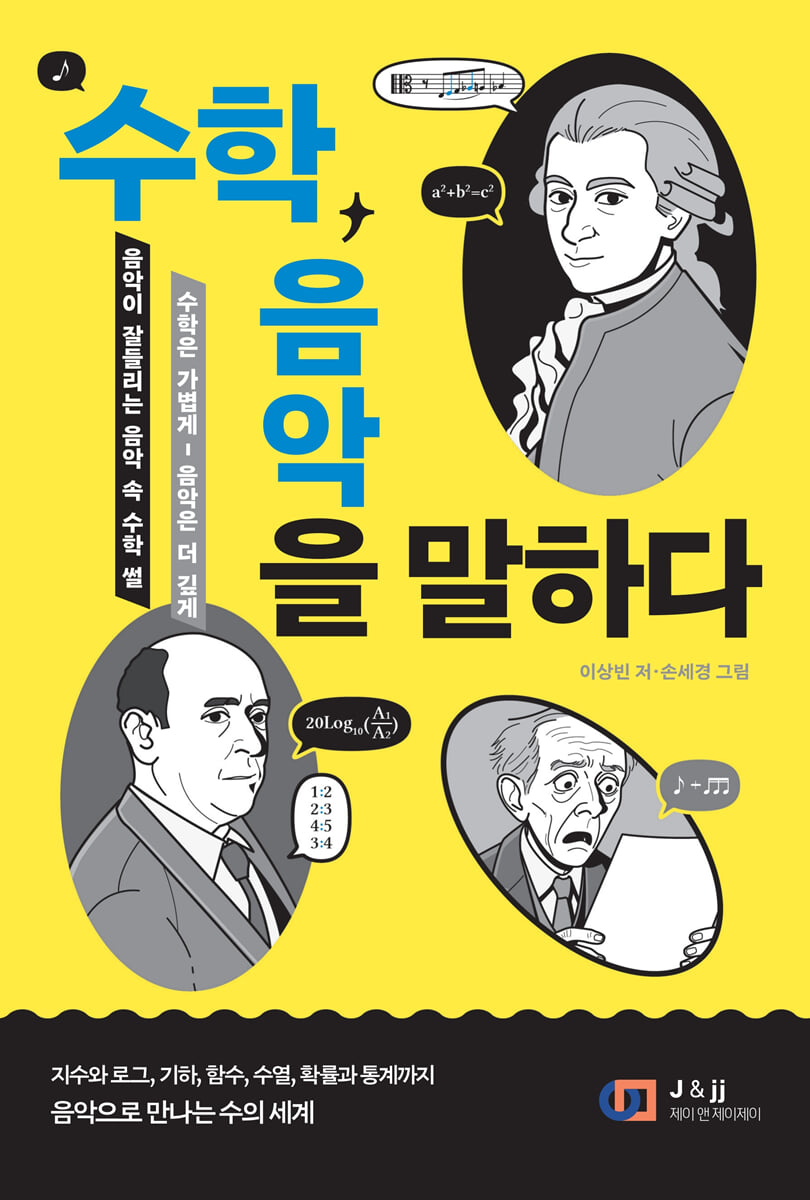
This book, "Mathematics Talks Music," conveys the mathematical elements hidden in music without being too heavy or difficult.
From ‘sound propagation’ to the secrets of ‘harmony and dissonance’, ‘equal temperament’.
It explains 'music' in an easy way using core mathematical principles that we have likely encountered in textbooks at least once, such as factors, ratios, functions, sequences, geometry, and probability.
We also decipher the mathematical codes hidden in musical works spanning both classical and contemporary periods, from Bach's mirror-symmetrical scores, Jimi Hendrix's distortions, Bela Bartok's Fibonacci sequence, and even modern AI compositions.
When music, which has always been infinitely lyrical, exciting, and soft, is viewed through the lens of mathematics, it becomes a little more rational, and we can discover a new side and charm to music that we had not seen before.
A mathematical journey into music
At first glance, ‘music’ and ‘mathematics’ seem distant.
In fact, these two are a well-matched combination that doesn't look too awkward.
This book, "Mathematics Talks Music," conveys the mathematical elements hidden in music without being too heavy or difficult.
From ‘sound propagation’ to the secrets of ‘harmony and dissonance’, ‘equal temperament’.
It explains 'music' in an easy way using core mathematical principles that we have likely encountered in textbooks at least once, such as factors, ratios, functions, sequences, geometry, and probability.
We also decipher the mathematical codes hidden in musical works spanning both classical and contemporary periods, from Bach's mirror-symmetrical scores, Jimi Hendrix's distortions, Bela Bartok's Fibonacci sequence, and even modern AI compositions.
When music, which has always been infinitely lyrical, exciting, and soft, is viewed through the lens of mathematics, it becomes a little more rational, and we can discover a new side and charm to music that we had not seen before.
- You can preview some of the book's contents.
Preview
index
preface
Introduction: About two people who seem awkward but are surprisingly close.
0.
Music Math Encyclopedia
1.
A cursory glance at mathematics, not watermelon, no, a cursory glance at music
- Between music and mathematics seen from the corner of my eye
Ⅰ.
sound propagation
1.
Your voice... Leega...
I heard
- Can you hear me? Yes?
2.
Who will you meet?
- When waves meet each other
Ⅱ.
Divisors and multiples
1.
Are you really only hearing 'E' here?
- Bounce the string!
- Beep! The scan results are normal (blue)!
2.
The ground I was standing on disappeared!
- Characteristics of sound as seen through the greatest common divisor
- Oh! There's no more sound?
Ⅲ.
Rain and ratio
1.
What is this sound that pops like a stone being chewed while eating?
- (Unclear) Harmony
2.
Twelve Dragon Balls obtained through arithmetic
- Twelve notes that are somewhat creepy, some of which are put together to create a chromatic scale.
3.
In the end, everyone carries the burden of discord
- When I applied the average rate, the disease got better.
But is it really better?
Ⅳ.
Exponents and logarithms
1.
Hey, can you turn up the video volume a bit?
- Wait! There's something you need to know first.
- You have to be able to trust people...
Isn't that right?
- Amplitude and decibels (dB), you two are different guys?
- Epilogue: Let's go and check the index and log with our own eyes!
2.
The higher the position, the more effort is needed to maintain that position.
- Even if you climb the mountain of frequencies like crazy, you'll only get to one key.
V.
function
1.
I tried to make the sound like minced meat.
- A right triangle that we met again after a long time, and a circle with a radius of 1
- A spiral ring that creates a sine wave!
- What if the ambulance siren sounds really, really fast?
2.
Rocker's crazy wildness, step on the distortion pedal!
- Jimmy rips the speaker!
VI.
sequence
1.
The Fibonacci sequence and the golden ratio in music
- Find hidden rules
2.
All twelve notes in an octave are numbered.
- Harmony and discord? Now you can play together.
VII.
Geometry
1.
Copy and reflect!
- Musical congruence and symmetry created by copying and reflecting
- Two mirror canons at once!
2.
Difference, repetition and pattern, and the terrible music that comes from them.
- 59bpm vs.
60bpm vs.
61bpm
- Walking a tightrope between order and disorder.
VIII.
Probability, Statistics, and Discrete Mathematics
1.
Born from a rhythm...
- What does it mean to make music by following established rules?
- What melody comes next? I don't know!
- Truly automatic, the computer starts composing music on its own.
2.
Should humans really be allowed to compose music?
- Composers, get out of the room now!
IX.
Epilogue End-of-Semester Achievement Evaluation
1.
Finally, I asked the AI, "Where is mathematics hiding?"
- Urgent review!
- What are the conditions for mathematics to be visible in music?
Introduction: About two people who seem awkward but are surprisingly close.
0.
Music Math Encyclopedia
1.
A cursory glance at mathematics, not watermelon, no, a cursory glance at music
- Between music and mathematics seen from the corner of my eye
Ⅰ.
sound propagation
1.
Your voice... Leega...
I heard
- Can you hear me? Yes?
2.
Who will you meet?
- When waves meet each other
Ⅱ.
Divisors and multiples
1.
Are you really only hearing 'E' here?
- Bounce the string!
- Beep! The scan results are normal (blue)!
2.
The ground I was standing on disappeared!
- Characteristics of sound as seen through the greatest common divisor
- Oh! There's no more sound?
Ⅲ.
Rain and ratio
1.
What is this sound that pops like a stone being chewed while eating?
- (Unclear) Harmony
2.
Twelve Dragon Balls obtained through arithmetic
- Twelve notes that are somewhat creepy, some of which are put together to create a chromatic scale.
3.
In the end, everyone carries the burden of discord
- When I applied the average rate, the disease got better.
But is it really better?
Ⅳ.
Exponents and logarithms
1.
Hey, can you turn up the video volume a bit?
- Wait! There's something you need to know first.
- You have to be able to trust people...
Isn't that right?
- Amplitude and decibels (dB), you two are different guys?
- Epilogue: Let's go and check the index and log with our own eyes!
2.
The higher the position, the more effort is needed to maintain that position.
- Even if you climb the mountain of frequencies like crazy, you'll only get to one key.
V.
function
1.
I tried to make the sound like minced meat.
- A right triangle that we met again after a long time, and a circle with a radius of 1
- A spiral ring that creates a sine wave!
- What if the ambulance siren sounds really, really fast?
2.
Rocker's crazy wildness, step on the distortion pedal!
- Jimmy rips the speaker!
VI.
sequence
1.
The Fibonacci sequence and the golden ratio in music
- Find hidden rules
2.
All twelve notes in an octave are numbered.
- Harmony and discord? Now you can play together.
VII.
Geometry
1.
Copy and reflect!
- Musical congruence and symmetry created by copying and reflecting
- Two mirror canons at once!
2.
Difference, repetition and pattern, and the terrible music that comes from them.
- 59bpm vs.
60bpm vs.
61bpm
- Walking a tightrope between order and disorder.
VIII.
Probability, Statistics, and Discrete Mathematics
1.
Born from a rhythm...
- What does it mean to make music by following established rules?
- What melody comes next? I don't know!
- Truly automatic, the computer starts composing music on its own.
2.
Should humans really be allowed to compose music?
- Composers, get out of the room now!
IX.
Epilogue End-of-Semester Achievement Evaluation
1.
Finally, I asked the AI, "Where is mathematics hiding?"
- Urgent review!
- What are the conditions for mathematics to be visible in music?
Detailed image

Publisher's Review
A scientific perspective that delves into the fundamentals of music
: From the 'propagation' of sound to the rules of 'harmony',
Perfectly deciphered in the language of mathematics.
Why do some chords feel comfortable to listen to, while others feel uncomfortable? This book answers this most fundamental question in music using mathematical principles.
Through 'number and multiple', the relationship between various frequency components (overtones) hidden in a single sound is explored, and the boundary between dissonance and consonance is explained through 'ratio and ratio'.
In particular, it dramatically shows how the mean temperament, which overcomes the limitations of pure temperament and Pythagorean temperament and fairly tunes all scales, was created through mathematical arithmetic.
The mathematics hidden in the scores of genius composers
: Masters such as Bach, Bela Bartok, and Mozart
The sophisticated algorithm behind creativity!
Great works of music are built on a dense structure, not just emotion.
This book explores the beauty of 'geometry' in Bach's canon and analyzes the rules of 'sequences' often observed in the works of Bela Bartok.
Additionally, it scientifically explains how the distortion effector, which is a symbol of guitarist Jimi Hendrix, distorts sound waves through the concept of 'function'.
From classical counterpoint to the patterns and changes of 20th-century minimal music, it clearly shows how the creativity of music, transcending time, has been expressed through mathematical tools.
The Present and Future of Music, Probability, and Artificial Intelligence
: From dice music to AI composition,
How did mathematics become the creator of music?
Whether we know it or not, mathematics has penetrated the realm of creating and consuming music.
A look into the future of music through 'probability, statistics, and discrete mathematics.'
It traces the process by which the primitive 'algorithmic composition' of Mozart's era developed into 'computer composition' through John Cage and Xenakis in the 20th century.
Furthermore, it clearly and humorously analyzes the mathematical principles that have permeated our music consumption patterns, including the current state of highly developed artificial intelligence composing music on its own and the music recommendation algorithms of streaming services we use.
This process will provide readers with interesting and intellectual answers to questions about the future of the combination of music and mathematics.
: From the 'propagation' of sound to the rules of 'harmony',
Perfectly deciphered in the language of mathematics.
Why do some chords feel comfortable to listen to, while others feel uncomfortable? This book answers this most fundamental question in music using mathematical principles.
Through 'number and multiple', the relationship between various frequency components (overtones) hidden in a single sound is explored, and the boundary between dissonance and consonance is explained through 'ratio and ratio'.
In particular, it dramatically shows how the mean temperament, which overcomes the limitations of pure temperament and Pythagorean temperament and fairly tunes all scales, was created through mathematical arithmetic.
The mathematics hidden in the scores of genius composers
: Masters such as Bach, Bela Bartok, and Mozart
The sophisticated algorithm behind creativity!
Great works of music are built on a dense structure, not just emotion.
This book explores the beauty of 'geometry' in Bach's canon and analyzes the rules of 'sequences' often observed in the works of Bela Bartok.
Additionally, it scientifically explains how the distortion effector, which is a symbol of guitarist Jimi Hendrix, distorts sound waves through the concept of 'function'.
From classical counterpoint to the patterns and changes of 20th-century minimal music, it clearly shows how the creativity of music, transcending time, has been expressed through mathematical tools.
The Present and Future of Music, Probability, and Artificial Intelligence
: From dice music to AI composition,
How did mathematics become the creator of music?
Whether we know it or not, mathematics has penetrated the realm of creating and consuming music.
A look into the future of music through 'probability, statistics, and discrete mathematics.'
It traces the process by which the primitive 'algorithmic composition' of Mozart's era developed into 'computer composition' through John Cage and Xenakis in the 20th century.
Furthermore, it clearly and humorously analyzes the mathematical principles that have permeated our music consumption patterns, including the current state of highly developed artificial intelligence composing music on its own and the music recommendation algorithms of streaming services we use.
This process will provide readers with interesting and intellectual answers to questions about the future of the combination of music and mathematics.
GOODS SPECIFICS
- Date of issue: November 1, 2025
- Page count, weight, size: 296 pages | 550g | 152*225*15mm
- ISBN13: 9791192924281
- ISBN10: 1192924282
You may also like
카테고리
korean


korean

![GQ KOREA Mark (Monthly): December [2025]](http://librairie.coreenne.fr/cdn/shop/files/8ef265dbbfbf186523ed75ba7319009d.jpg?v=1765340328&width=3840)


