

Chae Sa-jang's Wide and Shallow Land 15: New Art
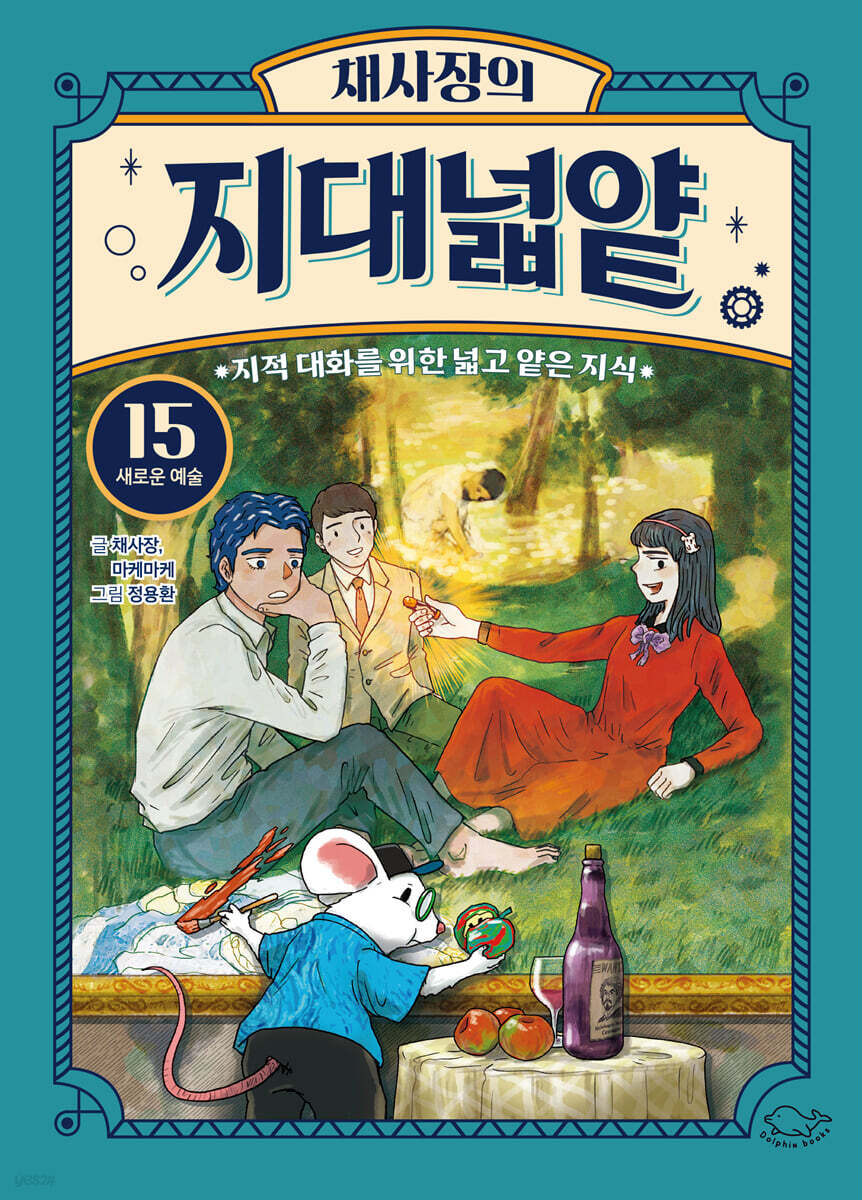 |
Description
Book Introduction
An amazing art class that brings beautiful knowledge to a child's life.
Knowing art history enriches your knowledge of humanity and human history!
“A series that children read and reread”
“It’s great for reading with parents because it explains difficult content in an easy-to-understand way.”
"Essential educational books for children that enhance reading and literacy skills."
The "Broad and Shallow Knowledge for Intellectual Conversation" series by Cha Sa-jang, a children's version of the "national textbook" that set a new record in the humanities and achieved triple million-seller status, is now available.
Upon its first publication in 2021, it created a huge sensation among parents and children, establishing itself as a must-read for elementary school students.
Readers unanimously say that this series is different from the typical educational comics that list fragments of knowledge.
This is because, as you enjoy the content of the book, you will naturally become capable of deep thinking and integrated thinking.
The 14th and 15th volumes of the "Chae Sa-jang's Wide and Shallow" series, which covers a wide range of fields and has sparked a craze for humanities among parents, focus on the field of art, particularly art history.
Readers who have studied the history of science and philosophy through this series will have discovered that academic disciplines and ideas have changed over time, and that within these changes have been perspectives such as absolutism, relativism, and skepticism.
Even from the perspective of looking at art, there exist worldviews of absolutism, relativism, and skepticism.
There is no need to learn all the complex art movements or memorize every detail.
However, a thorough understanding of the changes in perspective over time helps us interpret not only art history but also the entire history of mankind and understand humanity.
This journey with President Cha will provide a foundation for understanding art, which has often been perceived as difficult and complex, by clarifying it in a clear and concise manner.
A life that is exposed to and understands art from a young age is filled with extraordinary richness.
In these times, when it is more crucial than ever for humans to cultivate their unique qualities, a life that discovers beauty can change a child's future.
I hope that through this book, children will develop an artistic sensibility that they will carry with them throughout their lives.
Knowing art history enriches your knowledge of humanity and human history!
“A series that children read and reread”
“It’s great for reading with parents because it explains difficult content in an easy-to-understand way.”
"Essential educational books for children that enhance reading and literacy skills."
The "Broad and Shallow Knowledge for Intellectual Conversation" series by Cha Sa-jang, a children's version of the "national textbook" that set a new record in the humanities and achieved triple million-seller status, is now available.
Upon its first publication in 2021, it created a huge sensation among parents and children, establishing itself as a must-read for elementary school students.
Readers unanimously say that this series is different from the typical educational comics that list fragments of knowledge.
This is because, as you enjoy the content of the book, you will naturally become capable of deep thinking and integrated thinking.
The 14th and 15th volumes of the "Chae Sa-jang's Wide and Shallow" series, which covers a wide range of fields and has sparked a craze for humanities among parents, focus on the field of art, particularly art history.
Readers who have studied the history of science and philosophy through this series will have discovered that academic disciplines and ideas have changed over time, and that within these changes have been perspectives such as absolutism, relativism, and skepticism.
Even from the perspective of looking at art, there exist worldviews of absolutism, relativism, and skepticism.
There is no need to learn all the complex art movements or memorize every detail.
However, a thorough understanding of the changes in perspective over time helps us interpret not only art history but also the entire history of mankind and understand humanity.
This journey with President Cha will provide a foundation for understanding art, which has often been perceived as difficult and complex, by clarifying it in a clear and concise manner.
A life that is exposed to and understands art from a young age is filled with extraordinary richness.
In these times, when it is more crucial than ever for humans to cultivate their unique qualities, a life that discovers beauty can change a child's future.
I hope that through this book, children will develop an artistic sensibility that they will carry with them throughout their lives.
- You can preview some of the book's contents.
Preview
index
Prologue What kind of picture should I draw?
1.
Back alley troublemaker
- Baroque art
[Cha Sa-jang's Key Notes] Baroque and Rococo
[Master's Report] Masters of Baroque Art
[Break time] Baroque vs. Rococo
2.
If you show me an angel
- Realism
[Cha Sa-jang's Key Notes] Modern Art
[Master's Report] Courbet, the painter who painted facts
[Break time] Find the hidden picture
3.
Electric Impressionism
- Right now
[Chairman Cha's Key Note] Draw What You See
[Master's Report] Representative Impressionist Painters
[Break time] Find the correct sentence
4.
Post-Impressionism
- Starry Night
[Chairman Cha's Key Notes] Draw the Color of Your Heart
[Master's Report] Cezanne's Life and Works
[Break time] Letter from the Soul
5.
contemporary art
- Art as a weapon
[Chairman Cha's Key Notes] Obsession with Newness
[Master's Report] Art Today
[Break time] Crossword puzzle
Epilogue: Invitation from the Gods
Final summary
Art section summary
1.
Back alley troublemaker
- Baroque art
[Cha Sa-jang's Key Notes] Baroque and Rococo
[Master's Report] Masters of Baroque Art
[Break time] Baroque vs. Rococo
2.
If you show me an angel
- Realism
[Cha Sa-jang's Key Notes] Modern Art
[Master's Report] Courbet, the painter who painted facts
[Break time] Find the hidden picture
3.
Electric Impressionism
- Right now
[Chairman Cha's Key Note] Draw What You See
[Master's Report] Representative Impressionist Painters
[Break time] Find the correct sentence
4.
Post-Impressionism
- Starry Night
[Chairman Cha's Key Notes] Draw the Color of Your Heart
[Master's Report] Cezanne's Life and Works
[Break time] Letter from the Soul
5.
contemporary art
- Art as a weapon
[Chairman Cha's Key Notes] Obsession with Newness
[Master's Report] Art Today
[Break time] Crossword puzzle
Epilogue: Invitation from the Gods
Final summary
Art section summary
Detailed image

Publisher's Review
How did neglected paintings become masterpieces?
Baroque art was ridiculed as “the distorted pearl” for being too emotional and undignified.
Realism was judged to be unworthy of emotion because it dealt with the miserable and miserable lives of the common people.
Impressionism was criticized for its vague and roughly drawn forms.
Van Gogh and Cézanne's paintings were considered 'bad paintings', and Picasso's Cubism caused public discomfort because it was considered bizarre.
Most of the works we praise as masterpieces were coldly ignored at the time.
However, the challenges and experiments of artists who were not afraid of new attempts have become the driving force that broadens the aesthetic sensibility of humanity today.
Because only the pioneering pioneers are remembered in history, artists have had to pursue the new, sometimes to the point of obsession.
What was the new beauty they dreamed of, even amidst poor reviews?
When we look at the lives of artists hidden behind their masterpieces, filled with their thoughts, worries, pain, and hopes, the rich emotions hidden beyond the painting become ours to experience.
《Cha Sa-jang's Wide and Shallow Land, Vol. 15 - New Art》 presents personal encounters with artists through storytelling.
The masterpieces that they appreciate with empathy will reach them with a deeper and more unique emotion.
Meeting artists who lived in a rapidly changing era
Through their struggles, we learn about the essence of beauty that humanity has preserved.
Although humanity has been engaged in artistic activities since time immemorial, the first time that "beauty" became a core theme of art can be found in ancient Greek and Roman art.
Christian art in the Middle Ages functioned as a means of expressing faith rather than as art itself, and during the Renaissance, a literary revival movement, it began to pursue ideal beauty again along with human-centered thinking.
This trend later led to neoclassicism, representing the artistic movement that explored 'absolute beauty'.
However, as a reaction against absolutist art, 'relativist' art emerged.
Examples include the emotional and ornate Baroque and Rococo art, and Romanticism, which expressed the inner world of the artist.
In modern times, realism, impressionism, and post-impressionism emerged, and the artist's perspective and sensory expression became more important than ideal beauty.
For a long time, art seemed to alternate between absolutism and relativism, but in modern times, artists began to question the very concept of beauty itself.
Picasso's Cubism, which deconstructed the subject, and Kandinsky's abstract art, which completely eliminated the subject, shook the concept of art to its core.
During this period, artists experimented with entirely new artistic possibilities by asking themselves, "How should I express it?" rather than "What should I draw?"
Art in the 21st century is moving towards an era of convergence and participation.
The boundaries between technology and art are blurring, with digital art, NFTs, and AI art emerging, and "participatory art" has emerged, where the audience becomes part of the artwork.
Attempts to shake the object, subject, and meaning of art will continue in the future.
What will the art of the future be like for children? How much is considered technology and how much can be considered art? Will art still be necessary for humanity? When we approach art with the curiosity of an artist and ask questions, art will gift children with a new perspective on the world.
Aesthetic curiosity enriches my daily life and the world. I hope to gift it to my child through "Cha Sa-jang's Wide and Shallow Land, Vol. 15 - New Art."
An instant bestseller
Boy's Korea's Best Children's Book Selection
The Best Children's Humanities Books, Proven by Reader Reviews
We live in an age where more learning materials than ever are available through books and media.
Today's children take in a lot of information, but they may not have the time or energy to synthesize that knowledge and digest it into their own thoughts.
What we need more than anything is to connect the flow of knowledge and make it our own.
Speaking 'my thoughts' is not something that can be studied by memorization.
For children who need to understand hidden meanings and contexts and apply them to real life, this book will be an excellent teacher and discussion forum.
As important as knowledge is the power of thinking.
1.
Korea's first full-fledged humanities story comic for children!
By conveying only the core knowledge of humanities and arts in an easy and fun way, we can make difficult and complex humanities easier to understand.
It's organized into one easy-to-understand line.
2.
Providing the 'real knowledge' needed to survive in the world.
Baroque, Rococo, Neoclassicism, Realism, Impressionism, and even Modern Art!
It contains the learning content learned in school, but also provides real knowledge that is not taught in school.
3.
A cultural comic format you've never seen before, 100% worth collecting!
With text and pictures that are different from previous educational cartoons
Rather than providing only fragmentary information, we cultivate the ability to think for oneself and develop a perspective on the world.
4.
Brain-stimulating stories + mind-stimulating knowledge
Through the story of the protagonist Alpha struggling to survive in the world with his whole body,
You can enjoy a unique reading experience with stories that awaken your mind and knowledge that touches your heart.
5.
A knowledge series that explains everything about the world and life.
The important thing is to see the forest! Helping children broaden their understanding of the world.
It teaches wisdom beyond knowledge, how to live in the future.
How to read this book
1.
If you follow the main character's steps in the story, you can understand the flow of information.
2.
I try to figure out whether the art I've seen falls into the absolutist, relativist, or skepticist categories.
3.
In [Chairman Cha's Key Notes], find key keywords in the history of art.
4.
Let's connect the knowledge that you are curious about by looking at [Master's Report].
5.
It's more fun to summarize a book briefly in [Final Summary] and discuss it with people around you.
# Appendix [Western Art History Chronology]
Masterpieces and artists representing ancient times, the Renaissance, and modern times!
Take a look at the artists and their works to reflect on the major trends in art.
Baroque art was ridiculed as “the distorted pearl” for being too emotional and undignified.
Realism was judged to be unworthy of emotion because it dealt with the miserable and miserable lives of the common people.
Impressionism was criticized for its vague and roughly drawn forms.
Van Gogh and Cézanne's paintings were considered 'bad paintings', and Picasso's Cubism caused public discomfort because it was considered bizarre.
Most of the works we praise as masterpieces were coldly ignored at the time.
However, the challenges and experiments of artists who were not afraid of new attempts have become the driving force that broadens the aesthetic sensibility of humanity today.
Because only the pioneering pioneers are remembered in history, artists have had to pursue the new, sometimes to the point of obsession.
What was the new beauty they dreamed of, even amidst poor reviews?
When we look at the lives of artists hidden behind their masterpieces, filled with their thoughts, worries, pain, and hopes, the rich emotions hidden beyond the painting become ours to experience.
《Cha Sa-jang's Wide and Shallow Land, Vol. 15 - New Art》 presents personal encounters with artists through storytelling.
The masterpieces that they appreciate with empathy will reach them with a deeper and more unique emotion.
Meeting artists who lived in a rapidly changing era
Through their struggles, we learn about the essence of beauty that humanity has preserved.
Although humanity has been engaged in artistic activities since time immemorial, the first time that "beauty" became a core theme of art can be found in ancient Greek and Roman art.
Christian art in the Middle Ages functioned as a means of expressing faith rather than as art itself, and during the Renaissance, a literary revival movement, it began to pursue ideal beauty again along with human-centered thinking.
This trend later led to neoclassicism, representing the artistic movement that explored 'absolute beauty'.
However, as a reaction against absolutist art, 'relativist' art emerged.
Examples include the emotional and ornate Baroque and Rococo art, and Romanticism, which expressed the inner world of the artist.
In modern times, realism, impressionism, and post-impressionism emerged, and the artist's perspective and sensory expression became more important than ideal beauty.
For a long time, art seemed to alternate between absolutism and relativism, but in modern times, artists began to question the very concept of beauty itself.
Picasso's Cubism, which deconstructed the subject, and Kandinsky's abstract art, which completely eliminated the subject, shook the concept of art to its core.
During this period, artists experimented with entirely new artistic possibilities by asking themselves, "How should I express it?" rather than "What should I draw?"
Art in the 21st century is moving towards an era of convergence and participation.
The boundaries between technology and art are blurring, with digital art, NFTs, and AI art emerging, and "participatory art" has emerged, where the audience becomes part of the artwork.
Attempts to shake the object, subject, and meaning of art will continue in the future.
What will the art of the future be like for children? How much is considered technology and how much can be considered art? Will art still be necessary for humanity? When we approach art with the curiosity of an artist and ask questions, art will gift children with a new perspective on the world.
Aesthetic curiosity enriches my daily life and the world. I hope to gift it to my child through "Cha Sa-jang's Wide and Shallow Land, Vol. 15 - New Art."
An instant bestseller
Boy's Korea's Best Children's Book Selection
The Best Children's Humanities Books, Proven by Reader Reviews
We live in an age where more learning materials than ever are available through books and media.
Today's children take in a lot of information, but they may not have the time or energy to synthesize that knowledge and digest it into their own thoughts.
What we need more than anything is to connect the flow of knowledge and make it our own.
Speaking 'my thoughts' is not something that can be studied by memorization.
For children who need to understand hidden meanings and contexts and apply them to real life, this book will be an excellent teacher and discussion forum.
As important as knowledge is the power of thinking.
1.
Korea's first full-fledged humanities story comic for children!
By conveying only the core knowledge of humanities and arts in an easy and fun way, we can make difficult and complex humanities easier to understand.
It's organized into one easy-to-understand line.
2.
Providing the 'real knowledge' needed to survive in the world.
Baroque, Rococo, Neoclassicism, Realism, Impressionism, and even Modern Art!
It contains the learning content learned in school, but also provides real knowledge that is not taught in school.
3.
A cultural comic format you've never seen before, 100% worth collecting!
With text and pictures that are different from previous educational cartoons
Rather than providing only fragmentary information, we cultivate the ability to think for oneself and develop a perspective on the world.
4.
Brain-stimulating stories + mind-stimulating knowledge
Through the story of the protagonist Alpha struggling to survive in the world with his whole body,
You can enjoy a unique reading experience with stories that awaken your mind and knowledge that touches your heart.
5.
A knowledge series that explains everything about the world and life.
The important thing is to see the forest! Helping children broaden their understanding of the world.
It teaches wisdom beyond knowledge, how to live in the future.
How to read this book
1.
If you follow the main character's steps in the story, you can understand the flow of information.
2.
I try to figure out whether the art I've seen falls into the absolutist, relativist, or skepticist categories.
3.
In [Chairman Cha's Key Notes], find key keywords in the history of art.
4.
Let's connect the knowledge that you are curious about by looking at [Master's Report].
5.
It's more fun to summarize a book briefly in [Final Summary] and discuss it with people around you.
# Appendix [Western Art History Chronology]
Masterpieces and artists representing ancient times, the Renaissance, and modern times!
Take a look at the artists and their works to reflect on the major trends in art.
GOODS SPECIFICS
- Date of issue: November 19, 2025
- Format: Hardcover book binding method guide
- Page count, weight, size: 172 pages | 488g | 153*210*18mm
- ISBN13: 9791193487273
- ISBN10: 1193487277
- KC Certification: Certification Type: Conformity Confirmation
You may also like
카테고리
korean


korean

![GQ KOREA Mark (Monthly): December [2025]](http://librairie.coreenne.fr/cdn/shop/files/8ef265dbbfbf186523ed75ba7319009d.jpg?v=1765340328&width=3840)


