

Our class debt relationship
 |
Description
Book Introduction
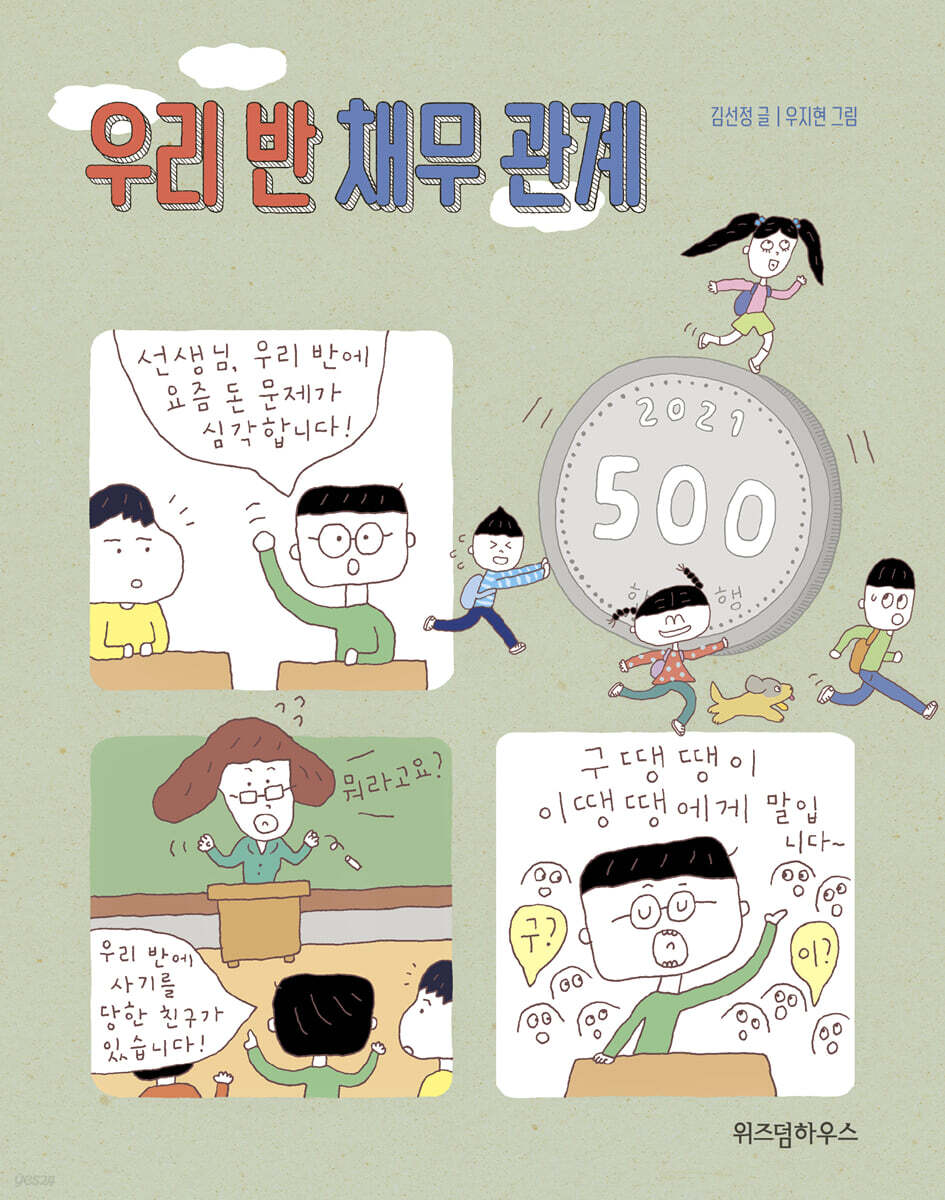
For children who have trouble with money issues among friends A shining message from author Kim Seon-jeong When a money issue arises among friends, the children find their own way to solve the problem through a class meeting. Children share their opinions honestly, without deceiving themselves, calculating future benefits, and come to the insightful conclusion, "Between us, five hundred won!" This is a very impressive fairy tale that shows children growing into independent thinkers and independent beings, and it contains the message that better ideas can be generated by putting our heads together. |
- You can preview some of the book's contents.
Preview
Detailed image

Into the book
It was true.
After eating lunch around 12 o'clock, I was really hungry in the afternoon.
Before going to the academy, mothers give their children money to buy something to eat at a convenience store or snack bar.
And for the children, the time spent buying something to eat with their friends was the most enjoyable and important moment.
The Marong Stationery Store in front of the school is like a convenience store, snack bar, and shopping mall for children.
The children could not imagine a life without the pleasure of spending money there.
--- p.52
The kids got bored quickly.
I didn't want to hear the second question because the first essential question was so trivial.
But it's no use.
Teachers can quickly stop children from saying things they don't want to hear, but children can't stop teachers from saying things they don't want to hear, no matter how much they want to hear them.
If you tell the teacher to stop talking, you'll probably have to listen to him talk ten times more.
--- p.53
“Hey, do you want to go get a slushie? Or do you want some sausages?”
"okay.
"How much do you have? I have a thousand won."
“You don’t have money? Then I’ll buy it for you today.”
When these kinds of words come and go, it's fun to go to Marong Stationery.
Even if you happen to go alone, you should pretend to know the other kids already gathered in front of the Marong Stationery Store, ask them what they eat, and share information about the new toys that came out recently.
--- p.54
Chansu bought ice cream and gave it to Hyungshik.
“Huh? I came to the academy.
Gu Chan-su, I ate well.
“I’ll buy it for you tomorrow! See you tomorrow!”
Hyungsik smiled broadly, holding an ice cream in one hand.
Chansu shouted at the back of Hyungshik's head as he hurriedly ran to the academy car.
"are you okay.
“It’s only five hundred won!”
After eating lunch around 12 o'clock, I was really hungry in the afternoon.
Before going to the academy, mothers give their children money to buy something to eat at a convenience store or snack bar.
And for the children, the time spent buying something to eat with their friends was the most enjoyable and important moment.
The Marong Stationery Store in front of the school is like a convenience store, snack bar, and shopping mall for children.
The children could not imagine a life without the pleasure of spending money there.
--- p.52
The kids got bored quickly.
I didn't want to hear the second question because the first essential question was so trivial.
But it's no use.
Teachers can quickly stop children from saying things they don't want to hear, but children can't stop teachers from saying things they don't want to hear, no matter how much they want to hear them.
If you tell the teacher to stop talking, you'll probably have to listen to him talk ten times more.
--- p.53
“Hey, do you want to go get a slushie? Or do you want some sausages?”
"okay.
"How much do you have? I have a thousand won."
“You don’t have money? Then I’ll buy it for you today.”
When these kinds of words come and go, it's fun to go to Marong Stationery.
Even if you happen to go alone, you should pretend to know the other kids already gathered in front of the Marong Stationery Store, ask them what they eat, and share information about the new toys that came out recently.
--- p.54
Chansu bought ice cream and gave it to Hyungshik.
“Huh? I came to the academy.
Gu Chan-su, I ate well.
“I’ll buy it for you tomorrow! See you tomorrow!”
Hyungsik smiled broadly, holding an ice cream in one hand.
Chansu shouted at the back of Hyungshik's head as he hurriedly ran to the academy car.
"are you okay.
“It’s only five hundred won!”
--- p.79
Publisher's Review
Rules for rationally organizing our debt relationship,
'Between us, five hundred won!'
Chansu lends Siwon the money he needs to buy supplies after Siwon offers to pay 500 won more.
But even though the promised day has arrived, Siwon does not return the money that Chansu lent him.
Chansu, who had been suffering alone, confides in his friend Hyungshik about this, and learns that Hyungshik also had a difficult time with his friend because of money.
The two report this to their teacher, and the children of Class 3-3 of Maryong Elementary School hold a 'meeting to create rules for rationally resolving debt relationships.'
How do children resolve debts between friends? After a heated debate, the children in the story establish rules: not to pressure a friend who refuses to buy something, to buy exactly 500 won worth of something for a friend, and to repay a friend's debt within three days.
What on earth is the basis for such a rule? Once you understand the circumstances, won't you find yourself slapping your knee and nodding along? Shouting, "Between us, 500 won!"
People are better when they are together than when they are alone.
I try to find a better way and become a better person.
"Our Class Debt Relationship" is a story about money problems that arise between children, and it makes you seriously think about how to wisely resolve the problems that inevitably arise between people.
The reason this story, which deals with the most unfamiliar subject matter in Korean children's literature, "money," is so vivid and relevant to our society today is probably because it is a story drawn from reality.
This is something that every child has likely experienced at least once, so you will quickly become engrossed in the story as soon as you open it, and you will find yourself cheering for the wisdom of the children in the story, who are filled with kindness and innocence.
The kids said, “It’s okay.
With just one word, “It’s only 500 won!”, he shows his insight to see through the essence of the problem and solve it.
This work is not limited to a realistic narrative and an interesting plot, but also contains deep thoughts that will make even adults nod their heads.
“When I was at school, I would discuss and resolve various issues that arose in the classroom with the children.
From first grade to sixth grade, there wasn't a single child who couldn't share their thoughts on their problems.
(Omitted) This story is one that I picked up during many meetings with children.
I came to believe it after meeting with children.
“People find better ways to do things together than when they are alone, and they try to become better people.”
As the author says, I hope that the children who read this story will develop the belief that 'putting our heads together can lead to better ideas.'
The only evidence of learning is change!
The joy of witnessing changes in children's minds and behavior
This work is also the first work published by the author, who worked as an elementary school teacher for a long time, concluding his time as a teacher.
The author said, “Because I have a job that gives me a lot of opportunities to talk to children, there have been many funny, nodding, and absurd things.
“But I feel very sorry that I wasted time not being able to write everything down one by one.”
Perhaps it is because of this regret that the author's identity as a teacher is so deeply embedded in every aspect of his work.
The author states throughout the work that the only evidence of learning is change, and that if there is no change, one cannot say that one has learned properly.
Artist Woo Ji-hyun, who drew the pictures, vividly reveals the changes in the hearts and actions of these characters in a four-panel cartoon format, showing how children learn and grow.
The joy of witnessing how children's minds and behaviors change through a certain process lingers long after the book is closed.
Like the scene in front of Marongmun-gu after all the children have left.
'Between us, five hundred won!'
Chansu lends Siwon the money he needs to buy supplies after Siwon offers to pay 500 won more.
But even though the promised day has arrived, Siwon does not return the money that Chansu lent him.
Chansu, who had been suffering alone, confides in his friend Hyungshik about this, and learns that Hyungshik also had a difficult time with his friend because of money.
The two report this to their teacher, and the children of Class 3-3 of Maryong Elementary School hold a 'meeting to create rules for rationally resolving debt relationships.'
How do children resolve debts between friends? After a heated debate, the children in the story establish rules: not to pressure a friend who refuses to buy something, to buy exactly 500 won worth of something for a friend, and to repay a friend's debt within three days.
What on earth is the basis for such a rule? Once you understand the circumstances, won't you find yourself slapping your knee and nodding along? Shouting, "Between us, 500 won!"
People are better when they are together than when they are alone.
I try to find a better way and become a better person.
"Our Class Debt Relationship" is a story about money problems that arise between children, and it makes you seriously think about how to wisely resolve the problems that inevitably arise between people.
The reason this story, which deals with the most unfamiliar subject matter in Korean children's literature, "money," is so vivid and relevant to our society today is probably because it is a story drawn from reality.
This is something that every child has likely experienced at least once, so you will quickly become engrossed in the story as soon as you open it, and you will find yourself cheering for the wisdom of the children in the story, who are filled with kindness and innocence.
The kids said, “It’s okay.
With just one word, “It’s only 500 won!”, he shows his insight to see through the essence of the problem and solve it.
This work is not limited to a realistic narrative and an interesting plot, but also contains deep thoughts that will make even adults nod their heads.
“When I was at school, I would discuss and resolve various issues that arose in the classroom with the children.
From first grade to sixth grade, there wasn't a single child who couldn't share their thoughts on their problems.
(Omitted) This story is one that I picked up during many meetings with children.
I came to believe it after meeting with children.
“People find better ways to do things together than when they are alone, and they try to become better people.”
As the author says, I hope that the children who read this story will develop the belief that 'putting our heads together can lead to better ideas.'
The only evidence of learning is change!
The joy of witnessing changes in children's minds and behavior
This work is also the first work published by the author, who worked as an elementary school teacher for a long time, concluding his time as a teacher.
The author said, “Because I have a job that gives me a lot of opportunities to talk to children, there have been many funny, nodding, and absurd things.
“But I feel very sorry that I wasted time not being able to write everything down one by one.”
Perhaps it is because of this regret that the author's identity as a teacher is so deeply embedded in every aspect of his work.
The author states throughout the work that the only evidence of learning is change, and that if there is no change, one cannot say that one has learned properly.
Artist Woo Ji-hyun, who drew the pictures, vividly reveals the changes in the hearts and actions of these characters in a four-panel cartoon format, showing how children learn and grow.
The joy of witnessing how children's minds and behaviors change through a certain process lingers long after the book is closed.
Like the scene in front of Marongmun-gu after all the children have left.
GOODS SPECIFICS
- Publication date: March 31, 2021
- Page count, weight, size: 84 pages | 210g | 167*212*7mm
- ISBN13: 9788962472417
- ISBN10: 8962472414
- KC Certification: Certification Type: Conformity Confirmation
You may also like
카테고리
korean


korean

![ELLE 엘르 스페셜 에디션 A형 : 12월 [2025]](http://librairie.coreenne.fr/cdn/shop/files/b8e27a3de6c9538896439686c6b0e8fb.jpg?v=1766436872&width=3840)


