

A house full of books and play
 |
Description
Book Introduction
A solid storyline, vivid characters, and moving illustrations.
The essence of historical fairy tales that are not mired in didacticism.
Winner of the 9th Munhakdongne Children's Literature Award.
Set against the backdrop of the historical event of the persecution of Catholicism during the Joseon Dynasty, this work is a historical fairy tale that delicately and intimately depicts the ideologies of society and individuals, the lives of the intellectual class and the general public, and their concerns through the life of a scribe.
The protagonist Jang Yi's father is a copyist who makes a living by copying countless Chinese character books, including Korean storybooks, day and night.
But one day, he is dragged to the government office and branded a Catholic scholar for copying a Catholic book.
Jang Yi's father was beaten so hard that he was about to burst, and he lay there like a living corpse, hovering between life and death.
In the face of a typhoon that suddenly strikes, the wealthy Jang family, who have nothing, are helpless.
This story is based on historical facts and has a solid structure, using clean sentences and sophisticated descriptions to create a story.
This is a work in which the characteristics of each character, including Jang Yi's character, come to life so vividly that it seems as if they are drawn before your eyes.
The essence of historical fairy tales that are not mired in didacticism.
Winner of the 9th Munhakdongne Children's Literature Award.
Set against the backdrop of the historical event of the persecution of Catholicism during the Joseon Dynasty, this work is a historical fairy tale that delicately and intimately depicts the ideologies of society and individuals, the lives of the intellectual class and the general public, and their concerns through the life of a scribe.
The protagonist Jang Yi's father is a copyist who makes a living by copying countless Chinese character books, including Korean storybooks, day and night.
But one day, he is dragged to the government office and branded a Catholic scholar for copying a Catholic book.
Jang Yi's father was beaten so hard that he was about to burst, and he lay there like a living corpse, hovering between life and death.
In the face of a typhoon that suddenly strikes, the wealthy Jang family, who have nothing, are helpless.
This story is based on historical facts and has a solid structure, using clean sentences and sophisticated descriptions to create a story.
This is a work in which the characteristics of each character, including Jang Yi's character, come to life so vividly that it seems as if they are drawn before your eyes.
- You can preview some of the book's contents.
Preview
index
1.
West
2.
A garden full of peach and plum blossoms
3.
Shadow on the conversation tree
4.
Seoyudang (Book Play Hall)
5.
Beautiful flute, aesthetic
6.
East
7.
The sin of believing
8.
Shadow leaning against the wall
9.
A useful tidbit
10.
Desperate, Jang-i
11.
Mind care
12.
Spring Night Story Banquet
13.
West window with the sun setting
14.
Discouragement
15.
A house full of books and play
Review: Opening a new chapter in historical fairy tales
West
2.
A garden full of peach and plum blossoms
3.
Shadow on the conversation tree
4.
Seoyudang (Book Play Hall)
5.
Beautiful flute, aesthetic
6.
East
7.
The sin of believing
8.
Shadow leaning against the wall
9.
A useful tidbit
10.
Desperate, Jang-i
11.
Mind care
12.
Spring Night Story Banquet
13.
West window with the sun setting
14.
Discouragement
15.
A house full of books and play
Review: Opening a new chapter in historical fairy tales
Publisher's Review
“What story did you write last night?”
“A story that will become food for us, a story that will become a comrade for some,
And later, I wrote a story about opening a small bookstore for our rich man.”
Showing the true essence of historical fairy tales!
The 9th Munhakdongne Children's Literature Award Grand Prize Winner
"The House Where Books Play" won the grand prize at the Munhakdongne Children's Literature Award, receiving praise for "clearly transcending the didacticism of historical works and opening a new chapter in the history of fairy tales."
Set against the backdrop of the historical event of the persecution of Catholicism during the Joseon Dynasty, this work delicately and intimately depicts the ideologies of society and individuals, the lives of the intellectual class and the general public, and their concerns through the life of a scribe.
Historical fairy tales often try to connect the story with educational effects by featuring protagonists with outstanding achievements rather than improving literary quality for young readers.
However, 『The House Where Books Play』 is an original historical fairy tale that breaks free from the comfortable structure and conventional story development.
Above all, it is because the protagonist, ‘Sentence’, never loses sight of the child’s perspective through his childhood.
The fact that the author has depicted the chaotic times through the eyes of a child so calmly yet precisely demonstrates his considerable historical insight and artistic skill.
It is expected that children living today will be able to look at our society and history with a deeper and warmer heart as they watch the protagonist Jang-i live brightly and healthily despite hardships and adversity.
When dealing with problematic historical periods, writers are constantly tempted to bring the issues of the period to the forefront, and to some extent, they succumb to that temptation.
But the author of this work is so detached from such temptations that he feels quite cool.
It depicts life at that time accurately, within the scope that even a child named Jang could see and understand.
It was considered to be the result of considerable literary training._From the review
The persecution of Catholicism and the tumultuous life of a mortal
One of the important events during the Joseon Dynasty was the ban on Western learning (Catholicism).
Western learning was later accepted as a religion after the book 『Cheonju Silui』, which was imported from the Ming Dynasty, was spread, and it spread regardless of social status, including commoners, women, gisaeng, and nobles.
Western learning advocated for the equality of all people in the world, prohibited ancestral rites, and rejected the existing society centered on Neo-Confucianism.
At that time, the country believed that pursuing Western learning and Catholicism was destroying the existing order and spreading a wrong culture, so they carried out harsh suppression.
The story of "The House Where Books Play" unfolds around this historical context.
The protagonist Jang Yi's father is a copyist who makes a living by copying countless Chinese character books, including Korean storybooks, day and night.
But one day, he is dragged to the government office and branded a Catholic scholar for copying a Catholic book.
Jang Yi's father, who kept his faith to the end with those who bought his Catholic books, was beaten so much that his stomach was about to burst, and he lay there like a living corpse, hovering between life and death.
In this way, for Father and Jang, the task of ‘writing’ brings both dreams and trials.
My father, who never lost his dream and worked hard all night long to the point where his hands would not move.
In the face of a typhoon that suddenly strikes, the wealthy Jang family, who have nothing, are helpless.
Bookstore errand boy Jang steps out into the world.
Jang-i begins her life as an errand boy at a bookstore, following the instructions of the bookstore owner, Choi Seo-kwae.
Jang-i spends her days busy organizing newly arrived storybooks and delivering ordered books.
Even in a lonely and difficult life, he grows up to be smart and dignified, always looking at the world with curious eyes.
Jang Yi goes to find Hong Gyo-ri on Choi Seo-gwae's errand.
Hong Gyo-ri was a renowned talent in Joseon who had already achieved high office at an early age. He was a remarkable person, one that is not easily found in someone of his stature.
Jang-i, who went to Hong Gyo-ri's library with love, is captivated by the signboard that reads "Seoyudang," which means "a house where books and play are played."
Hong Gyo-ri, a renowned bibliophile and collector, is, as we have heard, a person with a very special love for books.
Such an encounter with Hong Gyo-ri brings about many changes in Jang-i.
Then one day, the typhoon of Catholic persecution hits again.
At that moment, Jang Yi's mind is filled with thoughts of Hong Gyo-ri, who acknowledged and comforted him, and Nak-sim from the gisaeng house 'Doriwon', which he hates but keeps thinking about.
Ignoring Choi Seo-gwae's words to avoid the body, Jang-i heads somewhere as if being led...
A solid storyline, vivid characters, and moving illustrations.
It is by no means easy to construct a story with clean sentences and sophisticated descriptions based on historical facts and a solid structure.
The characteristics of each character, including the main character Jang Yi, come to life so vividly that it seems as if they are being drawn before your eyes.
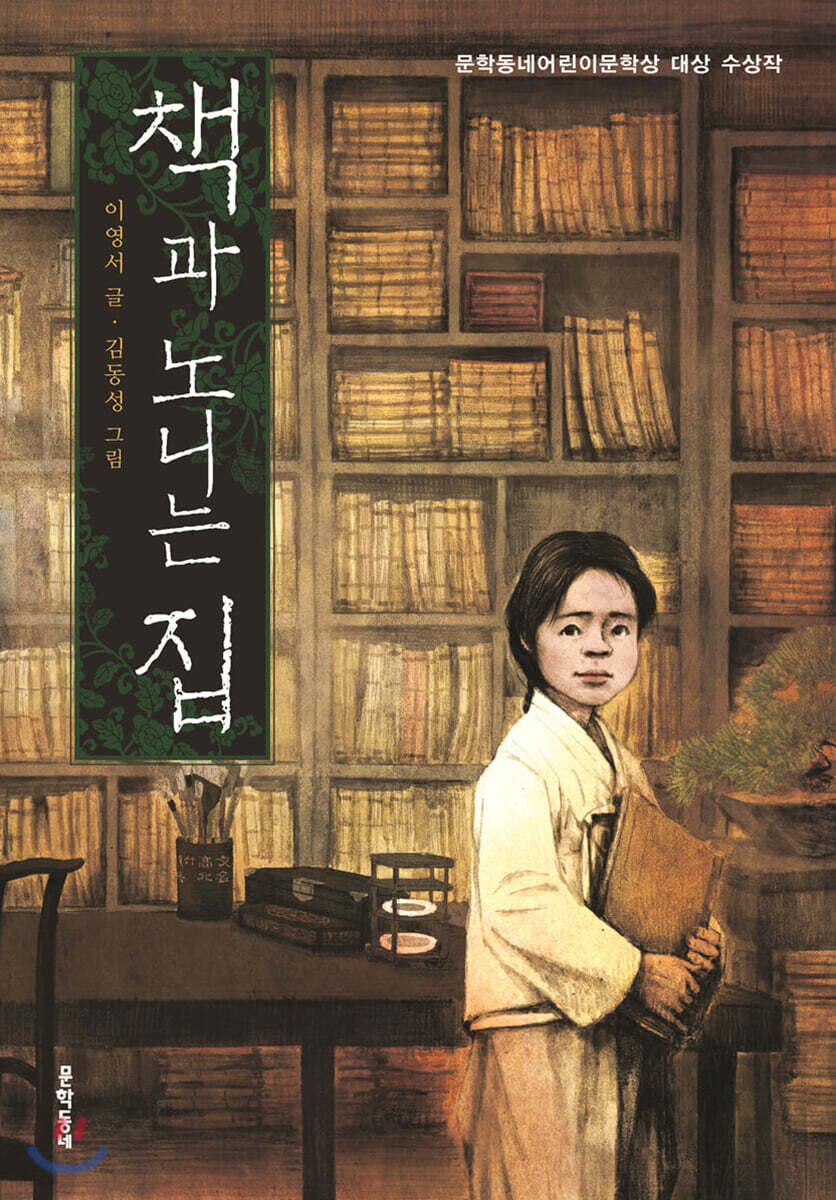
One of the things that makes this work even more attractive is Kim Dong-seong's painting.
The depth of the text is enhanced by the combination of pictures that are deeply imbued with Korean sentiment.
Kim Dong-seong's paintings, which are simple yet splendid in their beauty, possess a magical power that draws the viewer into the era and events of that era.
In this way, 『The House Where Books Play』 is a completely new historical fairy tale painstakingly created with the best writing and illustrations.
In the new year of 2009, I hope that by savoring the meaning and depth of 'books' with 'A House Where Books Play', you will have an even more valuable time reading books.
“A story that will become food for us, a story that will become a comrade for some,
And later, I wrote a story about opening a small bookstore for our rich man.”
Showing the true essence of historical fairy tales!
The 9th Munhakdongne Children's Literature Award Grand Prize Winner
"The House Where Books Play" won the grand prize at the Munhakdongne Children's Literature Award, receiving praise for "clearly transcending the didacticism of historical works and opening a new chapter in the history of fairy tales."
Set against the backdrop of the historical event of the persecution of Catholicism during the Joseon Dynasty, this work delicately and intimately depicts the ideologies of society and individuals, the lives of the intellectual class and the general public, and their concerns through the life of a scribe.
Historical fairy tales often try to connect the story with educational effects by featuring protagonists with outstanding achievements rather than improving literary quality for young readers.
However, 『The House Where Books Play』 is an original historical fairy tale that breaks free from the comfortable structure and conventional story development.
Above all, it is because the protagonist, ‘Sentence’, never loses sight of the child’s perspective through his childhood.
The fact that the author has depicted the chaotic times through the eyes of a child so calmly yet precisely demonstrates his considerable historical insight and artistic skill.
It is expected that children living today will be able to look at our society and history with a deeper and warmer heart as they watch the protagonist Jang-i live brightly and healthily despite hardships and adversity.
When dealing with problematic historical periods, writers are constantly tempted to bring the issues of the period to the forefront, and to some extent, they succumb to that temptation.
But the author of this work is so detached from such temptations that he feels quite cool.
It depicts life at that time accurately, within the scope that even a child named Jang could see and understand.
It was considered to be the result of considerable literary training._From the review
The persecution of Catholicism and the tumultuous life of a mortal
One of the important events during the Joseon Dynasty was the ban on Western learning (Catholicism).
Western learning was later accepted as a religion after the book 『Cheonju Silui』, which was imported from the Ming Dynasty, was spread, and it spread regardless of social status, including commoners, women, gisaeng, and nobles.
Western learning advocated for the equality of all people in the world, prohibited ancestral rites, and rejected the existing society centered on Neo-Confucianism.
At that time, the country believed that pursuing Western learning and Catholicism was destroying the existing order and spreading a wrong culture, so they carried out harsh suppression.
The story of "The House Where Books Play" unfolds around this historical context.
The protagonist Jang Yi's father is a copyist who makes a living by copying countless Chinese character books, including Korean storybooks, day and night.
But one day, he is dragged to the government office and branded a Catholic scholar for copying a Catholic book.
Jang Yi's father, who kept his faith to the end with those who bought his Catholic books, was beaten so much that his stomach was about to burst, and he lay there like a living corpse, hovering between life and death.
In this way, for Father and Jang, the task of ‘writing’ brings both dreams and trials.
My father, who never lost his dream and worked hard all night long to the point where his hands would not move.
In the face of a typhoon that suddenly strikes, the wealthy Jang family, who have nothing, are helpless.
Bookstore errand boy Jang steps out into the world.
Jang-i begins her life as an errand boy at a bookstore, following the instructions of the bookstore owner, Choi Seo-kwae.
Jang-i spends her days busy organizing newly arrived storybooks and delivering ordered books.
Even in a lonely and difficult life, he grows up to be smart and dignified, always looking at the world with curious eyes.
Jang Yi goes to find Hong Gyo-ri on Choi Seo-gwae's errand.
Hong Gyo-ri was a renowned talent in Joseon who had already achieved high office at an early age. He was a remarkable person, one that is not easily found in someone of his stature.
Jang-i, who went to Hong Gyo-ri's library with love, is captivated by the signboard that reads "Seoyudang," which means "a house where books and play are played."
Hong Gyo-ri, a renowned bibliophile and collector, is, as we have heard, a person with a very special love for books.
Such an encounter with Hong Gyo-ri brings about many changes in Jang-i.
Then one day, the typhoon of Catholic persecution hits again.
At that moment, Jang Yi's mind is filled with thoughts of Hong Gyo-ri, who acknowledged and comforted him, and Nak-sim from the gisaeng house 'Doriwon', which he hates but keeps thinking about.
Ignoring Choi Seo-gwae's words to avoid the body, Jang-i heads somewhere as if being led...
A solid storyline, vivid characters, and moving illustrations.
It is by no means easy to construct a story with clean sentences and sophisticated descriptions based on historical facts and a solid structure.
The characteristics of each character, including the main character Jang Yi, come to life so vividly that it seems as if they are being drawn before your eyes.
One of the things that makes this work even more attractive is Kim Dong-seong's painting.
The depth of the text is enhanced by the combination of pictures that are deeply imbued with Korean sentiment.
Kim Dong-seong's paintings, which are simple yet splendid in their beauty, possess a magical power that draws the viewer into the era and events of that era.
In this way, 『The House Where Books Play』 is a completely new historical fairy tale painstakingly created with the best writing and illustrations.
In the new year of 2009, I hope that by savoring the meaning and depth of 'books' with 'A House Where Books Play', you will have an even more valuable time reading books.
GOODS SPECIFICS
- Date of issue: January 9, 2009
- Page count, weight, size: 192 pages | 346g | 153*220*13mm
- ISBN13: 9788954607346
- ISBN10: 8954607349
- KC Certification: Certification Type: Conformity Confirmation
You may also like
카테고리
korean


korean

![GQ KOREA Mark (Monthly): December [2025]](http://librairie.coreenne.fr/cdn/shop/files/8ef265dbbfbf186523ed75ba7319009d.jpg?v=1765340328&width=3840)


