

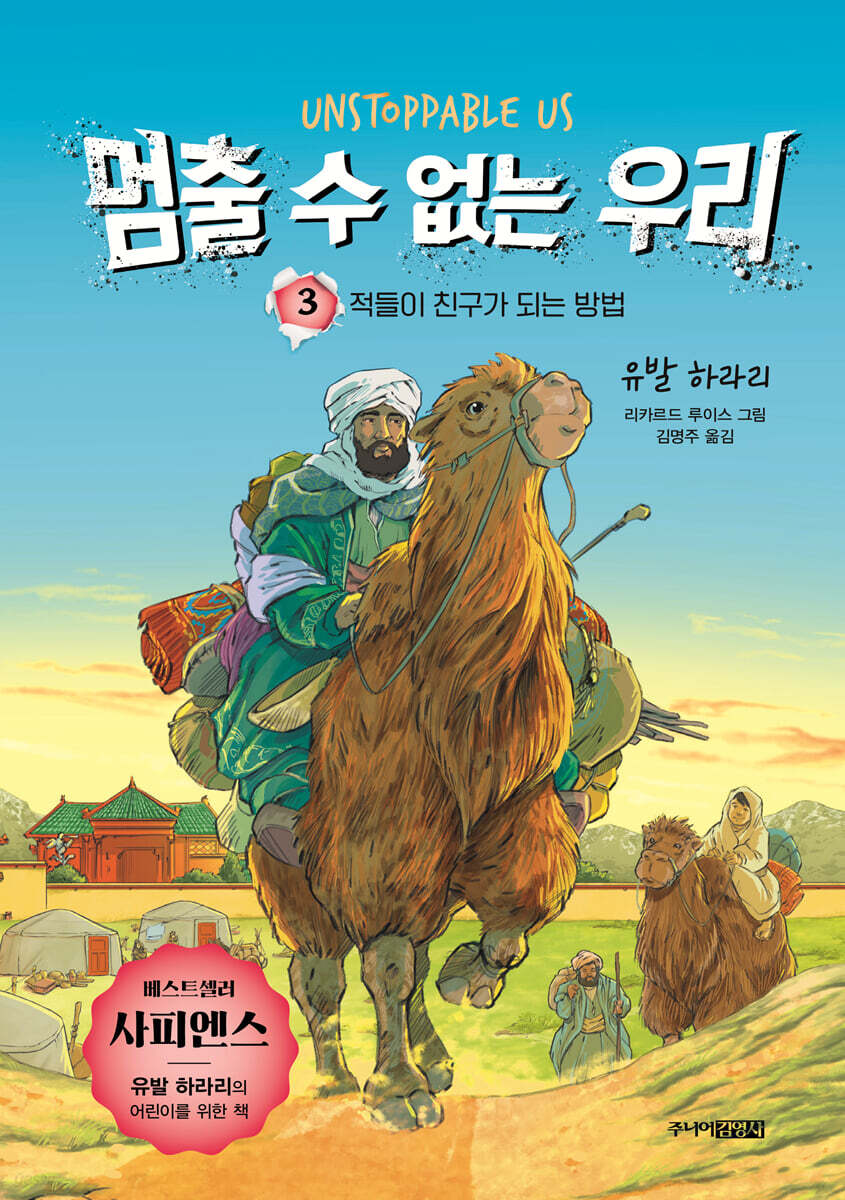
We Can't Stop 3
 |
Description
Book Introduction
A completely new book for children, written by Professor Yuval Harari, author of the best-selling book Sapiens!
The magnificent story of human history, civilization, and culture unfolds like an epic!
A never-before-heard story of humanity unfolds across the present and past!
Travel back in time and discover different cultural stories as you travel to long-lost cities!
Why have there been so many wars in human history?
The magnificent story of human history, civilization, and culture unfolds like an epic!
A never-before-heard story of humanity unfolds across the present and past!
Travel back in time and discover different cultural stories as you travel to long-lost cities!
Why have there been so many wars in human history?
- You can preview some of the book's contents.
Preview
index
Historical Timeline
About this book
Preface to the Korean edition
Preface - Are you like other people?
Chapter 1 Dragon Tribe, Ant Tribe, Wolf Tribe
Chapter 2: Secrets of the Ancient Market
Chapter 3: The Descendants of the Villains
Chapter 4: The Meaning of Life
Acknowledgements
Historical World Map
About this book
Preface to the Korean edition
Preface - Are you like other people?
Chapter 1 Dragon Tribe, Ant Tribe, Wolf Tribe
Chapter 2: Secrets of the Ancient Market
Chapter 3: The Descendants of the Villains
Chapter 4: The Meaning of Life
Acknowledgements
Historical World Map
Into the book
Gilgamesh tied heavy stones to his feet and went down to the bottom of the sea of life.
Then he found the plant and returned to land. But before Gilgamesh could eat the plant, he looked away for a moment and a snake stole the plant and swallowed it.
After that, the snake shed its skin, became young again, and lived forever, but Gilgamesh had to return to Uruk empty-handed.
Only then did he accept that there was no way to escape death.
No human can conquer death, stop time, or stop change.
Like Gilgamesh, the city of Uruk eventually disappeared.
All the buildings in Uruk collapsed, and all the streets were abandoned.
No one lives there today.
Just a few spiders, scorpions, lizards… … and some archaeologists are digging through the ruins in search of interesting ancient artifacts, such as clay tablets inscribed with the story of Gilgamesh.
Uruk no longer exists, but it left us the important gift of writing, as well as the story of Gilgamesh.
Uruk was the first place where writing was invented.
It is also possible for you to read not only this book but also newspapers, emails, and web pages.
Thanks to the big people.
--- p.21~22
Different types of money have been invented in different times and places.
But the standard of money is the same for everyone.
It should be something people always want to have.
Anyone would be willing to give up a pair of shoes, a fig, or a skateboard for that.
When the Carthaginian market first emerged, people used bullion of precious metals such as gold and silver as money.
Hundreds of years later, Ephesus and several nearby cities were the first to mint beautiful coins from this metal.
Later, Greek merchants brought this idea to Carthage, and the Carthaginians also began making coins.
Different countries used different types of money.
For example, in many parts of East Africa and South Asia, the shells of the oyster were used as money.
The oyster shell is a particularly pretty shell found on some islands and coasts of Africa and Asia.
The people of this area traded their oyster shells for rice, beans, and pork.
You could go to the market with a sack full of dogwood and buy necessities like shoes or pots and get a haircut.
Later, almost all countries started using colorful paper bills as money.
You'll probably use paper money too.
But most money today isn't metal coins or paper bills.
Of course, it's not a clam shell.
Do you know what most money is made of these days?
Made from electronic information on a computer.
Let's say someone has a million dollars.
That person doesn't have a million one-dollar coins or 100,000 ten-dollar bills stacked up at home.
Instead, they are stored as numbers in the bank's large computers.
If that person wants to buy a $100 pair of shoes, he or she can simply send $100 from that cryptocurrency to the shoe store's bank account.
All it takes is a credit card, a few clicks on your computer or smartphone, and you're done.
No matter how far away the store is, your money will arrive in seconds.
When you send money to a store, your bank's computer file will show a $100 decrease, and the store's computer file will show a $100 increase.
People can now buy shoes, bicycles, houses, and even spaceships made anywhere in the world simply by transferring digital currency from computer to computer.
--- p.54~55
We are used to happy endings where the villains and liars are defeated.
Because I always see stories like that in books and movies.
Villains seem very strong, lie and cheat, and do bad things, but heroes like Spider-Man or Wonder Woman show up and defeat them.
Good people always triumph over all adversity.
Of course, in most action movies, it initially seems like the good guys are losing the fight.
Because it's boring if you win from the start.
If Spider-Man defeats the villain within five minutes of the movie starting, it won't be fun.
So usually the villain tricks Spider-Man, and even captures him and puts him in a prison that he can't escape from...
But in the end, Spider-Man finds a secret escape route or Wonder Woman helps him defeat the villain at the last minute.
Movies always flow like that.
But unfortunately, the reality is not like that.
Sometimes the villains win.
Then he found the plant and returned to land. But before Gilgamesh could eat the plant, he looked away for a moment and a snake stole the plant and swallowed it.
After that, the snake shed its skin, became young again, and lived forever, but Gilgamesh had to return to Uruk empty-handed.
Only then did he accept that there was no way to escape death.
No human can conquer death, stop time, or stop change.
Like Gilgamesh, the city of Uruk eventually disappeared.
All the buildings in Uruk collapsed, and all the streets were abandoned.
No one lives there today.
Just a few spiders, scorpions, lizards… … and some archaeologists are digging through the ruins in search of interesting ancient artifacts, such as clay tablets inscribed with the story of Gilgamesh.
Uruk no longer exists, but it left us the important gift of writing, as well as the story of Gilgamesh.
Uruk was the first place where writing was invented.
It is also possible for you to read not only this book but also newspapers, emails, and web pages.
Thanks to the big people.
--- p.21~22
Different types of money have been invented in different times and places.
But the standard of money is the same for everyone.
It should be something people always want to have.
Anyone would be willing to give up a pair of shoes, a fig, or a skateboard for that.
When the Carthaginian market first emerged, people used bullion of precious metals such as gold and silver as money.
Hundreds of years later, Ephesus and several nearby cities were the first to mint beautiful coins from this metal.
Later, Greek merchants brought this idea to Carthage, and the Carthaginians also began making coins.
Different countries used different types of money.
For example, in many parts of East Africa and South Asia, the shells of the oyster were used as money.
The oyster shell is a particularly pretty shell found on some islands and coasts of Africa and Asia.
The people of this area traded their oyster shells for rice, beans, and pork.
You could go to the market with a sack full of dogwood and buy necessities like shoes or pots and get a haircut.
Later, almost all countries started using colorful paper bills as money.
You'll probably use paper money too.
But most money today isn't metal coins or paper bills.
Of course, it's not a clam shell.
Do you know what most money is made of these days?
Made from electronic information on a computer.
Let's say someone has a million dollars.
That person doesn't have a million one-dollar coins or 100,000 ten-dollar bills stacked up at home.
Instead, they are stored as numbers in the bank's large computers.
If that person wants to buy a $100 pair of shoes, he or she can simply send $100 from that cryptocurrency to the shoe store's bank account.
All it takes is a credit card, a few clicks on your computer or smartphone, and you're done.
No matter how far away the store is, your money will arrive in seconds.
When you send money to a store, your bank's computer file will show a $100 decrease, and the store's computer file will show a $100 increase.
People can now buy shoes, bicycles, houses, and even spaceships made anywhere in the world simply by transferring digital currency from computer to computer.
--- p.54~55
We are used to happy endings where the villains and liars are defeated.
Because I always see stories like that in books and movies.
Villains seem very strong, lie and cheat, and do bad things, but heroes like Spider-Man or Wonder Woman show up and defeat them.
Good people always triumph over all adversity.
Of course, in most action movies, it initially seems like the good guys are losing the fight.
Because it's boring if you win from the start.
If Spider-Man defeats the villain within five minutes of the movie starting, it won't be fun.
So usually the villain tricks Spider-Man, and even captures him and puts him in a prison that he can't escape from...
But in the end, Spider-Man finds a secret escape route or Wonder Woman helps him defeat the villain at the last minute.
Movies always flow like that.
But unfortunately, the reality is not like that.
Sometimes the villains win.
--- p.74
Publisher's Review
The human trilogy series, 『Sapiens』 『Homo Deus』 『21 Lessons for the 21st Century』 and
A completely new series for children from Professor Yuval Harari, famous for "Nexus"!
The history of humanity unfolds through storytelling, crossing the present and past!
In Volume 1, How Humans Ruled the Earth, Professor Yuval Harari tells the story of humans' adventures from the time they lived as insignificant apes on the African savannah, fearing cheetahs and hyenas, to the time when they became the strongest animals on Earth and hunted giant bears and mammoths.
Volume 2, Why the World Isn't Fair, examines how humans came to control animals like dogs, chickens, and cows, and how some people came to dominate others.
It covers how something that started out as a way to grow wheat led to famine and epidemics, how writing was invented, and why we pay taxes.
We are also exploring how humans gained the ability to control plants and animals, leading to their domination of one another.
We are exploring how the world came to be as it is today, why some people have so much while others have so little, where things went wrong, and how we can fix them.
In this book, Volume 3: How Enemies Become Friends, we travel back in time to explore the vast empires and what happens when different cultures collide.
It explains why so many wars have occurred throughout human history, how money has changed the world, and why people and things cannot always remain the same.
The third book in the "Unstoppable Us" series: How Enemies Become Friends
Why does everything change?
How could such different people cooperate and become such good friends?
Why have there been so many wars in human history?
No matter what our ancestors did, we are different people and can act differently!
Long ago, when foreigners from different countries and believing different stories met, what happened? Did they fight, or did they find a way to get along?
How did you find that method?
People are afraid of different things.
Fear of foreigners, unfamiliar places, strange foods, and unfamiliar thoughts.
But people also long for faraway places.
Because what you already know is boring, but what you don't know is exciting.
So people feel the urge to leave their homes and travel far beyond borders.
Even in ancient times, many people left for a larger and more complex world.
The people I met on my travels or at the places I arrived at each believed different stories and followed different leaders.
And sometimes they fought with each other.
Because there was no law that said people could always live in peace.
People usually get a headache when they have to think deeply about something.
So people have a habit of liking simple stories.
I want to hear stories that make it easy to judge who is a good person and who is a bad person.
But history is complicated.
And it's complicated because we ourselves are not characters in fairy tales.
We hope our ancestors were good people, but we are all descendants of villains to some degree.
This is an inconvenient truth: in every family, in every country, there are historically bad people.
This does not mean that we should abandon our ancestral heritage.
Even if we are descendants of villains, we can act differently from our ancestors.
Just because our ancestors waged war and built empires doesn't mean we should follow suit.
We can't change the past, but we can avoid repeating it.
No matter what our ancestors did, we are different people and can act differently.
Money that connects the world
Money is the most successful story ever created by humans.
But you can't buy friends or love with money!
Why are stories about money so compelling? Perhaps it's their beauty? Perhaps it's because ancient coins were made of gleaming gold and silver, beautifully engraved with images of gods and temples.
Modern banknotes also feature images of gods, temples, important figures, and famous buildings.
Also, the electronic money used by many people today does not have a picture of the god, but contains a very complex numerical encryption to make it trustworthy.
Because people have realized the biggest secret money holds.
Even though we didn't speak the same language or believe in the same god, we all wanted the same thing.
The idea is to want as much gold as possible.
Because if you had gold coins, you could have anything you wanted.
Because they even killed people to get money.
Money itself can't do anything, but with money you can buy things from other people or ask them to do things for you.
Money is not made of gold, paper, shells, or electronic information.
Making money is about trust.
If we just believe that other people want money, we all start to believe in money.
If people lose confidence in money, then money will lose all value and disappear.
Recommendation
It captivates the mind and turns thoughts upside down.
With a neat trick, he made the content easy and fun for young readers.
- The New York Times
A fascinating introduction to human history and archaeology.
It's written simply, but it covers a wide range of topics and is interesting.
- Kirkus Review
It's a very vivid, engaging and provocative piece of writing.
- Booklist
A completely new series for children from Professor Yuval Harari, famous for "Nexus"!
The history of humanity unfolds through storytelling, crossing the present and past!
In Volume 1, How Humans Ruled the Earth, Professor Yuval Harari tells the story of humans' adventures from the time they lived as insignificant apes on the African savannah, fearing cheetahs and hyenas, to the time when they became the strongest animals on Earth and hunted giant bears and mammoths.
Volume 2, Why the World Isn't Fair, examines how humans came to control animals like dogs, chickens, and cows, and how some people came to dominate others.
It covers how something that started out as a way to grow wheat led to famine and epidemics, how writing was invented, and why we pay taxes.
We are also exploring how humans gained the ability to control plants and animals, leading to their domination of one another.
We are exploring how the world came to be as it is today, why some people have so much while others have so little, where things went wrong, and how we can fix them.
In this book, Volume 3: How Enemies Become Friends, we travel back in time to explore the vast empires and what happens when different cultures collide.
It explains why so many wars have occurred throughout human history, how money has changed the world, and why people and things cannot always remain the same.
The third book in the "Unstoppable Us" series: How Enemies Become Friends
Why does everything change?
How could such different people cooperate and become such good friends?
Why have there been so many wars in human history?
No matter what our ancestors did, we are different people and can act differently!
Long ago, when foreigners from different countries and believing different stories met, what happened? Did they fight, or did they find a way to get along?
How did you find that method?
People are afraid of different things.
Fear of foreigners, unfamiliar places, strange foods, and unfamiliar thoughts.
But people also long for faraway places.
Because what you already know is boring, but what you don't know is exciting.
So people feel the urge to leave their homes and travel far beyond borders.
Even in ancient times, many people left for a larger and more complex world.
The people I met on my travels or at the places I arrived at each believed different stories and followed different leaders.
And sometimes they fought with each other.
Because there was no law that said people could always live in peace.
People usually get a headache when they have to think deeply about something.
So people have a habit of liking simple stories.
I want to hear stories that make it easy to judge who is a good person and who is a bad person.
But history is complicated.
And it's complicated because we ourselves are not characters in fairy tales.
We hope our ancestors were good people, but we are all descendants of villains to some degree.
This is an inconvenient truth: in every family, in every country, there are historically bad people.
This does not mean that we should abandon our ancestral heritage.
Even if we are descendants of villains, we can act differently from our ancestors.
Just because our ancestors waged war and built empires doesn't mean we should follow suit.
We can't change the past, but we can avoid repeating it.
No matter what our ancestors did, we are different people and can act differently.
Money that connects the world
Money is the most successful story ever created by humans.
But you can't buy friends or love with money!
Why are stories about money so compelling? Perhaps it's their beauty? Perhaps it's because ancient coins were made of gleaming gold and silver, beautifully engraved with images of gods and temples.
Modern banknotes also feature images of gods, temples, important figures, and famous buildings.
Also, the electronic money used by many people today does not have a picture of the god, but contains a very complex numerical encryption to make it trustworthy.
Because people have realized the biggest secret money holds.
Even though we didn't speak the same language or believe in the same god, we all wanted the same thing.
The idea is to want as much gold as possible.
Because if you had gold coins, you could have anything you wanted.
Because they even killed people to get money.
Money itself can't do anything, but with money you can buy things from other people or ask them to do things for you.
Money is not made of gold, paper, shells, or electronic information.
Making money is about trust.
If we just believe that other people want money, we all start to believe in money.
If people lose confidence in money, then money will lose all value and disappear.
Recommendation
It captivates the mind and turns thoughts upside down.
With a neat trick, he made the content easy and fun for young readers.
- The New York Times
A fascinating introduction to human history and archaeology.
It's written simply, but it covers a wide range of topics and is interesting.
- Kirkus Review
It's a very vivid, engaging and provocative piece of writing.
- Booklist
GOODS SPECIFICS
- Date of issue: November 28, 2024
- Format: Hardcover book binding method guide
- Page count, weight, size: 160 pages | 476g | 168*236*15mm
- ISBN13: 9791194330875
- ISBN10: 1194330878
- KC Certification: Certification Type: Conformity Confirmation
You may also like
카테고리
korean


korean

![ELLE 엘르 스페셜 에디션 A형 : 12월 [2025]](http://librairie.coreenne.fr/cdn/shop/files/b8e27a3de6c9538896439686c6b0e8fb.jpg?v=1766436872&width=3840)


