

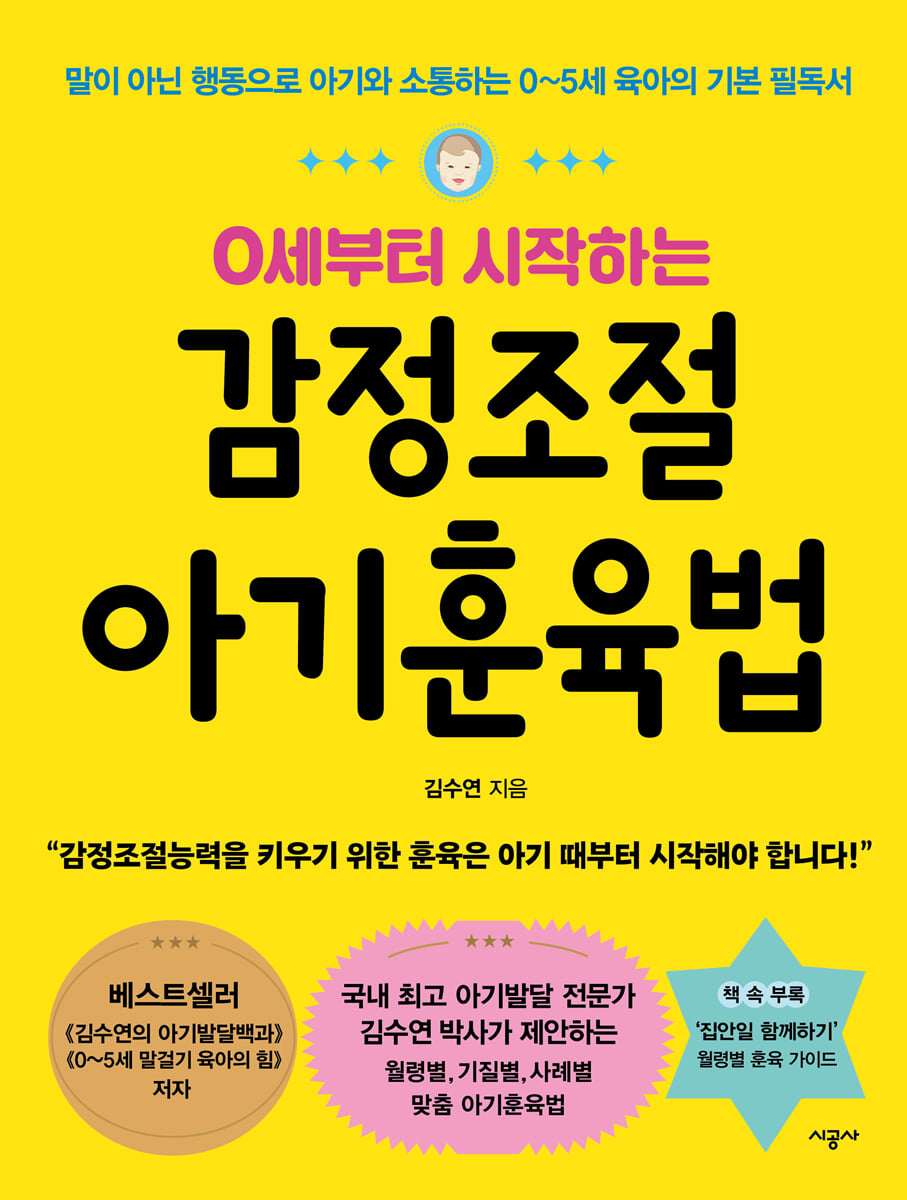
Emotional regulation and child discipline starting from birth
 |
Description
Book Introduction
Emotional control skills are essential for my child's precious future.
Emotional control skills must be developed through “baby discipline” from the age of 0!
Author of the bestselling books 『Kim Su-yeon's Encyclopedia of Baby Development』 and 『The Power of Parenting for Children Aged 0-5』
Dr. Kim Soo-yeon, Korea's leading baby development expert, tells us
Customized baby discipline methods for each month, temperament, and case!
·A test to check the level of a baby's emotional control ability
·The necessity of discipline and specific methods explained based on brain development research results.
·Preliminary preparations for successful <baby discipline>
13 Baby Discipline Techniques for Different Situations
·Discipline guide by month based on your baby's temperament and developmental characteristics
If you ask parents these days what the most difficult part of raising children is, they often answer that it is disciplining a child who cries or throws tantrums.
As cases of children who are unable to control their emotions, known as "golden children," are frequently introduced through broadcast media, it seems that a certain level of consensus has been formed on the importance and necessity of discipline.
However, despite the change in perception of discipline, its application has led to growing concerns and conflicts among parents.
I worry that if I scold a young child or say “No!” to stop their behavior, it will lower their self-esteem or cause problems forming attachments. I also worry that if I just say “Okay, okay” to a child who is self-centered and throws tantrums, they will not be able to adapt to school or society when they grow up.
Especially these days, when many first-time parents are raising a child and there is an abundance of parenting information, parents often face worries and conflicts about what to do when discipline is needed.
"Emotional Control and Baby Discipline Starting from 0 Years Old" is a book written by Dr. Suyeon Kim, Korea's leading baby development expert and parenting mentor, based on numerous counseling cases she has carried out in the field for over 30 years and the results of research on baby brain development that has been actively studied in academia.
In particular, since the basic neural network of the brain necessary for emotional regulation is formed between the ages of 0 and 3, it is emphasized that “baby discipline” must begin immediately after birth, that is, from the age of 0, so that the baby can regulate his or her emotions in stressful situations.
However, it is difficult to discipline babies at this age through conversation with their caregivers.
Therefore, this book defines discipline for babies who have difficulty communicating verbally as “baby discipline,” and introduces various methods to help babies identify their emotional control abilities through observing their behavior and foster emotional control abilities through communication through actions and sounds.
This book stands out for its structure that focuses on specific know-how for easier and more effective “baby discipline.”
First, through detailed illustrations and examples, we explain the definition and necessity of discipline, how to make your baby trust you, how to understand your baby's innate temperament and natural aggression, and what discipline methods to apply in various parenting situations.
It is also divided into chapters by developmental stage, and is full of tips to effectively understand your baby's auditory and visual cognitive development, motor development, language comprehension, temperament, and stress behavior, so that you can discipline them calmly and consistently.
We organize frequently occurring disciplinary concerns during child-rearing and present solutions in an easy-to-understand Q&A and column format.
We've tried to explain specific parenting tips in an easy-to-understand way so that new parents who have made the big decision to have and raise a baby in this 'era of the lowest birth rate' can raise a baby more easily.
This book will be of great help to new parents who want to help their precious babies develop emotional control early on, and to help them overcome stress and steadily take on new challenges as they grow.
Emotional control skills must be developed through “baby discipline” from the age of 0!
Author of the bestselling books 『Kim Su-yeon's Encyclopedia of Baby Development』 and 『The Power of Parenting for Children Aged 0-5』
Dr. Kim Soo-yeon, Korea's leading baby development expert, tells us
Customized baby discipline methods for each month, temperament, and case!
·A test to check the level of a baby's emotional control ability
·The necessity of discipline and specific methods explained based on brain development research results.
·Preliminary preparations for successful <baby discipline>
13 Baby Discipline Techniques for Different Situations
·Discipline guide by month based on your baby's temperament and developmental characteristics
If you ask parents these days what the most difficult part of raising children is, they often answer that it is disciplining a child who cries or throws tantrums.
As cases of children who are unable to control their emotions, known as "golden children," are frequently introduced through broadcast media, it seems that a certain level of consensus has been formed on the importance and necessity of discipline.
However, despite the change in perception of discipline, its application has led to growing concerns and conflicts among parents.
I worry that if I scold a young child or say “No!” to stop their behavior, it will lower their self-esteem or cause problems forming attachments. I also worry that if I just say “Okay, okay” to a child who is self-centered and throws tantrums, they will not be able to adapt to school or society when they grow up.
Especially these days, when many first-time parents are raising a child and there is an abundance of parenting information, parents often face worries and conflicts about what to do when discipline is needed.
"Emotional Control and Baby Discipline Starting from 0 Years Old" is a book written by Dr. Suyeon Kim, Korea's leading baby development expert and parenting mentor, based on numerous counseling cases she has carried out in the field for over 30 years and the results of research on baby brain development that has been actively studied in academia.
In particular, since the basic neural network of the brain necessary for emotional regulation is formed between the ages of 0 and 3, it is emphasized that “baby discipline” must begin immediately after birth, that is, from the age of 0, so that the baby can regulate his or her emotions in stressful situations.
However, it is difficult to discipline babies at this age through conversation with their caregivers.
Therefore, this book defines discipline for babies who have difficulty communicating verbally as “baby discipline,” and introduces various methods to help babies identify their emotional control abilities through observing their behavior and foster emotional control abilities through communication through actions and sounds.
This book stands out for its structure that focuses on specific know-how for easier and more effective “baby discipline.”
First, through detailed illustrations and examples, we explain the definition and necessity of discipline, how to make your baby trust you, how to understand your baby's innate temperament and natural aggression, and what discipline methods to apply in various parenting situations.
It is also divided into chapters by developmental stage, and is full of tips to effectively understand your baby's auditory and visual cognitive development, motor development, language comprehension, temperament, and stress behavior, so that you can discipline them calmly and consistently.
We organize frequently occurring disciplinary concerns during child-rearing and present solutions in an easy-to-understand Q&A and column format.
We've tried to explain specific parenting tips in an easy-to-understand way so that new parents who have made the big decision to have and raise a baby in this 'era of the lowest birth rate' can raise a baby more easily.
This book will be of great help to new parents who want to help their precious babies develop emotional control early on, and to help them overcome stress and steadily take on new challenges as they grow.
- You can preview some of the book's contents.
Preview
index
Prologue: Developing emotional control skills through "baby discipline" should begin at birth.
Part 1_Baby Discipline for My Precious Baby's Emotional Control Ability
Chapter 1_Why is Baby Discipline G necessary?
Help your baby develop a healthy sense of humor / Start with <baby discipline> from the newborn stage / <baby discipline> is not something that causes stress to your baby / Distinguish <baby discipline> from child abuse and neglect like this
Chapter 2: Preparing for Successful Baby Discipline
Help your baby trust you through play / Give your baby plenty of attention and praise
Chapter 3: Understanding Baby Temperament and Aggression
Be sure to check your baby's temperament / Understand how your baby expresses aggression
Chapter 4: 13 Baby Discipline Techniques for Different Situations
Approach slowly (wait 15 seconds) / Soothe with small stimulation / Put the baby on the floor when the baby is pushing on the back / Show empathy with a gentle attitude / Be silent + do not respond / Be silent + look at the baby with a firm expression / Keep a distance / Pick up the baby and go outside in 0.5 seconds / Use a child safety gate / Send a message with hand gestures / Restrain the body / Send a message that the baby is in pain / Return to daily life
Part 2: Tailored Discipline for Your Baby by Developmental Stage
Chapter 1: Birth to 6 Months (Baby Discipline)
Developmental characteristics of babies from birth to 6 months of age / Parents' feelings and reactions to babies' stressful behaviors from birth to 6 months of age / How to successfully discipline babies from birth to 6 months of age / How to discipline babies from birth to 6 months of age
Chapter 2: 7-16 Months of Age (Baby Discipline)
Developmental characteristics of babies aged 7 to 16 months / Parents' feelings and reactions to stressful behaviors in babies aged 7 to 16 months / How to successfully discipline babies aged 7 to 16 months / How to discipline babies aged 7 to 16 months
Chapter 3: 17-32 Months of Age (Baby Discipline)
Developmental characteristics of babies aged 17 to 32 months / Parents' feelings and reactions to the stressful behavior of babies aged 17 to 32 months / How to successfully discipline babies aged 17 to 32 months
Chapter 4: 33-48 Months of Age (Baby Discipline)
Developmental characteristics of babies aged 33 to 48 months / Parents' feelings and reactions to stressful behaviors in babies aged 33 to 48 months / How to successfully discipline babies aged 33 to 48 months / How to discipline babies aged 33 to 48 months
Chapter 5: Child Discipline After 48 Months
Developmental characteristics of children after 48 months of age / Parents' feelings and reactions to children's stressful behavior after 48 months of age / How to successfully discipline children after 48 months of age / How to discipline children after 48 months of age
Epilogue: A Letter to My Parents
Book Appendix: "Doing Housework Together": A Monthly Discipline Guide for Small Activities That Bring Big Change
Part 1_Baby Discipline for My Precious Baby's Emotional Control Ability
Chapter 1_Why is Baby Discipline G necessary?
Help your baby develop a healthy sense of humor / Start with <baby discipline> from the newborn stage / <baby discipline> is not something that causes stress to your baby / Distinguish <baby discipline> from child abuse and neglect like this
Chapter 2: Preparing for Successful Baby Discipline
Help your baby trust you through play / Give your baby plenty of attention and praise
Chapter 3: Understanding Baby Temperament and Aggression
Be sure to check your baby's temperament / Understand how your baby expresses aggression
Chapter 4: 13 Baby Discipline Techniques for Different Situations
Approach slowly (wait 15 seconds) / Soothe with small stimulation / Put the baby on the floor when the baby is pushing on the back / Show empathy with a gentle attitude / Be silent + do not respond / Be silent + look at the baby with a firm expression / Keep a distance / Pick up the baby and go outside in 0.5 seconds / Use a child safety gate / Send a message with hand gestures / Restrain the body / Send a message that the baby is in pain / Return to daily life
Part 2: Tailored Discipline for Your Baby by Developmental Stage
Chapter 1: Birth to 6 Months (Baby Discipline)
Developmental characteristics of babies from birth to 6 months of age / Parents' feelings and reactions to babies' stressful behaviors from birth to 6 months of age / How to successfully discipline babies from birth to 6 months of age / How to discipline babies from birth to 6 months of age
Chapter 2: 7-16 Months of Age (Baby Discipline)
Developmental characteristics of babies aged 7 to 16 months / Parents' feelings and reactions to stressful behaviors in babies aged 7 to 16 months / How to successfully discipline babies aged 7 to 16 months / How to discipline babies aged 7 to 16 months
Chapter 3: 17-32 Months of Age (Baby Discipline)
Developmental characteristics of babies aged 17 to 32 months / Parents' feelings and reactions to the stressful behavior of babies aged 17 to 32 months / How to successfully discipline babies aged 17 to 32 months
Chapter 4: 33-48 Months of Age (Baby Discipline)
Developmental characteristics of babies aged 33 to 48 months / Parents' feelings and reactions to stressful behaviors in babies aged 33 to 48 months / How to successfully discipline babies aged 33 to 48 months / How to discipline babies aged 33 to 48 months
Chapter 5: Child Discipline After 48 Months
Developmental characteristics of children after 48 months of age / Parents' feelings and reactions to children's stressful behavior after 48 months of age / How to successfully discipline children after 48 months of age / How to discipline children after 48 months of age
Epilogue: A Letter to My Parents
Book Appendix: "Doing Housework Together": A Monthly Discipline Guide for Small Activities That Bring Big Change
Detailed image

Into the book
In order to properly discipline a child, parents must first think deeply about the purpose of discipline.
Discipline is not a parenting technique that simply trains children with parental authority and power to make them obedient.
The purpose of discipline is to develop children's emotional control skills to overcome various stressful situations they encounter as they grow.
Discipline is a necessary process for children to grow into considerate, socially conscious, responsible, and self-confident adults.
If the purpose of discipline is correct, the parents' attitude and method of discipline toward their children can also be consistent and correct.
---From the "Prologue"
From the moment they are born, babies know that they absolutely need their parents' help to survive.
In order to get along well with their parents, babies reinforce the behaviors that their parents praise and restrain themselves from behaviors that their parents disapprove of.
If parents only sympathize with and praise their baby's behavior every time, the baby will come to think that he or she does not need to control his or her behavior.
As babies grow, they need guidance on which behaviors to reinforce and which to restrain in order to live with others in the world.
By giving praise for a good job and sometimes sending a clear message that it is not okay, babies become aware of their parents' reactions and develop a healthy sense of awareness, which is the foundation for social development.
Developing a "healthy sense of awareness"—being aware of one's parents' emotions, or thinking about what rules one must follow in order to live with them—is the beginning and foundation of social development necessary for living with others.
---From "Please help your baby develop a healthy sense of humor"
It is important to understand the level of stimulation that a newborn can control their emotions, and try not to give them too much stimulation when they cry.
Babies who have the ability to control their emotions by just seeing their parents' faces or hearing their voices are naturally gentle babies.
Even if a baby is naturally gentle and has excellent emotional control, if they are soothed with strong stimulation such as holding and shaking when they cry, they will increasingly demand stronger stimulation in stressful situations.
So, there is an advice from our ancestors that says, 'Don't let the baby touch you', that is, don't keep holding a crying baby.
The wisdom of parenting possessed by our ancestors who gave birth to and raised many children has been scientifically proven.
The beginning of childcare that allows you to raise your baby without touching him or her is “baby discipline.”
---From “Baby Discipline: Start from the newborn period”
In order to form an emotional regulation neural network in the baby's brain, babies must be given the opportunity to regulate their emotions on their own by waiting for a while in stressful situations from the neonatal period.
You should give your baby some time to calm down on his own and help him stop crying with small stimuli such as your voice or a rattle.
From birth to two years of age, babies spend most of their time with their parents.
During this time, perhaps the dedicated efforts of parents can immediately resolve the baby's stress.
For new parents who are always anxious, it may be easier to rush to a crying baby, soothe them, and address their stress right away than to wait for them to learn to regulate their emotions on their own.
However, in daycare, which is the first environment a baby experiences away from their parents, it is not possible to immediately resolve the baby's stressful situation.
So, from birth to three years of age, babies need affection and opportunities to regulate their emotions on their own.
If sufficient “baby discipline” is provided during this period, adjusting to life in daycare, the first social life that babies will experience, will not be that difficult.
---From “Baby Discipline Doesn’t Stress Babies”
Babies who grow up in overprotection may begin to fake their mother's attention as early as 7 to 9 months of age.
False crying, which begins at 7 to 9 months of age, may progress to falling backwards, rolling over, intentionally vomiting, or banging the head as the baby grows.
New parents are scared and feel bad for their baby who rolls around, so they end up giving in to all the baby's demands. As the baby grows up, when a stressful situation arises, he or she becomes unable to calm down his or her anger and expresses his or her stress more severely.
As children begin to speak, they often blurt out offensive words toward their parents without hesitation.
Most new parents who want to raise their children well but do not know how to raise them well adopt an overprotective attitude.
However, overprotective parenting, like child abuse, can result in the child having difficulty controlling their emotions in stressful situations as they grow up, so extreme caution is required.
---From “Baby Discipline Doesn’t Stress Babies”
If a parent is very ill and cannot interact with their baby, they can go to a place with a variety of play equipment, such as an indoor playground, and watch their baby play.
Just knowing that your parents are watching you when you run to them goes a long way in helping your baby build trust.
The first activity I recommend to parents who have very limited time to spend with their babies due to their busy work schedule is water play.
Water is a great way to quickly build trust in your baby.
At this time, it is more effective if the parents take off their clothes and have skin-to-skin contact with the baby while bathing or playing in the water.
---From "Let's help your baby trust you through play"
A baby's temperament is innate.
Yet, when a baby cries loudly, struggles, or throws things in a stressful situation, our society still tries to find the cause in the parents' parenting attitude rather than in the baby's innate temperament.
When a baby cries loudly and gets angry, new parents often feel a deep sense of guilt, thinking that they may have done something wrong while raising the baby.
It is important to understand the baby's temperament before the parents' parenting attitude.
Some of the causes of a baby's innate temperament are seen as family history.
However, the cause of temperament has not yet been 100% scientifically identified.
Even if the parents are gentle, a baby can be born with a fussy temperament, and even if the parents are fussy, a baby can be born with a gentle temperament.
Discipline is not a parenting technique that simply trains children with parental authority and power to make them obedient.
The purpose of discipline is to develop children's emotional control skills to overcome various stressful situations they encounter as they grow.
Discipline is a necessary process for children to grow into considerate, socially conscious, responsible, and self-confident adults.
If the purpose of discipline is correct, the parents' attitude and method of discipline toward their children can also be consistent and correct.
---From the "Prologue"
From the moment they are born, babies know that they absolutely need their parents' help to survive.
In order to get along well with their parents, babies reinforce the behaviors that their parents praise and restrain themselves from behaviors that their parents disapprove of.
If parents only sympathize with and praise their baby's behavior every time, the baby will come to think that he or she does not need to control his or her behavior.
As babies grow, they need guidance on which behaviors to reinforce and which to restrain in order to live with others in the world.
By giving praise for a good job and sometimes sending a clear message that it is not okay, babies become aware of their parents' reactions and develop a healthy sense of awareness, which is the foundation for social development.
Developing a "healthy sense of awareness"—being aware of one's parents' emotions, or thinking about what rules one must follow in order to live with them—is the beginning and foundation of social development necessary for living with others.
---From "Please help your baby develop a healthy sense of humor"
It is important to understand the level of stimulation that a newborn can control their emotions, and try not to give them too much stimulation when they cry.
Babies who have the ability to control their emotions by just seeing their parents' faces or hearing their voices are naturally gentle babies.
Even if a baby is naturally gentle and has excellent emotional control, if they are soothed with strong stimulation such as holding and shaking when they cry, they will increasingly demand stronger stimulation in stressful situations.
So, there is an advice from our ancestors that says, 'Don't let the baby touch you', that is, don't keep holding a crying baby.
The wisdom of parenting possessed by our ancestors who gave birth to and raised many children has been scientifically proven.
The beginning of childcare that allows you to raise your baby without touching him or her is “baby discipline.”
---From “Baby Discipline: Start from the newborn period”
In order to form an emotional regulation neural network in the baby's brain, babies must be given the opportunity to regulate their emotions on their own by waiting for a while in stressful situations from the neonatal period.
You should give your baby some time to calm down on his own and help him stop crying with small stimuli such as your voice or a rattle.
From birth to two years of age, babies spend most of their time with their parents.
During this time, perhaps the dedicated efforts of parents can immediately resolve the baby's stress.
For new parents who are always anxious, it may be easier to rush to a crying baby, soothe them, and address their stress right away than to wait for them to learn to regulate their emotions on their own.
However, in daycare, which is the first environment a baby experiences away from their parents, it is not possible to immediately resolve the baby's stressful situation.
So, from birth to three years of age, babies need affection and opportunities to regulate their emotions on their own.
If sufficient “baby discipline” is provided during this period, adjusting to life in daycare, the first social life that babies will experience, will not be that difficult.
---From “Baby Discipline Doesn’t Stress Babies”
Babies who grow up in overprotection may begin to fake their mother's attention as early as 7 to 9 months of age.
False crying, which begins at 7 to 9 months of age, may progress to falling backwards, rolling over, intentionally vomiting, or banging the head as the baby grows.
New parents are scared and feel bad for their baby who rolls around, so they end up giving in to all the baby's demands. As the baby grows up, when a stressful situation arises, he or she becomes unable to calm down his or her anger and expresses his or her stress more severely.
As children begin to speak, they often blurt out offensive words toward their parents without hesitation.
Most new parents who want to raise their children well but do not know how to raise them well adopt an overprotective attitude.
However, overprotective parenting, like child abuse, can result in the child having difficulty controlling their emotions in stressful situations as they grow up, so extreme caution is required.
---From “Baby Discipline Doesn’t Stress Babies”
If a parent is very ill and cannot interact with their baby, they can go to a place with a variety of play equipment, such as an indoor playground, and watch their baby play.
Just knowing that your parents are watching you when you run to them goes a long way in helping your baby build trust.
The first activity I recommend to parents who have very limited time to spend with their babies due to their busy work schedule is water play.
Water is a great way to quickly build trust in your baby.
At this time, it is more effective if the parents take off their clothes and have skin-to-skin contact with the baby while bathing or playing in the water.
---From "Let's help your baby trust you through play"
A baby's temperament is innate.
Yet, when a baby cries loudly, struggles, or throws things in a stressful situation, our society still tries to find the cause in the parents' parenting attitude rather than in the baby's innate temperament.
When a baby cries loudly and gets angry, new parents often feel a deep sense of guilt, thinking that they may have done something wrong while raising the baby.
It is important to understand the baby's temperament before the parents' parenting attitude.
Some of the causes of a baby's innate temperament are seen as family history.
However, the cause of temperament has not yet been 100% scientifically identified.
Even if the parents are gentle, a baby can be born with a fussy temperament, and even if the parents are fussy, a baby can be born with a gentle temperament.
---From "Be sure to check your baby's temperament"
Publisher's Review
〈Baby Discipline〉 is not a parenting technique for correcting problem behavior.
This is an essential parenting process that develops your baby's emotional control skills!
When you hear the word 'discipline', it may sound authoritarian and coercive.
However, discipline is not a parenting method that simply trains children with parental authority and power to raise them to be obedient children.
The purpose of discipline is to develop children's emotional control skills to overcome various stressful situations they encounter as they grow.
Discipline is a necessary process for my child to grow into a considerate, sociable, responsible, and self-esteem adult.
The "Baby Discipline" introduced in this book is a specific know-how to foster the emotional control skills essential for a child's future "from the age of 0," and at the same time, it is also a parental mindset that must be maintained continuously throughout the parenting process.
This is because it is not simply a parenting technique to correct a baby's behavioral problems such as crying or throwing tantrums, but rather a parent's effort to raise the baby properly and help him grow into a healthy member of society.
In order to properly discipline a child, parents must first think deeply about the purpose of discipline.
If the purpose of discipline is correct, the parents' attitude and method of discipline toward their baby can also be consistent and correct.
Through this, the baby grows up feeling secure and trusting in his or her parents.
It develops the basic neural network of the baby's brain necessary for emotional regulation.
〈Baby Discipline〉 should start from birth, from the age of 0!
Recent research on infant brain development proves that the period from birth to three years of age is a crucial period for developing the basic neural networks that form the ability to regulate emotions.
During this period, the brain's basic emotional regulation neural network must be sufficiently formed through exposure to stressful situations and experiences of regulating emotions on one's own. This allows children to easily adapt to group activities at daycare centers and kindergartens after the age of three, and develop the ability to understand others in conflict situations.
The advice to never stress babies under the age of three to help them form secure attachments was given before research on brain development was available.
Considering the research results on the development of the baby's brain, "baby discipline" to develop the baby's ability to regulate emotions should begin from birth.
Communicate with your baby through actions, not words.
A must-read for raising children aged 0-5 to help develop emotional regulation skills.
So how should we discipline young children who still struggle with verbal communication? Before the age of four or five, even if they understand well when they're happy, they become self-centered in stressful situations, making it difficult for them to understand lengthy explanations from their parents.
Therefore, no matter how many times you explain to your child that you cannot do something in a stressful situation, it will not help to change their behavior.
This is because when children are in stressful situations, they tend to perceive their parents' words as just repeated sounds or noises.
Parents who are unaware of this fact end up raising their voices and hitting their children, or giving up on discipline and accepting their children's problem behavior.
In a period when it is still difficult for the baby to understand the parents' words in stressful situations, it is necessary to fully understand the baby's developmental characteristics, temperament, and emotional control ability, and apply a customized 'baby discipline method' that conveys messages through facial expressions, silence, and distance depending on the stressful situation.
This book faithfully introduces, with illustrations, various methods of "baby discipline" that can be applied in actual parenting situations, as well as methods for identifying the developmental characteristics, temperament, and emotional control abilities of babies under the age of four who have difficulty communicating verbally, in order to successfully discipline them.
In addition, we present the know-how of ‘child discipline’ applicable to children aged 4 years or older who can communicate with their parents through conversation, and the basic direction and method of discipline for children aged 0 to 5 through the “‘Doing Housework Together’ Discipline Guide by Month” that brings about big changes through small activities.
This is an essential parenting process that develops your baby's emotional control skills!
When you hear the word 'discipline', it may sound authoritarian and coercive.
However, discipline is not a parenting method that simply trains children with parental authority and power to raise them to be obedient children.
The purpose of discipline is to develop children's emotional control skills to overcome various stressful situations they encounter as they grow.
Discipline is a necessary process for my child to grow into a considerate, sociable, responsible, and self-esteem adult.
The "Baby Discipline" introduced in this book is a specific know-how to foster the emotional control skills essential for a child's future "from the age of 0," and at the same time, it is also a parental mindset that must be maintained continuously throughout the parenting process.
This is because it is not simply a parenting technique to correct a baby's behavioral problems such as crying or throwing tantrums, but rather a parent's effort to raise the baby properly and help him grow into a healthy member of society.
In order to properly discipline a child, parents must first think deeply about the purpose of discipline.
If the purpose of discipline is correct, the parents' attitude and method of discipline toward their baby can also be consistent and correct.
Through this, the baby grows up feeling secure and trusting in his or her parents.
It develops the basic neural network of the baby's brain necessary for emotional regulation.
〈Baby Discipline〉 should start from birth, from the age of 0!
Recent research on infant brain development proves that the period from birth to three years of age is a crucial period for developing the basic neural networks that form the ability to regulate emotions.
During this period, the brain's basic emotional regulation neural network must be sufficiently formed through exposure to stressful situations and experiences of regulating emotions on one's own. This allows children to easily adapt to group activities at daycare centers and kindergartens after the age of three, and develop the ability to understand others in conflict situations.
The advice to never stress babies under the age of three to help them form secure attachments was given before research on brain development was available.
Considering the research results on the development of the baby's brain, "baby discipline" to develop the baby's ability to regulate emotions should begin from birth.
Communicate with your baby through actions, not words.
A must-read for raising children aged 0-5 to help develop emotional regulation skills.
So how should we discipline young children who still struggle with verbal communication? Before the age of four or five, even if they understand well when they're happy, they become self-centered in stressful situations, making it difficult for them to understand lengthy explanations from their parents.
Therefore, no matter how many times you explain to your child that you cannot do something in a stressful situation, it will not help to change their behavior.
This is because when children are in stressful situations, they tend to perceive their parents' words as just repeated sounds or noises.
Parents who are unaware of this fact end up raising their voices and hitting their children, or giving up on discipline and accepting their children's problem behavior.
In a period when it is still difficult for the baby to understand the parents' words in stressful situations, it is necessary to fully understand the baby's developmental characteristics, temperament, and emotional control ability, and apply a customized 'baby discipline method' that conveys messages through facial expressions, silence, and distance depending on the stressful situation.
This book faithfully introduces, with illustrations, various methods of "baby discipline" that can be applied in actual parenting situations, as well as methods for identifying the developmental characteristics, temperament, and emotional control abilities of babies under the age of four who have difficulty communicating verbally, in order to successfully discipline them.
In addition, we present the know-how of ‘child discipline’ applicable to children aged 4 years or older who can communicate with their parents through conversation, and the basic direction and method of discipline for children aged 0 to 5 through the “‘Doing Housework Together’ Discipline Guide by Month” that brings about big changes through small activities.
GOODS SPECIFICS
- Date of issue: May 10, 2024
- Page count, weight, size: 332 pages | 716g | 174*230*30mm
- ISBN13: 9791171253395
- ISBN10: 1171253397
You may also like
카테고리
korean


korean

![GQ KOREA Mark (Monthly): December [2025]](http://librairie.coreenne.fr/cdn/shop/files/8ef265dbbfbf186523ed75ba7319009d.jpg?v=1765340328&width=3840)


