

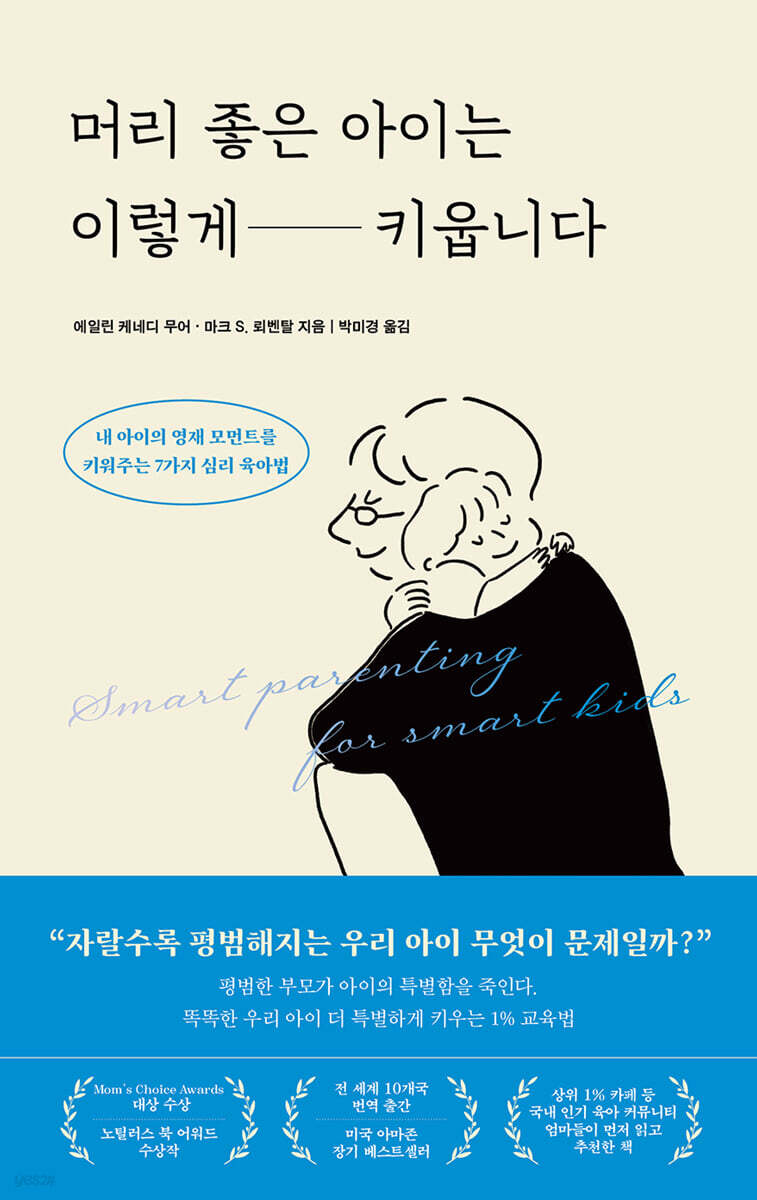
This is how to raise a smart child
 |
Description
Book Introduction
“My child is becoming more ordinary as he grows up. What could be the problem?”
Ordinary parents kill their children's specialness!
★ Winner of the US Mom's Choice Awards and the Nautilus Book Award
★ Published in 10 countries worldwide, a long-term bestseller on Amazon in the US
If you raise your child like everyone else, even a child who was different from others will end up just like everyone else.
World-renowned child psychologists with 40 years of experience
A timeless child education project
When raising a child, there are moments when the child's talent shines.
Children are born with their own gifted moments, whether they suddenly remember and repeat a book their mom or dad read to them, are good at solving puzzles they've never done before, or show interest in artistic activities like drawing, music, or dancing. So, how can we continue to nurture our children's gifted moments?
World-renowned child psychologists Eileen Kennedy Moore and Mark S.
Löwenthal, who has counseled countless gifted and talented children, has included in his book “How to Raise a Smart Child” the principles that parents must adhere to as “guardians of their children’s talents,” along with the warning that “if you raise your child like everyone else, even that child will end up just like everyone else.”
Parenting requires a delicate balance.
A child's giftedness will quickly fade if left unchecked, but trying to hasten their cognitive and emotional development won't make them grow faster.
Especially in this day and age where it is easy to come across the 'formula for raising children well', parents must maintain focus and guide their children well.
If you want to cherish your child's gifted moments and consistently stimulate their growth, you'll find the right answer in this book.
Ordinary parents kill their children's specialness!
★ Winner of the US Mom's Choice Awards and the Nautilus Book Award
★ Published in 10 countries worldwide, a long-term bestseller on Amazon in the US
If you raise your child like everyone else, even a child who was different from others will end up just like everyone else.
World-renowned child psychologists with 40 years of experience
A timeless child education project
When raising a child, there are moments when the child's talent shines.
Children are born with their own gifted moments, whether they suddenly remember and repeat a book their mom or dad read to them, are good at solving puzzles they've never done before, or show interest in artistic activities like drawing, music, or dancing. So, how can we continue to nurture our children's gifted moments?
World-renowned child psychologists Eileen Kennedy Moore and Mark S.
Löwenthal, who has counseled countless gifted and talented children, has included in his book “How to Raise a Smart Child” the principles that parents must adhere to as “guardians of their children’s talents,” along with the warning that “if you raise your child like everyone else, even that child will end up just like everyone else.”
Parenting requires a delicate balance.
A child's giftedness will quickly fade if left unchecked, but trying to hasten their cognitive and emotional development won't make them grow faster.
Especially in this day and age where it is easy to come across the 'formula for raising children well', parents must maintain focus and guide their children well.
If you want to cherish your child's gifted moments and consistently stimulate their growth, you'll find the right answer in this book.
- You can preview some of the book's contents.
Preview
index
Prologue: How should we raise our smart children?
Chapter 1.
It's Okay to Not Be Perfect: Letting Go of Perfectionism
Checklist: Does My Child Have Perfectionist Tendencies?
A child obsessed with mistakes
A child who blames others
You can't just do what you're good at
When you're smart but think you're stupid
Parents' Guide: How to Help Your Child Overcome Perfectionism
Chapter 2.
Smart Kids Are Lonelier: Relationships
Checklist: Is My Child Lonely?
A smart but lonely child
Friends are the hardest
A child who is afraid of socializing with many people
When you are rejected or rejected by a friend
Parents' Guide: How to Help Your Child Avoid Loneliness
Chapter 3.
How to Keep Your Intelligence from Hurtling You: Managing Your Sensitivity
Checklist: Is My Child Sensitive?
The negative side of a sensitive personality
A child who gets upset easily
When you take everything as criticism
A child who is sensitive to change and insists on routine
The more you know, the more you worry
Parents' Guide: How to Help Your Child Manage Their Emotions
Chapter 4.
Children Who Risk Their Lives on Competition: Managing Their Competitiveness
Checklist: Is My Child's Competitiveness at an Appropriate Level?
A child who is overly obsessed with results
A child who only wants to do things his own way
A child who doesn't know how to lose
If you hate competition
When even family feels like competition
Parents' Guide: How to Raise Children Who Don't Obsess Over Results
Chapter 5.
Children who are sensitive to adults: Coping with authority
Checklist: How uncomfortable will my child be with adults?
Children's social skills
A child who does not recognize hierarchical relationships
A child arguing with adults
A child who is very sensitive
Parents' Guide: How to Help Your Child Avoid Awkward Relationships with Adults
Chapter 6.
Smart but not hard-working: Motivation
- Checklist: How much does my child like studying?
A smart child who hates studying
Reasons for neglecting studies
How to Deal with a Child Who Bores with Studying
First strategy: develop proficiency
Second strategy: supporting autonomy
Third strategy: making connections felt
A child who doesn't give it his all
How to Encourage Your Child to Try
Parents' Guide: How to Raise Your Child to Learn on Their Own
Chapter 7.
Happy Kids Grow Smarter: Finding Balance in Growth
Checklist: Is my child growing up happily?
Why Sustainable Happiness Matters
A kid who only finds fault
A child who is smarter but more unhappy
Parents' Guide: How to Help Your Child Be Happy
Epilogue: How to Protect Your Child's Talent and Stimulate Growth
Chapter 1.
It's Okay to Not Be Perfect: Letting Go of Perfectionism
Checklist: Does My Child Have Perfectionist Tendencies?
A child obsessed with mistakes
A child who blames others
You can't just do what you're good at
When you're smart but think you're stupid
Parents' Guide: How to Help Your Child Overcome Perfectionism
Chapter 2.
Smart Kids Are Lonelier: Relationships
Checklist: Is My Child Lonely?
A smart but lonely child
Friends are the hardest
A child who is afraid of socializing with many people
When you are rejected or rejected by a friend
Parents' Guide: How to Help Your Child Avoid Loneliness
Chapter 3.
How to Keep Your Intelligence from Hurtling You: Managing Your Sensitivity
Checklist: Is My Child Sensitive?
The negative side of a sensitive personality
A child who gets upset easily
When you take everything as criticism
A child who is sensitive to change and insists on routine
The more you know, the more you worry
Parents' Guide: How to Help Your Child Manage Their Emotions
Chapter 4.
Children Who Risk Their Lives on Competition: Managing Their Competitiveness
Checklist: Is My Child's Competitiveness at an Appropriate Level?
A child who is overly obsessed with results
A child who only wants to do things his own way
A child who doesn't know how to lose
If you hate competition
When even family feels like competition
Parents' Guide: How to Raise Children Who Don't Obsess Over Results
Chapter 5.
Children who are sensitive to adults: Coping with authority
Checklist: How uncomfortable will my child be with adults?
Children's social skills
A child who does not recognize hierarchical relationships
A child arguing with adults
A child who is very sensitive
Parents' Guide: How to Help Your Child Avoid Awkward Relationships with Adults
Chapter 6.
Smart but not hard-working: Motivation
- Checklist: How much does my child like studying?
A smart child who hates studying
Reasons for neglecting studies
How to Deal with a Child Who Bores with Studying
First strategy: develop proficiency
Second strategy: supporting autonomy
Third strategy: making connections felt
A child who doesn't give it his all
How to Encourage Your Child to Try
Parents' Guide: How to Raise Your Child to Learn on Their Own
Chapter 7.
Happy Kids Grow Smarter: Finding Balance in Growth
Checklist: Is my child growing up happily?
Why Sustainable Happiness Matters
A kid who only finds fault
A child who is smarter but more unhappy
Parents' Guide: How to Help Your Child Be Happy
Epilogue: How to Protect Your Child's Talent and Stimulate Growth
Detailed image

Into the book
'Potential' is a tempting but dangerous word.
You would certainly be very happy if someone told you that your child has 'great potential'.
At that moment, you may imagine your child growing up to be a great person.
But the moment we view our potential as an innate talent and calling to achieve greater success, it becomes a burden.
Potential is not a destination, but a capacity to be cultivated and learned.
Parenting requires a delicate balance.
We must cherish our children in this moment while at the same time supporting them to move forward.
Balancing both roles requires four key elements of smart parenting.
This book is based on four elements: 'the ability to empathize and see the world through a child's eyes', 'the confidence to set appropriate limits', 'the sense of responsibility to look at the child more often than turn away', and 'trust in the child's ability to grow and learn'.
Wise and loving teaching is necessary for children to develop the social and emotional skills that will serve as a foundation for living in the world.
Children need to develop the psychological tools necessary to pursue their passions, overcome challenges, connect with others, and achieve their life goals.
--- From "Introductory Remarks"
Perfectionism doesn't enhance performance; it actually lowers or hinders it.
Because if you procrastinate and delay without boldly taking on a task, it becomes more difficult to start, proceed with, or complete the task.
You may lose energy by being anxious and unable to carry out your work, or you may worry too much about trivial things and end up ruining things.
Besides, perfectionism kills creativity.
When children are overly concerned about their performance and anxious about how a real or imagined audience will react, they are less free to invent, discover, or try new approaches.
For smart children to reach their full potential, they must adopt high standards but go beyond rigid perfectionism.
You must realize that you can perform and achieve without insisting on perfectionism.
You must learn to feel sorry for yourself and let go of the idea that you must be better than others to be recognized and loved.
--- 「Chapter 1.
From "It's Okay to Not Be Perfect"
Smartphones, which can be carried anywhere at any time, are an easy way to disconnect from social life.
There's no use lamenting about a 'simpler and more humble' time.
What can be done about that in today's world?
Ultimately, children today need more support to learn how to make and keep friends.
Learning how to make friends is in many ways no different from learning how to solve math problems.
Both involve three processes: ‘figuring out, thinking about, and solving.’
To solve a math problem, you must read and understand the problem.
For example, you need to understand that “Ah, this problem is a subtraction problem!”
Then we need to come up with a strategy to set up the appropriate equation to solve the problem.
Finally, you need to practice that strategy a lot, a lot.
This way, when these types of problems arise, you can solve them accurately and confidently.
--- 「Chapter 2.
From "Smart Kids Are Lonelier"
Smart children are awakened to harsh realities before they are emotionally ready to cope.
While children their age are oblivious to or indifferent to problems like hunger, ozone layer depletion, child abuse, drunk driving, and war, these children lose sleep worrying about the same issues adults have to worry about.
There are children in the world who have to face truly terrible situations.
However, some sensitive children find such situations very difficult even without experiencing them directly.
Because they have excellent reading skills, they often come across articles or books that deal with such issues early on, or they may be heartbroken when they hear or see such information by chance.
There is no need to force children to become strong.
The compassion of those children is a lovely quality and should be respected.
However, we must teach them coping strategies to manage their distress to minimize the suffering they experience.
Also, since they are still young, you need to make them understand that they can leave the big worries to adults.
--- Chapter 3.
From "If you don't want your cleverness to hurt you"
Some children attach so much meaning to defeat that they find it difficult to cope.
“I lost” quickly turns into “I can’t do it.”
The adult said, “It’s okay.
Even if you tell them, “It’s just a game!”, it doesn’t comfort them.
For those children, defeat is like being judged as flawed and inadequate.
Even though he finds defeat difficult, he cannot embrace the loser when he wins.
Kids who have a hard time being great losers usually don't become great winners either.
When children compete, parents' reactions influence their children's perspectives on winning and losing.
If parents are too concerned about winning or losing, their children will feel pressured and will not be able to easily cope with competitive situations.
When parents get upset or annoyed when their child cries after losing a game, the already disappointed child feels that the parent is blaming them and becomes even more upset.
However, if you block your child from experiencing disappointment by completely avoiding all situations where they win or lose, you are instilling in them the perception that competition is dangerous.
Children must gradually learn the skills to tolerate defeat.
Ideally, parents should accept the pain of defeat that their children feel while also helping them learn to cope with that pain.
--- Chapter 4.
From "Children Who Risk Their Lives on Competition"
No matter how much a child protests, he or she will never die or be seriously injured from boredom.
The ability to manage boredom is a crucial life skill and plays a crucial role in developing intrinsic motivation.
If your child comes to you complaining that he or she is bored, resist the temptation to relieve him or her of the boredom.
“I’m having a hard time because I don’t know what to do.
Acknowledge your child's feelings by saying something like, "I guess there's nothing that interests you," but don't provide an answer.
The child will groan in pain.
You will twist your body and fall down carelessly on a chair or table.
You'll complain that there's nothing to do at home.
Of course, you will remember all the exciting things you did with your child.
Before your eyes, you will see all the books, toys, and games your child owns.
Resist the temptation to recite such things.
Your child will find fault with whatever you suggest.
So let's postpone the idea until later.
Additionally, suggesting engaging activities when a child complains can send the wrong message about who is responsible for managing boredom.
If you persevere, something amazing will happen: your child will figure out what to do on his own.
--- Chapter 6.
"You're smart, so why don't you try harder?"
In my personal opinion, the best parenting response to a problem that's bothering you is to just yell, "Everyone out!"
People seem happier and more relaxed just by going outside.
There is plenty of space outside to breathe deeply and run around.
Exploring our surroundings, climbing trees, building secret hideouts behind bushes, playing ball, and tag—the outdoor activities we enjoyed as children are some of the fondest memories adults often have.
However, due to our busy, goal-oriented lifestyles, children these days are unable to enjoy these pleasures.
Research has shown that just five minutes of activity in nature can boost mood and self-esteem in adults.
Scientists call this the 'green exercise.'
If adults are like this, how great it must be for children to run around and play outside!
You would certainly be very happy if someone told you that your child has 'great potential'.
At that moment, you may imagine your child growing up to be a great person.
But the moment we view our potential as an innate talent and calling to achieve greater success, it becomes a burden.
Potential is not a destination, but a capacity to be cultivated and learned.
Parenting requires a delicate balance.
We must cherish our children in this moment while at the same time supporting them to move forward.
Balancing both roles requires four key elements of smart parenting.
This book is based on four elements: 'the ability to empathize and see the world through a child's eyes', 'the confidence to set appropriate limits', 'the sense of responsibility to look at the child more often than turn away', and 'trust in the child's ability to grow and learn'.
Wise and loving teaching is necessary for children to develop the social and emotional skills that will serve as a foundation for living in the world.
Children need to develop the psychological tools necessary to pursue their passions, overcome challenges, connect with others, and achieve their life goals.
--- From "Introductory Remarks"
Perfectionism doesn't enhance performance; it actually lowers or hinders it.
Because if you procrastinate and delay without boldly taking on a task, it becomes more difficult to start, proceed with, or complete the task.
You may lose energy by being anxious and unable to carry out your work, or you may worry too much about trivial things and end up ruining things.
Besides, perfectionism kills creativity.
When children are overly concerned about their performance and anxious about how a real or imagined audience will react, they are less free to invent, discover, or try new approaches.
For smart children to reach their full potential, they must adopt high standards but go beyond rigid perfectionism.
You must realize that you can perform and achieve without insisting on perfectionism.
You must learn to feel sorry for yourself and let go of the idea that you must be better than others to be recognized and loved.
--- 「Chapter 1.
From "It's Okay to Not Be Perfect"
Smartphones, which can be carried anywhere at any time, are an easy way to disconnect from social life.
There's no use lamenting about a 'simpler and more humble' time.
What can be done about that in today's world?
Ultimately, children today need more support to learn how to make and keep friends.
Learning how to make friends is in many ways no different from learning how to solve math problems.
Both involve three processes: ‘figuring out, thinking about, and solving.’
To solve a math problem, you must read and understand the problem.
For example, you need to understand that “Ah, this problem is a subtraction problem!”
Then we need to come up with a strategy to set up the appropriate equation to solve the problem.
Finally, you need to practice that strategy a lot, a lot.
This way, when these types of problems arise, you can solve them accurately and confidently.
--- 「Chapter 2.
From "Smart Kids Are Lonelier"
Smart children are awakened to harsh realities before they are emotionally ready to cope.
While children their age are oblivious to or indifferent to problems like hunger, ozone layer depletion, child abuse, drunk driving, and war, these children lose sleep worrying about the same issues adults have to worry about.
There are children in the world who have to face truly terrible situations.
However, some sensitive children find such situations very difficult even without experiencing them directly.
Because they have excellent reading skills, they often come across articles or books that deal with such issues early on, or they may be heartbroken when they hear or see such information by chance.
There is no need to force children to become strong.
The compassion of those children is a lovely quality and should be respected.
However, we must teach them coping strategies to manage their distress to minimize the suffering they experience.
Also, since they are still young, you need to make them understand that they can leave the big worries to adults.
--- Chapter 3.
From "If you don't want your cleverness to hurt you"
Some children attach so much meaning to defeat that they find it difficult to cope.
“I lost” quickly turns into “I can’t do it.”
The adult said, “It’s okay.
Even if you tell them, “It’s just a game!”, it doesn’t comfort them.
For those children, defeat is like being judged as flawed and inadequate.
Even though he finds defeat difficult, he cannot embrace the loser when he wins.
Kids who have a hard time being great losers usually don't become great winners either.
When children compete, parents' reactions influence their children's perspectives on winning and losing.
If parents are too concerned about winning or losing, their children will feel pressured and will not be able to easily cope with competitive situations.
When parents get upset or annoyed when their child cries after losing a game, the already disappointed child feels that the parent is blaming them and becomes even more upset.
However, if you block your child from experiencing disappointment by completely avoiding all situations where they win or lose, you are instilling in them the perception that competition is dangerous.
Children must gradually learn the skills to tolerate defeat.
Ideally, parents should accept the pain of defeat that their children feel while also helping them learn to cope with that pain.
--- Chapter 4.
From "Children Who Risk Their Lives on Competition"
No matter how much a child protests, he or she will never die or be seriously injured from boredom.
The ability to manage boredom is a crucial life skill and plays a crucial role in developing intrinsic motivation.
If your child comes to you complaining that he or she is bored, resist the temptation to relieve him or her of the boredom.
“I’m having a hard time because I don’t know what to do.
Acknowledge your child's feelings by saying something like, "I guess there's nothing that interests you," but don't provide an answer.
The child will groan in pain.
You will twist your body and fall down carelessly on a chair or table.
You'll complain that there's nothing to do at home.
Of course, you will remember all the exciting things you did with your child.
Before your eyes, you will see all the books, toys, and games your child owns.
Resist the temptation to recite such things.
Your child will find fault with whatever you suggest.
So let's postpone the idea until later.
Additionally, suggesting engaging activities when a child complains can send the wrong message about who is responsible for managing boredom.
If you persevere, something amazing will happen: your child will figure out what to do on his own.
--- Chapter 6.
"You're smart, so why don't you try harder?"
In my personal opinion, the best parenting response to a problem that's bothering you is to just yell, "Everyone out!"
People seem happier and more relaxed just by going outside.
There is plenty of space outside to breathe deeply and run around.
Exploring our surroundings, climbing trees, building secret hideouts behind bushes, playing ball, and tag—the outdoor activities we enjoyed as children are some of the fondest memories adults often have.
However, due to our busy, goal-oriented lifestyles, children these days are unable to enjoy these pleasures.
Research has shown that just five minutes of activity in nature can boost mood and self-esteem in adults.
Scientists call this the 'green exercise.'
If adults are like this, how great it must be for children to run around and play outside!
--- Chapter 7.
From “Happy Children Grow Smarter”
From “Happy Children Grow Smarter”
Publisher's Review
The book that the mothers of the gifted class in Daechi-dong secretly read.
The 1% Education Method for Raising Smart Children to Be More Special
What parent wouldn't be thrilled if someone told them their child had "great talent"?
But on the other hand, it can be a burden on the mind to worry that the child might not be able to fully utilize his or her abilities as he or she grows up.
Maybe that's why.
Parents of gifted children in Daechi-dong and popular parenting communities in Korea highly recommend this book as a solution to these parenting concerns.
This is especially because it contains very specific and realistic solutions by combining child psychology theory and on-site counseling cases to address 'problems that smart children are likely to experience as they grow up.'
What the two authors have put the most effort into in this book is to create a variety of examples and detailed scenarios that help both parents and children objectively understand problems and respond appropriately, so that parents can feel at ease.
“Bright children excel early, but they also face unique psychological challenges as they grow up.” The two authors, world-renowned child psychology experts, discovered the following psychological challenges for these “bright children.”
If you can't be perfect, avoid it altogether.
It is better to be marginalized.
I look around me with even greater sensitivity.
I can't stand losing.
Respond sensitively to the teacher's authority.
I get bored with studying easily and lose interest in everything quickly.
It provides practical solutions, including a topic-based checklist to help parents recognize these issues in their children early, a parent guide to be the best role model for their children, and detailed information on how to most effectively help our children at the right time.
If your child has shown signs of extraordinary talent, it's now the parents' turn.
These children need more help from their parents to learn, see, hear, and experience much more than other children.
This book will teach you how to change from being a “parent who watches over talent” to a “parent who protects talent.”
The 1% Education Method for Raising Smart Children to Be More Special
What parent wouldn't be thrilled if someone told them their child had "great talent"?
But on the other hand, it can be a burden on the mind to worry that the child might not be able to fully utilize his or her abilities as he or she grows up.
Maybe that's why.
Parents of gifted children in Daechi-dong and popular parenting communities in Korea highly recommend this book as a solution to these parenting concerns.
This is especially because it contains very specific and realistic solutions by combining child psychology theory and on-site counseling cases to address 'problems that smart children are likely to experience as they grow up.'
What the two authors have put the most effort into in this book is to create a variety of examples and detailed scenarios that help both parents and children objectively understand problems and respond appropriately, so that parents can feel at ease.
“Bright children excel early, but they also face unique psychological challenges as they grow up.” The two authors, world-renowned child psychology experts, discovered the following psychological challenges for these “bright children.”
If you can't be perfect, avoid it altogether.
It is better to be marginalized.
I look around me with even greater sensitivity.
I can't stand losing.
Respond sensitively to the teacher's authority.
I get bored with studying easily and lose interest in everything quickly.
It provides practical solutions, including a topic-based checklist to help parents recognize these issues in their children early, a parent guide to be the best role model for their children, and detailed information on how to most effectively help our children at the right time.
If your child has shown signs of extraordinary talent, it's now the parents' turn.
These children need more help from their parents to learn, see, hear, and experience much more than other children.
This book will teach you how to change from being a “parent who watches over talent” to a “parent who protects talent.”
GOODS SPECIFICS
- Date of issue: September 1, 2025
- Page count, weight, size: 436 pages | 592g | 142*225*21mm
- ISBN13: 9791199381520
- ISBN10: 1199381527
You may also like
카테고리
korean


korean

![GQ KOREA Mark (Monthly): December [2025]](http://librairie.coreenne.fr/cdn/shop/files/8ef265dbbfbf186523ed75ba7319009d.jpg?v=1765340328&width=3840)


