

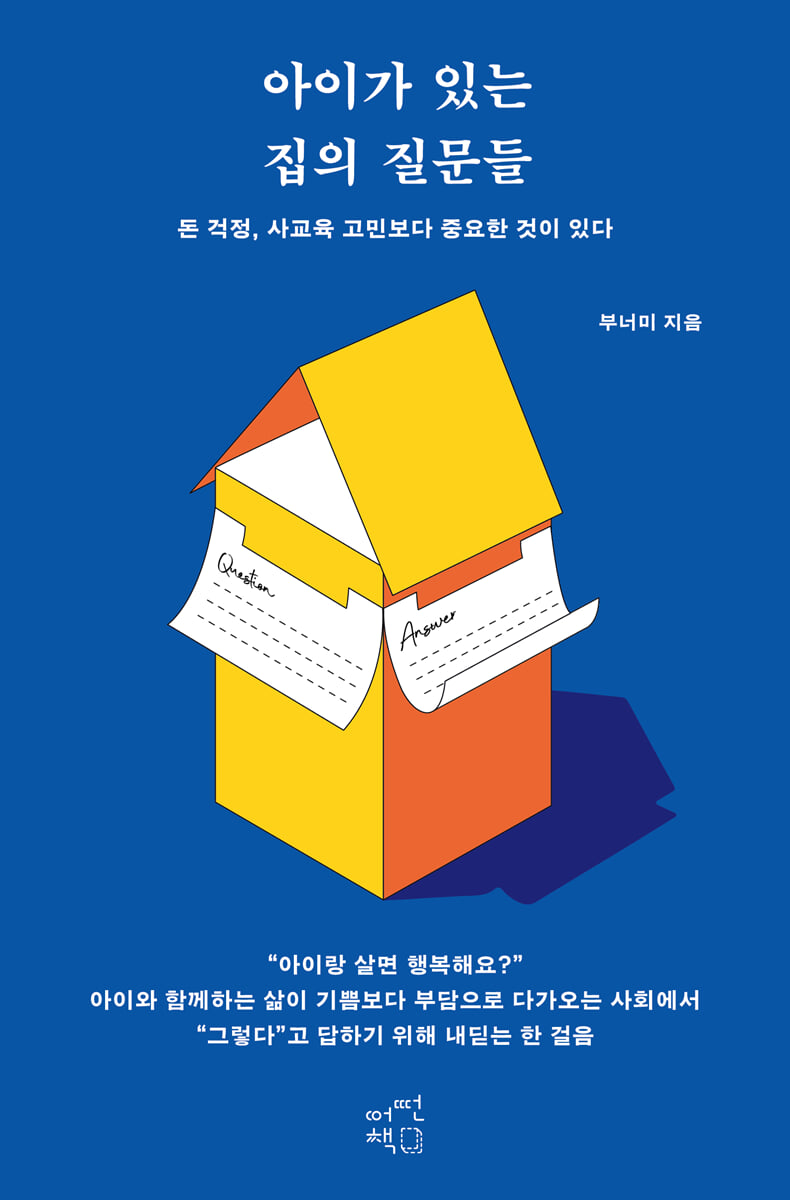
Questions for families with children
 |
Description
Book Introduction
When the closest adult is struggling to find a better life
The child learns the possibility of another life, the strength to rise again.
Bunermi's fourth book, "Questions for a House with Children"
Since the publication of her first book in 2019, Bunermi has been praised for “creating a language for married women,” and has now published her fourth book, “Questions for a House with Children.”
In this new book, Bunermi's unique perspective shines through, bringing everyday issues, often dismissed as "personal issues" or "family problems," into the center of discussion.
The theme of the book is 'Life with Children'.
In a reality where even within the home we are bound by systems and competition outside the home, the authors do not lose sight of the preciousness of this time when their children are growing up, and they continue to ask questions to overcome the helplessness of "there is nothing we can do" and move forward into a world where "things can change."
The child learns the possibility of another life, the strength to rise again.
Bunermi's fourth book, "Questions for a House with Children"
Since the publication of her first book in 2019, Bunermi has been praised for “creating a language for married women,” and has now published her fourth book, “Questions for a House with Children.”
In this new book, Bunermi's unique perspective shines through, bringing everyday issues, often dismissed as "personal issues" or "family problems," into the center of discussion.
The theme of the book is 'Life with Children'.
In a reality where even within the home we are bound by systems and competition outside the home, the authors do not lose sight of the preciousness of this time when their children are growing up, and they continue to ask questions to overcome the helplessness of "there is nothing we can do" and move forward into a world where "things can change."
- You can preview some of the book's contents.
Preview
index
〈Introduction〉Adults seeking a better life with their children
Chapter 1: May the Family Become a Possibility for Children
· Can I become a goose mother?
What to say to a child who is interested in dating
· Is it okay for our family to remain without deep conversations?
· Does it have to be the parents who tell everything?
· Can anyone use their mother's last name?
Chapter 2: What Kind of Family Should We Be to Care for Each Other?
· Can we accept neurodiverse children as they are?
· How can I properly care for a sick family member?
· Can I leave my child behind and go on a trip?
· Can we manage the family's shared bathroom together?
How to compensate parents who care for their children
Chapter 3: How to Protect Your Home from the Logic of the World
· Are there differences between members who earn money and those who don't?
· What should be emphasized in children's economic education?
· How to advise a child who uses a smartphone
· How do I teach my son that strength isn't everything?
· Is it okay for a son with long hair to remain like this?
· How to raise a child who can accept rejection well
Chapter 4: The Difficultest Conversation with the Closest One
· Can I have an honest conversation about sex with my grown son?
· How will you accept your father's new family?
· Why is my dad the one who drives in our house?
· Why is my mom the one who cooks at home?
· Is marital conflict only harmful to children?
· How to talk to a child influenced by YouTube
Chapter 5: The More We Think, the More Our Home Will Change
· What level of private education is appropriate for my home?
· Is it okay to diet while living with a growing child?
· Can parents prepare for their children's future?
· Do I really need to get married?
· What to tell your child if he or she is interested in homosexuality
References other than footnotes
Chapter 1: May the Family Become a Possibility for Children
· Can I become a goose mother?
What to say to a child who is interested in dating
· Is it okay for our family to remain without deep conversations?
· Does it have to be the parents who tell everything?
· Can anyone use their mother's last name?
Chapter 2: What Kind of Family Should We Be to Care for Each Other?
· Can we accept neurodiverse children as they are?
· How can I properly care for a sick family member?
· Can I leave my child behind and go on a trip?
· Can we manage the family's shared bathroom together?
How to compensate parents who care for their children
Chapter 3: How to Protect Your Home from the Logic of the World
· Are there differences between members who earn money and those who don't?
· What should be emphasized in children's economic education?
· How to advise a child who uses a smartphone
· How do I teach my son that strength isn't everything?
· Is it okay for a son with long hair to remain like this?
· How to raise a child who can accept rejection well
Chapter 4: The Difficultest Conversation with the Closest One
· Can I have an honest conversation about sex with my grown son?
· How will you accept your father's new family?
· Why is my dad the one who drives in our house?
· Why is my mom the one who cooks at home?
· Is marital conflict only harmful to children?
· How to talk to a child influenced by YouTube
Chapter 5: The More We Think, the More Our Home Will Change
· What level of private education is appropriate for my home?
· Is it okay to diet while living with a growing child?
· Can parents prepare for their children's future?
· Do I really need to get married?
· What to tell your child if he or she is interested in homosexuality
References other than footnotes
Into the book
I want to tell my child that while we are important to each other, we are not absolute beings, that sometimes the time we miss when we are apart connects us as much as the time we spend together, and that, above all, we become stronger when we spend time alone.
--- From "Can I Become a Goose Mother?"
When I finally managed to contact her colleague who had moved elsewhere and asked him to give a reference statement, he hesitated and asked:
“Can I help you?”
I answered forcefully.
“The mere fact that you testified will be a great help to the whistleblower.”
--- From "Do parents have to be the ones to tell everything?"
Since there is no one around you who uses your mother's surname, there may be an aspect of not actively considering other options.
That's why I think it's meaningful for a family like ours, who is a very ordinary family, to pass down the mother's surname to our children.
Because people will know that anyone can choose to use their mother's surname.
If you are planning to get married or have children, you may want to have a serious discussion with your partner.
At least, it could be a seed that makes us question things we have taken for granted.
--- From "Can anyone use their mother's surname?"
Nowadays, there is a growing movement to view neurodevelopmental disorders such as autism spectrum disorder, attention deficit hyperactivity disorder (ADHD), dyslexia, learning disabilities, and social communication disorders from a neurodiversity perspective rather than a pathological one.
Rather than viewing individuals as flawed entities in need of treatment, a neurodiversity perspective understands them as beings who perceive and experience the world through the unique workings of their nervous systems.
Just as each person has their own unique facial features.
This is also a perspective that reflects the voices of neurodiverse people, including people with autism.
--- From "Can Neurodiverse Children Be Accepted as They Are?"
In a capitalist society where what is not measured in money is easily overlooked, even within families, calculations are necessary for healthy interdependence.
I don't want to lump together the labor and financial support for children with the vague words "love and devotion."
It's strange that love and devotion become discount items rather than added value items.
--- From "How to compensate parents who take care of children"
“This time, instead of getting what you want, there’s a condition: someone gets hurt.
Would you like to press it?
Hesitation appears in the hand pressing the button.
Some people are firm in their decision not to press if someone gets hurt, others ask questions and reserve judgment, and still others insist on getting what they want no matter who gets hurt.
“Is the person hurt someone I know? Could it be my family?”
The hesitant student finally presses the button.
When asked why, he said with a proud expression, as if he had solved a difficult problem.
“If I press a button and become super rich, I can just use that money to solve the problem!”
--- From "What Should We Emphasize in Children's Economic Education?"
I took advantage of the fact that the kids were exclaiming “Sex!” in front of me as an exclamation to ask them a question.
“What is sex?”
“At what point in your relationship do you think you’ll be able to have sex?”
“At what age do you think you have to be to have sex?”
--- From "Can I Become a Goose Mother?"
When I finally managed to contact her colleague who had moved elsewhere and asked him to give a reference statement, he hesitated and asked:
“Can I help you?”
I answered forcefully.
“The mere fact that you testified will be a great help to the whistleblower.”
--- From "Do parents have to be the ones to tell everything?"
Since there is no one around you who uses your mother's surname, there may be an aspect of not actively considering other options.
That's why I think it's meaningful for a family like ours, who is a very ordinary family, to pass down the mother's surname to our children.
Because people will know that anyone can choose to use their mother's surname.
If you are planning to get married or have children, you may want to have a serious discussion with your partner.
At least, it could be a seed that makes us question things we have taken for granted.
--- From "Can anyone use their mother's surname?"
Nowadays, there is a growing movement to view neurodevelopmental disorders such as autism spectrum disorder, attention deficit hyperactivity disorder (ADHD), dyslexia, learning disabilities, and social communication disorders from a neurodiversity perspective rather than a pathological one.
Rather than viewing individuals as flawed entities in need of treatment, a neurodiversity perspective understands them as beings who perceive and experience the world through the unique workings of their nervous systems.
Just as each person has their own unique facial features.
This is also a perspective that reflects the voices of neurodiverse people, including people with autism.
--- From "Can Neurodiverse Children Be Accepted as They Are?"
In a capitalist society where what is not measured in money is easily overlooked, even within families, calculations are necessary for healthy interdependence.
I don't want to lump together the labor and financial support for children with the vague words "love and devotion."
It's strange that love and devotion become discount items rather than added value items.
--- From "How to compensate parents who take care of children"
“This time, instead of getting what you want, there’s a condition: someone gets hurt.
Would you like to press it?
Hesitation appears in the hand pressing the button.
Some people are firm in their decision not to press if someone gets hurt, others ask questions and reserve judgment, and still others insist on getting what they want no matter who gets hurt.
“Is the person hurt someone I know? Could it be my family?”
The hesitant student finally presses the button.
When asked why, he said with a proud expression, as if he had solved a difficult problem.
“If I press a button and become super rich, I can just use that money to solve the problem!”
--- From "What Should We Emphasize in Children's Economic Education?"
I took advantage of the fact that the kids were exclaiming “Sex!” in front of me as an exclamation to ask them a question.
“What is sex?”
“At what point in your relationship do you think you’ll be able to have sex?”
“At what age do you think you have to be to have sex?”
--- From "Can I have an honest conversation about sex with my grown son?"
Publisher's Review
To the question, “Are you happy living with a child?”
To answer “yes”, I first asked a question and thought deeply.
Stories from fellow caregivers
The reality facing parents in Korea is closely linked to the fact that Korea's total fertility rate (average number of children born per woman of childbearing age) is the lowest among OECD countries (0.72 in 2025).
Because raising children seems difficult, there is conflict between having children and not having children, and in reality, raising children consumes a lot of time and money, and socially, there is an atmosphere where children are not welcome, such as 'no kids zones'.
In a society where keywords like "entrance exam competition," "private education market," and "teenage depression" are associated with children and adolescents, parenting requires even greater commitment and more effort than necessary.
Bunermi, a group that studies family, home, motherhood, care, and sex with the awareness that "we can't just wait for the world to change," says that more questions are needed.
This is because the world children face outside the home is not limited to the realm of entrance exams or education.
Children have many questions.
As soon as they can speak, the question “What is this?” is always on their lips, and as they get older, they constantly ask “Why?”
Happily, but also burdensomely, the person answering those questions tends to be the caregiver who is with the children.
《Questions for a House with Children》 is centered around questions that would not have been asked if children were not present.
For a home to become a possibility for a child
To become a mother who protects her child from the logic of the world
The questions that the authors of Bunermi had as parents can be broadly divided into five categories.
Chapter 1, “May the Family Become a Possibility for Children,” contains topics that make us question whether families are becoming obstacles to each other.
Chapter 2: What Kind of Family Should We Be to Take Good Care of Each Other? examines the more pressing issue of care within families, where members must be each other's primary caregivers.
Chapter 3: How to Protect Your Home from the Logic of the World keenly captures the capitalist logic and lookism that have infiltrated even the home.
Chapter 4, "The Most Difficult Conversation with the Closest Ones," covers topics that can easily become even more contentious within the family, such as sex, division of labor, and political leanings.
In Chapter 5, 'Our home will change as much as we worry about it,' we think about current issues facing families with children, such as private education, diet, career paths, and sexual orientation.
The authors' questions do not end with questions, but lead to practices that change the side.
《Questions for a House with Children》 contains practical examples, both big and small.
You can meet the stories of a parent who questioned, "Why is it natural to take the father's surname?" and looked into social discussions before persuading her husband to give her child his surname; a parent who sought out and studied relevant education before forcing her son, who was about to enter middle school, to cut his long hair; and a parent who tried to fully recognize the economic value of a mother's labor by giving a regular stipend instead of an allowance to the mother (the child's grandparent) who takes care of her child.
A house that clearly shows how difficult it is to change sides.
People who change sides in such a house, Bunermi
In the winter of 2024, a family with extremely different political leanings between the parents and children became a hot topic.
The reason was that the social comments of celebrity parents differed from the behavior shown to their children at home.
Children and caregivers, who are physically closest, sometimes watch over each other.
Words alone cannot change someone's side.
Practicing at home is never easy.
That's because it has to be routine and repetitive.
In "Questions of a House with Children," we often see authors struggling to change their surroundings.
Through such efforts, I am amazed at the authors' consistency and steadfastness whenever they make a different choice or move in a desired direction.
Yet, we did not give up on this practice, and what we gained was the confidence that we had the power to change our surroundings.
The experience of entering a new, better life gives both adults and children the courage to face the future. _[Introduction]
"Questions for a Home with Children" is a book that reaches out to parents as the closest adults to their children, asking them to think together about what is important right now.
Asking my inner thoughts, I asked, “Isn’t the attitude of thinking about your own life and trying to move in a better direction even a little bit?”
To answer “yes”, I first asked a question and thought deeply.
Stories from fellow caregivers
The reality facing parents in Korea is closely linked to the fact that Korea's total fertility rate (average number of children born per woman of childbearing age) is the lowest among OECD countries (0.72 in 2025).
Because raising children seems difficult, there is conflict between having children and not having children, and in reality, raising children consumes a lot of time and money, and socially, there is an atmosphere where children are not welcome, such as 'no kids zones'.
In a society where keywords like "entrance exam competition," "private education market," and "teenage depression" are associated with children and adolescents, parenting requires even greater commitment and more effort than necessary.
Bunermi, a group that studies family, home, motherhood, care, and sex with the awareness that "we can't just wait for the world to change," says that more questions are needed.
This is because the world children face outside the home is not limited to the realm of entrance exams or education.
Children have many questions.
As soon as they can speak, the question “What is this?” is always on their lips, and as they get older, they constantly ask “Why?”
Happily, but also burdensomely, the person answering those questions tends to be the caregiver who is with the children.
《Questions for a House with Children》 is centered around questions that would not have been asked if children were not present.
For a home to become a possibility for a child
To become a mother who protects her child from the logic of the world
The questions that the authors of Bunermi had as parents can be broadly divided into five categories.
Chapter 1, “May the Family Become a Possibility for Children,” contains topics that make us question whether families are becoming obstacles to each other.
Chapter 2: What Kind of Family Should We Be to Take Good Care of Each Other? examines the more pressing issue of care within families, where members must be each other's primary caregivers.
Chapter 3: How to Protect Your Home from the Logic of the World keenly captures the capitalist logic and lookism that have infiltrated even the home.
Chapter 4, "The Most Difficult Conversation with the Closest Ones," covers topics that can easily become even more contentious within the family, such as sex, division of labor, and political leanings.
In Chapter 5, 'Our home will change as much as we worry about it,' we think about current issues facing families with children, such as private education, diet, career paths, and sexual orientation.
The authors' questions do not end with questions, but lead to practices that change the side.
《Questions for a House with Children》 contains practical examples, both big and small.
You can meet the stories of a parent who questioned, "Why is it natural to take the father's surname?" and looked into social discussions before persuading her husband to give her child his surname; a parent who sought out and studied relevant education before forcing her son, who was about to enter middle school, to cut his long hair; and a parent who tried to fully recognize the economic value of a mother's labor by giving a regular stipend instead of an allowance to the mother (the child's grandparent) who takes care of her child.
A house that clearly shows how difficult it is to change sides.
People who change sides in such a house, Bunermi
In the winter of 2024, a family with extremely different political leanings between the parents and children became a hot topic.
The reason was that the social comments of celebrity parents differed from the behavior shown to their children at home.
Children and caregivers, who are physically closest, sometimes watch over each other.
Words alone cannot change someone's side.
Practicing at home is never easy.
That's because it has to be routine and repetitive.
In "Questions of a House with Children," we often see authors struggling to change their surroundings.
Through such efforts, I am amazed at the authors' consistency and steadfastness whenever they make a different choice or move in a desired direction.
Yet, we did not give up on this practice, and what we gained was the confidence that we had the power to change our surroundings.
The experience of entering a new, better life gives both adults and children the courage to face the future. _[Introduction]
"Questions for a Home with Children" is a book that reaches out to parents as the closest adults to their children, asking them to think together about what is important right now.
Asking my inner thoughts, I asked, “Isn’t the attitude of thinking about your own life and trying to move in a better direction even a little bit?”
GOODS SPECIFICS
- Date of issue: November 10, 2025
- Page count, weight, size: 336 pages | 440g | 135*205*20mm
- ISBN13: 9791189385620
- ISBN10: 1189385627
You may also like
카테고리
korean


korean

![GQ KOREA Mark (Monthly): December [2025]](http://librairie.coreenne.fr/cdn/shop/files/8ef265dbbfbf186523ed75ba7319009d.jpg?v=1765340328&width=3840)


