

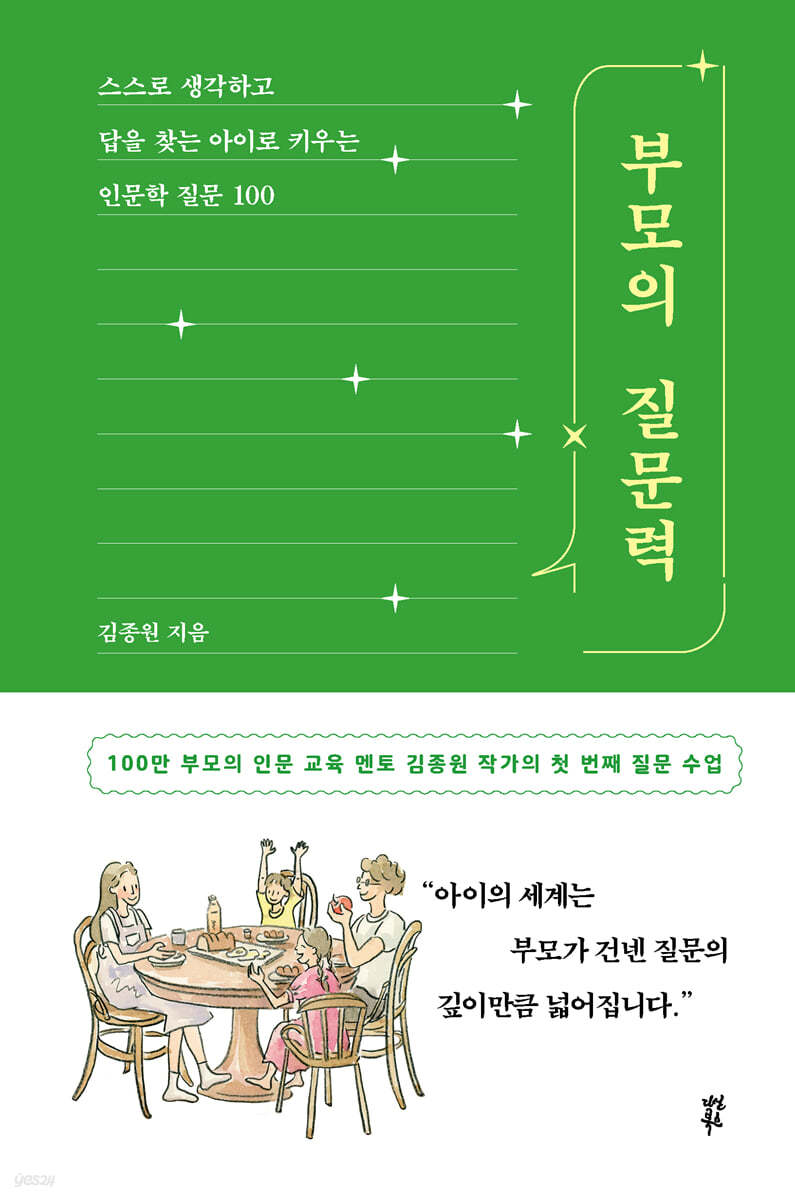
Parents' questioning power
 |
Description
Book Introduction
- A word from MD
-
No child answers without being asked!A parenting book on the humanities, "First Question," by Kim Jong-won, a mentor for Korean parents! It contains 100 humanities questions designed to foster children's critical thinking and self-esteem.
It conveys the message that one small question can deeply and broadly change a child's world.
A book recommended for parents who want to spend special time with their children through conversation.February 25, 2025. Baek Jeong-min, PD of Home Life
“A child’s world expands as much as the depth of the questions their parents ask.”
* 1 Million Readers' Choice! Author Kim Jong-won's First Question: A Childcare Book
* Includes 100 humanities questions to develop your child's thinking skills.
* The power of question education that has created creative giants around the world
Author Kim Jong-won, who has published 120 books and given over 100 lectures annually over the past 20 years, has shared the true wisdom of child education with Korean parents. He emphasizes that “the countless words parents give their children shape their world and create depth in their thoughts.”
Among these, 'Parents' Questions' in particular not only serve as a warm bridge for the relationship with a child who is growing into an independent subject, but also infinitely expands the child's thinking ability.
How did you spend time with your child last night? Did you lose precious time with them, distracted by your smartphone? Or did you, tired and annoyed, give them nothing but indifferent nagging and instructions instead of warm attention?
Now, ask your child one 'good question' at a time.
Instead of scolding your child with questions like, "Did you clean your room?" or "Did you do your homework before you played?", ask them one humanities question a day and you'll discover a truly amazing world.
For those of you who don't know what questions to ask or aren't comfortable with asking questions to your child, we've also included "100 Humanities Questions."
Spend some special time with your child tonight, following this friendly guide from Parents' Questions.
“If you were to write a book, what would be a good title?”
“What kind of person do you want to be in a year?”
“What would the world be like if everyone thought the same way?”
Does it feel vague and difficult? It's a difficult question for adults to answer, but your child will undoubtedly come up with surprising answers you wouldn't expect.
The seeds of growth for my child lie in ‘parents’ questions.’
Parents' questions will soon become the child's thoughts and will become the foundation for a more beautiful and abundant life.
* 1 Million Readers' Choice! Author Kim Jong-won's First Question: A Childcare Book
* Includes 100 humanities questions to develop your child's thinking skills.
* The power of question education that has created creative giants around the world
Author Kim Jong-won, who has published 120 books and given over 100 lectures annually over the past 20 years, has shared the true wisdom of child education with Korean parents. He emphasizes that “the countless words parents give their children shape their world and create depth in their thoughts.”
Among these, 'Parents' Questions' in particular not only serve as a warm bridge for the relationship with a child who is growing into an independent subject, but also infinitely expands the child's thinking ability.
How did you spend time with your child last night? Did you lose precious time with them, distracted by your smartphone? Or did you, tired and annoyed, give them nothing but indifferent nagging and instructions instead of warm attention?
Now, ask your child one 'good question' at a time.
Instead of scolding your child with questions like, "Did you clean your room?" or "Did you do your homework before you played?", ask them one humanities question a day and you'll discover a truly amazing world.
For those of you who don't know what questions to ask or aren't comfortable with asking questions to your child, we've also included "100 Humanities Questions."
Spend some special time with your child tonight, following this friendly guide from Parents' Questions.
“If you were to write a book, what would be a good title?”
“What kind of person do you want to be in a year?”
“What would the world be like if everyone thought the same way?”
Does it feel vague and difficult? It's a difficult question for adults to answer, but your child will undoubtedly come up with surprising answers you wouldn't expect.
The seeds of growth for my child lie in ‘parents’ questions.’
Parents' questions will soon become the child's thoughts and will become the foundation for a more beautiful and abundant life.
- You can preview some of the book's contents.
Preview
index
Prologue│No child answers without being asked.
Chapter 1 Learning Ability│A Child Who Absorbs Everything
3-Step Everyday Questioning Method to Spark Your Child's Thinking
Once you start loving, you can learn anything easily.
Questions to help you grow into a life expert who enjoys learning
If you can ask questions, you can learn from nature.
Questioning mind that catches both study and reading mind at the same time
Parents' questioning skills complete their children's studies.
Words that stop a child, words that move a child
* The Philosophers' Questioning Method × Johann Wolfgang von Goethe
Chapter 2 Imagination│A Child Playing Outside the Box
Everyday questions that rebuild a child's language skills
Reading is the only time a child is alone.
The 4-Step Observational Questioning Method: Connecting with Wisdom, Not Knowledge
Reading ends when you find the right question.
Daily questioning habits that change your mindset
A child who sees through the ten million varieties of diversity behind things
Thinking about my child's future gives me the courage to wait.
All questions should be directed to the child's inner self.
* The Philosophers' Questioning Method × Jean-Jacques Rousseau
Chapter 3: Expressiveness│A child who expresses anything in his own way
A child who knows how to ask questions finds light even in the darkness.
An active questioning method that subjectively reads the world
A child who is good at studying asks questions without hesitation, anytime, anywhere.
Writing for Children and Parents: Completed in 3 Months with Questions
Negotiation Questions: Creating Alternatives with Your Child
The experience of making choices on your own becomes a growth asset for your child.
3-Step Art Questioning Method that Connects Reading and Writing
* The Philosophers' Questioning Method × Toegye Yi Hwang
Chapter 4 Self-Esteem│A Child Unswayed by the Language of the World
Questions should always start with 'me'.
Small, everyday questions that start at your child's current level
A question that finds meaning even when drinking a glass of water
A child who understands meaning does not throw a tantrum.
Questions that turn a child's weaknesses into growth weapons
A child who conforms to the world, a child to whom the world conforms
The questions that build self-esteem are already in the child's mind.
A child who can reason for himself is not easily swayed.
* Philosophers' Questioning Method × Leonardo da Vinci
Epilogue│The questions from children and parents pile up to create a wonderful book.
Chapter 1 Learning Ability│A Child Who Absorbs Everything
3-Step Everyday Questioning Method to Spark Your Child's Thinking
Once you start loving, you can learn anything easily.
Questions to help you grow into a life expert who enjoys learning
If you can ask questions, you can learn from nature.
Questioning mind that catches both study and reading mind at the same time
Parents' questioning skills complete their children's studies.
Words that stop a child, words that move a child
* The Philosophers' Questioning Method × Johann Wolfgang von Goethe
Chapter 2 Imagination│A Child Playing Outside the Box
Everyday questions that rebuild a child's language skills
Reading is the only time a child is alone.
The 4-Step Observational Questioning Method: Connecting with Wisdom, Not Knowledge
Reading ends when you find the right question.
Daily questioning habits that change your mindset
A child who sees through the ten million varieties of diversity behind things
Thinking about my child's future gives me the courage to wait.
All questions should be directed to the child's inner self.
* The Philosophers' Questioning Method × Jean-Jacques Rousseau
Chapter 3: Expressiveness│A child who expresses anything in his own way
A child who knows how to ask questions finds light even in the darkness.
An active questioning method that subjectively reads the world
A child who is good at studying asks questions without hesitation, anytime, anywhere.
Writing for Children and Parents: Completed in 3 Months with Questions
Negotiation Questions: Creating Alternatives with Your Child
The experience of making choices on your own becomes a growth asset for your child.
3-Step Art Questioning Method that Connects Reading and Writing
* The Philosophers' Questioning Method × Toegye Yi Hwang
Chapter 4 Self-Esteem│A Child Unswayed by the Language of the World
Questions should always start with 'me'.
Small, everyday questions that start at your child's current level
A question that finds meaning even when drinking a glass of water
A child who understands meaning does not throw a tantrum.
Questions that turn a child's weaknesses into growth weapons
A child who conforms to the world, a child to whom the world conforms
The questions that build self-esteem are already in the child's mind.
A child who can reason for himself is not easily swayed.
* Philosophers' Questioning Method × Leonardo da Vinci
Epilogue│The questions from children and parents pile up to create a wonderful book.
Detailed image

Into the book
Don't just pour it into your child's brain, stimulate his or her thinking.
Let's say a child carelessly throws trash on the street.
In such cases, parents usually teach their children about what happens when they throw away trash anywhere and why they should not do that.
Instead, stimulate your child's thinking with simple questions like, "What will happen to the tissue you just threw away?" By encouraging them to imagine the future of that discarded tissue, they will gradually develop the ability to think independently, stimulate their own thinking, and dive into a broader and deeper ocean of learning.
A child who thinks for himself never stops growing.
---From the "Prologue"
It doesn't matter what you do or what knowledge you learn.
What matters is the child's mind looking at it.
You need to really understand why you're doing it, whether it makes you happy, and whether it's something you truly love.
The reason you need to love to grow is because when you love, you give everything.
Whenever your child starts something, ask them again and again, even if it seems boring.
“Why do you love that job?”
---From "Chapter 1: Learning Ability? A Child Who Absorbs Everything"
The important thing is the order.
We keep failing to follow the proper order, thus rendering what we have learned useless.
Observation, not study, is the priority.
Children who fill their daily lives with observation and find wisdom anytime, anywhere will begin to study on their own when they discover something they don't know, even without their parents telling them to.
It is not that knowledge accumulates to become wisdom, but rather that wisdom makes one crave knowledge.
---From "Chapter 2 Imagination? A Child Playing Outside the Box"
‘If I just keep playing like this, what will I become?’ The child thinks like this and begins to feel vague anxiety about his or her own existence and future.
Every thinking being worries about its own tomorrow.
The same goes for children.
Although he may not express it outwardly, he has many thoughts about his present and future.
Expressions that command and force are poisonous to the child and will only be absorbed.
Before you say anything, always think from the child's perspective.
Before saying anything to a child, always ask yourself, "How would I feel if I were that child?"
Let us refine and refine our words until they become as clear and transparent as possible.
---From "Chapter 2 Imagination? A Child Playing Outside the Box"
A person who can always create his own world in his head in everyday life does not have to wander around other worlds looking for an empty seat for himself.
There is no need to worry anxiously about how the world is changing.
Because there is another world in your heart.
Living in such a space for the rest of your life is the greatest blessing you can give yourself.
---From "Chapter 3: Expressiveness? A Child Who Expresses Anything in His Own Way"
It is more important to ask about the well-being of the inner self than to ask about the well-being of the outer self.
While it's good to greet people around you, the first thing you should do is help your child look inside themselves.
Let's make it a point to think about your existence every day and say hello to see how you are doing.
A person who can sincerely ask about his own well-being will naturally ask about the well-being of others.
The same goes for parents.
All questions and conversations should always be conducted from the child's perspective.
Every child's situation and environment will be different, but if you have the will to look at things from your child's perspective rather than someone else's, you will be able to easily come up with appropriate questions in everyday life that will help build your child's self-esteem.
---From "Chapter 4 Self-Esteem? A Child Unswayed by the Language of the World"
The world shakes parents and children endlessly.
Parents, who spend 24 hours a day thinking about their children, are swayed by the words of those around them, who throw them around without a second's hesitation. "If you don't start learning English right now, you'll fall behind forever." "Is this choice ruining your child's life?" Indifferent people, with a calm expression, blurt out scary words like curses.
To all parents who love their children the most in this world, never be swayed by the noise of the world.
As parents, we must think a thousand, ten thousand times to make the best choice for our children, and we must have a firm heart to believe in and support our decisions until the end.
Life is unpredictable.
What seems wrong now may turn out to be a good thing over time.
One thing we must never forget is that children should think for themselves and make many choices.
Just as a company is shaken when its leader is shaken, a family is shaken when parents are shaken.
If a child does not listen to his inner voice, his life will lose its center and fall apart.
Let's say a child carelessly throws trash on the street.
In such cases, parents usually teach their children about what happens when they throw away trash anywhere and why they should not do that.
Instead, stimulate your child's thinking with simple questions like, "What will happen to the tissue you just threw away?" By encouraging them to imagine the future of that discarded tissue, they will gradually develop the ability to think independently, stimulate their own thinking, and dive into a broader and deeper ocean of learning.
A child who thinks for himself never stops growing.
---From the "Prologue"
It doesn't matter what you do or what knowledge you learn.
What matters is the child's mind looking at it.
You need to really understand why you're doing it, whether it makes you happy, and whether it's something you truly love.
The reason you need to love to grow is because when you love, you give everything.
Whenever your child starts something, ask them again and again, even if it seems boring.
“Why do you love that job?”
---From "Chapter 1: Learning Ability? A Child Who Absorbs Everything"
The important thing is the order.
We keep failing to follow the proper order, thus rendering what we have learned useless.
Observation, not study, is the priority.
Children who fill their daily lives with observation and find wisdom anytime, anywhere will begin to study on their own when they discover something they don't know, even without their parents telling them to.
It is not that knowledge accumulates to become wisdom, but rather that wisdom makes one crave knowledge.
---From "Chapter 2 Imagination? A Child Playing Outside the Box"
‘If I just keep playing like this, what will I become?’ The child thinks like this and begins to feel vague anxiety about his or her own existence and future.
Every thinking being worries about its own tomorrow.
The same goes for children.
Although he may not express it outwardly, he has many thoughts about his present and future.
Expressions that command and force are poisonous to the child and will only be absorbed.
Before you say anything, always think from the child's perspective.
Before saying anything to a child, always ask yourself, "How would I feel if I were that child?"
Let us refine and refine our words until they become as clear and transparent as possible.
---From "Chapter 2 Imagination? A Child Playing Outside the Box"
A person who can always create his own world in his head in everyday life does not have to wander around other worlds looking for an empty seat for himself.
There is no need to worry anxiously about how the world is changing.
Because there is another world in your heart.
Living in such a space for the rest of your life is the greatest blessing you can give yourself.
---From "Chapter 3: Expressiveness? A Child Who Expresses Anything in His Own Way"
It is more important to ask about the well-being of the inner self than to ask about the well-being of the outer self.
While it's good to greet people around you, the first thing you should do is help your child look inside themselves.
Let's make it a point to think about your existence every day and say hello to see how you are doing.
A person who can sincerely ask about his own well-being will naturally ask about the well-being of others.
The same goes for parents.
All questions and conversations should always be conducted from the child's perspective.
Every child's situation and environment will be different, but if you have the will to look at things from your child's perspective rather than someone else's, you will be able to easily come up with appropriate questions in everyday life that will help build your child's self-esteem.
---From "Chapter 4 Self-Esteem? A Child Unswayed by the Language of the World"
The world shakes parents and children endlessly.
Parents, who spend 24 hours a day thinking about their children, are swayed by the words of those around them, who throw them around without a second's hesitation. "If you don't start learning English right now, you'll fall behind forever." "Is this choice ruining your child's life?" Indifferent people, with a calm expression, blurt out scary words like curses.
To all parents who love their children the most in this world, never be swayed by the noise of the world.
As parents, we must think a thousand, ten thousand times to make the best choice for our children, and we must have a firm heart to believe in and support our decisions until the end.
Life is unpredictable.
What seems wrong now may turn out to be a good thing over time.
One thing we must never forget is that children should think for themselves and make many choices.
Just as a company is shaken when its leader is shaken, a family is shaken when parents are shaken.
If a child does not listen to his inner voice, his life will lose its center and fall apart.
---From the "Epilogue"
Publisher's Review
“A child who knows how to ask questions
“You can pursue your dreams in any world!”
The power of humanities questions that foster children's learning, imagination, expressiveness, and self-esteem.
In an era where a single AI system can replace 600 jobs, how can we ensure our precious children grow up to be people who adapt to the world, not just conform to it? Kim Jong-won, a leading authority on humanities education and trusted by a million readers, asserts that parents' simple questions, prompting them to observe something entirely different even when looking at the same world, can transform their children's futures.
Former US President Barack Obama, a master of oratory, grew up experiencing firsthand the culture of sitting around the dinner table with his family and asking questions without formality, and director Bong Joon-ho of the film [Parasite] was also famous as an eccentric boy who asked outrageous questions to adults since middle and high school.
In this way, questioning is a very universal and proven educational method that can bring a person's abilities to the highest level.
The time spent between parents and children is a series of questions and answers.
But in everyday life, selecting and asking good questions is not as easy as it sounds.
Even when you ask a good question, if your child responds with “I don’t know” or “I can’t remember,” parents are bound to feel at a loss.
In this book, author Kim Jong-won introduces "100 Humanities Questions" that parents can ask and answer with their children to help resolve these difficulties.
Rather than simply listing questions, we also included specific explanations of how and in what situations the questions could be used. This is because we wanted parents to be able to freely and colorfully utilize the questions according to the unique circumstances of each child's life.
When the number of questions becomes as abundant as the number of children and parents in the world, children will break through the inner doors that have been confined and leap out into the world.
“The child’s behavior today is
“This is the answer to the question my parents asked me yesterday!”
How to Raise a Proactive Child Who Won't Be Swayed by the Changing World
Adults want to give children the answers.
It's about instilling 'what should I get from this information' and 'what should I realize from this experience'.
But the more that happens, the more you have to let go of the desire to give answers.
You need to discover special questions with your child, not just obvious answers.
If you ask questions that allow your child to encounter new discoveries in restaurant signs they come across on the street, in playground scenery, or in conversations with friends they have that day, their pockets of thought will grow significantly.
The same goes for reading books.
When the child puts the book down, the parent asks the child, “Are you finished reading?”
But author Kim Jong-won recommends asking, “Where did you stop reading?”
We need to provide a foundation for our children to fully absorb the knowledge and information in the book, rather than simply being absorbed by the story in the book.
In this way, parents must become people who press the pause button on their children's daily lives and develop their thinking skills through 'questioning skills.'
If you're a parent who's increasingly detached from your child's obsession with smartphones, TV, and games, or if you're concerned about your child's future in a complex and rapidly changing world, fill your child's daily life with wise stimulation through humanities questions that have nurtured geniuses of thought throughout the past thousands of years.
You can raise your child to be a confident child who is not swayed by the world and can ask questions without hesitation anytime, anywhere.
“You can pursue your dreams in any world!”
The power of humanities questions that foster children's learning, imagination, expressiveness, and self-esteem.
In an era where a single AI system can replace 600 jobs, how can we ensure our precious children grow up to be people who adapt to the world, not just conform to it? Kim Jong-won, a leading authority on humanities education and trusted by a million readers, asserts that parents' simple questions, prompting them to observe something entirely different even when looking at the same world, can transform their children's futures.
Former US President Barack Obama, a master of oratory, grew up experiencing firsthand the culture of sitting around the dinner table with his family and asking questions without formality, and director Bong Joon-ho of the film [Parasite] was also famous as an eccentric boy who asked outrageous questions to adults since middle and high school.
In this way, questioning is a very universal and proven educational method that can bring a person's abilities to the highest level.
The time spent between parents and children is a series of questions and answers.
But in everyday life, selecting and asking good questions is not as easy as it sounds.
Even when you ask a good question, if your child responds with “I don’t know” or “I can’t remember,” parents are bound to feel at a loss.
In this book, author Kim Jong-won introduces "100 Humanities Questions" that parents can ask and answer with their children to help resolve these difficulties.
Rather than simply listing questions, we also included specific explanations of how and in what situations the questions could be used. This is because we wanted parents to be able to freely and colorfully utilize the questions according to the unique circumstances of each child's life.
When the number of questions becomes as abundant as the number of children and parents in the world, children will break through the inner doors that have been confined and leap out into the world.
“The child’s behavior today is
“This is the answer to the question my parents asked me yesterday!”
How to Raise a Proactive Child Who Won't Be Swayed by the Changing World
Adults want to give children the answers.
It's about instilling 'what should I get from this information' and 'what should I realize from this experience'.
But the more that happens, the more you have to let go of the desire to give answers.
You need to discover special questions with your child, not just obvious answers.
If you ask questions that allow your child to encounter new discoveries in restaurant signs they come across on the street, in playground scenery, or in conversations with friends they have that day, their pockets of thought will grow significantly.
The same goes for reading books.
When the child puts the book down, the parent asks the child, “Are you finished reading?”
But author Kim Jong-won recommends asking, “Where did you stop reading?”
We need to provide a foundation for our children to fully absorb the knowledge and information in the book, rather than simply being absorbed by the story in the book.
In this way, parents must become people who press the pause button on their children's daily lives and develop their thinking skills through 'questioning skills.'
If you're a parent who's increasingly detached from your child's obsession with smartphones, TV, and games, or if you're concerned about your child's future in a complex and rapidly changing world, fill your child's daily life with wise stimulation through humanities questions that have nurtured geniuses of thought throughout the past thousands of years.
You can raise your child to be a confident child who is not swayed by the world and can ask questions without hesitation anytime, anywhere.
GOODS SPECIFICS
- Date of issue: February 19, 2025
- Format: Hardcover book binding method guide
- Page count, weight, size: 300 pages | 472g | 132*204*20mm
- ISBN13: 9791130663135
- ISBN10: 1130663132
You may also like
카테고리
korean


korean

![GQ KOREA Mark (Monthly): December [2025]](http://librairie.coreenne.fr/cdn/shop/files/8ef265dbbfbf186523ed75ba7319009d.jpg?v=1765340328&width=3840)


