

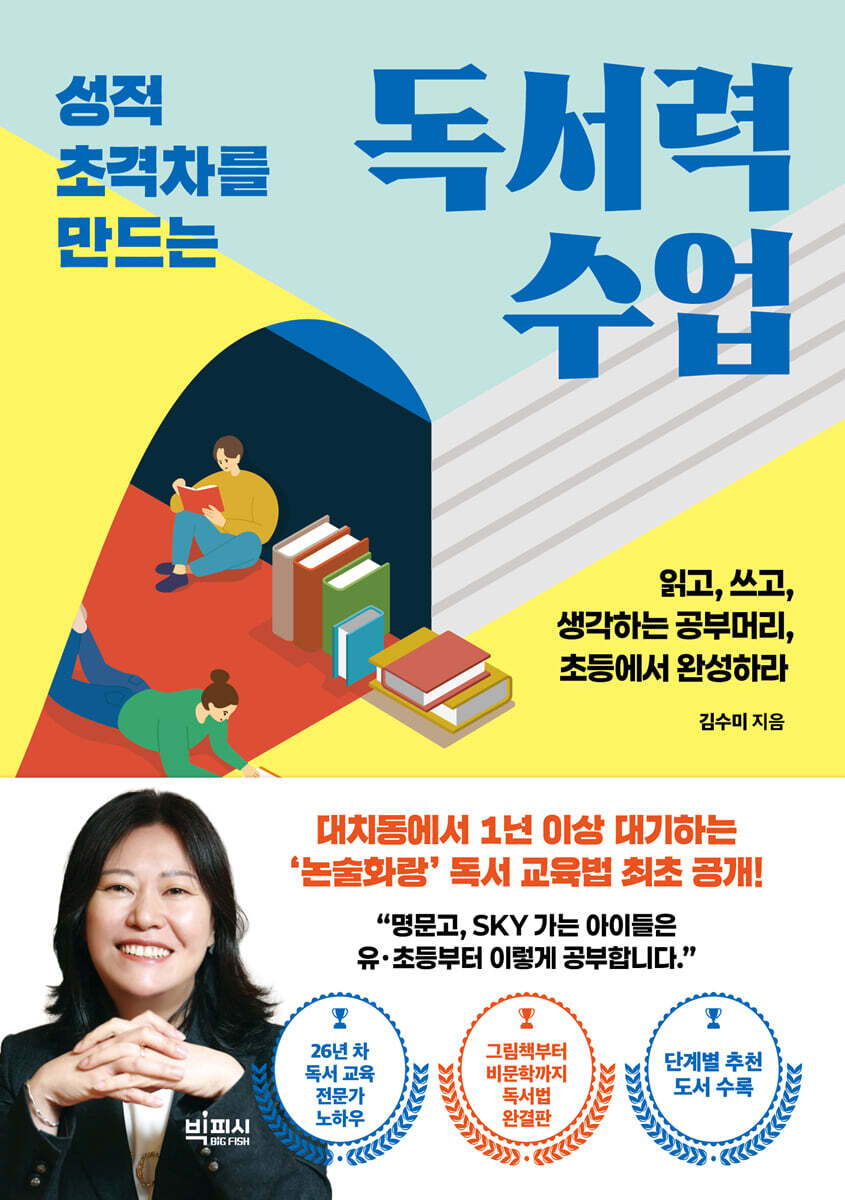
Reading classes that create a huge gap in grades
 |
Description
Book Introduction
- A word from MD
-
The power of reading books becomes the power of studying.The reading education method of Daechi-dong's representative reading and writing academy, 'Non-Sul Hwarang', is contained in one book.
Kim Soo-mi, who has taught tens of thousands of children for 26 years, presents a step-by-step reading strategy, from how to make children love books to how to write.
In an era where literacy is the ability to study, let's take a look at the most systematic reading education guide.
March 18, 2025. Baek Jeong-min, PD of Home Life
Quietly turning around grades in middle and high school
What is different about children?
In Daechi-dong, where it seems like they only teach problem-solving techniques, there is a person who has been digging a well called 'reading books' for nearly 30 years.
Kim Soo-mi is the CEO of the reading and writing academy 'Non-Sul Hwarang', which boasts 5,000 students and 15,000 students on the waiting list.
Having taught tens of thousands of children for 26 years, he has seen countless instances of children who gradually built their reading skills at the Nonsul Gallery during their preschool and elementary school years rapidly improving their grades when they entered middle and high school.
As a result, trust in the teaching methods of Nonsulhwarang gradually developed among those who initially did not pay much attention, and through word of mouth alone, it established itself as a prestigious school in Daechi-dong.
With over 10,000 parents attending the Nonsul Hwarang education information sessions each year, many parents are interested in Hwarang's educational methods and curious about its secrets.
What is the secret behind reading classes that children enjoy more than their parents? How can we immerse children in the world of reading? "Reading Classes That Create a Super Gap in Academic Achievement" provides the most concrete answers to these questions and offers a unique opportunity to glimpse the secrets of Daechi-dong's leading reading education institution.
What is different about children?
In Daechi-dong, where it seems like they only teach problem-solving techniques, there is a person who has been digging a well called 'reading books' for nearly 30 years.
Kim Soo-mi is the CEO of the reading and writing academy 'Non-Sul Hwarang', which boasts 5,000 students and 15,000 students on the waiting list.
Having taught tens of thousands of children for 26 years, he has seen countless instances of children who gradually built their reading skills at the Nonsul Gallery during their preschool and elementary school years rapidly improving their grades when they entered middle and high school.
As a result, trust in the teaching methods of Nonsulhwarang gradually developed among those who initially did not pay much attention, and through word of mouth alone, it established itself as a prestigious school in Daechi-dong.
With over 10,000 parents attending the Nonsul Hwarang education information sessions each year, many parents are interested in Hwarang's educational methods and curious about its secrets.
What is the secret behind reading classes that children enjoy more than their parents? How can we immerse children in the world of reading? "Reading Classes That Create a Super Gap in Academic Achievement" provides the most concrete answers to these questions and offers a unique opportunity to glimpse the secrets of Daechi-dong's leading reading education institution.
- You can preview some of the book's contents.
Preview
index
Prologue: The Secret of Reading Education That Quietly Turns Grades Around
PART 1.
A child with strong reading skills will eventually succeed.
The secret to Nonsulhwarang's unwavering leadership in Daechi-dong
My child can become a powerful literacy expert.
The secret of a child who remembers what he reads like taking a picture
If you read books, your Korean language score will naturally follow.
Parents' Skills for Leading Their Children into the World of Reading
PART 2.
A 3-Step Educational Method for Raising Children Who Love Books
Chapter 1.
[Step 1] Developing the basic skills of aspiring readers
To unleash your 'study potential' after the age of 12
The structure of one's native language becomes the structure of one's thoughts.
When is the best time to teach Korean?
The power of reading a book with your mom and dad's voice
Will Reading Independence Day ever come?
How to Make Reading Fun
Chapter 2.
[Step 2] Developing Beginner Reading Habits
The Foundation of Studying: Developing the Habit of Reading
Don't interfere with your child's reading.
3 Skills Gained Through Reading Training
How to Kill Two Birds: Creativity and Logical Thinking
How to Win Back a Child Who Has Disengaged from Reading
Chapter 3.
[Step 3] Jump into becoming a strong reader
To complete reading independence with knowledge books
Hwarang's reading education method that develops background knowledge
Overcoming the first hurdle to becoming a good student
The strongest study skills of top-tier children
PART 3.
3-Step Reading Method to Create a Super Gap in Academic Performance
Chapter 4.
[Step 1] Lower Elementary School Students: "Reading is Fun"
The Amazing Power of Picture Books to Build Self-Esteem and Literacy
7 Criteria for Choosing a Good Picture Book
+ A Parent's Checklist for Choosing Picture Books
Why Children Should Read Traditional and Classical Fairy Tales
Choosing books that fit your level, preferences, and educational impact
+ Recommended picture books to read before age 10
Chapter 5.
[Step 2] Middle and High School Students: "I Want to Try a Difficult Book"
A child needs a perfect hero.
+ Biographies Selection Criteria and Recommended Books
The Secret of a Child Who Reads Nonfiction Books Without Hesitation
+ Recommended Storybooks for Transitional Readers
Chapter 6.
[Stage 3] Upper Elementary School Students: "Curious about the Bigger World"
How to Make Difficult Classic Novels Easy to Read
+ Recommended classic novels to read in your teens
Extended Reading for Children at the Starting Line of Learning
+ Recommended genre novels for teenagers to read
+ Recommended non-fiction books for teenagers
PART 4.
Reading ability is only complete through reading and writing.
How to Handle a Child Who Is Beginning to Write
A blank sheet of paper requires unfounded confidence.
Let your child's speech be translated into writing.
The essential writing skills to write at the speed of thought
Step-by-step strategy to increase your writing volume
How to organize an outline with an introduction, body, and conclusion
+ Writing tips for starting with an introduction, body, and conclusion
A editing guide to develop an eye for good writing
Everything You Need to Know About Writing Reading Reports Leading Up to College Entrance Exams
+ How to write a reading report in the form of a topic exploration report
+ A list of questions for parents to help make reading log writing easier
PART 5.
Reading Skills You Should Know Before Entering Middle School
Why you should start managing your life history from the first year of middle school
What is a biographical report and what does it contain?
All entrance exams are based on reading logs.
What makes a child who does well on performance assessments different?
There's no easier way to explore your career path than reading.
PART 1.
A child with strong reading skills will eventually succeed.
The secret to Nonsulhwarang's unwavering leadership in Daechi-dong
My child can become a powerful literacy expert.
The secret of a child who remembers what he reads like taking a picture
If you read books, your Korean language score will naturally follow.
Parents' Skills for Leading Their Children into the World of Reading
PART 2.
A 3-Step Educational Method for Raising Children Who Love Books
Chapter 1.
[Step 1] Developing the basic skills of aspiring readers
To unleash your 'study potential' after the age of 12
The structure of one's native language becomes the structure of one's thoughts.
When is the best time to teach Korean?
The power of reading a book with your mom and dad's voice
Will Reading Independence Day ever come?
How to Make Reading Fun
Chapter 2.
[Step 2] Developing Beginner Reading Habits
The Foundation of Studying: Developing the Habit of Reading
Don't interfere with your child's reading.
3 Skills Gained Through Reading Training
How to Kill Two Birds: Creativity and Logical Thinking
How to Win Back a Child Who Has Disengaged from Reading
Chapter 3.
[Step 3] Jump into becoming a strong reader
To complete reading independence with knowledge books
Hwarang's reading education method that develops background knowledge
Overcoming the first hurdle to becoming a good student
The strongest study skills of top-tier children
PART 3.
3-Step Reading Method to Create a Super Gap in Academic Performance
Chapter 4.
[Step 1] Lower Elementary School Students: "Reading is Fun"
The Amazing Power of Picture Books to Build Self-Esteem and Literacy
7 Criteria for Choosing a Good Picture Book
+ A Parent's Checklist for Choosing Picture Books
Why Children Should Read Traditional and Classical Fairy Tales
Choosing books that fit your level, preferences, and educational impact
+ Recommended picture books to read before age 10
Chapter 5.
[Step 2] Middle and High School Students: "I Want to Try a Difficult Book"
A child needs a perfect hero.
+ Biographies Selection Criteria and Recommended Books
The Secret of a Child Who Reads Nonfiction Books Without Hesitation
+ Recommended Storybooks for Transitional Readers
Chapter 6.
[Stage 3] Upper Elementary School Students: "Curious about the Bigger World"
How to Make Difficult Classic Novels Easy to Read
+ Recommended classic novels to read in your teens
Extended Reading for Children at the Starting Line of Learning
+ Recommended genre novels for teenagers to read
+ Recommended non-fiction books for teenagers
PART 4.
Reading ability is only complete through reading and writing.
How to Handle a Child Who Is Beginning to Write
A blank sheet of paper requires unfounded confidence.
Let your child's speech be translated into writing.
The essential writing skills to write at the speed of thought
Step-by-step strategy to increase your writing volume
How to organize an outline with an introduction, body, and conclusion
+ Writing tips for starting with an introduction, body, and conclusion
A editing guide to develop an eye for good writing
Everything You Need to Know About Writing Reading Reports Leading Up to College Entrance Exams
+ How to write a reading report in the form of a topic exploration report
+ A list of questions for parents to help make reading log writing easier
PART 5.
Reading Skills You Should Know Before Entering Middle School
Why you should start managing your life history from the first year of middle school
What is a biographical report and what does it contain?
All entrance exams are based on reading logs.
What makes a child who does well on performance assessments different?
There's no easier way to explore your career path than reading.
Detailed image

Into the book
Moreover, unlike other subjects, Korean language proficiency, which is one's native language, is a basic ability that forms the basis of thinking ability.
Just learning Korean and being able to communicate smoothly in Korean on a daily basis does not mean that your Korean language skills are complete.
Aren't there people who read more difficult texts and understand and utilize higher-level concepts?
In developing these intellectual abilities, early childhood education and exposure to the mother tongue are key factors in determining a child's starting point.
---From "The Structure of the Mother Language Becomes the Structure of Thought"
The second thing to check when your child hates reading is the difficulty level of the book.
Children enjoy books that they can read fluently using their own reading skills.
It's hard even for adults to feel fun when there's no progress at all.
So, you should think about whether you are making your child read books as if they were studying because you want them to read difficult books.
Moreover, reading books this way not only destroys interest but also confidence.
Of course, that doesn't mean you can never read difficult books.
However, increasing the reading difficulty requires appropriate timing and experience.
---From "How to Immerse Yourself in the Joy of Reading"
Reading habits are developed over the next three years, starting when a child learns to read and begins to read on his or her own.
For a child who learns Hangul at age 5, the period of habit formation is from age 5 to 7, and for a child who learns Hangul at age 7, the period of habit formation is from age 7 to 9.
Considering this, it is disadvantageous for infants and toddlers, who have relatively weak thinking skills, to start learning Hangul early in life in order to develop the habit of reading.
---From "The Foundation of Studying: Developing the Habit of Reading"
In schools, reading aloud training is actively conducted in the first and second grades, and from the third grade onwards, reading aloud is not conducted separately other than representative reading of textbooks during class.
However, it is good to continue reading practice even in higher grades.
Because nothing builds basic physical strength as much as reading aloud as a direct training that can improve literacy.
That's why you can gauge whether someone's literacy is high or low by having them read aloud.
In addition, you can also check your child's reading habits.
You can determine your child's reading level by having them read aloud a text of about 1,000 words and checking how many times they make mistakes on each letter.
---From "3 Abilities Gained Through Reading Training"
In Hwarang, we begin by teaching children the concept of geography, the physical environment surrounding them, and then, based on this, we teach them the concepts of society and culture, and then, on top of that, the concepts of economics, law, and politics.
This process is usually completed over a one-year period in the third grade of elementary school, and once the understanding of these basic concepts is established to a certain extent, an advanced process is conducted to apply the new concepts learned so far in a complex manner.
---From "Hwarang's Reading Education Method for Developing Background Knowledge"
The fairy tale's somewhat formulaic conclusion may seem trite, but for children, it is a crucial step in learning to trust the world.
Children project themselves into picture books, learn to be courageous every day, overcome difficulties, and gain confidence through this process, and grow into strong children.
In this way, picture books are a valuable resource that purifies children's emotions and builds self-esteem.
---From "The Amazing Power of Picture Books to Build Self-Esteem and Literacy"
These days, parents stop reading storybooks to their children too early.
Parents who are impatient to acquire background knowledge encourage their children to read non-fiction and watch educational comics too quickly.
There are even parents who completely forbid their children from reading storybooks.
It's really sad that people don't consider something worthwhile just because the child likes it or because the child can do it easily.
The only way to become a child who is good at creating stories is to be exposed to so many stories and imagine them from a young age that you get tired of them.
---From "The Secret of a Child Who Reads Non-Fiction Books Without Hesitation"
After the 4th grade of elementary school, the reasoning ability that forms the basis of logical thinking begins to develop rapidly.
A genre that helps develop children's reasoning skills at this age is mystery novels.
'Deduction' is an extension of imagination, and it is the act of inferring the future with plausibility based on clues from reality.
Mystery novels are a genre that depicts the exciting process of deducing the cause of past events.
If you read a mystery novel and repeat the thought activity of finding cause and effect, your logical thinking skills can greatly improve.
---From "Extended Reading for Children at the Starting Line of Learning"
Children are supposed to write in a slow and steady manner.
It is natural to write inscriptions, and you cannot use a variety of vocabulary.
Spelling can also be wrong.
Teaching these children to use artificially excessive figurative language, onomatopoeia, and mimetic words before they have even established their own writing style is a cruel act that destroys their most precious individuality.
When a child writes in a childlike sentence or with a childlike thought, you need to give him/her specific feedback so that he/she knows that his/her writing is the best writing in the world.
A child who feels proud of his or her own immature writing can confidently express his or her thoughts and develop a good writing style.
Just learning Korean and being able to communicate smoothly in Korean on a daily basis does not mean that your Korean language skills are complete.
Aren't there people who read more difficult texts and understand and utilize higher-level concepts?
In developing these intellectual abilities, early childhood education and exposure to the mother tongue are key factors in determining a child's starting point.
---From "The Structure of the Mother Language Becomes the Structure of Thought"
The second thing to check when your child hates reading is the difficulty level of the book.
Children enjoy books that they can read fluently using their own reading skills.
It's hard even for adults to feel fun when there's no progress at all.
So, you should think about whether you are making your child read books as if they were studying because you want them to read difficult books.
Moreover, reading books this way not only destroys interest but also confidence.
Of course, that doesn't mean you can never read difficult books.
However, increasing the reading difficulty requires appropriate timing and experience.
---From "How to Immerse Yourself in the Joy of Reading"
Reading habits are developed over the next three years, starting when a child learns to read and begins to read on his or her own.
For a child who learns Hangul at age 5, the period of habit formation is from age 5 to 7, and for a child who learns Hangul at age 7, the period of habit formation is from age 7 to 9.
Considering this, it is disadvantageous for infants and toddlers, who have relatively weak thinking skills, to start learning Hangul early in life in order to develop the habit of reading.
---From "The Foundation of Studying: Developing the Habit of Reading"
In schools, reading aloud training is actively conducted in the first and second grades, and from the third grade onwards, reading aloud is not conducted separately other than representative reading of textbooks during class.
However, it is good to continue reading practice even in higher grades.
Because nothing builds basic physical strength as much as reading aloud as a direct training that can improve literacy.
That's why you can gauge whether someone's literacy is high or low by having them read aloud.
In addition, you can also check your child's reading habits.
You can determine your child's reading level by having them read aloud a text of about 1,000 words and checking how many times they make mistakes on each letter.
---From "3 Abilities Gained Through Reading Training"
In Hwarang, we begin by teaching children the concept of geography, the physical environment surrounding them, and then, based on this, we teach them the concepts of society and culture, and then, on top of that, the concepts of economics, law, and politics.
This process is usually completed over a one-year period in the third grade of elementary school, and once the understanding of these basic concepts is established to a certain extent, an advanced process is conducted to apply the new concepts learned so far in a complex manner.
---From "Hwarang's Reading Education Method for Developing Background Knowledge"
The fairy tale's somewhat formulaic conclusion may seem trite, but for children, it is a crucial step in learning to trust the world.
Children project themselves into picture books, learn to be courageous every day, overcome difficulties, and gain confidence through this process, and grow into strong children.
In this way, picture books are a valuable resource that purifies children's emotions and builds self-esteem.
---From "The Amazing Power of Picture Books to Build Self-Esteem and Literacy"
These days, parents stop reading storybooks to their children too early.
Parents who are impatient to acquire background knowledge encourage their children to read non-fiction and watch educational comics too quickly.
There are even parents who completely forbid their children from reading storybooks.
It's really sad that people don't consider something worthwhile just because the child likes it or because the child can do it easily.
The only way to become a child who is good at creating stories is to be exposed to so many stories and imagine them from a young age that you get tired of them.
---From "The Secret of a Child Who Reads Non-Fiction Books Without Hesitation"
After the 4th grade of elementary school, the reasoning ability that forms the basis of logical thinking begins to develop rapidly.
A genre that helps develop children's reasoning skills at this age is mystery novels.
'Deduction' is an extension of imagination, and it is the act of inferring the future with plausibility based on clues from reality.
Mystery novels are a genre that depicts the exciting process of deducing the cause of past events.
If you read a mystery novel and repeat the thought activity of finding cause and effect, your logical thinking skills can greatly improve.
---From "Extended Reading for Children at the Starting Line of Learning"
Children are supposed to write in a slow and steady manner.
It is natural to write inscriptions, and you cannot use a variety of vocabulary.
Spelling can also be wrong.
Teaching these children to use artificially excessive figurative language, onomatopoeia, and mimetic words before they have even established their own writing style is a cruel act that destroys their most precious individuality.
When a child writes in a childlike sentence or with a childlike thought, you need to give him/her specific feedback so that he/she knows that his/her writing is the best writing in the world.
A child who feels proud of his or her own immature writing can confidently express his or her thoughts and develop a good writing style.
---From "Let the child's speech become writing"
Publisher's Review
Waiting for more than a year in Daechi-dong
The first public disclosure of the 'Non-Sul Gallery' reading education method!
“Children who go to prestigious high schools and SKY
“From kindergarten and elementary school, we read, write, and think like this.”
* 26 years of reading education expertise
* Complete reading guide from picture books to non-fiction
* Includes recommended books by level
There is no educational method more effective than reading to raise children who are good at studying.
However, it is true that it is difficult to know which books to read and how to develop reading habits.
A great guide has been published for these parents.
This is the book, "Reading Skills Class that Creates a Super Gap in Grades," which contains the reading education method of "Non-Sul Hwarang," which has maintained its reputation in Daechi-dong for the past 26 years through word of mouth alone.
Kim Soo-mi, a reading education expert with 26 years of experience, has seen countless children who gradually built their reading skills in kindergarten and elementary school explode with academic potential and see their grades skyrocket in middle and high school.
Although reading education is the most effective way to develop children's study skills, many parents fail to do so.
This is because parents' impatience to increase the amount of reading material and read difficult books in the hope of immediate educational results reduces their children's interest in reading.
The author warns, “If you rush your child to become independent readers without considering their pace and move on to more difficult books, you will never be able to develop solid reading skills.” Through this book, the author presents the most effective and specific direction for reading education.
From independent reading to writing… from picture books to knowledge books
The Secret of Step-by-Step Reading Instruction That Silently Turns Your Grades Around
《Reading Skills Class that Creates a Super Gap in Academic Achievements》 is largely composed of five parts.
Part 1 covers the mindset of parents in leading their children into the world of reading.
In Parts 2 and 3, the author systematically organizes the know-how in reading education he has established through meeting tens of thousands of children.
First, in Part 2, we introduce a three-step reading education method that instills positive reading emotions in children, helps them develop good reading habits, and ultimately leads to reading independence.
It is filled with content that will serve as a guide for parents who are curious about whether their book-raising is on the right track, such as how long parents should stop reading books, whether it is okay to leave children reading the same books over and over again, and when is a good time to start reading knowledge books.
In Part 3, a three-stage reading method that can be applied from lower to upper elementary school grades is presented.
From picture books that stimulate the imagination, to biographies and non-fiction books that build background knowledge, and even literary works that lay the foundation for logical and critical thinking, we will share the secrets to gradually improving your reading level.
Here, we provide recommended books for each period and a wealth of post-reading activities that can be practiced at home to help parents guide their children's reading.
Part 4 provides detailed step-by-step instructions on how to write, from writing a single sentence to writing a complete piece.
If you want to raise a child who can write down his or her thoughts fluently without fear of writing, you can start from this section.
The final five parts provide tips for applying the thinking skills developed through reading to real middle school life, such as performance assessments and career exploration.
In particular, it explains why you should pay attention to managing your academic records starting from the first year of middle school, and the specific writing method, and even provides strategies for linking reading to college entrance exams.
Parents who consider reading to be the most important aspect of their children's education and who want to find a clue to systematic reading guidance should definitely read this book.
From poor imagination to strong thinking
The most systematic solution to develop literacy
Since declining literacy has emerged as a social problem, parents' interest in reading education has been increasing day by day.
This enthusiasm is also confirmed by the fact that over 10,000 parents attend the Essay Gallery education briefing session every year.
Parents attending the lecture often ask questions like these:
“I’m worried because I read books too slowly.” “I like books so I just let them be, but my reading comprehension is terrible.
“Is this okay?” “What kind of workbook should I do to improve my vocabulary?” After the toddler stage, when parents think that just having their child close to books is enough, they become impatient and want to quickly develop their child’s reading ability, thinking that reading is a learning progress that can be done ahead of time.
However, literacy skills, including vocabulary, that parents so desire, cannot be developed in a short period of time.
A toddler's simple imagination grows into creativity as they read enough picture books.
Traditional fairy tales with a structure of good triumphing over evil provide a window through which children under the age of 10, who think in black-and-white logic, can more easily understand the world.
When transitioning from storybooks to non-fiction books, it is effective to use educational comics appropriately.
If you know this reading education method and guide your child, you will no longer feel anxious or impatient.
If parents guide their children with a stable mind, the children will gradually develop the ability to read and understand, and with the thinking skills formed on that foundation, they will eventually do well in their studies.
If you want to raise your child to be a leader armed with solid reading skills, read this book right now and apply it to your education.
The first public disclosure of the 'Non-Sul Gallery' reading education method!
“Children who go to prestigious high schools and SKY
“From kindergarten and elementary school, we read, write, and think like this.”
* 26 years of reading education expertise
* Complete reading guide from picture books to non-fiction
* Includes recommended books by level
There is no educational method more effective than reading to raise children who are good at studying.
However, it is true that it is difficult to know which books to read and how to develop reading habits.
A great guide has been published for these parents.
This is the book, "Reading Skills Class that Creates a Super Gap in Grades," which contains the reading education method of "Non-Sul Hwarang," which has maintained its reputation in Daechi-dong for the past 26 years through word of mouth alone.
Kim Soo-mi, a reading education expert with 26 years of experience, has seen countless children who gradually built their reading skills in kindergarten and elementary school explode with academic potential and see their grades skyrocket in middle and high school.
Although reading education is the most effective way to develop children's study skills, many parents fail to do so.
This is because parents' impatience to increase the amount of reading material and read difficult books in the hope of immediate educational results reduces their children's interest in reading.
The author warns, “If you rush your child to become independent readers without considering their pace and move on to more difficult books, you will never be able to develop solid reading skills.” Through this book, the author presents the most effective and specific direction for reading education.
From independent reading to writing… from picture books to knowledge books
The Secret of Step-by-Step Reading Instruction That Silently Turns Your Grades Around
《Reading Skills Class that Creates a Super Gap in Academic Achievements》 is largely composed of five parts.
Part 1 covers the mindset of parents in leading their children into the world of reading.
In Parts 2 and 3, the author systematically organizes the know-how in reading education he has established through meeting tens of thousands of children.
First, in Part 2, we introduce a three-step reading education method that instills positive reading emotions in children, helps them develop good reading habits, and ultimately leads to reading independence.
It is filled with content that will serve as a guide for parents who are curious about whether their book-raising is on the right track, such as how long parents should stop reading books, whether it is okay to leave children reading the same books over and over again, and when is a good time to start reading knowledge books.
In Part 3, a three-stage reading method that can be applied from lower to upper elementary school grades is presented.
From picture books that stimulate the imagination, to biographies and non-fiction books that build background knowledge, and even literary works that lay the foundation for logical and critical thinking, we will share the secrets to gradually improving your reading level.
Here, we provide recommended books for each period and a wealth of post-reading activities that can be practiced at home to help parents guide their children's reading.
Part 4 provides detailed step-by-step instructions on how to write, from writing a single sentence to writing a complete piece.
If you want to raise a child who can write down his or her thoughts fluently without fear of writing, you can start from this section.
The final five parts provide tips for applying the thinking skills developed through reading to real middle school life, such as performance assessments and career exploration.
In particular, it explains why you should pay attention to managing your academic records starting from the first year of middle school, and the specific writing method, and even provides strategies for linking reading to college entrance exams.
Parents who consider reading to be the most important aspect of their children's education and who want to find a clue to systematic reading guidance should definitely read this book.
From poor imagination to strong thinking
The most systematic solution to develop literacy
Since declining literacy has emerged as a social problem, parents' interest in reading education has been increasing day by day.
This enthusiasm is also confirmed by the fact that over 10,000 parents attend the Essay Gallery education briefing session every year.
Parents attending the lecture often ask questions like these:
“I’m worried because I read books too slowly.” “I like books so I just let them be, but my reading comprehension is terrible.
“Is this okay?” “What kind of workbook should I do to improve my vocabulary?” After the toddler stage, when parents think that just having their child close to books is enough, they become impatient and want to quickly develop their child’s reading ability, thinking that reading is a learning progress that can be done ahead of time.
However, literacy skills, including vocabulary, that parents so desire, cannot be developed in a short period of time.
A toddler's simple imagination grows into creativity as they read enough picture books.
Traditional fairy tales with a structure of good triumphing over evil provide a window through which children under the age of 10, who think in black-and-white logic, can more easily understand the world.
When transitioning from storybooks to non-fiction books, it is effective to use educational comics appropriately.
If you know this reading education method and guide your child, you will no longer feel anxious or impatient.
If parents guide their children with a stable mind, the children will gradually develop the ability to read and understand, and with the thinking skills formed on that foundation, they will eventually do well in their studies.
If you want to raise your child to be a leader armed with solid reading skills, read this book right now and apply it to your education.
GOODS SPECIFICS
- Date of issue: March 19, 2025
- Page count, weight, size: 364 pages | 576g | 148*210*21mm
- ISBN13: 9791194033585
- ISBN10: 119403358X
You may also like
카테고리
korean


korean

![GQ KOREA Mark (Monthly): December [2025]](http://librairie.coreenne.fr/cdn/shop/files/8ef265dbbfbf186523ed75ba7319009d.jpg?v=1765340328&width=3840)


