

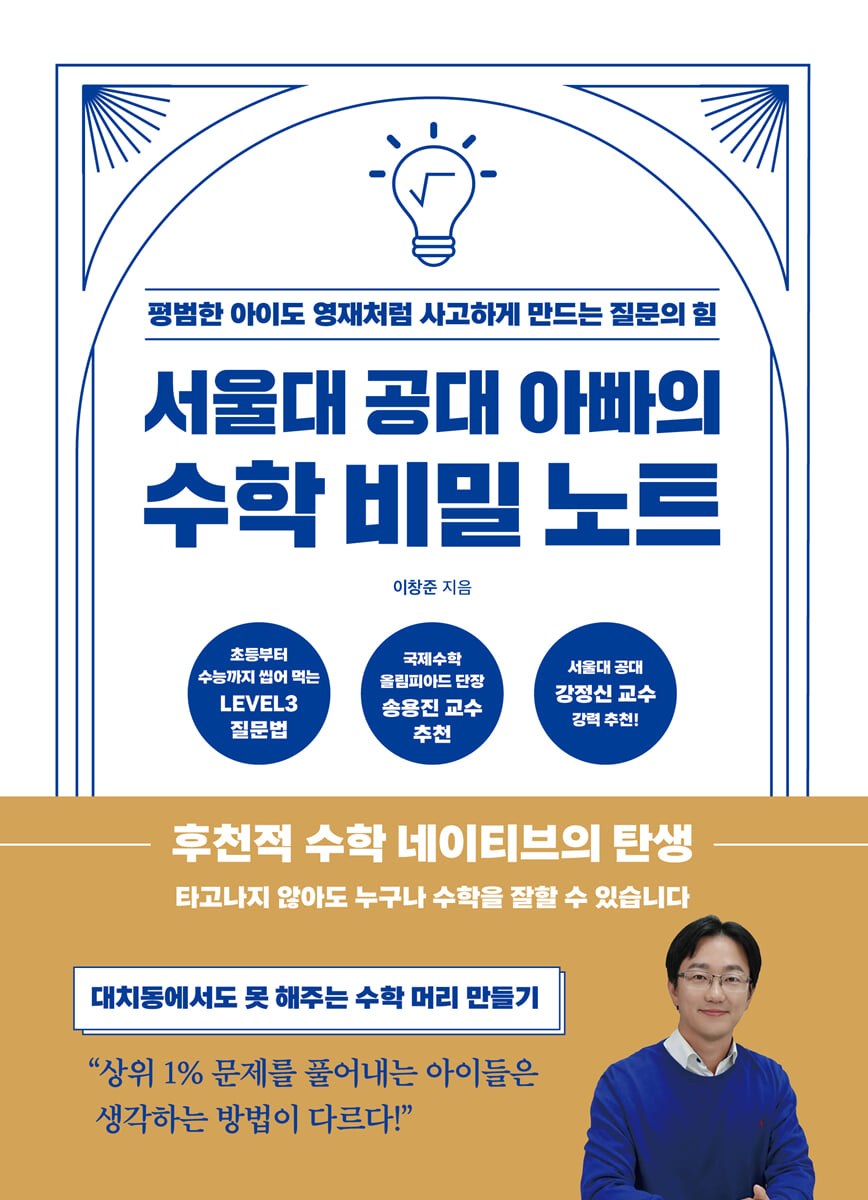
Seoul National University College of Engineering Dad's Secret Math Notes
 |
Description
Book Introduction
What my dad, a student at Seoul National University's College of Engineering, tells me
The secret of children who are good at math!
LEVEL3 Secret Math Study Method: From Elementary to the College Scholastic Ability Test
* Recommended by Professor Song Yong-jin, the mentor of math geniuses and director of the International Mathematical Olympiad
* Strongly recommended by Professor Kang Jeong-shin of Seoul National University College of Engineering
A father who majored in materials engineering at Seoul National University and earned a doctorate from the University of Tokyo developed this study method to help his two sons excel in math! Having spent years meeting and observing elite math students from Korea and abroad since their school days, the author discovered the secret to math success lies in asking good questions and being patient.
The author, who is a member of the steering committee of the Korea Foundation for the Advancement of Science and Creativity and is participating in a discussion on gifted education, says that the difference between gifted children and ordinary children is questions.
Gifted children ask questions and think for themselves, but ordinary children have to be asked questions to think.
This means that even 99% of ordinary children can think like a genius if they ask questions and wait.
So what questions should we ask? This book is filled with questions that empower even ordinary children to think like gifted children.
LEVEL 1 contains questions designed to encourage deeper and more diverse thinking on the content covered in the lower elementary school curriculum. LEVEL 2 includes content that partially covers the upper elementary and middle school curriculums, and questions that expand students' mathematical knowledge. LEVEL 3 presents questions about what students learn in middle and high school and how that content connects to real-life situations, expanding mathematical thinking beyond the CSAT to encompass everyday life.
The questions in this book cover everything from critical thinking, deepening, and even prioritization. Anyone can raise their child to be good at math just by asking these questions.
Even Daechi-dong can't offer you math skills! With this book, you can break free from the system where only innate talent is recognized, and cultivate your math aptitude through innate talent.
The secret of children who are good at math!
LEVEL3 Secret Math Study Method: From Elementary to the College Scholastic Ability Test
* Recommended by Professor Song Yong-jin, the mentor of math geniuses and director of the International Mathematical Olympiad
* Strongly recommended by Professor Kang Jeong-shin of Seoul National University College of Engineering
A father who majored in materials engineering at Seoul National University and earned a doctorate from the University of Tokyo developed this study method to help his two sons excel in math! Having spent years meeting and observing elite math students from Korea and abroad since their school days, the author discovered the secret to math success lies in asking good questions and being patient.
The author, who is a member of the steering committee of the Korea Foundation for the Advancement of Science and Creativity and is participating in a discussion on gifted education, says that the difference between gifted children and ordinary children is questions.
Gifted children ask questions and think for themselves, but ordinary children have to be asked questions to think.
This means that even 99% of ordinary children can think like a genius if they ask questions and wait.
So what questions should we ask? This book is filled with questions that empower even ordinary children to think like gifted children.
LEVEL 1 contains questions designed to encourage deeper and more diverse thinking on the content covered in the lower elementary school curriculum. LEVEL 2 includes content that partially covers the upper elementary and middle school curriculums, and questions that expand students' mathematical knowledge. LEVEL 3 presents questions about what students learn in middle and high school and how that content connects to real-life situations, expanding mathematical thinking beyond the CSAT to encompass everyday life.
The questions in this book cover everything from critical thinking, deepening, and even prioritization. Anyone can raise their child to be good at math just by asking these questions.
Even Daechi-dong can't offer you math skills! With this book, you can break free from the system where only innate talent is recognized, and cultivate your math aptitude through innate talent.
- You can preview some of the book's contents.
Preview
index
Recommendation
prolog
Even if you weren't born with a math brain, there are ways to make yourself good at math!
What Makes Someone Good at Math Different? ┃The Math Education Mindset You Can Gain by Reading This Book
Genuine reviews from parents and students
No more trial and error in studying math!
LEVEL 1.
Questions to understand the nature of mathematical language
The secrets of good students, discovered after 30 years of reflection
Raising a child to be good at studying later in life
Math doesn't work with shortcuts.
Why blisters occur
Q 01.
How many numbers are there in this world?
The practice of thinking is mathematics.
Q 02.
What if there were only eight numbers in this world?
Expanding the formation
Q 03.
What does 78×9 mean?
Memorizing the multiplication tables is not important.
Q 04.
Why do we do multiplication first when it comes to addition?
The depth of knowledge is proportional to the power of questioning.
Q 05.
Multiplication tables, don't you still have to memorize them?
A Math Study Method That Will Make You Four Times More Efficient
Q 06.
How are you going to share a loaf of bread?
Raising Math Language as a Native Speaker
Q 07.
The Biggest Villains of Elementary Math: Least Common Multiple and Greatest Common Divisor
The first step of teaching the greatest common divisor and least common multiple conversation
Q 08.
Why is 3 divided by 3 equal to 3 multiplied by 3?
What we should pursue in the early elementary grades is not efficiency, but fundamentals.
Q 09.
Why not +?
How to most effectively digest the concept of resentment
Q 10.
What is the difference between a circle and a circle?
If you internalize the language of mathematics, your child will become good at math.
Breaking free from a system where only gifted children can excel
There's no need to worry about not being able to produce elementary school students who are good at studying.
Study tips from a successful engineering student dad I
The time needed to raise a child who can concentrate
The brain that is activated when doing nothing
LEVEL 2.
Learning the language of mathematics by breaking common sense
The meaning of pre-learning that we knew until now was wrong.
Effective pre-learning solutions tailored to your child's needs
A decisive factor in determining grades in middle and high school
Changing the standard of 'knowing'
Q 11.
3, 2, 1 What's next?
Nothing is taken for granted in mathematics
Q 12.
Can you mentally calculate 37×27 in 3 seconds? How?
Techniques for solving problems that determine the difference between 3 and 4 points on the CSAT
Q 13.
What if four people are trying to share a pizza, but Dad keeps not coming?
Applying recurring decimals to fraction conversion
Q 14.
Why doesn't division by zero work?
Solving problems over and over again is not the way to minimize mistakes.
Q 15.
Why do the three angles of a triangle add up to 180 degrees?
Intuitive children solve problems.
Q 16.
Which is bigger, a round room or a square room?
Learn calculus concepts by maximizing your thinking skills.
Q 17.
What happens if you add 1 to a very, very large number?
The concept of infinity and imaginary numbers that defies common sense
Having an educational philosophy is more important than having a good tutor.
The biggest effect is parental scaffolding.
Study tips from a successful engineering student's dad, Part II
Creating a Study Roadmap for Your Child
Example of a practical roadmap
LEVEL 3.
The world of mathematics expands beyond the CSAT.
The expanding world of mathematics through Fermi's conjecture
The world we can think of with mathematics is endless.
Life and the CSAT are both equations.
Mathematics helps with logical decision-making in life, which is a series of decisions.
The Difference Between Top and Top Levels in Simultaneous Equations
Simultaneous equation problems that develop flexibility of thinking
Mathematical language learned through words, pictures, and formulas: inequalities
The ability to freely move between words, expressions, and pictures is mathematical ability.
Geometry part where fundamentals are important
Finding the area of a circle using points, lines, surfaces, and angles
In mathematics, what matters is not the formula.
A conversation that develops perspectives that connect numbers and letters
A sequence that elementary school students can solve but high school students cannot.
The most important thing in a sequence is to find the pattern and explain it in words.
Infinite World: Mathematics is ultimately philosophy.
The expanding world of mathematics as we embrace a new worldview
Enjoying a hike while looking at the peak called Calculus
Differentiation/Integration Made Easy
Study Tips from a Highly Aspiring Engineering Student's Dad III
Study tips to improve your test-taking skills
Structuring Knowledge┃Capacities Required for Structuring Knowledge
Epilogue
White lies parents tell themselves, but not their children.
Three Common White Lies Parents Tell | Why Are White Lies a Problem? | Parental Honesty Is More Powerful Motivation Than White Lies
Appendix Q&A
I only picked out the ones I was curious about
Q.
Do I really need to do critical thinking math?
Q.
What are some easy math quizzes that I can give my kids?
Q.
My child is good at math. Should I prepare for a specialized high school?
Q.
What do you think about IQ tests?
Q.
I keep making mistakes in simple calculations, but I hate it when people ask me to do them.
What should I do?
Q.
I'm wondering if my child is more inclined towards liberal arts or science.
How do you know?
Q.
Are there any study habits that should be developed from a young age?
Q.
Is there a way to help a child who lacks task-focusedness develop task-focusedness?
Q.
Is it better to study in a school district or in a non-school district?
prolog
Even if you weren't born with a math brain, there are ways to make yourself good at math!
What Makes Someone Good at Math Different? ┃The Math Education Mindset You Can Gain by Reading This Book
Genuine reviews from parents and students
No more trial and error in studying math!
LEVEL 1.
Questions to understand the nature of mathematical language
The secrets of good students, discovered after 30 years of reflection
Raising a child to be good at studying later in life
Math doesn't work with shortcuts.
Why blisters occur
Q 01.
How many numbers are there in this world?
The practice of thinking is mathematics.
Q 02.
What if there were only eight numbers in this world?
Expanding the formation
Q 03.
What does 78×9 mean?
Memorizing the multiplication tables is not important.
Q 04.
Why do we do multiplication first when it comes to addition?
The depth of knowledge is proportional to the power of questioning.
Q 05.
Multiplication tables, don't you still have to memorize them?
A Math Study Method That Will Make You Four Times More Efficient
Q 06.
How are you going to share a loaf of bread?
Raising Math Language as a Native Speaker
Q 07.
The Biggest Villains of Elementary Math: Least Common Multiple and Greatest Common Divisor
The first step of teaching the greatest common divisor and least common multiple conversation
Q 08.
Why is 3 divided by 3 equal to 3 multiplied by 3?
What we should pursue in the early elementary grades is not efficiency, but fundamentals.
Q 09.
Why not +?
How to most effectively digest the concept of resentment
Q 10.
What is the difference between a circle and a circle?
If you internalize the language of mathematics, your child will become good at math.
Breaking free from a system where only gifted children can excel
There's no need to worry about not being able to produce elementary school students who are good at studying.
Study tips from a successful engineering student dad I
The time needed to raise a child who can concentrate
The brain that is activated when doing nothing
LEVEL 2.
Learning the language of mathematics by breaking common sense
The meaning of pre-learning that we knew until now was wrong.
Effective pre-learning solutions tailored to your child's needs
A decisive factor in determining grades in middle and high school
Changing the standard of 'knowing'
Q 11.
3, 2, 1 What's next?
Nothing is taken for granted in mathematics
Q 12.
Can you mentally calculate 37×27 in 3 seconds? How?
Techniques for solving problems that determine the difference between 3 and 4 points on the CSAT
Q 13.
What if four people are trying to share a pizza, but Dad keeps not coming?
Applying recurring decimals to fraction conversion
Q 14.
Why doesn't division by zero work?
Solving problems over and over again is not the way to minimize mistakes.
Q 15.
Why do the three angles of a triangle add up to 180 degrees?
Intuitive children solve problems.
Q 16.
Which is bigger, a round room or a square room?
Learn calculus concepts by maximizing your thinking skills.
Q 17.
What happens if you add 1 to a very, very large number?
The concept of infinity and imaginary numbers that defies common sense
Having an educational philosophy is more important than having a good tutor.
The biggest effect is parental scaffolding.
Study tips from a successful engineering student's dad, Part II
Creating a Study Roadmap for Your Child
Example of a practical roadmap
LEVEL 3.
The world of mathematics expands beyond the CSAT.
The expanding world of mathematics through Fermi's conjecture
The world we can think of with mathematics is endless.
Life and the CSAT are both equations.
Mathematics helps with logical decision-making in life, which is a series of decisions.
The Difference Between Top and Top Levels in Simultaneous Equations
Simultaneous equation problems that develop flexibility of thinking
Mathematical language learned through words, pictures, and formulas: inequalities
The ability to freely move between words, expressions, and pictures is mathematical ability.
Geometry part where fundamentals are important
Finding the area of a circle using points, lines, surfaces, and angles
In mathematics, what matters is not the formula.
A conversation that develops perspectives that connect numbers and letters
A sequence that elementary school students can solve but high school students cannot.
The most important thing in a sequence is to find the pattern and explain it in words.
Infinite World: Mathematics is ultimately philosophy.
The expanding world of mathematics as we embrace a new worldview
Enjoying a hike while looking at the peak called Calculus
Differentiation/Integration Made Easy
Study Tips from a Highly Aspiring Engineering Student's Dad III
Study tips to improve your test-taking skills
Structuring Knowledge┃Capacities Required for Structuring Knowledge
Epilogue
White lies parents tell themselves, but not their children.
Three Common White Lies Parents Tell | Why Are White Lies a Problem? | Parental Honesty Is More Powerful Motivation Than White Lies
Appendix Q&A
I only picked out the ones I was curious about
Q.
Do I really need to do critical thinking math?
Q.
What are some easy math quizzes that I can give my kids?
Q.
My child is good at math. Should I prepare for a specialized high school?
Q.
What do you think about IQ tests?
Q.
I keep making mistakes in simple calculations, but I hate it when people ask me to do them.
What should I do?
Q.
I'm wondering if my child is more inclined towards liberal arts or science.
How do you know?
Q.
Are there any study habits that should be developed from a young age?
Q.
Is there a way to help a child who lacks task-focusedness develop task-focusedness?
Q.
Is it better to study in a school district or in a non-school district?
Detailed image

Into the book
Math is not a subject where you sit down and solve workbooks; it is a language.
No matter how many workbooks you have, no one can beat a native math speaker who is exposed to and uses math in their daily lives.
It's the same principle that even if you study English hard with books, you won't be able to do better than someone who grew up speaking English at home.
I hope that through this book, you will understand what people who are good at math think and grow up with.
---From "Educational Mindset You Can Gain While Reading This Book"
If I give children the problem, “How many numbers are there in the world?” and tell them a story, and then show them that math is about practicing thinking, they will feel the same way.
This book poses fun math questions and acts as a navigational aid, helping parents and children learn about real math through the process of thinking together to find answers to those questions.
---From "Mathematics is the practice of thinking"
Operations are very important in mathematics, but it is not important to quickly solve 483×78, but to understand that 483 times 78 is 483 added 78 times.
But we skip the process of understanding the meaning and just memorize it.
---From "What does 78×9 mean?"
The 'pre-learning' discussed in this book is not intended to reduce progress.
The goal is to first understand the 'mathematical concepts' of the curriculum to be learned in middle and high school and then develop the ability to solve given problems based on that understanding.
It's meaningless to teach formulas that can't be used since it's something you'll learn anyway.
We need to help them get to a state where they can ask themselves questions and solve problems.
---From "The meaning of pre-learning that we knew until now was wrong"
I think many people who read this book will agree that there is no need to pour everything into preparing for exams from a young age.
Solving problems quickly is equivalent to preparing for the exam.
Children who take the time to think about how to solve a problem are more likely to solve it successfully when faced with a difficult problem than children who have the habit of trying to solve it quickly as soon as they see it.
You can use your intuition to make a difference between yourself and other children.
No matter how many workbooks you have, no one can beat a native math speaker who is exposed to and uses math in their daily lives.
It's the same principle that even if you study English hard with books, you won't be able to do better than someone who grew up speaking English at home.
I hope that through this book, you will understand what people who are good at math think and grow up with.
---From "Educational Mindset You Can Gain While Reading This Book"
If I give children the problem, “How many numbers are there in the world?” and tell them a story, and then show them that math is about practicing thinking, they will feel the same way.
This book poses fun math questions and acts as a navigational aid, helping parents and children learn about real math through the process of thinking together to find answers to those questions.
---From "Mathematics is the practice of thinking"
Operations are very important in mathematics, but it is not important to quickly solve 483×78, but to understand that 483 times 78 is 483 added 78 times.
But we skip the process of understanding the meaning and just memorize it.
---From "What does 78×9 mean?"
The 'pre-learning' discussed in this book is not intended to reduce progress.
The goal is to first understand the 'mathematical concepts' of the curriculum to be learned in middle and high school and then develop the ability to solve given problems based on that understanding.
It's meaningless to teach formulas that can't be used since it's something you'll learn anyway.
We need to help them get to a state where they can ask themselves questions and solve problems.
---From "The meaning of pre-learning that we knew until now was wrong"
I think many people who read this book will agree that there is no need to pour everything into preparing for exams from a young age.
Solving problems quickly is equivalent to preparing for the exam.
Children who take the time to think about how to solve a problem are more likely to solve it successfully when faced with a difficult problem than children who have the habit of trying to solve it quickly as soon as they see it.
You can use your intuition to make a difference between yourself and other children.
---From "Intuitive Children Solve Problems"
Publisher's Review
All of the prior learning up to now was wrong!
Making our children math natives
The secret of a Seoul National University engineering student's father!
7-year-old civil service exam, bull math, gifted education… These are keywords that represent the current state of elementary math education in Korea.
Because of the high difficulty level and the enormous amount of study required, many parents make their children start learning math at a young age.
Because it is difficult, I think it is easier to get a good score by solving a variety of problems.
But is prior knowledge directly related to math scores? Does simply learning ahead of others or solving numerous difficult problems mean you'll be able to solve new problems with ease? It's easier to create new types of problems in math than in other subjects.
In other words, simply practicing problem solving a lot or memorizing difficult formulas does not give you the ability to solve new problems when they arise.
So, how can we help our children grow up to be math experts? The author, a father of two sons who majored in materials engineering at Seoul National University and received his doctorate from the University of Tokyo, offers the key secrets to raising children who excel in math.
Having met with elites at home and abroad, the author realized that people who are good at math treat math like a language.
For example, if we treat mathematics as a language, we can write 3 times 7 as 3 added 7 times, and we can express a circle as a shape that is made up of all points that are the same distance from the center.
In other words, the ability to accurately understand mathematical concepts in language and freely convert them into words, formulas, and pictures is the fundamental skill of those who approach mathematics as a language.
A native math student who is exposed to and uses math in daily life cannot be defeated by anyone, no matter how many workbooks they have solved.
It's the same principle that even if you study English hard with books, you won't be able to do better than someone who grew up speaking English at home.
Building a math brain that even Daechi-dong can't provide
“Anyone can be good at math, even if they weren’t born with it!”
So how can we make our children math natives? What's the best way to help them learn math as a language? A Seoul National University engineering major father has the know-how! It's asking good questions and being patient.
To study well, you must have intellectual curiosity and the habit of putting that intellectual curiosity into action.
While intellectual curiosity is certainly innate, it's easy to find research showing that it increases with asking lots of questions and taking the time to think about them.
The author, who is a member of the steering committee of the Korea Foundation for the Advancement of Science and Creativity and is participating in a discussion on gifted education, says that the difference between gifted children and ordinary children is questions.
Gifted children ask questions and think for themselves, but ordinary children have to be asked questions to think.
This means that even 99% of ordinary children can think like a genius if they ask questions and wait.
So what questions should we ask?
This book is full of questions answered by a Seoul National University engineering student's father.
These questions, which cover topics from elementary school through the college entrance exam, have the power to transform even average children into gifted thinkers. Level 1 includes questions designed to encourage deeper and more diverse thinking on the content covered in the lower elementary school curriculum. Level 2 covers content from upper elementary and middle school curricula, expanding students' mathematical knowledge. Level 3 presents questions that explore what students learn in middle and high school and how that content connects to real-life situations.
This book is designed to help parents read first and then ask questions to their children and encourage them to explore.
Even if you are a parent who had difficulty with math during your school days or a parent who is a liberal arts major, there is no need to worry.
It is written in a friendly, step-by-step manner so that even parents of so-called dropouts can easily understand it.
Any parent who has learned elementary math can understand the content, so all you have to do is read the book and ask questions for your children.
Questions and waiting have the power to restore relationships.
Through this book, the relationship between parents and children, who were frustrated and had no choice but to scold their children who were struggling with math problems, and the relationship between children and math, who felt rejected by the idea of math as boring and difficult, can be restored.
Parents' goal is not to raise children who only do well in elementary school.
Building the muscles to run when you really want to run is a smart choice you can make during elementary school.
This book is a guide and practical guide to help children grow up to be native speakers of math, capable of solving 4-point college entrance exam problems.
Making our children math natives
The secret of a Seoul National University engineering student's father!
7-year-old civil service exam, bull math, gifted education… These are keywords that represent the current state of elementary math education in Korea.
Because of the high difficulty level and the enormous amount of study required, many parents make their children start learning math at a young age.
Because it is difficult, I think it is easier to get a good score by solving a variety of problems.
But is prior knowledge directly related to math scores? Does simply learning ahead of others or solving numerous difficult problems mean you'll be able to solve new problems with ease? It's easier to create new types of problems in math than in other subjects.
In other words, simply practicing problem solving a lot or memorizing difficult formulas does not give you the ability to solve new problems when they arise.
So, how can we help our children grow up to be math experts? The author, a father of two sons who majored in materials engineering at Seoul National University and received his doctorate from the University of Tokyo, offers the key secrets to raising children who excel in math.
Having met with elites at home and abroad, the author realized that people who are good at math treat math like a language.
For example, if we treat mathematics as a language, we can write 3 times 7 as 3 added 7 times, and we can express a circle as a shape that is made up of all points that are the same distance from the center.
In other words, the ability to accurately understand mathematical concepts in language and freely convert them into words, formulas, and pictures is the fundamental skill of those who approach mathematics as a language.
A native math student who is exposed to and uses math in daily life cannot be defeated by anyone, no matter how many workbooks they have solved.
It's the same principle that even if you study English hard with books, you won't be able to do better than someone who grew up speaking English at home.
Building a math brain that even Daechi-dong can't provide
“Anyone can be good at math, even if they weren’t born with it!”
So how can we make our children math natives? What's the best way to help them learn math as a language? A Seoul National University engineering major father has the know-how! It's asking good questions and being patient.
To study well, you must have intellectual curiosity and the habit of putting that intellectual curiosity into action.
While intellectual curiosity is certainly innate, it's easy to find research showing that it increases with asking lots of questions and taking the time to think about them.
The author, who is a member of the steering committee of the Korea Foundation for the Advancement of Science and Creativity and is participating in a discussion on gifted education, says that the difference between gifted children and ordinary children is questions.
Gifted children ask questions and think for themselves, but ordinary children have to be asked questions to think.
This means that even 99% of ordinary children can think like a genius if they ask questions and wait.
So what questions should we ask?
This book is full of questions answered by a Seoul National University engineering student's father.
These questions, which cover topics from elementary school through the college entrance exam, have the power to transform even average children into gifted thinkers. Level 1 includes questions designed to encourage deeper and more diverse thinking on the content covered in the lower elementary school curriculum. Level 2 covers content from upper elementary and middle school curricula, expanding students' mathematical knowledge. Level 3 presents questions that explore what students learn in middle and high school and how that content connects to real-life situations.
This book is designed to help parents read first and then ask questions to their children and encourage them to explore.
Even if you are a parent who had difficulty with math during your school days or a parent who is a liberal arts major, there is no need to worry.
It is written in a friendly, step-by-step manner so that even parents of so-called dropouts can easily understand it.
Any parent who has learned elementary math can understand the content, so all you have to do is read the book and ask questions for your children.
Questions and waiting have the power to restore relationships.
Through this book, the relationship between parents and children, who were frustrated and had no choice but to scold their children who were struggling with math problems, and the relationship between children and math, who felt rejected by the idea of math as boring and difficult, can be restored.
Parents' goal is not to raise children who only do well in elementary school.
Building the muscles to run when you really want to run is a smart choice you can make during elementary school.
This book is a guide and practical guide to help children grow up to be native speakers of math, capable of solving 4-point college entrance exam problems.
GOODS SPECIFICS
- Date of issue: March 25, 2025
- Page count, weight, size: 304 pages | 522g | 152*210*30mm
- ISBN13: 9791158464400
- ISBN10: 1158464401
You may also like
카테고리
korean


korean

![GQ KOREA Mark (Monthly): December [2025]](http://librairie.coreenne.fr/cdn/shop/files/8ef265dbbfbf186523ed75ba7319009d.jpg?v=1765340328&width=3840)


