

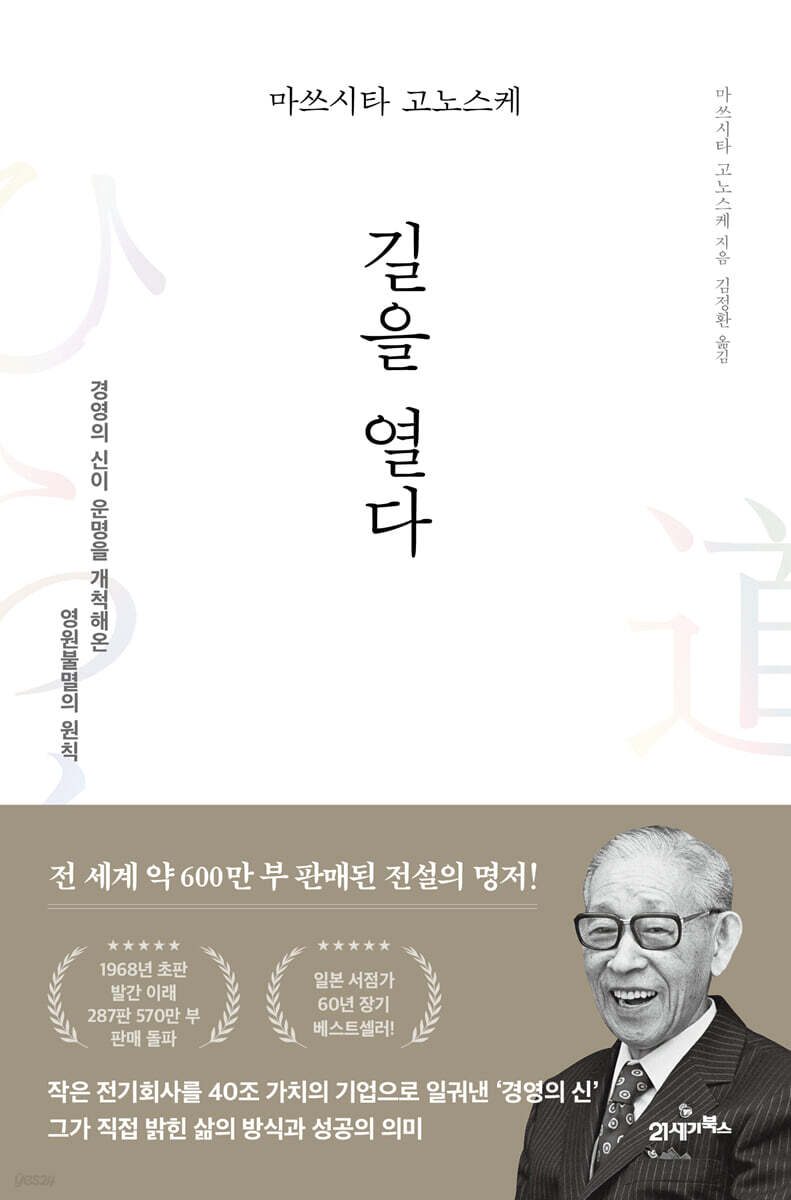
Konosuke Matsushita opens the way
 |
Description
Book Introduction
“The essence of life lies not in flashy success, but in the sincere steps of each day.”
An immortal classic that has sold 6 million copies worldwide over 60 years since its first publication.
A long-term steady seller that ranked 2nd in all-time bestseller lists in Japanese bookstores!
The book that became the original text of the philosophy of Konosuke Matsushita, the "God of Management."
21st Century Books publishes Korea's first complete translation.
『Matsushita Konosuke Opens the Way』 (original title: 道をひらく), which has been consistently loved for over 60 years since its first publication in 1968, is now being presented in a complete translation in Korea for the first time.
This Korean edition, published by 21st Century Books, is a faithful translation of the original text published by the Japanese publisher PHP Research Institute. It is a definitive edition that eliminates the regret of having lost the original text's simple and solid flavor due to excessive editing and adaptation that significantly altered the original sentences.
This complete translation is significant in that it conveys Matsushita's language as accurately as possible, fully conveying the author's voice.
"Matsushita Konosuke Opens the Way" is an immortal bestseller that has been reprinted over 287 times in Japan alone, selling a cumulative 5.7 million copies.
Since its publication, it has consistently appeared on the bestseller lists of Japanese bookstores, and in 2014, it sold over 5.11 million copies, ranking second in the postwar bestseller single volume/new book category.
This book, which has been considered a "book to use as a motto" for all generations from those in their 20s to those in their 60s and has established itself as a book of life philosophy that spans generations, can be said to be a national classic that has been used as a compass in life by a wide range of readers, from businesspeople to ordinary office workers, students, and housewives.
This book is a compilation of 121 short essays written by Matsushita himself on the front lines of management, emphasizing his attitude and mindset in everyday life.
He says, “The essence of life is not in flashy success, but in the sincere steps we take each day,” and he conveys the strength to overcome crises and frustrations, the courage to maintain trust with people, and the philosophy of growing together with society.
The anecdote of how the company survived without a single layoff even during turbulent times such as the Great Depression, the post-war defeat, and the oil shock is the reason why "Konosuke Matsushita Opens the Way" is read as a textbook on life and management rather than a simple self-help book.
John Kotter, a professor at Harvard Business School, described Matsushita as “a once-in-a-millennium kind of person.”
His philosophy goes beyond the legacy of a simple entrepreneur; it remains a principle that remains relevant even in today's chaotic times.
"Matsushita Konosuke Opens the Way" is a book that encapsulates these very principles: sincerity, trust, responsibility, and coexistence. With the publication of this complete translation, it will be reread by Korean readers as a classic that questions the essence of life and management.
An immortal classic that has sold 6 million copies worldwide over 60 years since its first publication.
A long-term steady seller that ranked 2nd in all-time bestseller lists in Japanese bookstores!
The book that became the original text of the philosophy of Konosuke Matsushita, the "God of Management."
21st Century Books publishes Korea's first complete translation.
『Matsushita Konosuke Opens the Way』 (original title: 道をひらく), which has been consistently loved for over 60 years since its first publication in 1968, is now being presented in a complete translation in Korea for the first time.
This Korean edition, published by 21st Century Books, is a faithful translation of the original text published by the Japanese publisher PHP Research Institute. It is a definitive edition that eliminates the regret of having lost the original text's simple and solid flavor due to excessive editing and adaptation that significantly altered the original sentences.
This complete translation is significant in that it conveys Matsushita's language as accurately as possible, fully conveying the author's voice.
"Matsushita Konosuke Opens the Way" is an immortal bestseller that has been reprinted over 287 times in Japan alone, selling a cumulative 5.7 million copies.
Since its publication, it has consistently appeared on the bestseller lists of Japanese bookstores, and in 2014, it sold over 5.11 million copies, ranking second in the postwar bestseller single volume/new book category.
This book, which has been considered a "book to use as a motto" for all generations from those in their 20s to those in their 60s and has established itself as a book of life philosophy that spans generations, can be said to be a national classic that has been used as a compass in life by a wide range of readers, from businesspeople to ordinary office workers, students, and housewives.
This book is a compilation of 121 short essays written by Matsushita himself on the front lines of management, emphasizing his attitude and mindset in everyday life.
He says, “The essence of life is not in flashy success, but in the sincere steps we take each day,” and he conveys the strength to overcome crises and frustrations, the courage to maintain trust with people, and the philosophy of growing together with society.
The anecdote of how the company survived without a single layoff even during turbulent times such as the Great Depression, the post-war defeat, and the oil shock is the reason why "Konosuke Matsushita Opens the Way" is read as a textbook on life and management rather than a simple self-help book.
John Kotter, a professor at Harvard Business School, described Matsushita as “a once-in-a-millennium kind of person.”
His philosophy goes beyond the legacy of a simple entrepreneur; it remains a principle that remains relevant even in today's chaotic times.
"Matsushita Konosuke Opens the Way" is a book that encapsulates these very principles: sincerity, trust, responsibility, and coexistence. With the publication of this complete translation, it will be reread by Korean readers as a classic that questions the essence of life and management.
- You can preview some of the book's contents.
Preview
index
Entering
Chapter 1: To Forge Your Own Destiny
The path given only to you | Accept and live as it is | Set your intentions and move forward | Walk cautiously, as if groping with your hands | Follow the laws of nature | Respect the various forms of life | Life is a battle of wits | When you can't avoid it, just move forward | A matter that transcends right and wrong | Willingly accept illness | Prepare for both life and death
Chapter 2 To start a new day
Greet each day anew | Practice broadening your perspective | Reflect on yourself in your surroundings | Do your best | Remember that rain can fall at any time | Be prepared for three changes a day | Ask, "Why?" | Be like a flower that blooms proudly | Live out your unique characteristics | Fear a life without thinking
Chapter 3: For a Life Together
Remember the power of connection | Greetings are lubricants | Share what you have as much as possible | Embrace both strengths and weaknesses | Why patience and tolerance are important | How to save each other | Recognize your responsibility | Accept sincere rebuke | What only humans can do | What a person is ignorant of the ways of the world | The more we share our hearts, the more strength we gain.
Chapter 4: Standing at the Moment of Decision
Make a decision first | Listen first and then give instructions | Fear not being able to cooperate more than wavering | The power to judge and execute | Do not be obsessed with small immediate gains | Not having a plan is a plan | The power to cut off the breath | The ability to be sensitive | A different perspective is a treasure of the world | Repeatedly ask yourself and answer questions | Push forward persistently | Do not be ashamed of worrying
Chapter 5: Overcoming Difficulties
Welcome worry | A heart that waits for the right time | The thoughts needed when standing at a crossroads of hardship | Don't be troubled even when things are difficult | Understand the light and dark sides of the world | The difference between those who consider work a competition and those who don't | The virtue of patience
Chapter 6: When you want to regain your confidence
Even if you fall, you can't get up without gaining something | Is it failure or success? | Everything is just a sheet of paper apart | The attitude you should have instead of absolute certainty | You must always make up your mind | The mind to do your best | You must not be rigid | You must follow the ways of the world | Don't rely on the wisdom of one person | After winter, spring eventually comes.
Chapter 7 To improve work performance
Where does 'my work' end? | Always consider how you work | Be careful, meticulous, and fast | In the end, finishing is everything | Grasp the flag first | Follow along tenaciously like a child | The power to attract results | What's more important than the success or failure of work | Don't neglect even the smallest details to avoid collapse | Awareness of being a professional
Chapter 8 To Grow Your Business
Change your perspective | The nobility of business | How to achieve success | What it means to have fans | Greet with both hands | The power of small things | Learn from your enemies | Deliberately jump into risky endeavors | Be passionate | Work as if you were running a branch | Same money, different values | Follow through to the end
Chapter 9: To live with an independent attitude
Learn on your own | Break free from self-centered thinking | Do not be content with your natural environment | A fearless life is more dangerous | This is not the time to sit still | Remember the turbulent times, especially in times of prosperity | Cherish your work | Start by knowing yourself | Once again with a sense of urgency | Return to your normal state of mind | It comes back to you in circles | You must teach to grow | You must learn from everything | The path lies in the most ordinary places | Why you must have a respectful heart | Think of other people's business as your own
Chapter 10: To Live a Rewarding Life
Face the truth | People are tempered like washed potatoes | You can get through the end of the year, but you can't get through the end of life | Acknowledge and take responsibility | Virtue comes from diligence | Wisdom also has its limits | Things to know before imitating | Elevate your spirit | The greatness of experience | Break through
Chapter 11: To Create a Better Country
Opening the way for the nation | Are you prepared? | The foundation of all work is belief | To prosper, think of it as your own work | Between peace and war | Can be resolved through conversation | Realize quickly | What is politics? | Aren't you expecting too much? | Serve the public | A mindset like a dam | Thinking of a good nation
Author's chronology
Chapter 1: To Forge Your Own Destiny
The path given only to you | Accept and live as it is | Set your intentions and move forward | Walk cautiously, as if groping with your hands | Follow the laws of nature | Respect the various forms of life | Life is a battle of wits | When you can't avoid it, just move forward | A matter that transcends right and wrong | Willingly accept illness | Prepare for both life and death
Chapter 2 To start a new day
Greet each day anew | Practice broadening your perspective | Reflect on yourself in your surroundings | Do your best | Remember that rain can fall at any time | Be prepared for three changes a day | Ask, "Why?" | Be like a flower that blooms proudly | Live out your unique characteristics | Fear a life without thinking
Chapter 3: For a Life Together
Remember the power of connection | Greetings are lubricants | Share what you have as much as possible | Embrace both strengths and weaknesses | Why patience and tolerance are important | How to save each other | Recognize your responsibility | Accept sincere rebuke | What only humans can do | What a person is ignorant of the ways of the world | The more we share our hearts, the more strength we gain.
Chapter 4: Standing at the Moment of Decision
Make a decision first | Listen first and then give instructions | Fear not being able to cooperate more than wavering | The power to judge and execute | Do not be obsessed with small immediate gains | Not having a plan is a plan | The power to cut off the breath | The ability to be sensitive | A different perspective is a treasure of the world | Repeatedly ask yourself and answer questions | Push forward persistently | Do not be ashamed of worrying
Chapter 5: Overcoming Difficulties
Welcome worry | A heart that waits for the right time | The thoughts needed when standing at a crossroads of hardship | Don't be troubled even when things are difficult | Understand the light and dark sides of the world | The difference between those who consider work a competition and those who don't | The virtue of patience
Chapter 6: When you want to regain your confidence
Even if you fall, you can't get up without gaining something | Is it failure or success? | Everything is just a sheet of paper apart | The attitude you should have instead of absolute certainty | You must always make up your mind | The mind to do your best | You must not be rigid | You must follow the ways of the world | Don't rely on the wisdom of one person | After winter, spring eventually comes.
Chapter 7 To improve work performance
Where does 'my work' end? | Always consider how you work | Be careful, meticulous, and fast | In the end, finishing is everything | Grasp the flag first | Follow along tenaciously like a child | The power to attract results | What's more important than the success or failure of work | Don't neglect even the smallest details to avoid collapse | Awareness of being a professional
Chapter 8 To Grow Your Business
Change your perspective | The nobility of business | How to achieve success | What it means to have fans | Greet with both hands | The power of small things | Learn from your enemies | Deliberately jump into risky endeavors | Be passionate | Work as if you were running a branch | Same money, different values | Follow through to the end
Chapter 9: To live with an independent attitude
Learn on your own | Break free from self-centered thinking | Do not be content with your natural environment | A fearless life is more dangerous | This is not the time to sit still | Remember the turbulent times, especially in times of prosperity | Cherish your work | Start by knowing yourself | Once again with a sense of urgency | Return to your normal state of mind | It comes back to you in circles | You must teach to grow | You must learn from everything | The path lies in the most ordinary places | Why you must have a respectful heart | Think of other people's business as your own
Chapter 10: To Live a Rewarding Life
Face the truth | People are tempered like washed potatoes | You can get through the end of the year, but you can't get through the end of life | Acknowledge and take responsibility | Virtue comes from diligence | Wisdom also has its limits | Things to know before imitating | Elevate your spirit | The greatness of experience | Break through
Chapter 11: To Create a Better Country
Opening the way for the nation | Are you prepared? | The foundation of all work is belief | To prosper, think of it as your own work | Between peace and war | Can be resolved through conversation | Realize quickly | What is politics? | Aren't you expecting too much? | Serve the public | A mindset like a dam | Thinking of a good nation
Author's chronology
Into the book
There is a path given only to you.
There is a noble path given by heaven.
I don't know what kind of road it is, but it is a road that no one else can walk.
It is a precious path that only you can walk, and that you cannot walk twice.
The road is sometimes wide and sometimes narrow.
There are uphill roads and downhill roads.
Sometimes it's smooth, but there are also times when you have to sweat and struggle to get through.
There will be times when you can't tell if this path is right or wrong, and there will be times when you want to seek solace.
But in the end, isn't this the only way?
I'm not saying give up.
This path you are standing on now, this path you are walking on now, in any case, you must walk this path without stopping.
Isn't this a precious path that only you can walk? A one-of-a-kind path given only to you?
--- p.16~18, from “The Path Given Only to You”
When it rains, I use an umbrella.
If you don't have an umbrella, cover yourself with a blanket.
Without that, you'll just end up getting wet.
If you don't have an umbrella on a rainy day, it's because you let your guard down and didn't prepare an umbrella when the weather was clear.
It's only when you get wet in the rain that you realize you need an umbrella.
And then, the next time it rains, I promise myself that I will prepare an umbrella so I don't get wet, and when the rain stops, I decide to put everything else aside and prepare an umbrella first.
This is also one of life's lessons.
(···) If you don't have an umbrella, getting wet once is inevitable.
Just wait for the rain to stop and don't forget to prepare so you don't get wet again.
An umbrella is very important when it rains, when working, and when living life.
--- p.53~54, from “Don’t forget that it can rain at any time”
If I forget that my work is actually the work of the world, it becomes ambition and petty self-satisfaction.
The world decides whether your performance will grow or not.
You just have to naturally increase your performance as the world wants.
The important thing is to do what the world asks of you with sincerity, humility, and diligence.
It is about diligently responding to the demands of the world.
I hope everyone never forgets the meaning of what they do.
--- p.171, from “How far does ‘my work’ go?”
In fact, we derive many benefits from those whom we perceive as enemies who block our path.
If the other person does this, I will do this, if this happens, I will respond like this, I think, racking my brains and thinking about this and that.
And it gradually develops.
You may think you are thinking on your own, but in reality you are being taught by others.
They are being stimulated by the other person and are squeezing out their wisdom.
In short, you could say that you are being taught by the enemy.
--- p.209~210, from “Learning from the Enemy”
A person directs another person to do something.
But if you just give instructions and that's it, or if you just ask for something and that's it, it's meaningless.
No results are achieved.
Once you have given your order, you must follow it.
We must track it thoroughly to the end.
That would be the responsible attitude of the person who gave the order.
It may not be easy for the person being tracked, but it is actually very difficult for the person doing the tracking.
More consideration is needed than just tracking the rocket.
Persistence is required.
But if you don't, you can easily end up spending each day vaguely.
Both the pursuer and the pursued must have this level of determination and courage.
There is a noble path given by heaven.
I don't know what kind of road it is, but it is a road that no one else can walk.
It is a precious path that only you can walk, and that you cannot walk twice.
The road is sometimes wide and sometimes narrow.
There are uphill roads and downhill roads.
Sometimes it's smooth, but there are also times when you have to sweat and struggle to get through.
There will be times when you can't tell if this path is right or wrong, and there will be times when you want to seek solace.
But in the end, isn't this the only way?
I'm not saying give up.
This path you are standing on now, this path you are walking on now, in any case, you must walk this path without stopping.
Isn't this a precious path that only you can walk? A one-of-a-kind path given only to you?
--- p.16~18, from “The Path Given Only to You”
When it rains, I use an umbrella.
If you don't have an umbrella, cover yourself with a blanket.
Without that, you'll just end up getting wet.
If you don't have an umbrella on a rainy day, it's because you let your guard down and didn't prepare an umbrella when the weather was clear.
It's only when you get wet in the rain that you realize you need an umbrella.
And then, the next time it rains, I promise myself that I will prepare an umbrella so I don't get wet, and when the rain stops, I decide to put everything else aside and prepare an umbrella first.
This is also one of life's lessons.
(···) If you don't have an umbrella, getting wet once is inevitable.
Just wait for the rain to stop and don't forget to prepare so you don't get wet again.
An umbrella is very important when it rains, when working, and when living life.
--- p.53~54, from “Don’t forget that it can rain at any time”
If I forget that my work is actually the work of the world, it becomes ambition and petty self-satisfaction.
The world decides whether your performance will grow or not.
You just have to naturally increase your performance as the world wants.
The important thing is to do what the world asks of you with sincerity, humility, and diligence.
It is about diligently responding to the demands of the world.
I hope everyone never forgets the meaning of what they do.
--- p.171, from “How far does ‘my work’ go?”
In fact, we derive many benefits from those whom we perceive as enemies who block our path.
If the other person does this, I will do this, if this happens, I will respond like this, I think, racking my brains and thinking about this and that.
And it gradually develops.
You may think you are thinking on your own, but in reality you are being taught by others.
They are being stimulated by the other person and are squeezing out their wisdom.
In short, you could say that you are being taught by the enemy.
--- p.209~210, from “Learning from the Enemy”
A person directs another person to do something.
But if you just give instructions and that's it, or if you just ask for something and that's it, it's meaningless.
No results are achieved.
Once you have given your order, you must follow it.
We must track it thoroughly to the end.
That would be the responsible attitude of the person who gave the order.
It may not be easy for the person being tracked, but it is actually very difficult for the person doing the tracking.
More consideration is needed than just tracking the rocket.
Persistence is required.
But if you don't, you can easily end up spending each day vaguely.
Both the pursuer and the pursued must have this level of determination and courage.
--- p.220, from "Track to the End"
Publisher's Review
“The secret of my success is that I was born poor, weak, and uneducated!
Reading the original text of Konosuke Matsushita's thought: A record of a man who pioneered life.
Konosuke Matsushita is a figure who left an unprecedented mark on Japanese economic history and world management history.
The journey of a poor boy who couldn't even finish elementary school to found an electrical appliance manufacturing company and grow it into the global company Panasonic is not just a success story, but a vivid testimony that reveals the essence of management and life.
His philosophy, which declared that “a company is a place where people are created,” demonstrates a unique perspective that views companies not simply as a place for profit-seeking, but as a community that prospers together with society.
His actions, which overcame numerous crises, including the Great Depression and the oil shock, are a vivid example of the management philosophy that the essence of a business is revealed only in times of crisis.
"Konosuke Matsushita Opens the Way" is not a simple management technique book or success story, but a book that organizes the difficulties and reflections the author personally experienced in the form of short essays. It is considered to be Konosuke Matsushita's representative work and the original source of his philosophy and thoughts.
As a man who overcame the disadvantages of being an elementary school dropout, having a weak constitution, and coming from a poor family to build the world-class company Panasonic, his writing is filled with vivid experiences of navigating life.
In the book, he candidly describes his failures, frustrations, conflicts in interpersonal relationships, and the sense of responsibility and weight he feels while running an organization.
The title, “Konosuke Matsushita Opens the Way,” encapsulates the author’s lifelong philosophy.
Opening the way is not about blaming external circumstances or shifting responsibility to others, but about cultivating one's own inner attitude and mindset.
Matsushita emphasizes that life is a series of daily choices, and that those who faithfully build up those small steps can ultimately open the path to the future.
This message remains powerful not only during Japan's period of rapid economic growth, but also in today's uncertain times.
In fact, he managed to keep the company going without laying off a single employee even during turbulent times such as the Great Depression, the post-war defeat, and the oil shock.
This proves that his writings are not mere idealism, but wisdom derived from practice and experience.
This is why Harvard Business School professor John Kotter described him as “a once-in-a-millennium person.”
Beyond the life of a business leader, "Konosuke Matsushita: Opening the Way" is a rare record that shows how one person can overcome the changing times and pioneer a new path.
Through the book, we can directly encounter the inner self of a person who, even in the face of crisis, remained steadfast and maintained his own principles.
It was the sincere steps that created the god of management.
A book that young people take out when they are worried about their career path, when office workers are frustrated, and when managers face a crisis.
Why Japanese Readers Call This Book "A Motto Book"
“Matsushita Konosuke Opens the Way” still sells 70,000 to 80,000 copies every year.
It is famous as a book to give as a gift to children at the end of the year and the new year to cheer on a new beginning or to graduate.
PHP Research Institute, a publisher, regularly announces book sales figures on its website, and recently surpassed 5.7 million copies.
The biggest reason this book has been loved for decades is its accessibility.
Not only is it a collection of short essays of just a few pages easy to read, but it also uses Konosuke Matsushita's characteristically spoken style to describe situations that anyone can experience in their daily lives in a short and concise manner.
Thanks to this, even busy office workers and students can take a moment to read it, and they can gain sufficient insight by simply opening it to the desired section when needed.
This is why it has become a 'book to use as a motto' that many people keep next to their desks and read whenever they need advice on life.
The content also deals with life topics that anyone can relate to, from business executives to those just starting out in society, housewives, and the elderly.
Topics like responsibility and integrity, human relationships, failure and growth have universality that transcends generations.
So, this book has become a national classic in Japan, and is also considered a life bible by leaders across the sea in Korea.
Matsushita always emphasized that “the essence of life is not in flashy success, but in the sincere steps taken every day.”
This concise message runs through the entire book.
His language is not difficult, but it has the power to discover new meaning every time you read it.
This book goes beyond a simple self-help book and functions as a "life companion" in that the more you read it, the more answers will emerge that are tailored to your own situation.
As in Japan, it will serve as a reliable guide that can be easily drawn upon at any time when young people are worried about their career paths, when office workers are frustrated, or when managers face a crisis.
Konosuke Matsushita, the 'God of Management' who turned the impossible into possible
11 Paths to Success He Discovered in His Life
A guide still relevant today, providing solutions across generations in times of crisis.
The significance of “Opening the Way for Konosuke Matsushita” goes beyond simply being a long-selling book.
In modern history, which has experienced countless upheavals, from economic reconstruction in the aftermath of war, to high growth, the bubble economy and its collapse, and finally the "lost 30 years," the question of how individuals and businesses should live and how they should fulfill their responsibilities has always been a crucial topic.
Each time, “Matsushita Konosuke Opens the Way” became the book that answered this very question.
The concept of 'the path given to oneself' in the book is not a simple fatalism, but rather an attitude of recognizing one's role and mission as a member of society and fulfilling one's responsibility.
This idea was intertwined with the corporate organizational culture and had a great influence.
In fact, "Konosuke Matsushita Opens the Way" has been used as a textbook in many corporate training settings, and countless managers have cited it when explaining their own philosophies.
The book has also been frequently featured in the media and popular culture. It has been cited numerous times in TV programs, lectures, and magazine articles, and has been hailed as a "must-read" book.
There are also many reviews on Amazon Japan, such as, “I read one chapter a day to calm my mind,” and “This is a book that parents give to their children, and seniors give to their juniors.”
Thanks to this cultural diffusion, "Matsushita Konosuke Opens the Way" has become a medium for social interaction beyond a simple personal reading experience.
The message conveyed in "Konosuke Matsushita Opens the Way" is a guide that encompasses life and management, individuals and communities.
Despite the changing times, it has served as an unwavering compass, and has been read as a 'book to be read and reflected on' by every generation.
When you feel lost amidst fierce competition, rapid change, and an uncertain future, this book provides the strength to return to basics.
Matsushita's message, emphasizing everyday choices, small steps, and consideration for others, offers wisdom applicable anywhere, anytime, and profound insights that resonate with everyone.
Readers of this book will gain a solid advisor who will guide them through difficult moments on life's journey, and through small actions, they will be able to pioneer a more meaningful life.
Reading the original text of Konosuke Matsushita's thought: A record of a man who pioneered life.
Konosuke Matsushita is a figure who left an unprecedented mark on Japanese economic history and world management history.
The journey of a poor boy who couldn't even finish elementary school to found an electrical appliance manufacturing company and grow it into the global company Panasonic is not just a success story, but a vivid testimony that reveals the essence of management and life.
His philosophy, which declared that “a company is a place where people are created,” demonstrates a unique perspective that views companies not simply as a place for profit-seeking, but as a community that prospers together with society.
His actions, which overcame numerous crises, including the Great Depression and the oil shock, are a vivid example of the management philosophy that the essence of a business is revealed only in times of crisis.
"Konosuke Matsushita Opens the Way" is not a simple management technique book or success story, but a book that organizes the difficulties and reflections the author personally experienced in the form of short essays. It is considered to be Konosuke Matsushita's representative work and the original source of his philosophy and thoughts.
As a man who overcame the disadvantages of being an elementary school dropout, having a weak constitution, and coming from a poor family to build the world-class company Panasonic, his writing is filled with vivid experiences of navigating life.
In the book, he candidly describes his failures, frustrations, conflicts in interpersonal relationships, and the sense of responsibility and weight he feels while running an organization.
The title, “Konosuke Matsushita Opens the Way,” encapsulates the author’s lifelong philosophy.
Opening the way is not about blaming external circumstances or shifting responsibility to others, but about cultivating one's own inner attitude and mindset.
Matsushita emphasizes that life is a series of daily choices, and that those who faithfully build up those small steps can ultimately open the path to the future.
This message remains powerful not only during Japan's period of rapid economic growth, but also in today's uncertain times.
In fact, he managed to keep the company going without laying off a single employee even during turbulent times such as the Great Depression, the post-war defeat, and the oil shock.
This proves that his writings are not mere idealism, but wisdom derived from practice and experience.
This is why Harvard Business School professor John Kotter described him as “a once-in-a-millennium person.”
Beyond the life of a business leader, "Konosuke Matsushita: Opening the Way" is a rare record that shows how one person can overcome the changing times and pioneer a new path.
Through the book, we can directly encounter the inner self of a person who, even in the face of crisis, remained steadfast and maintained his own principles.
It was the sincere steps that created the god of management.
A book that young people take out when they are worried about their career path, when office workers are frustrated, and when managers face a crisis.
Why Japanese Readers Call This Book "A Motto Book"
“Matsushita Konosuke Opens the Way” still sells 70,000 to 80,000 copies every year.
It is famous as a book to give as a gift to children at the end of the year and the new year to cheer on a new beginning or to graduate.
PHP Research Institute, a publisher, regularly announces book sales figures on its website, and recently surpassed 5.7 million copies.
The biggest reason this book has been loved for decades is its accessibility.
Not only is it a collection of short essays of just a few pages easy to read, but it also uses Konosuke Matsushita's characteristically spoken style to describe situations that anyone can experience in their daily lives in a short and concise manner.
Thanks to this, even busy office workers and students can take a moment to read it, and they can gain sufficient insight by simply opening it to the desired section when needed.
This is why it has become a 'book to use as a motto' that many people keep next to their desks and read whenever they need advice on life.
The content also deals with life topics that anyone can relate to, from business executives to those just starting out in society, housewives, and the elderly.
Topics like responsibility and integrity, human relationships, failure and growth have universality that transcends generations.
So, this book has become a national classic in Japan, and is also considered a life bible by leaders across the sea in Korea.
Matsushita always emphasized that “the essence of life is not in flashy success, but in the sincere steps taken every day.”
This concise message runs through the entire book.
His language is not difficult, but it has the power to discover new meaning every time you read it.
This book goes beyond a simple self-help book and functions as a "life companion" in that the more you read it, the more answers will emerge that are tailored to your own situation.
As in Japan, it will serve as a reliable guide that can be easily drawn upon at any time when young people are worried about their career paths, when office workers are frustrated, or when managers face a crisis.
Konosuke Matsushita, the 'God of Management' who turned the impossible into possible
11 Paths to Success He Discovered in His Life
A guide still relevant today, providing solutions across generations in times of crisis.
The significance of “Opening the Way for Konosuke Matsushita” goes beyond simply being a long-selling book.
In modern history, which has experienced countless upheavals, from economic reconstruction in the aftermath of war, to high growth, the bubble economy and its collapse, and finally the "lost 30 years," the question of how individuals and businesses should live and how they should fulfill their responsibilities has always been a crucial topic.
Each time, “Matsushita Konosuke Opens the Way” became the book that answered this very question.
The concept of 'the path given to oneself' in the book is not a simple fatalism, but rather an attitude of recognizing one's role and mission as a member of society and fulfilling one's responsibility.
This idea was intertwined with the corporate organizational culture and had a great influence.
In fact, "Konosuke Matsushita Opens the Way" has been used as a textbook in many corporate training settings, and countless managers have cited it when explaining their own philosophies.
The book has also been frequently featured in the media and popular culture. It has been cited numerous times in TV programs, lectures, and magazine articles, and has been hailed as a "must-read" book.
There are also many reviews on Amazon Japan, such as, “I read one chapter a day to calm my mind,” and “This is a book that parents give to their children, and seniors give to their juniors.”
Thanks to this cultural diffusion, "Matsushita Konosuke Opens the Way" has become a medium for social interaction beyond a simple personal reading experience.
The message conveyed in "Konosuke Matsushita Opens the Way" is a guide that encompasses life and management, individuals and communities.
Despite the changing times, it has served as an unwavering compass, and has been read as a 'book to be read and reflected on' by every generation.
When you feel lost amidst fierce competition, rapid change, and an uncertain future, this book provides the strength to return to basics.
Matsushita's message, emphasizing everyday choices, small steps, and consideration for others, offers wisdom applicable anywhere, anytime, and profound insights that resonate with everyone.
Readers of this book will gain a solid advisor who will guide them through difficult moments on life's journey, and through small actions, they will be able to pioneer a more meaningful life.
GOODS SPECIFICS
- Date of issue: October 22, 2025
- Format: Hardcover book binding method guide
- Page count, weight, size: 320 pages | 416g | 128*188*23mm
- ISBN13: 9791173575068
- ISBN10: 1173575065
You may also like
카테고리
korean


korean

![GQ KOREA Mark (Monthly): December [2025]](http://librairie.coreenne.fr/cdn/shop/files/8ef265dbbfbf186523ed75ba7319009d.jpg?v=1765340328&width=3840)


