

Semiconductor Odyssey
 |
Description
Book Introduction
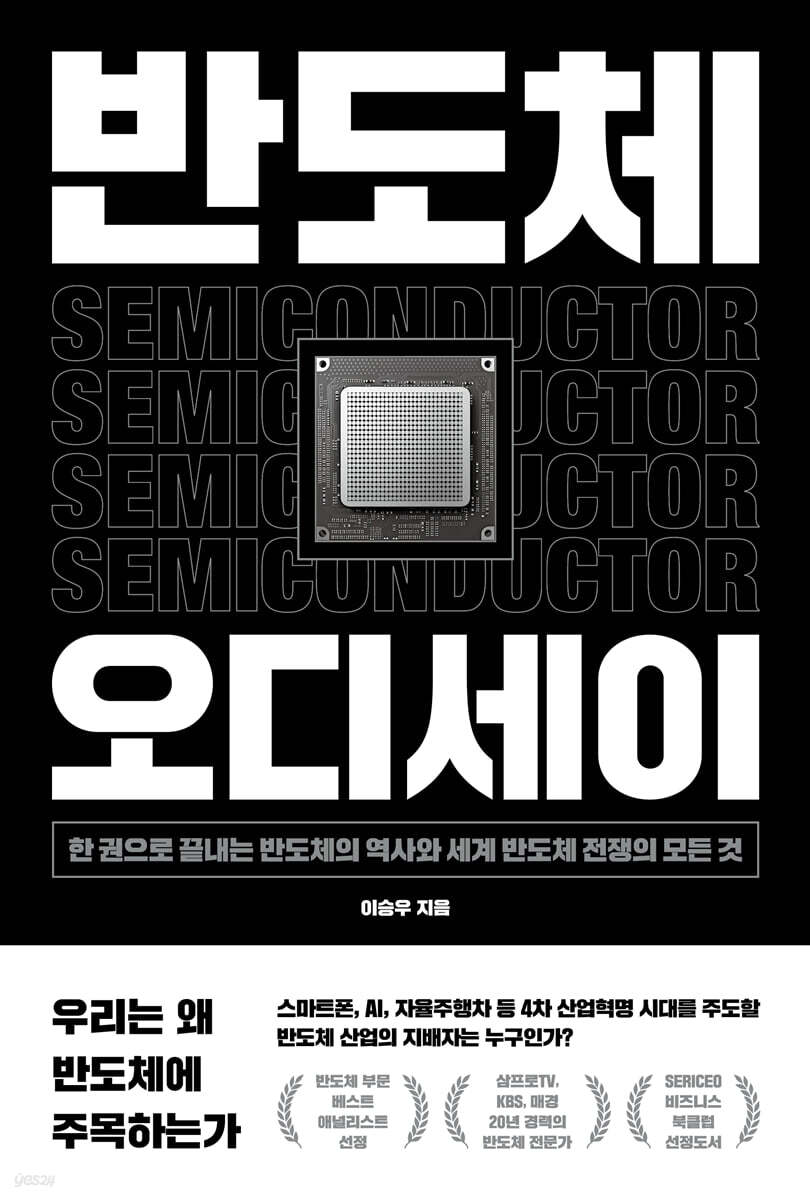
An epic tale connecting computers, semiconductors, and artificial intelligence. Hear from a semiconductor expert with 23 years of experience about the semiconductor industry from A to Z. This is the first solo book by analyst Seungwoo Lee, who is renowned for providing a three-dimensional analysis of the semiconductor industry through his diverse experience in engineering and management, sell-side and buy-side, and as head of two research centers. It tells, like an entertaining epic, the story of humanity's journey leading up to the birth of tiny chips called semiconductors, and the people who wrote new history amidst technological advancements. As you follow the stories of the people who invented computers through curiosity and intellectual exploration, you will naturally come across stories about the semiconductor manufacturing process. You can find concise and clear explanations of how silicon, the main raw material, is transformed into an integrated circuit that conducts electricity, what supervision is required to make a semiconductor a finished product with perfect function, and which companies are responsible for each of these design and manufacturing processes. We also examine the current global situation surrounding semiconductors, the flower of human civilization and a strategic resource for the 21st century. This book clearly conveys the US semiconductor industry strategy, the changing relationship with Japan and China, and the process by which Korea emerged as a semiconductor powerhouse. You can also learn about the sharp analysis and evaluation of a semiconductor expert analyst who objectively assesses the international standing and current status of the Korean semiconductor industry and suggests a direction for the future. Semiconductors are also essential for AI technology, a hot topic today. Who will be the key players in this new era of the Fourth Industrial Revolution? This book, which explores the development and industrial structure of semiconductors from various perspectives, will broaden experts and entrepreneurs' holistic perspective on the industry, while also providing investors with a keen eye for investing in the semiconductor sector. |
- You can preview some of the book's contents.
Preview
index
Prologue: The Flower of Human Civilization Built on the Fusion of Knowledge
Part 1: The Evolution of Civilization: From Carillon to Transistor
1.
History of mechanical calculators
2.
What do the protagonist and Napoleon have to do with computers?
3.
Charles Babbage and Ada Lovelace
4.
The rapidly growing population and the statistical machine
5.
The secrets of electricity and magnetism are finally revealed.
6.
The discovery of another universe within the atom
7.
The emergence of electronic computers
8.
The Spark of Innovation: The Birth of the Transistor and IC
9.
Tigers leave their skins, people leave their data.
10.
Turing's Short Life and Not-So-Short Achievements
11.
Von Neumann with alien intelligence
12.
Korean legend Dr. Kang Dae-won
Part 2: Semiconductor Manufacturing Processes: The Magic of Silicon Alchemy
13.
Semiconductor Manufacturing Process Overview
14.
Circuit Design - Preparing for Semiconductor Manufacturing
15.
Wafer - A Canvas for Building Transistor Cities
16.
Oxidation process - silicon surface enhancement work
17.
Photolithography - The Art of the Dance of Light
18. EUV - Light Born at the End of a Photon
19.
Etching Processes - Carving the Soul of Silicon
20.
Deposition process - deposition at the atomic and molecular level
21.
Wiring Process - Building Highways Between Transistors
22.
Ion Implantation - Bringing Semiconductors to Life
23.
Measurement/Inspection - Supervision for Integrity and Reliability
24. EDS, assembly, packaging
Part 3: Giants of the Silicon Age
25.
William Shockley - Silicon Valley's creator and worst manager
26.
Intel - Where did all those aliens go?
27.
Cyrix - The CPU fabless company that almost became the next AMD
28.
Micron - From Potato King to Silicon King
29.
Steve Appleton - The Fearless Superhero
30.
Apple - Seems like a semiconductor company, but maybe not.
31.
Jim Keller - Legendary Semiconductor Mercenary
32.
Texas Instruments - The Ruler of Analog
33.
Motorola - A pioneer in wireless and semiconductors
34. NEC - The History of Japanese Semiconductors: Blooming Like Cherry Blossoms
35. ASML - Only One, Beyond Number One
36. TSMC - We don't compete with our customers.
37.
NVIDIA - The New Leader of the AI Stage
38. AMD - A company rescued from the swamp
39.
The Story of Jensen Huang and Lisa Su
40.
Broadcom - Beyond Chips, to Software and Networks
41. The history of competition between CISC and RISC
42.
Korea's semiconductor pioneers
43.
Samsung Electronics - Standing at a Crossroads on the 40th Anniversary of the Tokyo Declaration
Part 4: Hegemonic Competition Surrounding Strategic Resources
44.
Strategic Resources in History
45.
Semiconductors, a strategic resource of the 21st century
46.
The Rise of Japanese Semiconductors and US Anxiety
47.
The butterfly effect caused by air bubbles in the screw
48.
The Plaza Accord and the US-Japan Semiconductor Agreement
49.
A Tango of Turmoil: The Changing Relations between the US and China
50.
China's Semiconductor Rise: A System of Unsolvable Equations
51.
A world of each for himself
Part 5: Artificial Intelligence Odyssey
52.
From Talos to Mechanical Turks
53.
From Deep Blue to AlphaGo
54.
Machine learning and deep learning
55. New Stars on the AI Stage
56.
AI semiconductors, the vessel that holds artificial intelligence
Part 6: The Semiconductor Industry in a Four-Dimensional Maze
57.
The Inconvenient Truth About Semiconductors
58. History and Characteristics of the DRAM Cycle
59.
Correlation between stock price and performance
60.
Why Semiconductor Investors Should Watch Louis Vuitton's Performance
61.
Semiconductor M&A - How to Gather Stars to Create a Constellation
Appendix
Main characters
Key chronology
Domestic semiconductor sector listed companies
Chinese semiconductor sector listed companies
Summary of major companies by process
Part 1: The Evolution of Civilization: From Carillon to Transistor
1.
History of mechanical calculators
2.
What do the protagonist and Napoleon have to do with computers?
3.
Charles Babbage and Ada Lovelace
4.
The rapidly growing population and the statistical machine
5.
The secrets of electricity and magnetism are finally revealed.
6.
The discovery of another universe within the atom
7.
The emergence of electronic computers
8.
The Spark of Innovation: The Birth of the Transistor and IC
9.
Tigers leave their skins, people leave their data.
10.
Turing's Short Life and Not-So-Short Achievements
11.
Von Neumann with alien intelligence
12.
Korean legend Dr. Kang Dae-won
Part 2: Semiconductor Manufacturing Processes: The Magic of Silicon Alchemy
13.
Semiconductor Manufacturing Process Overview
14.
Circuit Design - Preparing for Semiconductor Manufacturing
15.
Wafer - A Canvas for Building Transistor Cities
16.
Oxidation process - silicon surface enhancement work
17.
Photolithography - The Art of the Dance of Light
18. EUV - Light Born at the End of a Photon
19.
Etching Processes - Carving the Soul of Silicon
20.
Deposition process - deposition at the atomic and molecular level
21.
Wiring Process - Building Highways Between Transistors
22.
Ion Implantation - Bringing Semiconductors to Life
23.
Measurement/Inspection - Supervision for Integrity and Reliability
24. EDS, assembly, packaging
Part 3: Giants of the Silicon Age
25.
William Shockley - Silicon Valley's creator and worst manager
26.
Intel - Where did all those aliens go?
27.
Cyrix - The CPU fabless company that almost became the next AMD
28.
Micron - From Potato King to Silicon King
29.
Steve Appleton - The Fearless Superhero
30.
Apple - Seems like a semiconductor company, but maybe not.
31.
Jim Keller - Legendary Semiconductor Mercenary
32.
Texas Instruments - The Ruler of Analog
33.
Motorola - A pioneer in wireless and semiconductors
34. NEC - The History of Japanese Semiconductors: Blooming Like Cherry Blossoms
35. ASML - Only One, Beyond Number One
36. TSMC - We don't compete with our customers.
37.
NVIDIA - The New Leader of the AI Stage
38. AMD - A company rescued from the swamp
39.
The Story of Jensen Huang and Lisa Su
40.
Broadcom - Beyond Chips, to Software and Networks
41. The history of competition between CISC and RISC
42.
Korea's semiconductor pioneers
43.
Samsung Electronics - Standing at a Crossroads on the 40th Anniversary of the Tokyo Declaration
Part 4: Hegemonic Competition Surrounding Strategic Resources
44.
Strategic Resources in History
45.
Semiconductors, a strategic resource of the 21st century
46.
The Rise of Japanese Semiconductors and US Anxiety
47.
The butterfly effect caused by air bubbles in the screw
48.
The Plaza Accord and the US-Japan Semiconductor Agreement
49.
A Tango of Turmoil: The Changing Relations between the US and China
50.
China's Semiconductor Rise: A System of Unsolvable Equations
51.
A world of each for himself
Part 5: Artificial Intelligence Odyssey
52.
From Talos to Mechanical Turks
53.
From Deep Blue to AlphaGo
54.
Machine learning and deep learning
55. New Stars on the AI Stage
56.
AI semiconductors, the vessel that holds artificial intelligence
Part 6: The Semiconductor Industry in a Four-Dimensional Maze
57.
The Inconvenient Truth About Semiconductors
58. History and Characteristics of the DRAM Cycle
59.
Correlation between stock price and performance
60.
Why Semiconductor Investors Should Watch Louis Vuitton's Performance
61.
Semiconductor M&A - How to Gather Stars to Create a Constellation
Appendix
Main characters
Key chronology
Domestic semiconductor sector listed companies
Chinese semiconductor sector listed companies
Summary of major companies by process
Detailed image

Into the book
In this odyssey of expanding knowledge, we have witnessed the traces of changes, both large and small, etched into the trajectory of human existence, and how their cumulative effects have led to transformation beyond change.
From the discovery of fire to the invention of the printing press, and the laws of universal gravitation and electromagnetic induction, these moments accumulated one after another, ultimately forming today's Earth civilization.
And now we will encounter the story of a piece of silicon, tiny as a fingernail, yet containing amazingly complex structures within the blueprint of a much more sophisticated modern civilization.
--- p.5
The narrative of technology now extends beyond computers into a new era of artificial intelligence.
And on this new stage, new characters and new technologies take their place as protagonists. Advances in AI technology pose the philosophical question: where does human consciousness come from?
However, rather than addressing these high-level questions, this book will focus on identifying the key figures driving the current AI technology and related industries, as well as their relationships, to diagnose who will ultimately lead the AI revolution.
Finally, I've compiled common misconceptions about semiconductors, insights from an analyst's perspective on the semiconductor industry from an economic perspective, and investment reference indicators for investors.
--- p.9
“Semiconductor Odyssey” is not a book written to make any claims or draw any conclusions.
This book is the result of a multifaceted analysis and interpretation of the flow of technological leaps that emerge when the gradual advancement of technology accumulates and crosses a threshold, from the perspective of an analyst who has analyzed the core technologies of computers and semiconductors.
In addition, I included my thoughts on the hegemonic competition surrounding semiconductors, which are emerging as a key element of geopolitics and technological hegemony.
--- p.10
In today's complexly interconnected human network, few innovations have had a more profound impact than computers and semiconductors.
The automatic playing device that seemed so obvious evolved into a calculating machine that helped with addition and subtraction, and then into modern artificial intelligence.
The unfolding panorama of technology is simply astonishing.
The technological wonders and innovative journeys that have transcended the ages are a fascinating drama about humanity's ingenuity, curiosity, and transformation.
--- p.18
Even Lovelace predicted that “analog natural phenomena will be quantified, and then it will be possible to compose music, paint pictures, and do many other things through the mechanical manipulation of numbers.”
It also showed the surprising insight that “but it would be difficult for it to truly have human-like intelligence.”
In other words, she had already imagined the advent of the AI era that we are excited about in 2023 200 years ago.
--- p.41
His core idea behind the Turing machine is that a computer can simulate the process of thought, given the right set of instructions.
This means that given enough time and memory, a Turing machine could be a universal computing device capable of performing any calculation.
The concept of the Turing machine has played a crucial role in the development of algorithms, programming languages, and other fundamental concepts in computer science.
--- p.79
Von Neumann made many achievements across a wide range of disciplines and fields.
But von Neumann's most famous achievement was establishing the basic architecture of the current general-purpose computer, consisting of a CPU, memory, and program structure.
Among the Manhattan Project researchers, von Neumann, who was almost the only one who could freely go outside, published a paper titled “Introduction to the Theoretical Design of Computers” and actually designed the EDVAC, a stored-program computer with an independent structure for the CPU, memory, and program.
--- p.85
Dr. Kang Dae-won, along with Dr. Atala, received the 'Stuart Ballantine Medal' from the Franklin Institute in 1975 for his contribution to the development of the MOSFET, and in 2009, he was inducted into the Hall of Fame recognized by the U.S. Patent and Trademark Office.
Dr. Kang Dae-won, who retired from Bell Labs in 1988, continued his research in his later years as the director of a research institute established by NEC of Japan in the United States, but unfortunately passed away suddenly in 1992 at the young age of 61.
However, the two devices invented by Dr. Kang, the MOSFET and the floating gate, became important cornerstones of the modern IC revolution.
The name Kang Dae-won is remembered as another legend in the semiconductor industry.
--- p.89
The fundamental development direction of the semiconductor industry is to produce smaller transistors so that more transistors can be placed on a single chip.
This trend, known as Moore's Law, is key to enabling decades of exponential growth in computing power.
--- p.92
In the world of semiconductors, where ideas take shape and technologies evolve, the interaction between intellectual and visionary heroes and companies is truly special.
This chapter explores the stories of pioneers, innovators, and pioneers who left an indelible mark on the semiconductor landscape.
--- p.154
Apple is not officially a semiconductor company.
Semiconductor sales are also not counted.
But unofficially, it is already one of the most important semiconductor companies.
Why? According to data from market research firm Gartner, Apple will purchase a total of $67.1 billion worth of semiconductors in 2022, surpassing Samsung Electronics for the fourth consecutive year to become the world's largest semiconductor buyer.
Following Apple and Samsung Electronics are Lenovo, Dell, and BBK.
--- p.184
TSMC doesn't manufacture any of its own branded products. It's a manufacturing service provider, manufacturing products on behalf of companies like Apple, Qualcomm, Nvidia, and AMD.
Taiwan emphasizes its principle of not competing with American semiconductor companies.
Instead, it makes clear that Taiwan's path forward is to fill in their shortcomings and coexist with them. TSMC manufactures chips, ASE packages them, and Foxconn manufactures iPhones.
It's unclear how long this symbiotic relationship will last, but so far, especially since the pandemic, it's been quite successful.
--- p.222
Chairman Lee Byung-chul, who returned from the United States, immediately ordered the preparation of a plan for the semiconductor business.
And after receiving over 100 proposals seven months later, Chairman Lee Byung-chul began planning new businesses while staying at the Okura Hotel in Tokyo, Japan, from the end of 1982.
Above all, we are embarking on a journey to unravel the complex equations of what strategy Japanese companies used to surpass the United States, the leading semiconductor powerhouse; what geopolitical variables will the anti-Japanese sentiment spreading within the United States due to Japan's rapid rise play in the future; and what Samsung must do to catch up with Japan.
There is a saying, 'A handshake at the end of a fight.'
But this didn't make sense to Lee Byung-chul.
After completing a long-term and specific plan for the semiconductor business, he made a phone call to his brother-in-law, Hong Jin-ki (1917-1986), chairman of JoongAng Ilbo, on February 8, 1983, and formalized Samsung's plan to enter the VLSI semiconductor business.
The 'Tokyo Declaration' is considered one of the greatest moments in 20th century Korean economic history.
--- p.269
The semiconductor industry has fueled countless innovations that have transformed the world.
But fundamentally, semiconductors are just one part of electronic components.
The semiconductor industry, as it appears, has a significantly smaller market size than industries such as automobiles or energy.
But surprisingly, many people are unaware of this fact.
It is a widely acknowledged fact that Korea is a semiconductor powerhouse.
However, when looking at the Korean semiconductor industry from the perspective of the global semiconductor industry, there are more than a few holes here and there.
The competitiveness of the Korean semiconductor industry is much weaker than is known.
Korea's semiconductor industry may be a castle built on sand.
--- p.378
M&A efforts to strengthen vertical and horizontal integration in the semiconductor industry continue.
Looking back, it seems like NVIDIA's acquisition of Mellanox, which aimed to strengthen its data center networking technology beyond semiconductors, was a stroke of genius.
In addition, M&A is also underway to expand market influence by acquiring competitors in similar fields.
Examples of horizontal expansion include Microchip's acquisitions of Atmel and Microsemi, Analog Devices' acquisitions of Linear Technology and Maxim, and Renesas' acquisition of Dialog.
This type of vertical and horizontal integration provides important insights into how the semiconductor industry is responding to the advancement of AI and its expanding application areas.
From the discovery of fire to the invention of the printing press, and the laws of universal gravitation and electromagnetic induction, these moments accumulated one after another, ultimately forming today's Earth civilization.
And now we will encounter the story of a piece of silicon, tiny as a fingernail, yet containing amazingly complex structures within the blueprint of a much more sophisticated modern civilization.
--- p.5
The narrative of technology now extends beyond computers into a new era of artificial intelligence.
And on this new stage, new characters and new technologies take their place as protagonists. Advances in AI technology pose the philosophical question: where does human consciousness come from?
However, rather than addressing these high-level questions, this book will focus on identifying the key figures driving the current AI technology and related industries, as well as their relationships, to diagnose who will ultimately lead the AI revolution.
Finally, I've compiled common misconceptions about semiconductors, insights from an analyst's perspective on the semiconductor industry from an economic perspective, and investment reference indicators for investors.
--- p.9
“Semiconductor Odyssey” is not a book written to make any claims or draw any conclusions.
This book is the result of a multifaceted analysis and interpretation of the flow of technological leaps that emerge when the gradual advancement of technology accumulates and crosses a threshold, from the perspective of an analyst who has analyzed the core technologies of computers and semiconductors.
In addition, I included my thoughts on the hegemonic competition surrounding semiconductors, which are emerging as a key element of geopolitics and technological hegemony.
--- p.10
In today's complexly interconnected human network, few innovations have had a more profound impact than computers and semiconductors.
The automatic playing device that seemed so obvious evolved into a calculating machine that helped with addition and subtraction, and then into modern artificial intelligence.
The unfolding panorama of technology is simply astonishing.
The technological wonders and innovative journeys that have transcended the ages are a fascinating drama about humanity's ingenuity, curiosity, and transformation.
--- p.18
Even Lovelace predicted that “analog natural phenomena will be quantified, and then it will be possible to compose music, paint pictures, and do many other things through the mechanical manipulation of numbers.”
It also showed the surprising insight that “but it would be difficult for it to truly have human-like intelligence.”
In other words, she had already imagined the advent of the AI era that we are excited about in 2023 200 years ago.
--- p.41
His core idea behind the Turing machine is that a computer can simulate the process of thought, given the right set of instructions.
This means that given enough time and memory, a Turing machine could be a universal computing device capable of performing any calculation.
The concept of the Turing machine has played a crucial role in the development of algorithms, programming languages, and other fundamental concepts in computer science.
--- p.79
Von Neumann made many achievements across a wide range of disciplines and fields.
But von Neumann's most famous achievement was establishing the basic architecture of the current general-purpose computer, consisting of a CPU, memory, and program structure.
Among the Manhattan Project researchers, von Neumann, who was almost the only one who could freely go outside, published a paper titled “Introduction to the Theoretical Design of Computers” and actually designed the EDVAC, a stored-program computer with an independent structure for the CPU, memory, and program.
--- p.85
Dr. Kang Dae-won, along with Dr. Atala, received the 'Stuart Ballantine Medal' from the Franklin Institute in 1975 for his contribution to the development of the MOSFET, and in 2009, he was inducted into the Hall of Fame recognized by the U.S. Patent and Trademark Office.
Dr. Kang Dae-won, who retired from Bell Labs in 1988, continued his research in his later years as the director of a research institute established by NEC of Japan in the United States, but unfortunately passed away suddenly in 1992 at the young age of 61.
However, the two devices invented by Dr. Kang, the MOSFET and the floating gate, became important cornerstones of the modern IC revolution.
The name Kang Dae-won is remembered as another legend in the semiconductor industry.
--- p.89
The fundamental development direction of the semiconductor industry is to produce smaller transistors so that more transistors can be placed on a single chip.
This trend, known as Moore's Law, is key to enabling decades of exponential growth in computing power.
--- p.92
In the world of semiconductors, where ideas take shape and technologies evolve, the interaction between intellectual and visionary heroes and companies is truly special.
This chapter explores the stories of pioneers, innovators, and pioneers who left an indelible mark on the semiconductor landscape.
--- p.154
Apple is not officially a semiconductor company.
Semiconductor sales are also not counted.
But unofficially, it is already one of the most important semiconductor companies.
Why? According to data from market research firm Gartner, Apple will purchase a total of $67.1 billion worth of semiconductors in 2022, surpassing Samsung Electronics for the fourth consecutive year to become the world's largest semiconductor buyer.
Following Apple and Samsung Electronics are Lenovo, Dell, and BBK.
--- p.184
TSMC doesn't manufacture any of its own branded products. It's a manufacturing service provider, manufacturing products on behalf of companies like Apple, Qualcomm, Nvidia, and AMD.
Taiwan emphasizes its principle of not competing with American semiconductor companies.
Instead, it makes clear that Taiwan's path forward is to fill in their shortcomings and coexist with them. TSMC manufactures chips, ASE packages them, and Foxconn manufactures iPhones.
It's unclear how long this symbiotic relationship will last, but so far, especially since the pandemic, it's been quite successful.
--- p.222
Chairman Lee Byung-chul, who returned from the United States, immediately ordered the preparation of a plan for the semiconductor business.
And after receiving over 100 proposals seven months later, Chairman Lee Byung-chul began planning new businesses while staying at the Okura Hotel in Tokyo, Japan, from the end of 1982.
Above all, we are embarking on a journey to unravel the complex equations of what strategy Japanese companies used to surpass the United States, the leading semiconductor powerhouse; what geopolitical variables will the anti-Japanese sentiment spreading within the United States due to Japan's rapid rise play in the future; and what Samsung must do to catch up with Japan.
There is a saying, 'A handshake at the end of a fight.'
But this didn't make sense to Lee Byung-chul.
After completing a long-term and specific plan for the semiconductor business, he made a phone call to his brother-in-law, Hong Jin-ki (1917-1986), chairman of JoongAng Ilbo, on February 8, 1983, and formalized Samsung's plan to enter the VLSI semiconductor business.
The 'Tokyo Declaration' is considered one of the greatest moments in 20th century Korean economic history.
--- p.269
The semiconductor industry has fueled countless innovations that have transformed the world.
But fundamentally, semiconductors are just one part of electronic components.
The semiconductor industry, as it appears, has a significantly smaller market size than industries such as automobiles or energy.
But surprisingly, many people are unaware of this fact.
It is a widely acknowledged fact that Korea is a semiconductor powerhouse.
However, when looking at the Korean semiconductor industry from the perspective of the global semiconductor industry, there are more than a few holes here and there.
The competitiveness of the Korean semiconductor industry is much weaker than is known.
Korea's semiconductor industry may be a castle built on sand.
--- p.378
M&A efforts to strengthen vertical and horizontal integration in the semiconductor industry continue.
Looking back, it seems like NVIDIA's acquisition of Mellanox, which aimed to strengthen its data center networking technology beyond semiconductors, was a stroke of genius.
In addition, M&A is also underway to expand market influence by acquiring competitors in similar fields.
Examples of horizontal expansion include Microchip's acquisitions of Atmel and Microsemi, Analog Devices' acquisitions of Linear Technology and Maxim, and Renesas' acquisition of Dialog.
This type of vertical and horizontal integration provides important insights into how the semiconductor industry is responding to the advancement of AI and its expanding application areas.
--- p.407
Publisher's Review
The book that most accurately captures the roots and present of semiconductors!
Selected as the Best Analyst in the Semiconductor Division by Maeil Business Newspaper and Hankyung Business Newspaper
The best general knowledge book on the semiconductor industry, examining the market from both a vertical and horizontal perspective.
This is the first book by analyst Seungwoo Lee, a semiconductor expert with 23 years of experience who has appeared on numerous programs such as Sampro TV, Maeil Business Newspaper, and KBS and received favorable reviews from the market.
"Semiconductor Odyssey" is a book filled with the author's insight into the semiconductor industry, a subject he has repeatedly selected as a top semiconductor analyst, allowing readers to develop a perspective on the overall industry.
It is no exaggeration to say that semiconductors are the result of technology-intensive human progress, to the point where it is said that the entire development of human civilization is contained within a tiny chip.
Examining the process through which these semiconductors were developed and the processes through which they are completed will be a meaningful exploration for all modern people who live surrounded by electronic devices made of semiconductors.
Let's examine the author's key historical, economic, and geopolitical events in the semiconductor industry, and read about the development of semiconductor technology and the current outlook for the industry.
Part 1 traces the origins of technological progress, from humanity's first storage devices.
From the development of mechanical calculators, the precursor to computers, to the invention of transistors following the discovery of electricity, we explore the technological history that led to the birth of semiconductors, and also encounter the stories of prominent figures in computer development, such as Alan Turing and von Neumann.
Part 2 takes a look at the semiconductor manufacturing process.
From circuit design to the oxidation process that enhances the silicon surface, photolithography that completes it with light, the ion implantation process that gives life to semiconductors, the supervision process for integrity, and finally packaging, we vividly observe the process of realizing advanced technologies, and then examine the companies responsible for each process and the M&A charts of companies at the center of huge industries.
Understanding terms frequently seen in semiconductor-related news, such as IDM, fabless, foundry, and OSAT, will help you understand each process and industry structure.
What strategy should the Korean semiconductor industry adopt in the midst of the global semiconductor war?
We explore the semiconductor industry's connection to the AI industry and lay the groundwork for investment.
The stories of the giants who ushered in the silicon era are also interesting.
The stories of key figures and companies in the semiconductor industry, which can be seen from Part 3 onward, include stories of failed businessmen and successful entrepreneurs, as well as the sales strategies of companies currently leading their respective fields, making it both entertaining and informative.
Part 4 analyzes and diagnoses the international situation, accurately assessing each country's strategy for semiconductors, a strategic resource in the 21st century, and Korea's position in the semiconductor war.
The development of AI semiconductors, essential for the transition to the Fourth Industrial Revolution, is also an issue that semiconductor-producing countries are currently focusing on.
In Parts 5 and 6, we will examine the current state and future direction of the AI semiconductor industry, examine promising companies, and develop perspectives on investing in the semiconductor sector.
Semiconductors are the crystallization of civilization, where all of humanity's knowledge is concentrated and developed.
Let's explore the vast flow of technological history, the current competition for hegemony, and even the future prospects in "Semiconductor Odyssey."
The A to Z of semiconductors is in this one book.
Selected as the Best Analyst in the Semiconductor Division by Maeil Business Newspaper and Hankyung Business Newspaper
The best general knowledge book on the semiconductor industry, examining the market from both a vertical and horizontal perspective.
This is the first book by analyst Seungwoo Lee, a semiconductor expert with 23 years of experience who has appeared on numerous programs such as Sampro TV, Maeil Business Newspaper, and KBS and received favorable reviews from the market.
"Semiconductor Odyssey" is a book filled with the author's insight into the semiconductor industry, a subject he has repeatedly selected as a top semiconductor analyst, allowing readers to develop a perspective on the overall industry.
It is no exaggeration to say that semiconductors are the result of technology-intensive human progress, to the point where it is said that the entire development of human civilization is contained within a tiny chip.
Examining the process through which these semiconductors were developed and the processes through which they are completed will be a meaningful exploration for all modern people who live surrounded by electronic devices made of semiconductors.
Let's examine the author's key historical, economic, and geopolitical events in the semiconductor industry, and read about the development of semiconductor technology and the current outlook for the industry.
Part 1 traces the origins of technological progress, from humanity's first storage devices.
From the development of mechanical calculators, the precursor to computers, to the invention of transistors following the discovery of electricity, we explore the technological history that led to the birth of semiconductors, and also encounter the stories of prominent figures in computer development, such as Alan Turing and von Neumann.
Part 2 takes a look at the semiconductor manufacturing process.
From circuit design to the oxidation process that enhances the silicon surface, photolithography that completes it with light, the ion implantation process that gives life to semiconductors, the supervision process for integrity, and finally packaging, we vividly observe the process of realizing advanced technologies, and then examine the companies responsible for each process and the M&A charts of companies at the center of huge industries.
Understanding terms frequently seen in semiconductor-related news, such as IDM, fabless, foundry, and OSAT, will help you understand each process and industry structure.
What strategy should the Korean semiconductor industry adopt in the midst of the global semiconductor war?
We explore the semiconductor industry's connection to the AI industry and lay the groundwork for investment.
The stories of the giants who ushered in the silicon era are also interesting.
The stories of key figures and companies in the semiconductor industry, which can be seen from Part 3 onward, include stories of failed businessmen and successful entrepreneurs, as well as the sales strategies of companies currently leading their respective fields, making it both entertaining and informative.
Part 4 analyzes and diagnoses the international situation, accurately assessing each country's strategy for semiconductors, a strategic resource in the 21st century, and Korea's position in the semiconductor war.
The development of AI semiconductors, essential for the transition to the Fourth Industrial Revolution, is also an issue that semiconductor-producing countries are currently focusing on.
In Parts 5 and 6, we will examine the current state and future direction of the AI semiconductor industry, examine promising companies, and develop perspectives on investing in the semiconductor sector.
Semiconductors are the crystallization of civilization, where all of humanity's knowledge is concentrated and developed.
Let's explore the vast flow of technological history, the current competition for hegemony, and even the future prospects in "Semiconductor Odyssey."
The A to Z of semiconductors is in this one book.
GOODS SPECIFICS
- Date of issue: November 5, 2023
- Page count, weight, size: 436 pages | 648g | 152*225*26mm
- ISBN13: 9791189352738
- ISBN10: 1189352737
You may also like
카테고리
korean


korean

![GQ KOREA Mark (Monthly): December [2025]](http://librairie.coreenne.fr/cdn/shop/files/8ef265dbbfbf186523ed75ba7319009d.jpg?v=1765340328&width=3840)


