

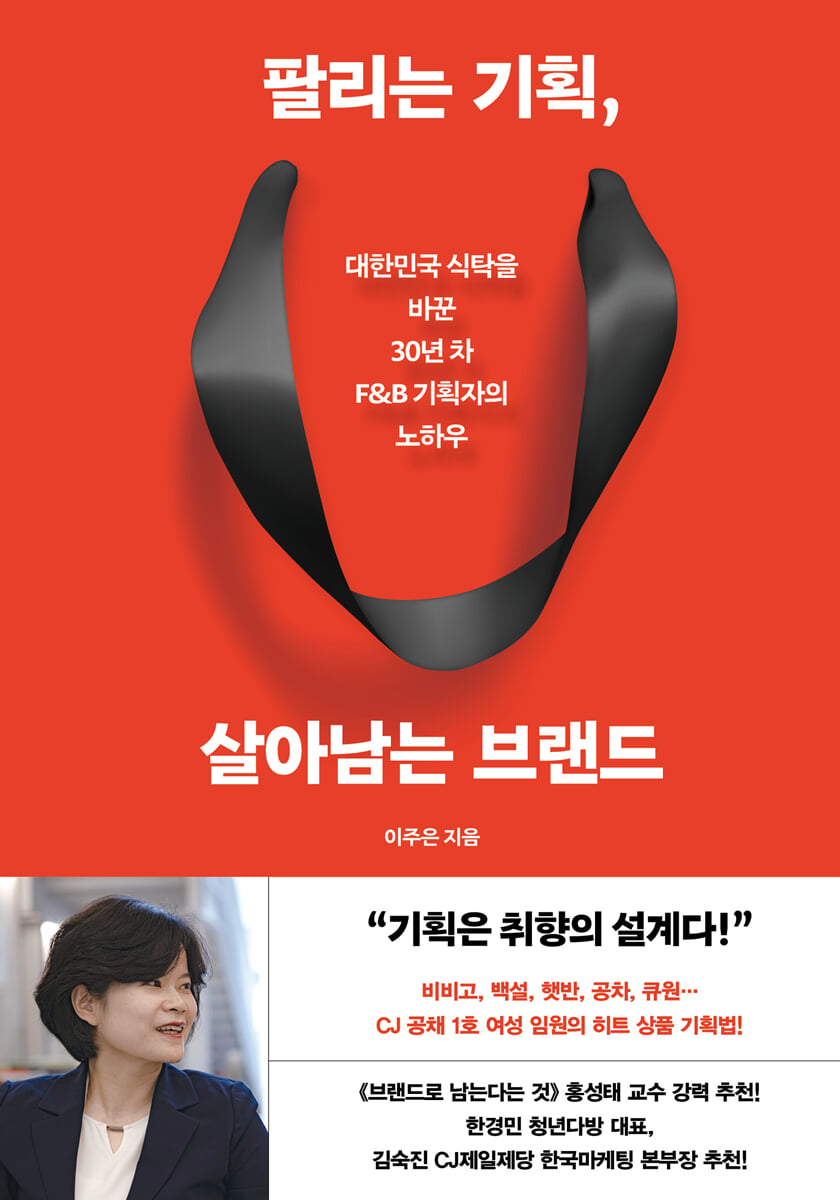
Selling plans, surviving brands
 |
Description
Book Introduction
“There’s a reason why every store sells well.”
CJ's first female executive reveals her hit product planning tips!
In many industries today, it is said that the market is saturated.
But is that really true? As the trend toward personalization accelerated in Korea, Bibigo launched convenient home meal replacement products like Yukgaejang, tailored to individual tastes. Within three years, the brand surpassed 40% market share and achieved approximately KRW 130 billion in sales.
In addition, Bibigo planned and launched a large-capacity pouch-type meal-type 'premium porridge' product in the traditional porridge market, which was mostly monotonous in texture and taste in containers, and set a record of exceeding 100 billion won in sales in the shortest period of time.
Behind Bibigo's growth was F&B product planning expert Lee Ju-eun.
In a market where new products and brands are literally pouring out every day, what's the difference between a plan that sells and a brand that survives? Author Lee Ju-eun, an F&B planner with 30 years of experience and a proven track record of success with numerous products and brands, says the difference lies in their "way of thinking."
The author has worked in product planning and marketing for various brands, including Bibigo, Baekseol, Haetban, Gongcha, and Qwon.
Among them, there are products that are still sold and loved even 20 years after their release.
This book contains the author's insights gained over 30 years of planning hundreds of products in the ever-changing F&B industry, which is closer to consumers than any other business.
It is a method of discovering the essential value of a product, implementing it in an optimal form, and delivering it to customers.
From discovering what people truly want amidst seemingly ever-changing trends to making your brand stand out among the crowd and making your product stand out through planning, the author shares his experiences alongside stories of brands that have consistently seized opportunities and succeeded in fierce competition.
It will serve as a valuable guide for marketers contemplating branding and product planning, self-employed restaurant owners grappling with the daily grind, and startup CEOs embarking on a journey with ambitious dreams.
CJ's first female executive reveals her hit product planning tips!
In many industries today, it is said that the market is saturated.
But is that really true? As the trend toward personalization accelerated in Korea, Bibigo launched convenient home meal replacement products like Yukgaejang, tailored to individual tastes. Within three years, the brand surpassed 40% market share and achieved approximately KRW 130 billion in sales.
In addition, Bibigo planned and launched a large-capacity pouch-type meal-type 'premium porridge' product in the traditional porridge market, which was mostly monotonous in texture and taste in containers, and set a record of exceeding 100 billion won in sales in the shortest period of time.
Behind Bibigo's growth was F&B product planning expert Lee Ju-eun.
In a market where new products and brands are literally pouring out every day, what's the difference between a plan that sells and a brand that survives? Author Lee Ju-eun, an F&B planner with 30 years of experience and a proven track record of success with numerous products and brands, says the difference lies in their "way of thinking."
The author has worked in product planning and marketing for various brands, including Bibigo, Baekseol, Haetban, Gongcha, and Qwon.
Among them, there are products that are still sold and loved even 20 years after their release.
This book contains the author's insights gained over 30 years of planning hundreds of products in the ever-changing F&B industry, which is closer to consumers than any other business.
It is a method of discovering the essential value of a product, implementing it in an optimal form, and delivering it to customers.
From discovering what people truly want amidst seemingly ever-changing trends to making your brand stand out among the crowd and making your product stand out through planning, the author shares his experiences alongside stories of brands that have consistently seized opportunities and succeeded in fierce competition.
It will serve as a valuable guide for marketers contemplating branding and product planning, self-employed restaurant owners grappling with the daily grind, and startup CEOs embarking on a journey with ambitious dreams.
- You can preview some of the book's contents.
Preview
index
Recommendation
Prologue: An Eye that Sees Everything as a Plan
PART 1: The Thinking of a Successful Planner
Think of it as stringing beads
Trends are not accidental
Eating, drinking, and working
Planners don't shop
Remember the local flavor
Reading books: the foundation of planning
Victory comes from words and writing.
PART 2: HOW TO CREATE A PLAN THAT SELLS
The power to define the problem
Explore beyond your five senses
Go meet and talk
The art of creative combination
Find local flavors
Let's find a small but strong market.
The story that created the fandom
Turning Current Problems into Future Opportunities: Qwon Allulose and Sun-dried Rice Cup Rice
The answer lies in street food.
The history of food
Collaboration is the Answer: Youth Cafe and Hanikalguksu
PART 3: Successful Product Planning Strategies
Where is my location?
New product planning process
Sometimes like a novelist, sometimes like a film director
An adventure that breaks the mold
Being the First: Nissin
What difference will it make?: Bibigo and Hakoya
The Persona of a Failed Care Food
After launch is when the real beginning begins.
Trust comes first
The power to protect and endure is strong: Osulloc
Light the way with a roadmap
PART 4: Communicative Brands Survive
A Cup of Tea Experience: Gongcha Korea
Innovation on Snow: Sulbing
Communicate Through Space: Baskin-Robbins
The Evolution of Pop-Up Stores: Bibigo
Play with the Brand: Heineken Experience
Communicate with Character: Hakoya
Even if there's just one memorable scene: Happy Bean Tofu
Capturing a Cinematic Sensation: Katsuo Udon
The most Korean images: Yoon Stay and Bibigo dumplings
PART 5: Planners Who Survive Even When the Market Changes
How to Write a Persuasive Business Plan
Successful Presentation Skills
B's strategy to defeat A
Prove it with numbers
Building a portfolio that grows your business
Lessons from Launching a New Brand
Small Brand Business Expansion Strategy
The secret to a hit product lies in its failures.
Survival Strategies for Food Startups
In the AI era, the planner's journey continues.
Epilogue: Small Dreams Make Big Changes
Prologue: An Eye that Sees Everything as a Plan
PART 1: The Thinking of a Successful Planner
Think of it as stringing beads
Trends are not accidental
Eating, drinking, and working
Planners don't shop
Remember the local flavor
Reading books: the foundation of planning
Victory comes from words and writing.
PART 2: HOW TO CREATE A PLAN THAT SELLS
The power to define the problem
Explore beyond your five senses
Go meet and talk
The art of creative combination
Find local flavors
Let's find a small but strong market.
The story that created the fandom
Turning Current Problems into Future Opportunities: Qwon Allulose and Sun-dried Rice Cup Rice
The answer lies in street food.
The history of food
Collaboration is the Answer: Youth Cafe and Hanikalguksu
PART 3: Successful Product Planning Strategies
Where is my location?
New product planning process
Sometimes like a novelist, sometimes like a film director
An adventure that breaks the mold
Being the First: Nissin
What difference will it make?: Bibigo and Hakoya
The Persona of a Failed Care Food
After launch is when the real beginning begins.
Trust comes first
The power to protect and endure is strong: Osulloc
Light the way with a roadmap
PART 4: Communicative Brands Survive
A Cup of Tea Experience: Gongcha Korea
Innovation on Snow: Sulbing
Communicate Through Space: Baskin-Robbins
The Evolution of Pop-Up Stores: Bibigo
Play with the Brand: Heineken Experience
Communicate with Character: Hakoya
Even if there's just one memorable scene: Happy Bean Tofu
Capturing a Cinematic Sensation: Katsuo Udon
The most Korean images: Yoon Stay and Bibigo dumplings
PART 5: Planners Who Survive Even When the Market Changes
How to Write a Persuasive Business Plan
Successful Presentation Skills
B's strategy to defeat A
Prove it with numbers
Building a portfolio that grows your business
Lessons from Launching a New Brand
Small Brand Business Expansion Strategy
The secret to a hit product lies in its failures.
Survival Strategies for Food Startups
In the AI era, the planner's journey continues.
Epilogue: Small Dreams Make Big Changes
Detailed image

Into the book
Let's take running shoes as an example.
The surge in sales of running shoes signals that health-conscious consumers' needs may also be influencing their choices of beverages and meal replacements.
As the new year begins, gym memberships explode and diet plans overflow, so it's only natural that people are turning to easy salads and healthy options over high-calorie options.
If hiking groups for seniors become more active, products like protein chocolate bars are likely to sell like hotcakes.
Capturing these subtle connections requires observing people closely, asking questions, and delving into the "why" behind their actions.
While seasonal changes and hit content can create new demand, true planners know that behind the buzzworthy content, numerous brands have likely already meticulously prepared and participated.
--- From "Trends are not accidents"
When I was a brand manager for a cold noodle company in the past, I paid attention to the sales patterns of seasonal products.
Beyond the simple fluctuations in temperature, demand for naengmyeon increases rapidly in the summer when the temperature reaches 30 degrees Celsius.
Contrary to the general prediction that soup dishes like yukgaejang would be sold mainly in the middle of winter, we also found that they enjoyed special sales in the summer due to consumers' reluctance to work in a hot kitchen for long periods of time.
This unexpected consumer behavior pattern was a valuable insight discovered through consistent monitoring of store observations and sales data.
--- From "Planners Don't Shop"
As the economy grew, our dining table also evolved.
In the 70s and 80s, consumers' interests rapidly shifted from 'how much they eat' to 'what they eat.'
Ramen and snacks began to appear on the table, and the 90s saw a boom in wellness.
“Can’t we eat delicious food while also taking care of our health?” This consumer question has presented a new challenge to the food industry.
In the 2000s, Korean society became physically closer, but dining tables began to become more personalized.
As large apartment complexes proliferate and every home becomes connected to the internet, paradoxically, the time families spend eating together has decreased.
The term "family" has become meaningless, and it has become natural for people to eat their own food at their own time even though they live in the same house.
--- From "The History of Food"
I immediately instructed the development team leader to check the quantity in stock, and was informed that there were millions of won in stock.
“Let’s take it all back.
“Whether we eat it or throw it away, it’s never for our customers.”
In the end, we paid half the cost together with the manufacturer and recovered all the inventory.
It was a huge loss, but it was an inevitable decision to maintain trust in the brand.
That day, a heavy silence fell over our team conference room.
But rather than feeling heavy-hearted about the enormous loss, I felt relieved.
This was a critical issue that determined the brand's long-term future rather than short-term sales.
Even now, when I think back on that day, I am convinced that I made the right decision.
--- From "Trust Comes First"
My aunt is diligently practicing yoga, and my niece keeps calling her.
The line in the commercial where the young nephew finally shouts “Ms. Kim Won-hee!” to his aunt who doesn’t answer no matter how many times he calls her is a humorous line that brings a smile to your face.
What makes this ad so bold is the final scene where the aunt and niece finish doing yoga together.
The setting of eating tofu and drinking water from a container caused the most heated debate in internal meetings.
“Isn’t it too much to drink the broth?” But the brand team was adamant.
“We need to demonstrate the authenticity of this product.”
We believed that scene was the clearest and most powerful scene that proved the purity of the product.
As expected, the reaction after the commercial aired was explosive.
Our factory was flooded with inquiries like, "Can you really drink the water?" and we turned these into product differentiation and trust.
The surge in sales of running shoes signals that health-conscious consumers' needs may also be influencing their choices of beverages and meal replacements.
As the new year begins, gym memberships explode and diet plans overflow, so it's only natural that people are turning to easy salads and healthy options over high-calorie options.
If hiking groups for seniors become more active, products like protein chocolate bars are likely to sell like hotcakes.
Capturing these subtle connections requires observing people closely, asking questions, and delving into the "why" behind their actions.
While seasonal changes and hit content can create new demand, true planners know that behind the buzzworthy content, numerous brands have likely already meticulously prepared and participated.
--- From "Trends are not accidents"
When I was a brand manager for a cold noodle company in the past, I paid attention to the sales patterns of seasonal products.
Beyond the simple fluctuations in temperature, demand for naengmyeon increases rapidly in the summer when the temperature reaches 30 degrees Celsius.
Contrary to the general prediction that soup dishes like yukgaejang would be sold mainly in the middle of winter, we also found that they enjoyed special sales in the summer due to consumers' reluctance to work in a hot kitchen for long periods of time.
This unexpected consumer behavior pattern was a valuable insight discovered through consistent monitoring of store observations and sales data.
--- From "Planners Don't Shop"
As the economy grew, our dining table also evolved.
In the 70s and 80s, consumers' interests rapidly shifted from 'how much they eat' to 'what they eat.'
Ramen and snacks began to appear on the table, and the 90s saw a boom in wellness.
“Can’t we eat delicious food while also taking care of our health?” This consumer question has presented a new challenge to the food industry.
In the 2000s, Korean society became physically closer, but dining tables began to become more personalized.
As large apartment complexes proliferate and every home becomes connected to the internet, paradoxically, the time families spend eating together has decreased.
The term "family" has become meaningless, and it has become natural for people to eat their own food at their own time even though they live in the same house.
--- From "The History of Food"
I immediately instructed the development team leader to check the quantity in stock, and was informed that there were millions of won in stock.
“Let’s take it all back.
“Whether we eat it or throw it away, it’s never for our customers.”
In the end, we paid half the cost together with the manufacturer and recovered all the inventory.
It was a huge loss, but it was an inevitable decision to maintain trust in the brand.
That day, a heavy silence fell over our team conference room.
But rather than feeling heavy-hearted about the enormous loss, I felt relieved.
This was a critical issue that determined the brand's long-term future rather than short-term sales.
Even now, when I think back on that day, I am convinced that I made the right decision.
--- From "Trust Comes First"
My aunt is diligently practicing yoga, and my niece keeps calling her.
The line in the commercial where the young nephew finally shouts “Ms. Kim Won-hee!” to his aunt who doesn’t answer no matter how many times he calls her is a humorous line that brings a smile to your face.
What makes this ad so bold is the final scene where the aunt and niece finish doing yoga together.
The setting of eating tofu and drinking water from a container caused the most heated debate in internal meetings.
“Isn’t it too much to drink the broth?” But the brand team was adamant.
“We need to demonstrate the authenticity of this product.”
We believed that scene was the clearest and most powerful scene that proved the purity of the product.
As expected, the reaction after the commercial aired was explosive.
Our factory was flooded with inquiries like, "Can you really drink the water?" and we turned these into product differentiation and trust.
--- From "Even if there is only one memorable scene: Happy Bean Tofu"
Publisher's Review
CJ's hidden protagonist who changed the Korean dining table!
Product planning know-how from F&B planning and marketing expert Lee Ju-eun
Joo-eun Lee, a hidden hero of CJ who joined CJ CheilJedang through the first open recruitment and served as the team leader of the 'Baekseol' brand and the 'Haetban' team, and then as the managing director of the 'Bibigo' brand group, led the overseas expansion of K-food. She has worked in the F&B industry for 30 years and has studied methods to capture what consumers want and will want in the future.
The author's ability to exploit gaps in the market is evident in 'Happy Bean Raw Tofu'.
At that time, the tofu market was divided into tofu for stew and tofu for pancakes.
The author, who was the planner of the SOY team at the time, created a new category of raw tofu called 'tofu that can be eaten right away without cooking', the first of its kind in the tofu market where there was a clear leader.
Also, 'CJ Happy Bean Morning Tofu', which was released in a packaged form with sauce and positioned as a breakfast meal, is still loved by consumers.
The author also actively reflected his own experiences in the planning.
The brand that contains the emotions and experiences felt during a trip to Japan is the Japanese cuisine brand 'Hakoya'.
In particular, 'Hakoya Sal-Eoreum-Dong-Dong Cold Buckwheat Soba' is a product that has received a good response as it reinterprets Japanese culture in a Korean style.
In Japan, soba is mainly enjoyed as a dipping dish, but Koreans are accustomed to enjoying cool soups in the summer, so Japanese soba was reinterpreted with the concept of "drinking soba," which became popular as an attractive summer product in the Korean market, which is centered on naengmyeon (cold noodles).
This product also recorded sales of hundreds of thousands of units, more than doubling the previous year's sales.
In this book, the author shares his unique planning know-how, such as how to have a sharp eye as a product planner, and how to turn small clues into bigger opportunities, such as the story of how he personally flew to Taiwan to find a new item for Gongcha Korea, which was struggling with stagnant growth, and discovered a new market called fruit tea, and the story of how he produced video content of Bibigo's handmade dumplings that received a good response as a sponsor of "Youn's Stay", leading to a global response and increasing local sales and brand awareness at the same time.
The author's extensive experience as a marketing consultant, working with brands such as Bibigo, Gongcha, and Qwon, provides insights that can be immediately applied to practice.
The F&B industry is a fiercely competitive business, with new products appearing in convenience stores every day and franchises that were popular last year no longer appearing this year.
Moreover, since food and drink products are directly connected to the body and mind of consumers, close communication with consumers is essential.
The author's emphasis on 'communication with customers' and 'designing tastes' is not limited to F&B.
Because it can be applied to any field that requires planning that understands consumers, it will serve as a useful compass for planning practitioners in various industries who need new ideas.
Is it enough if it's just delicious?
Best-selling products have stories.
When it comes to products with fandom and stories, you can't leave out local brands.
"Haetban Cupban" was developed after the author visited noodle restaurants in Jeonju during product development, contemplating "authentic Jeonju-style noodle soup" and the meaning that bean sprout soup holds for the Jeonju people. As CMO, the author actively participated in the commercialization of products like "Youthful Tea House" tteokbokki, "Yeongju Rantteok," "Hani Kalguksu," and "Hanban Wando Jeonbok Miyeokguk," all of which leveraged their own stories to garner positive consumer responses.
In this way, the author focuses on the story that connects the brand, the product, and the customer.
This book also contains observations of various products and brands in the F&B industry from the author's unique perspective with 30 years of experience.
"How did Sulbing become the epitome of K-dessert?" "Why did Baskin-Robbins choose to display 100 different ice cream flavors in a single store?" "What efforts do global ramen brand Nissin and alcoholic beverage brand Heineken make to remain in consumers' memories?" "What efforts do Pulmuone and Osulloc make to find markets and build their brands?" After reading this book through the experienced author's eyes, many foods and brands you encounter in real life will appear in a new light.
It is interesting to hear about not only large food companies, but also street foods such as '10-won bread', 'Oranda', 'corn ice cream', and 'seed hotteok'.
This book contains helpful information for planners who want to build close relationships with consumers and create fandoms, such as how to create newness in the familiar, like adding cheese instead of red bean paste to a ten-won bread, how to create empathy across all generations by reinterpreting nostalgic snacks in a modern way, like Oranda, and how to leave a deep impression by incorporating regional characteristics.
How to Become a Planner Who Survives in a Changing Market
Even if you have a good plan, it will be difficult to see the light of day if you cannot communicate it properly.
In this book, the author reveals his know-how in presentation and persuasion, gained through his experience receiving proposals from large corporations and making proposals at startups.
It teaches you how to write a good business plan, how to make your presentation stand out from the competition, and how to prepare for various situations by teaching you different strategies depending on whether your target audience is working-level staff or executives.
It also advises on how planners can survive in the AI era while maintaining their market sense.
First, the author emphasizes the ability to ask questions 'well'.
Because you need to understand the essence of the problem and ask the right questions to get quality answers from AI.
Second, we must consistently train ourselves to analyze the data presented by AI. Ultimately, it's up to humans to discover the formula for success and learn patterns from the vast data presented by AI.
The kind yet realistic advice of a senior colleague that only planners who constantly ask themselves what people are interested in and why successful people are successful and seek answers will be able to survive will serve as a good guide for practitioners struggling to become good planners.
Product planning know-how from F&B planning and marketing expert Lee Ju-eun
Joo-eun Lee, a hidden hero of CJ who joined CJ CheilJedang through the first open recruitment and served as the team leader of the 'Baekseol' brand and the 'Haetban' team, and then as the managing director of the 'Bibigo' brand group, led the overseas expansion of K-food. She has worked in the F&B industry for 30 years and has studied methods to capture what consumers want and will want in the future.
The author's ability to exploit gaps in the market is evident in 'Happy Bean Raw Tofu'.
At that time, the tofu market was divided into tofu for stew and tofu for pancakes.
The author, who was the planner of the SOY team at the time, created a new category of raw tofu called 'tofu that can be eaten right away without cooking', the first of its kind in the tofu market where there was a clear leader.
Also, 'CJ Happy Bean Morning Tofu', which was released in a packaged form with sauce and positioned as a breakfast meal, is still loved by consumers.
The author also actively reflected his own experiences in the planning.
The brand that contains the emotions and experiences felt during a trip to Japan is the Japanese cuisine brand 'Hakoya'.
In particular, 'Hakoya Sal-Eoreum-Dong-Dong Cold Buckwheat Soba' is a product that has received a good response as it reinterprets Japanese culture in a Korean style.
In Japan, soba is mainly enjoyed as a dipping dish, but Koreans are accustomed to enjoying cool soups in the summer, so Japanese soba was reinterpreted with the concept of "drinking soba," which became popular as an attractive summer product in the Korean market, which is centered on naengmyeon (cold noodles).
This product also recorded sales of hundreds of thousands of units, more than doubling the previous year's sales.
In this book, the author shares his unique planning know-how, such as how to have a sharp eye as a product planner, and how to turn small clues into bigger opportunities, such as the story of how he personally flew to Taiwan to find a new item for Gongcha Korea, which was struggling with stagnant growth, and discovered a new market called fruit tea, and the story of how he produced video content of Bibigo's handmade dumplings that received a good response as a sponsor of "Youn's Stay", leading to a global response and increasing local sales and brand awareness at the same time.
The author's extensive experience as a marketing consultant, working with brands such as Bibigo, Gongcha, and Qwon, provides insights that can be immediately applied to practice.
The F&B industry is a fiercely competitive business, with new products appearing in convenience stores every day and franchises that were popular last year no longer appearing this year.
Moreover, since food and drink products are directly connected to the body and mind of consumers, close communication with consumers is essential.
The author's emphasis on 'communication with customers' and 'designing tastes' is not limited to F&B.
Because it can be applied to any field that requires planning that understands consumers, it will serve as a useful compass for planning practitioners in various industries who need new ideas.
Is it enough if it's just delicious?
Best-selling products have stories.
When it comes to products with fandom and stories, you can't leave out local brands.
"Haetban Cupban" was developed after the author visited noodle restaurants in Jeonju during product development, contemplating "authentic Jeonju-style noodle soup" and the meaning that bean sprout soup holds for the Jeonju people. As CMO, the author actively participated in the commercialization of products like "Youthful Tea House" tteokbokki, "Yeongju Rantteok," "Hani Kalguksu," and "Hanban Wando Jeonbok Miyeokguk," all of which leveraged their own stories to garner positive consumer responses.
In this way, the author focuses on the story that connects the brand, the product, and the customer.
This book also contains observations of various products and brands in the F&B industry from the author's unique perspective with 30 years of experience.
"How did Sulbing become the epitome of K-dessert?" "Why did Baskin-Robbins choose to display 100 different ice cream flavors in a single store?" "What efforts do global ramen brand Nissin and alcoholic beverage brand Heineken make to remain in consumers' memories?" "What efforts do Pulmuone and Osulloc make to find markets and build their brands?" After reading this book through the experienced author's eyes, many foods and brands you encounter in real life will appear in a new light.
It is interesting to hear about not only large food companies, but also street foods such as '10-won bread', 'Oranda', 'corn ice cream', and 'seed hotteok'.
This book contains helpful information for planners who want to build close relationships with consumers and create fandoms, such as how to create newness in the familiar, like adding cheese instead of red bean paste to a ten-won bread, how to create empathy across all generations by reinterpreting nostalgic snacks in a modern way, like Oranda, and how to leave a deep impression by incorporating regional characteristics.
How to Become a Planner Who Survives in a Changing Market
Even if you have a good plan, it will be difficult to see the light of day if you cannot communicate it properly.
In this book, the author reveals his know-how in presentation and persuasion, gained through his experience receiving proposals from large corporations and making proposals at startups.
It teaches you how to write a good business plan, how to make your presentation stand out from the competition, and how to prepare for various situations by teaching you different strategies depending on whether your target audience is working-level staff or executives.
It also advises on how planners can survive in the AI era while maintaining their market sense.
First, the author emphasizes the ability to ask questions 'well'.
Because you need to understand the essence of the problem and ask the right questions to get quality answers from AI.
Second, we must consistently train ourselves to analyze the data presented by AI. Ultimately, it's up to humans to discover the formula for success and learn patterns from the vast data presented by AI.
The kind yet realistic advice of a senior colleague that only planners who constantly ask themselves what people are interested in and why successful people are successful and seek answers will be able to survive will serve as a good guide for practitioners struggling to become good planners.
GOODS SPECIFICS
- Date of issue: November 6, 2025
- Page count, weight, size: 284 pages | 362g | 140*200*16mm
- ISBN13: 9788965967699
- ISBN10: 8965967694
You may also like
카테고리
korean


korean

![GQ KOREA Mark (Monthly): December [2025]](http://librairie.coreenne.fr/cdn/shop/files/8ef265dbbfbf186523ed75ba7319009d.jpg?v=1765340328&width=3840)


