

American Business
 |
Description
Book Introduction
“Continuous decision-making is the essence of business.
So who makes the decisions, on what basis, and for whose benefit?”
The Complete History of American Business from a Pulitzer Prize-Winning Author
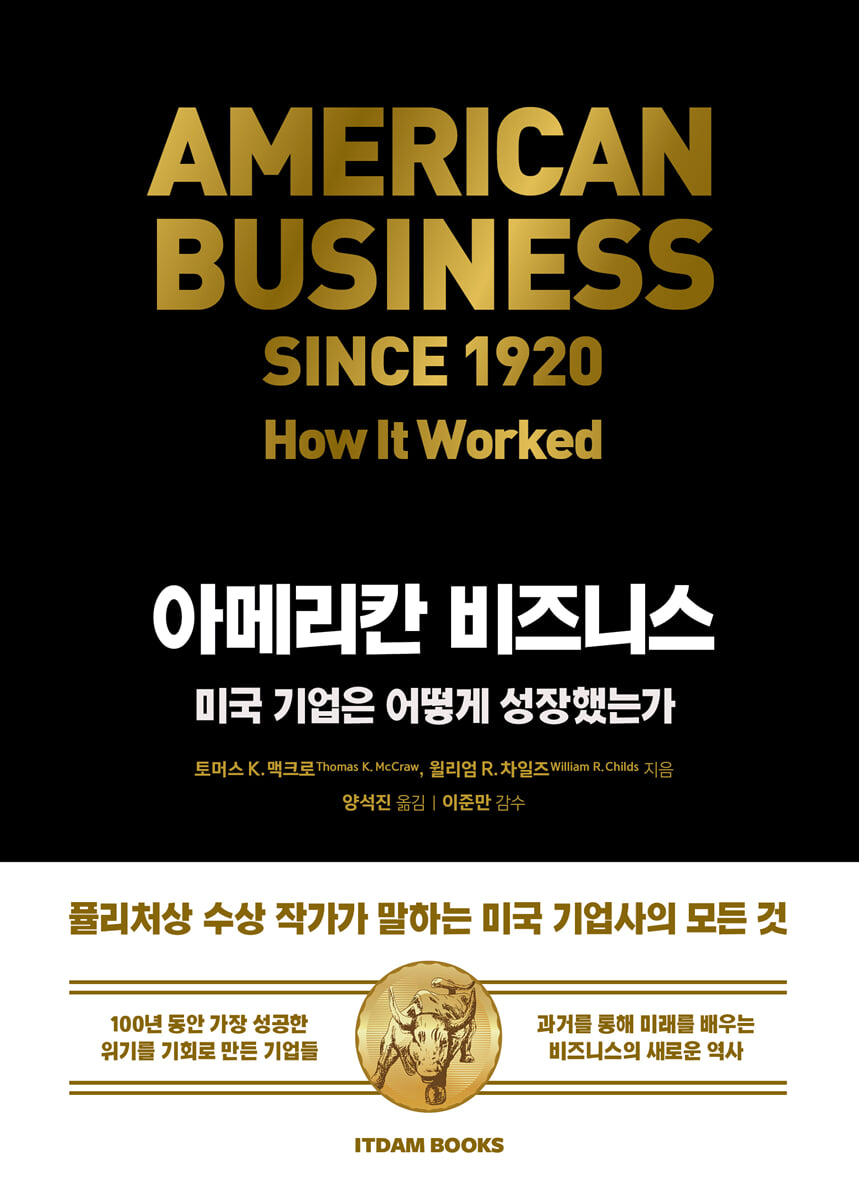
"American Business," a book on economics and management frequently mentioned by world-renowned investment expert Warren Buffett in his books, has been published.
This book is by Pulitzer Prize-winning author Thomas K.
William R. McCraw, a longtime researcher of 20th-century American and business history,
Childs (William R.
It was written by Childs for use as a textbook in college and graduate schools.
Accordingly, it presents an objective and diachronic perspective on corporate activities and economic phenomena in general.
Known as a must-read introductory business textbook in the United States, with numerous revisions since its first publication, "American Business" clearly demonstrates the changing trends of management systems and the historical context of corporate activities through its broad understanding and in-depth analysis.
So who makes the decisions, on what basis, and for whose benefit?”
The Complete History of American Business from a Pulitzer Prize-Winning Author
"American Business," a book on economics and management frequently mentioned by world-renowned investment expert Warren Buffett in his books, has been published.
This book is by Pulitzer Prize-winning author Thomas K.
William R. McCraw, a longtime researcher of 20th-century American and business history,
Childs (William R.
It was written by Childs for use as a textbook in college and graduate schools.
Accordingly, it presents an objective and diachronic perspective on corporate activities and economic phenomena in general.
Known as a must-read introductory business textbook in the United States, with numerous revisions since its first publication, "American Business" clearly demonstrates the changing trends of management systems and the historical context of corporate activities through its broad understanding and in-depth analysis.
- You can preview some of the book's contents.
Preview
index
prolog
Translator's Note
INTRO
The quality of life for Americans, past and present
The structure and development direction of this book
Key features of modern American corporate history
The birth and growth of large corporations
Two ways to approach decision-making structures
Three Industrial Revolutions and Paradigm Shifts in the Corporate Environment
American companies in the midst of creative destruction
The Successes and Shadows of American Business
CHAPTER 1: The Birth of Modern Management Techniques in the 1920s: GM Beats Ford
The birth of the automobile industry
Henry Ford, mass production, and centralized management
Alfred Sloan and Decentralized Management
GM vs. Ford: The Triumph of Decentralized Management
Implications of the Ford-GM Competition
CHAPTER 2: Corporate Welfare Capitalism, the Financial System, and the Great Depression
Corporate welfare capitalism in the 1920s
Functions of the financial system
A History of the American Financial System through 1920
Wall Street and the Stock Market in the 1920s
Great Depression
Companies that grew during the Great Depression
CHAPTER 3 P&G's Brand Management
P&G's multi-product sales and marketing strategy
P&G's corporate culture
Building P&G's Consumer Goods Market
Neil McElroy and Brand Management
Dr. Smelser and the Market Research Headquarters
Implications for Brand Management
P&G in the 21st century
A person who became a brand
CHAPTER 4: The New Deal and World War II: The Era of Government Regulation and Wartime Mobilization (1933–1945)
Franklin Roosevelt and the New Deal
Decentralization and expansion of regulation
The outbreak of World War II and the entry of the United States into the war
The excellence of American exhibition production capacity
Problems with the wartime mobilization system
Solving the problem of wartime supply through a decentralized military materiel control plan.
World War II and the Transformation of American Industry
Boeing and the Growth of the U.S. Aerospace Industry
Corruption Scandals in the U.S. Aerospace and Defense Industries
PHOTO 1
CHAPTER 5: Postwar Economic Prosperity and Social Revolution (1945–1970)
The Cold War and Corporations
Economic trends in the postwar period
The role and position of corporations in society
The Emergence of the Baby Boomer Generation and the Changes in American Society
The growth of the environmental movement
CHAPTER 6 THE RISE OF WOMEN AND MINORITIES
Women on the American Economic Stage
The reality of women in the labor market
The emergence of female CEOs
Black people appearing on the American economic stage
The emergence of a black CEO
Hispanics on the American economic stage
The rise of Hispanic CEOs
Foreign-born CEOs of American companies
PHOTO 2
CHAPTER 7 Science and R&D, from Television to Biotech
R&D during the Cold War
David Sarnoff and RCA
Sanofi and Television
Lessons from RCA's Management Failures
Risks of High-Tech Industries
Chemical, pharmaceutical, and biotechnology industries
CHAPTER 8 The Growth of the Franchise Industry and McDonald's
The socio-economic background that led to the emergence of the franchise industry
McDonald brothers
Ray Kroc
McDonald's financial magic
McDonald's strategy and operations
McDonald's Expands into the Global Market
The Duality of the Franchise Industry
The implications of McDonald's growth
CHAPTER 9 The IT Revolution and the Storm of Change Brought by Silicon Valley
The dawn of the IT industry
The birth and growth of IBM
The Rise of Silicon Valley and its New Corporate Culture
Internet and World Wide Web
New Powerhouses in the IT Industry
Expansion of the Internet
CHAPTER 10: The Financialization of Capitalism (1980s–2000s)
deindustrialization
Neoliberalism and the Economist's Time
The rise of the globalization era
The negative aspects of neoliberalism and globalization
financialization of capitalism
The problem of excessive compensation for executives and fund managers
opacity of information
CHAPTER 11 The Origin and Overcoming of the Great Depression
Chaos in the housing mortgage lending market
Federal government financial industry reform
Reform through the Dodd-Frank Act
The Limits of Federal-Led Financial Industry Reform
PHOTO 3
Epilogue
tribute
Reviewer's Note
Search
Translator's Note
INTRO
The quality of life for Americans, past and present
The structure and development direction of this book
Key features of modern American corporate history
The birth and growth of large corporations
Two ways to approach decision-making structures
Three Industrial Revolutions and Paradigm Shifts in the Corporate Environment
American companies in the midst of creative destruction
The Successes and Shadows of American Business
CHAPTER 1: The Birth of Modern Management Techniques in the 1920s: GM Beats Ford
The birth of the automobile industry
Henry Ford, mass production, and centralized management
Alfred Sloan and Decentralized Management
GM vs. Ford: The Triumph of Decentralized Management
Implications of the Ford-GM Competition
CHAPTER 2: Corporate Welfare Capitalism, the Financial System, and the Great Depression
Corporate welfare capitalism in the 1920s
Functions of the financial system
A History of the American Financial System through 1920
Wall Street and the Stock Market in the 1920s
Great Depression
Companies that grew during the Great Depression
CHAPTER 3 P&G's Brand Management
P&G's multi-product sales and marketing strategy
P&G's corporate culture
Building P&G's Consumer Goods Market
Neil McElroy and Brand Management
Dr. Smelser and the Market Research Headquarters
Implications for Brand Management
P&G in the 21st century
A person who became a brand
CHAPTER 4: The New Deal and World War II: The Era of Government Regulation and Wartime Mobilization (1933–1945)
Franklin Roosevelt and the New Deal
Decentralization and expansion of regulation
The outbreak of World War II and the entry of the United States into the war
The excellence of American exhibition production capacity
Problems with the wartime mobilization system
Solving the problem of wartime supply through a decentralized military materiel control plan.
World War II and the Transformation of American Industry
Boeing and the Growth of the U.S. Aerospace Industry
Corruption Scandals in the U.S. Aerospace and Defense Industries
PHOTO 1
CHAPTER 5: Postwar Economic Prosperity and Social Revolution (1945–1970)
The Cold War and Corporations
Economic trends in the postwar period
The role and position of corporations in society
The Emergence of the Baby Boomer Generation and the Changes in American Society
The growth of the environmental movement
CHAPTER 6 THE RISE OF WOMEN AND MINORITIES
Women on the American Economic Stage
The reality of women in the labor market
The emergence of female CEOs
Black people appearing on the American economic stage
The emergence of a black CEO
Hispanics on the American economic stage
The rise of Hispanic CEOs
Foreign-born CEOs of American companies
PHOTO 2
CHAPTER 7 Science and R&D, from Television to Biotech
R&D during the Cold War
David Sarnoff and RCA
Sanofi and Television
Lessons from RCA's Management Failures
Risks of High-Tech Industries
Chemical, pharmaceutical, and biotechnology industries
CHAPTER 8 The Growth of the Franchise Industry and McDonald's
The socio-economic background that led to the emergence of the franchise industry
McDonald brothers
Ray Kroc
McDonald's financial magic
McDonald's strategy and operations
McDonald's Expands into the Global Market
The Duality of the Franchise Industry
The implications of McDonald's growth
CHAPTER 9 The IT Revolution and the Storm of Change Brought by Silicon Valley
The dawn of the IT industry
The birth and growth of IBM
The Rise of Silicon Valley and its New Corporate Culture
Internet and World Wide Web
New Powerhouses in the IT Industry
Expansion of the Internet
CHAPTER 10: The Financialization of Capitalism (1980s–2000s)
deindustrialization
Neoliberalism and the Economist's Time
The rise of the globalization era
The negative aspects of neoliberalism and globalization
financialization of capitalism
The problem of excessive compensation for executives and fund managers
opacity of information
CHAPTER 11 The Origin and Overcoming of the Great Depression
Chaos in the housing mortgage lending market
Federal government financial industry reform
Reform through the Dodd-Frank Act
The Limits of Federal-Led Financial Industry Reform
PHOTO 3
Epilogue
tribute
Reviewer's Note
Search
Detailed image
.jpg)
Into the book
In this book, we describe the process by which companies respond to constantly changing consumer demands and evolving technologies from the perspective of an insider.
Focusing on managers, companies, and industries, we aim to show how companies have operated since 1920.
Additionally, we examined various socio-cultural contexts of contemporary America diachronically.
Through the corporate case studies and historical context presented in this book, we aim to provide a deeper understanding of the evolution of American corporate management styles over nearly 100 years.
Focusing on managers, companies, and industries, we aim to show how companies have operated since 1920.
Additionally, we examined various socio-cultural contexts of contemporary America diachronically.
Through the corporate case studies and historical context presented in this book, we aim to provide a deeper understanding of the evolution of American corporate management styles over nearly 100 years.
---From the "Prologue"
Publisher's Review
The most successful companies of the past 100 years that turned crises into opportunities
“Failure is the only opportunity to start again wisely.
(Failure is only the opportunity more intelligently to begin again.)”
_Henry Ford
From 1920 to the mid-2010s, the number of American companies grew rapidly.
After the Great Depression and World War II, the United States established itself as a global economic powerhouse in the mid-20th century.
But America's power faces new challenges in many industries due to globalization.
The rapidly changing business environment has had a significant impact on both companies and society.
Professor Lee Jun-man of Seoul National University's College of Business Administration, who oversaw the book, said that "American Business" will play a key role in understanding the success stories of American companies and applying them to the Korean environment.
This is because this book explains in detail the causes of the development of each industry, which is the most crucial element in understanding the American economy.
To understand change, it is important to understand the social background of the time along with the rise and fall of the company.
There is still much to be gained from past corporate activities.
This book, which can be considered a comprehensive overview of American corporate history, is an essential economic guide for the unstable post-normal era.
A New History of Business: Learning the Future Through the Past
“It’s easy to have principles when you’re rich.
The important thing is to have principles when you are poor.
(It's easy to have principles when you're rich.
The important thing is to have principles when you’re poor.)”
_Ray Kroc
This book, divided into eleven chapters, covers a vast amount of corporate history.
It provides a three-dimensional explanation of how Ford and GM developed their management strategies in the automobile wars of the 1920s.
The world, which achieved rapid growth at the height of the Second Industrial Revolution, laid the foundation for the growth of large corporations through large-scale capital investment.
Insights into how the Great Depression destroyed systems, including the emergence of a new corporate culture, are presented in a historical context.
The economic and social environment of the Cold War system will serve as an important milestone in understanding the world today and the world after.
The author of this book, Thomas K.
McCraw and William R.
Childs divides American corporate history into six periods.
The Great Depression of the 1920s and 1930s, the New Deal and World War II, the postwar period, the 1980s through the 2000s, and the financial crisis of 2007 and 2008.
Each chapter follows the perspectives of companies operating in major American industries and the entrepreneurs who founded them.
What American Business is ultimately about is the structure of decision-making.
Decision-making has been at the heart of the three industrial revolutions and the paradigm shifts in the corporate environment.
Managers have evolved to respond to changing markets.
As translator Yang Seok-jin said, “If you read this book together on a long journey of nearly 100 years, you will discover points that overlap with the economic and corporate phenomena of Korea today.”
It would be truly meaningful if "American Business" could serve as an opportunity for reflection and transformation in the current global economic crisis.
I hope this book will serve as a driving force for looking back on our society's past and designing its future.
Translator's Note
As you journey along this long journey of nearly 100 years, this book will reveal points of overlap with the current economic and corporate landscape in Korea.
There may be some things that Korean society and businesses should use as benchmarks, and there may also be some things that they should learn from and reflect on.
The translator believes that the translation is very meaningful if readers can find such food for thought through this short book.
(Yang Seok-jin, translator)
Reviewer's Note
This book primarily discusses the companies that have left the greatest mark on the American business environment, from the 1920s, when the United States emerged as a powerhouse in the industrial age, to the present, when the United States leads the global market.
For example, it includes the cases of Ford and its competitor GM, which led to the commercialization of automobiles, as well as the success stories of modern-day giants Amazon and Google.
The beauty of this book is that it doesn't simply cover the cases of these companies; it also explains the cultural and economic circumstances of the United States at that time, allowing readers to understand them accurately, while also telling the stories of the companies' founders and managers.
Knowing this social context is very helpful in understanding a company's strategy and performance.
This is because strategies must ultimately be implemented after a thorough analysis of the external environment and in accordance with environmental changes.
(Lee Jun-man, Professor, Seoul National University School of Business)
“Failure is the only opportunity to start again wisely.
(Failure is only the opportunity more intelligently to begin again.)”
_Henry Ford
From 1920 to the mid-2010s, the number of American companies grew rapidly.
After the Great Depression and World War II, the United States established itself as a global economic powerhouse in the mid-20th century.
But America's power faces new challenges in many industries due to globalization.
The rapidly changing business environment has had a significant impact on both companies and society.
Professor Lee Jun-man of Seoul National University's College of Business Administration, who oversaw the book, said that "American Business" will play a key role in understanding the success stories of American companies and applying them to the Korean environment.
This is because this book explains in detail the causes of the development of each industry, which is the most crucial element in understanding the American economy.
To understand change, it is important to understand the social background of the time along with the rise and fall of the company.
There is still much to be gained from past corporate activities.
This book, which can be considered a comprehensive overview of American corporate history, is an essential economic guide for the unstable post-normal era.
A New History of Business: Learning the Future Through the Past
“It’s easy to have principles when you’re rich.
The important thing is to have principles when you are poor.
(It's easy to have principles when you're rich.
The important thing is to have principles when you’re poor.)”
_Ray Kroc
This book, divided into eleven chapters, covers a vast amount of corporate history.
It provides a three-dimensional explanation of how Ford and GM developed their management strategies in the automobile wars of the 1920s.
The world, which achieved rapid growth at the height of the Second Industrial Revolution, laid the foundation for the growth of large corporations through large-scale capital investment.
Insights into how the Great Depression destroyed systems, including the emergence of a new corporate culture, are presented in a historical context.
The economic and social environment of the Cold War system will serve as an important milestone in understanding the world today and the world after.
The author of this book, Thomas K.
McCraw and William R.
Childs divides American corporate history into six periods.
The Great Depression of the 1920s and 1930s, the New Deal and World War II, the postwar period, the 1980s through the 2000s, and the financial crisis of 2007 and 2008.
Each chapter follows the perspectives of companies operating in major American industries and the entrepreneurs who founded them.
What American Business is ultimately about is the structure of decision-making.
Decision-making has been at the heart of the three industrial revolutions and the paradigm shifts in the corporate environment.
Managers have evolved to respond to changing markets.
As translator Yang Seok-jin said, “If you read this book together on a long journey of nearly 100 years, you will discover points that overlap with the economic and corporate phenomena of Korea today.”
It would be truly meaningful if "American Business" could serve as an opportunity for reflection and transformation in the current global economic crisis.
I hope this book will serve as a driving force for looking back on our society's past and designing its future.
Translator's Note
As you journey along this long journey of nearly 100 years, this book will reveal points of overlap with the current economic and corporate landscape in Korea.
There may be some things that Korean society and businesses should use as benchmarks, and there may also be some things that they should learn from and reflect on.
The translator believes that the translation is very meaningful if readers can find such food for thought through this short book.
(Yang Seok-jin, translator)
Reviewer's Note
This book primarily discusses the companies that have left the greatest mark on the American business environment, from the 1920s, when the United States emerged as a powerhouse in the industrial age, to the present, when the United States leads the global market.
For example, it includes the cases of Ford and its competitor GM, which led to the commercialization of automobiles, as well as the success stories of modern-day giants Amazon and Google.
The beauty of this book is that it doesn't simply cover the cases of these companies; it also explains the cultural and economic circumstances of the United States at that time, allowing readers to understand them accurately, while also telling the stories of the companies' founders and managers.
Knowing this social context is very helpful in understanding a company's strategy and performance.
This is because strategies must ultimately be implemented after a thorough analysis of the external environment and in accordance with environmental changes.
(Lee Jun-man, Professor, Seoul National University School of Business)
GOODS SPECIFICS
- Date of issue: June 30, 2023
- Page count, weight, size: 544 pages | 152*210*35mm
- ISBN13: 9791198222602
- ISBN10: 1198222603
You may also like
카테고리
korean


korean

![GQ KOREA Mark (Monthly): December [2025]](http://librairie.coreenne.fr/cdn/shop/files/8ef265dbbfbf186523ed75ba7319009d.jpg?v=1765340328&width=3840)


