

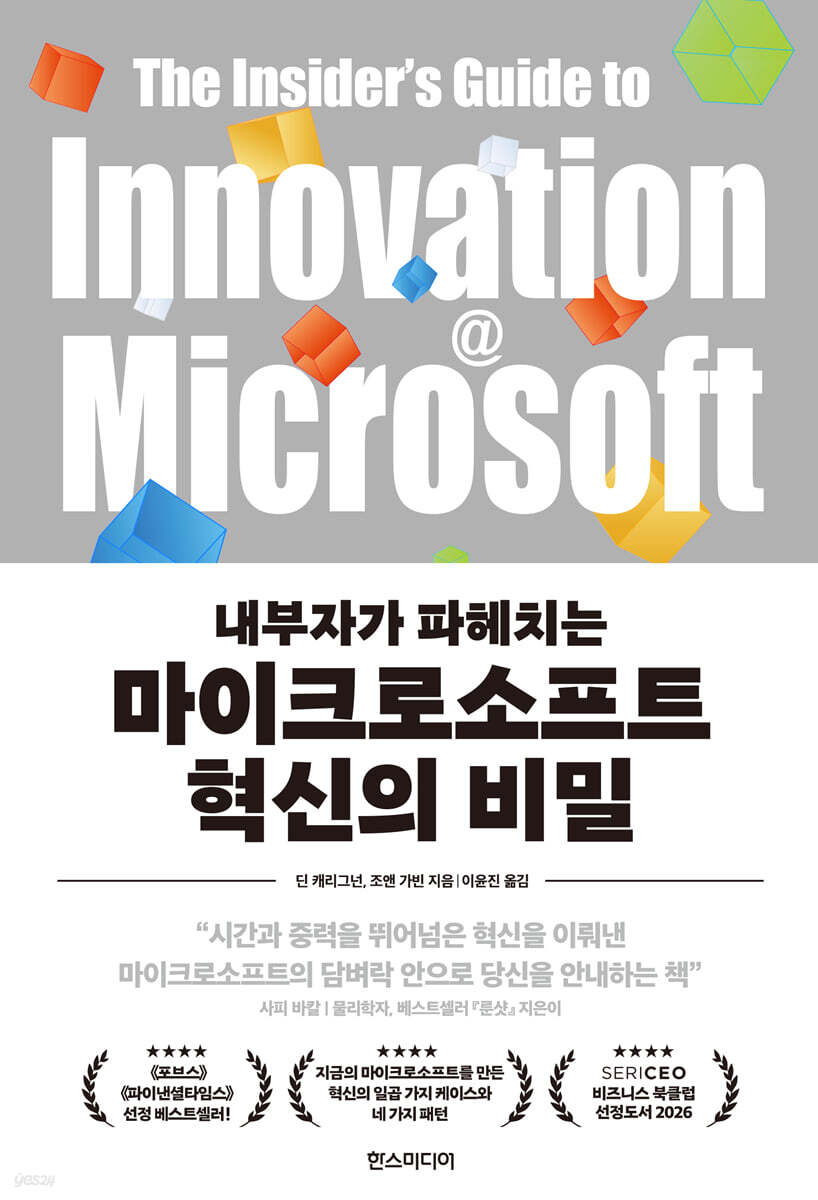
The Secret of Microsoft's Innovation
 |
Description
Book Introduction
Bestseller by Forbes and Financial Times
2026 SERICEO Business Book Club Selections
Microsoft, a representative tech company,
How can we achieve sustainable innovation?
The 'Magnificent 7' is a term referring to the seven giant technology companies that dominate the U.S. stock market: Apple, Microsoft, Google Alphabet, Amazon, Meta, Tesla, and Nvidia.
The company with the longest history among them is Microsoft, founded in 1975 and celebrating its 50th anniversary this year.
Microsoft has been a company that has changed the lives of people around the world and embraced their daily lives since the 1980s.
A select few elite groups have brought computers, previously used only for professional work, into every home and on every desk as 'PCs (Personal Computers),' and more recently, they have entered the game console business, dominating everything from work to dopamine-fueled gaming after work.
Microsoft has become an inseparable company from our daily lives.
In this book, "The Secrets of Microsoft Innovation," authors Dean Carrignan and Joan Garvin, as Microsoft insiders, delve into the company's secrets, demonstrating that consistent innovation is sustainable amidst rapidly changing technology trends.
2026 SERICEO Business Book Club Selections
Microsoft, a representative tech company,
How can we achieve sustainable innovation?
The 'Magnificent 7' is a term referring to the seven giant technology companies that dominate the U.S. stock market: Apple, Microsoft, Google Alphabet, Amazon, Meta, Tesla, and Nvidia.
The company with the longest history among them is Microsoft, founded in 1975 and celebrating its 50th anniversary this year.
Microsoft has been a company that has changed the lives of people around the world and embraced their daily lives since the 1980s.
A select few elite groups have brought computers, previously used only for professional work, into every home and on every desk as 'PCs (Personal Computers),' and more recently, they have entered the game console business, dominating everything from work to dopamine-fueled gaming after work.
Microsoft has become an inseparable company from our daily lives.
In this book, "The Secrets of Microsoft Innovation," authors Dean Carrignan and Joan Garvin, as Microsoft insiders, delve into the company's secrets, demonstrating that consistent innovation is sustainable amidst rapidly changing technology trends.
index
Recommendation
introduction
Entering
Hypothesis | Cases | Patterns
How to read this book
7 cases
XBOX
Xbox: Transforming the Gaming Experience | Xbox 360: Maturing the Gaming Business | BXT: A Framework for Innovation Success | Xbox One: Launch Failure | After Xbox One: Rebuilding Trust | The Xbox Team Today | A Culture of Innovation | The Story Continues
Visual Studio Code
The freedom to grow from nothing to something | From growth to expansion | Using the products you create yourself | It's not a zero-sum game.
Microsoft Office
Design First: Reimagining the Great Pyramid | New Feature Ban | Opening the Designer's Toolbox | A Few More Design Tools | Creating Great User Experiences | Engineering Finds the Way | Metrics of Success | Thoughts, Actions, Feelings | Preparation Pays Off
Cognitive Services
Even if you don't succeed at first | Wait, what would Watson have been like? | Try again | There's no time to lose | The power of compound interest | A game where everyone wins | Growing pains | Towards maturity
Microsoft Research
MSR's First Challenge | From Ambition to Reality | Making Room for Incalculable Risks | The Only Constant Is Change | A Big Mistake | Deeper Commitment to Innovation | The Road Ahead
ice
Without Google, there would be no Bing | Growth breeds growth | Constraints breed creativity | Finding hidden heroes | Experimenting for learning | Achieving continuous growth | Embracing new technologies | Building a deep learning ecosystem | And everything changed | The adventure continues.
Responsible Innovation
Five Journeys | Success Factors: A New Mindset Is Needed
4 patterns
Pattern 1: Daily Innovation
What is Operationalization? | Laying the Foundation for Innovation Every Day | Innovation is a Cycle
Pattern 2: Years of Innovation
What is the full innovation lifecycle? | Why is it so difficult? | How to make innovation easier | Practical advice for navigating the curve of change
Pattern 3: Innovation with Everyone
Innovation's Biggest Competitor | Overcoming Inertia: The Journey of Behavioral Change | Putting the Process into Action | Final Tip: Collaborate with Marketing Earlier
Pattern 4: Innovation Beyond Technology
Beyond Everyday Innovation and Radical Innovation | Feedback Loops: Mapping Supply and Demand | Putting It All Together
conclusion
Guiding Principle 1: Innovation is a company-wide effort | Guiding Principle 2: Innovation is cyclical | Guiding Principle 3: Innovation is built on trust | Conclusion | The conversation must continue.
Acknowledgements
annotation
References
introduction
Entering
Hypothesis | Cases | Patterns
How to read this book
7 cases
XBOX
Xbox: Transforming the Gaming Experience | Xbox 360: Maturing the Gaming Business | BXT: A Framework for Innovation Success | Xbox One: Launch Failure | After Xbox One: Rebuilding Trust | The Xbox Team Today | A Culture of Innovation | The Story Continues
Visual Studio Code
The freedom to grow from nothing to something | From growth to expansion | Using the products you create yourself | It's not a zero-sum game.
Microsoft Office
Design First: Reimagining the Great Pyramid | New Feature Ban | Opening the Designer's Toolbox | A Few More Design Tools | Creating Great User Experiences | Engineering Finds the Way | Metrics of Success | Thoughts, Actions, Feelings | Preparation Pays Off
Cognitive Services
Even if you don't succeed at first | Wait, what would Watson have been like? | Try again | There's no time to lose | The power of compound interest | A game where everyone wins | Growing pains | Towards maturity
Microsoft Research
MSR's First Challenge | From Ambition to Reality | Making Room for Incalculable Risks | The Only Constant Is Change | A Big Mistake | Deeper Commitment to Innovation | The Road Ahead
ice
Without Google, there would be no Bing | Growth breeds growth | Constraints breed creativity | Finding hidden heroes | Experimenting for learning | Achieving continuous growth | Embracing new technologies | Building a deep learning ecosystem | And everything changed | The adventure continues.
Responsible Innovation
Five Journeys | Success Factors: A New Mindset Is Needed
4 patterns
Pattern 1: Daily Innovation
What is Operationalization? | Laying the Foundation for Innovation Every Day | Innovation is a Cycle
Pattern 2: Years of Innovation
What is the full innovation lifecycle? | Why is it so difficult? | How to make innovation easier | Practical advice for navigating the curve of change
Pattern 3: Innovation with Everyone
Innovation's Biggest Competitor | Overcoming Inertia: The Journey of Behavioral Change | Putting the Process into Action | Final Tip: Collaborate with Marketing Earlier
Pattern 4: Innovation Beyond Technology
Beyond Everyday Innovation and Radical Innovation | Feedback Loops: Mapping Supply and Demand | Putting It All Together
conclusion
Guiding Principle 1: Innovation is a company-wide effort | Guiding Principle 2: Innovation is cyclical | Guiding Principle 3: Innovation is built on trust | Conclusion | The conversation must continue.
Acknowledgements
annotation
References
Detailed image

Into the book
A team of passionate gamers creates a product that attracts other passionate gamers.
New talent continued to improve the product, which attracted more talent to the team.
Their shared love of gaming unites the team and fuels industry-leading innovation.
--- p.46, from "XBOX"
Hypotheses are the subject of verification.
Verification can prove whether a hypothesis is true or false.
Either way, we learn something.
If the entire organization uses the word "hypothesis" rather than "idea," it can reduce the risk that members feel when sharing their thoughts.
If your claim is not an absolute truth but a theory, you can accept questions or doubts raised by others as help for verification and improvement, not as attacks.
This allows people to share hypotheses faster and more frequently, and gives teams the opportunity to collaborate and learn more frequently.
--- p.84, from "Visual Studio Code"
From another perspective, over-service can be explained by 'over-engineering and poor design'.
This kind of thing happens all too often.
We've all experienced, at one point or another, a product, service, or process that had features that far exceeded what the user needed, wanted, or could properly use.
Even newly released products often fall into this dilemma.
In fact, one of the reasons startups fail is because they exhaust their resources by building too many things too early, before they even find market fit.
--- p.93, from “Microsoft Office”
Missing out on the mobile revolution was a huge blow to Microsoft.
This incident served as an opportunity for the entire company to reaffirm its commitment to innovation and staying ahead of future changes.
Since Satya Nadella took over as CEO in 2014, he has focused on transforming the company from a "know-it-all" culture to a "learn-it-all" culture.
--- p.146, from “Microsoft Research”
The shift to deep learning has significantly helped Bing close the gap with Google in terms of search quality.
Google's transition to deep learning has been relatively slow because it has invested heavily in existing machine learning technologies and human resources.
Five years after pivoting to deep learning, Bing's internal analysis shows that it is now on par with Google on most key search quality metrics.
This shift paves the way for Bing to take a leading role in deploying powerful deep learning models, such as the GPT family, through a strategic partnership with Microsoft and OpenAI.
--- p.171, from "Ice"
The innovation process is often depicted as linear for simplicity, but in reality it is always circular.
Although it is expressed as going back to the previous step, the process itself always moves forward.
The more we repeat the process of divergence-convergence-synthesis, the more we learn.
There is no going back to before.
--- p.230, from "Pattern 1: Daily Innovation"
Enterprise-wide innovation inherently goes beyond "routine" tasks and requires investments of time, talent, and resources that transcend the boundaries of organizational charts and financial statements.
For this, support from the CEO and key executives is essential.
While such innovations can certainly begin at the grassroots level, long-term success requires the continued support and engagement of senior management.
Management has the privilege of strategic patience.
It is an essential part of realizing transformative values.
New talent continued to improve the product, which attracted more talent to the team.
Their shared love of gaming unites the team and fuels industry-leading innovation.
--- p.46, from "XBOX"
Hypotheses are the subject of verification.
Verification can prove whether a hypothesis is true or false.
Either way, we learn something.
If the entire organization uses the word "hypothesis" rather than "idea," it can reduce the risk that members feel when sharing their thoughts.
If your claim is not an absolute truth but a theory, you can accept questions or doubts raised by others as help for verification and improvement, not as attacks.
This allows people to share hypotheses faster and more frequently, and gives teams the opportunity to collaborate and learn more frequently.
--- p.84, from "Visual Studio Code"
From another perspective, over-service can be explained by 'over-engineering and poor design'.
This kind of thing happens all too often.
We've all experienced, at one point or another, a product, service, or process that had features that far exceeded what the user needed, wanted, or could properly use.
Even newly released products often fall into this dilemma.
In fact, one of the reasons startups fail is because they exhaust their resources by building too many things too early, before they even find market fit.
--- p.93, from “Microsoft Office”
Missing out on the mobile revolution was a huge blow to Microsoft.
This incident served as an opportunity for the entire company to reaffirm its commitment to innovation and staying ahead of future changes.
Since Satya Nadella took over as CEO in 2014, he has focused on transforming the company from a "know-it-all" culture to a "learn-it-all" culture.
--- p.146, from “Microsoft Research”
The shift to deep learning has significantly helped Bing close the gap with Google in terms of search quality.
Google's transition to deep learning has been relatively slow because it has invested heavily in existing machine learning technologies and human resources.
Five years after pivoting to deep learning, Bing's internal analysis shows that it is now on par with Google on most key search quality metrics.
This shift paves the way for Bing to take a leading role in deploying powerful deep learning models, such as the GPT family, through a strategic partnership with Microsoft and OpenAI.
--- p.171, from "Ice"
The innovation process is often depicted as linear for simplicity, but in reality it is always circular.
Although it is expressed as going back to the previous step, the process itself always moves forward.
The more we repeat the process of divergence-convergence-synthesis, the more we learn.
There is no going back to before.
--- p.230, from "Pattern 1: Daily Innovation"
Enterprise-wide innovation inherently goes beyond "routine" tasks and requires investments of time, talent, and resources that transcend the boundaries of organizational charts and financial statements.
For this, support from the CEO and key executives is essential.
While such innovations can certainly begin at the grassroots level, long-term success requires the continued support and engagement of senior management.
Management has the privilege of strategic patience.
It is an essential part of realizing transformative values.
--- p.301, from “Conclusion”
Publisher's Review
What made Microsoft what it is today
Success and failure, and the true innovation that comes from them
Kikio is having a hard time with the new KakaoTalk update.
This is because the company is having difficulty changing direction despite the market's cold reception of its ability to provide features that go beyond users' needs.
In an attempt to breathe new life into the messenger business that had been around for over 10 years, they brought in new people from outside and attempted to change things by offering a different service than before, but that wasn't what consumers wanted.
Although they came up with their own self-help measures, Kakao's innovation appears to have ultimately failed.
This is because they failed to properly understand the needs of consumers, and even though they did understand them, they failed to change direction in time.
This book also contains a similar anecdote from the development of Xbox.
Ignorance of the main customer base, game nerds, resulted in a miserable failure.
However, this failure allowed Microsoft to make a major shift in direction and establish itself firmly in the gaming industry.
The two authors of "Secrets of Microsoft Innovation" focus primarily on their work over the past 20 years, detailing Microsoft's sustainable innovation based on its various business endeavors across various sectors, the successes and failures that followed, and the valuable lessons learned from them.
Insiders who have been with us through the entire innovation process
The Secret Unraveled in 7 Cases and 4 Patterns
The two authors of this book, Dean Carrignan and Joan Garvin, are both "insiders" who have followed Microsoft's path of innovation over the past 20 years.
In particular, Carrignan has spent most of his career at Microsoft, directly and indirectly involved in the company's innovation processes across all its business areas, and he knows the ins and outs of its successes and failures better than anyone else.
The two authors explain specific examples of innovation by categorizing them into seven cases, ranging from areas well-known to general consumers, such as Xbox, Office, and Bing, to internal innovation standards such as Visual Studio Code, Microsoft Research, Cognitive Services, and Responsible Innovation.
And by introducing four patterns that transform the secrets of innovation learned from real-world cases into sustainable ones, the book provides guidance that anyone can apply to their own business.
Success and failure, and the true innovation that comes from them
Kikio is having a hard time with the new KakaoTalk update.
This is because the company is having difficulty changing direction despite the market's cold reception of its ability to provide features that go beyond users' needs.
In an attempt to breathe new life into the messenger business that had been around for over 10 years, they brought in new people from outside and attempted to change things by offering a different service than before, but that wasn't what consumers wanted.
Although they came up with their own self-help measures, Kakao's innovation appears to have ultimately failed.
This is because they failed to properly understand the needs of consumers, and even though they did understand them, they failed to change direction in time.
This book also contains a similar anecdote from the development of Xbox.
Ignorance of the main customer base, game nerds, resulted in a miserable failure.
However, this failure allowed Microsoft to make a major shift in direction and establish itself firmly in the gaming industry.
The two authors of "Secrets of Microsoft Innovation" focus primarily on their work over the past 20 years, detailing Microsoft's sustainable innovation based on its various business endeavors across various sectors, the successes and failures that followed, and the valuable lessons learned from them.
Insiders who have been with us through the entire innovation process
The Secret Unraveled in 7 Cases and 4 Patterns
The two authors of this book, Dean Carrignan and Joan Garvin, are both "insiders" who have followed Microsoft's path of innovation over the past 20 years.
In particular, Carrignan has spent most of his career at Microsoft, directly and indirectly involved in the company's innovation processes across all its business areas, and he knows the ins and outs of its successes and failures better than anyone else.
The two authors explain specific examples of innovation by categorizing them into seven cases, ranging from areas well-known to general consumers, such as Xbox, Office, and Bing, to internal innovation standards such as Visual Studio Code, Microsoft Research, Cognitive Services, and Responsible Innovation.
And by introducing four patterns that transform the secrets of innovation learned from real-world cases into sustainable ones, the book provides guidance that anyone can apply to their own business.
GOODS SPECIFICS
- Date of issue: October 30, 2025
- Format: Hardcover book binding method guide
- Page count, weight, size: 320 pages | 640g | 145*215*22mm
- ISBN13: 9791194777625
- ISBN10: 1194777627
You may also like
카테고리
korean


korean

![GQ KOREA Mark (Monthly): December [2025]](http://librairie.coreenne.fr/cdn/shop/files/8ef265dbbfbf186523ed75ba7319009d.jpg?v=1765340328&width=3840)


