

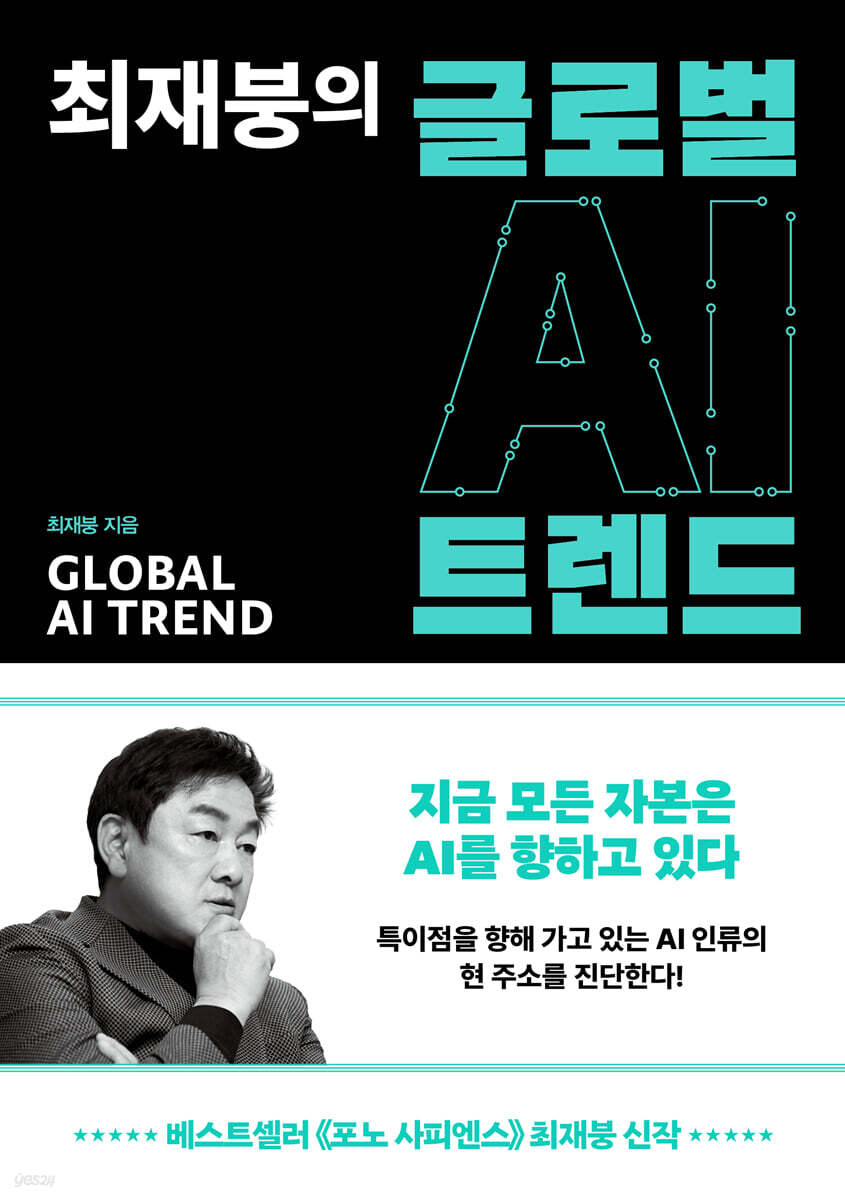
Jae-Boong Choi's Global AI Trends
 |
Description
Book Introduction
★ "AI capital surpasses 3 trillion won. We must find a way to survive."
★ The latest AI industry report by Jae-Bung Choi, author of the best-selling books "Phono Sapiens" and "AI Sapiens."
A must-read for office workers worried about losing their jobs to AI.
"For the first time in 30 years! The future brought about by mega-capital."
Forget the deluge of AI information; this concise, core AI survival guide is for humanity.
"The combined market capitalization of all listed companies in South Korea is less than Nvidia alone?" Money doesn't lie.
The flow of capital clearly indicates where humanity's future will lead.
Before we knew it, the speed of technological evolution had begun to outpace human thought.
Artificial intelligence is fundamentally changing our daily lives, industries, and even our way of thinking right now.
The author, who led the intellectual exploration of the artificial intelligence era with his previous work, AI Sapiens, has returned to writing after a year and a half.
What made me change my resolve that “there would be no more use for the time being” was the crazy pace at which the world was changing.
The changes that have taken place in the past 12 months rival those experienced by a single generation.
Technology has outpaced predictions, and capital has proven it.
The revolution has shifted from a possibility to a reality, with unprecedented funding pouring into investment markets that had been indifferent to any new technology for decades.
Professor Choi Jae-boong, Korea's leading expert on the Fourth Industrial Revolution, offers insight into this profound transition and answers the question, "What should we learn now?"
Technological change breeds fear, but the only way to overcome it is through learning.
The author's message of "AI-PT," which emphasizes that 30 minutes of consistent study a day can create a completely different life in three years, is simple yet powerful.
While "AI Sapiens" explored the philosophical implications of artificial intelligence, this new work will serve as a practical guide that covers technology, economy, and society as a whole.
★ The latest AI industry report by Jae-Bung Choi, author of the best-selling books "Phono Sapiens" and "AI Sapiens."
A must-read for office workers worried about losing their jobs to AI.
"For the first time in 30 years! The future brought about by mega-capital."
Forget the deluge of AI information; this concise, core AI survival guide is for humanity.
"The combined market capitalization of all listed companies in South Korea is less than Nvidia alone?" Money doesn't lie.
The flow of capital clearly indicates where humanity's future will lead.
Before we knew it, the speed of technological evolution had begun to outpace human thought.
Artificial intelligence is fundamentally changing our daily lives, industries, and even our way of thinking right now.
The author, who led the intellectual exploration of the artificial intelligence era with his previous work, AI Sapiens, has returned to writing after a year and a half.
What made me change my resolve that “there would be no more use for the time being” was the crazy pace at which the world was changing.
The changes that have taken place in the past 12 months rival those experienced by a single generation.
Technology has outpaced predictions, and capital has proven it.
The revolution has shifted from a possibility to a reality, with unprecedented funding pouring into investment markets that had been indifferent to any new technology for decades.
Professor Choi Jae-boong, Korea's leading expert on the Fourth Industrial Revolution, offers insight into this profound transition and answers the question, "What should we learn now?"
Technological change breeds fear, but the only way to overcome it is through learning.
The author's message of "AI-PT," which emphasizes that 30 minutes of consistent study a day can create a completely different life in three years, is simple yet powerful.
While "AI Sapiens" explored the philosophical implications of artificial intelligence, this new work will serve as a practical guide that covers technology, economy, and society as a whole.
- You can preview some of the book's contents.
Preview
index
prolog
Part 1: A Chance to Ride the AI Rising Curve
01 The history of civilization rewritten after 30 years
02 What's important is the AI worldview
Part 2: Global AI Trends
03 The Core of AI: LLM
04 AI in Our Daily Lives
05 Palantir is coming
06 AI that changes world standards
07 Physical AI: From Virtual to Real
08 AI goes to the battlefield
Part 3: The Era of the US-China AI Hegemony War
09 The Prelude to the US-China AI Hegemony War
10 January 28, 2025, the landscape begins to change.
11. Who will win physical AI? The US or China?
Part 4: Meta Industry and the Fandom Economy
12 Borderless Industries: Meta-Industries
13 The Fandom Economy Created by 'Subscriptions' and 'Likes'
14 Reasons Why BTS's Fandom Has Lasted for 10 Years
15 No longer a chaser, now a leader
Epilogue
Part 1: A Chance to Ride the AI Rising Curve
01 The history of civilization rewritten after 30 years
02 What's important is the AI worldview
Part 2: Global AI Trends
03 The Core of AI: LLM
04 AI in Our Daily Lives
05 Palantir is coming
06 AI that changes world standards
07 Physical AI: From Virtual to Real
08 AI goes to the battlefield
Part 3: The Era of the US-China AI Hegemony War
09 The Prelude to the US-China AI Hegemony War
10 January 28, 2025, the landscape begins to change.
11. Who will win physical AI? The US or China?
Part 4: Meta Industry and the Fandom Economy
12 Borderless Industries: Meta-Industries
13 The Fandom Economy Created by 'Subscriptions' and 'Likes'
14 Reasons Why BTS's Fandom Has Lasted for 10 Years
15 No longer a chaser, now a leader
Epilogue
Detailed image

Into the book
Capital from all over the world is now pouring massively into the AI industry.
Just as the Internet did 30 years ago, AI will fundamentally change the paradigm of existing industries and spark another revolution for humanity.
Historically, every industrial revolution has been based on the concentration of capital.
This time there will be no exception.
We are clearly in the midst of an AI revolution.
--- p.18, from 「01 〈History of Civilization Rewritten in 30 Years〉」
The advent of Nano Banana heralded a new era in which LMM would go beyond simply understanding text and images to also take charge of creation and editing.
In the future, LMM is expected to become a center of innovation in almost all industries, including education, healthcare, entertainment, and marketing.
The democratization of creation will accelerate, as anyone can create high-quality content without the need for complex, specialized tools.
This will not only lead to new business opportunities and job creation, but will also create an entirely new work environment where AI and humans collaborate.
--- p.65, from 「03 〈The Core of AI: LLM〉」
In the United States, many jobs are already being replaced by AI, and new forms of management and organizational structures are emerging.
This is called "compressed management," and while the proportion of new employees has decreased significantly, mid-level experts with advanced knowledge and experience are using AI as if they were new employees, achieving work performance that is ten times better than before.
If these changes become active in the research field, it is highly likely that almost all companies will adopt and utilize similar systems in the future, making this an important area for us to closely track and study.
--- p.75, from 「04 〈AI Approaching Our Daily Life〉」
It's becoming clear that the AI talent war has become a key battleground that will determine the future of nations and companies.
Until 2024, the contract amount was in the hundreds of billions of won, but now it is soaring to hundreds of billions and trillions of won.
More importantly, it's not simply the size of the money, but the fact that we've entered an era where young talent can negotiate on equal footing with companies while maintaining their own philosophy and vision.
And within it, the presence of female engineers is becoming increasingly prominent.
Female engineers like Mira Murati, who was introduced earlier, Lucy Guo, who co-founded Scale AI, and Luo Fuli, who was a key figure in the DeepSec craze, are changing the landscape of the IT industry, which was previously considered male-dominated.
--- p.105~106, from 「06 〈AI that Changes World Standards〉」
Tesla is currently developing the Optimus 3, and its biggest goal is to do household chores.
In fact, robots have been shown learning various household tasks such as cooking, washing dishes, cleaning, and folding clothes.
Tesla plans to begin mass production of Optimus in 2026, with an annual production capacity of 5,000 to 12,000 robots.
These robots are expected to be used in the future not only in production sites but also in homes.
--- p.120, from 「07 〈Physical AI: From Virtual to Reality〉」
All of this could be seen as the beginning of a major cataclysm.
Even OpenAI, the developer of ChatGPT, is facing a crisis, making it difficult for any company to guarantee a stable future.
A representative example is Netscape, an Internet company that dominated the Internet browser market in the early 1900s and eventually disappeared into history.
That's why companies are now sparing no expense in securing talented individuals and securing competitive technologies.
--- p.149, from “09 〈The Prelude to the US-China AI Hegemony War〉”
While Korea ranks sixth, this ranking demonstrates both its unique technological prowess and its potential to participate in the global AI ecosystem.
Universities and research institutes are steadily cultivating AI talent, and companies are increasingly investing resources in key AI fields such as LLM, humanoids, and autonomous driving.
However, there is still a gap in capital and human resources compared to the United States and China, so to leap to third place in the future, multifaceted efforts will be necessary, including policy support, corporate investment, and expansion of research infrastructure.
In fact, Korea has had relatively low interest in and investment in AI.
It is also known that the number of GPUs secured by 2024 was only 4,000 units.
Nonetheless, it is somewhat encouraging to have achieved a 6th place finish.
That's because Korea has three robust infrastructures in place to prepare for the future of AI.
--- p.174, from “11 〈Will the winner of physical AI be the US or China?〉”
Metaindustry is not limited to the content industry.
Various fields, including fashion, gaming, education, finance, and healthcare, are connected through digital platforms, and the boundaries between previously separate industries are breaking down.
As industries converge and boundaries disappear, user and consumer engagement expands beyond simple consumption to encompass relationships and experiences.
The true power of the meta industry is revealed in its expansion into the fandom economy.
In the past, fandoms were mainly formed within specific countries and language groups.
But today's fandoms are formed on the basis of a global network that transcends borders and cultures.
--- p.192~193, from 「12 〈Industry without Borders, Meta Industry〉」
Ultimately, the goal of AI is the survival and prosperity of companies.
At the heart of it all is the customer, and the ability to design experiences that drive subscriptions and likes is absolutely essential.
At this time, utilizing AI can reduce labor costs by about one-tenth compared to the past.
If you actively utilize this when starting a business, you can reduce the cost from 1 billion won in the past to 100 million won.
In today's world, success must be based on AI and requires deep knowledge in the necessary fields.
This new ecosystem will only get stronger in the future.
Preparing for the future based on the consumer ecosystem of the fandom economy will be the most important mission going forward.
--- p.222~223, from 「14 〈Why BTS Fandom Continues for 10 Years〉」
Developing a habit of studying AI for even 30 minutes or an hour a day can be a catalyst for changing your future.
At least in the next 3, 5, or 10 years, it will create a significant turning point in your life.
The emergence of the meritocracy era is also closely related to the development of AI.
It is no longer an era where it matters which school you went to or who you know.
We have now entered an era where we can easily utilize experts with PhD-level intelligence through AI.
If I'm proficient in AI, I'm entering an era where I can receive professional help in business strategy, programming, marketing, and more.
Just as the Internet did 30 years ago, AI will fundamentally change the paradigm of existing industries and spark another revolution for humanity.
Historically, every industrial revolution has been based on the concentration of capital.
This time there will be no exception.
We are clearly in the midst of an AI revolution.
--- p.18, from 「01 〈History of Civilization Rewritten in 30 Years〉」
The advent of Nano Banana heralded a new era in which LMM would go beyond simply understanding text and images to also take charge of creation and editing.
In the future, LMM is expected to become a center of innovation in almost all industries, including education, healthcare, entertainment, and marketing.
The democratization of creation will accelerate, as anyone can create high-quality content without the need for complex, specialized tools.
This will not only lead to new business opportunities and job creation, but will also create an entirely new work environment where AI and humans collaborate.
--- p.65, from 「03 〈The Core of AI: LLM〉」
In the United States, many jobs are already being replaced by AI, and new forms of management and organizational structures are emerging.
This is called "compressed management," and while the proportion of new employees has decreased significantly, mid-level experts with advanced knowledge and experience are using AI as if they were new employees, achieving work performance that is ten times better than before.
If these changes become active in the research field, it is highly likely that almost all companies will adopt and utilize similar systems in the future, making this an important area for us to closely track and study.
--- p.75, from 「04 〈AI Approaching Our Daily Life〉」
It's becoming clear that the AI talent war has become a key battleground that will determine the future of nations and companies.
Until 2024, the contract amount was in the hundreds of billions of won, but now it is soaring to hundreds of billions and trillions of won.
More importantly, it's not simply the size of the money, but the fact that we've entered an era where young talent can negotiate on equal footing with companies while maintaining their own philosophy and vision.
And within it, the presence of female engineers is becoming increasingly prominent.
Female engineers like Mira Murati, who was introduced earlier, Lucy Guo, who co-founded Scale AI, and Luo Fuli, who was a key figure in the DeepSec craze, are changing the landscape of the IT industry, which was previously considered male-dominated.
--- p.105~106, from 「06 〈AI that Changes World Standards〉」
Tesla is currently developing the Optimus 3, and its biggest goal is to do household chores.
In fact, robots have been shown learning various household tasks such as cooking, washing dishes, cleaning, and folding clothes.
Tesla plans to begin mass production of Optimus in 2026, with an annual production capacity of 5,000 to 12,000 robots.
These robots are expected to be used in the future not only in production sites but also in homes.
--- p.120, from 「07 〈Physical AI: From Virtual to Reality〉」
All of this could be seen as the beginning of a major cataclysm.
Even OpenAI, the developer of ChatGPT, is facing a crisis, making it difficult for any company to guarantee a stable future.
A representative example is Netscape, an Internet company that dominated the Internet browser market in the early 1900s and eventually disappeared into history.
That's why companies are now sparing no expense in securing talented individuals and securing competitive technologies.
--- p.149, from “09 〈The Prelude to the US-China AI Hegemony War〉”
While Korea ranks sixth, this ranking demonstrates both its unique technological prowess and its potential to participate in the global AI ecosystem.
Universities and research institutes are steadily cultivating AI talent, and companies are increasingly investing resources in key AI fields such as LLM, humanoids, and autonomous driving.
However, there is still a gap in capital and human resources compared to the United States and China, so to leap to third place in the future, multifaceted efforts will be necessary, including policy support, corporate investment, and expansion of research infrastructure.
In fact, Korea has had relatively low interest in and investment in AI.
It is also known that the number of GPUs secured by 2024 was only 4,000 units.
Nonetheless, it is somewhat encouraging to have achieved a 6th place finish.
That's because Korea has three robust infrastructures in place to prepare for the future of AI.
--- p.174, from “11 〈Will the winner of physical AI be the US or China?〉”
Metaindustry is not limited to the content industry.
Various fields, including fashion, gaming, education, finance, and healthcare, are connected through digital platforms, and the boundaries between previously separate industries are breaking down.
As industries converge and boundaries disappear, user and consumer engagement expands beyond simple consumption to encompass relationships and experiences.
The true power of the meta industry is revealed in its expansion into the fandom economy.
In the past, fandoms were mainly formed within specific countries and language groups.
But today's fandoms are formed on the basis of a global network that transcends borders and cultures.
--- p.192~193, from 「12 〈Industry without Borders, Meta Industry〉」
Ultimately, the goal of AI is the survival and prosperity of companies.
At the heart of it all is the customer, and the ability to design experiences that drive subscriptions and likes is absolutely essential.
At this time, utilizing AI can reduce labor costs by about one-tenth compared to the past.
If you actively utilize this when starting a business, you can reduce the cost from 1 billion won in the past to 100 million won.
In today's world, success must be based on AI and requires deep knowledge in the necessary fields.
This new ecosystem will only get stronger in the future.
Preparing for the future based on the consumer ecosystem of the fandom economy will be the most important mission going forward.
--- p.222~223, from 「14 〈Why BTS Fandom Continues for 10 Years〉」
Developing a habit of studying AI for even 30 minutes or an hour a day can be a catalyst for changing your future.
At least in the next 3, 5, or 10 years, it will create a significant turning point in your life.
The emergence of the meritocracy era is also closely related to the development of AI.
It is no longer an era where it matters which school you went to or who you know.
We have now entered an era where we can easily utilize experts with PhD-level intelligence through AI.
If I'm proficient in AI, I'm entering an era where I can receive professional help in business strategy, programming, marketing, and more.
--- p.236, from 「15 〈No longer a pursuer, now a leader〉」
Publisher's Review
"In the midst of the US-China AI hegemony war, is it possible for Korea to join the top three AI powers?"
Understanding the current flow of capital is essential to understanding the future map of power.
During the 2025 APEC, Nvidia CEO Jensen Huang visited Korea and held the so-called '8300 trillion won meeting' with Samsung Electronics Chairman Lee Jae-yong and Hyundai Motor Group Chairman Chung Eui-sun.
This meeting is a signal that global capital is paying attention to Korea, which possesses semiconductors, manufacturing, and talent amidst the technological hegemony competition between the United States and China, and is a symbolic scene showing how the power landscape is being reorganized in the AI era.
We are now at the threshold of "physical AI," the stage where intelligence connects with real-world industries, and we face a structural opportunity that could allow Korea to leap forward to become one of the world's top three powers.
In this book, the author shifts the discussion from "How will AI change the world?" to "Who will rule the world through AI?" The essence of the AI industry lies not in the technology itself, but in the realignment of capital and power.
This study provides a detailed analysis of who is securing new dominance at the top of the value chain, spanning semiconductors, cloud computing, and content platforms, and what strategic position Korea can occupy within this structure.
The book presents new coordinates for AI capitalism through Nvidia's monopolistic strategy to dominate the standards of the robotics era with Optimus and Cosmos, Samsung's semiconductor supply chain war in a head-on confrontation with TSMC, and the sovereign AI competition being promoted by each country at the national level.
This book elevates technological discourse to the language of political economy, demonstrating the grounds for Korea to establish itself as a leader, not just a participant, in this massive current. Before the AI industry becomes centered around the US and China, Korea, with its three pillars of hardware, software, and talent, has the final opportunity to position itself as one of the "AI powerhouses." That opportunity is now.
The "university is useless" theory has taken hold in the AI industry, led by Palantir.
How should we cultivate, connect, and foster collaboration among talent in the AI era?
Zuckerberg: "If we don't secure talent now, we have no future." For several years now, the AI industry has been in a fierce competition for talent, with salaries in the hundreds of millions of won making it seem ridiculous.
Ironically, what is fueling this fierce battle of wits is the 'AI bubble'.
After the bubble bursts, the one thing a company must secure to survive is undoubtedly 'talent'.
The generational shift has already begun.
Mark Zuckerberg, born in 1984, is called the 'elder', and Alexander Wang, born in 1997, has emerged as Meta's AI chief.
Professor Choi Jae-boong emphasizes the strategic response of individuals, saying, “The AI era is a ‘meritocracy’ era where people are evaluated based on their abilities and performance rather than their academic background or seniority.”
A symbol of this change is the ‘Palantir Internship.’
This program, which practices the "Theory of University Uselessness" for high school graduates, is considered an innovative talent testing ground that is attracting attention from AI companies around the world.
Following the footsteps of the 'PayPal Mafia' led by Elon Musk and Sam Altman, attention is focused on whether the 'Palantir Mafia' will emerge as a new era's leading player.
Ultimately, the author's consistent view is that the key to leadership in the AI era lies not in the technology itself, but in how we cultivate, connect, and collaborate with talent.
The areas where humans can differentiate themselves from AI are ‘relationships’ and ‘empathy.’
While fandom is often treated as a byproduct of consumer culture, the author emphasizes that fandom should be placed at the center of AI technology utilization. Only when AI is viewed not as a mere tool but as a technology that amplifies connections with fans can true competitiveness be achieved.
A new, borderless market mechanism has been created, where creators and fans co-create through AI tools, exchanging data and emotions.
Why Samyang Beats Ottogi and Nongshim to Take First Place
30 Minutes a Day of "AI-PT": A New Self-Development Paradigm in the AI Era
The fandom economy is a brand asset that Korea can most effectively leverage in the AI era, and the author defines it as "a new growth model created by the convergence of emotion and technology."
Netflix's "K-Pop Demon Hunters," which delicately captures the emotions of Korean culture, attracted global attention, and Samyang Foods' Buldak Bokkeum Myeon was exported to over 100 countries, surpassing Ottogi and Nongshim in sales, all in the same vein.
This is because they have secured a solid competitive edge based on a strong fandom in the digital ecosystem that spreads across the world in an instant.
Emotional connections with fans around the world, whether in movies, dramas, webtoons, or beauty products, are ultimately built through content, and AI helps produce content more easily, quickly, and precisely.
Therefore, the author strongly recommends 'AI-PT (AI Personal Training)' that is repeated daily.
The only way to keep up with this rapidly changing world is through consistent learning, and even AI can help with studying AI. AI-PT is a new training method that designs self-study routines tailored to each individual's level and goals, providing daily feedback.
“If you study AI-PT for just 30 minutes a day for three years, your worldview will change and you will be able to see opportunities instead of fears.” This is the self-development paradigm shift in the AI era that the author repeatedly emphasizes in this book.
If "AI Sapiens" was a philosophical journey questioning the nature of artificial intelligence and human identity, this book is much more realistic.
We present concrete strategies for reading capital movements, building a fandom economy, and learning with AI.
As artificial intelligence races toward 2030, this book will serve as a practical manual for all readers to become leaders in the AI era.
Understanding the current flow of capital is essential to understanding the future map of power.
During the 2025 APEC, Nvidia CEO Jensen Huang visited Korea and held the so-called '8300 trillion won meeting' with Samsung Electronics Chairman Lee Jae-yong and Hyundai Motor Group Chairman Chung Eui-sun.
This meeting is a signal that global capital is paying attention to Korea, which possesses semiconductors, manufacturing, and talent amidst the technological hegemony competition between the United States and China, and is a symbolic scene showing how the power landscape is being reorganized in the AI era.
We are now at the threshold of "physical AI," the stage where intelligence connects with real-world industries, and we face a structural opportunity that could allow Korea to leap forward to become one of the world's top three powers.
In this book, the author shifts the discussion from "How will AI change the world?" to "Who will rule the world through AI?" The essence of the AI industry lies not in the technology itself, but in the realignment of capital and power.
This study provides a detailed analysis of who is securing new dominance at the top of the value chain, spanning semiconductors, cloud computing, and content platforms, and what strategic position Korea can occupy within this structure.
The book presents new coordinates for AI capitalism through Nvidia's monopolistic strategy to dominate the standards of the robotics era with Optimus and Cosmos, Samsung's semiconductor supply chain war in a head-on confrontation with TSMC, and the sovereign AI competition being promoted by each country at the national level.
This book elevates technological discourse to the language of political economy, demonstrating the grounds for Korea to establish itself as a leader, not just a participant, in this massive current. Before the AI industry becomes centered around the US and China, Korea, with its three pillars of hardware, software, and talent, has the final opportunity to position itself as one of the "AI powerhouses." That opportunity is now.
The "university is useless" theory has taken hold in the AI industry, led by Palantir.
How should we cultivate, connect, and foster collaboration among talent in the AI era?
Zuckerberg: "If we don't secure talent now, we have no future." For several years now, the AI industry has been in a fierce competition for talent, with salaries in the hundreds of millions of won making it seem ridiculous.
Ironically, what is fueling this fierce battle of wits is the 'AI bubble'.
After the bubble bursts, the one thing a company must secure to survive is undoubtedly 'talent'.
The generational shift has already begun.
Mark Zuckerberg, born in 1984, is called the 'elder', and Alexander Wang, born in 1997, has emerged as Meta's AI chief.
Professor Choi Jae-boong emphasizes the strategic response of individuals, saying, “The AI era is a ‘meritocracy’ era where people are evaluated based on their abilities and performance rather than their academic background or seniority.”
A symbol of this change is the ‘Palantir Internship.’
This program, which practices the "Theory of University Uselessness" for high school graduates, is considered an innovative talent testing ground that is attracting attention from AI companies around the world.
Following the footsteps of the 'PayPal Mafia' led by Elon Musk and Sam Altman, attention is focused on whether the 'Palantir Mafia' will emerge as a new era's leading player.
Ultimately, the author's consistent view is that the key to leadership in the AI era lies not in the technology itself, but in how we cultivate, connect, and collaborate with talent.
The areas where humans can differentiate themselves from AI are ‘relationships’ and ‘empathy.’
While fandom is often treated as a byproduct of consumer culture, the author emphasizes that fandom should be placed at the center of AI technology utilization. Only when AI is viewed not as a mere tool but as a technology that amplifies connections with fans can true competitiveness be achieved.
A new, borderless market mechanism has been created, where creators and fans co-create through AI tools, exchanging data and emotions.
Why Samyang Beats Ottogi and Nongshim to Take First Place
30 Minutes a Day of "AI-PT": A New Self-Development Paradigm in the AI Era
The fandom economy is a brand asset that Korea can most effectively leverage in the AI era, and the author defines it as "a new growth model created by the convergence of emotion and technology."
Netflix's "K-Pop Demon Hunters," which delicately captures the emotions of Korean culture, attracted global attention, and Samyang Foods' Buldak Bokkeum Myeon was exported to over 100 countries, surpassing Ottogi and Nongshim in sales, all in the same vein.
This is because they have secured a solid competitive edge based on a strong fandom in the digital ecosystem that spreads across the world in an instant.
Emotional connections with fans around the world, whether in movies, dramas, webtoons, or beauty products, are ultimately built through content, and AI helps produce content more easily, quickly, and precisely.
Therefore, the author strongly recommends 'AI-PT (AI Personal Training)' that is repeated daily.
The only way to keep up with this rapidly changing world is through consistent learning, and even AI can help with studying AI. AI-PT is a new training method that designs self-study routines tailored to each individual's level and goals, providing daily feedback.
“If you study AI-PT for just 30 minutes a day for three years, your worldview will change and you will be able to see opportunities instead of fears.” This is the self-development paradigm shift in the AI era that the author repeatedly emphasizes in this book.
If "AI Sapiens" was a philosophical journey questioning the nature of artificial intelligence and human identity, this book is much more realistic.
We present concrete strategies for reading capital movements, building a fandom economy, and learning with AI.
As artificial intelligence races toward 2030, this book will serve as a practical manual for all readers to become leaders in the AI era.
GOODS SPECIFICS
- Date of issue: November 19, 2025
- Page count, weight, size: 248 pages | 358g | 148*210*16mm
- ISBN13: 9791124070017
- ISBN10: 112407001X
You may also like
카테고리
korean


korean

![GQ KOREA Mark (Monthly): December [2025]](http://librairie.coreenne.fr/cdn/shop/files/8ef265dbbfbf186523ed75ba7319009d.jpg?v=1765340328&width=3840)


