

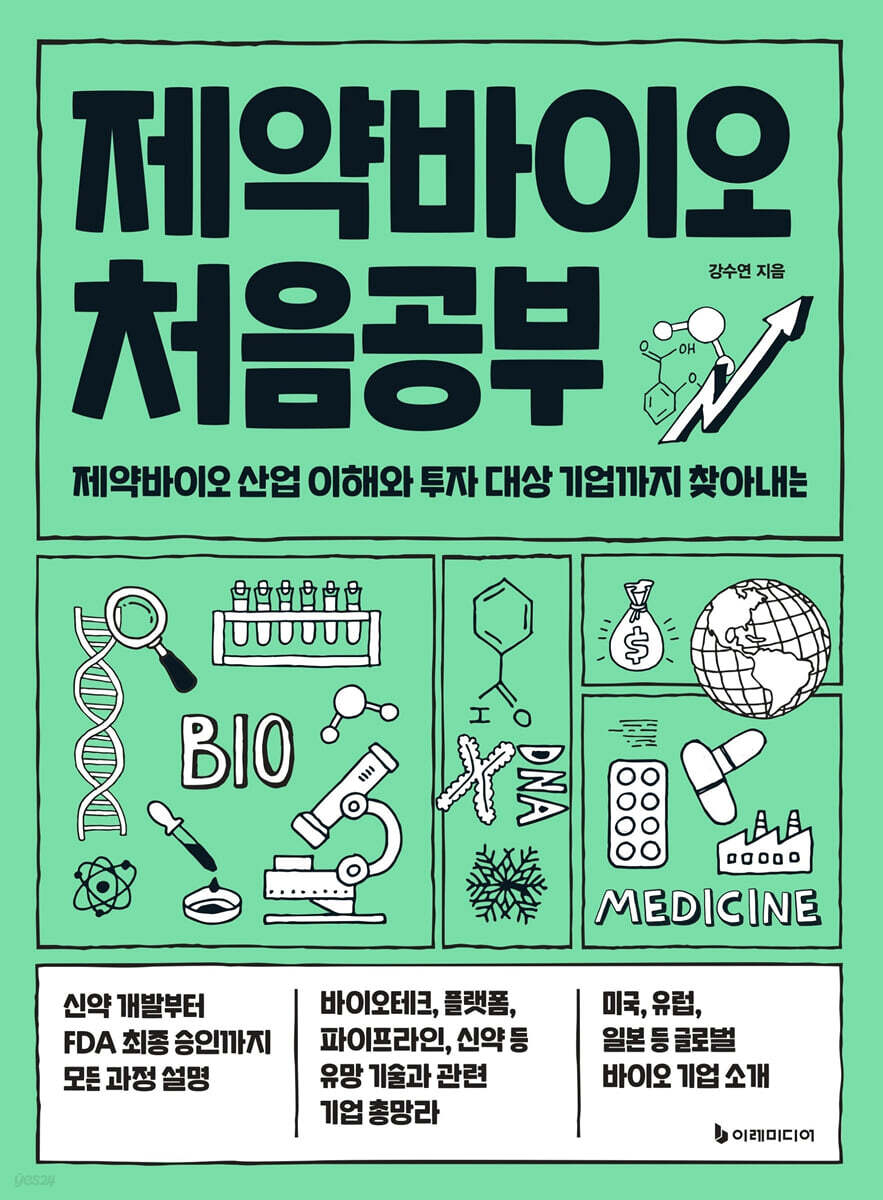
First study of pharmaceutical and biotechnology
 |
Description
Book Introduction
Explains the entire process from new drug development to final FDA approval.
A comprehensive overview of promising technologies and related companies, including biotech, platforms, pipelines, and new drugs.
Introduction to global bio companies from the US, Europe, and Japan
A single book covering everything from basic pharmaceutical and biotechnology knowledge to investment strategies!
The pharmaceutical and biotechnology industry is considered one of the most volatile and difficult to understand sectors in the stock market.
Many individual investors become overly optimistic or pessimistic after being exposed to content from news articles, blogs, YouTube, etc.
Moreover, pharmaceutical and biotech investors often have difficulty distinguishing between useful and unnecessary information.
Therefore, investors need the ability to rationally assess the complex pharmaceutical and biotechnology industries and the true value of companies.
To address these challenges, "Pharmaceutical Biotechnology: A Beginner's Guide" provides knowledge about the pharmaceutical biotechnology industry and the new drug development process, and presents a practical framework for identifying meaningful stocks.
The author, a longtime veteran of the pharmaceutical and biotechnology industry, draws on his extensive experience to objectively explain the characteristics of the rapidly evolving pharmaceutical and biotechnology industry and the factors driving stock price fluctuations through data analysis.
Avoid overly positive or pessimistic views and present a balanced picture of what constitutes risk and opportunity.
"Pharmaceutical and Biotechnology: A Beginner's Guide" is the perfect book for investors who want to make investment decisions with a cool-headed perspective, avoiding irrational judgments.
A comprehensive overview of promising technologies and related companies, including biotech, platforms, pipelines, and new drugs.
Introduction to global bio companies from the US, Europe, and Japan
A single book covering everything from basic pharmaceutical and biotechnology knowledge to investment strategies!
The pharmaceutical and biotechnology industry is considered one of the most volatile and difficult to understand sectors in the stock market.
Many individual investors become overly optimistic or pessimistic after being exposed to content from news articles, blogs, YouTube, etc.
Moreover, pharmaceutical and biotech investors often have difficulty distinguishing between useful and unnecessary information.
Therefore, investors need the ability to rationally assess the complex pharmaceutical and biotechnology industries and the true value of companies.
To address these challenges, "Pharmaceutical Biotechnology: A Beginner's Guide" provides knowledge about the pharmaceutical biotechnology industry and the new drug development process, and presents a practical framework for identifying meaningful stocks.
The author, a longtime veteran of the pharmaceutical and biotechnology industry, draws on his extensive experience to objectively explain the characteristics of the rapidly evolving pharmaceutical and biotechnology industry and the factors driving stock price fluctuations through data analysis.
Avoid overly positive or pessimistic views and present a balanced picture of what constitutes risk and opportunity.
"Pharmaceutical and Biotechnology: A Beginner's Guide" is the perfect book for investors who want to make investment decisions with a cool-headed perspective, avoiding irrational judgments.
- You can preview some of the book's contents.
Preview
index
Introduction - For Wise Pharmaceutical and Bio Investments
[Part 1] Laying the Foundations of Pharmaceutical and Biotechnology
Chapter 1.
ABCs of Pharmaceutical and Bio Investment
1.1 Why You Should Consider Pharmaceutical and Biotech Stocks
Growth potential / Increasing demand for pharmaceuticals / Resilience to economic cycles
1.2 Even when investing in ETFs, you need to have a discerning eye for industries and stocks.
1.3 Unique Characteristics of the Pharmaceutical and Biotechnology Industry
Government price controls / strict regulatory environment / market monopolies / long timelines and high costs of new drug development
1.4 Going over key terms
Brand name and active ingredient name / Chemical pharmaceuticals / Biopharmaceuticals / Original pharmaceuticals / Generic pharmaceuticals /
Biosimilar / Indication
1.5 Learn More About Biosimilars
Similar but not bioequivalent / Complex to develop and manufacture / Stricter regulatory approval requirements compared to generic drugs
Chapter 2.
The dynamism of the pharmaceutical and biotechnology industries
2.1 Market exclusivity for pharmaceuticals
Patent/Data Exclusivity/Market Exclusivity
2.2 Emergence and competition of generics and biosimilars
Original Pharmaceutical Companies' Countermeasures / Market Competition in Generics and Biosimilars
2.3 Mergers and Acquisitions and Licensing
The Significance of M&A and Licensing in the Pharmaceutical and Biotechnology Industry / M&A Process / The Impact of M&A on Stock Prices / Biotech Licensing Trends
2.4 Pressure to lower drug prices
[Part 2] From New Drug Development to Clinical Trials
Chapter 3.
New drug development process and product approval
3.1 New Drug Development Journey
Candidate discovery and development / preclinical trials / clinical trials / formulation development, process development / product approval application / product approval acquisition and launch / post-marketing safety monitoring and phase 4 clinical trials / health insurance registration
3.2 Data required for new drug approval
Data on the safety and efficacy of pharmaceuticals / Data on the quality of pharmaceuticals / Data on the manufacturing of pharmaceuticals
3.3 Expedited Drug Review System
Fast-track designation / Breakthrough therapy designation / Priority review / Accelerated approval
3.4 Delay or refusal of approval by regulatory authorities
Chapter 4.
Understanding Clinical Trials: The Core of New Drug Development
4.1 Classification of clinical trials
Human pharmacology trials / therapeutic exploratory trials / therapeutic confirmatory trials / post-approval clinical trials
4.2 Strategic Clinical Trial Design and the Importance of Clinical Trial Plans
Clinical trial title / Subject selection and exclusion criteria / Drug administered / Primary endpoint / Secondary endpoint / Clinical trial institution
4.3 Clinical trial period
Study design and size / Follow-up period / Regulatory requirements / Target disease / Interim analysis results
4.4 Clinical trial success, statistical significance, and clinical significance
Statistical significance / Clinical significance
4.5 Clinical Trial Failures and Interim Analysis
Scientific issues / Clinical trial planning issues / Issues related to clinical trial operation
4.6 Things to keep in mind when reading clinical trial results
[Part 3] Pharmaceutical and Bio Investment Practices
Chapter 5.
Types of Pharmaceutical and Bio Stocks
5.1 Biotechnology
Securing funding sources (venture capital, government subsidies, strategic partnerships, IPOs) / M&A / licensing out / Introduction to major biotechs
5.2 Large pharmaceutical companies
5.3 CRO
5.4 CDMO
5.5 Generic and Biosimilar Companies
Chapter 6.
Chapter 6: Choosing Pharmaceutical and Bio Investment Stocks
6.1 Risk Assessment Factors (4M)
Market exclusivity strategy / Market competition / Monetary stability / Milestone phase
6.2 Growth Potential Exploration Factors (4Ps)
Partnership potential / Pipeline competitiveness / Proven track record / Product power
6.3 Other things to consider before investing
Market expectations / Stock price catalyst timing / Macroeconomic factors
[Part 4] Essential Appendix for Pharmaceutical and Bio Investment
Chapter 7.
Unmet medical needs for cancer
7.1 Why Cancer is Difficult to Conquer
Heterogeneity of cancer / Adaptability and resistance of cancer cells / Metastasis / Difficulty in early diagnosis
7.2 Types of cancer with high unmet medical needs
Pancreatic cancer / biliary tract cancer / glioblastoma / liver cancer / small cell lung cancer
7.3 Trends in Anticancer Drug Research and Development
Immune checkpoint inhibitors / CAR-T therapy / antibody-drug conjugates / cancer vaccines
Chapter 8.
Pharmaceutical and bio platform technology
8.1 Antibody-drug conjugate (ADC) technology
8.2 Targeted Protein Degradation (TPD) Technology
8.3 Dual antibody technology
8.4 Subcutaneous injection formulation technology
8.5 Long-acting injectable formulation technology
8.6 Blood-brain barrier (BBB) penetration technology
Chapter 9.
Obesity Treatment Market: A Trend-Based Look
9.1 Growth of the obesity treatment market
9.2 Perspectives on the Health Benefits of Anti-Obesity Drugs
9.3 Scalability of GLP-1 receptor agonists
9.4 Efforts to improve administration convenience
9.5 Possibility of new mechanisms of action
9.6 Current Status of Obesity Treatment Development
9.7 Considerations When Investing in Obesity Treatment Development Companies
Uncertainty and market competitiveness before product approval / Securing production and supply capacity / Insurance coverage issues / Technology and differentiating factors
Chapter 10.
88 Korean pharmaceutical and biotech companies categorized by keyword
Concluding Remarks: A Journey to Smart Pharmaceutical and Biotech Investment
[Part 1] Laying the Foundations of Pharmaceutical and Biotechnology
Chapter 1.
ABCs of Pharmaceutical and Bio Investment
1.1 Why You Should Consider Pharmaceutical and Biotech Stocks
Growth potential / Increasing demand for pharmaceuticals / Resilience to economic cycles
1.2 Even when investing in ETFs, you need to have a discerning eye for industries and stocks.
1.3 Unique Characteristics of the Pharmaceutical and Biotechnology Industry
Government price controls / strict regulatory environment / market monopolies / long timelines and high costs of new drug development
1.4 Going over key terms
Brand name and active ingredient name / Chemical pharmaceuticals / Biopharmaceuticals / Original pharmaceuticals / Generic pharmaceuticals /
Biosimilar / Indication
1.5 Learn More About Biosimilars
Similar but not bioequivalent / Complex to develop and manufacture / Stricter regulatory approval requirements compared to generic drugs
Chapter 2.
The dynamism of the pharmaceutical and biotechnology industries
2.1 Market exclusivity for pharmaceuticals
Patent/Data Exclusivity/Market Exclusivity
2.2 Emergence and competition of generics and biosimilars
Original Pharmaceutical Companies' Countermeasures / Market Competition in Generics and Biosimilars
2.3 Mergers and Acquisitions and Licensing
The Significance of M&A and Licensing in the Pharmaceutical and Biotechnology Industry / M&A Process / The Impact of M&A on Stock Prices / Biotech Licensing Trends
2.4 Pressure to lower drug prices
[Part 2] From New Drug Development to Clinical Trials
Chapter 3.
New drug development process and product approval
3.1 New Drug Development Journey
Candidate discovery and development / preclinical trials / clinical trials / formulation development, process development / product approval application / product approval acquisition and launch / post-marketing safety monitoring and phase 4 clinical trials / health insurance registration
3.2 Data required for new drug approval
Data on the safety and efficacy of pharmaceuticals / Data on the quality of pharmaceuticals / Data on the manufacturing of pharmaceuticals
3.3 Expedited Drug Review System
Fast-track designation / Breakthrough therapy designation / Priority review / Accelerated approval
3.4 Delay or refusal of approval by regulatory authorities
Chapter 4.
Understanding Clinical Trials: The Core of New Drug Development
4.1 Classification of clinical trials
Human pharmacology trials / therapeutic exploratory trials / therapeutic confirmatory trials / post-approval clinical trials
4.2 Strategic Clinical Trial Design and the Importance of Clinical Trial Plans
Clinical trial title / Subject selection and exclusion criteria / Drug administered / Primary endpoint / Secondary endpoint / Clinical trial institution
4.3 Clinical trial period
Study design and size / Follow-up period / Regulatory requirements / Target disease / Interim analysis results
4.4 Clinical trial success, statistical significance, and clinical significance
Statistical significance / Clinical significance
4.5 Clinical Trial Failures and Interim Analysis
Scientific issues / Clinical trial planning issues / Issues related to clinical trial operation
4.6 Things to keep in mind when reading clinical trial results
[Part 3] Pharmaceutical and Bio Investment Practices
Chapter 5.
Types of Pharmaceutical and Bio Stocks
5.1 Biotechnology
Securing funding sources (venture capital, government subsidies, strategic partnerships, IPOs) / M&A / licensing out / Introduction to major biotechs
5.2 Large pharmaceutical companies
5.3 CRO
5.4 CDMO
5.5 Generic and Biosimilar Companies
Chapter 6.
Chapter 6: Choosing Pharmaceutical and Bio Investment Stocks
6.1 Risk Assessment Factors (4M)
Market exclusivity strategy / Market competition / Monetary stability / Milestone phase
6.2 Growth Potential Exploration Factors (4Ps)
Partnership potential / Pipeline competitiveness / Proven track record / Product power
6.3 Other things to consider before investing
Market expectations / Stock price catalyst timing / Macroeconomic factors
[Part 4] Essential Appendix for Pharmaceutical and Bio Investment
Chapter 7.
Unmet medical needs for cancer
7.1 Why Cancer is Difficult to Conquer
Heterogeneity of cancer / Adaptability and resistance of cancer cells / Metastasis / Difficulty in early diagnosis
7.2 Types of cancer with high unmet medical needs
Pancreatic cancer / biliary tract cancer / glioblastoma / liver cancer / small cell lung cancer
7.3 Trends in Anticancer Drug Research and Development
Immune checkpoint inhibitors / CAR-T therapy / antibody-drug conjugates / cancer vaccines
Chapter 8.
Pharmaceutical and bio platform technology
8.1 Antibody-drug conjugate (ADC) technology
8.2 Targeted Protein Degradation (TPD) Technology
8.3 Dual antibody technology
8.4 Subcutaneous injection formulation technology
8.5 Long-acting injectable formulation technology
8.6 Blood-brain barrier (BBB) penetration technology
Chapter 9.
Obesity Treatment Market: A Trend-Based Look
9.1 Growth of the obesity treatment market
9.2 Perspectives on the Health Benefits of Anti-Obesity Drugs
9.3 Scalability of GLP-1 receptor agonists
9.4 Efforts to improve administration convenience
9.5 Possibility of new mechanisms of action
9.6 Current Status of Obesity Treatment Development
9.7 Considerations When Investing in Obesity Treatment Development Companies
Uncertainty and market competitiveness before product approval / Securing production and supply capacity / Insurance coverage issues / Technology and differentiating factors
Chapter 10.
88 Korean pharmaceutical and biotech companies categorized by keyword
Concluding Remarks: A Journey to Smart Pharmaceutical and Biotech Investment
Detailed image

Publisher's Review
With the development of new drugs and final FDA approval,
Uncovering the pharmaceutical and biotechnology industry structure that creates a monopolistic profit structure!
The pharmaceutical and biotechnology industries are promising fields with sustained growth, but the process from candidate discovery to clinical trials, approval, and commercialization is highly complex and intertwined.
Although it has attracted a lot of investor interest due to its high growth potential, it also has the disadvantage of being difficult to understand market conditions and predict the future.
However, if you properly understand the characteristics of the pharmaceutical and biotechnology industry, you can gain a proper perspective on the market and stocks.
Furthermore, demand in the pharmaceutical and biotechnology markets is growing significantly due to not only stock investment but also technological innovation and the aging population trend in advanced countries.
In particular, blockbuster new drugs are advantageous in securing stable profits due to their high barriers to entry and increased corporate value.
Global pharmaceutical and biotech companies are investing massive amounts of money in research and development to focus on developing new drugs, and are actively pursuing the adoption of new drug development platforms and AI technologies.
We have now entered an era where pharmaceutical and biotechnology technologies have become an important criterion for evaluating national competitiveness.
When, how, and why do pharmaceutical and biotech stock prices rise?
And why does it suddenly fall?
Pharmaceutical and biotech investors often mistake insignificant news for positive news and rush to buy stocks, only to regret it later. They also often miss out on profit opportunities by selling stocks too quickly to wait.
The author wrote "Pharmaceutical Bio: A Beginner's Guide" with the conviction that individual investors can invest without being easily swayed by false expectations or disappointment if they gain a deeper understanding of the industry's operating principles, the new drug development process, and clinical trial results.
Drawing on his extensive experience developing and implementing new drug approval strategies in the pharmaceutical and biotech sectors, the author offers insights into how to identify key investment signals amidst the chaotic information landscape of the stock market.
This book explains how stock prices rise and fall at various inflection points, such as clinical trials, patent litigation, mergers and acquisitions, and pipeline construction.
Furthermore, it serves as a guide for pharmaceutical and biotech investments by combining the insights of industry experts with investor perspectives.
K-Bio, which sells not only new drugs but also platforms
If you know the pharmaceutical and bio market well, you will see the ten-bagger!
Korea was once called a bio wasteland.
However, through long-term investment, regulatory innovation, and meticulous research by biotech companies, they are successfully concluding technology transfer agreements one after another, proving their technological competitiveness in the global market.
What is noteworthy is that domestic pharmaceutical and bio companies are not limited to developing new drugs or biosimilars, but are expanding their business areas into various fields such as biotechnology, platforms, CDMOs, and obesity treatments.
Now that domestic biotech companies have proven they possess technologies directly linked to the core pipeline strategies of global big pharmas, what should we, as investors, prepare for and which companies should we invest in? "Pharmaceutical Biotechnology: A Beginner's Guide" is written by an industry insider who evaluates various pharmaceutical and biotech sectors with concrete data, helping investors make rational and objective investments.
The growth of K-Bio, which has captivated global big pharma, has just begun.
Will you hesitate in the face of fear, or will you embrace the innovation of pharmaceuticals and biotechnology? This book serves as a compass and strategic map, guiding investors to make excellent choices at that very crossroads.
Uncovering the pharmaceutical and biotechnology industry structure that creates a monopolistic profit structure!
The pharmaceutical and biotechnology industries are promising fields with sustained growth, but the process from candidate discovery to clinical trials, approval, and commercialization is highly complex and intertwined.
Although it has attracted a lot of investor interest due to its high growth potential, it also has the disadvantage of being difficult to understand market conditions and predict the future.
However, if you properly understand the characteristics of the pharmaceutical and biotechnology industry, you can gain a proper perspective on the market and stocks.
Furthermore, demand in the pharmaceutical and biotechnology markets is growing significantly due to not only stock investment but also technological innovation and the aging population trend in advanced countries.
In particular, blockbuster new drugs are advantageous in securing stable profits due to their high barriers to entry and increased corporate value.
Global pharmaceutical and biotech companies are investing massive amounts of money in research and development to focus on developing new drugs, and are actively pursuing the adoption of new drug development platforms and AI technologies.
We have now entered an era where pharmaceutical and biotechnology technologies have become an important criterion for evaluating national competitiveness.
When, how, and why do pharmaceutical and biotech stock prices rise?
And why does it suddenly fall?
Pharmaceutical and biotech investors often mistake insignificant news for positive news and rush to buy stocks, only to regret it later. They also often miss out on profit opportunities by selling stocks too quickly to wait.
The author wrote "Pharmaceutical Bio: A Beginner's Guide" with the conviction that individual investors can invest without being easily swayed by false expectations or disappointment if they gain a deeper understanding of the industry's operating principles, the new drug development process, and clinical trial results.
Drawing on his extensive experience developing and implementing new drug approval strategies in the pharmaceutical and biotech sectors, the author offers insights into how to identify key investment signals amidst the chaotic information landscape of the stock market.
This book explains how stock prices rise and fall at various inflection points, such as clinical trials, patent litigation, mergers and acquisitions, and pipeline construction.
Furthermore, it serves as a guide for pharmaceutical and biotech investments by combining the insights of industry experts with investor perspectives.
K-Bio, which sells not only new drugs but also platforms
If you know the pharmaceutical and bio market well, you will see the ten-bagger!
Korea was once called a bio wasteland.
However, through long-term investment, regulatory innovation, and meticulous research by biotech companies, they are successfully concluding technology transfer agreements one after another, proving their technological competitiveness in the global market.
What is noteworthy is that domestic pharmaceutical and bio companies are not limited to developing new drugs or biosimilars, but are expanding their business areas into various fields such as biotechnology, platforms, CDMOs, and obesity treatments.
Now that domestic biotech companies have proven they possess technologies directly linked to the core pipeline strategies of global big pharmas, what should we, as investors, prepare for and which companies should we invest in? "Pharmaceutical Biotechnology: A Beginner's Guide" is written by an industry insider who evaluates various pharmaceutical and biotech sectors with concrete data, helping investors make rational and objective investments.
The growth of K-Bio, which has captivated global big pharma, has just begun.
Will you hesitate in the face of fear, or will you embrace the innovation of pharmaceuticals and biotechnology? This book serves as a compass and strategic map, guiding investors to make excellent choices at that very crossroads.
GOODS SPECIFICS
- Date of issue: June 9, 2025
- Page count, weight, size: 256 pages | 542g | 170*235*18mm
- ISBN13: 9791193394687
- ISBN10: 1193394686
You may also like
카테고리
korean


korean

![GQ KOREA Mark (Monthly): December [2025]](http://librairie.coreenne.fr/cdn/shop/files/8ef265dbbfbf186523ed75ba7319009d.jpg?v=1765340328&width=3840)


