

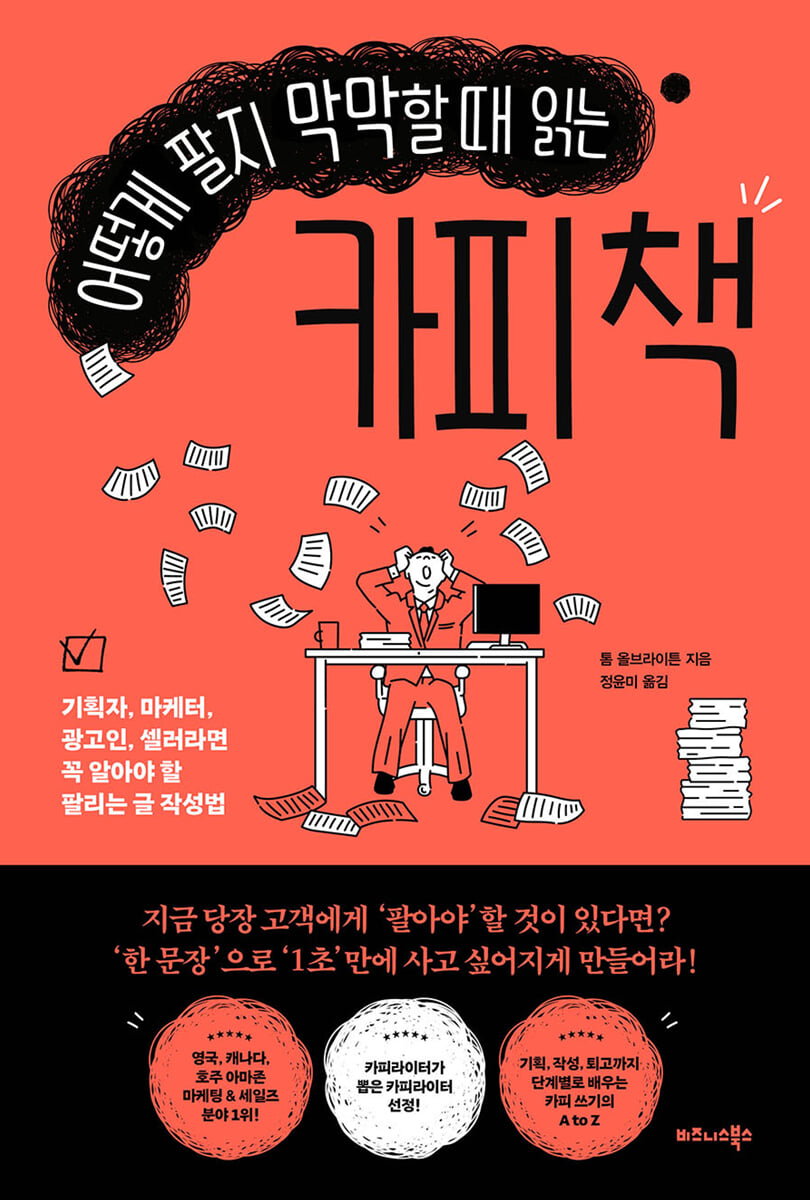
A copybook to read when you're at a loss as to how to sell.
 |
Description
Book Introduction
#1 in Amazon Marketing & Sales in the UK, Canada, and Australia! The perfect copy formula that sells in 'one second' with 'one sentence'! A book like 'cider' that will solve your worries about how to sell! “We solve your heating problems.” vs. “I’ll fix your boiler.” “Four Ways to Avoid Wasting Money on Wine You Don’t Like.” vs. “Four ways to buy only the wines you love.” Which sentence moves your heart? The answer is always the latter. This is because it attracts the customer's attention by using easy and simple words instead of complex and difficult words, and a positive tone instead of a negative tone. A well-written copy like this brings the customer across the room closer to the target (product or service) we are trying to sell. That's why anyone who wants to sell something—whether they're a planner, marketer, self-employed person, or a solo seller dreaming of starting an online business—needs a "one sentence" that will move the hearts of customers. If you're feeling lost because you've created a great product but it's not selling or attracting customers' attention, it's time to train yourself to write sentences that sell! This book contains a three-step copywriting formula that creates emotion and resonance, from planning to writing and proofreading. By examining over 100 examples of copy and real-life advertising photos, you'll learn the writing formula that will make your product stand out. Additionally, it contains various diagrams and illustrations so that anyone can understand the content quickly and easily. At the end of each chapter, there's a "Practical Exercises for Copy That Sells" section where you can discover "selling points" in everyday life and learn how to make your brand stand out. By following this book, you can captivate your customers with a single verb instead of adverbs and adjectives, and imprint your brand in their minds with catchy rhymes. If you can master the magic of these diverse copy, your customers will find your brand first without you having to shout, leading to increased sales. |
- You can preview some of the book's contents.
Preview
index
Introduction_ How to Write Copy That Moves Hearts and Changes Behavior
Part 1: Planning Your Advertising Copy
01_ What to Sell: Identifying the Products and Services You Want to Sell
The essence of copywriting is 'to sell'
You can show as much as you know and sell as much as you know.
Meet, experience, and talk in person
How to avoid the curse of knowledge
02_ What to Sell: Everything about Benefits that Make People Open Their Wallets and Click
The Difference Between Features and Benefits: Information or Benefits?
If there is no benefit, customers won't even look at it.
Sell the sizzle, not the sausage.
Tangible benefits and heart-pounding benefits
Why do we scream first and rationalize later?
“So what is it?”
A unique benefit called 'product-specific strengths'
Even for the same product, each person's attraction is different.
To target experts and early adopters
03_ Who are you targeting? There is no product that everyone needs.
Who is this ad for?
How do they live?: Create a profile
What Do They Want?: Identifying Needs
How do they feel?: Empathize
Focus on the leader's actions, not his words.
Imaginary Leaders, Marketing Personas
How to Make Leaders Naturally Integrate into Your Advertising
04_ Starting the copywriting process, writing a brief: defining the role and effectiveness of copy and setting goals
Copywriting Needs a Rulebook Too
A brief is a promise between a copywriter and a client.
Example of a Copywriting Brief
The more detailed the plan, the more perfect the execution.
Part 2: Writing Advertising Copy
05_ One eye-catching sentence is enough: Creating a powerful headline that starts and ends your ad
What is a headline?
Express it as it is
Let them know that this ad is 'for you'
Hey, here's something you might like.
Stimulate curiosity and memory
Make them answer the question
Explain the 'justification and reason'
It is human nature to be attracted to 'new things'.
Why 'Just Do It' Was a Success
06_ The Secret to Writing Copy That Will Make You Read It All: Structuring Your Ad Copy
There is an order to organizing ideas.
Always start strong
So what are the benefits?
The AIDA Formula: The Basic Framework for Copywriting
Show the problem and suggest a solution
What Happens in Our Heads Before We Spend Money
Buyer vs.
People who actually use it
Drawing a family tree for effective information delivery
The irresistible phrase, "○○ ways"
The more difficult it is, the easier it seems, the more unfamiliar it is, the more familiar it seems
How to Use the 'Magic of 3'
A good article to look at is also good to read.
07_ How to Get People to Do What You Want Naturally: Presenting a Call to Action That Encourages Action
How to Transform a "Listener" into a "Doer"
Basic Call to Action: Giving a Firm Order
Emphasize and persuade the benefits
Show that it's simple, fast, and easy.
Provide a stepping stone for crossing
Part 3: Upgrading Your Ad Copy
08_ How to Create Memorable Advertisements: 20 Copywriting Techniques that Create Resonance and Emotion
Creativity: A Key Element in Creating Advertising Copy
The purpose of advertising creativity is to 'solve problems'.
1.
Focus on simplicity and the core
2.
Connect ideas in new combinations
3.
Turn it over and look at it crookedly
4.
Explaining the new in a familiar way with metaphors
5.
Balance tension and integration, showing contrast
6.
A humorous tactic that instantly imprints the advertisement
7.
Fun but never light, a play on words
8.
Sometimes an image is worth a thousand words.
9.
Give the pleasure of finding hidden meanings
10.
Create shock and emotional turmoil
11.
The moment you flip it over, a new idea is born.
12.
Rephrase it in the opposite way
13.
Same product, different perspectives, unexpected results
14.
How to make someone know without saying anything
15.
The 'buyer' doesn't have to be the protagonist.
16.
To answer the question, “So what is it?”
17.
Break the fourth wall
18.
Borrow awareness and attention
19.
Timing is everything, getting on top of the issue
20.
Don't hesitate to use references.
09_ When your thoughts reach a dead end: Six ways to overcome idea exhaustion
1.
Just think about it
2.
Change the location
3.
Try freewriting
4.
Use your unconscious mind
5.
Think of the 'worst idea'
6.
How to cherish fragile ideas
10_ Is this ad a conversation or a notification?: How to speak to the leader so that he or she can hear it.
What is 'engagement'?
Advertising is a private conversation with a leader.
The illusion that the client is the leader
Dialogue scenarios that predict the leader's response
'We' not 'You'
The best writing sounds like words
Can you repeat the ad copy to a friend?
Use everyday words as they are
Think from the leader's perspective
Use concrete expressions, not concepts.
Verbs rather than nouns, active rather than passive voice
Close the gap between words and reality
Let me hear, see, and touch
The more you tell them not to do something, the more they want to do it.
Avoid jargon and clichés whenever possible.
A Copywriter's Powerful Weapon: Storytelling
11_ All First Drafts Are Garbage: A Revision Strategy That Brings Life to Your Copy
Fix it, fix it, fix it again
Write briefly.
Then it will be read
The more you think, 'This is well written,' the more careful you should be.
Haven't you been telling only nice stories?
Get out of the sea of modifiers
There is no right answer.
There is only an optimal length
When to go fast and when to go slow
Create a rhythm that sticks in your ears
Make it rhyme to make it sound fun
Stand out with your double-edged sword
Keep it short and to the point
Sometimes rules are best broken
Check for errors with fresh eyes
12_ Make an Offer They Can't Refuse: Six Principles for Making Your Advertising Copy More Persuasive
Why I'm Not Convinced Even by Clear Benefits
Persuasion without purpose is just an empty echo.
Six Persuasion Techniques to Win People's Hearts
Connect all the principles and use them
To change a leader who does not want to change
13_ How to Scientifically Move People: Nine Psychological Techniques to Maximize the Effectiveness of Your Copy
It all depends on the mind
1.
The Endowment Effect: Why Free Samples Aren't "Free"
2.
Loss aversion: the unpleasantness of unbearable loss
3.
The Forer Effect: The Most Powerful Technique for Eliciting Empathy
4.
Cost Reframing: What is the Baseline?
5.
Sunk costs: "Since you've already spent money, why not spend some more?"
6.
The Reactance Effect: Our Innate Rebellious Instinct
7.
Infiltration Command: It seems like a command, but it's not a command.
8.
Double Bind: Two Paths to Purchase
9.
Discrimination Bias: The Desire for "Better"
14_ Creating a Trustworthy Voice: Creating a Consistent Brand Tone
The secret of a brand that you can know the moment you see it
If a brand were a person
Dig into human characteristics
Reveal your brand's authenticity
From character to value
From value to tone
Sometimes, your tone must change to suit the situation.
Creating guidelines for tone
Five Characteristics of Tone Used in Real Life
Chapter 15: Is My Copy That Weird?: How to Respond Wisely to Client Feedback Requests
Clients and copywriters are in the same boat
Respect feedback and read it carefully.
Neither the copywriter nor the client are the protagonists.
Wrong directions lead to the wrong destination.
The courage to reject wrong feedback
Going out_ The best copy is 'your own copy'!
Acknowledgements
main
Part 1: Planning Your Advertising Copy
01_ What to Sell: Identifying the Products and Services You Want to Sell
The essence of copywriting is 'to sell'
You can show as much as you know and sell as much as you know.
Meet, experience, and talk in person
How to avoid the curse of knowledge
02_ What to Sell: Everything about Benefits that Make People Open Their Wallets and Click
The Difference Between Features and Benefits: Information or Benefits?
If there is no benefit, customers won't even look at it.
Sell the sizzle, not the sausage.
Tangible benefits and heart-pounding benefits
Why do we scream first and rationalize later?
“So what is it?”
A unique benefit called 'product-specific strengths'
Even for the same product, each person's attraction is different.
To target experts and early adopters
03_ Who are you targeting? There is no product that everyone needs.
Who is this ad for?
How do they live?: Create a profile
What Do They Want?: Identifying Needs
How do they feel?: Empathize
Focus on the leader's actions, not his words.
Imaginary Leaders, Marketing Personas
How to Make Leaders Naturally Integrate into Your Advertising
04_ Starting the copywriting process, writing a brief: defining the role and effectiveness of copy and setting goals
Copywriting Needs a Rulebook Too
A brief is a promise between a copywriter and a client.
Example of a Copywriting Brief
The more detailed the plan, the more perfect the execution.
Part 2: Writing Advertising Copy
05_ One eye-catching sentence is enough: Creating a powerful headline that starts and ends your ad
What is a headline?
Express it as it is
Let them know that this ad is 'for you'
Hey, here's something you might like.
Stimulate curiosity and memory
Make them answer the question
Explain the 'justification and reason'
It is human nature to be attracted to 'new things'.
Why 'Just Do It' Was a Success
06_ The Secret to Writing Copy That Will Make You Read It All: Structuring Your Ad Copy
There is an order to organizing ideas.
Always start strong
So what are the benefits?
The AIDA Formula: The Basic Framework for Copywriting
Show the problem and suggest a solution
What Happens in Our Heads Before We Spend Money
Buyer vs.
People who actually use it
Drawing a family tree for effective information delivery
The irresistible phrase, "○○ ways"
The more difficult it is, the easier it seems, the more unfamiliar it is, the more familiar it seems
How to Use the 'Magic of 3'
A good article to look at is also good to read.
07_ How to Get People to Do What You Want Naturally: Presenting a Call to Action That Encourages Action
How to Transform a "Listener" into a "Doer"
Basic Call to Action: Giving a Firm Order
Emphasize and persuade the benefits
Show that it's simple, fast, and easy.
Provide a stepping stone for crossing
Part 3: Upgrading Your Ad Copy
08_ How to Create Memorable Advertisements: 20 Copywriting Techniques that Create Resonance and Emotion
Creativity: A Key Element in Creating Advertising Copy
The purpose of advertising creativity is to 'solve problems'.
1.
Focus on simplicity and the core
2.
Connect ideas in new combinations
3.
Turn it over and look at it crookedly
4.
Explaining the new in a familiar way with metaphors
5.
Balance tension and integration, showing contrast
6.
A humorous tactic that instantly imprints the advertisement
7.
Fun but never light, a play on words
8.
Sometimes an image is worth a thousand words.
9.
Give the pleasure of finding hidden meanings
10.
Create shock and emotional turmoil
11.
The moment you flip it over, a new idea is born.
12.
Rephrase it in the opposite way
13.
Same product, different perspectives, unexpected results
14.
How to make someone know without saying anything
15.
The 'buyer' doesn't have to be the protagonist.
16.
To answer the question, “So what is it?”
17.
Break the fourth wall
18.
Borrow awareness and attention
19.
Timing is everything, getting on top of the issue
20.
Don't hesitate to use references.
09_ When your thoughts reach a dead end: Six ways to overcome idea exhaustion
1.
Just think about it
2.
Change the location
3.
Try freewriting
4.
Use your unconscious mind
5.
Think of the 'worst idea'
6.
How to cherish fragile ideas
10_ Is this ad a conversation or a notification?: How to speak to the leader so that he or she can hear it.
What is 'engagement'?
Advertising is a private conversation with a leader.
The illusion that the client is the leader
Dialogue scenarios that predict the leader's response
'We' not 'You'
The best writing sounds like words
Can you repeat the ad copy to a friend?
Use everyday words as they are
Think from the leader's perspective
Use concrete expressions, not concepts.
Verbs rather than nouns, active rather than passive voice
Close the gap between words and reality
Let me hear, see, and touch
The more you tell them not to do something, the more they want to do it.
Avoid jargon and clichés whenever possible.
A Copywriter's Powerful Weapon: Storytelling
11_ All First Drafts Are Garbage: A Revision Strategy That Brings Life to Your Copy
Fix it, fix it, fix it again
Write briefly.
Then it will be read
The more you think, 'This is well written,' the more careful you should be.
Haven't you been telling only nice stories?
Get out of the sea of modifiers
There is no right answer.
There is only an optimal length
When to go fast and when to go slow
Create a rhythm that sticks in your ears
Make it rhyme to make it sound fun
Stand out with your double-edged sword
Keep it short and to the point
Sometimes rules are best broken
Check for errors with fresh eyes
12_ Make an Offer They Can't Refuse: Six Principles for Making Your Advertising Copy More Persuasive
Why I'm Not Convinced Even by Clear Benefits
Persuasion without purpose is just an empty echo.
Six Persuasion Techniques to Win People's Hearts
Connect all the principles and use them
To change a leader who does not want to change
13_ How to Scientifically Move People: Nine Psychological Techniques to Maximize the Effectiveness of Your Copy
It all depends on the mind
1.
The Endowment Effect: Why Free Samples Aren't "Free"
2.
Loss aversion: the unpleasantness of unbearable loss
3.
The Forer Effect: The Most Powerful Technique for Eliciting Empathy
4.
Cost Reframing: What is the Baseline?
5.
Sunk costs: "Since you've already spent money, why not spend some more?"
6.
The Reactance Effect: Our Innate Rebellious Instinct
7.
Infiltration Command: It seems like a command, but it's not a command.
8.
Double Bind: Two Paths to Purchase
9.
Discrimination Bias: The Desire for "Better"
14_ Creating a Trustworthy Voice: Creating a Consistent Brand Tone
The secret of a brand that you can know the moment you see it
If a brand were a person
Dig into human characteristics
Reveal your brand's authenticity
From character to value
From value to tone
Sometimes, your tone must change to suit the situation.
Creating guidelines for tone
Five Characteristics of Tone Used in Real Life
Chapter 15: Is My Copy That Weird?: How to Respond Wisely to Client Feedback Requests
Clients and copywriters are in the same boat
Respect feedback and read it carefully.
Neither the copywriter nor the client are the protagonists.
Wrong directions lead to the wrong destination.
The courage to reject wrong feedback
Going out_ The best copy is 'your own copy'!
Acknowledgements
main
Detailed image

Into the book
Copywriting is a kind of bridge-building activity.
At one end of the bridge are the 'people' (customers) who read the advertising copy, and at the other end are the copywriter and the 'target' he has to sell.
Copywriters have to get people to cross that bridge and become interested in the product or service they're trying to sell.
It doesn't matter what people are thinking or feeling right now.
Copywriters have to change their thoughts and feelings to get them to cross the bridge, to act differently.
--- From "How to Write Copy That Moves Hearts and Changes Behavior"
Even the same product can provide different benefits to different people.
And we shouldn't assume that the buyer is necessarily a 'user'.
In other words, while advertising copy is targeted at buyers, there may be other people who actually benefit from using the product.
It is also possible that such real users can have a significant influence on purchasing decisions without being seen.
Let's think about school uniforms.
While price and durability are paramount for parents, students prioritize comfort and style.
Therefore, the school uniform that satisfies both parents and students will sell best.
Even if parents buy a good quality and inexpensive cardigan for their child, it is meaningless if the child doesn't wear it and just stuffs it in his or her school bag.
--- From "02_What to Sell"
The phrase '10 percent battery remaining' doesn't tell you anything about the product.
But it reminds me of an awkward situation that many people have experienced at least once.
If this phrase triggers people's memories, they will look closely at the advertising copy that follows.
This can be more effective than advertising copy that simply introduces a direct benefit, such as "Charge your phone on your way to work."
--- From "05_One sentence that catches the eye is enough"
I never read The Economist.
-Intern (42 years old)
The hidden strategy of this ad is to connect the magazine it is advertising with its information power.
This copy does not directly mention benefits.
But the fact that he's still an intern even though he's 42 years old shows the intent of the advertisement.
If you don't read this magazine, you're not smart.
It also means that if this person reads The Economist, he would be much better off than he is now.
--- From "08_How to Create Memorable Advertisements"
Renowned copywriter Tony Brignull once said, “Treat adjectives and adverbs like they’re worth £500 each.
But the verb doesn't cost any money," he said.
After you've actually finished your advertising copy, ask yourself if you'd be willing to pay £500 for each adjective or adverb.
If you can answer that you are willing to pay, then that adjective or adverb is absolutely necessary.
But if you find yourself tilting your head, it's better to absorb the meaning of the adjective or adverb into the verb or replace it with a word with a stronger meaning.
--- From "11_All First Drafts Are Trash"
“Thousands of people visit this webpage every day and pledge to donate their organs.” This ad copy was eventually used for a short time and then disappeared as the number of pledges actually decreased.
The problem with this copy is that it gives the leader a reason not to pledge.
Because thousands of people take the pledge every day, it made me think, 'I don't really need to come forward and take the pledge.'
It would have been better to apply the principle of scarcity and emphasize how few people are willing to donate their organs.
This is not to say that if a leader does not act, he or she will suffer, but rather to make it known that if a leader does not act, 'others' will suffer.
--- From "12_Make an Offer They Can't Refuse"
If you honestly state the price of a product in an advertisement, the reader will compare that price to the "cost" of not buying it at all, which is zero.
But if you mention other numbers first in the ad, the leader starts comparing them one by one in his head.
This process of limiting a leader's expectations to a specific range is called 'anchoring'.
If you mention a higher price before revealing the actual price of the product, the leader will feel that the price is cheaper the moment he hears it.
At one end of the bridge are the 'people' (customers) who read the advertising copy, and at the other end are the copywriter and the 'target' he has to sell.
Copywriters have to get people to cross that bridge and become interested in the product or service they're trying to sell.
It doesn't matter what people are thinking or feeling right now.
Copywriters have to change their thoughts and feelings to get them to cross the bridge, to act differently.
--- From "How to Write Copy That Moves Hearts and Changes Behavior"
Even the same product can provide different benefits to different people.
And we shouldn't assume that the buyer is necessarily a 'user'.
In other words, while advertising copy is targeted at buyers, there may be other people who actually benefit from using the product.
It is also possible that such real users can have a significant influence on purchasing decisions without being seen.
Let's think about school uniforms.
While price and durability are paramount for parents, students prioritize comfort and style.
Therefore, the school uniform that satisfies both parents and students will sell best.
Even if parents buy a good quality and inexpensive cardigan for their child, it is meaningless if the child doesn't wear it and just stuffs it in his or her school bag.
--- From "02_What to Sell"
The phrase '10 percent battery remaining' doesn't tell you anything about the product.
But it reminds me of an awkward situation that many people have experienced at least once.
If this phrase triggers people's memories, they will look closely at the advertising copy that follows.
This can be more effective than advertising copy that simply introduces a direct benefit, such as "Charge your phone on your way to work."
--- From "05_One sentence that catches the eye is enough"
I never read The Economist.
-Intern (42 years old)
The hidden strategy of this ad is to connect the magazine it is advertising with its information power.
This copy does not directly mention benefits.
But the fact that he's still an intern even though he's 42 years old shows the intent of the advertisement.
If you don't read this magazine, you're not smart.
It also means that if this person reads The Economist, he would be much better off than he is now.
--- From "08_How to Create Memorable Advertisements"
Renowned copywriter Tony Brignull once said, “Treat adjectives and adverbs like they’re worth £500 each.
But the verb doesn't cost any money," he said.
After you've actually finished your advertising copy, ask yourself if you'd be willing to pay £500 for each adjective or adverb.
If you can answer that you are willing to pay, then that adjective or adverb is absolutely necessary.
But if you find yourself tilting your head, it's better to absorb the meaning of the adjective or adverb into the verb or replace it with a word with a stronger meaning.
--- From "11_All First Drafts Are Trash"
“Thousands of people visit this webpage every day and pledge to donate their organs.” This ad copy was eventually used for a short time and then disappeared as the number of pledges actually decreased.
The problem with this copy is that it gives the leader a reason not to pledge.
Because thousands of people take the pledge every day, it made me think, 'I don't really need to come forward and take the pledge.'
It would have been better to apply the principle of scarcity and emphasize how few people are willing to donate their organs.
This is not to say that if a leader does not act, he or she will suffer, but rather to make it known that if a leader does not act, 'others' will suffer.
--- From "12_Make an Offer They Can't Refuse"
If you honestly state the price of a product in an advertisement, the reader will compare that price to the "cost" of not buying it at all, which is zero.
But if you mention other numbers first in the ad, the leader starts comparing them one by one in his head.
This process of limiting a leader's expectations to a specific range is called 'anchoring'.
If you mention a higher price before revealing the actual price of the product, the leader will feel that the price is cheaper the moment he hears it.
--- From "13_How to Scientifically Move the Human Heart"
Publisher's Review
Best-selling brands have a 'one sentence' that attracts customers!
The magic of powerful copy that will make even the most turned-away customers open their wallets!
“Bed is science”, “Sunday is 0000 chef…”
Remember those ads above? The moment you hear those phrases, people naturally think of a specific product.
Dozens, even hundreds, of products and services are created every day, but the single most important factor in surviving the fierce competition is this one sentence.
Well-written copy changes people's thoughts, actions, and even emotions, naturally creating a connection between the brand and customers.
Feeling lost and confused about how to sell? Then, let's learn the various copywriting formulas that will help you create a brand that customers seek out first.
Planning copy, writing copy, and upgrading copy
Just learn the 3-step formula and your sales will start to increase!
What you want to sell can be a product or service, or a brand or idea itself.
But no matter what we want to sell, our ultimate task is to find out what interests people and 'move their hearts'.
If you master the three-step formula in this book, you'll be able to write sentences that will engage and move your customers, no matter what you're selling.
Step 1: Plan Your Ad Copy “Remember, you’re ultimately selling to the ‘customer’!”
Most sellers try to reach customers by listing the features of their product.
You must not be mistaken.
Your customers are not currently interested in what you are trying to sell.
What they are interested in is 'themselves'.
That's why you have to convince them of what 'benefits' your product can provide to 'them'.
In Part 1, we'll look at what you need to know before you write a selling sentence.
Figure out what benefits your product can provide to customers and envision who the customers are who actually need that experience.
Draw a picture of your specific customer and imagine where they live, what they want, and what they feel.
After that, plan how to approach your customers.
Let's look at an example.
“99.9 percent antibacterial effect” vs.
“Because you are precious.”
The former presents specific figures and talks about 'realistic benefits', while the latter approaches customers emotionally and subjectively and talks about 'abstract benefits'.
Most products offer both "tangible benefits" and "abstract benefits," but which one you focus on depends on what you're selling.
For example, in the case of computers or electronic devices, it would be more effective to focus on the 'practical benefits', but in the case of insurance, it is more important to consider what value they can provide in the future.
In this way, Part 1 will go over things you should consider before writing actual sentences.
Step 2: Write your ad copy: “One sentence is all it takes to grab attention!”
Now, let's write a sentence to sell it in earnest.
The most important thing is to write a headline that immediately grabs the customer's attention.
Part 2 teaches you how to write actionable sentences that actually get your customers to "click" on your product and make a purchase.
Let's look at a few methods together.
“10 percent battery left.”
Reading the above sentence, we can naturally imagine the difficult situation of having a low battery on our cell phone.
These sentences don't give any information about the actual product.
But it subtly piques curiosity by drawing on the customer's memories and experiences.
"Why the server in your office will soon become obsolete."
The above sentence makes me imagine a short drama.
It is a strategy that uses giving reasons and justifications.
As customers read this sentence, they begin to wonder, "Why?" why they should choose this product.
In Part 2, you'll learn effective strategies for structuring sentences in various ways and encouraging customers to take action.
Step 3: Upgrade Your Ad Copy: “There’s no such thing as perfect copy from the start!”
Do you feel like the sentences you've painstakingly crafted aren't appealing to your customers at all? If so, don't worry.
You're not the only one who wants to throw the sentence you just wrote in the trash right now.
Anyone who is at a loss about how to sell has probably thought about this at least once.
Part 3 will teach you 20 copywriting techniques to help you communicate the sentences you've written more effectively to your customers.
You'll also learn nine scientific psychological techniques to captivate hesitant customers, as well as principles for persuasively engaging with them.
“Spotify Free is currently invitation-only.
You will need to obtain an invitation token to access this service.”
Spotify, a real-world music sharing service, advertises that its service can be accessed through a limited number of "invitation tokens."
However, since the number of invitations that can be made per customer is 10, the service actually provided is not rare.
However, customers feel that this service is exclusive and very special.
By emphasizing scarcity in this way, customers feel compelled to act "now" rather than "later" and purchase the product.
If you learn these various psychological techniques and principles of persuasion to move the hearts of your target audience, your customers will be captivated and have no choice but to buy your product.
By the time you finish this book, you'll spend less time worrying about how to sell your products, and you'll experience the miracle of increased sales just by changing a single word or sentence.
The magic of powerful copy that will make even the most turned-away customers open their wallets!
“Bed is science”, “Sunday is 0000 chef…”
Remember those ads above? The moment you hear those phrases, people naturally think of a specific product.
Dozens, even hundreds, of products and services are created every day, but the single most important factor in surviving the fierce competition is this one sentence.
Well-written copy changes people's thoughts, actions, and even emotions, naturally creating a connection between the brand and customers.
Feeling lost and confused about how to sell? Then, let's learn the various copywriting formulas that will help you create a brand that customers seek out first.
Planning copy, writing copy, and upgrading copy
Just learn the 3-step formula and your sales will start to increase!
What you want to sell can be a product or service, or a brand or idea itself.
But no matter what we want to sell, our ultimate task is to find out what interests people and 'move their hearts'.
If you master the three-step formula in this book, you'll be able to write sentences that will engage and move your customers, no matter what you're selling.
Step 1: Plan Your Ad Copy “Remember, you’re ultimately selling to the ‘customer’!”
Most sellers try to reach customers by listing the features of their product.
You must not be mistaken.
Your customers are not currently interested in what you are trying to sell.
What they are interested in is 'themselves'.
That's why you have to convince them of what 'benefits' your product can provide to 'them'.
In Part 1, we'll look at what you need to know before you write a selling sentence.
Figure out what benefits your product can provide to customers and envision who the customers are who actually need that experience.
Draw a picture of your specific customer and imagine where they live, what they want, and what they feel.
After that, plan how to approach your customers.
Let's look at an example.
“99.9 percent antibacterial effect” vs.
“Because you are precious.”
The former presents specific figures and talks about 'realistic benefits', while the latter approaches customers emotionally and subjectively and talks about 'abstract benefits'.
Most products offer both "tangible benefits" and "abstract benefits," but which one you focus on depends on what you're selling.
For example, in the case of computers or electronic devices, it would be more effective to focus on the 'practical benefits', but in the case of insurance, it is more important to consider what value they can provide in the future.
In this way, Part 1 will go over things you should consider before writing actual sentences.
Step 2: Write your ad copy: “One sentence is all it takes to grab attention!”
Now, let's write a sentence to sell it in earnest.
The most important thing is to write a headline that immediately grabs the customer's attention.
Part 2 teaches you how to write actionable sentences that actually get your customers to "click" on your product and make a purchase.
Let's look at a few methods together.
“10 percent battery left.”
Reading the above sentence, we can naturally imagine the difficult situation of having a low battery on our cell phone.
These sentences don't give any information about the actual product.
But it subtly piques curiosity by drawing on the customer's memories and experiences.
"Why the server in your office will soon become obsolete."
The above sentence makes me imagine a short drama.
It is a strategy that uses giving reasons and justifications.
As customers read this sentence, they begin to wonder, "Why?" why they should choose this product.
In Part 2, you'll learn effective strategies for structuring sentences in various ways and encouraging customers to take action.
Step 3: Upgrade Your Ad Copy: “There’s no such thing as perfect copy from the start!”
Do you feel like the sentences you've painstakingly crafted aren't appealing to your customers at all? If so, don't worry.
You're not the only one who wants to throw the sentence you just wrote in the trash right now.
Anyone who is at a loss about how to sell has probably thought about this at least once.
Part 3 will teach you 20 copywriting techniques to help you communicate the sentences you've written more effectively to your customers.
You'll also learn nine scientific psychological techniques to captivate hesitant customers, as well as principles for persuasively engaging with them.
“Spotify Free is currently invitation-only.
You will need to obtain an invitation token to access this service.”
Spotify, a real-world music sharing service, advertises that its service can be accessed through a limited number of "invitation tokens."
However, since the number of invitations that can be made per customer is 10, the service actually provided is not rare.
However, customers feel that this service is exclusive and very special.
By emphasizing scarcity in this way, customers feel compelled to act "now" rather than "later" and purchase the product.
If you learn these various psychological techniques and principles of persuasion to move the hearts of your target audience, your customers will be captivated and have no choice but to buy your product.
By the time you finish this book, you'll spend less time worrying about how to sell your products, and you'll experience the miracle of increased sales just by changing a single word or sentence.
GOODS SPECIFICS
- Date of issue: May 28, 2024
- Page count, weight, size: 380 pages | 656g | 152*225*22mm
- ISBN13: 9791162543740
- ISBN10: 1162543744
You may also like
카테고리
korean


korean

![GQ KOREA Mark (Monthly): December [2025]](http://librairie.coreenne.fr/cdn/shop/files/8ef265dbbfbf186523ed75ba7319009d.jpg?v=1765340328&width=3840)


