

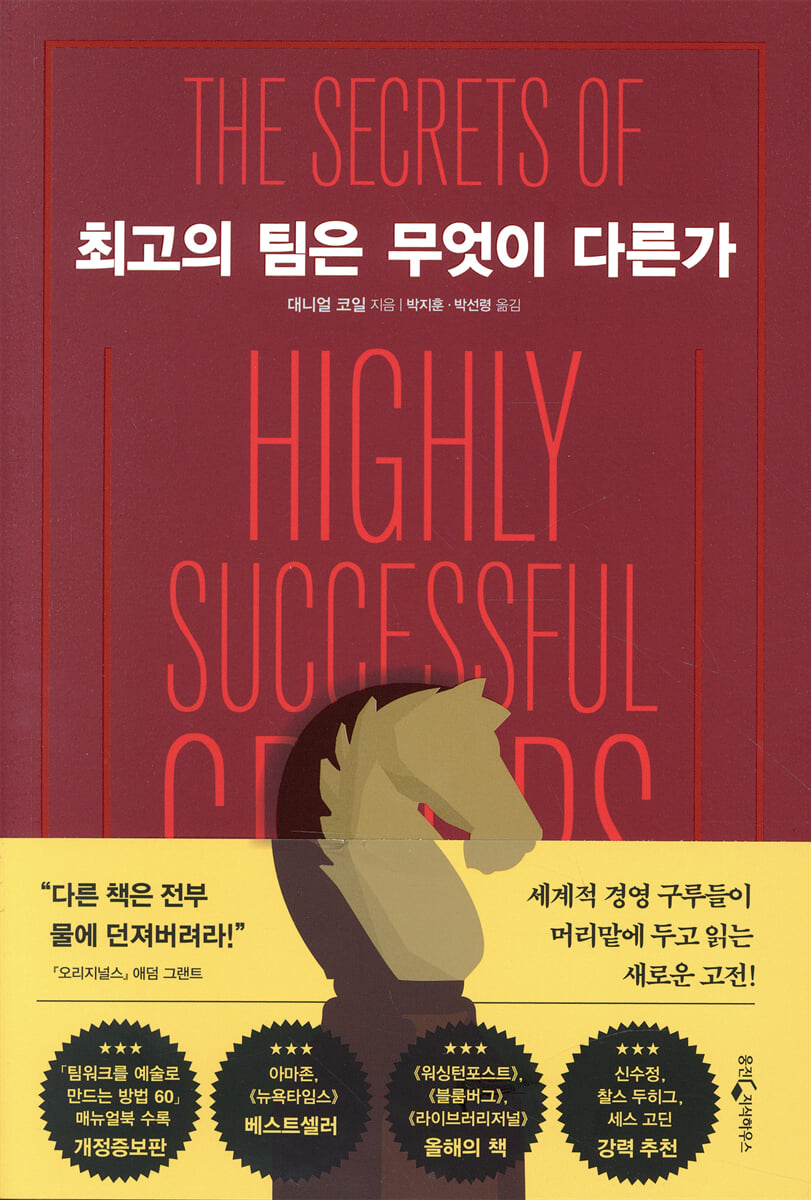
What Makes the Best Teams Different?
 |
Description
Book Introduction
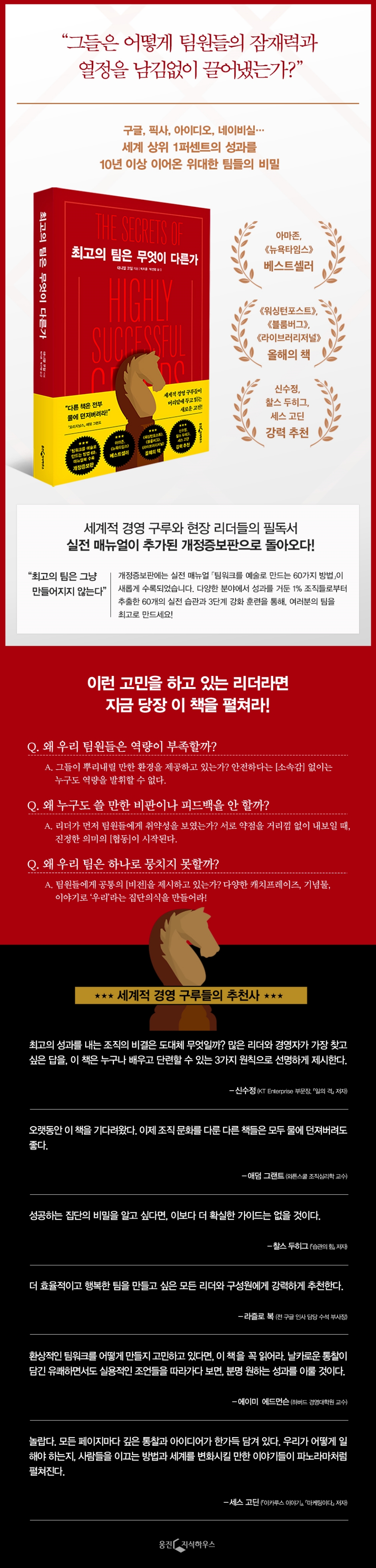
A new classic that world-class management gurus keep on their bedside tables.
A must-read for field leaders and team members, now revised and expanded after four years!
“Throw all the other books into the water!”
*Amazon, [New York Times] bestseller
*[Washington Post], [Bloomberg], [Library Journal] Book of the Year
*Highly recommended by Shin Soo-jung, Adam Grant, Amy Edmondson, Charles Duhigg, and Seth Godin
*Newly included in the practical manual "60 Ways to Turn Teamwork into Art"
Since its publication in 2018, "What Makes the Best Teams Different" has been considered a must-read for global management gurus and field leaders, establishing itself as a "new classic" in the field of organizational management. Four years later, a revised and expanded edition has been published.
This book was highly recommended by the world's top business experts, including Shin Soo-jung, head of KT Enterprise, Amy Edmondson, professor at Harvard Business School, and Charles Duhigg, author of "The Power of Habit." Wharton School professor Adam Grant praised it so highly that he said, "You can throw all other books in the water."
It has also been cited by executives and team leaders who lead actual organizations as “a book that can be applied immediately” and “a book that team members want to read and discuss together.”
What secret lies behind this book that has earned it such consistent love?
Daniel Coyle, renowned journalist and bestselling author of The Talent Code, was uncovering the secrets of people with special talents for a New York Times cover story when he was suddenly struck by a question.
'Why do some groups become smaller than the sum of their individual abilities, while others grow larger?' He then travels to find the best organizations.
From Silicon Valley IT companies to US Navy SEALs, NBA basketball teams, and legendary thieves, after three years of relentless investigation, the secrets of their success are finally revealed.
The kindergarten team defeats the MBA teams and wins the tower-building mission.
Google, a small venture company, and the ragtag NBA basketball team, the San Antonio Spurs, defeat their elite rivals and become champions.
This book says that the secret lies not in individual talent or effort, but in three cultural codes.
Overturning the old adage that "competent people make a competent team," it scientifically analyzes the process by which close collaboration leads to high performance.
If you want to learn the secrets of success for the top 1% of organizations, and if you want to unleash the full potential and passion of your team members as a leader, open this book now.
A must-read for field leaders and team members, now revised and expanded after four years!
“Throw all the other books into the water!”
*Amazon, [New York Times] bestseller
*[Washington Post], [Bloomberg], [Library Journal] Book of the Year
*Highly recommended by Shin Soo-jung, Adam Grant, Amy Edmondson, Charles Duhigg, and Seth Godin
*Newly included in the practical manual "60 Ways to Turn Teamwork into Art"
Since its publication in 2018, "What Makes the Best Teams Different" has been considered a must-read for global management gurus and field leaders, establishing itself as a "new classic" in the field of organizational management. Four years later, a revised and expanded edition has been published.
This book was highly recommended by the world's top business experts, including Shin Soo-jung, head of KT Enterprise, Amy Edmondson, professor at Harvard Business School, and Charles Duhigg, author of "The Power of Habit." Wharton School professor Adam Grant praised it so highly that he said, "You can throw all other books in the water."
It has also been cited by executives and team leaders who lead actual organizations as “a book that can be applied immediately” and “a book that team members want to read and discuss together.”
What secret lies behind this book that has earned it such consistent love?
Daniel Coyle, renowned journalist and bestselling author of The Talent Code, was uncovering the secrets of people with special talents for a New York Times cover story when he was suddenly struck by a question.
'Why do some groups become smaller than the sum of their individual abilities, while others grow larger?' He then travels to find the best organizations.
From Silicon Valley IT companies to US Navy SEALs, NBA basketball teams, and legendary thieves, after three years of relentless investigation, the secrets of their success are finally revealed.
The kindergarten team defeats the MBA teams and wins the tower-building mission.
Google, a small venture company, and the ragtag NBA basketball team, the San Antonio Spurs, defeat their elite rivals and become champions.
This book says that the secret lies not in individual talent or effort, but in three cultural codes.
Overturning the old adage that "competent people make a competent team," it scientifically analyzes the process by which close collaboration leads to high performance.
If you want to learn the secrets of success for the top 1% of organizations, and if you want to unleash the full potential and passion of your team members as a leader, open this book now.
- You can preview some of the book's contents.
Preview
index
Prologue: How Kindergarteners Beat the MBA Team
PART1.
Is your team a place to put down roots?
Chapter 1.
Commonalities of High-Performing Organizations
The Secret of Outlier Groups Revealed by the Poisoned Apple Experiment
10 Communication Techniques for Creating Great Chemistry
-A source of psychological safety, a signal of belonging
-The answer is in the signal
Chapter 2.
Why Affiliation Signals Matter
How Google Toppled an Industry Giant
-A sense of belonging is formed outside, not inside.
Success Story 1: The Christmas Armistice
Success Story 2: The One-Hour Training That Changed Everything
-Failure Case: Missile Force Problems
Chapter 3.
Analog communication methods that break down relationship barriers
NBA problem child transforms into top team player
-Analog skinship with renowned director Popovich
The premise of good feedback: "It has to be you."
Chapter 4.
Conditions for an organization that attracts people
How a Startup with No Money Became the Best
The 'Collision' Law of the Eccentric Billionaire
-Your performance depends on the spacing between desks?
◆12 Leader Behavioral Strategies for Enhancing a Sense of Belonging
PART2.
How to Respond to Vulnerabilities
Chapter 5.
Why Vulnerability Links Are Essential
The Strange Conversation That Saved 185 Lives
-Turn simple connections into collaborations.
The Link of Vulnerability: Sharing Suffering Becomes United
Lessons from the Red Balloon Project
Chapter 6.
How to Train Your Collaborative Muscles
-Something Delta Force doesn't have, but Navy SEALs do.
-The principle of cooperation hidden in the log PT
The Engine of Vulnerability: The Secret of Improvisation [Harold]
-“They think with one brain.”
Chapter 7.
Questions that bring out the truth
-Leadership that led the most effective teams on the planet
-The Bin Laden Assassination Operation: The Courage to Face Inconvenient Truths
-The Secret to Bell Labs' Surprising Success
- Asking questions that hit the right spot
-Great listeners create 'us'
◆ Leaders' Behavioral Strategies for Developing Habits of Cooperation 13
PART3.
Is there a story that creates 'us'?
Chapter 8.
Setting a common milestone
A one-page motto that saved a company on the brink of collapse.
-How to make everyone see the same thing
-Stories move people.
How are high-purpose environments created?
Chapter 9.
Messages need direction too
-Priorities of Michelin-starred restaurants
-The more important the value, the more you should name it.
The surprising power of clichés
Chapter 10.
How to Create a Sustainable Team
-The one thing Pixar focused on
-The mechanism that creates the best out of the worst
-Be a supporter, not a leader.
◆7 Action Strategies for Visionary Leaders
Epilogue The best teams aren't just made.
annotation
[Book in Book]
60 Ways to Make Teamwork an Art
Getting Started: Your Team Can Become Great, Too
Strength Training Level 0: Team Reality Awareness
STEP1.
Belonging: No individual is greater than the team.
Strengthening Training Phase 1: Strengthening Team Safety
STEP2.
Collaboration: Be proactive in sharing your weaknesses.
Strengthening Training Phase 2: Strengthening Team Communication
STEP3.
Vision: Get everyone looking in the same direction
Strengthening Training Step 3: Strengthening Team Purpose
PART1.
Is your team a place to put down roots?
Chapter 1.
Commonalities of High-Performing Organizations
The Secret of Outlier Groups Revealed by the Poisoned Apple Experiment
10 Communication Techniques for Creating Great Chemistry
-A source of psychological safety, a signal of belonging
-The answer is in the signal
Chapter 2.
Why Affiliation Signals Matter
How Google Toppled an Industry Giant
-A sense of belonging is formed outside, not inside.
Success Story 1: The Christmas Armistice
Success Story 2: The One-Hour Training That Changed Everything
-Failure Case: Missile Force Problems
Chapter 3.
Analog communication methods that break down relationship barriers
NBA problem child transforms into top team player
-Analog skinship with renowned director Popovich
The premise of good feedback: "It has to be you."
Chapter 4.
Conditions for an organization that attracts people
How a Startup with No Money Became the Best
The 'Collision' Law of the Eccentric Billionaire
-Your performance depends on the spacing between desks?
◆12 Leader Behavioral Strategies for Enhancing a Sense of Belonging
PART2.
How to Respond to Vulnerabilities
Chapter 5.
Why Vulnerability Links Are Essential
The Strange Conversation That Saved 185 Lives
-Turn simple connections into collaborations.
The Link of Vulnerability: Sharing Suffering Becomes United
Lessons from the Red Balloon Project
Chapter 6.
How to Train Your Collaborative Muscles
-Something Delta Force doesn't have, but Navy SEALs do.
-The principle of cooperation hidden in the log PT
The Engine of Vulnerability: The Secret of Improvisation [Harold]
-“They think with one brain.”
Chapter 7.
Questions that bring out the truth
-Leadership that led the most effective teams on the planet
-The Bin Laden Assassination Operation: The Courage to Face Inconvenient Truths
-The Secret to Bell Labs' Surprising Success
- Asking questions that hit the right spot
-Great listeners create 'us'
◆ Leaders' Behavioral Strategies for Developing Habits of Cooperation 13
PART3.
Is there a story that creates 'us'?
Chapter 8.
Setting a common milestone
A one-page motto that saved a company on the brink of collapse.
-How to make everyone see the same thing
-Stories move people.
How are high-purpose environments created?
Chapter 9.
Messages need direction too
-Priorities of Michelin-starred restaurants
-The more important the value, the more you should name it.
The surprising power of clichés
Chapter 10.
How to Create a Sustainable Team
-The one thing Pixar focused on
-The mechanism that creates the best out of the worst
-Be a supporter, not a leader.
◆7 Action Strategies for Visionary Leaders
Epilogue The best teams aren't just made.
annotation
[Book in Book]
60 Ways to Make Teamwork an Art
Getting Started: Your Team Can Become Great, Too
Strength Training Level 0: Team Reality Awareness
STEP1.
Belonging: No individual is greater than the team.
Strengthening Training Phase 1: Strengthening Team Safety
STEP2.
Collaboration: Be proactive in sharing your weaknesses.
Strengthening Training Phase 2: Strengthening Team Communication
STEP3.
Vision: Get everyone looking in the same direction
Strengthening Training Step 3: Strengthening Team Purpose
Detailed image
Into the book
Business school students appear to be helping each other, but in reality they are just obsessed with status management.
They find their role and place in the big picture.
Your mind is filled with thoughts like, 'Who is in charge?', 'Is it okay to criticize that person's ideas?', and 'What rules should I follow?'
We spend so much time protecting our positions instead of focusing on what needs to be done that we miss the real problem.
(……) Kindergarten children don’t win because they’re smart.
The reason they win is because they cooperate more cleverly.
If ordinary people gathered together used the same methods as children, they could achieve something greater than the sum of their abilities.
This book is about how this method works.
---From the "Prologue"
Google was a hotbed of belonging signals.
They worked shoulder to shoulder, safely connected to each other and immersed themselves in the project.
On the other hand, Overture, although well-funded and in a favorable position in many ways, was held back by rigid communication and bureaucratic systems.
Deciding on a single issue required numerous meetings and approval from multiple committees.
The overture's affiliation signal had to be relatively weak.
Google didn't win the billion-dollar game because it was smarter.
Because it was safer.
---「Chapter 2.
From “Why Affiliation Signals Are Important”
Spurs players gathered in the conference room to analyze the game against Oklahoma City.
The players sat down, trembling.
Everyone expected Popovich to go through all the mistakes they made the night before, detailing what they did wrong and what they could have done better.
Popovich silently showed the players a video: a CNN documentary commemorating the 50th anniversary of the Voting Rights Act.
(……) The players thought, answered, and agreed with each other’s opinions.
Again they talked.
It was a common sight at Spurs.
Popovich led the conversation on topics such as the Syrian war, regime change in Argentina, same-sex marriage, racism and terrorism.
In fact, the subject matter didn't matter to Popovich, as long as he could convey just one message.
“We are all connected.” That fact was bigger and more important than basketball.
---「Chapter 3.
From "Analog Communication Methods that Break Down Relationship Barriers"
In the process of creating a team that boasts high performance and excellent teamwork, outstanding intelligence or extensive experience did not play a major role.
Rather, there was a closer relationship between the location and distance of the desk.
“The simple act of making eye contact and sharing each other’s traces at close range is more important than you might think.
Just seeing someone else's things or space while you're working can remind you of their presence, and this can have a huge impact.
(……) If you are on the same team but your colleagues are working on different floors, it is as if you are in different countries.”
---「Chapter 4.
From “Conditions for an organization that attracts people”
The mechanism of cooperation can be summarized as follows:
"We instinctively try to hide our vulnerabilities, but revealing them actually builds trust and fosters cooperation." This directly connects to the principles of teamwork.
As we will see shortly, cooperation does not suddenly diminish.
It is like a kind of 'group muscle', and communication is formed through repetition in a specific pattern.
A group of people expose their vulnerabilities, share risks, but ultimately share a rewarding process.
---「Chapter 5.
From “Why Vulnerability Links Are Essential”
We usually think of motivation and goals as being an innate part of an individual's nature.
From that perspective, people either have motivation or desire or they don't.
But what a series of experiments shows is that motivation is not something that is given, but rather something that is created through communication in a certain way.
"Your current address is here, and where you want to go is over there." This shared future can become a goal or lead to action.
Like Johnson & Johnson's slogan, "We put our customers' safety first," or the Navy SEALs' slogan, "We shoot, we move, we communicate."
It is important to create a connection and to have a continuous connection around it.
In other words, the key is to convey the ‘story.’
---「Chapter 8.
From “Setting a Common Milestone”
Catmull, tasked with reviving Disney as the world's leading animation brand, first overhauled the decision-making system.
The source of creativity is placed in the hands of the director, not the executives.
In the new system, directors were not assigned tasks, but came up with and pursued their own ideas.
Executives have moved beyond their role as directors to support the director and team.
(……) What happened? Since 2010, the Disney team has risen to the level of Pixar with the success of Tangled, Wreck-It Ralph, Frozen, Big Hero 6, and Zootopia.
Catmull emphasizes that there was virtually no turnover among employees during this process.
(……) Setting creative goals has little to do with creativity.
To foster innovation, you need to empower people, support those in power, and channel the group's energy in one direction.
The energy poured into a passionate, error-filled, and rewarding journey breathes life into creativity.
---「Chapter 10.
From “How to Create a Sustainable Team”
We tend to think that smart people who achieve great things are somewhat tolerable even if they have bad personalities or behave badly.
But that kind of thinking is wrong.
Sir Alex Ferguson, the former manager of Manchester United and considered one of the greatest managers in European football history, had only one principle that led the team to success for 27 years.
“You don’t need a player bigger than the team.” Numerous studies show that the negative impact of high-performing “smart idiots” on the group is greater than the benefits they bring.
A zero-tolerance policy toward such fools effectively sends a neon-blinking signal of belonging to its members.
No one, no matter how talented, is more important than the rest of the group.
---「Step 1.
From "No individual is greater than the team"
If you were to use only one of the 60 tips in this book, I recommend this one.
It's a post-mortem review.
This is a powerful tool for building trust based on simple facts: discussing the strengths and weaknesses of your accomplishments will improve group performance.
The Navy SEALs further refined AAR, the post-action review feedback tool that originated in the military, and it became the foundation for their unique teamwork.
After a project, sales call, or meeting, get your team together and discuss the following questions:
The goal of conversation is not to determine who deserves praise and who deserves blame.
It's about clarifying the situation so we can all learn together.
▶ What went well?
▶ What didn't go well?
▶ What will you do differently next time?
They find their role and place in the big picture.
Your mind is filled with thoughts like, 'Who is in charge?', 'Is it okay to criticize that person's ideas?', and 'What rules should I follow?'
We spend so much time protecting our positions instead of focusing on what needs to be done that we miss the real problem.
(……) Kindergarten children don’t win because they’re smart.
The reason they win is because they cooperate more cleverly.
If ordinary people gathered together used the same methods as children, they could achieve something greater than the sum of their abilities.
This book is about how this method works.
---From the "Prologue"
Google was a hotbed of belonging signals.
They worked shoulder to shoulder, safely connected to each other and immersed themselves in the project.
On the other hand, Overture, although well-funded and in a favorable position in many ways, was held back by rigid communication and bureaucratic systems.
Deciding on a single issue required numerous meetings and approval from multiple committees.
The overture's affiliation signal had to be relatively weak.
Google didn't win the billion-dollar game because it was smarter.
Because it was safer.
---「Chapter 2.
From “Why Affiliation Signals Are Important”
Spurs players gathered in the conference room to analyze the game against Oklahoma City.
The players sat down, trembling.
Everyone expected Popovich to go through all the mistakes they made the night before, detailing what they did wrong and what they could have done better.
Popovich silently showed the players a video: a CNN documentary commemorating the 50th anniversary of the Voting Rights Act.
(……) The players thought, answered, and agreed with each other’s opinions.
Again they talked.
It was a common sight at Spurs.
Popovich led the conversation on topics such as the Syrian war, regime change in Argentina, same-sex marriage, racism and terrorism.
In fact, the subject matter didn't matter to Popovich, as long as he could convey just one message.
“We are all connected.” That fact was bigger and more important than basketball.
---「Chapter 3.
From "Analog Communication Methods that Break Down Relationship Barriers"
In the process of creating a team that boasts high performance and excellent teamwork, outstanding intelligence or extensive experience did not play a major role.
Rather, there was a closer relationship between the location and distance of the desk.
“The simple act of making eye contact and sharing each other’s traces at close range is more important than you might think.
Just seeing someone else's things or space while you're working can remind you of their presence, and this can have a huge impact.
(……) If you are on the same team but your colleagues are working on different floors, it is as if you are in different countries.”
---「Chapter 4.
From “Conditions for an organization that attracts people”
The mechanism of cooperation can be summarized as follows:
"We instinctively try to hide our vulnerabilities, but revealing them actually builds trust and fosters cooperation." This directly connects to the principles of teamwork.
As we will see shortly, cooperation does not suddenly diminish.
It is like a kind of 'group muscle', and communication is formed through repetition in a specific pattern.
A group of people expose their vulnerabilities, share risks, but ultimately share a rewarding process.
---「Chapter 5.
From “Why Vulnerability Links Are Essential”
We usually think of motivation and goals as being an innate part of an individual's nature.
From that perspective, people either have motivation or desire or they don't.
But what a series of experiments shows is that motivation is not something that is given, but rather something that is created through communication in a certain way.
"Your current address is here, and where you want to go is over there." This shared future can become a goal or lead to action.
Like Johnson & Johnson's slogan, "We put our customers' safety first," or the Navy SEALs' slogan, "We shoot, we move, we communicate."
It is important to create a connection and to have a continuous connection around it.
In other words, the key is to convey the ‘story.’
---「Chapter 8.
From “Setting a Common Milestone”
Catmull, tasked with reviving Disney as the world's leading animation brand, first overhauled the decision-making system.
The source of creativity is placed in the hands of the director, not the executives.
In the new system, directors were not assigned tasks, but came up with and pursued their own ideas.
Executives have moved beyond their role as directors to support the director and team.
(……) What happened? Since 2010, the Disney team has risen to the level of Pixar with the success of Tangled, Wreck-It Ralph, Frozen, Big Hero 6, and Zootopia.
Catmull emphasizes that there was virtually no turnover among employees during this process.
(……) Setting creative goals has little to do with creativity.
To foster innovation, you need to empower people, support those in power, and channel the group's energy in one direction.
The energy poured into a passionate, error-filled, and rewarding journey breathes life into creativity.
---「Chapter 10.
From “How to Create a Sustainable Team”
We tend to think that smart people who achieve great things are somewhat tolerable even if they have bad personalities or behave badly.
But that kind of thinking is wrong.
Sir Alex Ferguson, the former manager of Manchester United and considered one of the greatest managers in European football history, had only one principle that led the team to success for 27 years.
“You don’t need a player bigger than the team.” Numerous studies show that the negative impact of high-performing “smart idiots” on the group is greater than the benefits they bring.
A zero-tolerance policy toward such fools effectively sends a neon-blinking signal of belonging to its members.
No one, no matter how talented, is more important than the rest of the group.
---「Step 1.
From "No individual is greater than the team"
If you were to use only one of the 60 tips in this book, I recommend this one.
It's a post-mortem review.
This is a powerful tool for building trust based on simple facts: discussing the strengths and weaknesses of your accomplishments will improve group performance.
The Navy SEALs further refined AAR, the post-action review feedback tool that originated in the military, and it became the foundation for their unique teamwork.
After a project, sales call, or meeting, get your team together and discuss the following questions:
The goal of conversation is not to determine who deserves praise and who deserves blame.
It's about clarifying the situation so we can all learn together.
▶ What went well?
▶ What didn't go well?
▶ What will you do differently next time?
---「Step 2.
From “Actively share your weaknesses”
From “Actively share your weaknesses”
Publisher's Review
Google, Pixar, IDEO, Navy SEALs…
The Secret of Teams That Grew to the Top 1% in the World Over 10 Years
“A genius feeds ten thousand.” “A lion led by a flock of sheep will defeat a flock of lions led by sheep.” These adages, emphasizing individual talent and strong leadership, have long been held up as truths that drive organizational success.
Accordingly, numerous groups, including the government, corporations, the military, and schools, were looking for only the 'capable' individuals with the best qualifications and charisma.
Just as 1 plus 1 equals 2, I believed that if I just gathered the best people, the best team would be created on its own.
But is that really true? In reality, the exact opposite happens.
In Nokia's tower-building experiment, a team of kindergarteners defeated an elite MBA team.
Google, a small venture company, won the competition against the large company Overture and became the number one company.
The NBA's most winning team over the past 20 years hasn't been a team with massive financial resources, but rather a classic "small-market" team: the San Antonio Spurs.
What was the secret to their success? It was teamwork and team culture.
Daniel Coyle, a renowned journalist and bestselling author of The Talent Code, who uncovered the secrets of people who demonstrate extraordinary talent even in difficult environments, scientifically analyzes how a culture that fosters collaboration and close relationships among its members leads to outstanding performance in this book, The Talent Code.
This is the result of three years of direct reporting on the world's best teams, which have achieved performance in the top 1% of the world and have been on the rise for at least 10 years.
Through in-depth coverage of the world's top teams, including Google, Pixar, the Navy SEALs, a role model for special forces around the world, and the San Antonio Spurs, the NBA's highest-winning team, we reveal how a well-crafted organizational culture can create explosive synergy.
“Why are some teams greater than the sum of their parts?”
3 Codes for Building a Great Team of Ordinary People
What is the real secret to the success of the world's best teams, as revealed by the author? While their organizational structures and individual team members varied greatly, they all had one thing in common.
There was a special atmosphere within the team.
The author, who went out to report, thought, “I want to work here with them for a longer time, even if it means changing jobs.”
Often, the importance of an organization's culture is overlooked, like the air it breathes.
But anyone can intuitively understand it.
The warm and vibrant atmosphere you feel when you enter an organization with a strong culture, and the cold and depressed atmosphere you feel when you enter an organization with a weak culture.
A ‘good culture’ is never formed by accident.
This book says there is a way to create a "good culture" that creates a great team that exceeds the sum of its individual members' abilities.
It's about a sense of belonging that feels safe within the organization, collaboration that exposes vulnerability, and a shared vision.
The author clearly presents, through specific examples and scientific analysis, how these three cultural codes, which transform ordinary people into top-tier teams, work within organizations.
Through this book, readers will gain a clearer understanding of the concept of the "best team," something they've only vaguely grasped until now, and will also learn practical, specific know-how that can be applied to any group.
A must-read for field leaders,
Build artistic teamwork with 60 practical habits!
Author Daniel Coyle emphasizes that leaders hold the key to transforming an organization into a "great place to work," one that achieves both remarkable performance and member satisfaction.
This is not to say that all matters should be led by a charismatic leader.
This means that rather than being a helmsman who directly controls the ship, you should become a captain who oversees all operations and naturally develops the capabilities of the members.
The existing book also briefly provided leadership behavioral strategies to enhance a sense of belonging, cooperation, and vision through tips on "Leader Behavioral Strategies" summarized at the end of each chapter. However, this revised and expanded edition has newly added a practical manual to solidify the specific implementation methods.
If you diligently follow the 60 practical habits and three-step reinforcement training outlined in the back of the book, you will soon grow into a leader who has mastered the secret to making 1 plus 1 not 2 but 10.
Do you want to transform your organization into a "great team to work for" and a "high-performing team?" Instead of simply blaming your team members for their abilities, do you want to fully tap into their potential and passion? This book will transform your organization from the ground up.
The Secret of Teams That Grew to the Top 1% in the World Over 10 Years
“A genius feeds ten thousand.” “A lion led by a flock of sheep will defeat a flock of lions led by sheep.” These adages, emphasizing individual talent and strong leadership, have long been held up as truths that drive organizational success.
Accordingly, numerous groups, including the government, corporations, the military, and schools, were looking for only the 'capable' individuals with the best qualifications and charisma.
Just as 1 plus 1 equals 2, I believed that if I just gathered the best people, the best team would be created on its own.
But is that really true? In reality, the exact opposite happens.
In Nokia's tower-building experiment, a team of kindergarteners defeated an elite MBA team.
Google, a small venture company, won the competition against the large company Overture and became the number one company.
The NBA's most winning team over the past 20 years hasn't been a team with massive financial resources, but rather a classic "small-market" team: the San Antonio Spurs.
What was the secret to their success? It was teamwork and team culture.
Daniel Coyle, a renowned journalist and bestselling author of The Talent Code, who uncovered the secrets of people who demonstrate extraordinary talent even in difficult environments, scientifically analyzes how a culture that fosters collaboration and close relationships among its members leads to outstanding performance in this book, The Talent Code.
This is the result of three years of direct reporting on the world's best teams, which have achieved performance in the top 1% of the world and have been on the rise for at least 10 years.
Through in-depth coverage of the world's top teams, including Google, Pixar, the Navy SEALs, a role model for special forces around the world, and the San Antonio Spurs, the NBA's highest-winning team, we reveal how a well-crafted organizational culture can create explosive synergy.
“Why are some teams greater than the sum of their parts?”
3 Codes for Building a Great Team of Ordinary People
What is the real secret to the success of the world's best teams, as revealed by the author? While their organizational structures and individual team members varied greatly, they all had one thing in common.
There was a special atmosphere within the team.
The author, who went out to report, thought, “I want to work here with them for a longer time, even if it means changing jobs.”
Often, the importance of an organization's culture is overlooked, like the air it breathes.
But anyone can intuitively understand it.
The warm and vibrant atmosphere you feel when you enter an organization with a strong culture, and the cold and depressed atmosphere you feel when you enter an organization with a weak culture.
A ‘good culture’ is never formed by accident.
This book says there is a way to create a "good culture" that creates a great team that exceeds the sum of its individual members' abilities.
It's about a sense of belonging that feels safe within the organization, collaboration that exposes vulnerability, and a shared vision.
The author clearly presents, through specific examples and scientific analysis, how these three cultural codes, which transform ordinary people into top-tier teams, work within organizations.
Through this book, readers will gain a clearer understanding of the concept of the "best team," something they've only vaguely grasped until now, and will also learn practical, specific know-how that can be applied to any group.
A must-read for field leaders,
Build artistic teamwork with 60 practical habits!
Author Daniel Coyle emphasizes that leaders hold the key to transforming an organization into a "great place to work," one that achieves both remarkable performance and member satisfaction.
This is not to say that all matters should be led by a charismatic leader.
This means that rather than being a helmsman who directly controls the ship, you should become a captain who oversees all operations and naturally develops the capabilities of the members.
The existing book also briefly provided leadership behavioral strategies to enhance a sense of belonging, cooperation, and vision through tips on "Leader Behavioral Strategies" summarized at the end of each chapter. However, this revised and expanded edition has newly added a practical manual to solidify the specific implementation methods.
If you diligently follow the 60 practical habits and three-step reinforcement training outlined in the back of the book, you will soon grow into a leader who has mastered the secret to making 1 plus 1 not 2 but 10.
Do you want to transform your organization into a "great team to work for" and a "high-performing team?" Instead of simply blaming your team members for their abilities, do you want to fully tap into their potential and passion? This book will transform your organization from the ground up.
GOODS SPECIFICS
- Publication date: November 22, 2022
- Page count, weight, size: 428 pages | 646g | 152*225*25mm
- ISBN13: 9788901266428
- ISBN10: 8901266423
You may also like
카테고리
korean


korean

![GQ KOREA Mark (Monthly): December [2025]](http://librairie.coreenne.fr/cdn/shop/files/8ef265dbbfbf186523ed75ba7319009d.jpg?v=1765340328&width=3840)


