

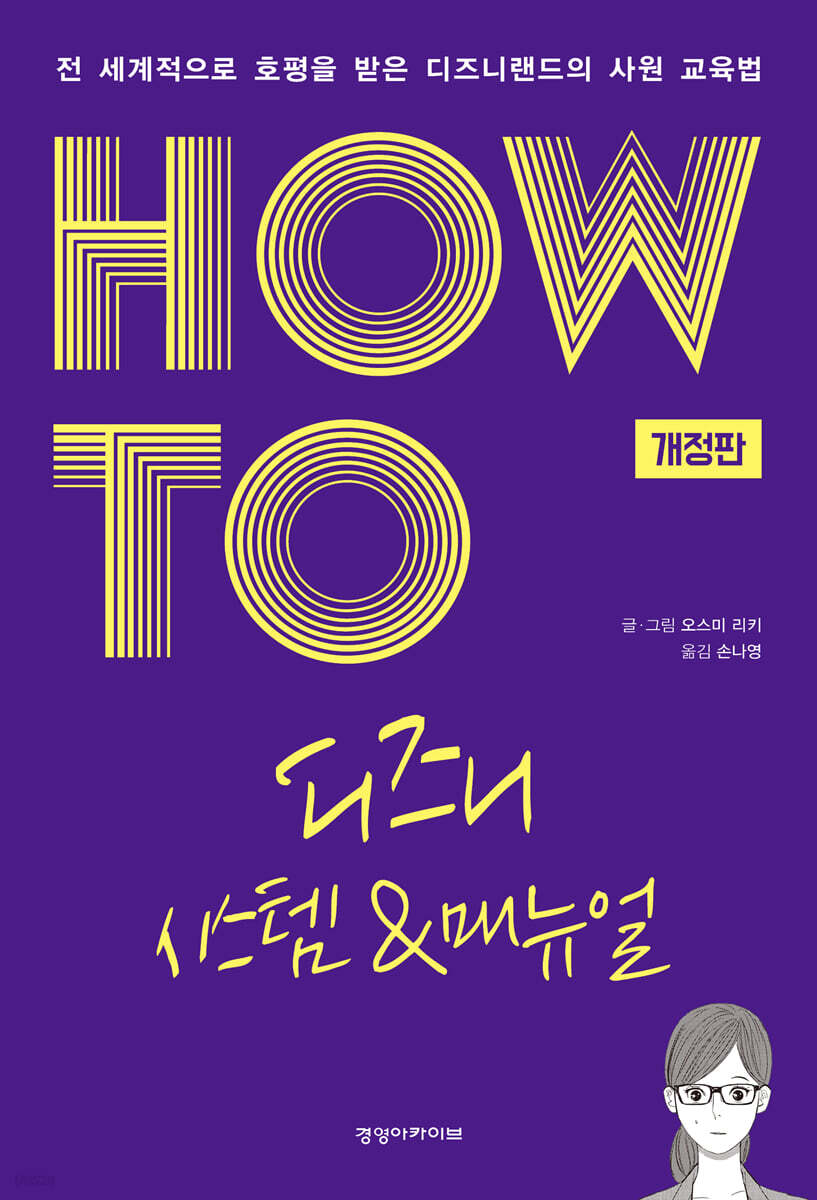
HOW TO Disney System & Manual
 |
Description
Book Introduction
Disneyland, where over 90% of the staff are part-time workers
Nevertheless, everyone provides 'miraculous service' that impresses customers.
is providing.
What on earth is the reason?
Discover Disney's system and manual know-how in one book!
Disneyland employees, who work as if it were their own business and provide the best service, even though more than 90% of the employees are part-time workers rather than full-time employees.
The secret lies in the unique Disney-style educational system and manual.
What exactly is the management manual Disney practices? What is the Disney structure that creates rules that encourage employees to work with excitement? This book introduces Disney's employee training methods and management manual, which transform anyone into a top employee. It also highlights tips and key points, presented in a comic format, so that even ordinary companies can easily apply them.
The Disney-style system introduced in this book can be applied to any workplace, including hospitality and service industries, indirect businesses with no customer contact, and companies with office work as their primary focus.
Moreover, it can be useful not only for large organizations at the company level, but also for smaller organizations such as departments, teams, and stores.
This is a must-read leadership book for anyone who wants to learn how to create a corporate manual that fosters employees who do their part based on strong relationships of trust.
Nevertheless, everyone provides 'miraculous service' that impresses customers.
is providing.
What on earth is the reason?
Discover Disney's system and manual know-how in one book!
Disneyland employees, who work as if it were their own business and provide the best service, even though more than 90% of the employees are part-time workers rather than full-time employees.
The secret lies in the unique Disney-style educational system and manual.
What exactly is the management manual Disney practices? What is the Disney structure that creates rules that encourage employees to work with excitement? This book introduces Disney's employee training methods and management manual, which transform anyone into a top employee. It also highlights tips and key points, presented in a comic format, so that even ordinary companies can easily apply them.
The Disney-style system introduced in this book can be applied to any workplace, including hospitality and service industries, indirect businesses with no customer contact, and companies with office work as their primary focus.
Moreover, it can be useful not only for large organizations at the company level, but also for smaller organizations such as departments, teams, and stores.
This is a must-read leadership book for anyone who wants to learn how to create a corporate manual that fosters employees who do their part based on strong relationships of trust.
index
Entering
Disney's Ultimate Manual for Changing Prologue Teams
Chapter 1: Boost Your Team's Abilities with the Disney Manual
Chapter 1-1 The Disney Manual was created to improve team functioning.
Chapter 1-2: The Disney Manual: The Same Results No Matter Who Runs It
Chapter 1-3 What do manuals that don't work have in common?
Chapter 2: Introducing the Disney System to Your Workplace
Chapter 2-1 The Disney System Benefits All Occupations and Companies
Chapter 2-2 A system that supports new employees and improves their work capabilities.
Chapter 2-3 Let's Create a Disney-Style Manual
Chapter 3: Disney-style training to establish the system
Chapter 3-1 What is the Brother System?
Chapter 3-2 Educational Success Depends on Communication
Chapter 4: The Disney System Creates a Vibrant Workplace
Chapter 4-1 What is the secret to Disney employees having fun at work?
Chapter 4-2 How to introduce a system that encourages the saying “thank you” in your workplace?
Chapter 5: Disney's System for Creating the Best Employees by Always Reminding Them of Disney's Philosophy
Chapter 5-1 How Disney Activates Organizations with Systems
Chapter 5-2 What is Cross-Communication?
Chapter 5-3 Studying Ideology and Founders
Chapter 5-4 How to introduce cross-communication into the workplace?
Epilogue: Disney's System Works Miracles
Conclusion
Disney's Ultimate Manual for Changing Prologue Teams
Chapter 1: Boost Your Team's Abilities with the Disney Manual
Chapter 1-1 The Disney Manual was created to improve team functioning.
Chapter 1-2: The Disney Manual: The Same Results No Matter Who Runs It
Chapter 1-3 What do manuals that don't work have in common?
Chapter 2: Introducing the Disney System to Your Workplace
Chapter 2-1 The Disney System Benefits All Occupations and Companies
Chapter 2-2 A system that supports new employees and improves their work capabilities.
Chapter 2-3 Let's Create a Disney-Style Manual
Chapter 3: Disney-style training to establish the system
Chapter 3-1 What is the Brother System?
Chapter 3-2 Educational Success Depends on Communication
Chapter 4: The Disney System Creates a Vibrant Workplace
Chapter 4-1 What is the secret to Disney employees having fun at work?
Chapter 4-2 How to introduce a system that encourages the saying “thank you” in your workplace?
Chapter 5: Disney's System for Creating the Best Employees by Always Reminding Them of Disney's Philosophy
Chapter 5-1 How Disney Activates Organizations with Systems
Chapter 5-2 What is Cross-Communication?
Chapter 5-3 Studying Ideology and Founders
Chapter 5-4 How to introduce cross-communication into the workplace?
Epilogue: Disney's System Works Miracles
Conclusion
Into the book
There are many different types of companies in the world.
And any company will have manuals, systems, and rules.
So, how do Disney's manuals and systems differ from those of a typical company? The biggest difference is whether the manuals are designed for individuals or not.
General manuals are designed to enhance an individual's abilities.
Meanwhile, Disney's manual is designed to elevate the capabilities of the entire team.
Walt Disney was a person with a lot of experience in forming teams to produce animation.
He was in his mid-50s when he opened Disneyland.
By then, Walt Disney had overcome several difficult experiences as a manager, including a studio staff strike.
--- p.36
Walt Disney felt that it wasn't that they didn't want to work or cooperate, but that they simply didn't know what to do.
So, we changed the stranger by writing a detailed manual of the tasks and procedures to be done.
Second, 'disregard' literally means 'to disregard'. If there is someone who disregards or takes a sloppy approach to the established rules, cracks will appear in the results of the work.
For example, if you skip the intermediate steps while cleaning because you think it's "too much of a hassle" or "you can't tell at first glance," the rules you've been firmly following will become distorted.
Third, ‘mindless’ refers to a state in which one does not know ‘why this service should be provided’ or ‘why this procedure is necessary’ and just moves like a machine.
You could also call it a suspension of thought due to familiarity.
Although I think I'm doing my job properly, I end up doing it half-heartedly, ignoring the essence and falling into mannerism.
“Rather than kicking out these members, we change them by creating a simple and clear manual.
Then, the team can produce consistent results, regardless of individual ability.” This is the essence of the manual defined by Walt Disney.
--- p.38
What would happen if all members followed the manual? We could break the "2.6.2 rule" in organizational theory.
The '2.6.2 Law' is a theory that holds that the top 20% of productive and active people lead the organization, the middle 60% are average, and the bottom 20% are made up of members who are low in both performance and productivity and do not take active action.
However, if you gather the top 20% of members and create a new organization, the distribution of talent within that organization is said to be 2:6:2.
In fact, Walt Disney faced the same problem.
So what he came up with was to leverage all of his employees, 100% of his constituents, by using a manual to manage the bottom 20%.
We will create an environment where anyone can perform the minimum 'necessary tasks' without any problems.
Rather than relying on the power of a specific individual, we will raise the average of all members.
By achieving these two things, we were able to dramatically increase the team's capabilities.
--- p.68
As the saying goes, "Even beads need to be strung to become a treasure," no matter how excellent a manual is, it is useless if it is not adopted by employees.
This is also the case at Disney sites, and a system has been created to prevent this.
The reason all Disneyland employees are familiar with the manual is thanks to a system called the "Brother System."
This is a refined version of the 'Elder System' (on-site practical guidance from senior employees to new employees) that can be found in general companies.
It is a system where new employees are assigned a senior employee as their exclusive training manager and receive guidance from him.
Up to this point, it is no different from a normal company.
However, this 'brother system' is characterized by the fact that the senior in charge provides guidance to the junior in charge almost one-on-one, and that the training is thorough regardless of whether it is public or private.
It's Disney's unique system that hopes that paired seniors and juniors will grow like brothers.
Since seniors are always around and can give advice right away when you don't know something, situations like "I don't know what to do" or "I'm too anxious to properly serve customers" never arise.
--- p.104
"Employees quit quickly," "There's no sense of unity within the organization or team," "Subordinates don't take initiative," "The company as a whole is lacking energy." I'm sure some leaders among you have these concerns. In fact, when I give lectures or give training sessions, I often hear these questions and share these concerns with others.
Working at Disneyland means there are a lot of manuals to follow, and since you're working in a crowded amusement park every day, you're bound to be busy during your shift.
Despite this, Disneyland employees always work with a bright and positive attitude.
What's surprising is that 90% of the employees working at Disneyland are part-time workers.
We don't hire special people, and our hourly wages aren't high compared to other companies.
But it's surprising that other companies envy the work attitude of such ordinary people.
So, what's the secret to Disney employees' joy at work? It's "self-efficacy."
'Self-efficacy' is a term used in psychology.
In simple terms, it means, “I am helping others!” and “I am being recognized by others!”
--- p.138
Cross-communication is a method of semi-forcing employees to participate in communication.
This is a system that creates time to share thoughts face-to-face regardless of age, gender, position, nationality, career, etc.
In workplaces with morning and evening meetings, we are sometimes forced to engage in one-way communication, such as checking monthly target figures, listening to a short speech from the boss, or reciting the founding principles.
The idea is to use that time for ‘cross-communication.’
Rather than one person speaking unilaterally, the group freely and honestly discusses positive themes, such as happy or good things that happened that day.
It would be great if you could talk about essential topics like "why are you doing this?" and connect them to the company's philosophy.
--- p.171
Even if you study ideology, you don't have to think it's difficult.
Surprisingly, even in everyday questions, stories about the nature or ideology of work sometimes arise.
Be mindful to set universal and positive themes.
For example, you could choose a topic like, "What was an enjoyable experience you had while working?"
Let's have one person from each group take turns talking about this topic.
“At that time, I responded like this and the customer was very happy, so I was happy.”, “When I had some free time, I recreated the company extension directory and distributed it, and everyone thanked me, so I was happy.”, etc. If you hear a lot of useful stories like this, you’ve succeeded.
Then, if you ask yourself questions like, 'But what does it mean to be happy?', 'Are being happy and being joyful the same thing?', you will gradually get closer to the essence.
The important thing is that the goal is not to get the right answer.
Rather than trying to summarize the story simply, we should focus on broadening the scope of thought by encouraging each person to share their own opinions on the topic.
And avoid negative topics like 'revealing the company's problems'.
And any company will have manuals, systems, and rules.
So, how do Disney's manuals and systems differ from those of a typical company? The biggest difference is whether the manuals are designed for individuals or not.
General manuals are designed to enhance an individual's abilities.
Meanwhile, Disney's manual is designed to elevate the capabilities of the entire team.
Walt Disney was a person with a lot of experience in forming teams to produce animation.
He was in his mid-50s when he opened Disneyland.
By then, Walt Disney had overcome several difficult experiences as a manager, including a studio staff strike.
--- p.36
Walt Disney felt that it wasn't that they didn't want to work or cooperate, but that they simply didn't know what to do.
So, we changed the stranger by writing a detailed manual of the tasks and procedures to be done.
Second, 'disregard' literally means 'to disregard'. If there is someone who disregards or takes a sloppy approach to the established rules, cracks will appear in the results of the work.
For example, if you skip the intermediate steps while cleaning because you think it's "too much of a hassle" or "you can't tell at first glance," the rules you've been firmly following will become distorted.
Third, ‘mindless’ refers to a state in which one does not know ‘why this service should be provided’ or ‘why this procedure is necessary’ and just moves like a machine.
You could also call it a suspension of thought due to familiarity.
Although I think I'm doing my job properly, I end up doing it half-heartedly, ignoring the essence and falling into mannerism.
“Rather than kicking out these members, we change them by creating a simple and clear manual.
Then, the team can produce consistent results, regardless of individual ability.” This is the essence of the manual defined by Walt Disney.
--- p.38
What would happen if all members followed the manual? We could break the "2.6.2 rule" in organizational theory.
The '2.6.2 Law' is a theory that holds that the top 20% of productive and active people lead the organization, the middle 60% are average, and the bottom 20% are made up of members who are low in both performance and productivity and do not take active action.
However, if you gather the top 20% of members and create a new organization, the distribution of talent within that organization is said to be 2:6:2.
In fact, Walt Disney faced the same problem.
So what he came up with was to leverage all of his employees, 100% of his constituents, by using a manual to manage the bottom 20%.
We will create an environment where anyone can perform the minimum 'necessary tasks' without any problems.
Rather than relying on the power of a specific individual, we will raise the average of all members.
By achieving these two things, we were able to dramatically increase the team's capabilities.
--- p.68
As the saying goes, "Even beads need to be strung to become a treasure," no matter how excellent a manual is, it is useless if it is not adopted by employees.
This is also the case at Disney sites, and a system has been created to prevent this.
The reason all Disneyland employees are familiar with the manual is thanks to a system called the "Brother System."
This is a refined version of the 'Elder System' (on-site practical guidance from senior employees to new employees) that can be found in general companies.
It is a system where new employees are assigned a senior employee as their exclusive training manager and receive guidance from him.
Up to this point, it is no different from a normal company.
However, this 'brother system' is characterized by the fact that the senior in charge provides guidance to the junior in charge almost one-on-one, and that the training is thorough regardless of whether it is public or private.
It's Disney's unique system that hopes that paired seniors and juniors will grow like brothers.
Since seniors are always around and can give advice right away when you don't know something, situations like "I don't know what to do" or "I'm too anxious to properly serve customers" never arise.
--- p.104
"Employees quit quickly," "There's no sense of unity within the organization or team," "Subordinates don't take initiative," "The company as a whole is lacking energy." I'm sure some leaders among you have these concerns. In fact, when I give lectures or give training sessions, I often hear these questions and share these concerns with others.
Working at Disneyland means there are a lot of manuals to follow, and since you're working in a crowded amusement park every day, you're bound to be busy during your shift.
Despite this, Disneyland employees always work with a bright and positive attitude.
What's surprising is that 90% of the employees working at Disneyland are part-time workers.
We don't hire special people, and our hourly wages aren't high compared to other companies.
But it's surprising that other companies envy the work attitude of such ordinary people.
So, what's the secret to Disney employees' joy at work? It's "self-efficacy."
'Self-efficacy' is a term used in psychology.
In simple terms, it means, “I am helping others!” and “I am being recognized by others!”
--- p.138
Cross-communication is a method of semi-forcing employees to participate in communication.
This is a system that creates time to share thoughts face-to-face regardless of age, gender, position, nationality, career, etc.
In workplaces with morning and evening meetings, we are sometimes forced to engage in one-way communication, such as checking monthly target figures, listening to a short speech from the boss, or reciting the founding principles.
The idea is to use that time for ‘cross-communication.’
Rather than one person speaking unilaterally, the group freely and honestly discusses positive themes, such as happy or good things that happened that day.
It would be great if you could talk about essential topics like "why are you doing this?" and connect them to the company's philosophy.
--- p.171
Even if you study ideology, you don't have to think it's difficult.
Surprisingly, even in everyday questions, stories about the nature or ideology of work sometimes arise.
Be mindful to set universal and positive themes.
For example, you could choose a topic like, "What was an enjoyable experience you had while working?"
Let's have one person from each group take turns talking about this topic.
“At that time, I responded like this and the customer was very happy, so I was happy.”, “When I had some free time, I recreated the company extension directory and distributed it, and everyone thanked me, so I was happy.”, etc. If you hear a lot of useful stories like this, you’ve succeeded.
Then, if you ask yourself questions like, 'But what does it mean to be happy?', 'Are being happy and being joyful the same thing?', you will gradually get closer to the essence.
The important thing is that the goal is not to get the right answer.
Rather than trying to summarize the story simply, we should focus on broadening the scope of thought by encouraging each person to share their own opinions on the topic.
And avoid negative topics like 'revealing the company's problems'.
--- p.181
Publisher's Review
Save the struggling Forest Restaurant!
Disney's Management Manual: Easy to Understand Through Comics
The author of this book, Riki Osumi, worked at Oriental Land, which operates Tokyo Disneyland, for 20 years starting in 1990, and held various positions from the field to the core of management.
In the process, I discovered that the Disney system and manual were excellent, and I wanted to share this excellent system with other companies, so I became independent in 2009.
Since then, I have provided Disney-style training as an instructor or consultant to over 150 companies, or supported the introduction of Disney-style systems.
This book introduces the system established by Walt Disney, the founder of Disneyland, based on the author's experience, and explains, with cartoons, how he created and established the Disney system.
The manga is set in Forest, a family restaurant chain with over 50 stores across Japan.
One day, Sayaka Ito, the branch manager, is suddenly transferred to the "Management System Improvement Department," a newly established department at the head office.
And the three missions that fell to her were 'escape from price competition', 'standardization and efficiency of service quality', and 'qualitative enhancement of customer service'.
Sayaka, along with her boss Tooru Akiyama, who is from Disneyland, introduces Disney-style systems and manuals to the store, and they begin to improve the problems the store is facing.
The main story of this book is that the store undergoes an unexpected and surprising change.
Every company has manuals, systems, and rules.
Forest Restaurant, the setting of the story, is a mid-sized company with a certain level of recognition in Japan.
But why did they abandon their traditional growth-based playbook and opt for Disney's? What makes the Disney system different?
The secret to a system that allows every employee to achieve maximum performance
What are the challenges most businesses face, and how can they be changed?
Although most of the employees at Tokyo Disneyland are part-time workers rather than full-time employees, they work as if it were their own work and strive to provide the best service to customers.
The secret to Disneyland's ability to build a brand value that differentiates it from other theme parks lies in its systematic employee training.
As is well known, Walt Disney overcame several difficult experiences as a manager, including a studio staff strike.
Based on that experience, he defined three reasons why teams fail to function properly when organizational order breaks down.
We found that if we could eliminate just these three causes, the organization would function properly, and even if some of its members lacked performance, the team as a whole would consistently produce above-average results.
The three causes are 'strangers' (people who don't know what their role is), 'disregards' (people who don't follow the established rules), and 'mindless people' (people who work mechanically without a service mindset).
So, how should we create a manual to change these?
The main characters of the Forest Restaurant in the book thoroughly follow Disney's principle: "Change the organization by creating a simple and clear manual."
The key to a simple and accurate manual lies in ‘specificity.’
For example, instead of simply setting the manual as “When cleaning the bathroom, wipe the sink dry,” it should be “1.
“Wipe the inside of the sink with detergent and a sponge.” “2.
“Wring out the rag so that the water doesn’t run and use one half of it to wipe the inside of the sink, making sure to thoroughly clean the corners.” “3.
“Wipe the outside of the sink thoroughly with the remaining part of the rag, squeezing it out of the water.” “4.
The goal is to provide detailed instructions that do not allow for exceptions, such as, “Wipe off any remaining moisture on the sink with half of a dry rag.”
This kind of manual can transform all the types of strangers, disregards, and mindless people who undermine the team's ability to perform a task into excellent employees because it ensures that the same results are produced regardless of who is in charge of the task.
In addition, the book introduces the Brother System, where seniors provide thorough one-on-one guidance to juniors, and methods for energizing teams and employees by inducing self-efficacy through "being helpful to others" and "being recognized by others."
Manuals are not intended to limit work, but rather to increase work efficiency by eliminating individual differences in work.
If the entire team is familiar with these Disney manuals, every employee will undoubtedly be able to achieve maximum performance.
Disneyland's globally acclaimed employee training method
A manual applicable to any company and a must-read for CEOs, managers, and team leaders!
When we say, "Improving efficiency with systems and manuals," we might think of a dry organization that focuses only on routine services or efficiency, but that's a big misunderstanding.
Author Riki Osumi asserts that the most important tasks a leader must perform are to clearly indicate the direction in which the organization and team should move forward, and to make subordinates feel proud that they are helpful, recognized by others, and that this is where they belong.
It would not be an exaggeration to say that the Disney-style system introduced in this book exists for that purpose.
If a leader does his or her job well, the team and the members of the organization will act and move on their own, like the employees at Disneyland, and have a vibrant work life.
Dream, faith, courage, action.
These are the four pillars that support the Walt Disney Company.
At the same time, it's a concept that allows other companies to soar above the limitations of traditional management, armed with Disney's magic.
Disney's success is as much due to Walt's clear management principles as to his entertainment and business acumen.
This book thoroughly analyzes Disney's management strategy and clearly suggests lessons for our companies.
Additionally, the Disney-style system introduced in the book can be applied to any workplace, including service industries, indirect businesses with no customer contact, and companies with office work as their core.
Moreover, this system can be effectively applied not only to large organizations at the company level, but also to smaller organizations such as departments, teams, and stores.
This is a must-read leadership manual for anyone who wants to know how to train and build trust with their employees so they can become fully engaged employees.
Disney's Management Manual: Easy to Understand Through Comics
The author of this book, Riki Osumi, worked at Oriental Land, which operates Tokyo Disneyland, for 20 years starting in 1990, and held various positions from the field to the core of management.
In the process, I discovered that the Disney system and manual were excellent, and I wanted to share this excellent system with other companies, so I became independent in 2009.
Since then, I have provided Disney-style training as an instructor or consultant to over 150 companies, or supported the introduction of Disney-style systems.
This book introduces the system established by Walt Disney, the founder of Disneyland, based on the author's experience, and explains, with cartoons, how he created and established the Disney system.
The manga is set in Forest, a family restaurant chain with over 50 stores across Japan.
One day, Sayaka Ito, the branch manager, is suddenly transferred to the "Management System Improvement Department," a newly established department at the head office.
And the three missions that fell to her were 'escape from price competition', 'standardization and efficiency of service quality', and 'qualitative enhancement of customer service'.
Sayaka, along with her boss Tooru Akiyama, who is from Disneyland, introduces Disney-style systems and manuals to the store, and they begin to improve the problems the store is facing.
The main story of this book is that the store undergoes an unexpected and surprising change.
Every company has manuals, systems, and rules.
Forest Restaurant, the setting of the story, is a mid-sized company with a certain level of recognition in Japan.
But why did they abandon their traditional growth-based playbook and opt for Disney's? What makes the Disney system different?
The secret to a system that allows every employee to achieve maximum performance
What are the challenges most businesses face, and how can they be changed?
Although most of the employees at Tokyo Disneyland are part-time workers rather than full-time employees, they work as if it were their own work and strive to provide the best service to customers.
The secret to Disneyland's ability to build a brand value that differentiates it from other theme parks lies in its systematic employee training.
As is well known, Walt Disney overcame several difficult experiences as a manager, including a studio staff strike.
Based on that experience, he defined three reasons why teams fail to function properly when organizational order breaks down.
We found that if we could eliminate just these three causes, the organization would function properly, and even if some of its members lacked performance, the team as a whole would consistently produce above-average results.
The three causes are 'strangers' (people who don't know what their role is), 'disregards' (people who don't follow the established rules), and 'mindless people' (people who work mechanically without a service mindset).
So, how should we create a manual to change these?
The main characters of the Forest Restaurant in the book thoroughly follow Disney's principle: "Change the organization by creating a simple and clear manual."
The key to a simple and accurate manual lies in ‘specificity.’
For example, instead of simply setting the manual as “When cleaning the bathroom, wipe the sink dry,” it should be “1.
“Wipe the inside of the sink with detergent and a sponge.” “2.
“Wring out the rag so that the water doesn’t run and use one half of it to wipe the inside of the sink, making sure to thoroughly clean the corners.” “3.
“Wipe the outside of the sink thoroughly with the remaining part of the rag, squeezing it out of the water.” “4.
The goal is to provide detailed instructions that do not allow for exceptions, such as, “Wipe off any remaining moisture on the sink with half of a dry rag.”
This kind of manual can transform all the types of strangers, disregards, and mindless people who undermine the team's ability to perform a task into excellent employees because it ensures that the same results are produced regardless of who is in charge of the task.
In addition, the book introduces the Brother System, where seniors provide thorough one-on-one guidance to juniors, and methods for energizing teams and employees by inducing self-efficacy through "being helpful to others" and "being recognized by others."
Manuals are not intended to limit work, but rather to increase work efficiency by eliminating individual differences in work.
If the entire team is familiar with these Disney manuals, every employee will undoubtedly be able to achieve maximum performance.
Disneyland's globally acclaimed employee training method
A manual applicable to any company and a must-read for CEOs, managers, and team leaders!
When we say, "Improving efficiency with systems and manuals," we might think of a dry organization that focuses only on routine services or efficiency, but that's a big misunderstanding.
Author Riki Osumi asserts that the most important tasks a leader must perform are to clearly indicate the direction in which the organization and team should move forward, and to make subordinates feel proud that they are helpful, recognized by others, and that this is where they belong.
It would not be an exaggeration to say that the Disney-style system introduced in this book exists for that purpose.
If a leader does his or her job well, the team and the members of the organization will act and move on their own, like the employees at Disneyland, and have a vibrant work life.
Dream, faith, courage, action.
These are the four pillars that support the Walt Disney Company.
At the same time, it's a concept that allows other companies to soar above the limitations of traditional management, armed with Disney's magic.
Disney's success is as much due to Walt's clear management principles as to his entertainment and business acumen.
This book thoroughly analyzes Disney's management strategy and clearly suggests lessons for our companies.
Additionally, the Disney-style system introduced in the book can be applied to any workplace, including service industries, indirect businesses with no customer contact, and companies with office work as their core.
Moreover, this system can be effectively applied not only to large organizations at the company level, but also to smaller organizations such as departments, teams, and stores.
This is a must-read leadership manual for anyone who wants to know how to train and build trust with their employees so they can become fully engaged employees.
GOODS SPECIFICS
- Date of issue: August 31, 2021
- Pages, weight, size: 192 pages | 332g | 145*210*20mm
- ISBN13: 9791188166329
- ISBN10: 1188166328
You may also like
카테고리
korean


korean

![GQ KOREA Mark (Monthly): December [2025]](http://librairie.coreenne.fr/cdn/shop/files/8ef265dbbfbf186523ed75ba7319009d.jpg?v=1765340328&width=3840)


