

Krafton Way
 |
Description
Book Introduction
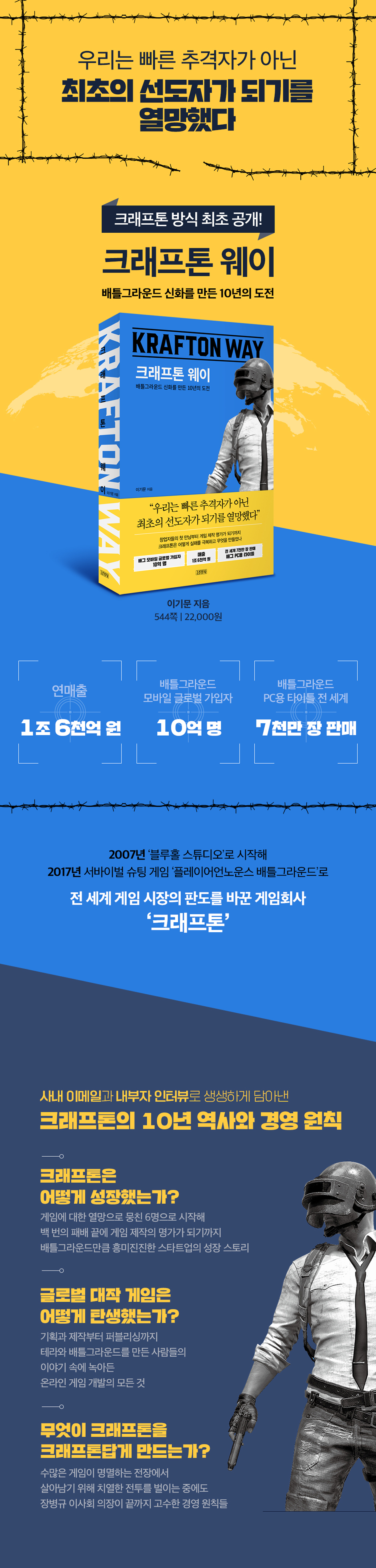
“We aspired to be leaders, not fast followers.”
From the founders' first meeting to becoming a game production powerhouse
How Krafton Overcame Failure and Created What It Did
The secret of the Krafton method revealed by Krafton itself
The survival shooting game 'PlayerUnknown's Battlegrounds', released in 2017, is a masterpiece that rewrote the history of Korean gaming, selling over 70 million copies of the PC title worldwide and surpassing 1 billion cumulative mobile subscribers worldwide, breaking records every day.
Building on the global success of Battlegrounds, Krafton, once a marginal player in the domestic gaming industry, has grown into a global company.
"The Krafton Way" is Krafton's autobiography that shows how Krafton overcame failures and grew into a "master of game development" over the past 10 years, from its founding in 2007 to the launch of Battlegrounds.
The story of Krafton, which vividly tells the story of how it rose to the top with "Battlegrounds," a game that has 1 billion users worldwide, after a hundred defeats on a battlefield where countless games flash by, through internal emails and insider interviews, is finally revealed.
From the founders' first meeting to becoming a game production powerhouse
How Krafton Overcame Failure and Created What It Did
The secret of the Krafton method revealed by Krafton itself
The survival shooting game 'PlayerUnknown's Battlegrounds', released in 2017, is a masterpiece that rewrote the history of Korean gaming, selling over 70 million copies of the PC title worldwide and surpassing 1 billion cumulative mobile subscribers worldwide, breaking records every day.
Building on the global success of Battlegrounds, Krafton, once a marginal player in the domestic gaming industry, has grown into a global company.
"The Krafton Way" is Krafton's autobiography that shows how Krafton overcame failures and grew into a "master of game development" over the past 10 years, from its founding in 2007 to the launch of Battlegrounds.
The story of Krafton, which vividly tells the story of how it rose to the top with "Battlegrounds," a game that has 1 billion users worldwide, after a hundred defeats on a battlefield where countless games flash by, through internal emails and insider interviews, is finally revealed.
- You can preview some of the book's contents.
Preview
index
prolog
Ground Zero 2006: The Beginning of a Myth
2007 Player Entry: ID Bluehole Studio
2008 Tutorial: First Mission, Prototype
Bugs from 2009-2010: Errors inside and outside the game
2011-2012 The Terra Live: The First MMORPG Launch
Battlefield of Fighting: Bluehole 2.0 (2013-2014)
Guild Formation 2015: Alliance for Mobile Gaming
Survival Games of 2016: Money Pressure and Territorial Expansion
Back in 2017, the climax of Battlegrounds: Project BRO
Epilogue
Jang Byeong-gyu's message
#1 About the Vision
#2 About decision making
#3 About Investment
#4 About Communication
#5 About the Market
#6 About the Challenge
#7 About Talent
#8 About the organization
#9 About the beginning
Ground Zero 2006: The Beginning of a Myth
2007 Player Entry: ID Bluehole Studio
2008 Tutorial: First Mission, Prototype
Bugs from 2009-2010: Errors inside and outside the game
2011-2012 The Terra Live: The First MMORPG Launch
Battlefield of Fighting: Bluehole 2.0 (2013-2014)
Guild Formation 2015: Alliance for Mobile Gaming
Survival Games of 2016: Money Pressure and Territorial Expansion
Back in 2017, the climax of Battlegrounds: Project BRO
Epilogue
Jang Byeong-gyu's message
#1 About the Vision
#2 About decision making
#3 About Investment
#4 About Communication
#5 About the Market
#6 About the Challenge
#7 About Talent
#8 About the organization
#9 About the beginning
Detailed image
Into the book
This book, which contains the history of Krafton, is ultimately a story about people.
This is a story about humans who rotate and orbit like planets in the gaming world and collide with each other.
Some people succeed in shining like stars, while others fall like meteors and become dark.
Most failed, and only a few succeeded.
But they all burned themselves and moved constantly.
--- p.9
Jang Byeong-gyu's thought was that you wouldn't know what games they were making even if you looked at them, and you wouldn't know what they were making even if you tried to find out.
We also accepted the old rule of the game market that 'it is difficult to predict the success of a game before it is released on the market.'
If I didn't have trust and expectations for the people around me, I wouldn't have even thought about starting a business.
--- p.38
"We're in an industry with a lot of really exciting things happening. MMORPGs are just getting started.
Bluehole could be something bigger.
It's a road worth taking.
(…) I don’t believe that the gaming industry is saturated.
You can start making history from now on.
“We just need to create a world-class game with our own unique style.”
--- p.72
Non-targeting technology, which was considered a technical challenge, was implemented in MMORPG.
The conference room was filled with joy.
Even the external experts called in for evaluation were all speechless with surprise.
Even to Planning Team Leader Park Hyeon-gyu, the level was so high that it was unbelievable.
Moreover, the production time was cut in half compared to when creating a similar-sized prototype in the past.
We created an innovative prototype in one go.
--- p.103
I thought success would come as soon as I released it.
The sweet future has turned into a bitter reality.
If things continued like this, Bluehole would have to continue to suffer.
Sales are rising considerably thanks to the launch effect, but the emergency light has been turned on for preparations for the launch in the US and Japanese markets scheduled for this year.
Can a game with proven weak retention succeed overseas?
Success was a distant dream, and it was questionable whether the production costs could be recovered.
Terra was a less fun game than I expected.
--- p.178
“You have to communicate with programmers from Mars, planners from Venus, and executives from Earth.
Moreover, the fun of a game is an area that is difficult to measure, manage, and predict.
Dialogue and empathy are important.
Gone are the days when games were made by otakus who were stuck at home and obsessed with their hobbies.
“Let’s look at people and the world, not just games.”
--- p.239
“Production failure and box office failure are two separate things.
Of course, I reprimanded the Elin Expedition development team.
The object of criticism was the problem in the production process, not the failure to do well in the market.
The production team's responsibility is to ensure that the product is completed and released within the planned schedule and investment, and that the live performance is thoroughly prepared.
--- p.306
The reason that quality and proven production leadership is rare is because of the fundamental nature of games as products.
The essence of the game is fun.
Fun is an emotion and an instinct, not a matter of reason or rationality.
(…) The process of discovering and creating fun is a process of trial and error, and the creator is destined to repeat the process of making and breaking like a potter.
--- p.389
“What is the goal and where is the end? Goals change.
I don't know the end.
However, what is important is something different from the global games that have written existing history, something that opens the beginning of a new history rather than numbers.
I think that to achieve this, we really need to seriously invest everything and approach the fundamental questions.
I am prepared to give my all until I achieve this.
Of course, I know that some people need to approach this conservatively, manage it, and prepare for it.
But if you think this vision is worth challenging, what will management do?”
This is a story about humans who rotate and orbit like planets in the gaming world and collide with each other.
Some people succeed in shining like stars, while others fall like meteors and become dark.
Most failed, and only a few succeeded.
But they all burned themselves and moved constantly.
--- p.9
Jang Byeong-gyu's thought was that you wouldn't know what games they were making even if you looked at them, and you wouldn't know what they were making even if you tried to find out.
We also accepted the old rule of the game market that 'it is difficult to predict the success of a game before it is released on the market.'
If I didn't have trust and expectations for the people around me, I wouldn't have even thought about starting a business.
--- p.38
"We're in an industry with a lot of really exciting things happening. MMORPGs are just getting started.
Bluehole could be something bigger.
It's a road worth taking.
(…) I don’t believe that the gaming industry is saturated.
You can start making history from now on.
“We just need to create a world-class game with our own unique style.”
--- p.72
Non-targeting technology, which was considered a technical challenge, was implemented in MMORPG.
The conference room was filled with joy.
Even the external experts called in for evaluation were all speechless with surprise.
Even to Planning Team Leader Park Hyeon-gyu, the level was so high that it was unbelievable.
Moreover, the production time was cut in half compared to when creating a similar-sized prototype in the past.
We created an innovative prototype in one go.
--- p.103
I thought success would come as soon as I released it.
The sweet future has turned into a bitter reality.
If things continued like this, Bluehole would have to continue to suffer.
Sales are rising considerably thanks to the launch effect, but the emergency light has been turned on for preparations for the launch in the US and Japanese markets scheduled for this year.
Can a game with proven weak retention succeed overseas?
Success was a distant dream, and it was questionable whether the production costs could be recovered.
Terra was a less fun game than I expected.
--- p.178
“You have to communicate with programmers from Mars, planners from Venus, and executives from Earth.
Moreover, the fun of a game is an area that is difficult to measure, manage, and predict.
Dialogue and empathy are important.
Gone are the days when games were made by otakus who were stuck at home and obsessed with their hobbies.
“Let’s look at people and the world, not just games.”
--- p.239
“Production failure and box office failure are two separate things.
Of course, I reprimanded the Elin Expedition development team.
The object of criticism was the problem in the production process, not the failure to do well in the market.
The production team's responsibility is to ensure that the product is completed and released within the planned schedule and investment, and that the live performance is thoroughly prepared.
--- p.306
The reason that quality and proven production leadership is rare is because of the fundamental nature of games as products.
The essence of the game is fun.
Fun is an emotion and an instinct, not a matter of reason or rationality.
(…) The process of discovering and creating fun is a process of trial and error, and the creator is destined to repeat the process of making and breaking like a potter.
--- p.389
“What is the goal and where is the end? Goals change.
I don't know the end.
However, what is important is something different from the global games that have written existing history, something that opens the beginning of a new history rather than numbers.
I think that to achieve this, we really need to seriously invest everything and approach the fundamental questions.
I am prepared to give my all until I achieve this.
Of course, I know that some people need to approach this conservatively, manage it, and prepare for it.
But if you think this vision is worth challenging, what will management do?”
--- p.521
Publisher's Review
“We aspired to be leaders, not fast followers.”
From the founders' first meeting to becoming a game production powerhouse
How Krafton Overcame Failure and Created What It Did
The secret of the Krafton method revealed by Krafton itself
Annual sales of 1.6 trillion won
"PUBG Mobile reaches 1 billion global subscribers."
Battlegrounds PC title sells 70 million copies worldwide.
This is the achievement made by Krafton, which started as Bluehole Studio in 2007, in 2020.
Building on the global success of the survival shooter game 'PlayerUnknown's Battlegrounds', which was released in 2017, Krafton, which had been on the fringes of the domestic gaming industry, has grown into a global company and is preparing for an IPO.
Jang Byung-kyu, chairman of the board and one of Krafton's founders and largest shareholder, recently donated 11 billion won to KAIST as a development fund and donated 100 billion won worth of stock to all employees, sharing Krafton's achievements with society.
However, not many people know about the numerous failures Krafton has experienced.
Behind Krafton's success lie games large and small, costing hundreds of millions, if not billions, of dollars, and the people who fought to develop them. There were those who, faced with the rapid shift from PC gaming to mobile gaming, abandoned their original vision to find a way to survive.
"Krafton Way, 10 Years of Challenges That Created the Battlegrounds Myth" shines a spotlight on those who walked that long, dark tunnel, while also revealing the secrets of Krafton's growth that changed the landscape of the global gaming market.
“This book, which contains the history of Krafton, is ultimately a story about people.
This is a story about humans who rotate and orbit like planets in the gaming world and collide with each other.
Some people succeed in shining like stars, while others fall like meteors and become dark.
Most failed, and only a few succeeded.
But they all burned themselves and moved constantly.” (p. 9)
How Krafton Grew
A startup's growth story as exciting as Battlegrounds.
And Krafton's unique principles contained within it
Author Lee Ki-moon, a reporter, reviews internal emails and interviews members to examine Krafton's 10-year history in chronological order.
It contains detailed internal circumstances never mentioned in the media and behind-the-scenes stories that companies are reluctant to reveal, and Chairman Jang Byung-kyu's thoughts while leading Krafton are also included at the end of each chapter, showing Krafton's intense game development process and painful growth process like a documentary.
There is no such thing as moderate success in the gaming industry.
In the harsh reality of 'hit or miss,' how Krafton overcame failure and became a 'game production powerhouse' is finally revealed in 'Krafton Way,' a two-year investigation.
The six people who first met in 2006 joined forces and founded Krafton (then Bluehole) in 2007.
They are Jang Byeong-gyu, a synonym for first-generation venture entrepreneurs; Kim Kang-seok, who was in charge of service planning and game distribution at Neowiz; and Park Yong-hyeon, Hwang Cheol-woong, Kim Jeong-han, and Park Hyeon-gyu, who have experience producing 'Lineage 2'.
The development team had to deal with executives who wanted to be deeply involved in the production and users who only looked for bugs in the game, while the management team had to deal with developers who failed to meet expectations and publishers who were hesitant to invest.
Even amidst the internal and external battles between the development team and management, there is a principle that Chairman Jang Byung-kyu has maintained to the end.
- The vision must also be able to change.
The 'separation of production and management' was abandoned in 2009 when the production team failed to maintain 'Large Scale Production On Time On Budget' during the development of 'TERA'.
Additionally, with the advent of the mobile gaming era in 2013, the company revised its vision of becoming a powerhouse in online PC games to a 'powerhouse in game production.'
“It is more difficult to change a vision than to create one.
Managers must develop the habit of rethinking their vision.
There are countless organizations in the world, but an organization without customers has no value.
“Organizations must never stop changing to keep pace with their customers and markets, and major organizational changes can begin with a change in vision.” (p. 41)
Investing is an act of faith.
Producing products within the given deadline was a duty and promise that the Krafton development team had to keep.
This is because publishers can prepare marketing and investors can consider follow-up investments according to the development schedule.
However, the game development period continued to increase and funds were always insufficient.
Terra, which was developed with a budget of 40 billion won over 4 years, contrary to the initial plan of 30 billion won over 3 years, was ultimately recorded as a failed project.
“Investing can often seem like a ‘momentary fooling of the many.’
The fact that an investment was received and the process and results after the investment remain.
Investing is an act of faith and trust, and it's about building a reputation and track record in a collaborative society.
“We must not forget that consistent action, faith, and trust are more important than contracts.” (p. 119)
- Work with talent, not workers.
Chairman Jang Byung-kyu preached the theory of talent through 'Bluehole Live Talk,' a regular communication channel between management and employees, and urged employees to become talents, not workers.
He says, "In the knowledge industry, talent is evaluated on performance, not on the number of hours worked. They must have a sense of community and consider the entire organization, be able to set strict self-discipline, be highly motivated and determined, learn from failure, and specialize in collaboration."
In line with this talent theory, Jang Byung-kyu does not follow the relatively free game industry culture, but rather campaigns for compliance with work hours and pressures the development team to deliver results within the production deadline.
Those who were dissatisfied with the organization were sent away without hesitation and replaced with outside personnel.
In 2011, when users continued to leave after the official launch of TERA, and in 2016, when sales of Devilian, developed by Gino Games, declined, the company boldly implemented restructuring, and prior to the production of Elyon and Battleground, it recruited the industry's top production PD and the creator of battle royale games. After changing direction to mobile game development, it merged and acquired game companies such as Gino Games, Squall, and Phoenix to launch a joint operation.
How Battlegrounds Was Born
What made Krafton what it is today
From the production to publishing of TERA and Battlegrounds
Everything about online game development
- Production fields: art, programming, planning
Game production is broadly divided into art, which involves graphic design, programming, which operates the game software, and planning, which involves creating the game story and rules.
Another interesting aspect of this book is that it provides a glimpse into the online game development process based on the game industry's proposition that "art is responsible for initial success, while planning is responsible for maintaining popularity."
When creating TERA, our first project, we focused on finding a balance between maximizing graphics and optimizing the game for current-spec computers, and on creating a story with clear cause-and-effect relationships and diversifying rewards as characters travel to and from hunting grounds.
- Build, Milestone, Beta Test, Live
If a build is a homework assignment, a milestone is the submission point.
Developers create builds to pass set milestones.
Krafton considered the ability to meet set milestones as a key indicator of development capability.
During the development of TERA, 200 people completed a build (interim result) that allowed them to actually play a part of the game. They evaluated the fun factor and completeness, then set a milestone (deadline) and created another build.
You can learn the ins and outs of the process of testing a build with users, fixing errors, and releasing it to the public (live).
- Marketing field: The role of a publisher who holds game copyright and is responsible for distribution, promotion, and marketing.
If the game developer is the author, the publisher is the publishing company.
There was a heated debate over how Tera would be serviced in Korea in 2008, whether to service the game directly or to publish it through a partnership.
If Krafton directly services the game, its box office profits will increase, but it will have to bear the full risk of failure.
If you outsource the service to a professional publisher, you will have to share the profits, but you can reduce marketing and promotion costs and it will also be advantageous for attracting initial customers.
After two months of negotiations, a publishing contract was signed with NHN, and Terra immediately became a hot topic in the gaming industry as a highly anticipated game.
That's why you need to choose your publisher carefully.
For example, "There are several reasons why Ellen's Expedition failed to succeed in the market, including the incompetence of the local publisher and the misjudgment of the management who chose that publisher." (p. 306)
“Going down a path no one has ever walked before is a repetition of self-confidence and self-doubt.
If doubt and confidence form a virtuous cycle, the first path will lead to great success.
“We must be the first leaders, not the fast followers.” (Page 537) “Krafton Way, 10 Years of Challenges That Created the Battleground Myth” shows the ‘first path’ that Krafton has walked.
As the name "Krafton" implies, this book confirms that the driving force behind this path was "a thorough craftsmanship in game production and a challenging spirit that is not afraid of failure."
From the founders' first meeting to becoming a game production powerhouse
How Krafton Overcame Failure and Created What It Did
The secret of the Krafton method revealed by Krafton itself
Annual sales of 1.6 trillion won
"PUBG Mobile reaches 1 billion global subscribers."
Battlegrounds PC title sells 70 million copies worldwide.
This is the achievement made by Krafton, which started as Bluehole Studio in 2007, in 2020.
Building on the global success of the survival shooter game 'PlayerUnknown's Battlegrounds', which was released in 2017, Krafton, which had been on the fringes of the domestic gaming industry, has grown into a global company and is preparing for an IPO.
Jang Byung-kyu, chairman of the board and one of Krafton's founders and largest shareholder, recently donated 11 billion won to KAIST as a development fund and donated 100 billion won worth of stock to all employees, sharing Krafton's achievements with society.
However, not many people know about the numerous failures Krafton has experienced.
Behind Krafton's success lie games large and small, costing hundreds of millions, if not billions, of dollars, and the people who fought to develop them. There were those who, faced with the rapid shift from PC gaming to mobile gaming, abandoned their original vision to find a way to survive.
"Krafton Way, 10 Years of Challenges That Created the Battlegrounds Myth" shines a spotlight on those who walked that long, dark tunnel, while also revealing the secrets of Krafton's growth that changed the landscape of the global gaming market.
“This book, which contains the history of Krafton, is ultimately a story about people.
This is a story about humans who rotate and orbit like planets in the gaming world and collide with each other.
Some people succeed in shining like stars, while others fall like meteors and become dark.
Most failed, and only a few succeeded.
But they all burned themselves and moved constantly.” (p. 9)
How Krafton Grew
A startup's growth story as exciting as Battlegrounds.
And Krafton's unique principles contained within it
Author Lee Ki-moon, a reporter, reviews internal emails and interviews members to examine Krafton's 10-year history in chronological order.
It contains detailed internal circumstances never mentioned in the media and behind-the-scenes stories that companies are reluctant to reveal, and Chairman Jang Byung-kyu's thoughts while leading Krafton are also included at the end of each chapter, showing Krafton's intense game development process and painful growth process like a documentary.
There is no such thing as moderate success in the gaming industry.
In the harsh reality of 'hit or miss,' how Krafton overcame failure and became a 'game production powerhouse' is finally revealed in 'Krafton Way,' a two-year investigation.
The six people who first met in 2006 joined forces and founded Krafton (then Bluehole) in 2007.
They are Jang Byeong-gyu, a synonym for first-generation venture entrepreneurs; Kim Kang-seok, who was in charge of service planning and game distribution at Neowiz; and Park Yong-hyeon, Hwang Cheol-woong, Kim Jeong-han, and Park Hyeon-gyu, who have experience producing 'Lineage 2'.
The development team had to deal with executives who wanted to be deeply involved in the production and users who only looked for bugs in the game, while the management team had to deal with developers who failed to meet expectations and publishers who were hesitant to invest.
Even amidst the internal and external battles between the development team and management, there is a principle that Chairman Jang Byung-kyu has maintained to the end.
- The vision must also be able to change.
The 'separation of production and management' was abandoned in 2009 when the production team failed to maintain 'Large Scale Production On Time On Budget' during the development of 'TERA'.
Additionally, with the advent of the mobile gaming era in 2013, the company revised its vision of becoming a powerhouse in online PC games to a 'powerhouse in game production.'
“It is more difficult to change a vision than to create one.
Managers must develop the habit of rethinking their vision.
There are countless organizations in the world, but an organization without customers has no value.
“Organizations must never stop changing to keep pace with their customers and markets, and major organizational changes can begin with a change in vision.” (p. 41)
Investing is an act of faith.
Producing products within the given deadline was a duty and promise that the Krafton development team had to keep.
This is because publishers can prepare marketing and investors can consider follow-up investments according to the development schedule.
However, the game development period continued to increase and funds were always insufficient.
Terra, which was developed with a budget of 40 billion won over 4 years, contrary to the initial plan of 30 billion won over 3 years, was ultimately recorded as a failed project.
“Investing can often seem like a ‘momentary fooling of the many.’
The fact that an investment was received and the process and results after the investment remain.
Investing is an act of faith and trust, and it's about building a reputation and track record in a collaborative society.
“We must not forget that consistent action, faith, and trust are more important than contracts.” (p. 119)
- Work with talent, not workers.
Chairman Jang Byung-kyu preached the theory of talent through 'Bluehole Live Talk,' a regular communication channel between management and employees, and urged employees to become talents, not workers.
He says, "In the knowledge industry, talent is evaluated on performance, not on the number of hours worked. They must have a sense of community and consider the entire organization, be able to set strict self-discipline, be highly motivated and determined, learn from failure, and specialize in collaboration."
In line with this talent theory, Jang Byung-kyu does not follow the relatively free game industry culture, but rather campaigns for compliance with work hours and pressures the development team to deliver results within the production deadline.
Those who were dissatisfied with the organization were sent away without hesitation and replaced with outside personnel.
In 2011, when users continued to leave after the official launch of TERA, and in 2016, when sales of Devilian, developed by Gino Games, declined, the company boldly implemented restructuring, and prior to the production of Elyon and Battleground, it recruited the industry's top production PD and the creator of battle royale games. After changing direction to mobile game development, it merged and acquired game companies such as Gino Games, Squall, and Phoenix to launch a joint operation.
How Battlegrounds Was Born
What made Krafton what it is today
From the production to publishing of TERA and Battlegrounds
Everything about online game development
- Production fields: art, programming, planning
Game production is broadly divided into art, which involves graphic design, programming, which operates the game software, and planning, which involves creating the game story and rules.
Another interesting aspect of this book is that it provides a glimpse into the online game development process based on the game industry's proposition that "art is responsible for initial success, while planning is responsible for maintaining popularity."
When creating TERA, our first project, we focused on finding a balance between maximizing graphics and optimizing the game for current-spec computers, and on creating a story with clear cause-and-effect relationships and diversifying rewards as characters travel to and from hunting grounds.
- Build, Milestone, Beta Test, Live
If a build is a homework assignment, a milestone is the submission point.
Developers create builds to pass set milestones.
Krafton considered the ability to meet set milestones as a key indicator of development capability.
During the development of TERA, 200 people completed a build (interim result) that allowed them to actually play a part of the game. They evaluated the fun factor and completeness, then set a milestone (deadline) and created another build.
You can learn the ins and outs of the process of testing a build with users, fixing errors, and releasing it to the public (live).
- Marketing field: The role of a publisher who holds game copyright and is responsible for distribution, promotion, and marketing.
If the game developer is the author, the publisher is the publishing company.
There was a heated debate over how Tera would be serviced in Korea in 2008, whether to service the game directly or to publish it through a partnership.
If Krafton directly services the game, its box office profits will increase, but it will have to bear the full risk of failure.
If you outsource the service to a professional publisher, you will have to share the profits, but you can reduce marketing and promotion costs and it will also be advantageous for attracting initial customers.
After two months of negotiations, a publishing contract was signed with NHN, and Terra immediately became a hot topic in the gaming industry as a highly anticipated game.
That's why you need to choose your publisher carefully.
For example, "There are several reasons why Ellen's Expedition failed to succeed in the market, including the incompetence of the local publisher and the misjudgment of the management who chose that publisher." (p. 306)
“Going down a path no one has ever walked before is a repetition of self-confidence and self-doubt.
If doubt and confidence form a virtuous cycle, the first path will lead to great success.
“We must be the first leaders, not the fast followers.” (Page 537) “Krafton Way, 10 Years of Challenges That Created the Battleground Myth” shows the ‘first path’ that Krafton has walked.
As the name "Krafton" implies, this book confirms that the driving force behind this path was "a thorough craftsmanship in game production and a challenging spirit that is not afraid of failure."
GOODS SPECIFICS
- Date of issue: July 1, 2021
- Page count, weight, size: 544 pages | 722g | 145*215*25mm
- ISBN13: 9788934986836
- ISBN10: 8934986832
You may also like
카테고리
korean


korean

![GQ KOREA Mark (Monthly): December [2025]](http://librairie.coreenne.fr/cdn/shop/files/8ef265dbbfbf186523ed75ba7319009d.jpg?v=1765340328&width=3840)


