

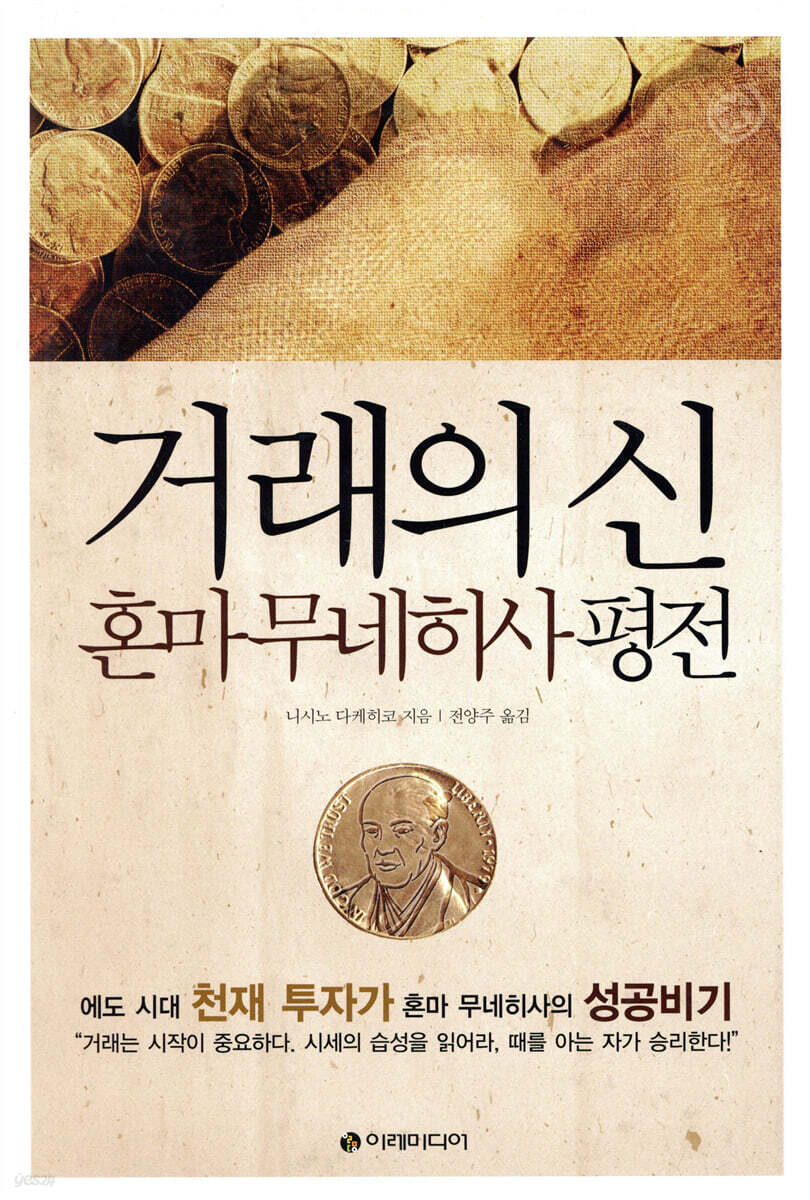
The God of Trade, Honma Munehisa's Biography
 |
Description
Book Introduction
What is the real deal according to Munehisa Honma?
Honma Munehisa was born during the Tokugawa shogunate and became the adopted son of the Honma family, a merchant family, at the age of 23.
Afterwards, he amassed enormous wealth through his mysterious transactions at the Osaka Dojima Grain Exchange, making the Honma family the wealthiest family in the Edo period.
The Japanese call Honma Munehisa "the merchant's heaven, the god of trade."
He is known as the creator of the candlestick chart and Sakada's Five Methods, which are currently used by investors.
His investment secret book, "Munehisa Biroku," is one of the must-reads among stock investors today, but little is known about what kind of person he was during his lifetime.
We do not know much about what led to Munehisa Honma's entry into the rice trade and his subsequent enormous wealth, what kind of enlightenment he went through, or what kind of life he led.
Therefore, this book focuses on the life of Munehisa Homma, who achieved enlightenment through Zen meditation, and developed a thorough investment strategy and winning investment tactics by devouring military books and the Analects of Confucius to establish his outlook on life and acquire investment acumen.
The "Sakata Five Laws" were developed for rice trading using a scientific and academic approach, and historical facts and fiction were added to portray the true nature of investors.
The pearls of wisdom he left behind will serve as a compass for investment for today's stock investors.
Honma Munehisa was born during the Tokugawa shogunate and became the adopted son of the Honma family, a merchant family, at the age of 23.
Afterwards, he amassed enormous wealth through his mysterious transactions at the Osaka Dojima Grain Exchange, making the Honma family the wealthiest family in the Edo period.
The Japanese call Honma Munehisa "the merchant's heaven, the god of trade."
He is known as the creator of the candlestick chart and Sakada's Five Methods, which are currently used by investors.
His investment secret book, "Munehisa Biroku," is one of the must-reads among stock investors today, but little is known about what kind of person he was during his lifetime.
We do not know much about what led to Munehisa Honma's entry into the rice trade and his subsequent enormous wealth, what kind of enlightenment he went through, or what kind of life he led.
Therefore, this book focuses on the life of Munehisa Homma, who achieved enlightenment through Zen meditation, and developed a thorough investment strategy and winning investment tactics by devouring military books and the Analects of Confucius to establish his outlook on life and acquire investment acumen.
The "Sakata Five Laws" were developed for rice trading using a scientific and academic approach, and historical facts and fiction were added to portray the true nature of investors.
The pearls of wisdom he left behind will serve as a compass for investment for today's stock investors.
- You can preview some of the book's contents.
Preview
index
Introduction
Main characters
letter.
Munehisa Honma talks about the deal
Trading Course by Investment God Munehisa
The Surefire Investment Strategy: Read the Market's Habits
The secret of the master: aim for the ceiling and floor, not the ceiling and floor.
Stop for a moment at the crosswalk
Resting is also a form of investment.
Always invest humbly
Chapter 1: The Mysterious Man, Munehisa Honma
Munehisa, the mystery of birth
Why misinformation spreads
Chapter 2: Munehisa's Father, Shrouded in Mystery
Origins and Family Tree of the Honma Family
True bloodline that even confuses relatives
Motomitsu, the manager of Kyuemon?
Motomitsu, Kyuemon's eldest or second son?
Motomitsu's children
Motomitsu's teachings and the Honma family's precepts
Chapter 3: The Birth of Investor Munehisa Honma
Munehisa takes over the Honma family
Sakata, the center of rice trading
Sakata's Five Laws: Creating Investment, Not Speculation
Futures trading born from a rice-centric economy
From broker to rice miller: Zenbe's frustrations and rise
Munehisa is disowned by the Honma family.
Chapter 4: Munehisa's Rice Investments Fail
The feud between Munehisa and Mitsuoka
The Tengu of Dewa Falls in Edo 086
Chapter 5: Awakening to the Way of Investment through Zen Meditation
Finding the Path to Investment in Gaianji
Let go of your worries and become a god of investment.
Gaining Investment Insights Through Meditation
The Threefold Strategy: Crop, Psychology, and Price to Penetrate the Market
The Resurrection of a Genius, the Revived Tengu of Dewa
Natural disasters, deepening wealth disparity, and rising populace during the Edo period
Chapter 6: Munehisa and His Disciples Discuss Investment
Failure in investing is a disease.
The Investor's Secret to Success: Train Your Emotions, the Beast Within
Purify your mind and discover the path of investment.
Those who succeed and those who fail as investors
Chapter 7: Munehisa Honma Learns Investing Through Military Strategy
The difference between strategy and tactics
Aphorisms on strategic tactics to help you invest in rice
Learn to invest with investment maxims
Quotes from the Analects that Will Help You Invest
Chapter 8: The Life of My Nephew, Mitsuoka Honma
The Honma family, the "pioneers of revival"
Assisting in the financial reconstruction of the Shonai Domain
First taste of frustration due to political discord
Chapter 9: Munehisa in his later years
Leading the way in social work through investment experience
Analysis of Edo Period Investment Secrets
The Unparalleled Secret Book, Munehisa Boku
Reconciliation with Mitsuoka
Main characters
letter.
Munehisa Honma talks about the deal
Trading Course by Investment God Munehisa
The Surefire Investment Strategy: Read the Market's Habits
The secret of the master: aim for the ceiling and floor, not the ceiling and floor.
Stop for a moment at the crosswalk
Resting is also a form of investment.
Always invest humbly
Chapter 1: The Mysterious Man, Munehisa Honma
Munehisa, the mystery of birth
Why misinformation spreads
Chapter 2: Munehisa's Father, Shrouded in Mystery
Origins and Family Tree of the Honma Family
True bloodline that even confuses relatives
Motomitsu, the manager of Kyuemon?
Motomitsu, Kyuemon's eldest or second son?
Motomitsu's children
Motomitsu's teachings and the Honma family's precepts
Chapter 3: The Birth of Investor Munehisa Honma
Munehisa takes over the Honma family
Sakata, the center of rice trading
Sakata's Five Laws: Creating Investment, Not Speculation
Futures trading born from a rice-centric economy
From broker to rice miller: Zenbe's frustrations and rise
Munehisa is disowned by the Honma family.
Chapter 4: Munehisa's Rice Investments Fail
The feud between Munehisa and Mitsuoka
The Tengu of Dewa Falls in Edo 086
Chapter 5: Awakening to the Way of Investment through Zen Meditation
Finding the Path to Investment in Gaianji
Let go of your worries and become a god of investment.
Gaining Investment Insights Through Meditation
The Threefold Strategy: Crop, Psychology, and Price to Penetrate the Market
The Resurrection of a Genius, the Revived Tengu of Dewa
Natural disasters, deepening wealth disparity, and rising populace during the Edo period
Chapter 6: Munehisa and His Disciples Discuss Investment
Failure in investing is a disease.
The Investor's Secret to Success: Train Your Emotions, the Beast Within
Purify your mind and discover the path of investment.
Those who succeed and those who fail as investors
Chapter 7: Munehisa Honma Learns Investing Through Military Strategy
The difference between strategy and tactics
Aphorisms on strategic tactics to help you invest in rice
Learn to invest with investment maxims
Quotes from the Analects that Will Help You Invest
Chapter 8: The Life of My Nephew, Mitsuoka Honma
The Honma family, the "pioneers of revival"
Assisting in the financial reconstruction of the Shonai Domain
First taste of frustration due to political discord
Chapter 9: Munehisa in his later years
Leading the way in social work through investment experience
Analysis of Edo Period Investment Secrets
The Unparalleled Secret Book, Munehisa Boku
Reconciliation with Mitsuoka
Into the book
The Surefire Investment Strategy: Read the Market's Habits
“Is there a secret to winning every time you invest in rice?” Zenbe asked Munehisa.
“If you buy low and sell high, sell high and buy low, you can always win in investing.
However, this is easier said than done.
We've all had the bitter experience of thinking we bought something cheap, only to find out the price later drops, or feeling satisfied with selling it for a high price, only to find out the price later rises significantly.
It's best to think that there is no such thing as a surefire way to win in trading, or in other words, a surefire way to invest.
But it is entirely possible to significantly increase your chances of success.” ---p.018
Resting is also a form of investment.
“It’s common for novice investors to act rashly on small price fluctuations right before their eyes.
A true expert doesn't pay attention to the small fluctuations in prices unfolding before his eyes, but only observes the big picture.
When looking at the current market price, I carefully consider whether it is a full-blown bull market or bear market, or a sideways market with small ups and downs, and if it is a full-blown bull market or bear market, where is the bottom and where is the ceiling, what is the current level, etc. After carefully considering these, I only think about buying when it is close to the bottom and selling when it is close to the ceiling.
At other times, I stop investing and wait patiently for the perfect time to buy or sell.
“People who act like this can make a lot of money by investing in rice.” ---p.022~023
Sakata's Five Laws: Creating Investment, Not Speculation
The 'Sakata Five Laws', the laws of rice prices developed by Munehisa, are still widely used today in stock prices and other fields.
Sakata's Five Methods is a type of chart that uses candlesticks, which are bar graphs in the shape of candles. The five characteristics (Samsan, Samcheon, Samgong, Sambyung, and Sambeop) that appear on this chart are used to determine when to buy or sell.
Candlesticks display the opening, closing, high, and low prices during a period in the form of a bar graph. If the closing price is higher than the opening price, it is displayed in white (formerly red), and if the closing price is lower than the opening price, it is displayed in black.
A white candle is called a bullish candle, and a black candle is called a bearish candle.
The high and low prices within a given period are indicated by lines extending above and below the candlestick (shadows and tails).
If the candlestick period is one day, it is called a daily candlestick, if it is one week, it is called a weekly candlestick, if it is one month, it is called a monthly candlestick, and if it is one year, it is called an annual candlestick.
If you keep adding candles like this, a certain movement will appear.
This is the chart.
---pp.066~067
Munehisa Honma: Learning to Invest Through Military Strategy
“What does the saying ‘Move when the price goes up or down by 30%’ mean?”
“How much should the price rise from a low price to sell, and how much should the price fall from a high price to buy? This is a question that troubles many investors.
One answer that can be found is the investment adage, "Move when the price goes up or down by 30%."
If you're having trouble determining when to buy or sell, remember this investing maxim:
Depending on the investment environment, the price may rise two to three times from the bottom, but keep in mind that there are also cases where the price falls by more than half from the high price.
“This adage may not be true in times of unprecedented famine or bumper crops, but in other cases, it will serve as an important criterion.”
“Is there a secret to winning every time you invest in rice?” Zenbe asked Munehisa.
“If you buy low and sell high, sell high and buy low, you can always win in investing.
However, this is easier said than done.
We've all had the bitter experience of thinking we bought something cheap, only to find out the price later drops, or feeling satisfied with selling it for a high price, only to find out the price later rises significantly.
It's best to think that there is no such thing as a surefire way to win in trading, or in other words, a surefire way to invest.
But it is entirely possible to significantly increase your chances of success.” ---p.018
Resting is also a form of investment.
“It’s common for novice investors to act rashly on small price fluctuations right before their eyes.
A true expert doesn't pay attention to the small fluctuations in prices unfolding before his eyes, but only observes the big picture.
When looking at the current market price, I carefully consider whether it is a full-blown bull market or bear market, or a sideways market with small ups and downs, and if it is a full-blown bull market or bear market, where is the bottom and where is the ceiling, what is the current level, etc. After carefully considering these, I only think about buying when it is close to the bottom and selling when it is close to the ceiling.
At other times, I stop investing and wait patiently for the perfect time to buy or sell.
“People who act like this can make a lot of money by investing in rice.” ---p.022~023
Sakata's Five Laws: Creating Investment, Not Speculation
The 'Sakata Five Laws', the laws of rice prices developed by Munehisa, are still widely used today in stock prices and other fields.
Sakata's Five Methods is a type of chart that uses candlesticks, which are bar graphs in the shape of candles. The five characteristics (Samsan, Samcheon, Samgong, Sambyung, and Sambeop) that appear on this chart are used to determine when to buy or sell.
Candlesticks display the opening, closing, high, and low prices during a period in the form of a bar graph. If the closing price is higher than the opening price, it is displayed in white (formerly red), and if the closing price is lower than the opening price, it is displayed in black.
A white candle is called a bullish candle, and a black candle is called a bearish candle.
The high and low prices within a given period are indicated by lines extending above and below the candlestick (shadows and tails).
If the candlestick period is one day, it is called a daily candlestick, if it is one week, it is called a weekly candlestick, if it is one month, it is called a monthly candlestick, and if it is one year, it is called an annual candlestick.
If you keep adding candles like this, a certain movement will appear.
This is the chart.
---pp.066~067
Munehisa Honma: Learning to Invest Through Military Strategy
“What does the saying ‘Move when the price goes up or down by 30%’ mean?”
“How much should the price rise from a low price to sell, and how much should the price fall from a high price to buy? This is a question that troubles many investors.
One answer that can be found is the investment adage, "Move when the price goes up or down by 30%."
If you're having trouble determining when to buy or sell, remember this investing maxim:
Depending on the investment environment, the price may rise two to three times from the bottom, but keep in mind that there are also cases where the price falls by more than half from the high price.
“This adage may not be true in times of unprecedented famine or bumper crops, but in other cases, it will serve as an important criterion.”
---p.145
Publisher's Review
The secret to an investor's success,
Train your emotions, the beast within you!
The god of investment, Munehisa Honma, held trading seminars in his later years, imparting his philosophy on investing, how to judge market prices, and the Sakata Five Laws.
At the seminar, his disciple, Zenbe (a rice merchant from Sakata), asked:
“What is the secret to success as an investor?”
“To succeed as an investor, it is important to thoroughly understand the nature, characteristics, and habits of investments, buy at the best time to buy (the bottom price), sell at the best time to sell (the ceiling price), and wait patiently until the best time to buy/sell arrives.
To achieve this, you must cultivate your investment acumen (knowledge, thinking skills, foresight, judgment), patience, and execution skills.”
Honma Munehisa was born in 1717 during the Tokugawa shogunate and became the adopted son of the Honma family, a merchant family, at the age of 23.
Afterwards, he amassed enormous wealth through his mysterious transactions at the Osaka Dojima Grain Exchange, making the Honma family the wealthiest family in the Edo period.
The Japanese call Honma Munehisa "the merchant's heaven, the god of trade."
Munehisa Honma is known as the creator of the candlestick chart and the Sakada Five Methods, which are currently used by investors.
His investment secret book, "Munehisa Biroku," contains many lessons that are helpful for stock investment today and is considered a must-read for investors.
In "The God of Trading, Honma Munehisa's Biography," Munehisa's entire life, which enabled him to establish investment techniques that amassed enormous wealth, is used to convey to modern people the true attitude toward investing.
Munehisa's investment advice, which contains a profound philosophy on successful trading, is passed down through his investment secret book, "Munehisa Biroku," but nothing is known about what kind of person he was.
The background of Munehisa Honma, who began trading rice and amassed enormous wealth, the process of enlightenment through which he developed his investment philosophy, and the life he led were all shrouded in mystery.
"The God of Trading, Munehisa Honma's Biography" depicts the life of Munehisa Honma, who achieved enlightenment through Zen meditation and developed a thorough investment strategy and winning investment tactics by devouring military books and the Analects of Confucius to establish his outlook on life and acquire investment acumen. It combines historical facts and fiction to show the true face of an investor.
Munehisa Honma talks about the deal
“The beginning of a deal is important.
If the beginning is bad, it is bound to go wrong.
Transactions should not be rushed.
Rushing is like starting wrong.
“If you think there is no market as good as today for buying or selling, wait three days.”
Munehisa Honma says that the first condition for winning in investing is “buy low and sell high, sell high and buy low.”
This is not as easy as it sounds.
In reality, it is a very difficult method.
There is no surefire way to win in real investing.
However, if you follow Munehisa's advice, you can increase your chances of success.
Munehisa Honma discovered the secrets of investing while practicing martial arts and attaining enlightenment through meditation.
Instead of simply investing in rice based on guts, luck, and courage, Munehisa invested with cool-headed judgment based on scientific and academic knowledge.
And he achieved enormous wealth that no one had ever achieved before.
The 'Sakata Five Methods' and candlesticks, developed for rice trading using a scientific and academic approach, are now widely used in stock investment.
Moreover, the pearl-like sayings left behind by Munehisa Honma will serve as an investment compass for today's stock investors.
Train your emotions, the beast within you!
The god of investment, Munehisa Honma, held trading seminars in his later years, imparting his philosophy on investing, how to judge market prices, and the Sakata Five Laws.
At the seminar, his disciple, Zenbe (a rice merchant from Sakata), asked:
“What is the secret to success as an investor?”
“To succeed as an investor, it is important to thoroughly understand the nature, characteristics, and habits of investments, buy at the best time to buy (the bottom price), sell at the best time to sell (the ceiling price), and wait patiently until the best time to buy/sell arrives.
To achieve this, you must cultivate your investment acumen (knowledge, thinking skills, foresight, judgment), patience, and execution skills.”
Honma Munehisa was born in 1717 during the Tokugawa shogunate and became the adopted son of the Honma family, a merchant family, at the age of 23.
Afterwards, he amassed enormous wealth through his mysterious transactions at the Osaka Dojima Grain Exchange, making the Honma family the wealthiest family in the Edo period.
The Japanese call Honma Munehisa "the merchant's heaven, the god of trade."
Munehisa Honma is known as the creator of the candlestick chart and the Sakada Five Methods, which are currently used by investors.
His investment secret book, "Munehisa Biroku," contains many lessons that are helpful for stock investment today and is considered a must-read for investors.
In "The God of Trading, Honma Munehisa's Biography," Munehisa's entire life, which enabled him to establish investment techniques that amassed enormous wealth, is used to convey to modern people the true attitude toward investing.
Munehisa's investment advice, which contains a profound philosophy on successful trading, is passed down through his investment secret book, "Munehisa Biroku," but nothing is known about what kind of person he was.
The background of Munehisa Honma, who began trading rice and amassed enormous wealth, the process of enlightenment through which he developed his investment philosophy, and the life he led were all shrouded in mystery.
"The God of Trading, Munehisa Honma's Biography" depicts the life of Munehisa Honma, who achieved enlightenment through Zen meditation and developed a thorough investment strategy and winning investment tactics by devouring military books and the Analects of Confucius to establish his outlook on life and acquire investment acumen. It combines historical facts and fiction to show the true face of an investor.
Munehisa Honma talks about the deal
“The beginning of a deal is important.
If the beginning is bad, it is bound to go wrong.
Transactions should not be rushed.
Rushing is like starting wrong.
“If you think there is no market as good as today for buying or selling, wait three days.”
Munehisa Honma says that the first condition for winning in investing is “buy low and sell high, sell high and buy low.”
This is not as easy as it sounds.
In reality, it is a very difficult method.
There is no surefire way to win in real investing.
However, if you follow Munehisa's advice, you can increase your chances of success.
Munehisa Honma discovered the secrets of investing while practicing martial arts and attaining enlightenment through meditation.
Instead of simply investing in rice based on guts, luck, and courage, Munehisa invested with cool-headed judgment based on scientific and academic knowledge.
And he achieved enormous wealth that no one had ever achieved before.
The 'Sakata Five Methods' and candlesticks, developed for rice trading using a scientific and academic approach, are now widely used in stock investment.
Moreover, the pearl-like sayings left behind by Munehisa Honma will serve as an investment compass for today's stock investors.
GOODS SPECIFICS
- Date of issue: October 10, 2013
- Format: Hardcover book binding method guide
- Page count, weight, size: 188 pages | 404g | 153*224*20mm
- ISBN13: 9788991998841
- ISBN10: 8991998844
You may also like
카테고리
korean


korean

![GQ KOREA Mark (Monthly): December [2025]](http://librairie.coreenne.fr/cdn/shop/files/8ef265dbbfbf186523ed75ba7319009d.jpg?v=1765340328&width=3840)


