

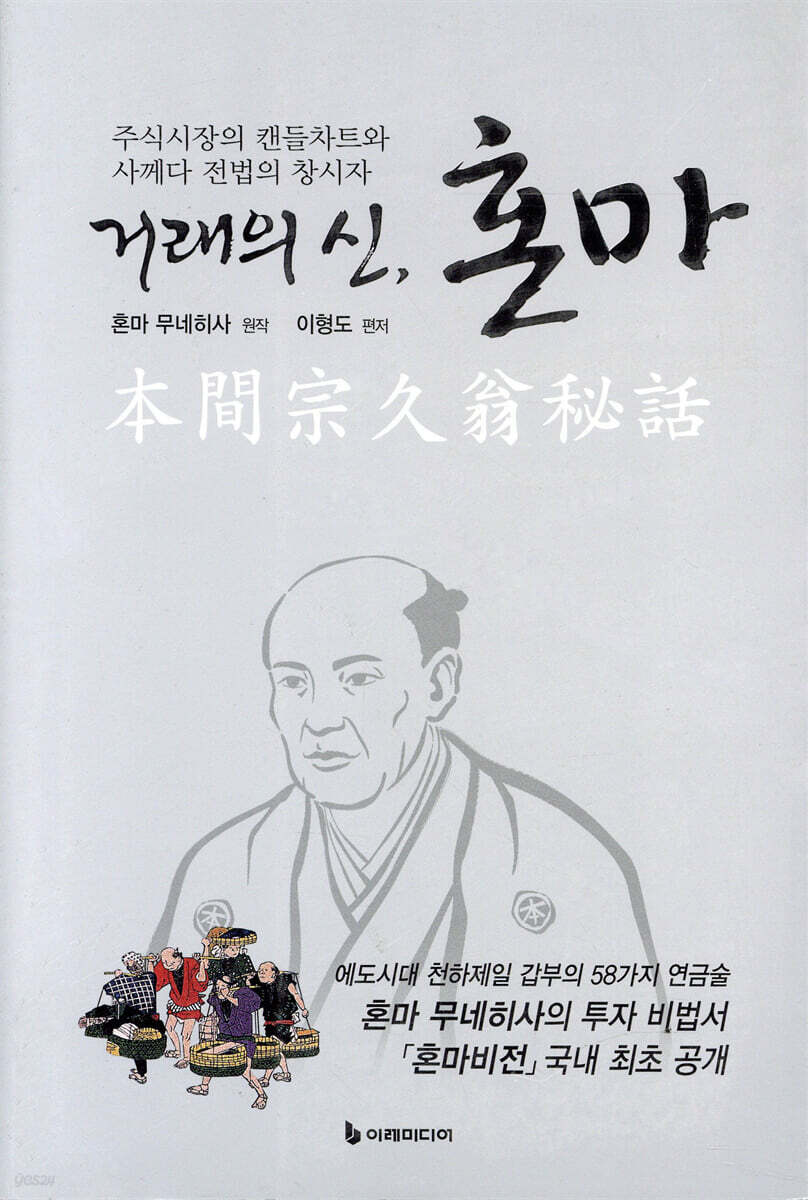
Honma, the god of trading
 |
Description
Book Introduction
A revised edition of "Honma, the God of Trading," a book that covers the life, merchant spirit, and investment methods of Munehisa Honma (1717-1803), a wealthy merchant who shook the Japanese economy with rice trading during the Edo period.
Munehisa Honma is the inventor of the candlestick chart, which is still used around the world today, and the person who organized the 'Sakata Five Methods', which are well known in Korea as the 'Sakata Method'.
This book is the first in Korea to introduce Munehisa Honma's investment secret book, "Honma Vision." In this revised edition, the material has been supplemented by personally reporting and filming along the footsteps of Munehisa Honma, adding to the sense of realism.
This book will not only teach you his investment techniques, but also show you the way to achieve the spirit of trading and the level of investment.
Munehisa Honma is the inventor of the candlestick chart, which is still used around the world today, and the person who organized the 'Sakata Five Methods', which are well known in Korea as the 'Sakata Method'.
This book is the first in Korea to introduce Munehisa Honma's investment secret book, "Honma Vision." In this revised edition, the material has been supplemented by personally reporting and filming along the footsteps of Munehisa Honma, adding to the sense of realism.
This book will not only teach you his investment techniques, but also show you the way to achieve the spirit of trading and the level of investment.
index
In publishing a revised edition
Talk about books
Part 1: The Secrets of a 250-Year-Old Folk Song
1.
Honma, the richest man in the world who appears in folk songs
What happened in Sakata, Dojima, and Kuramae?
From rice production to shipment, as seen through the Sankyo Warehouse.
Shaking the world with rice trading
2.
Dojima Grain Exchange and Prepaid Checks
What is futures trading and the futures market?
The Relationship Between Field Transactions and Prepaid Checks
Asia's first futures market, the Osaka Dojima Grain Exchange
3.
The Lost Book of Japan's Greatest Commercial Law, "Honma Hiden"
Why did "Honma Vision" disappear?
The birth and family of Munehisa Honma
Called the Tengu of Dewa
Stories that are passed down
4.
Giving is beneficial
Mitsuoka Honma, known as the pioneer of public interest
No one starved to death in the Shonai domain.
Part 2: "Honma Secret"
1.
The Trinity's Strategy (三位の?)
The beginning of a deal is important.
The bearish trend is strong at the beginning of the month and weak at the end.
When people run west, I run east.
When everyone is feeling helpless, change your mind and start buying.
2.
The good or bad of a crop is the basis of market prices.
Rice in a stagnant state from winter to February
The price of rice, which reached its ceiling price in January, will then fall.
Rice at the ceiling price from July to October
How to deal with poor crops
3.
Listen to what the market says
Rapid market fluctuations require agile responses.
The Three Laws
The ceiling price is nearing its end
Movement after hitting the ceiling
4.
It is important to know naturalness
The ups and downs of prices are a natural law.
After the upward trend in stagnation
When it is expressed as a decline in a stagnant state
If you miss the buying opportunity, wait patiently for the right time.
Weakness that suddenly lost momentum
Increase your profits significantly, don't settle for small profits.
Fall after rise
When your judgment is wrong, dispose of it quickly and take a break.
5.
Heart comes before profit
Attitude of the mind in times of good fortune
Don't be intoxicated by victory
Aiming for the floor and aiming for the ceiling
A sudden rise with a flying bag
You have to be good at selling to be successful.
6.
What to do when you rest
If the cold air is strong in summer
Resting is also important
The year when funds ran out
Ceiling, floor 3 years
If you act without making up your mind, you will only lose.
It is forbidden to go against the market price.
7.
Look at rice as a whole
There are two kinds of regret.
Capture the movement of the ceiling and floor
Changing one's mind
My one penny judgment
Free yourself from greed
Be consistent
Stagnation Transaction Rules
If you feel like trading, wait two days.
When I am optimistic, others are optimistic too.
Don't think about making money in a hurry
The good and bad of crops are fundamental
8.
Do's and Don'ts
Don't sell rice in a good year
Don't buy rice in a famine
Don't buy at the top and don't sell at the bottom.
A bad harvest in a good year, a good harvest in a bad year
Emotions are taboo in trading.
Rice trading is like military tactics.
If you don't know, split it and sell it.
Attitude is the most important thing
Don't rush the deal
The foolishness of discussing the highs and lows of prices
Break free from the preconceptions of the previous year
If you trade all year round, you will lose your luck.
Don't trade based on the daily price.
Start by setting up your funds
Don't start it just to kill time
You must never show this article to anyone else.
Talk about books
Part 1: The Secrets of a 250-Year-Old Folk Song
1.
Honma, the richest man in the world who appears in folk songs
What happened in Sakata, Dojima, and Kuramae?
From rice production to shipment, as seen through the Sankyo Warehouse.
Shaking the world with rice trading
2.
Dojima Grain Exchange and Prepaid Checks
What is futures trading and the futures market?
The Relationship Between Field Transactions and Prepaid Checks
Asia's first futures market, the Osaka Dojima Grain Exchange
3.
The Lost Book of Japan's Greatest Commercial Law, "Honma Hiden"
Why did "Honma Vision" disappear?
The birth and family of Munehisa Honma
Called the Tengu of Dewa
Stories that are passed down
4.
Giving is beneficial
Mitsuoka Honma, known as the pioneer of public interest
No one starved to death in the Shonai domain.
Part 2: "Honma Secret"
1.
The Trinity's Strategy (三位の?)
The beginning of a deal is important.
The bearish trend is strong at the beginning of the month and weak at the end.
When people run west, I run east.
When everyone is feeling helpless, change your mind and start buying.
2.
The good or bad of a crop is the basis of market prices.
Rice in a stagnant state from winter to February
The price of rice, which reached its ceiling price in January, will then fall.
Rice at the ceiling price from July to October
How to deal with poor crops
3.
Listen to what the market says
Rapid market fluctuations require agile responses.
The Three Laws
The ceiling price is nearing its end
Movement after hitting the ceiling
4.
It is important to know naturalness
The ups and downs of prices are a natural law.
After the upward trend in stagnation
When it is expressed as a decline in a stagnant state
If you miss the buying opportunity, wait patiently for the right time.
Weakness that suddenly lost momentum
Increase your profits significantly, don't settle for small profits.
Fall after rise
When your judgment is wrong, dispose of it quickly and take a break.
5.
Heart comes before profit
Attitude of the mind in times of good fortune
Don't be intoxicated by victory
Aiming for the floor and aiming for the ceiling
A sudden rise with a flying bag
You have to be good at selling to be successful.
6.
What to do when you rest
If the cold air is strong in summer
Resting is also important
The year when funds ran out
Ceiling, floor 3 years
If you act without making up your mind, you will only lose.
It is forbidden to go against the market price.
7.
Look at rice as a whole
There are two kinds of regret.
Capture the movement of the ceiling and floor
Changing one's mind
My one penny judgment
Free yourself from greed
Be consistent
Stagnation Transaction Rules
If you feel like trading, wait two days.
When I am optimistic, others are optimistic too.
Don't think about making money in a hurry
The good and bad of crops are fundamental
8.
Do's and Don'ts
Don't sell rice in a good year
Don't buy rice in a famine
Don't buy at the top and don't sell at the bottom.
A bad harvest in a good year, a good harvest in a bad year
Emotions are taboo in trading.
Rice trading is like military tactics.
If you don't know, split it and sell it.
Attitude is the most important thing
Don't rush the deal
The foolishness of discussing the highs and lows of prices
Break free from the preconceptions of the previous year
If you trade all year round, you will lose your luck.
Don't trade based on the daily price.
Start by setting up your funds
Don't start it just to kill time
You must never show this article to anyone else.
Into the book
Going inside the candle means thinking about the time the candle was formed.
Just as Munehisa Homma drew candlesticks by hand after finishing his trading 250 years ago, it is important to take time to reflect on what happened that day and to make judgments about what happened that day.
Transactions occur hundreds and thousands of times, and people do their best to make profits, protect profits, and prevent losses.
That was how the price of rice was formed at that time.
People who participate in a transaction approach it with the best mindset they can and with a positive mindset that they can do something.
Some of them are profitable, but others fail.
When you make a profit, you may feel satisfied and relaxed, and you may spend the time whistling while trading. However, for those who suffer large losses, frustration, self-loathing, despair, and loss of motivation may consume them, and they may spend the day in a state of despair.
That was the trading hours of a typical day at the Dojima Grain Exchange.
--- From 'When people run west, I run east'
This can be seen by examining the three thousand of the five Sakata laws.
It is believed that the name Samcheon came to represent the bottom not only because of the shape of the character but also because water has the property of flowing to low places.
It is also believed that the floor is not a cement floor, but rather a floor with properties like water that rises and falls.
However, this bottom is not a single bottom or double bottom as is referred to in Western technical analysis, but rather a fairly safe and solid bottom that has formed three bottoms, making it more reliable.
In today's technical analysis, the so-called single bottom refers to a V-shaped bottom, and the double bottom refers to a VV-shaped bottom.
However, in the case of Samcheon, it is said that Samcheon, VVV is a case where the floor is confirmed once more.
--- From 'When everyone is helpless, change your mind and start buying'
People who have studied Munehisa Honma's business method in depth call him 'simhak'.
Because we find in his writings the insights into human psychology that he has achieved.
This insight into human psychology does not refer to the psychology of any particular individual, but rather to the psychology of the masses engaging in transactions.
Market participants need to hear this very thing.
The sound tells us, 'We've hit the bottom and now it's going up', 'We've hit the ceiling and now it's going down'.
Even if the price fluctuates greatly during the rise, the sound tells us that it 'keeps rising' or 'keeps falling'.
So if you don't hear that sound, you will be swayed by the fluctuating prices and thrown away miserably.
The more rapidly the market fluctuates, the more agile you need to be in responding.
To do that, you must silence the inner movements within yourself and quietly listen to the market.
Just as Munehisa Homma drew candlesticks by hand after finishing his trading 250 years ago, it is important to take time to reflect on what happened that day and to make judgments about what happened that day.
Transactions occur hundreds and thousands of times, and people do their best to make profits, protect profits, and prevent losses.
That was how the price of rice was formed at that time.
People who participate in a transaction approach it with the best mindset they can and with a positive mindset that they can do something.
Some of them are profitable, but others fail.
When you make a profit, you may feel satisfied and relaxed, and you may spend the time whistling while trading. However, for those who suffer large losses, frustration, self-loathing, despair, and loss of motivation may consume them, and they may spend the day in a state of despair.
That was the trading hours of a typical day at the Dojima Grain Exchange.
--- From 'When people run west, I run east'
This can be seen by examining the three thousand of the five Sakata laws.
It is believed that the name Samcheon came to represent the bottom not only because of the shape of the character but also because water has the property of flowing to low places.
It is also believed that the floor is not a cement floor, but rather a floor with properties like water that rises and falls.
However, this bottom is not a single bottom or double bottom as is referred to in Western technical analysis, but rather a fairly safe and solid bottom that has formed three bottoms, making it more reliable.
In today's technical analysis, the so-called single bottom refers to a V-shaped bottom, and the double bottom refers to a VV-shaped bottom.
However, in the case of Samcheon, it is said that Samcheon, VVV is a case where the floor is confirmed once more.
--- From 'When everyone is helpless, change your mind and start buying'
People who have studied Munehisa Honma's business method in depth call him 'simhak'.
Because we find in his writings the insights into human psychology that he has achieved.
This insight into human psychology does not refer to the psychology of any particular individual, but rather to the psychology of the masses engaging in transactions.
Market participants need to hear this very thing.
The sound tells us, 'We've hit the bottom and now it's going up', 'We've hit the ceiling and now it's going down'.
Even if the price fluctuates greatly during the rise, the sound tells us that it 'keeps rising' or 'keeps falling'.
So if you don't hear that sound, you will be swayed by the fluctuating prices and thrown away miserably.
The more rapidly the market fluctuates, the more agile you need to be in responding.
To do that, you must silence the inner movements within yourself and quietly listen to the market.
--- From 'Agile response is required in times of rapid market fluctuations'
Publisher's Review
The 58 Alchemy Techniques of the World's Greatest Merchant of the Edo Period!
This book deals with the life, merchant spirit, and investment methods of Homma Munehisa (1717-1803), a wealthy merchant from Sakata who shook the Japanese economy with rice trading during the time of the 8th Shogun Yoshimune of the Edo period in Japan.
He is known as the inventor of the candlestick chart, which is still used around the world today, and his 'Sakata Five Methods', well known in Korea as 'Sakata Denpo', is an investment method referenced by investors around the world.
Honma Munehisa was born in Dewa, Yamagata Prefecture, and was adopted into the Honma family at the age of 23, taking the name Honma Munehisa.
He amassed enormous wealth through rice trading, and his business skills were so extraordinary that the following song was sung at the time:
Sakata is sunny, Dojima is cloudy
It's raining in front of the rice warehouse in Edo.
Ah, I may not be as good as Honma-sama, but I want to be at least as good as the Lord of the Families.
This old folk song, sung mainly in the Sakata area of present-day Yamagata Prefecture, sings of the power of Honma Munehisa, who was in a world of unattainable wealth, through contrast with the "lord."
This book reveals that the 'Honma' sung in this folk song is actually Munehisa Honma through a multifaceted analysis, and reconstructs and reveals hidden facts about his life and family.
It also introduces his merchant spirit, the 58 alchemy techniques that made him Midas' hand, and explains the true meaning of winning in the market.
The 'candlestick chart' is so well known and widely used that everyone has seen it at least once, but the person who created it, Munehisa Homma, and who he is, are largely unknown in Korea.
There is also a lack of introduction to the 'Sakata Five Laws', also known as the 'Sakeda Law'.
This book attempts to fill this intellectual gap in our society and introduces Munehisa Honma's investment secret book, "Honma Vision," for the first time in Korea.
This book covers the life, merchant spirit, and investment methods of Munehisa Homma (1717-1803), a wealthy merchant who shook the Japanese economy with rice trading during the Edo period.
He is the inventor of the candlestick chart, which is still used around the world today, and the person who organized the 'Sakata Five Methods', which are well known in Korea as the 'Sakata Method'.
Munehisa Homma, the ghost who invented candlestick charts
Candlestick charts are currently the most common tool used by investors around the world to trade stocks.
Yet, until the first edition of this book, little was known about who created the tool and when.
The author, deeply concerned about this, embarked on a arduous journey to find its starting point, and after many twists and turns, finally found Munehisa Honma.
Honma is a man who earned the nickname "Tengu" (a ghost-like being) while trading rice about 250 years ago.
At that time, Japan was fighting a war over rice under the rule of Yoshimune, the eighth shogun of the Tokugawa shogunate.
Just like in our country, rice was a staple food in Japan and was a grain that was used like cash.
However, because the harvest did not meet the demand every year, there was extreme buying and selling and the price of rice fluctuated wildly.
Here, due to the shogunate's intention to centralize power, the local lords' cash expenditures increased rapidly, and they had to buy and sell the rice they collected as taxes.
In accordance with these circumstances, rice trading took place on a large scale in Osaka Dojima and Edo, and it is said that in some years, several times the amount of rice harvested in a year was traded.
In this situation, it was inevitable that the exchanges would be crowded and chaos would be extreme.
Honma also reached the point of bankruptcy in the midst of the rapids of chaos.
However, I thought that I needed a standard for judgment for trading, so I started working on charting the price fluctuations over the course of a day.
That's how the candle-shaped chart, the candle chart, was born.
Leaving behind the undefeated trading technique "Honma Vision"
Munehisa Honma established the 'Sakata Five Methods' based on the candlestick charts he completed.
The 'Sakata Five Laws' refer to 'three mountains, three heavens, three emptinesses, three diseases, and three laws.'
Even in the modern stock market, this is being applied to standardize various patterns based on candlestick combinations, but the meaning and depth of these patterns cannot match the true meaning.
Simply memorizing that 'there are three mountains, so it's called Samsan, and this pattern suggests a decline' is of no help in the actual market.
We need to understand what causes the formation of Samsan, what is the basis for the belief that once Samsan is completed, there will be a downward trend, and even the underlying human psychology.
Munehisa Honma quietly observed the inner workings of a candlestick, the joys, fears, disappointments, and hopes of market participants during the day, and learned the rules of trading.
As a result, the "Sakata Five Laws" and the "Three Strategies" were established and left for future generations as the "Honma Vision."
However, Honma Munehisa was concerned that this book might be misunderstood and sold rashly, and so he asked that it not be made public.
However, as time passed, the aspirations of countless people opened the door to the taboo, and it was finally released to our country for the first time.
In this book, readers will not simply learn investment techniques from Munehisa Homma.
Through him, you will encounter the lofty spirit of Sangdo and be shown the path to reaching the level of investment.
In this revised edition, we supplemented the material by personally reporting and filming along the footsteps of Munehisa Honma, adding to the sense of realism.
In his hometown of Sakata, the Honma family's reputation and influence still lingered, and affection for the family was palpable.
We added new facts and information leading up to the final stop of our journey, Zuidokuji Temple in Tokyo, and provided a wealth of photographs to make it more vivid for readers.
This book deals with the life, merchant spirit, and investment methods of Homma Munehisa (1717-1803), a wealthy merchant from Sakata who shook the Japanese economy with rice trading during the time of the 8th Shogun Yoshimune of the Edo period in Japan.
He is known as the inventor of the candlestick chart, which is still used around the world today, and his 'Sakata Five Methods', well known in Korea as 'Sakata Denpo', is an investment method referenced by investors around the world.
Honma Munehisa was born in Dewa, Yamagata Prefecture, and was adopted into the Honma family at the age of 23, taking the name Honma Munehisa.
He amassed enormous wealth through rice trading, and his business skills were so extraordinary that the following song was sung at the time:
Sakata is sunny, Dojima is cloudy
It's raining in front of the rice warehouse in Edo.
Ah, I may not be as good as Honma-sama, but I want to be at least as good as the Lord of the Families.
This old folk song, sung mainly in the Sakata area of present-day Yamagata Prefecture, sings of the power of Honma Munehisa, who was in a world of unattainable wealth, through contrast with the "lord."
This book reveals that the 'Honma' sung in this folk song is actually Munehisa Honma through a multifaceted analysis, and reconstructs and reveals hidden facts about his life and family.
It also introduces his merchant spirit, the 58 alchemy techniques that made him Midas' hand, and explains the true meaning of winning in the market.
The 'candlestick chart' is so well known and widely used that everyone has seen it at least once, but the person who created it, Munehisa Homma, and who he is, are largely unknown in Korea.
There is also a lack of introduction to the 'Sakata Five Laws', also known as the 'Sakeda Law'.
This book attempts to fill this intellectual gap in our society and introduces Munehisa Honma's investment secret book, "Honma Vision," for the first time in Korea.
This book covers the life, merchant spirit, and investment methods of Munehisa Homma (1717-1803), a wealthy merchant who shook the Japanese economy with rice trading during the Edo period.
He is the inventor of the candlestick chart, which is still used around the world today, and the person who organized the 'Sakata Five Methods', which are well known in Korea as the 'Sakata Method'.
Munehisa Homma, the ghost who invented candlestick charts
Candlestick charts are currently the most common tool used by investors around the world to trade stocks.
Yet, until the first edition of this book, little was known about who created the tool and when.
The author, deeply concerned about this, embarked on a arduous journey to find its starting point, and after many twists and turns, finally found Munehisa Honma.
Honma is a man who earned the nickname "Tengu" (a ghost-like being) while trading rice about 250 years ago.
At that time, Japan was fighting a war over rice under the rule of Yoshimune, the eighth shogun of the Tokugawa shogunate.
Just like in our country, rice was a staple food in Japan and was a grain that was used like cash.
However, because the harvest did not meet the demand every year, there was extreme buying and selling and the price of rice fluctuated wildly.
Here, due to the shogunate's intention to centralize power, the local lords' cash expenditures increased rapidly, and they had to buy and sell the rice they collected as taxes.
In accordance with these circumstances, rice trading took place on a large scale in Osaka Dojima and Edo, and it is said that in some years, several times the amount of rice harvested in a year was traded.
In this situation, it was inevitable that the exchanges would be crowded and chaos would be extreme.
Honma also reached the point of bankruptcy in the midst of the rapids of chaos.
However, I thought that I needed a standard for judgment for trading, so I started working on charting the price fluctuations over the course of a day.
That's how the candle-shaped chart, the candle chart, was born.
Leaving behind the undefeated trading technique "Honma Vision"
Munehisa Honma established the 'Sakata Five Methods' based on the candlestick charts he completed.
The 'Sakata Five Laws' refer to 'three mountains, three heavens, three emptinesses, three diseases, and three laws.'
Even in the modern stock market, this is being applied to standardize various patterns based on candlestick combinations, but the meaning and depth of these patterns cannot match the true meaning.
Simply memorizing that 'there are three mountains, so it's called Samsan, and this pattern suggests a decline' is of no help in the actual market.
We need to understand what causes the formation of Samsan, what is the basis for the belief that once Samsan is completed, there will be a downward trend, and even the underlying human psychology.
Munehisa Honma quietly observed the inner workings of a candlestick, the joys, fears, disappointments, and hopes of market participants during the day, and learned the rules of trading.
As a result, the "Sakata Five Laws" and the "Three Strategies" were established and left for future generations as the "Honma Vision."
However, Honma Munehisa was concerned that this book might be misunderstood and sold rashly, and so he asked that it not be made public.
However, as time passed, the aspirations of countless people opened the door to the taboo, and it was finally released to our country for the first time.
In this book, readers will not simply learn investment techniques from Munehisa Homma.
Through him, you will encounter the lofty spirit of Sangdo and be shown the path to reaching the level of investment.
In this revised edition, we supplemented the material by personally reporting and filming along the footsteps of Munehisa Honma, adding to the sense of realism.
In his hometown of Sakata, the Honma family's reputation and influence still lingered, and affection for the family was palpable.
We added new facts and information leading up to the final stop of our journey, Zuidokuji Temple in Tokyo, and provided a wealth of photographs to make it more vivid for readers.
GOODS SPECIFICS
- Date of issue: March 24, 2008
- Page count, weight, size: 335 pages | 620g | 153*224*30mm
- ISBN13: 9788991998162
- ISBN10: 899199816X
You may also like
카테고리
korean


korean

![GQ KOREA Mark (Monthly): December [2025]](http://librairie.coreenne.fr/cdn/shop/files/8ef265dbbfbf186523ed75ba7319009d.jpg?v=1765340328&width=3840)


