

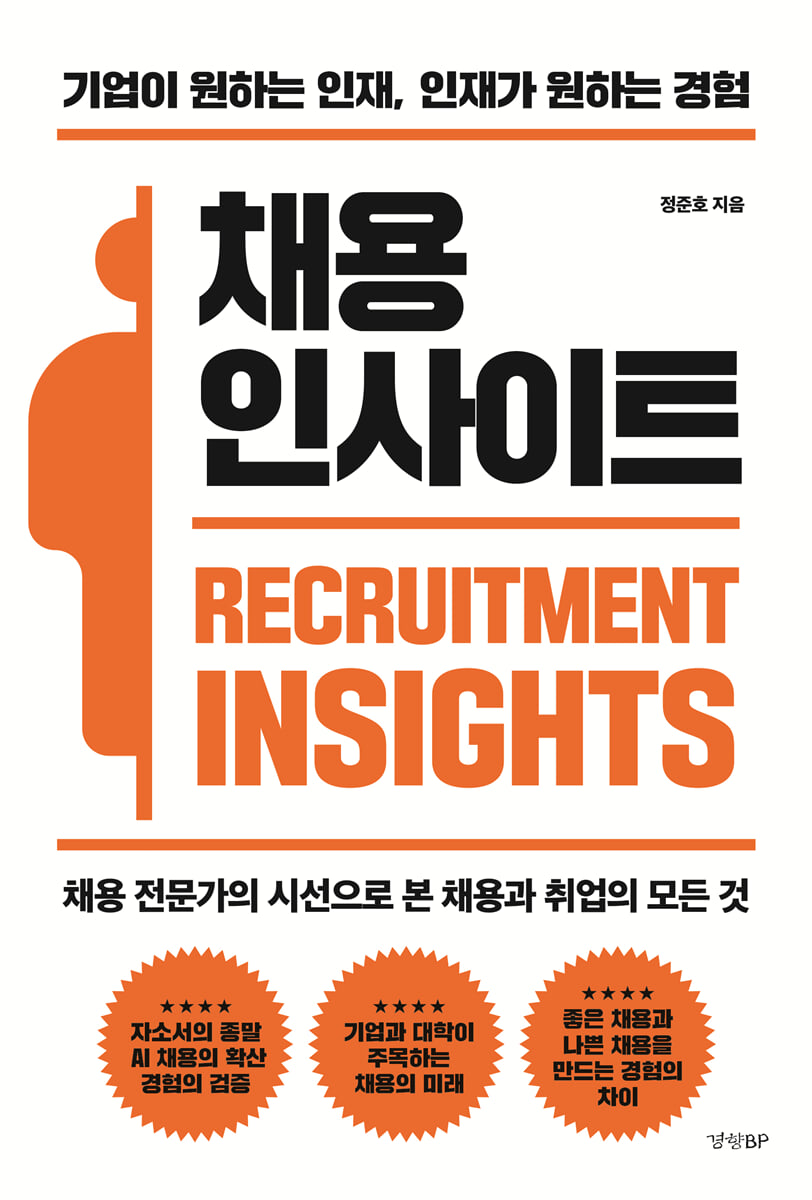
Recruitment Insights
 |
Description
Book Introduction
Finding the Answer to Successful Hiring and Successful Employment
The hiring process is changing.
With rolling hiring and outbound recruiting becoming the norm, companies and talent connect in entirely new ways.
Companies design the “applicant experience,” and applicants design their “career journey.”
Companies need to understand the evolving rules of hiring, from rolling recruitment to AI-based selection and candidate experience design, to attract talent and secure a job.
This book provides a three-dimensional explanation of what kind of talent companies seek, how they hire, and what kind of experiences they design in the AI era.
This is a practical guide for HR professionals who must first identify the waves of change at the forefront of recruitment, and for job seekers who must strategically prepare for their opportunities at the doorstep of recruitment.
Changing Recruitment Rules: From Regular Recruitment to Rolling Recruitment
The era of regular recruitment twice a year, as in the past, is over.
Companies are now transitioning to a rolling hiring system that "immediately recruits the right talent, for the right job, at the right time."
This book provides practical guidance on why companies no longer conduct regular recruitment, the new rules created by rolling recruitment, and the strategies job seekers should develop amidst this shift.
In particular, the author emphasizes, “In this era of rolling recruitment, job seekers must also operate as a brand.”
It's no longer a simple process of "submitting an application after graduation," but rather a constant search for opportunities and updating your skills and experience that is key to competitiveness.
The Changing Ideals of Talent: Experience Over Specs, Competence Over Age
The standards that companies look for in talent have fundamentally changed.
This book explains this as 'career expansion' and presents the ideal talent for an era where the distinction between 'newcomers' and 'experienced' is no longer simple.
The author says, “What companies want is not a complete talent, but a learning talent who grows through experience.”
Rather than the 'spec-centered selection' of the past, the evaluation is now shifting to focus on experience solving problems in actual work, responsibility demonstrated in relationships with the organization, and agility to learn about change.
It provides insightful insights into the changing labor market trends, such as "Junior talents rising in place of new hires," "Senior talents recognized for their abilities, not their age," and "Boomerang talents who re-enter the workforce after leaving their jobs."
The New Standard in Recruitment: Candidate Experience
The biggest message of this book is that 'recruitment is experience design.'
The author says that while working on a talent retention project in the past, “I found the answer in the memories of those who stayed rather than in the reasons for those who left.”
What I realized through that experience is the 'employee experience' and the 'applicant experience' that comes before that.
In other words, recruiting is no longer simply a matter of managing procedures; it is a matter of designing how applicants experience the company, and this experience has become a key indicator that determines the company's brand and competitiveness.
This book presents, with rich examples, why companies should treat applicants like customers and why recruiters should transform into "experience designers."
The hiring process is changing.
With rolling hiring and outbound recruiting becoming the norm, companies and talent connect in entirely new ways.
Companies design the “applicant experience,” and applicants design their “career journey.”
Companies need to understand the evolving rules of hiring, from rolling recruitment to AI-based selection and candidate experience design, to attract talent and secure a job.
This book provides a three-dimensional explanation of what kind of talent companies seek, how they hire, and what kind of experiences they design in the AI era.
This is a practical guide for HR professionals who must first identify the waves of change at the forefront of recruitment, and for job seekers who must strategically prepare for their opportunities at the doorstep of recruitment.
Changing Recruitment Rules: From Regular Recruitment to Rolling Recruitment
The era of regular recruitment twice a year, as in the past, is over.
Companies are now transitioning to a rolling hiring system that "immediately recruits the right talent, for the right job, at the right time."
This book provides practical guidance on why companies no longer conduct regular recruitment, the new rules created by rolling recruitment, and the strategies job seekers should develop amidst this shift.
In particular, the author emphasizes, “In this era of rolling recruitment, job seekers must also operate as a brand.”
It's no longer a simple process of "submitting an application after graduation," but rather a constant search for opportunities and updating your skills and experience that is key to competitiveness.
The Changing Ideals of Talent: Experience Over Specs, Competence Over Age
The standards that companies look for in talent have fundamentally changed.
This book explains this as 'career expansion' and presents the ideal talent for an era where the distinction between 'newcomers' and 'experienced' is no longer simple.
The author says, “What companies want is not a complete talent, but a learning talent who grows through experience.”
Rather than the 'spec-centered selection' of the past, the evaluation is now shifting to focus on experience solving problems in actual work, responsibility demonstrated in relationships with the organization, and agility to learn about change.
It provides insightful insights into the changing labor market trends, such as "Junior talents rising in place of new hires," "Senior talents recognized for their abilities, not their age," and "Boomerang talents who re-enter the workforce after leaving their jobs."
The New Standard in Recruitment: Candidate Experience
The biggest message of this book is that 'recruitment is experience design.'
The author says that while working on a talent retention project in the past, “I found the answer in the memories of those who stayed rather than in the reasons for those who left.”
What I realized through that experience is the 'employee experience' and the 'applicant experience' that comes before that.
In other words, recruiting is no longer simply a matter of managing procedures; it is a matter of designing how applicants experience the company, and this experience has become a key indicator that determines the company's brand and competitiveness.
This book presents, with rich examples, why companies should treat applicants like customers and why recruiters should transform into "experience designers."
- You can preview some of the book's contents.
Preview
index
PROLOGUE - The Path Between Talent and Business: The Beginning of a Changed Recruitment Process
CHAPTER 1: The Era of Rolling Recruitment: Changed Rules
STEP 01 Why don't companies issue regular bonds anymore?
STEP 02 The Hidden Secret of Rolling Recruitment
Job Hunting Guide 1: Practical Strategies for Job Seekers in the Era of Rolling Recruitment
CHAPTER 2 The Talent Companies Want
STEP 03 Career Expansion 1: Rising Junior Talents Instead of New Hires
STEP 04 Career Expansion 2: Senior Talent Recognized for Competence, Not Age
STEP 05 Career Expansion 3: Boomerang Talents Re-entering the Company After Leaving
STEP 06: New hires with similar experience: Hiring based on experience rather than qualifications.
Job Hunting Guide 2: Characteristics of Successful Candidates According to Recruiters
CHAPTER 3 CHANGES IN RECRUITMENT METHODS
STEP 07: Recruitment is possible only when you know the right talent.
STEP 08 The End of the Self-Introduction: New Evaluation Criteria
STEP 09 AI Proxy Warfare Between Applicants and Companies
STEP 10: Competency-Based Interview: The Decisive Criteria for Success
STEP 11: Reputation Check: Do a Preliminary Check, Not a Background Check
STEP 12 Even careers have a probationary period.
Job Hunting Guide 3: Step-by-Step Guide to the Recruitment Process for Job Seekers
CHAPTER 4: THE NEW STANDARD IN RECRUITMENT AND EMPLOYMENT: THE APPLICANT EXPERIENCE
STEP 13: Experience is more important than outbound/inbound.
STEP 14: The 3L Experience Journey that Determines Recruitment and Employment: Learn - Like - Longing
STEP 15 Minimum Candidate Experience Requirements, Recruitment Procedures
STEP 16 Fairness: Applicants Are Evaluated Properly
STEP 17 Efficiency: A company that respects applicants' time and effort.
STEP 18 Respect: Applicants who are treated as customers and colleagues
CHAPTER 5: Designing the Candidate Experience for HR Professionals
STEP 19 Step 1: Create a Candidate Persona
STEP 20: Analyzing the Applicant Experience Journey
STEP 21 Step 3: Planting a Moment of Memory
CHAPTER 6: Applicant Experiences in the Recruitment Stage
STEP 22 How to Make an Impression at Your First Meeting
STEP 23 Applicant-Centered Recruitment
STEP 24: Good companies are different from the start, starting with their job postings.
CHAPTER 7: Applicant Experiences in the Selection Stage
STEP 25 Designing a Typical Design Worth the Challenge
STEP 26 Interview prepared by the company and applicant together
STEP 27 Applicant Evaluation for Recruitment
STEP 28: Onboarding: The End and Beginning of the Recruitment Journey
EPILOGUE - From Candidate Experience to Employee Experience, Expanding the Career Journey
References
CHAPTER 1: The Era of Rolling Recruitment: Changed Rules
STEP 01 Why don't companies issue regular bonds anymore?
STEP 02 The Hidden Secret of Rolling Recruitment
Job Hunting Guide 1: Practical Strategies for Job Seekers in the Era of Rolling Recruitment
CHAPTER 2 The Talent Companies Want
STEP 03 Career Expansion 1: Rising Junior Talents Instead of New Hires
STEP 04 Career Expansion 2: Senior Talent Recognized for Competence, Not Age
STEP 05 Career Expansion 3: Boomerang Talents Re-entering the Company After Leaving
STEP 06: New hires with similar experience: Hiring based on experience rather than qualifications.
Job Hunting Guide 2: Characteristics of Successful Candidates According to Recruiters
CHAPTER 3 CHANGES IN RECRUITMENT METHODS
STEP 07: Recruitment is possible only when you know the right talent.
STEP 08 The End of the Self-Introduction: New Evaluation Criteria
STEP 09 AI Proxy Warfare Between Applicants and Companies
STEP 10: Competency-Based Interview: The Decisive Criteria for Success
STEP 11: Reputation Check: Do a Preliminary Check, Not a Background Check
STEP 12 Even careers have a probationary period.
Job Hunting Guide 3: Step-by-Step Guide to the Recruitment Process for Job Seekers
CHAPTER 4: THE NEW STANDARD IN RECRUITMENT AND EMPLOYMENT: THE APPLICANT EXPERIENCE
STEP 13: Experience is more important than outbound/inbound.
STEP 14: The 3L Experience Journey that Determines Recruitment and Employment: Learn - Like - Longing
STEP 15 Minimum Candidate Experience Requirements, Recruitment Procedures
STEP 16 Fairness: Applicants Are Evaluated Properly
STEP 17 Efficiency: A company that respects applicants' time and effort.
STEP 18 Respect: Applicants who are treated as customers and colleagues
CHAPTER 5: Designing the Candidate Experience for HR Professionals
STEP 19 Step 1: Create a Candidate Persona
STEP 20: Analyzing the Applicant Experience Journey
STEP 21 Step 3: Planting a Moment of Memory
CHAPTER 6: Applicant Experiences in the Recruitment Stage
STEP 22 How to Make an Impression at Your First Meeting
STEP 23 Applicant-Centered Recruitment
STEP 24: Good companies are different from the start, starting with their job postings.
CHAPTER 7: Applicant Experiences in the Selection Stage
STEP 25 Designing a Typical Design Worth the Challenge
STEP 26 Interview prepared by the company and applicant together
STEP 27 Applicant Evaluation for Recruitment
STEP 28: Onboarding: The End and Beginning of the Recruitment Journey
EPILOGUE - From Candidate Experience to Employee Experience, Expanding the Career Journey
References
Detailed image

GOODS SPECIFICS
- Date of issue: November 19, 2025
- Page count, weight, size: 272 pages | 152*225*20mm
- ISBN13: 9788969526410
- ISBN10: 8969526412
You may also like
카테고리
korean


korean

![GQ KOREA Mark (Monthly): December [2025]](http://librairie.coreenne.fr/cdn/shop/files/8ef265dbbfbf186523ed75ba7319009d.jpg?v=1765340328&width=3840)


