

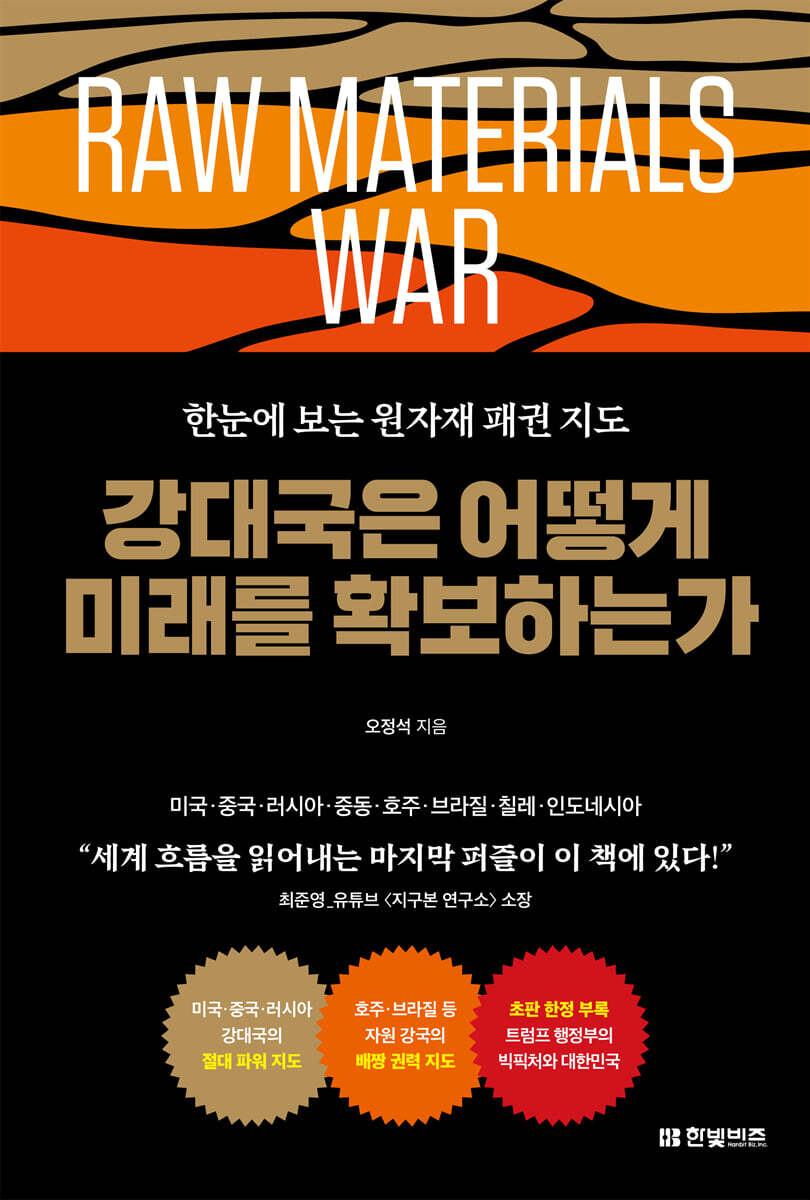
How Great Powers Secure the Future
 |
Description
Book Introduction
YouTube [Global Research Institute] Director Choi Jun-young's recommendation
“The final puzzle piece to understanding the world’s trends is in this book!”
A raw materials map that provides a bird's eye view of the flow of resource hegemony.
What are the great powers doing to further their own interests?
Read the raw materials now, as the world order is about to be reorganized!
At a time when international relations are so turbulent that it is difficult to predict even an inch ahead, a book has been published that attempts to predict the future of hegemony through the flow of raw materials.
Author Oh Jeong-seok, who has been analyzing and researching the global economy and international raw materials markets for over 20 years at the International Finance Center, is Korea's leading raw materials expert, producing reports that serve as foundational data for government policymaking and assist financial institutions and private companies in managing international financial risks.
Raw materials move from producing countries to consuming countries.
No country on earth is self-sufficient in all raw materials.
Raw material reserves and import/export trends are unlikely to be significantly affected by political and diplomatic situations.
Because a certain level is always needed to support the national economy.
Therefore, a thorough understanding of the import and export flows of key raw materials can help us understand resource strategies among countries, which can serve as a useful benchmark for forecasting the new world order that will emerge after the US-led deglobalization.
The future belongs to countries that secure a stable supply of raw materials necessary for future technological development, such as rare earth elements and nickel.
In this book, we will explore the choices that major powers such as the United States, China, the Middle East, and Russia are making to maintain their current hegemony and the choices they will make in the future.
Let's also examine the concerns and strategies of countries like Brazil, Chile, and Indonesia, which are striving to seize future opportunities based on their abundant resources.
“The final puzzle piece to understanding the world’s trends is in this book!”
A raw materials map that provides a bird's eye view of the flow of resource hegemony.
What are the great powers doing to further their own interests?
Read the raw materials now, as the world order is about to be reorganized!
At a time when international relations are so turbulent that it is difficult to predict even an inch ahead, a book has been published that attempts to predict the future of hegemony through the flow of raw materials.
Author Oh Jeong-seok, who has been analyzing and researching the global economy and international raw materials markets for over 20 years at the International Finance Center, is Korea's leading raw materials expert, producing reports that serve as foundational data for government policymaking and assist financial institutions and private companies in managing international financial risks.
Raw materials move from producing countries to consuming countries.
No country on earth is self-sufficient in all raw materials.
Raw material reserves and import/export trends are unlikely to be significantly affected by political and diplomatic situations.
Because a certain level is always needed to support the national economy.
Therefore, a thorough understanding of the import and export flows of key raw materials can help us understand resource strategies among countries, which can serve as a useful benchmark for forecasting the new world order that will emerge after the US-led deglobalization.
The future belongs to countries that secure a stable supply of raw materials necessary for future technological development, such as rare earth elements and nickel.
In this book, we will explore the choices that major powers such as the United States, China, the Middle East, and Russia are making to maintain their current hegemony and the choices they will make in the future.
Let's also examine the concerns and strategies of countries like Brazil, Chile, and Indonesia, which are striving to seize future opportunities based on their abundant resources.
- You can preview some of the book's contents.
Preview
index
Entering
Reading the World Economy Game through Raw Materials
prolog
The world of raw materials is as complex as it is important.
Raw materials that govern our daily lives
Processing to create value
Raw materials value chain
Various issues surrounding raw materials
S&P GSCI, an abbreviated version of the international raw materials market
The ultimate weapon on a silent battlefield
Problems to be solved
Rediscover the world map with the raw materials puzzle
Raw materials trade is the lifeblood of the global economy.
Part 1
Oil as a source of power and security
petroleum
Just know this
Oil and crude oil
Barrels and gallons
Oil value chain
Real market and derivatives market
Standard oil type
reserves
oil-producing countries
oil majors
Oil data
Middle East
powerful supply hegemony
The Middle East awakens to oil interests
Huge reserves and world-class competitiveness
Spare production capacity that Western oil-producing countries do not have
The largest importer of Middle Eastern crude oil
Premium applicable only to Asia
Oil becomes a weapon
Oil, which has become a hot topic in Middle Eastern oil-producing countries
Oil-rich countries seeking to transition away from oil
The emergence of shale oil, a powerful competitor
Asia
Another hegemon with enormous demand
The center of oil consumption
Russia's saviors: China and India
Oil-eating hippopotamus, Asia
When you break free from excessive oil cravings
Not only is it the best in crude oil imports, but its refining capabilities are also top-notch.
Meeting global demand for petroleum products
Dependence on Middle Eastern crude oil: a gain or a loss?
Why Middle Eastern Crude Oil Is Preferred
Singapore, Asia's oil hub
USA
Containing the Middle East with shale oil
From an oil importer to an oil exporter
Shale oil, which led a new energy revolution
Shale oil is very American
The oil price war that became a vaccine for the shale industry
Shale oil gets stronger the more it gets hit
Crude oil is also made in the USA
Why US Crude Oil Imports Have Increased
The impact of the sharp decline in US crude oil imports
North American oil hub, the Gulf Coast
dense oil transportation pipelines
Mecca of international crude oil futures trading
New York Mercantile Exchange WTI futures launched in response to market demand
Futures price more important than spot price
The explosion in popularity of futures trading since the 2000s
European Union and Russia
Seeking new opportunities during a supply-demand transition
Why the EU's Oil Demand Has Declined
The European Union's green energy policy
Energy security challenges facing the European Union
Dangerous levels of dependence on Russian crude oil
Diversification of import sources
ARA, Europe's oil hub
ARA is an export-oriented oil hub in the hinterland.
From oil hub to hydrogen hub
The Future of Russia, One of the World's Top Three Oil Powers
The oil industry that led Russia's revival after the collapse of the Soviet Union
Russia's oil industry at a crossroads
[World Oil Map]
Part 2
Minerals and metals that secure future technologies
Minerals and Metals
Just know this before you go
mineral
metal
6 major non-ferrous metals
Rare metals and rare earths
Mining, beneficiation, smelting, refining
London Metal Exchange
Mineral Major
Metal Industry and Energy
reserves
Alloys and plating
china
Unrivaled demand that doesn't even tolerate competition for hegemony
Nonferrous metal prices depend on the Chinese economy.
Another battleground between China and the United States
Iron ore is a black hole, steel is a white hole
Global anti-dumping regulations targeting China
The Rice of Industry, the Future of the Steel Industry
If China reduces metal production, the world's air quality will improve.
Decarbonization is the future competitiveness of China's metal industry.
Australia and Russia
I'm not afraid of a trade war either.
Australia has the world's largest iron ore reserves
International reference price for iron ore
Can Korea maintain its position as the world's leading iron ore exporter?
Russia's Weaponized Strategic Minerals: Platinum Group Elements
Russia is a metallurgical power and a vulnerable nation.
Chile and Indonesia
Hold the fate of future technology in your hands
Chile, a country with diverse mineral resources
AI will be useless if Chilean mines close.
Chile's Faltering Copper Industry
Indonesia, Asia's mineral blue chip
Indonesia's motives behind its ban on mineral exports
My Way in Indonesia
Africa
Another arena of great powers
A country with great potential and unexplored areas
Fierce competition among major powers over Africa's mineral resources
Africa at the crossroads of dependence and prosperity
[World Minerals and Metals Map]
Part 3
Grain, an essential resource directly related to survival
grain
Just know this before you go
agricultural products and grains
List of Grains to Watch Out for
World Agricultural Commodities Futures Exchange
bushel
Grain year
El Niño and La Niña
Grain and fuel
agricultural byproducts
World grain production
grain majors
USA
An agricultural superpower with food hegemony
Dominating the global grain market
Soybeans grow where corn is planted.
The wheat belt of the great plains stretching north to south
The Mystery of U.S. Grain Production
Innovation in agricultural productivity driven by cutting-edge technology
The endless evolution of agricultural technology
Are genetically modified crops a blessing or a curse?
Monsanto's Two Faces
American corn and soybeans are genetically modified crops
If there were no genetically modified crops
A food crisis that no one can avoid
Food resource nationalism and food riots
brazil
The only alternative to the United States
Background of becoming the world's grain warehouse
World's largest soybean producer
Corn that can be grown in three crops
Ranked first in sugar production
The Real Winner of the US-China Soybean War
The Amazon is sacrificed to feed the world
Is beef ruining the Amazon?
russia
Using food as a weapon
The Butterfly Effect of Russia's Heat Wave and Drought
The world's leading soju and beer brand
The cooking oil war brought on by the Russo-Ukrainian War
Cooking oil, an essential part of our diet
Fertilizer is another of Russia's weapons
What Happens When Russia Controls Fertilizer Exports
China and India
Will it cause a global food crisis?
China's grain vacuum cleaner
If China eats less, will the world's food situation improve?
India, a surprising agricultural powerhouse
International sugarflation triggered by India
As China and India's incomes rise, will the world's food shortages worsen?
The threat posed by increased meat consumption
World Grain Map
Coming out
Our Opportunities in the Evolving Raw Materials Market
Reading the World Economy Game through Raw Materials
prolog
The world of raw materials is as complex as it is important.
Raw materials that govern our daily lives
Processing to create value
Raw materials value chain
Various issues surrounding raw materials
S&P GSCI, an abbreviated version of the international raw materials market
The ultimate weapon on a silent battlefield
Problems to be solved
Rediscover the world map with the raw materials puzzle
Raw materials trade is the lifeblood of the global economy.
Part 1
Oil as a source of power and security
petroleum
Just know this
Oil and crude oil
Barrels and gallons
Oil value chain
Real market and derivatives market
Standard oil type
reserves
oil-producing countries
oil majors
Oil data
Middle East
powerful supply hegemony
The Middle East awakens to oil interests
Huge reserves and world-class competitiveness
Spare production capacity that Western oil-producing countries do not have
The largest importer of Middle Eastern crude oil
Premium applicable only to Asia
Oil becomes a weapon
Oil, which has become a hot topic in Middle Eastern oil-producing countries
Oil-rich countries seeking to transition away from oil
The emergence of shale oil, a powerful competitor
Asia
Another hegemon with enormous demand
The center of oil consumption
Russia's saviors: China and India
Oil-eating hippopotamus, Asia
When you break free from excessive oil cravings
Not only is it the best in crude oil imports, but its refining capabilities are also top-notch.
Meeting global demand for petroleum products
Dependence on Middle Eastern crude oil: a gain or a loss?
Why Middle Eastern Crude Oil Is Preferred
Singapore, Asia's oil hub
USA
Containing the Middle East with shale oil
From an oil importer to an oil exporter
Shale oil, which led a new energy revolution
Shale oil is very American
The oil price war that became a vaccine for the shale industry
Shale oil gets stronger the more it gets hit
Crude oil is also made in the USA
Why US Crude Oil Imports Have Increased
The impact of the sharp decline in US crude oil imports
North American oil hub, the Gulf Coast
dense oil transportation pipelines
Mecca of international crude oil futures trading
New York Mercantile Exchange WTI futures launched in response to market demand
Futures price more important than spot price
The explosion in popularity of futures trading since the 2000s
European Union and Russia
Seeking new opportunities during a supply-demand transition
Why the EU's Oil Demand Has Declined
The European Union's green energy policy
Energy security challenges facing the European Union
Dangerous levels of dependence on Russian crude oil
Diversification of import sources
ARA, Europe's oil hub
ARA is an export-oriented oil hub in the hinterland.
From oil hub to hydrogen hub
The Future of Russia, One of the World's Top Three Oil Powers
The oil industry that led Russia's revival after the collapse of the Soviet Union
Russia's oil industry at a crossroads
[World Oil Map]
Part 2
Minerals and metals that secure future technologies
Minerals and Metals
Just know this before you go
mineral
metal
6 major non-ferrous metals
Rare metals and rare earths
Mining, beneficiation, smelting, refining
London Metal Exchange
Mineral Major
Metal Industry and Energy
reserves
Alloys and plating
china
Unrivaled demand that doesn't even tolerate competition for hegemony
Nonferrous metal prices depend on the Chinese economy.
Another battleground between China and the United States
Iron ore is a black hole, steel is a white hole
Global anti-dumping regulations targeting China
The Rice of Industry, the Future of the Steel Industry
If China reduces metal production, the world's air quality will improve.
Decarbonization is the future competitiveness of China's metal industry.
Australia and Russia
I'm not afraid of a trade war either.
Australia has the world's largest iron ore reserves
International reference price for iron ore
Can Korea maintain its position as the world's leading iron ore exporter?
Russia's Weaponized Strategic Minerals: Platinum Group Elements
Russia is a metallurgical power and a vulnerable nation.
Chile and Indonesia
Hold the fate of future technology in your hands
Chile, a country with diverse mineral resources
AI will be useless if Chilean mines close.
Chile's Faltering Copper Industry
Indonesia, Asia's mineral blue chip
Indonesia's motives behind its ban on mineral exports
My Way in Indonesia
Africa
Another arena of great powers
A country with great potential and unexplored areas
Fierce competition among major powers over Africa's mineral resources
Africa at the crossroads of dependence and prosperity
[World Minerals and Metals Map]
Part 3
Grain, an essential resource directly related to survival
grain
Just know this before you go
agricultural products and grains
List of Grains to Watch Out for
World Agricultural Commodities Futures Exchange
bushel
Grain year
El Niño and La Niña
Grain and fuel
agricultural byproducts
World grain production
grain majors
USA
An agricultural superpower with food hegemony
Dominating the global grain market
Soybeans grow where corn is planted.
The wheat belt of the great plains stretching north to south
The Mystery of U.S. Grain Production
Innovation in agricultural productivity driven by cutting-edge technology
The endless evolution of agricultural technology
Are genetically modified crops a blessing or a curse?
Monsanto's Two Faces
American corn and soybeans are genetically modified crops
If there were no genetically modified crops
A food crisis that no one can avoid
Food resource nationalism and food riots
brazil
The only alternative to the United States
Background of becoming the world's grain warehouse
World's largest soybean producer
Corn that can be grown in three crops
Ranked first in sugar production
The Real Winner of the US-China Soybean War
The Amazon is sacrificed to feed the world
Is beef ruining the Amazon?
russia
Using food as a weapon
The Butterfly Effect of Russia's Heat Wave and Drought
The world's leading soju and beer brand
The cooking oil war brought on by the Russo-Ukrainian War
Cooking oil, an essential part of our diet
Fertilizer is another of Russia's weapons
What Happens When Russia Controls Fertilizer Exports
China and India
Will it cause a global food crisis?
China's grain vacuum cleaner
If China eats less, will the world's food situation improve?
India, a surprising agricultural powerhouse
International sugarflation triggered by India
As China and India's incomes rise, will the world's food shortages worsen?
The threat posed by increased meat consumption
World Grain Map
Coming out
Our Opportunities in the Evolving Raw Materials Market
Detailed image

Into the book
In addition to the scale of production, there is another important difference that other oil-producing countries cannot keep up with Middle Eastern countries.
This is spare capacity.
Spare capacity is the difference between production capacity and actual production, and literally means the ability to quickly increase crude oil production in an emergency.
Spare capacity is crucial because it acts as a buffer to stabilize the market in the event of unexpected disruptions in crude oil supplies anywhere in the world, such as war, wildfires, severe weather, or technical failures.
It's not well known, but there are more problems with crude oil supply around the world than you might think.
Therefore, if there had been no spare production capacity in the Middle Eastern oil-producing countries, the international crude oil market would have been much more unstable than it is now.
--- p.48
China and India boast enormous oil purchasing power, enough to neutralize Western sanctions against Russia.
However, other Asian countries, such as Japan, South Korea, Taiwan, and Singapore, have long been on the list of the world's top oil consumers.
Therefore, Asia is treated as a major player in the international raw materials market, incomparable to other regions.
Asia's role as a center of oil consumption is expected to grow further in the future.
We live in an era where when the Asian economy coughs, the international oil market catches the flu.
--- p.67~68
It's difficult to say who won the oil price war that began in 2014, as both sides suffered enormous economic losses.
But it's clear that American shale producers survived and emerged stronger.
Unlike OPEC, which is comprised of state-owned oil companies, American shale companies, which have been engaged in fierce competition in a free market, have learned how to survive in any adverse conditions through fierce restructuring and bold technological innovation.
Much like a Silicon Valley startup, it rekindled the shale boom by reducing costs and increasing efficiency through rapid decision-making, downsizing idle personnel, utilizing cutting-edge equipment, and improving drilling techniques.
--- p.93
In the case of nickel, which is attracting attention as a key material for secondary batteries, China's imports of ore and concentrate reached 43.53 million tons in 2021, accounting for 82% of the global market share, nearly 14 times that of South Korea, which ranked second.
The amount of nickel metal imported was 150,000 tons, more than six times that of second-place Japan, and the amount of ferronickel (an alloy of 20 percent nickel and 80 percent iron), a raw material for stainless steel, imported was almost swept at 3.73 million tons.
China imports nickel ore and concentrate from countries such as the Philippines, Australia, and Russia.
Until 2019, the country imported nearly half of its ore from Indonesia, the world's largest producer, but diversified its suppliers after Indonesia banned the export of ore and concentrate.
--- p.146
Almost all of Australia's iron ore is exported to Asia. According to OEC data, a total of $87.9 billion was exported in 2022, of which $72.5 billion (83%) went to China, $6.5 billion (7.4%) to Japan, $5.2 billion (2%) to South Korea, and $1.8 billion (2%) to Taiwan.
In the early 2000s, exports were concentrated in four Asian countries, accounting for 86 percent, but some exports were also made to other regions, including France, the United Kingdom, Germany, and the United States.
However, since around 2010, it has been heading only towards Asia.
It can be seen that export destinations have been reorganized to focus on geographically close locations in order to reduce transportation costs.
--- p.160
U.S. soybean production is projected to reach 113.3 million tons in 2023/2024, accounting for 29 percent of global production and ranking second.
Until 2016/2017, it was the undisputed world number one, just like corn, but it lost its top spot to Brazil, which has been rising rapidly.
However, it is a far cry from the 50 million tonnes of production produced by Argentina, which ranks third.
Exports reached 46.3 million tons, the second largest after Brazil, and the combined exports of the two countries account for 86 percent of global soybean exports.
As of 2023, 54 percent of U.S. soybean exports went to China, followed by the EU with 12 percent, Mexico with 10 percent, Japan with 5 percent, and Indonesia with 4.5 percent.
--- p.213
Brazil quickly filled the void left by the United States.
In December 2018 alone, China imported 4.39 million tons of Brazilian soybeans, more than three times the amount from the previous year, and the playing field for China's soybean imports that year was 81 percent Brazilian and 10 percent American, lopsided in favor of Brazil.
Brazil's dependence on China for soybean exports also hit a record high of 82 percent, up from 70 percent the previous year.
In fact, the reversal in market share between the US and Brazil in China's soybean import market has been clearly evident since 2013, but the gap has widened significantly since 2018. While the gap has narrowed somewhat since then due to the recovery of US exports to China, it has not narrowed to the same level as before.
This is spare capacity.
Spare capacity is the difference between production capacity and actual production, and literally means the ability to quickly increase crude oil production in an emergency.
Spare capacity is crucial because it acts as a buffer to stabilize the market in the event of unexpected disruptions in crude oil supplies anywhere in the world, such as war, wildfires, severe weather, or technical failures.
It's not well known, but there are more problems with crude oil supply around the world than you might think.
Therefore, if there had been no spare production capacity in the Middle Eastern oil-producing countries, the international crude oil market would have been much more unstable than it is now.
--- p.48
China and India boast enormous oil purchasing power, enough to neutralize Western sanctions against Russia.
However, other Asian countries, such as Japan, South Korea, Taiwan, and Singapore, have long been on the list of the world's top oil consumers.
Therefore, Asia is treated as a major player in the international raw materials market, incomparable to other regions.
Asia's role as a center of oil consumption is expected to grow further in the future.
We live in an era where when the Asian economy coughs, the international oil market catches the flu.
--- p.67~68
It's difficult to say who won the oil price war that began in 2014, as both sides suffered enormous economic losses.
But it's clear that American shale producers survived and emerged stronger.
Unlike OPEC, which is comprised of state-owned oil companies, American shale companies, which have been engaged in fierce competition in a free market, have learned how to survive in any adverse conditions through fierce restructuring and bold technological innovation.
Much like a Silicon Valley startup, it rekindled the shale boom by reducing costs and increasing efficiency through rapid decision-making, downsizing idle personnel, utilizing cutting-edge equipment, and improving drilling techniques.
--- p.93
In the case of nickel, which is attracting attention as a key material for secondary batteries, China's imports of ore and concentrate reached 43.53 million tons in 2021, accounting for 82% of the global market share, nearly 14 times that of South Korea, which ranked second.
The amount of nickel metal imported was 150,000 tons, more than six times that of second-place Japan, and the amount of ferronickel (an alloy of 20 percent nickel and 80 percent iron), a raw material for stainless steel, imported was almost swept at 3.73 million tons.
China imports nickel ore and concentrate from countries such as the Philippines, Australia, and Russia.
Until 2019, the country imported nearly half of its ore from Indonesia, the world's largest producer, but diversified its suppliers after Indonesia banned the export of ore and concentrate.
--- p.146
Almost all of Australia's iron ore is exported to Asia. According to OEC data, a total of $87.9 billion was exported in 2022, of which $72.5 billion (83%) went to China, $6.5 billion (7.4%) to Japan, $5.2 billion (2%) to South Korea, and $1.8 billion (2%) to Taiwan.
In the early 2000s, exports were concentrated in four Asian countries, accounting for 86 percent, but some exports were also made to other regions, including France, the United Kingdom, Germany, and the United States.
However, since around 2010, it has been heading only towards Asia.
It can be seen that export destinations have been reorganized to focus on geographically close locations in order to reduce transportation costs.
--- p.160
U.S. soybean production is projected to reach 113.3 million tons in 2023/2024, accounting for 29 percent of global production and ranking second.
Until 2016/2017, it was the undisputed world number one, just like corn, but it lost its top spot to Brazil, which has been rising rapidly.
However, it is a far cry from the 50 million tonnes of production produced by Argentina, which ranks third.
Exports reached 46.3 million tons, the second largest after Brazil, and the combined exports of the two countries account for 86 percent of global soybean exports.
As of 2023, 54 percent of U.S. soybean exports went to China, followed by the EU with 12 percent, Mexico with 10 percent, Japan with 5 percent, and Indonesia with 4.5 percent.
--- p.213
Brazil quickly filled the void left by the United States.
In December 2018 alone, China imported 4.39 million tons of Brazilian soybeans, more than three times the amount from the previous year, and the playing field for China's soybean imports that year was 81 percent Brazilian and 10 percent American, lopsided in favor of Brazil.
Brazil's dependence on China for soybean exports also hit a record high of 82 percent, up from 70 percent the previous year.
In fact, the reversal in market share between the US and Brazil in China's soybean import market has been clearly evident since 2013, but the gap has widened significantly since 2018. While the gap has narrowed somewhat since then due to the recovery of US exports to China, it has not narrowed to the same level as before.
--- p.235
Publisher's Review
The United States, China, Russia, the Middle East, Australia, Brazil…
Understanding the flow of raw materials reveals the world order!
From oil to rare earths
A 22-Chapter Map of the Raw Materials Supply Chain: A Global Hegemony Landscape
Since Donald Trump took office as the 47th President of the United States, the existing world order has been shaken.
There were also instances of coveting the territory of Canada and Greenland, which were allies, and cooperating with Russia for profit.
They do not hesitate to slap tariffs on countries with which they have maintained friendly cooperative relations to revive American manufacturing.
High value-added manufacturing companies, such as semiconductor companies, are being pressured to relocate their production bases to the United States.
The prevailing view is that the United States is leading deglobalization and will establish a new world order.
Although we live in an age where nothing is certain, there is one clear criterion for reading the flow.
It is the supply and demand of raw materials.
Raw materials are essential for national management, but options are limited.
Therefore, even if there is a political or diplomatic conflict with a specific country, it may be necessary to maintain a continuous relationship to secure the supply of raw materials.
In fact, the United States, the world's largest grain exporter, sends half of its soybean exports to China even amid its conflict with the country.
Of course, as the US-China dispute continues, China is gradually reducing its imports of US soybeans and increasing its imports of Brazilian soybeans.
Brazil is also an agricultural powerhouse, known as the world's grain storehouse, producing soybeans, corn, and coffee.
However, it will be difficult for China to change its exporting countries all at once to meet its high demand for grain.
Additionally, the United States became an oil exporter thanks to the success of the shale revolution.
The relationship between the Middle East and the US has become competitive over oil exports, and this has led to a change in the US's geopolitical value judgment regarding the Middle East.
Although U.S. crude oil exports to Asia, which absorbs the majority of global oil demand, have increased, Asia still imports far more crude oil from the Middle East than from the U.S. due to its geographical proximity.
As such, there are not enough substitutes for raw materials between countries, so the expected range is limited.
Having a basic understanding of raw materials will provide you with a solid basis for forecasting the big picture, even if the world order is reorganized.
Which country has a stable supply of raw materials?
Strategies and visions of each country drawn on a world map
And the survival method in South Korea
This book covers three major raw materials that are essential for the survival and prosperity of a nation.
These include oil, minerals and metals, and grains.
The author of this book, who has been analyzing and reporting on the international raw materials market for over 20 years, says that anyone interested in the international economy and investment must understand the raw materials market.
For readers who don't even have the courage to tackle the difficult and complex nature of raw materials, we've carefully covered the basics of each raw material.
We have taken care to lay the groundwork by introducing key concepts, major companies, and value chains.
We also addressed raw material supply and demand issues by country and region.
The trajectories of where resources buried in the United States, China, the Middle East, Russia, Asia, Brazil, Australia, Chile, and Indonesia move, are plotted on a map, and their proportions and trends are also drawn on the map, allowing the flow of resource hegemony to be seen at a glance.
Part 1, "Oil as Power and Security," begins with the basics of oil and covers the supply and demand structure, characteristics, and problems of the Middle East, the United States, and Russia, which serve as suppliers of oil, and Asia and the European Union, which serve as consumers of oil.
Part 2, "Minerals and Metals that Secure Future Technology," begins with the basics of minerals and metals, examining the reality of China's unrivaled demand, the strength of Australia and Russia's supply hegemony, which is not afraid of a trade war, and the current status and limitations of mineral reserves in Chile, Indonesia, and Africa.
Part 3, "Grains: An Essential Resource Directly Linked to Survival," explores the agricultural superpower the United States, Brazil, the only alternative to the United States, and the undeniable presence of Russia, China, and India in the global grain market.
The book includes 22 chapters of "Material Hegemony Maps," which depict the movement routes, proportions, and trends of raw materials on a world map.
If we follow the supply and demand issues of major raw material countries, we may face the reality of countries joining forces to seize the initiative in the future.
Understanding the flow of raw materials reveals the world order!
From oil to rare earths
A 22-Chapter Map of the Raw Materials Supply Chain: A Global Hegemony Landscape
Since Donald Trump took office as the 47th President of the United States, the existing world order has been shaken.
There were also instances of coveting the territory of Canada and Greenland, which were allies, and cooperating with Russia for profit.
They do not hesitate to slap tariffs on countries with which they have maintained friendly cooperative relations to revive American manufacturing.
High value-added manufacturing companies, such as semiconductor companies, are being pressured to relocate their production bases to the United States.
The prevailing view is that the United States is leading deglobalization and will establish a new world order.
Although we live in an age where nothing is certain, there is one clear criterion for reading the flow.
It is the supply and demand of raw materials.
Raw materials are essential for national management, but options are limited.
Therefore, even if there is a political or diplomatic conflict with a specific country, it may be necessary to maintain a continuous relationship to secure the supply of raw materials.
In fact, the United States, the world's largest grain exporter, sends half of its soybean exports to China even amid its conflict with the country.
Of course, as the US-China dispute continues, China is gradually reducing its imports of US soybeans and increasing its imports of Brazilian soybeans.
Brazil is also an agricultural powerhouse, known as the world's grain storehouse, producing soybeans, corn, and coffee.
However, it will be difficult for China to change its exporting countries all at once to meet its high demand for grain.
Additionally, the United States became an oil exporter thanks to the success of the shale revolution.
The relationship between the Middle East and the US has become competitive over oil exports, and this has led to a change in the US's geopolitical value judgment regarding the Middle East.
Although U.S. crude oil exports to Asia, which absorbs the majority of global oil demand, have increased, Asia still imports far more crude oil from the Middle East than from the U.S. due to its geographical proximity.
As such, there are not enough substitutes for raw materials between countries, so the expected range is limited.
Having a basic understanding of raw materials will provide you with a solid basis for forecasting the big picture, even if the world order is reorganized.
Which country has a stable supply of raw materials?
Strategies and visions of each country drawn on a world map
And the survival method in South Korea
This book covers three major raw materials that are essential for the survival and prosperity of a nation.
These include oil, minerals and metals, and grains.
The author of this book, who has been analyzing and reporting on the international raw materials market for over 20 years, says that anyone interested in the international economy and investment must understand the raw materials market.
For readers who don't even have the courage to tackle the difficult and complex nature of raw materials, we've carefully covered the basics of each raw material.
We have taken care to lay the groundwork by introducing key concepts, major companies, and value chains.
We also addressed raw material supply and demand issues by country and region.
The trajectories of where resources buried in the United States, China, the Middle East, Russia, Asia, Brazil, Australia, Chile, and Indonesia move, are plotted on a map, and their proportions and trends are also drawn on the map, allowing the flow of resource hegemony to be seen at a glance.
Part 1, "Oil as Power and Security," begins with the basics of oil and covers the supply and demand structure, characteristics, and problems of the Middle East, the United States, and Russia, which serve as suppliers of oil, and Asia and the European Union, which serve as consumers of oil.
Part 2, "Minerals and Metals that Secure Future Technology," begins with the basics of minerals and metals, examining the reality of China's unrivaled demand, the strength of Australia and Russia's supply hegemony, which is not afraid of a trade war, and the current status and limitations of mineral reserves in Chile, Indonesia, and Africa.
Part 3, "Grains: An Essential Resource Directly Linked to Survival," explores the agricultural superpower the United States, Brazil, the only alternative to the United States, and the undeniable presence of Russia, China, and India in the global grain market.
The book includes 22 chapters of "Material Hegemony Maps," which depict the movement routes, proportions, and trends of raw materials on a world map.
If we follow the supply and demand issues of major raw material countries, we may face the reality of countries joining forces to seize the initiative in the future.
GOODS SPECIFICS
- Date of issue: May 30, 2025
- Page count, weight, size: 284 pages | 590g | 155*225*21mm
- ISBN13: 9791157848072
You may also like
카테고리
korean


korean

![GQ KOREA Mark (Monthly): December [2025]](http://librairie.coreenne.fr/cdn/shop/files/8ef265dbbfbf186523ed75ba7319009d.jpg?v=1765340328&width=3840)


