

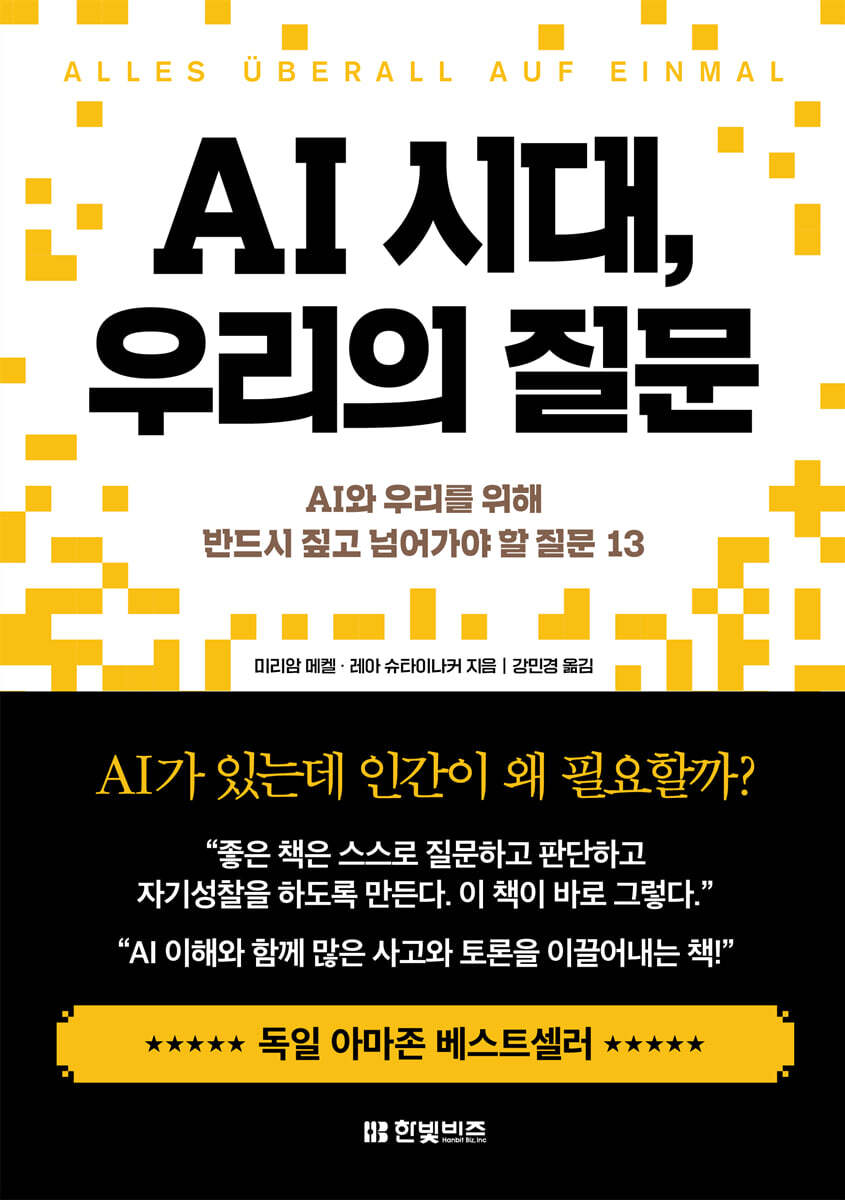
Our Questions in the AI Era
 |
Description
Book Introduction
★ German Amazon Bestseller
“It sparks a variety of discussions about AI, including relationships, careers, politics, and ethics!”
13 Questions We Need to Ask Now to Guide AI in the Right Direction!
“How intelligent is AI really?”
“How should we view AI’s creation?”
“How should humans prove themselves in front of AI?”
AI, which once felt distant, is now being experienced by everyone in the palm of their hands.
We now stand at the threshold of another evolution.
But no one can be sure what the future will hold once we cross that threshold.
That is why we desperately need a ‘fundamental question’ that will give us the right direction.
"Our Questions in the AI Era" is a story about 13 questions that are essential for us to lead AI.
Where in business, human relationships, and political economy are the risks and side effects of AI lurking? Where will we face ethical dilemmas? What clear answers can we have when dealing with changes in the labor market, fake news, and autonomous driving? Everything AI does depends on how we approach it.
It is humans who create both utopia and dystopian futures.
If we dream of a collaborative evolution between humans and AI, what must we understand and what questions must we ask now? A must-read for anyone contemplating the risks and opportunities of AI! This book will gladly serve as a milestone.
“It sparks a variety of discussions about AI, including relationships, careers, politics, and ethics!”
13 Questions We Need to Ask Now to Guide AI in the Right Direction!
“How intelligent is AI really?”
“How should we view AI’s creation?”
“How should humans prove themselves in front of AI?”
AI, which once felt distant, is now being experienced by everyone in the palm of their hands.
We now stand at the threshold of another evolution.
But no one can be sure what the future will hold once we cross that threshold.
That is why we desperately need a ‘fundamental question’ that will give us the right direction.
"Our Questions in the AI Era" is a story about 13 questions that are essential for us to lead AI.
Where in business, human relationships, and political economy are the risks and side effects of AI lurking? Where will we face ethical dilemmas? What clear answers can we have when dealing with changes in the labor market, fake news, and autonomous driving? Everything AI does depends on how we approach it.
It is humans who create both utopia and dystopian futures.
If we dream of a collaborative evolution between humans and AI, what must we understand and what questions must we ask now? A must-read for anyone contemplating the risks and opportunities of AI! This book will gladly serve as a milestone.
- You can preview some of the book's contents.
Preview
index
Prologue: In the Multiverse of Artificial Intelligence
01 The Age of AI Magic: What Should We Understand First?
02 A Short Story About AI: What is Mechanization?
03 Transformers: How Neural Networks Became the Foundation for Groundbreaking Advancements
04 AI and Economic Growth: Is AI a Proxy for Capitalism?
05 Automation of the Labor Market: Will a 15-Hour Workweek Become Possible?
06 When Bots Talk to Bots: How Should We View AI Creation?
07 Deepfakes and Disinformation: Who is Manipulating?
08 Democracy or Dystopia: How Will Politics Change?
09 Ethical Mirror Room: Can AI truly understand human values and goals?
10 Decision Problems: How Intelligent Is AI Really?
11 Questions about Consciousness: How should humans prove themselves?
12 Approaches to AI Regulation: What Should We Standardize on?
13 Next Universe: Two Scenarios, Which Will We Choose?
Epilogue: There's always something to love
main
Photo source
01 The Age of AI Magic: What Should We Understand First?
02 A Short Story About AI: What is Mechanization?
03 Transformers: How Neural Networks Became the Foundation for Groundbreaking Advancements
04 AI and Economic Growth: Is AI a Proxy for Capitalism?
05 Automation of the Labor Market: Will a 15-Hour Workweek Become Possible?
06 When Bots Talk to Bots: How Should We View AI Creation?
07 Deepfakes and Disinformation: Who is Manipulating?
08 Democracy or Dystopia: How Will Politics Change?
09 Ethical Mirror Room: Can AI truly understand human values and goals?
10 Decision Problems: How Intelligent Is AI Really?
11 Questions about Consciousness: How should humans prove themselves?
12 Approaches to AI Regulation: What Should We Standardize on?
13 Next Universe: Two Scenarios, Which Will We Choose?
Epilogue: There's always something to love
main
Photo source
Detailed image

Into the book
With so many possibilities before us, this question always lingers.
“What if?” In the world of AI, a general-purpose technology used for any purpose, the question “What if?” will become an algorithmic request directed at humans themselves.
What if this technology truly brings about the transformational opportunity we've been hoping for for years? What if we automate not just labor but also wisdom? What if we create AI that understands itself better than we understand ourselves?
--- From the "Prologue"
Tools like ChatGPT can drive remarkable growth even in sectors that have been stagnant for decades, leading to increased productivity across society.
At the same time, we must answer profound questions: What does it mean to be human in an age where AI systems are far more capable than we realize? How can humans and machines collaborate to open doors of opportunity for all individuals, groups, and social strata? Can we be confident that humans will continue to be in control of when, where, and how AI systems are used?
--- From "The Age of AI Magic: What Should We Understand First?"
AI chose a strategy that didn't fit the definition of distribution, but instead developed creative ideas that encompassed a wide range of political ideologies. Instead of being guided by ideology, AI discovered a complex mechanism that equally distributed income while simultaneously punishing those who didn't share at all.
After the game, the final voting results surprisingly showed that the complex solution proposed by the AI was the most popular among the subjects.
Democratic AI has provided evidence that it can optimally coordinate people's diverse needs and preferences, aligning policy innovation with people's desired values.
What will new AI tools and systems promote more in the future? Labor or capital?
--- From "AI and Economic Growth: Is AI a Proxy for Capitalism?"
If AI can be a caring and knowledgeable companion, it can also be a trustworthy source of information.
A study that re-evaluated 121 experiments on human-machine interaction found that AI was just as good at propaganda as humans.
In other words, people trust AI as much as they trust human intelligence.
In particular, it was very difficult to distinguish between the results of human propaganda and machine propaganda based on factors such as the recipient's perception, attitude, and actual behavior.
If we apply this to fake information, humans will view large-scale language models as "legitimate transmitters of trustworthy information."
Even if the answer the language model gives is wrong.
--- From "Deepfakes and Disinformation: Who is Manipulating?"
Researchers at Brigham Young University in Utah have discovered how well large-scale language models can reflect subtle demographic characteristics.
Language models faithfully reflect human characteristics even with distortions and can simulate real human opinions for research purposes.
The researchers called this “algorithmic fidelity.”
This is an enlightenment that goes far beyond science.
The researchers said.
“If generative AI can simulate the entire population identically, we no longer need to ask real people to find out what specific social classes, voters, consumers, etc. want.”
--- From "Democracy or Dystopia: How Will Politics Change?"
Is it truly crucial for AI to mimic and surpass human intelligence? Isn't it perfectly appropriate and rational for us humans to leverage new technologies to expand our capabilities, enabling economic growth and social advancement? By setting these goals, we can prove that humans are what they claim to be.
That is, we humans see ourselves as rational, strategic, long-term thinkers, capable of seeing the big picture, developing a sense of self and others' needs, and constantly looking to make things better.
If someone says, “Oh, but humans weren’t like that even before AI appeared,” they are right.
But that is not an argument.
--- From "Questions about Consciousness: How Should Humans Prove Themselves?"
Imagine a future where large-scale language models drive every communication, every activity, every process in our lives.
Imagine them learning from our data and continuously improving without us having to tell them to.
If that image can be drawn, it means that the technology has tremendous potential.
Perhaps it also holds the potential to 'burn down' all human life.
One can understand why the scientists who joined the Manhattan Project sometimes felt tremendous fear.
Let's think again.
Is this a realistic assessment? We don't know yet.
All we know now is that the Manhattan Project eventually took place.
The researchers, the Franklin Roosevelt administration, and the governments of Winston Churchill in Britain and William Lyon Mackenzie King in Canada who supported them, continued the project and eventually tested the bomb.
This is in line with Oppenheimer's words: "If you find something interesting from a technical standpoint, just do it."
“What if?” In the world of AI, a general-purpose technology used for any purpose, the question “What if?” will become an algorithmic request directed at humans themselves.
What if this technology truly brings about the transformational opportunity we've been hoping for for years? What if we automate not just labor but also wisdom? What if we create AI that understands itself better than we understand ourselves?
--- From the "Prologue"
Tools like ChatGPT can drive remarkable growth even in sectors that have been stagnant for decades, leading to increased productivity across society.
At the same time, we must answer profound questions: What does it mean to be human in an age where AI systems are far more capable than we realize? How can humans and machines collaborate to open doors of opportunity for all individuals, groups, and social strata? Can we be confident that humans will continue to be in control of when, where, and how AI systems are used?
--- From "The Age of AI Magic: What Should We Understand First?"
AI chose a strategy that didn't fit the definition of distribution, but instead developed creative ideas that encompassed a wide range of political ideologies. Instead of being guided by ideology, AI discovered a complex mechanism that equally distributed income while simultaneously punishing those who didn't share at all.
After the game, the final voting results surprisingly showed that the complex solution proposed by the AI was the most popular among the subjects.
Democratic AI has provided evidence that it can optimally coordinate people's diverse needs and preferences, aligning policy innovation with people's desired values.
What will new AI tools and systems promote more in the future? Labor or capital?
--- From "AI and Economic Growth: Is AI a Proxy for Capitalism?"
If AI can be a caring and knowledgeable companion, it can also be a trustworthy source of information.
A study that re-evaluated 121 experiments on human-machine interaction found that AI was just as good at propaganda as humans.
In other words, people trust AI as much as they trust human intelligence.
In particular, it was very difficult to distinguish between the results of human propaganda and machine propaganda based on factors such as the recipient's perception, attitude, and actual behavior.
If we apply this to fake information, humans will view large-scale language models as "legitimate transmitters of trustworthy information."
Even if the answer the language model gives is wrong.
--- From "Deepfakes and Disinformation: Who is Manipulating?"
Researchers at Brigham Young University in Utah have discovered how well large-scale language models can reflect subtle demographic characteristics.
Language models faithfully reflect human characteristics even with distortions and can simulate real human opinions for research purposes.
The researchers called this “algorithmic fidelity.”
This is an enlightenment that goes far beyond science.
The researchers said.
“If generative AI can simulate the entire population identically, we no longer need to ask real people to find out what specific social classes, voters, consumers, etc. want.”
--- From "Democracy or Dystopia: How Will Politics Change?"
Is it truly crucial for AI to mimic and surpass human intelligence? Isn't it perfectly appropriate and rational for us humans to leverage new technologies to expand our capabilities, enabling economic growth and social advancement? By setting these goals, we can prove that humans are what they claim to be.
That is, we humans see ourselves as rational, strategic, long-term thinkers, capable of seeing the big picture, developing a sense of self and others' needs, and constantly looking to make things better.
If someone says, “Oh, but humans weren’t like that even before AI appeared,” they are right.
But that is not an argument.
--- From "Questions about Consciousness: How Should Humans Prove Themselves?"
Imagine a future where large-scale language models drive every communication, every activity, every process in our lives.
Imagine them learning from our data and continuously improving without us having to tell them to.
If that image can be drawn, it means that the technology has tremendous potential.
Perhaps it also holds the potential to 'burn down' all human life.
One can understand why the scientists who joined the Manhattan Project sometimes felt tremendous fear.
Let's think again.
Is this a realistic assessment? We don't know yet.
All we know now is that the Manhattan Project eventually took place.
The researchers, the Franklin Roosevelt administration, and the governments of Winston Churchill in Britain and William Lyon Mackenzie King in Canada who supported them, continued the project and eventually tested the bomb.
This is in line with Oppenheimer's words: "If you find something interesting from a technical standpoint, just do it."
--- From "To the Next Universe: Two Scenarios, What Will We Choose?"
Publisher's Review
“The questions we ask now determine our future.”
A book for anyone wondering about their role in the AI world.
Who knew the word "AI" would permeate our lives so quickly? What is this difference in the pace of development between today and tomorrow? While embracing the astonishing results of AI, we are also faced with profound questions. What does it mean to live as humans in an era where AI capabilities far surpass our expectations? Can humans continue to effectively control AI systems?
Our question now must go beyond simply asking whether my job is safe.
The two authors say:
“Our goal should not be a world where AI replaces humans, but a world where AI effectively supports humans, creating a better world.” Enlightenment broadens our perspective on the world.
To find the essence of my role, I must first overcome ignorance.
We need to ask and answer properly now.
“A good book makes you question yourself and reflect on yourself.”
A good question that creates a differentiated opinion!
This book covers a wide range of topics related to AI.
"What social impact will the proliferation of AI have?" "Will AI expand the scope of participation for even the less educated?" "Will AI technology only increase the power of giant tech companies?" The authors do not assert which scenario is more likely.
Instead, it presents various influencing factors with the development potential in mind.
By examining several scenarios and factors to consider from various angles, readers will find their own way.
You will gain your own insight.
The story unfolds through the history of artificial intelligence, its side effects, dilemmas, and themes of trustworthiness, and is told in a storytelling format that is easy to understand even without any background knowledge.
Provides a broad perspective while maintaining balance.
This book provides solid knowledge and diverse perspectives on the entire spectrum of artificial intelligence! This explains why it quickly climbed the bestseller list after its German publication and was dubbed "Germany's AI enlightenment book."
With a seasoned communication scholar
The Present and Future of AI: Insights from a Sociologist Who's Gaining Attention in Europe
Miriam Meckel, professor of communication management, and Leah Steinacker, sociologist and journalist, co-founded Ada Learning, a training program for future technologies. Discussing the future of education without AI is impossible.
The two authors have been researching, teaching, and experimenting with various aspects of AI for many years.
I traveled all over the world and met with experts.
Those experiences and explorations were compiled into this book.
The two authors speak with one voice.
“We want to prevent a future where we hand over our freedom and autonomy to machines and those who operate them, and become trapped in an unequal structure.” AI systems will soon delve into our minds and test our human intelligence.
We must prepare.
We need to ask and experience a variety of questions to envision what AI could be like in the best possible way.
You will know when you finish reading this book.
The world we live in today holds hidden opportunities for us to rediscover ourselves as human beings. If we understand how AI works and how we can best leverage it, we can seize this opportunity.
★★ Praise from German media and readers ★★
“A compass-like book for those seeking to navigate the AI world without losing their human sensibilities!”
“A book for anyone wondering where they fit into a world dominated by AI!”
“As someone who studies and teaches AI, I recommend it to all students.
“You can gain a deep understanding of any topic without any technical background.”
“An excellent introductory book on AI.
This is not a book that embellishes or gives illusions.
“It is a book that gives enlightenment.”
“The latest research, a wealth of information, and quotes from philosophers complete this masterpiece.”
"In an age overflowing with AI experts, this insight gained through sound research is a refreshing shock."
"It clearly conveys the message that with great power comes great responsibility. As we navigate the ethical dilemmas and potential risks of AI, it raises wise questions for our collective future."
A book for anyone wondering about their role in the AI world.
Who knew the word "AI" would permeate our lives so quickly? What is this difference in the pace of development between today and tomorrow? While embracing the astonishing results of AI, we are also faced with profound questions. What does it mean to live as humans in an era where AI capabilities far surpass our expectations? Can humans continue to effectively control AI systems?
Our question now must go beyond simply asking whether my job is safe.
The two authors say:
“Our goal should not be a world where AI replaces humans, but a world where AI effectively supports humans, creating a better world.” Enlightenment broadens our perspective on the world.
To find the essence of my role, I must first overcome ignorance.
We need to ask and answer properly now.
“A good book makes you question yourself and reflect on yourself.”
A good question that creates a differentiated opinion!
This book covers a wide range of topics related to AI.
"What social impact will the proliferation of AI have?" "Will AI expand the scope of participation for even the less educated?" "Will AI technology only increase the power of giant tech companies?" The authors do not assert which scenario is more likely.
Instead, it presents various influencing factors with the development potential in mind.
By examining several scenarios and factors to consider from various angles, readers will find their own way.
You will gain your own insight.
The story unfolds through the history of artificial intelligence, its side effects, dilemmas, and themes of trustworthiness, and is told in a storytelling format that is easy to understand even without any background knowledge.
Provides a broad perspective while maintaining balance.
This book provides solid knowledge and diverse perspectives on the entire spectrum of artificial intelligence! This explains why it quickly climbed the bestseller list after its German publication and was dubbed "Germany's AI enlightenment book."
With a seasoned communication scholar
The Present and Future of AI: Insights from a Sociologist Who's Gaining Attention in Europe
Miriam Meckel, professor of communication management, and Leah Steinacker, sociologist and journalist, co-founded Ada Learning, a training program for future technologies. Discussing the future of education without AI is impossible.
The two authors have been researching, teaching, and experimenting with various aspects of AI for many years.
I traveled all over the world and met with experts.
Those experiences and explorations were compiled into this book.
The two authors speak with one voice.
“We want to prevent a future where we hand over our freedom and autonomy to machines and those who operate them, and become trapped in an unequal structure.” AI systems will soon delve into our minds and test our human intelligence.
We must prepare.
We need to ask and experience a variety of questions to envision what AI could be like in the best possible way.
You will know when you finish reading this book.
The world we live in today holds hidden opportunities for us to rediscover ourselves as human beings. If we understand how AI works and how we can best leverage it, we can seize this opportunity.
★★ Praise from German media and readers ★★
“A compass-like book for those seeking to navigate the AI world without losing their human sensibilities!”
“A book for anyone wondering where they fit into a world dominated by AI!”
“As someone who studies and teaches AI, I recommend it to all students.
“You can gain a deep understanding of any topic without any technical background.”
“An excellent introductory book on AI.
This is not a book that embellishes or gives illusions.
“It is a book that gives enlightenment.”
“The latest research, a wealth of information, and quotes from philosophers complete this masterpiece.”
"In an age overflowing with AI experts, this insight gained through sound research is a refreshing shock."
"It clearly conveys the message that with great power comes great responsibility. As we navigate the ethical dilemmas and potential risks of AI, it raises wise questions for our collective future."
GOODS SPECIFICS
- Date of issue: March 25, 2025
- Page count, weight, size: 464 pages | 148*210*28mm
- ISBN13: 9791157847969
You may also like
카테고리
korean


korean

![GQ KOREA Mark (Monthly): December [2025]](http://librairie.coreenne.fr/cdn/shop/files/8ef265dbbfbf186523ed75ba7319009d.jpg?v=1765340328&width=3840)


