

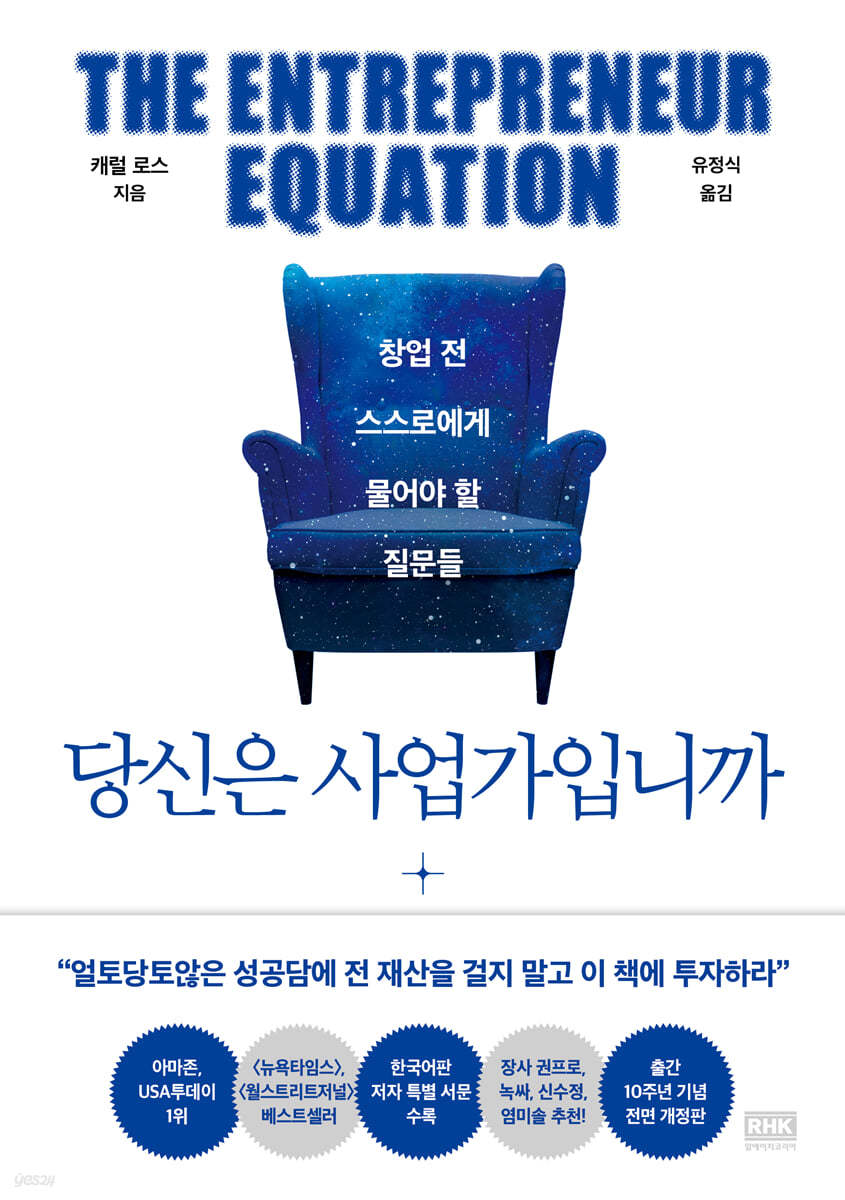
Are you a businessman?
 |
Description
Book Introduction
Revised edition commemorating the 10th anniversary of the best-selling book in the field of economics and management.
“Don’t ever do business.
“Until I read this book.”
The one business insurance policy worth paying a billion dollars for is back!
Shin Soo-jung, head of KT division, strongly recommends Jang Sa-kwon, Nok Sa, and writer Yeom Mi-sol.
Do I Have "Entrepreneur DNA"? Essential Checklist Included
"Are You a Businessman?", a global bestseller and a long-time steady seller in the domestic economics and management field, has been published in a revised edition to commemorate its 10th anniversary.
In the wake of the pandemic, a global economic downturn and a prolonged recession, and at a time when terms like "economic growth" and "lifelong employment" seem like dead words, this book's unique thematic awareness shines even brighter.
For those who desperately want to find a different path, this book is like a "preventive vaccine" that will minimize failure in life by allowing them to face the cold, capitalist market rather than fantasy-like success stories.
In the face of today's market conditions, which are even more severe than a decade ago, this book offers realistic, honest, and "hard-hitting" teachings that are still applicable to countless people who are worried about their future livelihoods.
Author Jeongsik Yoo, who translated the original book for publication in the revised edition and is currently working as a management consultant, reviewed the entire manuscript.
A manuscript titled “Translator’s Note” was also added, which contains the author’s honest experience of actually starting a publishing company over the past ten years since the book’s publication (“What if I had read this book again from the perspective of a reader who was thinking of starting a business before publishing?”).
In addition, the revised edition includes a special preface by the author, along with recommendations from industry insiders and businesspeople (Jang Sa Kwon-pro, Nok Sa, Shin Su-jeong, and Yeom Mi-sol) who have considered this book a life-changing book, especially a book they love.
The author states in the introduction that although the market situation has changed since 10 years ago, there are eternal truths that remain unchanged.
If you want to start a business, the first question you should ask yourself is not, "Can I do business?" but, "Should I do business?"
Contrary to popular belief, this book is not a threatening warning: “Never start a business!”
Rather, it will serve as a minimum safety guide and a single business insurance policy for those of you who are at a crossroads in life, who do not dream of making a fortune overnight but do not want to go bankrupt.
“Don’t ever do business.
“Until I read this book.”
The one business insurance policy worth paying a billion dollars for is back!
Shin Soo-jung, head of KT division, strongly recommends Jang Sa-kwon, Nok Sa, and writer Yeom Mi-sol.
Do I Have "Entrepreneur DNA"? Essential Checklist Included
"Are You a Businessman?", a global bestseller and a long-time steady seller in the domestic economics and management field, has been published in a revised edition to commemorate its 10th anniversary.
In the wake of the pandemic, a global economic downturn and a prolonged recession, and at a time when terms like "economic growth" and "lifelong employment" seem like dead words, this book's unique thematic awareness shines even brighter.
For those who desperately want to find a different path, this book is like a "preventive vaccine" that will minimize failure in life by allowing them to face the cold, capitalist market rather than fantasy-like success stories.
In the face of today's market conditions, which are even more severe than a decade ago, this book offers realistic, honest, and "hard-hitting" teachings that are still applicable to countless people who are worried about their future livelihoods.
Author Jeongsik Yoo, who translated the original book for publication in the revised edition and is currently working as a management consultant, reviewed the entire manuscript.
A manuscript titled “Translator’s Note” was also added, which contains the author’s honest experience of actually starting a publishing company over the past ten years since the book’s publication (“What if I had read this book again from the perspective of a reader who was thinking of starting a business before publishing?”).
In addition, the revised edition includes a special preface by the author, along with recommendations from industry insiders and businesspeople (Jang Sa Kwon-pro, Nok Sa, Shin Su-jeong, and Yeom Mi-sol) who have considered this book a life-changing book, especially a book they love.
The author states in the introduction that although the market situation has changed since 10 years ago, there are eternal truths that remain unchanged.
If you want to start a business, the first question you should ask yourself is not, "Can I do business?" but, "Should I do business?"
Contrary to popular belief, this book is not a threatening warning: “Never start a business!”
Rather, it will serve as a minimum safety guide and a single business insurance policy for those of you who are at a crossroads in life, who do not dream of making a fortune overnight but do not want to go bankrupt.
- You can preview some of the book's contents.
Preview
index
Author's Preface
Praise poured in for this book
Recommendation
preface
Part 1: The Delusional Businessman
1.
People who chase their dreams
2.
Can anyone be a businessman?
3.
A society that encourages entrepreneurship
Part 2 Are you a businessman?
|Evaluate the motivation of the business|
4.
Rules of the game
5.
The fantasy of 'becoming the boss'
6.
It's always a matter of pride
7.
How much is my idea worth?
8.
Between hobby and business
9.
It's always people who matter
|Seize the timing for starting a business|
10.
You can't kill two birds with one stone.
11.
Don't run before you can walk
12.
When should I start a business?
13.
It's not what you know that matters, but who you know.
14.
Businesses are suffering because of money worries.
|Know your personality|
15.
Business is a roller coaster, not a merry-go-round.
16.
'New thing addiction'
17.
Business isn't built overnight.
18.
Are you Santa or an elf?
19.
The road to hell is paved with good intentions.
Part 3 How to Get What You Want?
|People who discovered opportunities|
20.
Control the flow of money
21.
Sir, I'm here.
22.
You're so smart it's ridiculous
23.
When you acquire a company, you also acquire its problems.
24.
There is no such thing as an "entrepreneur gene."
|Wisdom to overcome crisis|
25.
Anticipate risks correctly
26.
What You Lose When You Quit Your Job
27.
Staff members who are like scoundrels
28.
There is always a shortage of money in the granary.
29.
No matter how many friends you have, you are alone.
Part 4: The Path of an Entrepreneur
30.
Finalize the business equation
31.
Don't be fooled by other people's success stories.
32.
A cheat sheet you can look at at any time
Translator's Note
main
Praise poured in for this book
Recommendation
preface
Part 1: The Delusional Businessman
1.
People who chase their dreams
2.
Can anyone be a businessman?
3.
A society that encourages entrepreneurship
Part 2 Are you a businessman?
|Evaluate the motivation of the business|
4.
Rules of the game
5.
The fantasy of 'becoming the boss'
6.
It's always a matter of pride
7.
How much is my idea worth?
8.
Between hobby and business
9.
It's always people who matter
|Seize the timing for starting a business|
10.
You can't kill two birds with one stone.
11.
Don't run before you can walk
12.
When should I start a business?
13.
It's not what you know that matters, but who you know.
14.
Businesses are suffering because of money worries.
|Know your personality|
15.
Business is a roller coaster, not a merry-go-round.
16.
'New thing addiction'
17.
Business isn't built overnight.
18.
Are you Santa or an elf?
19.
The road to hell is paved with good intentions.
Part 3 How to Get What You Want?
|People who discovered opportunities|
20.
Control the flow of money
21.
Sir, I'm here.
22.
You're so smart it's ridiculous
23.
When you acquire a company, you also acquire its problems.
24.
There is no such thing as an "entrepreneur gene."
|Wisdom to overcome crisis|
25.
Anticipate risks correctly
26.
What You Lose When You Quit Your Job
27.
Staff members who are like scoundrels
28.
There is always a shortage of money in the granary.
29.
No matter how many friends you have, you are alone.
Part 4: The Path of an Entrepreneur
30.
Finalize the business equation
31.
Don't be fooled by other people's success stories.
32.
A cheat sheet you can look at at any time
Translator's Note
main
Detailed image

Into the book
I'm proud to have written a book that helps readers thoroughly and honestly assess the question, "Am I the right person to start the right business at the right time?"
I hope that even if you fail, you will 'fail fast and fail cheap', and not repeat the same mistakes twice.
I hope you'll consider the question, not "Can I take the opportunity?" but "Should I take the opportunity?"
I also encourage you to think carefully about whether you're planning to expand your business by drawing a big picture, so that you're doing something that creates lasting value, rather than just a money-making hobby or a stressful job.
Over the past ten years, people have often read this book and said, “That’s so scary,” and every time, I’ve said, “Absolutely not.”
--- p.7
In the United States alone, every year, up to 6 million people consider whether to invest in their "dream company."
A small percentage of these investors make a decent living, while only 1% achieve incredible success.
However, a whopping 90% of people who invest in "dream companies" lose part or all of their investment within a few years.
Yet, every year, millions more people rush to invest.
You might guess that 'dream company' is a scam or a cult, but it's something we're all very familiar with.
The 'dream company' is none other than the 'entrepreneur'.
--- p.24
I hope you don't blow all your money, time, energy, and discernment on starting a venture simply because there's no entrepreneurial vetting process.
Initially, I addressed this issue by using a patented assessment method I call FIRED-UP®.
This assessment method is a basic test to determine whether the timing is right for starting a business and whether aspiring entrepreneurs have the right mindset.
In this book, I will expand on the Fired-Up assessment method to provide a more in-depth verification process.
Anyone considering starting, acquiring, or franchising a business should follow this verification process very carefully.
--- p.55
When you first start skiing, you should practice on beginner slopes and then steadily practice on increasingly difficult slopes before you can tackle the most difficult slopes.
Remember the Bill Gates story mentioned in Chapter 3? He focused on each step he took and didn't suddenly try to "fly high" one day.
If you are serious about your business and are willing to sacrifice your own unique capital, namely time and effort, for the sake of your business, you will have the best chance of success.
So, to get the building blocks you need to make your business a success, you must first 'get enough experience'.
Never say you're too old to learn.
The school of life is a continuous learning process.
Even in the business world, continuous education is necessary for growth.
Don't try to find shortcuts.
There are no shortcuts to entrepreneurship.
--- p.164
You need to evaluate the potential return on your investment in a new business you're planning to launch or an acquisition you're considering.
While it might seem like you need some kind of "super decryptor" to get everything right, understanding and understanding the financial story of your business is paramount to the success of any business venture.
Running a business from a financial perspective is both an art and a science.
You may be scared of it, but you have to do it.
You may be tempted to skip over looking at your business from a financial perspective, but it's one of the most important tasks and roles you'll undertake as soon as you jump into business.
If you don't want to take on that job, never leave your current job.
--- pp.244-245
Another way to do a "sanity check" for yourself is to figure out how much you earn per hour.
Let's go back to our example of a business that earns $30,000 in sales and $30,000 in pretax profit.
It takes a lot of time and effort to get this business off the ground.
There are 52 weeks in a year, and if you assume you take two weeks off for vacation (which is a fantasy!), you actually work 50 weeks a year.
It's common for business people to work seven days a week, but I decided to work only five days a week, so I'd work long hours during the week but have some free time on the weekends (which is a good decision).
So let's say you work 250 days a year.
Let's say you have to work 12 hours a day, from 7 a.m. to 7 p.m., running your business while taking care of chores like paperwork, to have time to rest on the weekends.
In fact, 12 hours is a conservative assumption (most people work around 14 hours), but this is just an example.
If you work 12 hours a day for 250 days, that's 3,000 hours a year.
So, to earn $30,000 a year on $300,000 in sales, you would need to work 3,000 hours (remember, this doesn't even take into account reinvestment to grow your business).
This means that even with all the risk, hassle, and hard work, and an initial investment of $60,000, you're only making $10 an hour.
--- pp.300-301
If you're still considering a new business opportunity, the final step in your vetting process is to conduct a final assessment of your situation, the opportunity, and the overall risk and reward.
ㆍ (1) Motivation for Business: Will the reality of being an entrepreneur bring you the rewards you seek?
ㆍ (2) Timing: Are you in the best position to become an entrepreneur? Or should you wait a little longer to increase rewards and reduce risks?
ㆍ (3) Personality traits: Does the path of an entrepreneur fit well with your strengths?
ㆍ (4) Business Opportunity: Is the compensation sufficient for the business model?
Based on these questions, I hope you'll comprehensively evaluate the quantitative and qualitative risks and rewards that appear in your entrepreneurial equation, and ultimately decide whether to become an entrepreneur.
--- pp.383-384
That's all.
I hope you understand why being an entrepreneur is so much more difficult and challenging today than it was in previous generations, and why the potential rewards of starting, acquiring, or franchising a business aren't nearly as rewarding.
If you decide to continue working, I'm confident you'll find a way to work with an entrepreneurial mindset without necessarily becoming one, by focusing on your core competencies and being highly motivated.
You might even adopt the "Jobby" approach and test your business concept to see if it's worth pouring all your life savings into.
If you decide to start a business, you must be prepared to wear multiple hats simultaneously.
You also need to be confident that you've clearly assessed that the positive aspects of the business far outweigh the money, time, and effort you're investing.
Whichever path you choose, I believe we will meet again.
I'm the one who tells you, "You have spinach stuck in your teeth."
So that you can get rid of the spinach and smile happily and enjoy the rest of your life.
I hope that even if you fail, you will 'fail fast and fail cheap', and not repeat the same mistakes twice.
I hope you'll consider the question, not "Can I take the opportunity?" but "Should I take the opportunity?"
I also encourage you to think carefully about whether you're planning to expand your business by drawing a big picture, so that you're doing something that creates lasting value, rather than just a money-making hobby or a stressful job.
Over the past ten years, people have often read this book and said, “That’s so scary,” and every time, I’ve said, “Absolutely not.”
--- p.7
In the United States alone, every year, up to 6 million people consider whether to invest in their "dream company."
A small percentage of these investors make a decent living, while only 1% achieve incredible success.
However, a whopping 90% of people who invest in "dream companies" lose part or all of their investment within a few years.
Yet, every year, millions more people rush to invest.
You might guess that 'dream company' is a scam or a cult, but it's something we're all very familiar with.
The 'dream company' is none other than the 'entrepreneur'.
--- p.24
I hope you don't blow all your money, time, energy, and discernment on starting a venture simply because there's no entrepreneurial vetting process.
Initially, I addressed this issue by using a patented assessment method I call FIRED-UP®.
This assessment method is a basic test to determine whether the timing is right for starting a business and whether aspiring entrepreneurs have the right mindset.
In this book, I will expand on the Fired-Up assessment method to provide a more in-depth verification process.
Anyone considering starting, acquiring, or franchising a business should follow this verification process very carefully.
--- p.55
When you first start skiing, you should practice on beginner slopes and then steadily practice on increasingly difficult slopes before you can tackle the most difficult slopes.
Remember the Bill Gates story mentioned in Chapter 3? He focused on each step he took and didn't suddenly try to "fly high" one day.
If you are serious about your business and are willing to sacrifice your own unique capital, namely time and effort, for the sake of your business, you will have the best chance of success.
So, to get the building blocks you need to make your business a success, you must first 'get enough experience'.
Never say you're too old to learn.
The school of life is a continuous learning process.
Even in the business world, continuous education is necessary for growth.
Don't try to find shortcuts.
There are no shortcuts to entrepreneurship.
--- p.164
You need to evaluate the potential return on your investment in a new business you're planning to launch or an acquisition you're considering.
While it might seem like you need some kind of "super decryptor" to get everything right, understanding and understanding the financial story of your business is paramount to the success of any business venture.
Running a business from a financial perspective is both an art and a science.
You may be scared of it, but you have to do it.
You may be tempted to skip over looking at your business from a financial perspective, but it's one of the most important tasks and roles you'll undertake as soon as you jump into business.
If you don't want to take on that job, never leave your current job.
--- pp.244-245
Another way to do a "sanity check" for yourself is to figure out how much you earn per hour.
Let's go back to our example of a business that earns $30,000 in sales and $30,000 in pretax profit.
It takes a lot of time and effort to get this business off the ground.
There are 52 weeks in a year, and if you assume you take two weeks off for vacation (which is a fantasy!), you actually work 50 weeks a year.
It's common for business people to work seven days a week, but I decided to work only five days a week, so I'd work long hours during the week but have some free time on the weekends (which is a good decision).
So let's say you work 250 days a year.
Let's say you have to work 12 hours a day, from 7 a.m. to 7 p.m., running your business while taking care of chores like paperwork, to have time to rest on the weekends.
In fact, 12 hours is a conservative assumption (most people work around 14 hours), but this is just an example.
If you work 12 hours a day for 250 days, that's 3,000 hours a year.
So, to earn $30,000 a year on $300,000 in sales, you would need to work 3,000 hours (remember, this doesn't even take into account reinvestment to grow your business).
This means that even with all the risk, hassle, and hard work, and an initial investment of $60,000, you're only making $10 an hour.
--- pp.300-301
If you're still considering a new business opportunity, the final step in your vetting process is to conduct a final assessment of your situation, the opportunity, and the overall risk and reward.
ㆍ (1) Motivation for Business: Will the reality of being an entrepreneur bring you the rewards you seek?
ㆍ (2) Timing: Are you in the best position to become an entrepreneur? Or should you wait a little longer to increase rewards and reduce risks?
ㆍ (3) Personality traits: Does the path of an entrepreneur fit well with your strengths?
ㆍ (4) Business Opportunity: Is the compensation sufficient for the business model?
Based on these questions, I hope you'll comprehensively evaluate the quantitative and qualitative risks and rewards that appear in your entrepreneurial equation, and ultimately decide whether to become an entrepreneur.
--- pp.383-384
That's all.
I hope you understand why being an entrepreneur is so much more difficult and challenging today than it was in previous generations, and why the potential rewards of starting, acquiring, or franchising a business aren't nearly as rewarding.
If you decide to continue working, I'm confident you'll find a way to work with an entrepreneurial mindset without necessarily becoming one, by focusing on your core competencies and being highly motivated.
You might even adopt the "Jobby" approach and test your business concept to see if it's worth pouring all your life savings into.
If you decide to start a business, you must be prepared to wear multiple hats simultaneously.
You also need to be confident that you've clearly assessed that the positive aspects of the business far outweigh the money, time, and effort you're investing.
Whichever path you choose, I believe we will meet again.
I'm the one who tells you, "You have spinach stuck in your teeth."
So that you can get rid of the spinach and smile happily and enjoy the rest of your life.
--- pp.398-399
Publisher's Review
Enduring an era where the words 'lifelong employment' and 'economic growth' seem to have disappeared
To all those who are wondering, "Should I try starting a business?"
The Naked Truth About Business Revealed by a World-Class Business Strategist
“I hope that even if you fail, you will ‘fail fast and fail cheap’ and not repeat the same mistakes twice.
I hope you'll consider the question, not "Can I take the opportunity?" but "Should I take the opportunity?"
Over the past ten years, people have often responded to this book by saying, “It’s so scary,” and I’ve always responded, “Absolutely not.”
My goal with this book is to prepare you for what it means to start and run your own business, a truth you might sometimes prefer to ignore.
I want everyone to succeed.
“The definition of success will be different for each person.”
_From the author's preface
The era of global economic recession, low growth, high prices, and an aging population has arrived, making it increasingly difficult to make a living.
If, while enduring this long period, you've ever thought, "How long can I keep working at this company?" or "Should I start my own business?" while commuting to and from work, I recommend reading this book before you even try anything else.
If you're contemplating whether to pursue a side hustle, a side hustle, a business, self-employment, or a personal venture, you need to break free from the rosy illusions of success told by celebrities and the sugarcoated promises of "You'll definitely succeed!"
The author, a world-renowned business strategist and consultant on startup and growth strategies for countless companies, from solopreneurs to Fortune 500 companies, delivers the unequivocal truth: "90% of those who start a business fail."
I would say frankly that there is no such thing as a 'three-step staircase to success' in this world.
Before you pour all your money, time, energy, and mental energy into dreaming of starting your own business, you need to thoroughly dissect whether you have the value to survive as a solopreneur and face the harsh reality.
There are thousands of books out there telling the story of dazzling success, but only this one offers essential survival guidance in the capitalist marketplace, not short-sighted motivation.
“It really hit my business head on.
This book pulled me out of my addiction to success stories.
“He completely destroyed me, who was just pretending to be a businessman.” _Jangsa Kwon Pro (Kwon Jeong-hoon)
If you dare to dream of success in a competitive market with a 10% survival rate,
Thoroughly verify that you are qualified to be a businessperson!
People who are dissatisfied with their current lives and vaguely think, "Wouldn't it be nice to start my own business?", people with a spirit of venture and dream of starting a business, people who are intoxicated by dreams like, "I'll start a business and make a lot of money," or "I'll start a company and become the CEO," people who are confident that they have a unique business idea, and people who don't know why their business failed even after it has already failed.
This book, written for all of these purposes, is divided into four parts.
Part 1, "The Delusional Entrepreneur," examines how the American Dream shaped the illusions and misconceptions surrounding entrepreneurship, and how this tendency to jump into business without any verification, based solely on those illusions and misconceptions, manifests itself in statistics on subsequent business success and failure.
The author makes a blunt point that more than 90% of businesses fail within five years of starting, and that the reason so many fail is because people who shouldn't be in business start businesses in the first place.
Professionals like accountants, doctors, and lawyers undergo a rigorous verification process before being issued their licenses. The author's question begins with why there has historically been no verification process for businesspeople.
Part 2, "Are You an Entrepreneur?", involves a thorough self-assessment process to determine whether you are qualified to live as an entrepreneur.
Based on your personal circumstances, inner characteristics (there is a separate "personality" that can make you a businessman), etc., you can evaluate your strengths and weaknesses by linking yourself to the entrepreneur.
It lists and analyzes the motivations behind the business ideas you have in mind, awakens you to the reality of how valuable your current ideas are, and identifies the true nature of the evil bosses you will have to deal with when you become an entrepreneur.
It also suggests ways to find the best, if not the best, time to start a business.
“This was exactly the book I was looking for in the chaotic bookstore aisles.” _Noksa (Park Jeong-su)
Practical survival strategies to minimize the chances of your challenge failing.
Perhaps by this point the readers will be getting tired.
You might be venting your anger, saying, 'So you want me to start a business? Or not?'
The author then goes beyond assessing whether you are a good fit for the business world and simulates all the scenarios that could arise if you were to become a business owner.
Part 3, "How to Get What You Want," covers the opportunities and rewards of being an entrepreneur, as well as the critical risks and potential issues (such as employee management and benefits), and, most importantly, the essentials of financial management.
This book compares the money you can make and lose from your business with a chart, and presents a clear and sharp lecture on money management using easy-to-understand sentences that explain various economic terms and figures, such as financial statements and cash flow.
If you've come this far, you might be seeing yourself becoming an entrepreneur (or giving up on being an entrepreneur and focusing more on your current job).
In the final part 4, "The Entrepreneur's Path," the author comprehensively examines the verification process outlined above.
We examine whether all the risks, issues, and rewards we've analyzed so far are balanced, and whether, considering the trade-offs, they create a value worth risking one's life for.
And at the end, I've included a sort of "cheat sheet" summary so you can reference the entire book at a glance.
This is not intended to discourage those who dream of having their own company, but rather the author's sincere wish for your success.
Many of the real-world challenges that entrepreneurs face are very real issues, yet they are often not considered during the business planning stage.
When evaluating potential risks and rewards for pursuing a business, it is essential to thoroughly consider all risks, including worst-case scenarios.
By following the author's checklist, you'll naturally discover whether you're truly suited to become an entrepreneur and what you need to prepare to take on all the risks and successfully lead your business.
In other words, this book does not lead readers to business success in just a few hours of reading (the author argues that this is an impossible fantasy).
It is the minimum defense against the future of all those who may be walking down the path of business failure (or perhaps even life failure), with the author's decades of experience and knowledge, with all his passion and dedication.
To all those who are wondering, "Should I try starting a business?"
The Naked Truth About Business Revealed by a World-Class Business Strategist
“I hope that even if you fail, you will ‘fail fast and fail cheap’ and not repeat the same mistakes twice.
I hope you'll consider the question, not "Can I take the opportunity?" but "Should I take the opportunity?"
Over the past ten years, people have often responded to this book by saying, “It’s so scary,” and I’ve always responded, “Absolutely not.”
My goal with this book is to prepare you for what it means to start and run your own business, a truth you might sometimes prefer to ignore.
I want everyone to succeed.
“The definition of success will be different for each person.”
_From the author's preface
The era of global economic recession, low growth, high prices, and an aging population has arrived, making it increasingly difficult to make a living.
If, while enduring this long period, you've ever thought, "How long can I keep working at this company?" or "Should I start my own business?" while commuting to and from work, I recommend reading this book before you even try anything else.
If you're contemplating whether to pursue a side hustle, a side hustle, a business, self-employment, or a personal venture, you need to break free from the rosy illusions of success told by celebrities and the sugarcoated promises of "You'll definitely succeed!"
The author, a world-renowned business strategist and consultant on startup and growth strategies for countless companies, from solopreneurs to Fortune 500 companies, delivers the unequivocal truth: "90% of those who start a business fail."
I would say frankly that there is no such thing as a 'three-step staircase to success' in this world.
Before you pour all your money, time, energy, and mental energy into dreaming of starting your own business, you need to thoroughly dissect whether you have the value to survive as a solopreneur and face the harsh reality.
There are thousands of books out there telling the story of dazzling success, but only this one offers essential survival guidance in the capitalist marketplace, not short-sighted motivation.
“It really hit my business head on.
This book pulled me out of my addiction to success stories.
“He completely destroyed me, who was just pretending to be a businessman.” _Jangsa Kwon Pro (Kwon Jeong-hoon)
If you dare to dream of success in a competitive market with a 10% survival rate,
Thoroughly verify that you are qualified to be a businessperson!
People who are dissatisfied with their current lives and vaguely think, "Wouldn't it be nice to start my own business?", people with a spirit of venture and dream of starting a business, people who are intoxicated by dreams like, "I'll start a business and make a lot of money," or "I'll start a company and become the CEO," people who are confident that they have a unique business idea, and people who don't know why their business failed even after it has already failed.
This book, written for all of these purposes, is divided into four parts.
Part 1, "The Delusional Entrepreneur," examines how the American Dream shaped the illusions and misconceptions surrounding entrepreneurship, and how this tendency to jump into business without any verification, based solely on those illusions and misconceptions, manifests itself in statistics on subsequent business success and failure.
The author makes a blunt point that more than 90% of businesses fail within five years of starting, and that the reason so many fail is because people who shouldn't be in business start businesses in the first place.
Professionals like accountants, doctors, and lawyers undergo a rigorous verification process before being issued their licenses. The author's question begins with why there has historically been no verification process for businesspeople.
Part 2, "Are You an Entrepreneur?", involves a thorough self-assessment process to determine whether you are qualified to live as an entrepreneur.
Based on your personal circumstances, inner characteristics (there is a separate "personality" that can make you a businessman), etc., you can evaluate your strengths and weaknesses by linking yourself to the entrepreneur.
It lists and analyzes the motivations behind the business ideas you have in mind, awakens you to the reality of how valuable your current ideas are, and identifies the true nature of the evil bosses you will have to deal with when you become an entrepreneur.
It also suggests ways to find the best, if not the best, time to start a business.
“This was exactly the book I was looking for in the chaotic bookstore aisles.” _Noksa (Park Jeong-su)
Practical survival strategies to minimize the chances of your challenge failing.
Perhaps by this point the readers will be getting tired.
You might be venting your anger, saying, 'So you want me to start a business? Or not?'
The author then goes beyond assessing whether you are a good fit for the business world and simulates all the scenarios that could arise if you were to become a business owner.
Part 3, "How to Get What You Want," covers the opportunities and rewards of being an entrepreneur, as well as the critical risks and potential issues (such as employee management and benefits), and, most importantly, the essentials of financial management.
This book compares the money you can make and lose from your business with a chart, and presents a clear and sharp lecture on money management using easy-to-understand sentences that explain various economic terms and figures, such as financial statements and cash flow.
If you've come this far, you might be seeing yourself becoming an entrepreneur (or giving up on being an entrepreneur and focusing more on your current job).
In the final part 4, "The Entrepreneur's Path," the author comprehensively examines the verification process outlined above.
We examine whether all the risks, issues, and rewards we've analyzed so far are balanced, and whether, considering the trade-offs, they create a value worth risking one's life for.
And at the end, I've included a sort of "cheat sheet" summary so you can reference the entire book at a glance.
This is not intended to discourage those who dream of having their own company, but rather the author's sincere wish for your success.
Many of the real-world challenges that entrepreneurs face are very real issues, yet they are often not considered during the business planning stage.
When evaluating potential risks and rewards for pursuing a business, it is essential to thoroughly consider all risks, including worst-case scenarios.
By following the author's checklist, you'll naturally discover whether you're truly suited to become an entrepreneur and what you need to prepare to take on all the risks and successfully lead your business.
In other words, this book does not lead readers to business success in just a few hours of reading (the author argues that this is an impossible fantasy).
It is the minimum defense against the future of all those who may be walking down the path of business failure (or perhaps even life failure), with the author's decades of experience and knowledge, with all his passion and dedication.
GOODS SPECIFICS
- Date of issue: January 31, 2025
- Page count, weight, size: 408 pages | 636g | 148*210*25mm
- ISBN13: 9788925574028
- ISBN10: 8925574020
You may also like
카테고리
korean


korean

![GQ KOREA Mark (Monthly): December [2025]](http://librairie.coreenne.fr/cdn/shop/files/8ef265dbbfbf186523ed75ba7319009d.jpg?v=1765340328&width=3840)


