

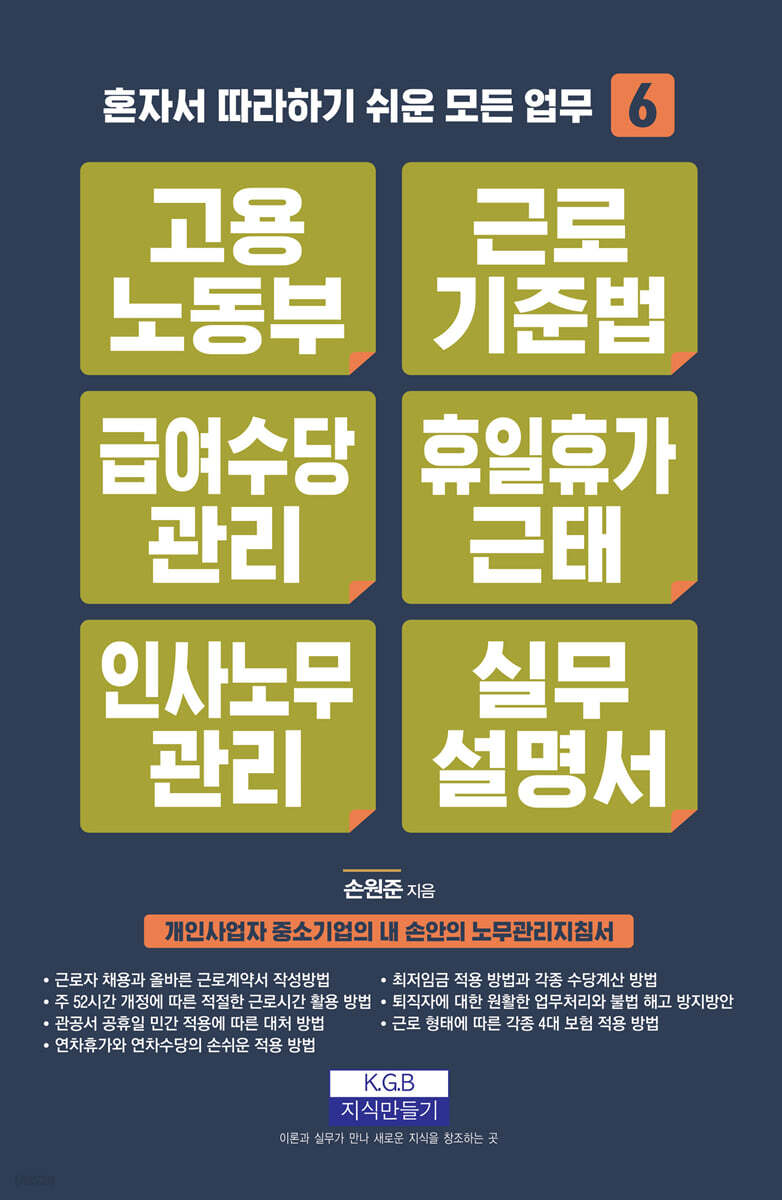
Ministry of Employment and Labor Labor Standards Act Salary, Allowance, Holiday, Vacation, Attendance, Personnel, and Labor Management Practice Manual
 |
Description
Book Introduction
"Labor Management Guidelines for Self-Employed Small and Medium-Sized Businesses"
· How to hire workers and write proper employment contracts
· How to properly utilize working hours according to the 52-hour workweek revision
· How to respond to public holidays applied to the private sector
· Easy way to apply for annual leave and annual leave allowance
· Minimum wage application method and various allowance calculation method
· Measures to ensure smooth work processes for retirees and prevent illegal dismissals
· How to apply the four major insurances according to employment type
· + & benefits for book purchasing members
+ Additional information provided through Naver Cafe Accounting Shelter
+ Additional information provided through Naver Cafe Easy Kyungri
+ Provides a more efficient search function than e-books through Internet search
+ Q&A via the Internet
+ Solve various practical problems through books and internet information
· How to hire workers and write proper employment contracts
· How to properly utilize working hours according to the 52-hour workweek revision
· How to respond to public holidays applied to the private sector
· Easy way to apply for annual leave and annual leave allowance
· Minimum wage application method and various allowance calculation method
· Measures to ensure smooth work processes for retirees and prevent illegal dismissals
· How to apply the four major insurances according to employment type
· + & benefits for book purchasing members
+ Additional information provided through Naver Cafe Accounting Shelter
+ Additional information provided through Naver Cafe Easy Kyungri
+ Provides a more efficient search function than e-books through Internet search
+ Q&A via the Internet
+ Solve various practical problems through books and internet information
index
Chapter 1 Recruitment and Employment Contracts
■ Summary of new employee duties
■ Labor Standards Act applicable to workplaces with 5 or more employees
1.
Worker as defined in the Labor Standards Act
[Example] The concept of worker is different when deducting health insurance and national pension.
2.
Calculation method and examples of the number of regular workers
[Case] Example of calculating the number of regular workers
3.
The Labor Standards Act applies only to workplaces with five or more employees.
4.
The Labor Standards Act applies even to workplaces with fewer than 5 employees.
[Case] Application of Labor Laws Based on the Number of Regular Employees
■ Labor laws to check in relation to hiring
1.
Things to keep in mind when recruiting and hiring
[Case] When the person being hired falls under a disqualification reason
[Example] Persons with disabilities who are subject to mandatory employment obligations, such as persons with disabilities who are subject to mandatory employment obligations
[Case] Laws You Must Know When Recruiting or Hiring
[Case] Justification of Dismissal Due to Falsification of Academic Background and Career
[Case] Required Documents and Employment Permit Issuance Procedures for Hiring Persons Under 15 Years of Age
2.
Legal requirements for hiring
[Case] Application for Approval of Recruitment Review Fees
[Case] Request for Return of Recruitment Documents
■ How to write an employment contract correctly
[Case] Justification for Dismissal of Workers During Probationary Period
■ Preparation and storage of worker roster
■ Employment contract period and employment issues for temporary workers
■ Documents required upon joining the company
[Case] Things to Check When Hiring Workers
■ Precautions when hiring part-time and daily workers
1.
Daily workers and part-time workers as defined by the Labor Standards Act
2.
Obligations to prepare and state in writing an employment contract
3.
Things to check regarding wage payment
[Case] Calculating the Minimum Wage for Workers
4.
Working hours and breaks
5.
day off
[Case] Regular working hours and weekly holiday allowance for part-time workers
6.
Annual leave
7.
Coverage of 4 major insurances
8.
Part-time job holiday allowance
[Case] Things to keep in mind when hiring youth for part-time work
9.
Alternatives for Income and Tax Treatment of Part-Time Workers with a Daily Labor Character
10.
Preparation and submission of daily wage income payment statement
■ Employment contracts and dismissal of trainees
■ Is legal education absolutely necessary?
Chapter 2 Working Hours Management
■ You can only work up to 52 hours per week (7 days)
[Example] Calculating the 52-hour workweek
[Example] Working Hour Limits for Holiday Substitute Work
[Example] Overtime work limit per worker
[Example] Young workers can work up to 40 hours per week.
[Case] Calculating Paid Working Hours for a 40-Hour Workweek
[Case] How to Deal with the 52-Hour Workweek
■ 40 hours of statutory working hours per week and company-defined working hours
1.
Statutory working hours, regular working hours, and paid working hours
2.
When looking at working hours on a case-by-case basis
[Example] Calculating hourly wages
■ Workers excluded from working hours
■ Special Overtime Work System
■ Exceptions to the 52-hour workweek
1.
Special Overtime Work System
2.
Temporary additional overtime
3.
Industries with special working hours and break times
4.
Exclusion from application of working hours, rest, and holidays
■ Corporate self-help measures for 52-hour workweek
■ Deemed working hours system
1.
Requirements for introducing the deemed working hours system
[Case] Cases where the deemed working hours system does not apply
2.
What industries can utilize the deemed working hours system?
3.
Deemed working hours system for work outside the workplace
[Case] Should employment rules be changed when introducing a system of deemed working hours outside the workplace?
[Case] Example of a Labor-Management Agreement Regarding the Deemed Working Hours System Outside the Workplace
[Case] If a system of off-site work hours is introduced, do I need to pay overtime, night work, or holiday overtime?
[Case] How are weekly holidays and annual paid leave applied when a system of deemed working hours outside the workplace is introduced?
4.
Deemed working hours system for discretionary work
Requirements for introducing a system of deemed working hours for discretionary work
Overtime? Holidays? Night work and holidays? Vacations
[Case] Example of a Labor-Management Agreement on Discretionary Working Hours
■ Flexible working hours
1.
Available industries? Jobs
2.
Flexible working hours within 2 weeks
3.
Flexible working hours within 3 months
4.
Flexible working hours within 6 months
5.
Overtime, Holidays, Night Work, and Holidays? Their Relationship to Vacations
6.
Exclusion from flexible working hours system
7.
Wage protection
8.
Overtime work hours calculation method
[Case] If the average weekly working hours per unit period exceed 40 hours
[Case] If the average weekly working hours for a unit period exceed 40 hours, and the working hours for a specific week exceed 48 hours
[Case] Calculating Overtime Hours under a 4-Week Flexible Working Hour System
[Case] Example of flexible working hours system employment rules for up to two weeks
[Case] Example of a Labor-Management Agreement on Flexible Working Hours for Less Than 3 Months
[Case] Flexible working hours for 3 to 6 months
■ Flexible working hours system
1.
What industries can utilize flexible working hours?
2.
Differences from other systems
3.
Requirements for introducing a flexible working hour system
4.
Overtime? Holidays? Night work and holidays? Relationship with vacations
5.
Exclusion from application of the flexible working hours system
[Case] Example of a Labor-Management Agreement on Flexible Working Hours
■ Shortened working hours during pregnancy
[Case] How to Use the Shortened Working Hours System During Pregnancy
Chapter 3 Holidays and Attendance Management
■ Statutory holidays, contractual holidays, and statutory holidays
1.
statutory holidays
2.
statutory holidays
[Example] Substitute public holidays
3.
Contracted holidays
4.
Employees or part-time workers who worked on holidays
■ Holidays, non-working days, and holiday substitutions
1.
Difference between holidays and non-working days
2.
Is Saturday a holiday? A day off?
If Saturday is designated as a holiday
If Saturday is designated as a holiday
[Case] Legal Character of Saturday
[Case] Calculating Saturday Work and Overtime Pay
3.
Holiday replacement
[Case] Requirements for Holiday Substitution
[Case] Cases where holiday substitution is not permitted
■ If an employee takes sick leave, leave and salary processing
■ How to handle tardiness, early departure, going out, and absence
■ How to deal with unauthorized absences, salary, holiday pay, and severance pay
[Case] How to calculate wages per day (when resigning after working for only a few days)
Chapter 4 Vacation and Wage Allowance Management
■ Minimum wage calculation method
[Case] Determining whether a monthly worker is below the minimum wage
■ Salary payment during training period
■ Amount that can be deducted from wages at will by the employer
[Case] Can my annual salary be reduced even during the contract period?
[Example] I work on an annual salary basis, but do I need to pay overtime pay separately?
■ Calculation method of average wage (applied to calculating severance pay)
1.
When the average wage applies
2.
Wages included and excluded from the average wage
3.
Periods and wages excluded from the calculation of average wages
4.
Calculation method of average wage
[Example] Calculating average wages when there is a bonus
[Example] Calculating average wages when there is annual leave allowance
[Case] Comprehensive Calculation of Average Wage
5.
Minimum average wage
■ Calculation method of regular wages (applied to calculating allowances)
1.
When the regular wage applies
2.
Standards for determining regular wages
3.
Scope of wages included in regular wages
[Case] Calculating the regular wage for a 400% regular bonus
[Case] Management Plan for Allowances Paid as Regular Wages
[Examples] Regular bonuses, holiday (Lunar New Year, Chuseok) bonuses, summer vacation pay, qualification allowances, family allowances
4.
Calculation method of regular wages
Calculation of regular wages (hourly, weekly, monthly)
Calculation of daily regular wages
[Case] Average Wage and Regular Wage Calculation Case
■ Salary calculation for mid-term hires (retirees) (daily calculation method)
■ Calculation method for overtime, night, and holiday work allowances
1.
Workplaces with less than 5 regular employees are excluded.
2.
Payment requirements, amount, and calculation examples for overtime pay
[Example] Maximum weekly working hours
3.
Night work allowance payment requirements, amount, and calculation examples
4.
Holiday work allowance payment requirements, amount, and calculation examples
[Case] Calculation Procedure for Overtime Pay (Overtime, Night Work, Holiday Work)
[Case] Calculation Formula (Method) for Additional Wages for Overlapping Holiday, Overtime, and Night Work
[Example] Payment of holiday work allowance when working on Chuseok or Lunar New Year
[Case] Wage Payment Methods Based on Saturday Work Type
[Example] If I sign a contract with a comprehensive wage system, do I not have to pay overtime or night work allowances separately?
[Example] On which days can employees receive holiday work allowance at any company?
[Case] Calculating Overtime Pay for Part-Time Workers
■ Calculation of annual leave days and annual leave allowance payment amount
1.
Annual leave and annual leave allowance for employees in their first year of employment
2.
Annual leave and annual leave allowance for employees in their second year of employment
[Example] Calculation method for granting annual leave by fiscal year
[Example] Absence due to personal illness is deducted from annual leave.
[Example] Deduction of annual paid leave due to missing or being late to work or leaving work early
[Example] Processing work when using annual leave in advance
[Case] What is the calculation method for annual leave allowance and what is the wage used as the basis for payment of annual leave allowance?
[Case] Payment of annual leave allowance to a person who resigned mid-term
[Case] Annual leave allowance payment for employees with less than one year of service
[Case] Payment of annual leave allowance based on monthly leave concept
■ Payment of weekly holidays and calculation method of weekly holiday allowance
1.
Requirements for payment of holiday pay
2.
Weekly holiday allowance for employees hired during the week
3.
Holiday pay when a public holiday falls on a holiday
4.
Automatic calculation of holiday pay
■ Menstrual leave and menstrual allowance
■ Compensatory leave system
[Case] Things to keep in mind regarding the compensatory leave system
[Case] Agreement on Compensatory Leave Implementation
■ Leave of absence and reinstatement
1.
The concept of leave of absence
2.
Validity of the user's leave of absence
3.
sick leave
[Example] Non-work-related injuries and sick leave must follow company regulations.
[Case] Can sick leave be replaced with annual leave?
4.
Leave of absence due to criminal prosecution, etc.
5.
Payment of wages during leave
6.
rehabilitation
[Case] Things to keep in mind regarding leave of absence and reinstatement
■ Comprehensive wage system
[Case] Things to keep in mind regarding comprehensive wage calculation
[Example] If I work overtime after signing a comprehensive wage contract, can I not receive overtime pay?
■ Severance pay and maternity leave pay
■ Books to be prepared in relation to wage management
1.
Payroll and payslip
[Case] Obligation to issue payslips
2.
Preparation of worker list
[Case] Problems when wages are deposited into a spouse or family member's account
Chapter 5 Retirement and Dismissal Management
■ Fair dismissal and severance pay
1.
Reasons why dismissal due to worker's reasons is justified
2.
Reasons why dismissal due to user-related reasons is justified
3.
The Labor Standards Act prohibits dismissal
4.
Notice of dismissal and severance pay
5.
Written notice and procedures for dismissal
■ Submission of resignation letter and work processing
■ If the resignation is not accepted even after submission
■ Calculation method and payment of retirement pay
1.
Severance pay payment standards
[Example] Period included in the continuous employment period
2.
Automatic retirement allowance calculation method
Whether (holiday) bonuses or annual leave allowances are included in the average wage
How to calculate average wages when there is a bonus
How to calculate average wage when there is annual leave allowance
Method for calculating average wages in case of unauthorized absence
Minimum average wage
[Case] When to use average wage as standard wage and when to use regular wage
3.
Severance pay calculation example
[Case] Severance Pay Statement
4.
Calculating severance pay for businesses with fewer than 5 employees
[Case] Payment of retirement benefits based on length of service at workplaces with fewer than 5 regular employees
■ Calculation method for retirement income tax of employees
1.
Retirement income tax calculation structure
2.
Retirement income amount
3.
Retirement income tax calculation amount
4.
Retirement income tax calculation example
■ Handover in case of resignation
■ Documents that must be kept even after an employee leaves the company
1.
Obligation to preserve contract documents
2.
Certificate of Use
■ Retirement Pension System
1.
Defined Benefit Pension Plan (DB Plan)
2.
Defined Contribution Pension System (DC System)
3.
Individual Retirement Plan (IRP)
4.
Handling of past employment periods when introducing a retirement pension system
Chapter 6: Management of the Four Major Insurances
■ Is it necessary to have the 4 major insurances?
■ Exclusions from subscription to the four major insurances
■ Four major insurances for daily and part-time workers
1.
Obligation to subscribe to the four major insurance policies for daily workers
[Case] Differences Between Daily Workers and the Four Major Insurances
2.
Exclusions from the four major insurance policies for daily workers
Persons excluded from the list of workers eligible for national pension coverage
[Case] National Pension for Daily Workers
Persons excluded from the list of workers eligible for health insurance
[Case] Health Insurance for Daily Workers
[Case] Application of National Pension and Health Insurance according to Employment Contract
Employment Insurance? Workers excluded from industrial accident compensation insurance coverage
[Case] Determination of daily workers under the Employment Insurance Act
[Case] What You Need to Know About Daily Worker Processing
[Case] Can I avoid paying the four major insurance premiums while working part-time?
■ 4 major insurances for part-time workers (60 hours per month)
1.
If there is an employment contract
2.
If there is no employment contract
■ Four major insurance policies for overseas dispatched workers
■ Four major insurances for foreign workers
[Case] Determining eligibility for employment insurance for foreign business owners
■ Four major insurances for trainees
■ Four major insurance policies for the elderly
■ Four major insurance policies for CEOs and registered executives
[Case] Application of the four major insurances to employers (CEOs) and employees
■ Exceptions to payment (deferral) for the four major insurances
1.
National Pension Payment Exception
[Case] What should I do with my national pension if I have income while exempt from payment?
[Example] Can I temporarily suspend insurance premium payments while abroad?
[Case] I closed my business (suspended business). Do I have to pay national pension?
2.
Health insurance notification deferral
[Case] How to Apply for Exception/Resumption of Payment for the Four Major Insurances
■ Report to the 4 major insurance companies when salary (wage) changes
■ 4 major insurances during leave of absence
■ Calculation method for the four major insurance premiums deducted from salary
■ Four major insurance deduction methods when paying bonuses
[Example] Four major insurance policies, including Lunar New Year bonuses
■ 4 major insurance deductions for new employees
[Case] Four major insurance premium assessment criteria based on date of employment
■ 4 major insurance deductions for retirees
[Case] Payment standards for the four major insurances upon joining and leaving the company
■ Application examples of the four major insurance deductions for new and retired employees
1.
Payment period during which insurance premiums must be paid
2.
If acquisition and loss occur in the same month
3.
If acquired on the 1st and lost in the same month
■ National Pension Total Income Report
■ Total salary report
1.
Health Insurance Total Amount Reporting and Preparation Method (Abolished)
[Case] Notification of Additional Health Insurance Settlement Amount
[Case] Documents required for business site inspection
2.
Employment and Industrial Accident Insurance Total Compensation Report
■ Year-end settlement of the four major insurances
[Case] Calculating Retirement (Year-End) Insurance Premiums
[Case] Health Insurance Settlement Method for Dual Subscribers
■ When working at a family company, 4 types of insurance are applied to spouse and relatives.
■ Application of the four major insurance policies to unpaid CEOs
■ Application of the four major insurances to registered executives, non-registered executives, and non-executive executives
■ Summary of new employee duties
■ Labor Standards Act applicable to workplaces with 5 or more employees
1.
Worker as defined in the Labor Standards Act
[Example] The concept of worker is different when deducting health insurance and national pension.
2.
Calculation method and examples of the number of regular workers
[Case] Example of calculating the number of regular workers
3.
The Labor Standards Act applies only to workplaces with five or more employees.
4.
The Labor Standards Act applies even to workplaces with fewer than 5 employees.
[Case] Application of Labor Laws Based on the Number of Regular Employees
■ Labor laws to check in relation to hiring
1.
Things to keep in mind when recruiting and hiring
[Case] When the person being hired falls under a disqualification reason
[Example] Persons with disabilities who are subject to mandatory employment obligations, such as persons with disabilities who are subject to mandatory employment obligations
[Case] Laws You Must Know When Recruiting or Hiring
[Case] Justification of Dismissal Due to Falsification of Academic Background and Career
[Case] Required Documents and Employment Permit Issuance Procedures for Hiring Persons Under 15 Years of Age
2.
Legal requirements for hiring
[Case] Application for Approval of Recruitment Review Fees
[Case] Request for Return of Recruitment Documents
■ How to write an employment contract correctly
[Case] Justification for Dismissal of Workers During Probationary Period
■ Preparation and storage of worker roster
■ Employment contract period and employment issues for temporary workers
■ Documents required upon joining the company
[Case] Things to Check When Hiring Workers
■ Precautions when hiring part-time and daily workers
1.
Daily workers and part-time workers as defined by the Labor Standards Act
2.
Obligations to prepare and state in writing an employment contract
3.
Things to check regarding wage payment
[Case] Calculating the Minimum Wage for Workers
4.
Working hours and breaks
5.
day off
[Case] Regular working hours and weekly holiday allowance for part-time workers
6.
Annual leave
7.
Coverage of 4 major insurances
8.
Part-time job holiday allowance
[Case] Things to keep in mind when hiring youth for part-time work
9.
Alternatives for Income and Tax Treatment of Part-Time Workers with a Daily Labor Character
10.
Preparation and submission of daily wage income payment statement
■ Employment contracts and dismissal of trainees
■ Is legal education absolutely necessary?
Chapter 2 Working Hours Management
■ You can only work up to 52 hours per week (7 days)
[Example] Calculating the 52-hour workweek
[Example] Working Hour Limits for Holiday Substitute Work
[Example] Overtime work limit per worker
[Example] Young workers can work up to 40 hours per week.
[Case] Calculating Paid Working Hours for a 40-Hour Workweek
[Case] How to Deal with the 52-Hour Workweek
■ 40 hours of statutory working hours per week and company-defined working hours
1.
Statutory working hours, regular working hours, and paid working hours
2.
When looking at working hours on a case-by-case basis
[Example] Calculating hourly wages
■ Workers excluded from working hours
■ Special Overtime Work System
■ Exceptions to the 52-hour workweek
1.
Special Overtime Work System
2.
Temporary additional overtime
3.
Industries with special working hours and break times
4.
Exclusion from application of working hours, rest, and holidays
■ Corporate self-help measures for 52-hour workweek
■ Deemed working hours system
1.
Requirements for introducing the deemed working hours system
[Case] Cases where the deemed working hours system does not apply
2.
What industries can utilize the deemed working hours system?
3.
Deemed working hours system for work outside the workplace
[Case] Should employment rules be changed when introducing a system of deemed working hours outside the workplace?
[Case] Example of a Labor-Management Agreement Regarding the Deemed Working Hours System Outside the Workplace
[Case] If a system of off-site work hours is introduced, do I need to pay overtime, night work, or holiday overtime?
[Case] How are weekly holidays and annual paid leave applied when a system of deemed working hours outside the workplace is introduced?
4.
Deemed working hours system for discretionary work
Requirements for introducing a system of deemed working hours for discretionary work
Overtime? Holidays? Night work and holidays? Vacations
[Case] Example of a Labor-Management Agreement on Discretionary Working Hours
■ Flexible working hours
1.
Available industries? Jobs
2.
Flexible working hours within 2 weeks
3.
Flexible working hours within 3 months
4.
Flexible working hours within 6 months
5.
Overtime, Holidays, Night Work, and Holidays? Their Relationship to Vacations
6.
Exclusion from flexible working hours system
7.
Wage protection
8.
Overtime work hours calculation method
[Case] If the average weekly working hours per unit period exceed 40 hours
[Case] If the average weekly working hours for a unit period exceed 40 hours, and the working hours for a specific week exceed 48 hours
[Case] Calculating Overtime Hours under a 4-Week Flexible Working Hour System
[Case] Example of flexible working hours system employment rules for up to two weeks
[Case] Example of a Labor-Management Agreement on Flexible Working Hours for Less Than 3 Months
[Case] Flexible working hours for 3 to 6 months
■ Flexible working hours system
1.
What industries can utilize flexible working hours?
2.
Differences from other systems
3.
Requirements for introducing a flexible working hour system
4.
Overtime? Holidays? Night work and holidays? Relationship with vacations
5.
Exclusion from application of the flexible working hours system
[Case] Example of a Labor-Management Agreement on Flexible Working Hours
■ Shortened working hours during pregnancy
[Case] How to Use the Shortened Working Hours System During Pregnancy
Chapter 3 Holidays and Attendance Management
■ Statutory holidays, contractual holidays, and statutory holidays
1.
statutory holidays
2.
statutory holidays
[Example] Substitute public holidays
3.
Contracted holidays
4.
Employees or part-time workers who worked on holidays
■ Holidays, non-working days, and holiday substitutions
1.
Difference between holidays and non-working days
2.
Is Saturday a holiday? A day off?
If Saturday is designated as a holiday
If Saturday is designated as a holiday
[Case] Legal Character of Saturday
[Case] Calculating Saturday Work and Overtime Pay
3.
Holiday replacement
[Case] Requirements for Holiday Substitution
[Case] Cases where holiday substitution is not permitted
■ If an employee takes sick leave, leave and salary processing
■ How to handle tardiness, early departure, going out, and absence
■ How to deal with unauthorized absences, salary, holiday pay, and severance pay
[Case] How to calculate wages per day (when resigning after working for only a few days)
Chapter 4 Vacation and Wage Allowance Management
■ Minimum wage calculation method
[Case] Determining whether a monthly worker is below the minimum wage
■ Salary payment during training period
■ Amount that can be deducted from wages at will by the employer
[Case] Can my annual salary be reduced even during the contract period?
[Example] I work on an annual salary basis, but do I need to pay overtime pay separately?
■ Calculation method of average wage (applied to calculating severance pay)
1.
When the average wage applies
2.
Wages included and excluded from the average wage
3.
Periods and wages excluded from the calculation of average wages
4.
Calculation method of average wage
[Example] Calculating average wages when there is a bonus
[Example] Calculating average wages when there is annual leave allowance
[Case] Comprehensive Calculation of Average Wage
5.
Minimum average wage
■ Calculation method of regular wages (applied to calculating allowances)
1.
When the regular wage applies
2.
Standards for determining regular wages
3.
Scope of wages included in regular wages
[Case] Calculating the regular wage for a 400% regular bonus
[Case] Management Plan for Allowances Paid as Regular Wages
[Examples] Regular bonuses, holiday (Lunar New Year, Chuseok) bonuses, summer vacation pay, qualification allowances, family allowances
4.
Calculation method of regular wages
Calculation of regular wages (hourly, weekly, monthly)
Calculation of daily regular wages
[Case] Average Wage and Regular Wage Calculation Case
■ Salary calculation for mid-term hires (retirees) (daily calculation method)
■ Calculation method for overtime, night, and holiday work allowances
1.
Workplaces with less than 5 regular employees are excluded.
2.
Payment requirements, amount, and calculation examples for overtime pay
[Example] Maximum weekly working hours
3.
Night work allowance payment requirements, amount, and calculation examples
4.
Holiday work allowance payment requirements, amount, and calculation examples
[Case] Calculation Procedure for Overtime Pay (Overtime, Night Work, Holiday Work)
[Case] Calculation Formula (Method) for Additional Wages for Overlapping Holiday, Overtime, and Night Work
[Example] Payment of holiday work allowance when working on Chuseok or Lunar New Year
[Case] Wage Payment Methods Based on Saturday Work Type
[Example] If I sign a contract with a comprehensive wage system, do I not have to pay overtime or night work allowances separately?
[Example] On which days can employees receive holiday work allowance at any company?
[Case] Calculating Overtime Pay for Part-Time Workers
■ Calculation of annual leave days and annual leave allowance payment amount
1.
Annual leave and annual leave allowance for employees in their first year of employment
2.
Annual leave and annual leave allowance for employees in their second year of employment
[Example] Calculation method for granting annual leave by fiscal year
[Example] Absence due to personal illness is deducted from annual leave.
[Example] Deduction of annual paid leave due to missing or being late to work or leaving work early
[Example] Processing work when using annual leave in advance
[Case] What is the calculation method for annual leave allowance and what is the wage used as the basis for payment of annual leave allowance?
[Case] Payment of annual leave allowance to a person who resigned mid-term
[Case] Annual leave allowance payment for employees with less than one year of service
[Case] Payment of annual leave allowance based on monthly leave concept
■ Payment of weekly holidays and calculation method of weekly holiday allowance
1.
Requirements for payment of holiday pay
2.
Weekly holiday allowance for employees hired during the week
3.
Holiday pay when a public holiday falls on a holiday
4.
Automatic calculation of holiday pay
■ Menstrual leave and menstrual allowance
■ Compensatory leave system
[Case] Things to keep in mind regarding the compensatory leave system
[Case] Agreement on Compensatory Leave Implementation
■ Leave of absence and reinstatement
1.
The concept of leave of absence
2.
Validity of the user's leave of absence
3.
sick leave
[Example] Non-work-related injuries and sick leave must follow company regulations.
[Case] Can sick leave be replaced with annual leave?
4.
Leave of absence due to criminal prosecution, etc.
5.
Payment of wages during leave
6.
rehabilitation
[Case] Things to keep in mind regarding leave of absence and reinstatement
■ Comprehensive wage system
[Case] Things to keep in mind regarding comprehensive wage calculation
[Example] If I work overtime after signing a comprehensive wage contract, can I not receive overtime pay?
■ Severance pay and maternity leave pay
■ Books to be prepared in relation to wage management
1.
Payroll and payslip
[Case] Obligation to issue payslips
2.
Preparation of worker list
[Case] Problems when wages are deposited into a spouse or family member's account
Chapter 5 Retirement and Dismissal Management
■ Fair dismissal and severance pay
1.
Reasons why dismissal due to worker's reasons is justified
2.
Reasons why dismissal due to user-related reasons is justified
3.
The Labor Standards Act prohibits dismissal
4.
Notice of dismissal and severance pay
5.
Written notice and procedures for dismissal
■ Submission of resignation letter and work processing
■ If the resignation is not accepted even after submission
■ Calculation method and payment of retirement pay
1.
Severance pay payment standards
[Example] Period included in the continuous employment period
2.
Automatic retirement allowance calculation method
Whether (holiday) bonuses or annual leave allowances are included in the average wage
How to calculate average wages when there is a bonus
How to calculate average wage when there is annual leave allowance
Method for calculating average wages in case of unauthorized absence
Minimum average wage
[Case] When to use average wage as standard wage and when to use regular wage
3.
Severance pay calculation example
[Case] Severance Pay Statement
4.
Calculating severance pay for businesses with fewer than 5 employees
[Case] Payment of retirement benefits based on length of service at workplaces with fewer than 5 regular employees
■ Calculation method for retirement income tax of employees
1.
Retirement income tax calculation structure
2.
Retirement income amount
3.
Retirement income tax calculation amount
4.
Retirement income tax calculation example
■ Handover in case of resignation
■ Documents that must be kept even after an employee leaves the company
1.
Obligation to preserve contract documents
2.
Certificate of Use
■ Retirement Pension System
1.
Defined Benefit Pension Plan (DB Plan)
2.
Defined Contribution Pension System (DC System)
3.
Individual Retirement Plan (IRP)
4.
Handling of past employment periods when introducing a retirement pension system
Chapter 6: Management of the Four Major Insurances
■ Is it necessary to have the 4 major insurances?
■ Exclusions from subscription to the four major insurances
■ Four major insurances for daily and part-time workers
1.
Obligation to subscribe to the four major insurance policies for daily workers
[Case] Differences Between Daily Workers and the Four Major Insurances
2.
Exclusions from the four major insurance policies for daily workers
Persons excluded from the list of workers eligible for national pension coverage
[Case] National Pension for Daily Workers
Persons excluded from the list of workers eligible for health insurance
[Case] Health Insurance for Daily Workers
[Case] Application of National Pension and Health Insurance according to Employment Contract
Employment Insurance? Workers excluded from industrial accident compensation insurance coverage
[Case] Determination of daily workers under the Employment Insurance Act
[Case] What You Need to Know About Daily Worker Processing
[Case] Can I avoid paying the four major insurance premiums while working part-time?
■ 4 major insurances for part-time workers (60 hours per month)
1.
If there is an employment contract
2.
If there is no employment contract
■ Four major insurance policies for overseas dispatched workers
■ Four major insurances for foreign workers
[Case] Determining eligibility for employment insurance for foreign business owners
■ Four major insurances for trainees
■ Four major insurance policies for the elderly
■ Four major insurance policies for CEOs and registered executives
[Case] Application of the four major insurances to employers (CEOs) and employees
■ Exceptions to payment (deferral) for the four major insurances
1.
National Pension Payment Exception
[Case] What should I do with my national pension if I have income while exempt from payment?
[Example] Can I temporarily suspend insurance premium payments while abroad?
[Case] I closed my business (suspended business). Do I have to pay national pension?
2.
Health insurance notification deferral
[Case] How to Apply for Exception/Resumption of Payment for the Four Major Insurances
■ Report to the 4 major insurance companies when salary (wage) changes
■ 4 major insurances during leave of absence
■ Calculation method for the four major insurance premiums deducted from salary
■ Four major insurance deduction methods when paying bonuses
[Example] Four major insurance policies, including Lunar New Year bonuses
■ 4 major insurance deductions for new employees
[Case] Four major insurance premium assessment criteria based on date of employment
■ 4 major insurance deductions for retirees
[Case] Payment standards for the four major insurances upon joining and leaving the company
■ Application examples of the four major insurance deductions for new and retired employees
1.
Payment period during which insurance premiums must be paid
2.
If acquisition and loss occur in the same month
3.
If acquired on the 1st and lost in the same month
■ National Pension Total Income Report
■ Total salary report
1.
Health Insurance Total Amount Reporting and Preparation Method (Abolished)
[Case] Notification of Additional Health Insurance Settlement Amount
[Case] Documents required for business site inspection
2.
Employment and Industrial Accident Insurance Total Compensation Report
■ Year-end settlement of the four major insurances
[Case] Calculating Retirement (Year-End) Insurance Premiums
[Case] Health Insurance Settlement Method for Dual Subscribers
■ When working at a family company, 4 types of insurance are applied to spouse and relatives.
■ Application of the four major insurance policies to unpaid CEOs
■ Application of the four major insurances to registered executives, non-registered executives, and non-executive executives
Into the book
Overtime work and holiday work are not separately distinguished, and are limited to a maximum of 12 hours per week.
① The maximum number of hours per week must be 12 hours or less, regardless of whether it includes overtime or holiday work.
② Working days → Monday to Sunday (excluding holidays)
Additionally, employers are obligated to provide overtime pay to employees who work on holidays.
At this time, 8 hours is the standard.
For less than 8 hours, 50% of the wage must be paid, and for more than 8 hours, 100% of the wage must be paid.
Night work from 10 PM to 6 AM the next day must also be paid with an additional 50% or more of the regular wage.
Therefore, in cases where overtime work and night work overlap, an additional wage of 50% + 50% = 100% must be paid.
For example, if you worked 7 hours of overtime in one week and 6 more hours on holidays, you would be working an additional 13 hours in addition to your statutory working hours.
This is a violation of the current Labor Standards Act.
Overtime pay is not applied twice when working on a holiday, but night work and holiday work pay are applied twice.
--- From "Calculation Method for 52 Hours a Week"
It is good to know the paid working hours below, as they are useful when calculating wages, such as calculating various allowances or calculating regular wages.
① Work 8 hours a day for 5 weekdays
→ Basic working hours = 40 hours per week
② One paid holiday is provided when working more than 15 hours per week.
Since the worker works 8 hours a day, the paid holiday is also 8 hours.
→ Paid holidays = 8 hours per week
③ Actual working hours + paid holidays
→ 48 hours a week
④ A year has 365 days, which is 52.14285714 weeks.
→ 365 days ÷ 7 days = 52.14285714 weeks
⑤ 1 month is 4.34523809 weeks when converted to weeks
→ 52.14285714 weeks ÷ 12 months = 4.34523809 weeks
⑥ Paid working hours per month = ③ × ⑤
→ 48 hours × 4.34523809 weeks = 208.57142832 = 209 hours
For example, the weekly wage of a worker whose hourly wage is 10,030 won is calculated as 10,030 won x 48 hours.
--- From “Calculating Paid Hours for Workers Working 40 Hours a Week”
If you resign before completing a full month, your salary must be calculated and paid based on the number of days you worked.
For example, how do you calculate the August wages if you worked (or quit) from August 1st to 10th?
① Monthly salary: 2.5 million won (base salary 2.1 million won, license allowance 200,000 won, meal allowance 200,000 won)
② Calculation method: (Total salary for the month ÷ Total number of days for the month) × Number of working days (including paid holidays)
= (2.5 million won ÷ 31) × 10
= 806,451 won (August wages)
--- From "Wage Calculation Method"
Annual leave allowance, like bonus, must include three months' worth.
Annual leave allowance is calculated by including the annual leave allowance compensation accrued in the previous year in the average wage of retirement pay, and annual leave allowance accrued upon retirement is excluded from the calculation of retirement pay.
1.
Unused annual paid leave allowance that has already accrued before retirement
Based on the attendance rate in the year before retirement, 3/12 of the unused annual paid leave allowance for the number of days worked out of the annual paid leave accrued in the year before retirement is included in the average wage calculation standard wage for calculating retirement pay.
2.
Unused annual paid leave allowance for which payment is only made upon retirement
The unused annual paid leave allowance, which is the reason for payment only arising upon retirement without using the annual paid leave accrued in the year of retirement based on the attendance rate in the year prior to retirement, is not included in the standard wage for calculating the average wage for calculating the retirement allowance, as it is not wages paid to the worker prior to the date of occurrence of the reason for calculation according to the definition of average wage.
Annual leave equivalent to less than 1 year of monthly leave (retirement between 1 and 2 years)
3 ÷ 12 is included in the average wage calculation standard wage for calculating retirement allowance.
Annual leave allowance accrued upon reaching one year of service
Unused annual paid leave accrued in the year prior to retirement based on attendance rate in the year prior to retirement
3 ÷ 12 is included in the average wage calculation standard wage for calculating retirement allowance.
Unused annual paid leave allowance, which is paid only when the employee retires without using the annual paid leave accrued in the year of retirement based on the attendance rate in the year before retirement
The average wage is not included in the standard wage for calculating retirement benefits.
However, if a worker does not use his/her annual leave despite the workplace promoting the use of annual leave in accordance with Article 61 of the Labor Standards Act, the employer is not obligated to compensate for the unused leave. In this case, if there is no unused annual leave allowance to compensate, it is not included in the calculation of average wage.
① The maximum number of hours per week must be 12 hours or less, regardless of whether it includes overtime or holiday work.
② Working days → Monday to Sunday (excluding holidays)
Additionally, employers are obligated to provide overtime pay to employees who work on holidays.
At this time, 8 hours is the standard.
For less than 8 hours, 50% of the wage must be paid, and for more than 8 hours, 100% of the wage must be paid.
Night work from 10 PM to 6 AM the next day must also be paid with an additional 50% or more of the regular wage.
Therefore, in cases where overtime work and night work overlap, an additional wage of 50% + 50% = 100% must be paid.
For example, if you worked 7 hours of overtime in one week and 6 more hours on holidays, you would be working an additional 13 hours in addition to your statutory working hours.
This is a violation of the current Labor Standards Act.
Overtime pay is not applied twice when working on a holiday, but night work and holiday work pay are applied twice.
--- From "Calculation Method for 52 Hours a Week"
It is good to know the paid working hours below, as they are useful when calculating wages, such as calculating various allowances or calculating regular wages.
① Work 8 hours a day for 5 weekdays
→ Basic working hours = 40 hours per week
② One paid holiday is provided when working more than 15 hours per week.
Since the worker works 8 hours a day, the paid holiday is also 8 hours.
→ Paid holidays = 8 hours per week
③ Actual working hours + paid holidays
→ 48 hours a week
④ A year has 365 days, which is 52.14285714 weeks.
→ 365 days ÷ 7 days = 52.14285714 weeks
⑤ 1 month is 4.34523809 weeks when converted to weeks
→ 52.14285714 weeks ÷ 12 months = 4.34523809 weeks
⑥ Paid working hours per month = ③ × ⑤
→ 48 hours × 4.34523809 weeks = 208.57142832 = 209 hours
For example, the weekly wage of a worker whose hourly wage is 10,030 won is calculated as 10,030 won x 48 hours.
--- From “Calculating Paid Hours for Workers Working 40 Hours a Week”
If you resign before completing a full month, your salary must be calculated and paid based on the number of days you worked.
For example, how do you calculate the August wages if you worked (or quit) from August 1st to 10th?
① Monthly salary: 2.5 million won (base salary 2.1 million won, license allowance 200,000 won, meal allowance 200,000 won)
② Calculation method: (Total salary for the month ÷ Total number of days for the month) × Number of working days (including paid holidays)
= (2.5 million won ÷ 31) × 10
= 806,451 won (August wages)
--- From "Wage Calculation Method"
Annual leave allowance, like bonus, must include three months' worth.
Annual leave allowance is calculated by including the annual leave allowance compensation accrued in the previous year in the average wage of retirement pay, and annual leave allowance accrued upon retirement is excluded from the calculation of retirement pay.
1.
Unused annual paid leave allowance that has already accrued before retirement
Based on the attendance rate in the year before retirement, 3/12 of the unused annual paid leave allowance for the number of days worked out of the annual paid leave accrued in the year before retirement is included in the average wage calculation standard wage for calculating retirement pay.
2.
Unused annual paid leave allowance for which payment is only made upon retirement
The unused annual paid leave allowance, which is the reason for payment only arising upon retirement without using the annual paid leave accrued in the year of retirement based on the attendance rate in the year prior to retirement, is not included in the standard wage for calculating the average wage for calculating the retirement allowance, as it is not wages paid to the worker prior to the date of occurrence of the reason for calculation according to the definition of average wage.
Annual leave equivalent to less than 1 year of monthly leave (retirement between 1 and 2 years)
3 ÷ 12 is included in the average wage calculation standard wage for calculating retirement allowance.
Annual leave allowance accrued upon reaching one year of service
Unused annual paid leave accrued in the year prior to retirement based on attendance rate in the year prior to retirement
3 ÷ 12 is included in the average wage calculation standard wage for calculating retirement allowance.
Unused annual paid leave allowance, which is paid only when the employee retires without using the annual paid leave accrued in the year of retirement based on the attendance rate in the year before retirement
The average wage is not included in the standard wage for calculating retirement benefits.
However, if a worker does not use his/her annual leave despite the workplace promoting the use of annual leave in accordance with Article 61 of the Labor Standards Act, the employer is not obligated to compensate for the unused leave. In this case, if there is no unused annual leave allowance to compensate, it is not included in the calculation of average wage.
--- From “Method of Calculating Average Wage in Case of Annual Leave Allowance”
Publisher's Review
Chapter 1 Recruitment and Employment Contracts
It explains various problems that arise when hiring workers, how to deal with them, and how to write a proper employment contract.
Chapter 2 Working Hours Management
It explains various issues and application methods related to flexible working hours, which have recently been receiving much attention.
Chapter 3 Holidays and Attendance Management
It presents practical handling methods for implementing public holidays in the private sector and problem-free labor management methods, such as the issue of part-time workers' weekly holidays.
Chapter 4 Vacation and Wage Allowance Management
Rather than explaining the calculation method according to the minimum wage revision and the Labor Standards Act related to wage allowances such as annual leave, weekly holidays, and overtime work separately, we are promoting understanding by explaining them in conjunction with each other in accordance with the work flow.
Chapter 5 Retirement and Dismissal Management
This chapter explains the procedures and methods of dismissal to ensure smooth work processes when employees resign and to prevent disputes arising from illegal dismissal in advance.
Chapter 6: Management of the Four Major Insurances
It explains the four major insurance issues related to employee hiring/leaving and workplaces by employment type (permanent workers, daily workers, foreign workers, etc.) and age group (general workers, senior citizens, etc.).
Additionally, it teaches methods of withholding taxes when paying wages and bonuses to regular workers, daily workers, and foreign workers.
It explains various problems that arise when hiring workers, how to deal with them, and how to write a proper employment contract.
Chapter 2 Working Hours Management
It explains various issues and application methods related to flexible working hours, which have recently been receiving much attention.
Chapter 3 Holidays and Attendance Management
It presents practical handling methods for implementing public holidays in the private sector and problem-free labor management methods, such as the issue of part-time workers' weekly holidays.
Chapter 4 Vacation and Wage Allowance Management
Rather than explaining the calculation method according to the minimum wage revision and the Labor Standards Act related to wage allowances such as annual leave, weekly holidays, and overtime work separately, we are promoting understanding by explaining them in conjunction with each other in accordance with the work flow.
Chapter 5 Retirement and Dismissal Management
This chapter explains the procedures and methods of dismissal to ensure smooth work processes when employees resign and to prevent disputes arising from illegal dismissal in advance.
Chapter 6: Management of the Four Major Insurances
It explains the four major insurance issues related to employee hiring/leaving and workplaces by employment type (permanent workers, daily workers, foreign workers, etc.) and age group (general workers, senior citizens, etc.).
Additionally, it teaches methods of withholding taxes when paying wages and bonuses to regular workers, daily workers, and foreign workers.
GOODS SPECIFICS
- Date of issue: January 13, 2025
- Page count, weight, size: 368 pages | 153*224*30mm
- ISBN13: 9791190819428
- ISBN10: 1190819422
You may also like
카테고리
korean


korean

![GQ KOREA Mark (Monthly): December [2025]](http://librairie.coreenne.fr/cdn/shop/files/8ef265dbbfbf186523ed75ba7319009d.jpg?v=1765340328&width=3840)


