

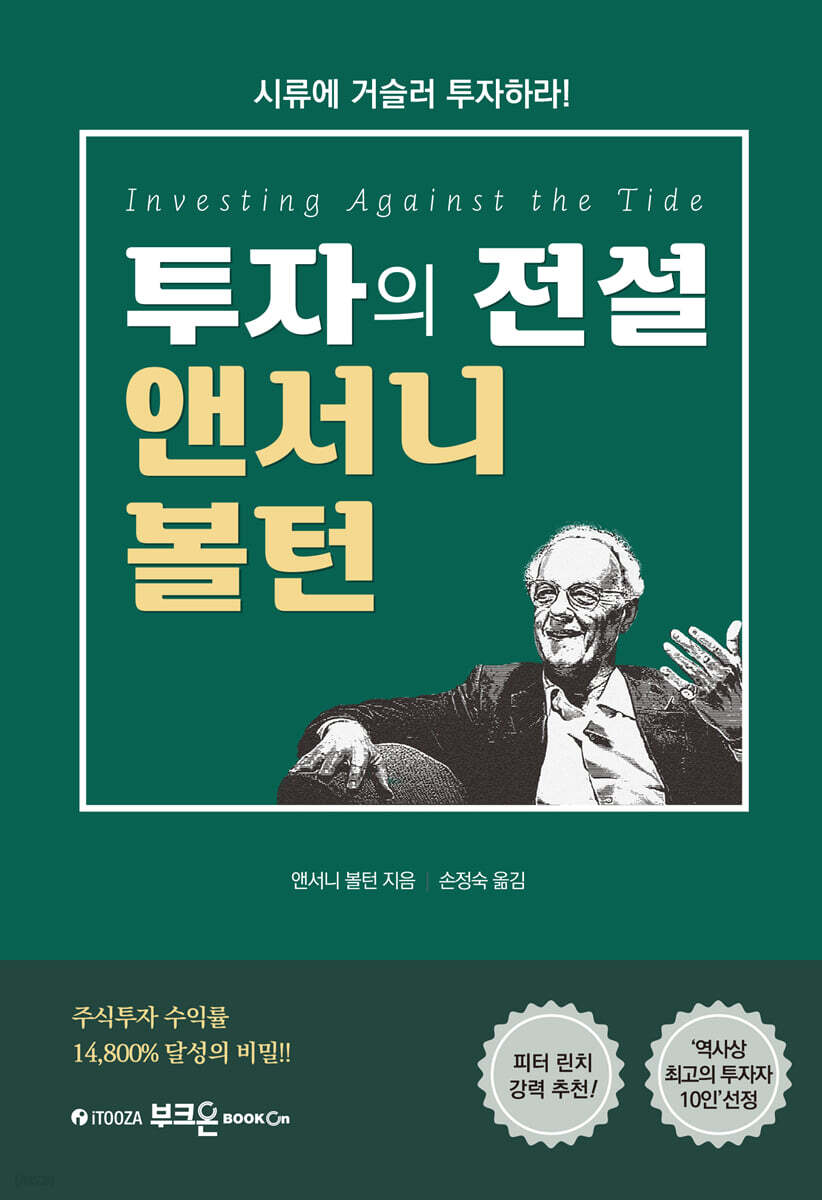
Investment legend Anthony Bolton
 |
Description
Book Introduction
Anthony Bolton, the greatest investor known as the 'investment legend' or 'Europe's Warren Buffett'.
This book is a kind of investment memoir containing the investment life and secrets of successful investment of Anthony Bolton (former head of Fidelity Investments), a representative British fund manager who was selected by the influential British newspaper The Times as one of the 10 greatest investors in history, along with Warren Buffett and Benjamin Graham.
In this book, Anthony Bolton rejects the investment method of simply timing trades based on trends, and instead demonstrates his expertise in investing based on thorough fundamental analysis.
However, this does not mean that technical analysis is completely ruled out.
Another virtue of this book is that it provides a perspective on and application of technical analysis from a value investor's perspective.
He also shares his own insights and practical know-how, gained through his 30 years of investment experience, including how to select good companies, the qualities of a successful investor, how to buy and sell wisely, how to construct an optimal portfolio, how to determine the best trading timing, and how to overcome a slump when investments are not going well.
This book is a kind of investment memoir containing the investment life and secrets of successful investment of Anthony Bolton (former head of Fidelity Investments), a representative British fund manager who was selected by the influential British newspaper The Times as one of the 10 greatest investors in history, along with Warren Buffett and Benjamin Graham.
In this book, Anthony Bolton rejects the investment method of simply timing trades based on trends, and instead demonstrates his expertise in investing based on thorough fundamental analysis.
However, this does not mean that technical analysis is completely ruled out.
Another virtue of this book is that it provides a perspective on and application of technical analysis from a value investor's perspective.
He also shares his own insights and practical know-how, gained through his 30 years of investment experience, including how to select good companies, the qualities of a successful investor, how to buy and sell wisely, how to construct an optimal portfolio, how to determine the best trading timing, and how to overcome a slump when investments are not going well.
- You can preview some of the book's contents.
Preview
index
Acknowledgements
caution
A testimonial from Peter Lynch - being compared to Anthony Bolton is the ultimate compliment.
Introduction - Invest Against the Current
Part 1: Principles and Practice of Legendary Investors
Chapter 1 - How to Distinguish Good Companies from Bad Companies
Chapter 2 - Good CEO vs.
bad CEO
Chapter 3 - Invest Only When You Have a Clear Reason
Chapter 4 - The Traits of a Successful Investor
Chapter 5 - How to Build a Stock Portfolio
Chapter 6 - Financial Assessment
Chapter 7 - How to Reduce Investment Risk
Chapter 8 - How to View Valuation
Chapter 9 - Selecting a Potential Acquisition Target
Chapter 10 - My Favorite Stock Style
Chapter 11 - How to Buy and Sell Wisely
Chapter 12 - Are Technical Analysis and Charts Necessary?
Chapter 13 - Develop an Eye for Useful Information
Chapter 14 - Actively Leverage Other People's Ideas
Chapter 15 - How to Timing Your Trades
Chapter 16 - How to Overcome Investment Failures
Chapter 17 - Twelve Qualities of a Great Investor
Part 2: Secret Notes from a Legendary Investor
Chapter 18 - Stocks that made money, stocks that made money
Chapter 19 - The Best and Worst Stocks of My Life
Chapter 20 - The Investment World: Yesterday and Today
Chapter 21 - Five Issues in the Investment World
Part 3 - The Truth and Lessons of Investing Revealed by a Legendary Investor
Details of funds managed by Anthony Bolton
A letter to Fidelity founder Johnson
References
caution
A testimonial from Peter Lynch - being compared to Anthony Bolton is the ultimate compliment.
Introduction - Invest Against the Current
Part 1: Principles and Practice of Legendary Investors
Chapter 1 - How to Distinguish Good Companies from Bad Companies
Chapter 2 - Good CEO vs.
bad CEO
Chapter 3 - Invest Only When You Have a Clear Reason
Chapter 4 - The Traits of a Successful Investor
Chapter 5 - How to Build a Stock Portfolio
Chapter 6 - Financial Assessment
Chapter 7 - How to Reduce Investment Risk
Chapter 8 - How to View Valuation
Chapter 9 - Selecting a Potential Acquisition Target
Chapter 10 - My Favorite Stock Style
Chapter 11 - How to Buy and Sell Wisely
Chapter 12 - Are Technical Analysis and Charts Necessary?
Chapter 13 - Develop an Eye for Useful Information
Chapter 14 - Actively Leverage Other People's Ideas
Chapter 15 - How to Timing Your Trades
Chapter 16 - How to Overcome Investment Failures
Chapter 17 - Twelve Qualities of a Great Investor
Part 2: Secret Notes from a Legendary Investor
Chapter 18 - Stocks that made money, stocks that made money
Chapter 19 - The Best and Worst Stocks of My Life
Chapter 20 - The Investment World: Yesterday and Today
Chapter 21 - Five Issues in the Investment World
Part 3 - The Truth and Lessons of Investing Revealed by a Legendary Investor
Details of funds managed by Anthony Bolton
A letter to Fidelity founder Johnson
References
Into the book
I've seen many smart, hard-working, and dedicated people who would succeed at anything they set their hands on fail at investing.
Why? Investing is harder than it looks, and it's even harder to do it consistently.
Buying low and selling high is never easy.
--- From the "Introductory Note"
You should also look at charts that show rising or falling earnings.
This allows you to see at a glance whether average expectations are improving or worsening.
Additionally, I review all official announcements, including recent corporate performance reports and press releases.
Financial statements related to performance must be read in their original form.
Executives put a lot of thought into choosing words and expressions, which may not appear in a press summary.
I prefer to read corporate reports in their original form, but I remain skeptical about corporate outlooks.
When a company issues a detailed forecast, saying its earnings will rise or fall by a certain amount, analysts tend to accept it uncritically.
--- From "Chapter 1: How to Distinguish Good Companies from Bad Companies"
One of the more important aspects of our investment decision-making process is observing how insiders view their own company's stock.
The most important case is when an insider makes a trade that is different from what I predicted.
For example, directors may buy a large quantity of stocks that have already risen significantly, or sell stocks that have fallen significantly.
Although not common, keep a close eye on these transactions when they appear.
You will be able to get a lot of information.
--- Chapter 2 Good CEO vs.
From "Bad CEO"
Although there are cases where performance and stock price diverge for more than one or two years, most stock prices follow corporate profits in the long run.
Therefore, predicting corporate profits is one of the most important tasks for investment professionals.
Analysts in the securities industry spend a lot of time on this.
In my view, it seems much more important to evaluate the quality of the company's exclusive business capabilities.
When I look at stocks, I consider roughly the following six factors:
In this book, we will explore these six factors in more detail.
◇ Quality of Exclusive Business Power (Chapter 1) ◇ Management (Chapter 2) ◇ Finance (Chapter 6) ◇ Valuation (Chapter 8) ◇ M&A Potential (Chapter 9) ◇ Technical Analysis (Chapter 12)
--- From "Invest only when the reason is clear"
While it is true that stock prices contain information (otherwise all technical analysis would be useless), we should not be overly influenced by them.
Successful investing is a combination of independent thinking and listening to the market.
If you lean to one side and ignore the other, you cannot succeed.
--- From "Chapter 4: The Character of a Successful Investor"
I usually buy stocks with a one to two year outlook.
The average holding period is 18 months, which is quite consistent.
But I can wait as patiently as I want, and I can wait for years as long as I have faith that my reasons are right.
Our analysts often tell me this:
“Yes, Anthony, this stock is cheap.
But I don't see any catalyst in the short term." Then I tell them,
“In my experience, it is highly unusual for a significant departure to be accompanied by a catalyst to correct it (if it were so obvious, there would be no departure in the first place).”
--- From "Chapter 8: How to View Valuation"
Remember that bull markets cover up 'blemishes', while bear markets always reveal them.
But the fact remains that the scratches will always remain.
It's like a painting where if you look at it from one side you see a smiling face, but if you look at it from the other side you see a grumpy face.
This change comes not from the painting itself, but from our perspective on it.
Why? Investing is harder than it looks, and it's even harder to do it consistently.
Buying low and selling high is never easy.
--- From the "Introductory Note"
You should also look at charts that show rising or falling earnings.
This allows you to see at a glance whether average expectations are improving or worsening.
Additionally, I review all official announcements, including recent corporate performance reports and press releases.
Financial statements related to performance must be read in their original form.
Executives put a lot of thought into choosing words and expressions, which may not appear in a press summary.
I prefer to read corporate reports in their original form, but I remain skeptical about corporate outlooks.
When a company issues a detailed forecast, saying its earnings will rise or fall by a certain amount, analysts tend to accept it uncritically.
--- From "Chapter 1: How to Distinguish Good Companies from Bad Companies"
One of the more important aspects of our investment decision-making process is observing how insiders view their own company's stock.
The most important case is when an insider makes a trade that is different from what I predicted.
For example, directors may buy a large quantity of stocks that have already risen significantly, or sell stocks that have fallen significantly.
Although not common, keep a close eye on these transactions when they appear.
You will be able to get a lot of information.
--- Chapter 2 Good CEO vs.
From "Bad CEO"
Although there are cases where performance and stock price diverge for more than one or two years, most stock prices follow corporate profits in the long run.
Therefore, predicting corporate profits is one of the most important tasks for investment professionals.
Analysts in the securities industry spend a lot of time on this.
In my view, it seems much more important to evaluate the quality of the company's exclusive business capabilities.
When I look at stocks, I consider roughly the following six factors:
In this book, we will explore these six factors in more detail.
◇ Quality of Exclusive Business Power (Chapter 1) ◇ Management (Chapter 2) ◇ Finance (Chapter 6) ◇ Valuation (Chapter 8) ◇ M&A Potential (Chapter 9) ◇ Technical Analysis (Chapter 12)
--- From "Invest only when the reason is clear"
While it is true that stock prices contain information (otherwise all technical analysis would be useless), we should not be overly influenced by them.
Successful investing is a combination of independent thinking and listening to the market.
If you lean to one side and ignore the other, you cannot succeed.
--- From "Chapter 4: The Character of a Successful Investor"
I usually buy stocks with a one to two year outlook.
The average holding period is 18 months, which is quite consistent.
But I can wait as patiently as I want, and I can wait for years as long as I have faith that my reasons are right.
Our analysts often tell me this:
“Yes, Anthony, this stock is cheap.
But I don't see any catalyst in the short term." Then I tell them,
“In my experience, it is highly unusual for a significant departure to be accompanied by a catalyst to correct it (if it were so obvious, there would be no departure in the first place).”
--- From "Chapter 8: How to View Valuation"
Remember that bull markets cover up 'blemishes', while bear markets always reveal them.
But the fact remains that the scratches will always remain.
It's like a painting where if you look at it from one side you see a smiling face, but if you look at it from the other side you see a grumpy face.
This change comes not from the painting itself, but from our perspective on it.
--- From "Chapter 15: How to Find the Best Trading Timing"
Publisher's Review
Highly recommended and praised by domestic and international investment experts.
Anthony Bolton's clear investment advice: Achieve a cumulative return of 14,000% over 28 years!
"Invest against the trend"...
The Great Investor's Contrarian Investment Strategy
This book is a kind of investment memoir containing the investment life and secrets of successful investment of Anthony Bolton (former head of Fidelity Investments), a representative British fund manager who was selected by the influential British newspaper The Times as one of the 10 greatest investors in history, along with Warren Buffett and Benjamin Graham.
Anthony Bolton managed Fidelity's flagship fund, the Global Special Situations Fund, for 28 years before retiring from investment management in late 2007, achieving a cumulative return of a staggering 14,000%.
This corresponds to an annual average of 19.5%, and what is most surprising is that it has never once underperformed the market return in 28 years.
This is considered an exceptional case that breaks the financial world's established rule that "no investor can outperform the market average return over the long term in a rational and efficient market."
This is a truly remarkable record, considering that Peter Lynch, another prominent fund manager at Fidelity, unfortunately underperformed the market in two years during his 13-year career as a fund manager.
Peter Lynch, who wrote the foreword for this article, reflected this when he praised Anthony Bolton, saying, “To be compared to Anthony Bolton is the highest compliment.”
If an investor had put 10 million won into Anthony Bolton's fund when he started managing it, he would have had 1.4 billion won in his hands 28 years later.
What is the secret to the extraordinary returns of great investors?
So how did Anthony Bolton achieve such impressive investment performance? His investment philosophy can be summarized as a contrarian investment strategy: "Buy when the stock market is bleeding, sell when it's full of laughter."
The original title of this book is 'investing against the tide'.
His contrarian investing has already proven itself with a 14,000% return over 28 years, but his exceptional investment acumen shined even brighter during the worst market conditions.
He had the remarkable acumen to step back from investing in late 2006 and early 2007, when the shadow of the global financial crisis was slowly looming over investors, yet their cheers were overwhelming, warning that "the bull market was coming to an end."
And that's not all.
In early 2009, he delivered a message of hope to investors, declaring, "The global stock market bottomed in March and a new bull market has begun," displaying remarkable market forecasting prowess. (See Chosun Ilbo interview, May 9, 2009.) This animalistic investment instinct, however, actually stems from the principle of "contrarian investing."
It is about staying true to the principle of thinking differently from the crowd and investing separately from the crowd.
Of course, at its foundation is so-called value investing, which focuses thoroughly on the value of a company and invests when it is undervalued.
In this book, he rejects the investment method of simply timing trades based on trends, and instead shares his investment experience based on thorough fundamental analysis.
However, that does not mean that he completely ruled out technical analysis.
“Fundamental analysis becomes more meaningful when combined with technical analysis,” he explains.
Another strength of this book is that it offers a unique perspective on and application of technical analysis from a great value investor.
In this book, he shares his firsthand experience and practical know-how from his 30 years of investing, including how to select good companies, the qualities of a successful investor, how to buy and sell wisely, how to construct an optimal portfolio, how to determine the best trading timing, and how to overcome a slump when investments are not going well.
As he stated in the preface, "Standing on the shoulders of giants is truly a great investment," this is a valuable investment textbook that readers who have been thirsting for the know-how of great investors should not miss.
Anthony Bolton's clear investment advice: Achieve a cumulative return of 14,000% over 28 years!
"Invest against the trend"...
The Great Investor's Contrarian Investment Strategy
This book is a kind of investment memoir containing the investment life and secrets of successful investment of Anthony Bolton (former head of Fidelity Investments), a representative British fund manager who was selected by the influential British newspaper The Times as one of the 10 greatest investors in history, along with Warren Buffett and Benjamin Graham.
Anthony Bolton managed Fidelity's flagship fund, the Global Special Situations Fund, for 28 years before retiring from investment management in late 2007, achieving a cumulative return of a staggering 14,000%.
This corresponds to an annual average of 19.5%, and what is most surprising is that it has never once underperformed the market return in 28 years.
This is considered an exceptional case that breaks the financial world's established rule that "no investor can outperform the market average return over the long term in a rational and efficient market."
This is a truly remarkable record, considering that Peter Lynch, another prominent fund manager at Fidelity, unfortunately underperformed the market in two years during his 13-year career as a fund manager.
Peter Lynch, who wrote the foreword for this article, reflected this when he praised Anthony Bolton, saying, “To be compared to Anthony Bolton is the highest compliment.”
If an investor had put 10 million won into Anthony Bolton's fund when he started managing it, he would have had 1.4 billion won in his hands 28 years later.
What is the secret to the extraordinary returns of great investors?
So how did Anthony Bolton achieve such impressive investment performance? His investment philosophy can be summarized as a contrarian investment strategy: "Buy when the stock market is bleeding, sell when it's full of laughter."
The original title of this book is 'investing against the tide'.
His contrarian investing has already proven itself with a 14,000% return over 28 years, but his exceptional investment acumen shined even brighter during the worst market conditions.
He had the remarkable acumen to step back from investing in late 2006 and early 2007, when the shadow of the global financial crisis was slowly looming over investors, yet their cheers were overwhelming, warning that "the bull market was coming to an end."
And that's not all.
In early 2009, he delivered a message of hope to investors, declaring, "The global stock market bottomed in March and a new bull market has begun," displaying remarkable market forecasting prowess. (See Chosun Ilbo interview, May 9, 2009.) This animalistic investment instinct, however, actually stems from the principle of "contrarian investing."
It is about staying true to the principle of thinking differently from the crowd and investing separately from the crowd.
Of course, at its foundation is so-called value investing, which focuses thoroughly on the value of a company and invests when it is undervalued.
In this book, he rejects the investment method of simply timing trades based on trends, and instead shares his investment experience based on thorough fundamental analysis.
However, that does not mean that he completely ruled out technical analysis.
“Fundamental analysis becomes more meaningful when combined with technical analysis,” he explains.
Another strength of this book is that it offers a unique perspective on and application of technical analysis from a great value investor.
In this book, he shares his firsthand experience and practical know-how from his 30 years of investing, including how to select good companies, the qualities of a successful investor, how to buy and sell wisely, how to construct an optimal portfolio, how to determine the best trading timing, and how to overcome a slump when investments are not going well.
As he stated in the preface, "Standing on the shoulders of giants is truly a great investment," this is a valuable investment textbook that readers who have been thirsting for the know-how of great investors should not miss.
GOODS SPECIFICS
- Date of issue: October 30, 2024
- Format: Hardcover book binding method guide
- Page count, weight, size: 300 pages | 132*193*20mm
- ISBN13: 9791198375933
- ISBN10: 1198375930
You may also like
카테고리
korean


korean

![GQ KOREA Mark (Monthly): December [2025]](http://librairie.coreenne.fr/cdn/shop/files/8ef265dbbfbf186523ed75ba7319009d.jpg?v=1765340328&width=3840)


