

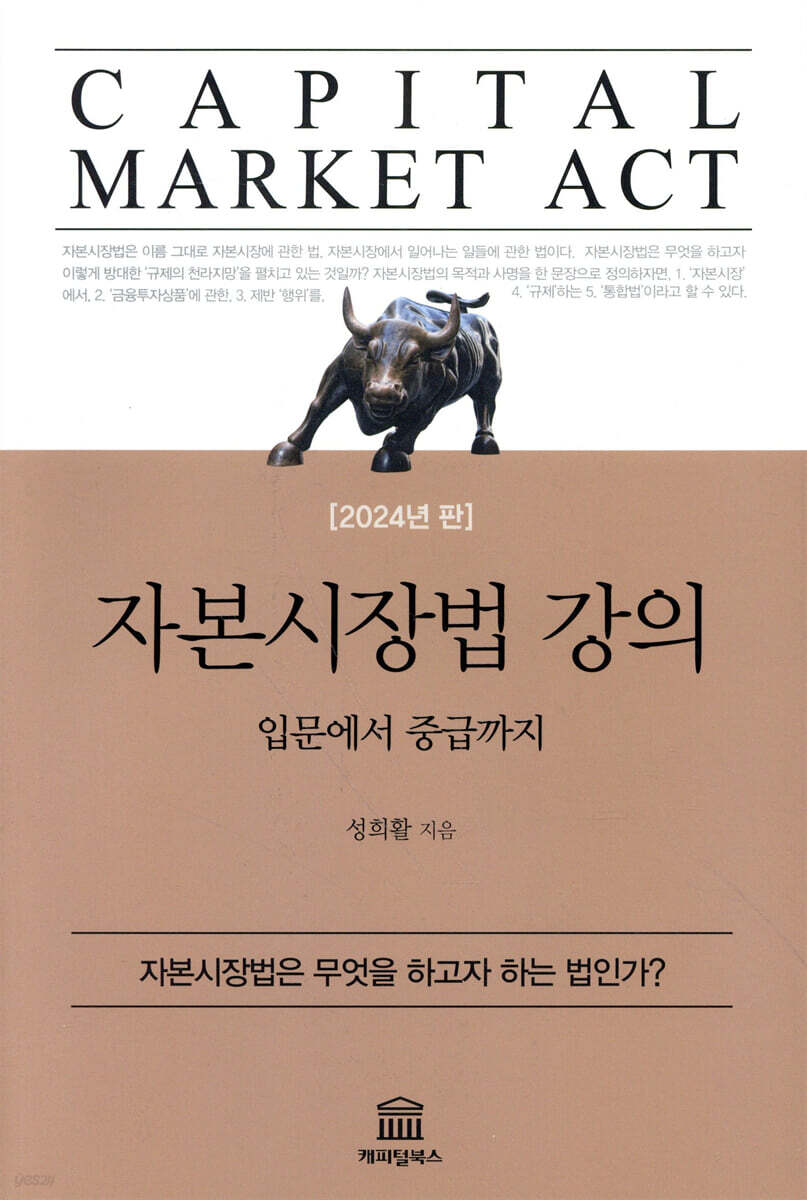
Capital Market Law Lecture
 |
Description
Book Introduction
What does the Capital Markets Act intend to do?
For those who are studying capital market law for the first time
With basic knowledge of capital market law
A commentary for those who need a systematic understanding
This book is a basic commentary on the vast and complex capital market law, written based on the author's practical experience in the capital market and the materials and experience accumulated while teaching capital market law to law school students and capital market experts. It aims to make the vast and complex capital market law as easy to understand as possible.
While there have been quite a few professional books published explaining the capital market law, this is the first book in Korea to be published in an easy-to-understand introductory format.
The book's content begins with very basic topics for beginners, and focuses on a general explanation of the regulatory system and legal principles of capital market law. At times, it also covers a considerable amount of in-depth topics, such as the background, reasons, and problems of the current regulatory system and legal principles.
Therefore, as the subtitle of this book states, “From Beginner to Intermediate,” it is intended to be of great help not only to those who are new to capital market law but also to those who have some basic knowledge and need a more systematic understanding of the law.
For those who are studying capital market law for the first time
With basic knowledge of capital market law
A commentary for those who need a systematic understanding
This book is a basic commentary on the vast and complex capital market law, written based on the author's practical experience in the capital market and the materials and experience accumulated while teaching capital market law to law school students and capital market experts. It aims to make the vast and complex capital market law as easy to understand as possible.
While there have been quite a few professional books published explaining the capital market law, this is the first book in Korea to be published in an easy-to-understand introductory format.
The book's content begins with very basic topics for beginners, and focuses on a general explanation of the regulatory system and legal principles of capital market law. At times, it also covers a considerable amount of in-depth topics, such as the background, reasons, and problems of the current regulatory system and legal principles.
Therefore, as the subtitle of this book states, “From Beginner to Intermediate,” it is intended to be of great help not only to those who are new to capital market law but also to those who have some basic knowledge and need a more systematic understanding of the law.
- You can preview some of the book's contents.
Preview
index
Chapter 1 General Provisions
Section 1 Overview of the Capital Markets Act
Section 2. Structure of the Capital Market Act
Section 3: Characteristics of the Capital Market Act as Regulatory Administration Law and Related Laws and Regulations
Section 4. Purpose of the Capital Market Act and the Four Major Regulatory Paradigms
Section 5 Capital Market Regulatory Agencies
Chapter 2: Basic Knowledge for Understanding Capital Market Law
Section 1: Basic Market Systems for Understanding Capital Markets Act
Section 2: Concept and Scope of Financial Investment Products and Investment Contract Securities, the Gateway to the Capital Market Act
Section 3: Explanation of basic terms necessary for understanding the Capital Markets Act
Chapter 3 Regulation of Financial Investment Businesses
Section 1 Overview of Financial Regulations
Section 2 Regulations on entry of financial investment companies
Section 3 Regulation of the governance structure of financial investment companies
Section 4 Regulation of the Soundness of Financial Investment Companies
Section 5 Regulation of Business Conduct of Financial Investment Companies
Chapter 4 Regulations on Securities Issuance (Public Offering Regulations)
Section 1 Philosophy of Competition Regulation
Section 2 Method of issuing securities
Section 3 Issuance System and Regulations
Section 4. Devices to ensure the authenticity of securities reports
Chapter 5 Continuous Disclosure Obligations of Public and Listed Corporations
Section 1 Overview of the obligation to continue disclosure
Section 2 Corporations Subject to Submission of Business Reports
Section 3 Contents of regular disclosures (business reports, semi-annual reports, quarterly reports)
Section 4 Contents of irregular disclosures (Major Matters Report and Exchange's Periodic Disclosures)
Chapter 6 Regulation of Mergers and Acquisitions (M&A)
Section 1 Types of M&A
Section 2 M&A Regulations under the Capital Market Act
Chapter 7 Unfair Trade Regulations
Section 1 Overview of Unfair Trade Regulations
Section 2 Insider Trading
Section 3 Regulation of price manipulation
Section 4 Regulation of Unfair Transactions
Section 5 Regulation of Market Disruption
Section 6 Short Selling Regulations
Section 7 Calculation of Unjust Enrichment
Section 1 Overview of the Capital Markets Act
Section 2. Structure of the Capital Market Act
Section 3: Characteristics of the Capital Market Act as Regulatory Administration Law and Related Laws and Regulations
Section 4. Purpose of the Capital Market Act and the Four Major Regulatory Paradigms
Section 5 Capital Market Regulatory Agencies
Chapter 2: Basic Knowledge for Understanding Capital Market Law
Section 1: Basic Market Systems for Understanding Capital Markets Act
Section 2: Concept and Scope of Financial Investment Products and Investment Contract Securities, the Gateway to the Capital Market Act
Section 3: Explanation of basic terms necessary for understanding the Capital Markets Act
Chapter 3 Regulation of Financial Investment Businesses
Section 1 Overview of Financial Regulations
Section 2 Regulations on entry of financial investment companies
Section 3 Regulation of the governance structure of financial investment companies
Section 4 Regulation of the Soundness of Financial Investment Companies
Section 5 Regulation of Business Conduct of Financial Investment Companies
Chapter 4 Regulations on Securities Issuance (Public Offering Regulations)
Section 1 Philosophy of Competition Regulation
Section 2 Method of issuing securities
Section 3 Issuance System and Regulations
Section 4. Devices to ensure the authenticity of securities reports
Chapter 5 Continuous Disclosure Obligations of Public and Listed Corporations
Section 1 Overview of the obligation to continue disclosure
Section 2 Corporations Subject to Submission of Business Reports
Section 3 Contents of regular disclosures (business reports, semi-annual reports, quarterly reports)
Section 4 Contents of irregular disclosures (Major Matters Report and Exchange's Periodic Disclosures)
Chapter 6 Regulation of Mergers and Acquisitions (M&A)
Section 1 Types of M&A
Section 2 M&A Regulations under the Capital Market Act
Chapter 7 Unfair Trade Regulations
Section 1 Overview of Unfair Trade Regulations
Section 2 Insider Trading
Section 3 Regulation of price manipulation
Section 4 Regulation of Unfair Transactions
Section 5 Regulation of Market Disruption
Section 6 Short Selling Regulations
Section 7 Calculation of Unjust Enrichment
Publisher's Review
This book is not written in an academic style, citing and discussing the works and papers of other scholars like a typical introductory book, but rather in a lecture-style format, as if you were talking face to face in a classroom.
This can be said to be the author's intention to enable readers unfamiliar with capital market law to easily access the capital market.
By reading and understanding this book, beginners will be able to understand the difference between a company and a corporation, the differences between securities, stocks, and equity, how initial public offerings and listings are distinguished and carried out, how the level and scope of regulations for financial investment companies and listed companies are differentiated, what corporate mergers and acquisitions (M&A) are and how and why they are regulated by law, and what the relationship is between the Financial Services Commission, the Securities and Futures Commission, and the Financial Supervisory Service.
Readers with basic knowledge will be able to grasp the overall framework of the Capital Markets Act at a glance based on the four major regulatory paradigms, understand the precise concepts and infinite expandability of investment contract securities and derivatives, be amazed by the vast regulations on the financial investment industry, learn the scope and limitations of regulations on listed corporations, and become newly alert to the lax yet meticulous regulations on unfair trade practices.
- What is the difference between a company and a corporation?
- What is the difference between securities, stocks, and stock certificates?
- What is the difference between an IPO and a listing?
How are the levels and scope of regulation for financial investment companies and listed companies differentiated?
What are mergers and acquisitions (M&A) and how and why are they regulated legally?
What is the relationship between the Financial Services Commission, the Securities and Futures Commission, and the Financial Supervisory Service?
How far can the concepts of investment contract securities and derivatives be expanded?
- What are the scope and limits of regulation of listed corporations?
How thorough are the regulations on unfair trade practices?
- What is the relationship between the Capital Markets Act and the Financial Consumer Protection Act?
- What does the imposition of fines for the three major unfair trade practices mean?
Korea's first introductory book on capital market law
This book is for beginners who want to understand capital market law.
This book will be very useful for readers who already have basic knowledge but want a more systematic understanding of capital market law.
In this book, the author pays great attention to the very important terms and concepts covered in capital market law.
In particular, the author intentionally asks in this book, “Why is that so?” “The reason is...
The phrase “because” was used a lot.
The reason was, firstly, to provide many opportunities for readers to think for themselves rather than just reading mechanically.
Second, by explaining the background and reasons for the system and regulations, we aimed to enable students to acquire and internalize as many of the basic principles that underpin the existence and inevitable change of the system and regulations as possible, rather than simply memorizing the current status of the system and the wording of the articles.
And I wanted to get a feel for how the basic principles in the book are actually applied through case studies.
The importance of a thorough understanding of the fundamental principles of capital market law.
Although this book is an introductory text, as the author states in the preface, if you are familiar with the background and basic principles, rather than the constantly changing state of the capital market, you will have no difficulty studying and applying the capital market law in your work, even if the details change due to legal revisions.
While it would be helpful for a commentary on a vast and specialized law like the Capital Markets Act to provide detailed explanations of specifics, this may not be essential.
Even if a book is written in detail and accurately, it is too risky to understand the current regulations by just looking at the book due to the nature of the capital market laws that change frequently. Therefore, you must check the laws yourself whenever necessary.
In this respect, as the author points out, press articles can be considered excellent study materials.
By thoroughly understanding the fundamental principles of capital market law, reading relevant media articles every day, organizing them into notes, searching for relevant materials on any parts you don't understand, asking experts, and discussing them with colleagues, you'll soon find yourself at an advanced level.
In this sense, although this book is an introductory text, I believe it will be very useful for readers who wish to begin studying capital market law professionally.
Reflecting the latest revisions to the Capital Market Act
This book has been reprinted several times since its first publication in December 2018.
The 2024 edition, which is being published after two years, reflects major changes in the law over the past two years, including the Financial Services Commission's system of imposing fines for unfair trade practices, the legalization of a method for calculating unjust profits when imposing fines and surcharges for unfair trade practices, and the introduction of a pre-disclosure system for insider trading.
In addition, as understanding investment contract securities becomes more important in relation to piecemeal investment, the content has been faithfully supplemented in this regard.
It also includes new regulations on quasi-investment advisory firms, which were revised in January 2024.
This can be said to be the author's intention to enable readers unfamiliar with capital market law to easily access the capital market.
By reading and understanding this book, beginners will be able to understand the difference between a company and a corporation, the differences between securities, stocks, and equity, how initial public offerings and listings are distinguished and carried out, how the level and scope of regulations for financial investment companies and listed companies are differentiated, what corporate mergers and acquisitions (M&A) are and how and why they are regulated by law, and what the relationship is between the Financial Services Commission, the Securities and Futures Commission, and the Financial Supervisory Service.
Readers with basic knowledge will be able to grasp the overall framework of the Capital Markets Act at a glance based on the four major regulatory paradigms, understand the precise concepts and infinite expandability of investment contract securities and derivatives, be amazed by the vast regulations on the financial investment industry, learn the scope and limitations of regulations on listed corporations, and become newly alert to the lax yet meticulous regulations on unfair trade practices.
- What is the difference between a company and a corporation?
- What is the difference between securities, stocks, and stock certificates?
- What is the difference between an IPO and a listing?
How are the levels and scope of regulation for financial investment companies and listed companies differentiated?
What are mergers and acquisitions (M&A) and how and why are they regulated legally?
What is the relationship between the Financial Services Commission, the Securities and Futures Commission, and the Financial Supervisory Service?
How far can the concepts of investment contract securities and derivatives be expanded?
- What are the scope and limits of regulation of listed corporations?
How thorough are the regulations on unfair trade practices?
- What is the relationship between the Capital Markets Act and the Financial Consumer Protection Act?
- What does the imposition of fines for the three major unfair trade practices mean?
Korea's first introductory book on capital market law
This book is for beginners who want to understand capital market law.
This book will be very useful for readers who already have basic knowledge but want a more systematic understanding of capital market law.
In this book, the author pays great attention to the very important terms and concepts covered in capital market law.
In particular, the author intentionally asks in this book, “Why is that so?” “The reason is...
The phrase “because” was used a lot.
The reason was, firstly, to provide many opportunities for readers to think for themselves rather than just reading mechanically.
Second, by explaining the background and reasons for the system and regulations, we aimed to enable students to acquire and internalize as many of the basic principles that underpin the existence and inevitable change of the system and regulations as possible, rather than simply memorizing the current status of the system and the wording of the articles.
And I wanted to get a feel for how the basic principles in the book are actually applied through case studies.
The importance of a thorough understanding of the fundamental principles of capital market law.
Although this book is an introductory text, as the author states in the preface, if you are familiar with the background and basic principles, rather than the constantly changing state of the capital market, you will have no difficulty studying and applying the capital market law in your work, even if the details change due to legal revisions.
While it would be helpful for a commentary on a vast and specialized law like the Capital Markets Act to provide detailed explanations of specifics, this may not be essential.
Even if a book is written in detail and accurately, it is too risky to understand the current regulations by just looking at the book due to the nature of the capital market laws that change frequently. Therefore, you must check the laws yourself whenever necessary.
In this respect, as the author points out, press articles can be considered excellent study materials.
By thoroughly understanding the fundamental principles of capital market law, reading relevant media articles every day, organizing them into notes, searching for relevant materials on any parts you don't understand, asking experts, and discussing them with colleagues, you'll soon find yourself at an advanced level.
In this sense, although this book is an introductory text, I believe it will be very useful for readers who wish to begin studying capital market law professionally.
Reflecting the latest revisions to the Capital Market Act
This book has been reprinted several times since its first publication in December 2018.
The 2024 edition, which is being published after two years, reflects major changes in the law over the past two years, including the Financial Services Commission's system of imposing fines for unfair trade practices, the legalization of a method for calculating unjust profits when imposing fines and surcharges for unfair trade practices, and the introduction of a pre-disclosure system for insider trading.
In addition, as understanding investment contract securities becomes more important in relation to piecemeal investment, the content has been faithfully supplemented in this regard.
It also includes new regulations on quasi-investment advisory firms, which were revised in January 2024.
GOODS SPECIFICS
- Date of issue: February 1, 2024
- Page count, weight, size: 467 pages | 152*225*30mm
- ISBN13: 9791197850035
- ISBN10: 1197850031
You may also like
카테고리
korean


korean

![GQ KOREA Mark (Monthly): December [2025]](http://librairie.coreenne.fr/cdn/shop/files/8ef265dbbfbf186523ed75ba7319009d.jpg?v=1765340328&width=3840)


