

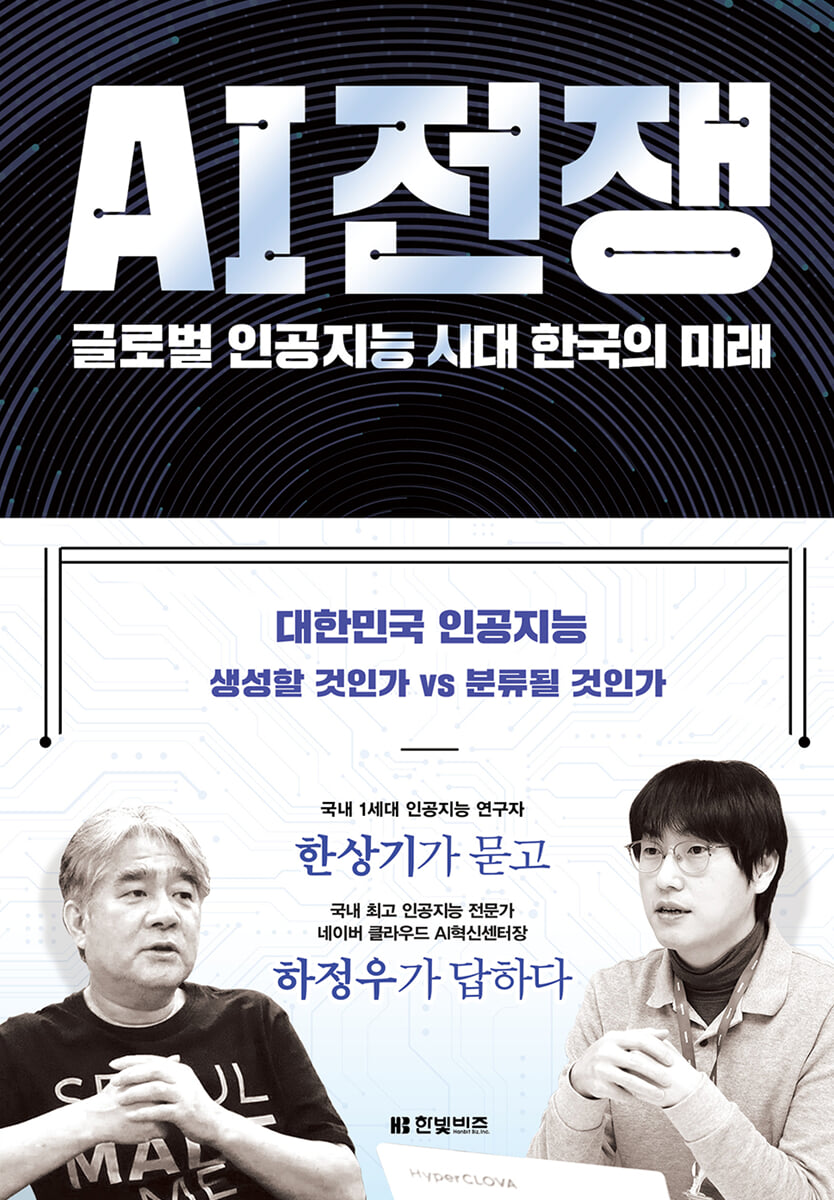
AI war
 |
Description
Book Introduction
The era of global AI war triggered by ChatGPT,
What will become of the artificial intelligence ecosystem in South Korea?
Korea's top AI expert, Ha Jung-woo, head of Naver AI Innovation Center, speaks
The Competitiveness and Future of Korean Artificial Intelligence
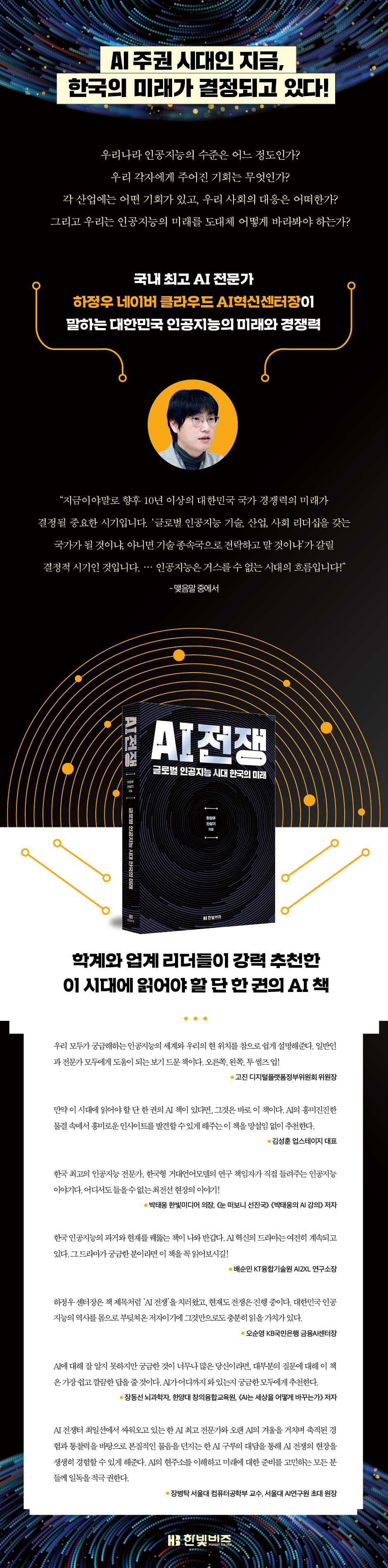
Go Jin, Kim Sung-hoon, Park Tae-woong, Bae Soon-min, Oh Soon-young, Jang Dong-seon, Jang Byeong-tak…
Highly recommended by domestic AI industry and academic leaders!
As of 2023, the world is in an AI war.
In November 2022, OpenAI stunned everyone with GPT-3.5, and then again this March with the release of GPT-4.
Not to be outdone, global big tech companies are now competing fiercely to dominate the artificial intelligence market, with Meta (Facebook) launching Rama, Google launching Bard, and Amazon launching Bedrock.
So, what about AI in Korea? With the entire world engaged in the AI war, where is Korea's AI industry headed? It's time to soberly assess the ChatGPT craze and face the current state of AI in Korea.
From our perspective, it is time to seriously explore what kind of future will come.
While many media outlets and books are excited by the ChatGPT craze, introducing foreign technologies and global trends, this book provides a glimpse into the present and future of artificial intelligence in Korea.
This book delves into how each of us should respond to this enormous wave and what we should prepare for, through the vivid voice of Ha Jung-woo, Director of Naver Cloud AI Innovation Center.
Director Ha Jung-woo is currently the most prominent figure in Korea's artificial intelligence field, recognized by all as the country's leading AI expert. This is precisely why experts from the AI industry and academia alike are enthusiastically recommending this book.
Because it is a story from the front line that you cannot hear anywhere else.
Now is the time to bring artificial intelligence's gaze into our own.
If you're curious about the present and future of artificial intelligence in Korea and want to discover business opportunities and possibilities within it, open this book right now!
What will become of the artificial intelligence ecosystem in South Korea?
Korea's top AI expert, Ha Jung-woo, head of Naver AI Innovation Center, speaks
The Competitiveness and Future of Korean Artificial Intelligence
Go Jin, Kim Sung-hoon, Park Tae-woong, Bae Soon-min, Oh Soon-young, Jang Dong-seon, Jang Byeong-tak…
Highly recommended by domestic AI industry and academic leaders!
As of 2023, the world is in an AI war.
In November 2022, OpenAI stunned everyone with GPT-3.5, and then again this March with the release of GPT-4.
Not to be outdone, global big tech companies are now competing fiercely to dominate the artificial intelligence market, with Meta (Facebook) launching Rama, Google launching Bard, and Amazon launching Bedrock.
So, what about AI in Korea? With the entire world engaged in the AI war, where is Korea's AI industry headed? It's time to soberly assess the ChatGPT craze and face the current state of AI in Korea.
From our perspective, it is time to seriously explore what kind of future will come.
While many media outlets and books are excited by the ChatGPT craze, introducing foreign technologies and global trends, this book provides a glimpse into the present and future of artificial intelligence in Korea.
This book delves into how each of us should respond to this enormous wave and what we should prepare for, through the vivid voice of Ha Jung-woo, Director of Naver Cloud AI Innovation Center.
Director Ha Jung-woo is currently the most prominent figure in Korea's artificial intelligence field, recognized by all as the country's leading AI expert. This is precisely why experts from the AI industry and academia alike are enthusiastically recommending this book.
Because it is a story from the front line that you cannot hear anywhere else.
Now is the time to bring artificial intelligence's gaze into our own.
If you're curious about the present and future of artificial intelligence in Korea and want to discover business opportunities and possibilities within it, open this book right now!
- You can preview some of the book's contents.
Preview
index
preface
Chapter 1: The Beginning of an Irresistible Intellectual Revolution
What the dawn of the AI era means
History of Artificial Intelligence Development
The impact AlphaGo had on Korean society
A New Shock: The Emergence of Interactive Services
Key Players in the AI Era
The current state of artificial intelligence in Korea
Background of the rapid development of artificial intelligence
How far has artificial intelligence come?
The ultimate stage of development: artificial general intelligence (AGI).
What will happen 10 years from now
The emergence of artificial intelligence assistants
People using artificial intelligence will replace you.
Future challenges
Chapter 2: How to View the Hyper-Giant AI Pandemic
What is Generative Artificial Intelligence?
The beginning of the foundation model
The image-generating service that sparked the AI boom
Limitations of automatic image generation services and efforts to overcome them
Who is responsible for copyright infringement?
From Text to Speech: The Advancement of Generative AI
Google vs. OpenAI/Microsoft
Causes and Solutions of Hallucinations
Risk of personal and confidential information leaks
How can we categorize the levels of artificial intelligence?
If you say it stops, will it really stop?
Climate Crisis and Artificial Intelligence
Ha Jung-woo's "Things to Keep in Mind When Utilizing Super-Large-Scale AI: Dos & Don'ts"
Chapter 3: Korea's AI Ecosystem by Industry
Artificial intelligence is already in our lives.
The Current State and Prospects of AI Services and Finance
Healthcare: Where AI Will Create Ultimate Value
Education: High Expectations, But Reality Is Challenging
Manufacturing: A Strong National Drive Is Needed
E-commerce and Retail: Productivity and Competitiveness Depend on AI
Agriculture, Fisheries, Livestock, and Forestry: AI is essential for food sovereignty.
Defense and the Arms Industry: The Battlefield Paradigm Is Shifting
Law: One of the professions most impacted by ChatGPT
Interpretation: The threat of giant language models is terrifying.
For commercialization of artificial intelligence to be possible
Chapter 4: The Position of Korean Artificial Intelligence and AI Sovereignty
The Flow and Regrets of AI Strategy
Korea's AI Level and Models to Learn from
Korea's top five AI development companies
The question of government's role
We need human resources and talent urgently.
Naver's human resource development program
To become a talent needed in the era of artificial intelligence
Korea's AI Startups and Their Limitations
What the government should and shouldn't do
National Strategy Agenda and Development Budget Issues
Global Expansion Strategy and Sovereign Cloud
Chapter 5: Naver and the Path to AI Innovation
The Near Future of Naver's Artificial Intelligence
The Beginning of News AI: Naver News Service
Naver Clova Note, a voice recording that you can see and hear
Naver Clova Care Call, an interactive care service
Naver's competitiveness in the global market
The Importance of Securing Overseas Manpower and Its Utilization Status
HyperClova X, a super-large AI
Full-scale launch of cloud business and development of overseas markets
Naver and Samsung Electronics' AI semiconductor development
Plans for Edge Computing and Security Issues
Chapter 6: The Future with Artificial Intelligence
Artificial intelligence risk issues
How far should we go with opaque AI?
Concerns and dilemmas in using it for the benefit of humans
When will robots and artificial intelligence intersect?
Can artificial intelligence share human emotions?
Sensitive issues related to robots
Will robots become human slaves or companions?
What businesses and individuals need to prepare to keep pace with the times
Books and movies about artificial intelligence
Ultimately, we need a device for people.
Conclusion
Acknowledgements
Chapter 1: The Beginning of an Irresistible Intellectual Revolution
What the dawn of the AI era means
History of Artificial Intelligence Development
The impact AlphaGo had on Korean society
A New Shock: The Emergence of Interactive Services
Key Players in the AI Era
The current state of artificial intelligence in Korea
Background of the rapid development of artificial intelligence
How far has artificial intelligence come?
The ultimate stage of development: artificial general intelligence (AGI).
What will happen 10 years from now
The emergence of artificial intelligence assistants
People using artificial intelligence will replace you.
Future challenges
Chapter 2: How to View the Hyper-Giant AI Pandemic
What is Generative Artificial Intelligence?
The beginning of the foundation model
The image-generating service that sparked the AI boom
Limitations of automatic image generation services and efforts to overcome them
Who is responsible for copyright infringement?
From Text to Speech: The Advancement of Generative AI
Google vs. OpenAI/Microsoft
Causes and Solutions of Hallucinations
Risk of personal and confidential information leaks
How can we categorize the levels of artificial intelligence?
If you say it stops, will it really stop?
Climate Crisis and Artificial Intelligence
Ha Jung-woo's "Things to Keep in Mind When Utilizing Super-Large-Scale AI: Dos & Don'ts"
Chapter 3: Korea's AI Ecosystem by Industry
Artificial intelligence is already in our lives.
The Current State and Prospects of AI Services and Finance
Healthcare: Where AI Will Create Ultimate Value
Education: High Expectations, But Reality Is Challenging
Manufacturing: A Strong National Drive Is Needed
E-commerce and Retail: Productivity and Competitiveness Depend on AI
Agriculture, Fisheries, Livestock, and Forestry: AI is essential for food sovereignty.
Defense and the Arms Industry: The Battlefield Paradigm Is Shifting
Law: One of the professions most impacted by ChatGPT
Interpretation: The threat of giant language models is terrifying.
For commercialization of artificial intelligence to be possible
Chapter 4: The Position of Korean Artificial Intelligence and AI Sovereignty
The Flow and Regrets of AI Strategy
Korea's AI Level and Models to Learn from
Korea's top five AI development companies
The question of government's role
We need human resources and talent urgently.
Naver's human resource development program
To become a talent needed in the era of artificial intelligence
Korea's AI Startups and Their Limitations
What the government should and shouldn't do
National Strategy Agenda and Development Budget Issues
Global Expansion Strategy and Sovereign Cloud
Chapter 5: Naver and the Path to AI Innovation
The Near Future of Naver's Artificial Intelligence
The Beginning of News AI: Naver News Service
Naver Clova Note, a voice recording that you can see and hear
Naver Clova Care Call, an interactive care service
Naver's competitiveness in the global market
The Importance of Securing Overseas Manpower and Its Utilization Status
HyperClova X, a super-large AI
Full-scale launch of cloud business and development of overseas markets
Naver and Samsung Electronics' AI semiconductor development
Plans for Edge Computing and Security Issues
Chapter 6: The Future with Artificial Intelligence
Artificial intelligence risk issues
How far should we go with opaque AI?
Concerns and dilemmas in using it for the benefit of humans
When will robots and artificial intelligence intersect?
Can artificial intelligence share human emotions?
Sensitive issues related to robots
Will robots become human slaves or companions?
What businesses and individuals need to prepare to keep pace with the times
Books and movies about artificial intelligence
Ultimately, we need a device for people.
Conclusion
Acknowledgements
Detailed image
Into the book
The era of artificial intelligence is dawning, and super-large-scale artificial intelligence is driving it.
In the past, when using artificial intelligence for a specific task or function, we would click on menus and input text using a keyboard or mouse while being conscious that we were using artificial intelligence.
But the countless technologies being developed recently allow us to use them naturally, almost like having a conversation, without any particular conscious effort to "use AI." We've entered an era where communication with machines, like human conversation, is achieved through voice, and virtually everything can be connected to action.
--- p.18 From “Chapter 1: The Beginning of an Irresistible Intellectual Revolution”
The key area that will drive the tremendous advancements in artificial intelligence over the next decade will be hardware, and semiconductors in particular.
Running a super-large artificial intelligence consumes enormous amounts of energy, namely electricity.
We need to optimize and lighten the semiconductors used in AI services to dramatically reduce energy costs.
The human body uses very little energy.
Of course, there are many errors, but while humans work while using energy very efficiently, the current super-large artificial intelligence works while using an enormous amount of energy.
This raises the question of how sustainable this will be.
… … If the cost is high, the usage fee will also be high, and then there will be limitations in using it in many places.
Right now, global tech companies are spending a lot of money on expensive products, as if they're going to die, but this approach is not sustainable.
--- p.49~50 From “Chapter 1: The Beginning of an Irresistible Intellectual Revolution”
I think the position of mid-sized companies focusing on artificial intelligence technology will become ambiguous.
As global big tech companies provide a variety of functions through their massive artificial intelligence platforms, easily replaceable service-oriented companies will find it difficult to keep up.
They will have to find ways to survive, either by being acquired or by providing component technologies to big tech companies.
… … If we were to compete solely on technology, we would be competing one-on-one with Adobe in image creation, and one-on-one with OpenAI, Microsoft, and Google in language, but that is now realistically difficult.
--- p.81~82 From “Chapter 2: How to View the Pandemic of Super-Large-Scale Artificial Intelligence”
In 1975, genetic engineers met in Asilomar, California, and agreed to halt research until guidelines for recombinant DNA were developed.
After that, the National Institutes of Health in the United States issued guidelines, and we followed them.
There are concerns that artificial intelligence could pose a threat to humanity, although it is not yet known whether it is as dangerous as recombinant DNA, and even President Biden has said that it could be a potential threat, but we will wait and see.
In January 2017, AI experts gathered at the iconic Asilomar and announced 23 principles for AI technology.
Afterwards, guidelines were created for each country that joined the OECD.
Shouldn't we examine whether current AI development adheres to these guidelines and complies with privacy regulations, such as the European Union's General Data Protection Regulation?
--- p.103 From “Chapter 2: How to View the Pandemic of Super-Large-Scale Artificial Intelligence”
Energy issues are one of our biggest challenges.
It's a task as important as the hallucination problem.
Because the model is so large, it requires a lot of calculations and a lot of computing power.
Semiconductors are the key to computing power.
Currently, the most widely used semiconductor in AI services is NVIDIA's GPU. However, due to limited production and lack of alternatives, we have no choice but to rely on it, even if it's expensive. The immediate challenge is to develop a product that's lighter, consumes less power, and is more affordable than GPUs.
--- p.106 From “Chapter 2: How to View the Pandemic of Super-Large-Scale Artificial Intelligence”
Companies that provide services centered on the internet or mobile apps should pay attention to the massive AI-centric plugin ecosystem.
Users who previously used independent channels or apps are likely to run apps through conversational, hyper-large-scale artificial intelligence interfaces created by big tech companies like OpenAI/Microsoft, Google, and Naver.
Super-large artificial intelligence will become the main gate.
Conversely, if you choose to operate a separate channel without utilizing the main gate, the risk will be extremely high.
Regardless of the industry or size of your business, you should utilize it as quickly and widely as possible, and carefully consider which tasks will be most effective and how to prioritize them.
The era of artificial intelligence has already begun, so companies that quickly grasp this opportunity will have many more opportunities, while the rest will fall behind or be eliminated.
--- p.116~177 From “Chapter 3: Korea’s Artificial Intelligence Ecosystem by Industry”
I believe that when AI technology becomes sufficiently advanced, the fields that will ultimately create the most value are finance and medicine.
Why? Because it's natural for people to want to be rich and live long without getting sick.
So, I think that artificial intelligence technology for these two fields will inevitably develop.
However, while finance is clearly a business that generates profits, healthcare, at least in our country, has the characteristic of being a field where publicness is important.
Moreover, the influence of existing groups is strong and the barriers to entry are high.
Even though they explain that artificial intelligence is an assistive tool, they are still putting up a strong defense against the idea that it will ultimately infringe on their vested rights.
--- p.124 From “Chapter 3: Korea’s Artificial Intelligence Ecosystem by Industry”
A foreign judge made headlines when he claimed he wrote his rulings using ChatGPT. One of the areas where LLMs excel is law.
It's based on case law.
We make decisions based on past cases and write our decisions based on precedents.
This is what language models do best.
In this way, you can receive the most help from the legal market.
… … I think there are also positive social aspects.
The legal field is a market with very asymmetric information.
Typically, situations that call for legal assistance are those involving difficult and distressing circumstances. However, from the customer's perspective, the terminology can be difficult to understand, making it difficult to approach, and accurately assessing the value can be incredibly challenging.
So, if we could get help from artificial intelligence, we could significantly lower the barriers to entry.
On the other hand, it could be a crisis for lawyers, prosecutors, and judges who provide services in the existing legal market.
--- p.169~170 From “Chapter 3: Korea’s Artificial Intelligence Ecosystem by Industry”
Looking at the field of artificial intelligence as a whole, as I mentioned earlier, I think it ranks between 6th and 10th in the world.
Stanford University's Human-Centered AI Lab releases its annual report on artificial intelligence.
The ranking is based on a comparison of overall competitiveness in research, technology, commercialization, talent, infrastructure, and legal systems, and our country ranks at that level.
A similar ranking is found in the Global AI Index, published annually by Tortoise Media in the UK based on global AI investment, innovation, and implementation levels, ranking 7th as of 2022.
Among them, the level of technology in super-large artificial intelligence is ranked among the top 2 or 3 in the world.
This is because only the United States, China, South Korea, and Israel possess super-large AI models, and only three countries – the United States, China, and South Korea – have established ecosystems.
--- p.198 From “Chapter 4: The Position of Korean Artificial Intelligence and AI Sovereignty”
Strengthening the competitiveness of super-large artificial intelligence is absolutely necessary.
The blueprint that OpenAI has presented through its ChatGPT plugin clearly shows that the world will be completely divided into those with this super-large AI and those without.
The massive AI plugin ecosystem will become a black hole for all personal data.
Therefore, our country must also build its own, competitive, and massive artificial intelligence ecosystem to prevent data sovereignty dependence due to the export of personal data abroad.
Strengthening the competitiveness of hyper-large-scale AI means carefully planning and implementing strategies for the overall ecosystem, including not only hyper-large-scale AI development technology but also industry and society.
--- p.204 From “Chapter 4: The Position of Korean Artificial Intelligence and AI Sovereignty”
The Middle East, with its ambiguous relationship with the United States, presents a significant business opportunity for technologically advanced Chinese companies.
In fact, I understand that Chinese companies are very willing to participate in large-scale projects such as NEOM City in Saudi Arabia.
So, to successfully advance into the Middle East, we need to develop a differentiated strategy that the United States or China find difficult to provide.
While it may be difficult for our government to pursue a state-led drive like China, to compete with global tech companies, we need to provide more aggressive support as a single team with domestic AI companies.
--- p.282 From “Chapter 5: Naver and the Path to Artificial Intelligence Innovation”
The US and Europe have different positions.
There is no country in Europe that has its own LLM.
But if this situation persists, how much will Europe's competitiveness decline in the next 50 years, or even in just 10? The UK, however, seems to be a bit different.
As I mentioned before, in early 2023, the British government announced that it would invest 1 billion pounds in infrastructure for large-scale artificial intelligence in the public sector, but the Labour Party think tank argued that it would be difficult to avoid technological dependence on the United States with that amount, so 11 billion pounds should be spent.
It's interesting to note that the UK, having left the European Union, is taking a different approach to artificial intelligence than other European countries.
In the past, when using artificial intelligence for a specific task or function, we would click on menus and input text using a keyboard or mouse while being conscious that we were using artificial intelligence.
But the countless technologies being developed recently allow us to use them naturally, almost like having a conversation, without any particular conscious effort to "use AI." We've entered an era where communication with machines, like human conversation, is achieved through voice, and virtually everything can be connected to action.
--- p.18 From “Chapter 1: The Beginning of an Irresistible Intellectual Revolution”
The key area that will drive the tremendous advancements in artificial intelligence over the next decade will be hardware, and semiconductors in particular.
Running a super-large artificial intelligence consumes enormous amounts of energy, namely electricity.
We need to optimize and lighten the semiconductors used in AI services to dramatically reduce energy costs.
The human body uses very little energy.
Of course, there are many errors, but while humans work while using energy very efficiently, the current super-large artificial intelligence works while using an enormous amount of energy.
This raises the question of how sustainable this will be.
… … If the cost is high, the usage fee will also be high, and then there will be limitations in using it in many places.
Right now, global tech companies are spending a lot of money on expensive products, as if they're going to die, but this approach is not sustainable.
--- p.49~50 From “Chapter 1: The Beginning of an Irresistible Intellectual Revolution”
I think the position of mid-sized companies focusing on artificial intelligence technology will become ambiguous.
As global big tech companies provide a variety of functions through their massive artificial intelligence platforms, easily replaceable service-oriented companies will find it difficult to keep up.
They will have to find ways to survive, either by being acquired or by providing component technologies to big tech companies.
… … If we were to compete solely on technology, we would be competing one-on-one with Adobe in image creation, and one-on-one with OpenAI, Microsoft, and Google in language, but that is now realistically difficult.
--- p.81~82 From “Chapter 2: How to View the Pandemic of Super-Large-Scale Artificial Intelligence”
In 1975, genetic engineers met in Asilomar, California, and agreed to halt research until guidelines for recombinant DNA were developed.
After that, the National Institutes of Health in the United States issued guidelines, and we followed them.
There are concerns that artificial intelligence could pose a threat to humanity, although it is not yet known whether it is as dangerous as recombinant DNA, and even President Biden has said that it could be a potential threat, but we will wait and see.
In January 2017, AI experts gathered at the iconic Asilomar and announced 23 principles for AI technology.
Afterwards, guidelines were created for each country that joined the OECD.
Shouldn't we examine whether current AI development adheres to these guidelines and complies with privacy regulations, such as the European Union's General Data Protection Regulation?
--- p.103 From “Chapter 2: How to View the Pandemic of Super-Large-Scale Artificial Intelligence”
Energy issues are one of our biggest challenges.
It's a task as important as the hallucination problem.
Because the model is so large, it requires a lot of calculations and a lot of computing power.
Semiconductors are the key to computing power.
Currently, the most widely used semiconductor in AI services is NVIDIA's GPU. However, due to limited production and lack of alternatives, we have no choice but to rely on it, even if it's expensive. The immediate challenge is to develop a product that's lighter, consumes less power, and is more affordable than GPUs.
--- p.106 From “Chapter 2: How to View the Pandemic of Super-Large-Scale Artificial Intelligence”
Companies that provide services centered on the internet or mobile apps should pay attention to the massive AI-centric plugin ecosystem.
Users who previously used independent channels or apps are likely to run apps through conversational, hyper-large-scale artificial intelligence interfaces created by big tech companies like OpenAI/Microsoft, Google, and Naver.
Super-large artificial intelligence will become the main gate.
Conversely, if you choose to operate a separate channel without utilizing the main gate, the risk will be extremely high.
Regardless of the industry or size of your business, you should utilize it as quickly and widely as possible, and carefully consider which tasks will be most effective and how to prioritize them.
The era of artificial intelligence has already begun, so companies that quickly grasp this opportunity will have many more opportunities, while the rest will fall behind or be eliminated.
--- p.116~177 From “Chapter 3: Korea’s Artificial Intelligence Ecosystem by Industry”
I believe that when AI technology becomes sufficiently advanced, the fields that will ultimately create the most value are finance and medicine.
Why? Because it's natural for people to want to be rich and live long without getting sick.
So, I think that artificial intelligence technology for these two fields will inevitably develop.
However, while finance is clearly a business that generates profits, healthcare, at least in our country, has the characteristic of being a field where publicness is important.
Moreover, the influence of existing groups is strong and the barriers to entry are high.
Even though they explain that artificial intelligence is an assistive tool, they are still putting up a strong defense against the idea that it will ultimately infringe on their vested rights.
--- p.124 From “Chapter 3: Korea’s Artificial Intelligence Ecosystem by Industry”
A foreign judge made headlines when he claimed he wrote his rulings using ChatGPT. One of the areas where LLMs excel is law.
It's based on case law.
We make decisions based on past cases and write our decisions based on precedents.
This is what language models do best.
In this way, you can receive the most help from the legal market.
… … I think there are also positive social aspects.
The legal field is a market with very asymmetric information.
Typically, situations that call for legal assistance are those involving difficult and distressing circumstances. However, from the customer's perspective, the terminology can be difficult to understand, making it difficult to approach, and accurately assessing the value can be incredibly challenging.
So, if we could get help from artificial intelligence, we could significantly lower the barriers to entry.
On the other hand, it could be a crisis for lawyers, prosecutors, and judges who provide services in the existing legal market.
--- p.169~170 From “Chapter 3: Korea’s Artificial Intelligence Ecosystem by Industry”
Looking at the field of artificial intelligence as a whole, as I mentioned earlier, I think it ranks between 6th and 10th in the world.
Stanford University's Human-Centered AI Lab releases its annual report on artificial intelligence.
The ranking is based on a comparison of overall competitiveness in research, technology, commercialization, talent, infrastructure, and legal systems, and our country ranks at that level.
A similar ranking is found in the Global AI Index, published annually by Tortoise Media in the UK based on global AI investment, innovation, and implementation levels, ranking 7th as of 2022.
Among them, the level of technology in super-large artificial intelligence is ranked among the top 2 or 3 in the world.
This is because only the United States, China, South Korea, and Israel possess super-large AI models, and only three countries – the United States, China, and South Korea – have established ecosystems.
--- p.198 From “Chapter 4: The Position of Korean Artificial Intelligence and AI Sovereignty”
Strengthening the competitiveness of super-large artificial intelligence is absolutely necessary.
The blueprint that OpenAI has presented through its ChatGPT plugin clearly shows that the world will be completely divided into those with this super-large AI and those without.
The massive AI plugin ecosystem will become a black hole for all personal data.
Therefore, our country must also build its own, competitive, and massive artificial intelligence ecosystem to prevent data sovereignty dependence due to the export of personal data abroad.
Strengthening the competitiveness of hyper-large-scale AI means carefully planning and implementing strategies for the overall ecosystem, including not only hyper-large-scale AI development technology but also industry and society.
--- p.204 From “Chapter 4: The Position of Korean Artificial Intelligence and AI Sovereignty”
The Middle East, with its ambiguous relationship with the United States, presents a significant business opportunity for technologically advanced Chinese companies.
In fact, I understand that Chinese companies are very willing to participate in large-scale projects such as NEOM City in Saudi Arabia.
So, to successfully advance into the Middle East, we need to develop a differentiated strategy that the United States or China find difficult to provide.
While it may be difficult for our government to pursue a state-led drive like China, to compete with global tech companies, we need to provide more aggressive support as a single team with domestic AI companies.
--- p.282 From “Chapter 5: Naver and the Path to Artificial Intelligence Innovation”
The US and Europe have different positions.
There is no country in Europe that has its own LLM.
But if this situation persists, how much will Europe's competitiveness decline in the next 50 years, or even in just 10? The UK, however, seems to be a bit different.
As I mentioned before, in early 2023, the British government announced that it would invest 1 billion pounds in infrastructure for large-scale artificial intelligence in the public sector, but the Labour Party think tank argued that it would be difficult to avoid technological dependence on the United States with that amount, so 11 billion pounds should be spent.
It's interesting to note that the UK, having left the European Union, is taking a different approach to artificial intelligence than other European countries.
--- p.305 From “Chapter 6: The Future with Artificial Intelligence”
Publisher's Review
A meeting between Korea's first-generation AI researchers and today's top AI experts.
A leading AI expert answers questions with the confidence and insight gained through years of experience.
How is AI evolving, and what is the generative AI that's currently attracting attention? What is the state of AI in Korea, and what opportunities are we presented with? What opportunities exist for each industry, and what direction are our government policies and societal responses taking? And how should we view the future of AI?
These are the questions everyone is curious about about artificial intelligence.
But the general public needs a more incisive questioner to delve into these topics, and an expert to answer all of these questions properly.
This is how the meeting between Korea's first-generation artificial intelligence researcher, Sangki Han, and Korea's top artificial intelligence expert, Jungwoo Ha, took place.
This book, composed of a dialogue between two people, traces the long history of artificial intelligence, from the Turing Test to today's generative AI, and examines how AI technology is transforming various sectors of society, how it can be applied in various industries, and what opportunities it presents.
Above all, we will diagnose and examine the level of competitiveness and capability of our country's artificial intelligence to counter the massive artificial intelligence of overseas big tech companies.
The conversation between a seasoned AI guru who majored in artificial intelligence in the 1980s and experienced the so-called "AI winter" firsthand and a top industry leader currently fighting on the front lines of AI is in itself incredibly valuable.
Through this conversation between two experts, readers will gain a vivid glimpse into the current AI war, and through it, they will gain valuable insights and opportunities to prepare for the future.
Technological Sovereignty or Technological Dependence?
South Korea stands at a crossroads of crisis and opportunity.
The choices you make today will determine your future for more than 10 years!
In the early 2000s, Korea was a global leader in the Internet industry, with Naver, Daum, and Cyworld, backed by its strong broadband infrastructure.
However, it has since failed to maintain global leadership and lost its competitiveness, and the current mobile app ecosystem is dependent on Android and iOS.
However, the emergence of super-large-scale generative artificial intelligence technology is once again shaking up the global technology and industry landscape.
This is a crisis for us, but it is also a tremendous opportunity that has returned after 20 years.
Artificial intelligence is an irreversible trend of the times, and in the future, the world will be divided into countries with super-large AI technologies and those without.
We are in an era of artificial intelligence warfare that is increasingly becoming a money game.
Will South Korea emerge as a global leader in AI technology, or will it be relegated to being a data-dependent nation? This book will serve as your first guide to anticipating that future and seizing the opportunities it offers.
A leading AI expert answers questions with the confidence and insight gained through years of experience.
How is AI evolving, and what is the generative AI that's currently attracting attention? What is the state of AI in Korea, and what opportunities are we presented with? What opportunities exist for each industry, and what direction are our government policies and societal responses taking? And how should we view the future of AI?
These are the questions everyone is curious about about artificial intelligence.
But the general public needs a more incisive questioner to delve into these topics, and an expert to answer all of these questions properly.
This is how the meeting between Korea's first-generation artificial intelligence researcher, Sangki Han, and Korea's top artificial intelligence expert, Jungwoo Ha, took place.
This book, composed of a dialogue between two people, traces the long history of artificial intelligence, from the Turing Test to today's generative AI, and examines how AI technology is transforming various sectors of society, how it can be applied in various industries, and what opportunities it presents.
Above all, we will diagnose and examine the level of competitiveness and capability of our country's artificial intelligence to counter the massive artificial intelligence of overseas big tech companies.
The conversation between a seasoned AI guru who majored in artificial intelligence in the 1980s and experienced the so-called "AI winter" firsthand and a top industry leader currently fighting on the front lines of AI is in itself incredibly valuable.
Through this conversation between two experts, readers will gain a vivid glimpse into the current AI war, and through it, they will gain valuable insights and opportunities to prepare for the future.
Technological Sovereignty or Technological Dependence?
South Korea stands at a crossroads of crisis and opportunity.
The choices you make today will determine your future for more than 10 years!
In the early 2000s, Korea was a global leader in the Internet industry, with Naver, Daum, and Cyworld, backed by its strong broadband infrastructure.
However, it has since failed to maintain global leadership and lost its competitiveness, and the current mobile app ecosystem is dependent on Android and iOS.
However, the emergence of super-large-scale generative artificial intelligence technology is once again shaking up the global technology and industry landscape.
This is a crisis for us, but it is also a tremendous opportunity that has returned after 20 years.
Artificial intelligence is an irreversible trend of the times, and in the future, the world will be divided into countries with super-large AI technologies and those without.
We are in an era of artificial intelligence warfare that is increasingly becoming a money game.
Will South Korea emerge as a global leader in AI technology, or will it be relegated to being a data-dependent nation? This book will serve as your first guide to anticipating that future and seizing the opportunities it offers.
GOODS SPECIFICS
- Date of issue: July 17, 2023
- Page count, weight, size: 360 pages | 542g | 148*213*24mm
- ISBN13: 9791157846825
- ISBN10: 1157846823
You may also like
카테고리
korean


korean

![GQ KOREA Mark (Monthly): December [2025]](http://librairie.coreenne.fr/cdn/shop/files/8ef265dbbfbf186523ed75ba7319009d.jpg?v=1765340328&width=3840)


