

bubble economics
 |
Description
Book Introduction
Recommended by Professor Kim Young-ik of 'Doctor Doom'!
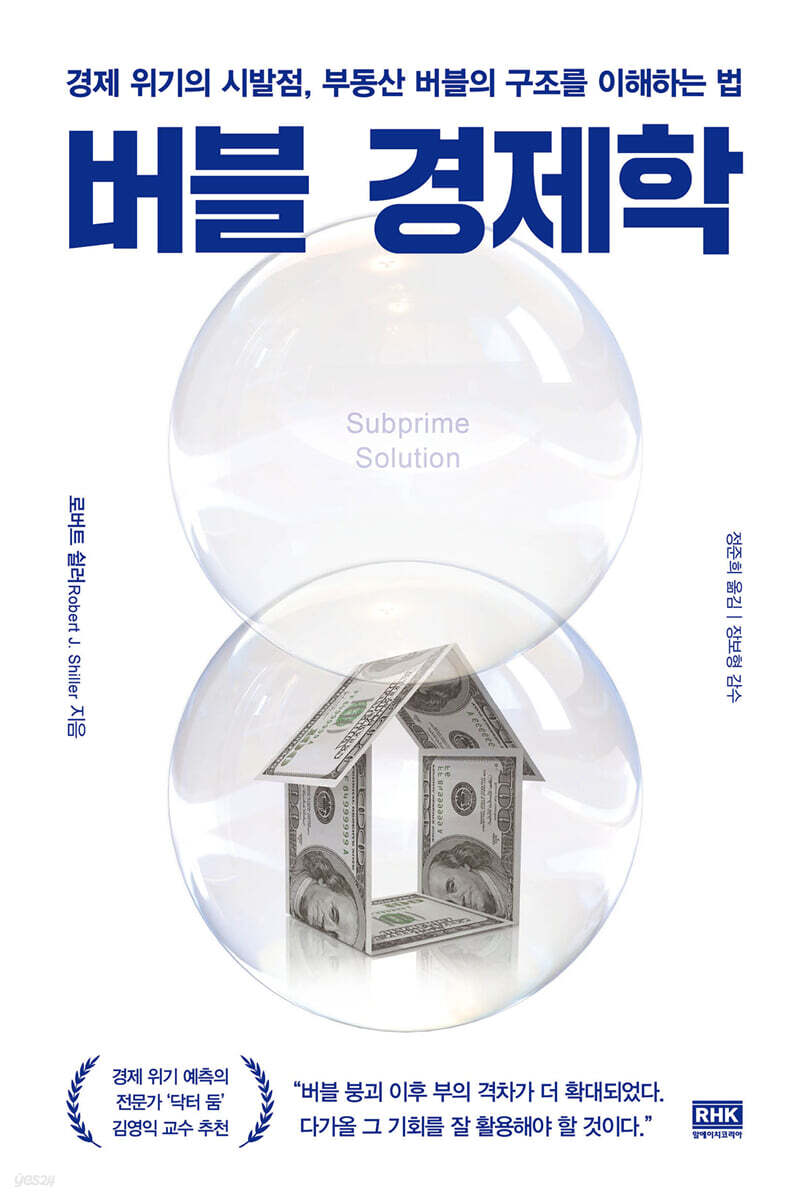
Nobel Prize winner Robert Shiller publishes a revised edition of "Bubble Economics."
The one book you need to understand recurring bubbles! Robert Shiller, renowned for his analysis of market bubbles and the resulting economic crises, won the Nobel Prize in Economics for his theories on market inefficiencies driven by asset prices.
This book, one of Professor Shiller's early works, analyzes the 'subprime mortgage crisis' caused by the bubble in the U.S. real estate market during the 2008 global financial crisis, and presents short-term and long-term measures to resolve and prepare for the bubble and economic crisis.
"Bubble Economics" begins with a detailed analysis of the 2007 US housing loan crisis, examining how the housing market has evolved over the past 100 years and how bubbles formed along the way.
Furthermore, he argues that the phenomenon of 'social contagion' of thoughts is at the root of the mechanism by which bubbles are formed, and points to the long-standing myth of real estate prices as the cause of the bubble.
Based on these analyses, Professor Shiller argues that short-term measures, often in the form of bailouts, are inevitable to overcome the crisis caused by the bubble.
However, at the same time, the author makes it clear that what is more important than short-term measures is to establish a financial system for all by reorganizing the financial infrastructure, and he proposes long-term measures to achieve this.
Nobel Prize winner Robert Shiller publishes a revised edition of "Bubble Economics."
The one book you need to understand recurring bubbles! Robert Shiller, renowned for his analysis of market bubbles and the resulting economic crises, won the Nobel Prize in Economics for his theories on market inefficiencies driven by asset prices.
This book, one of Professor Shiller's early works, analyzes the 'subprime mortgage crisis' caused by the bubble in the U.S. real estate market during the 2008 global financial crisis, and presents short-term and long-term measures to resolve and prepare for the bubble and economic crisis.
"Bubble Economics" begins with a detailed analysis of the 2007 US housing loan crisis, examining how the housing market has evolved over the past 100 years and how bubbles formed along the way.
Furthermore, he argues that the phenomenon of 'social contagion' of thoughts is at the root of the mechanism by which bubbles are formed, and points to the long-standing myth of real estate prices as the cause of the bubble.
Based on these analyses, Professor Shiller argues that short-term measures, often in the form of bailouts, are inevitable to overcome the crisis caused by the bubble.
However, at the same time, the author makes it clear that what is more important than short-term measures is to establish a financial system for all by reorganizing the financial infrastructure, and he proposes long-term measures to achieve this.
- You can preview some of the book's contents.
Preview
index
Recommended Article / Asset Price Bubbles Recur
Review / Beyond the Subprime Blues: Toward Financial Democracy
Prologue / Standing at the greatest historical turning point since the Great Depression.
Chapter 1: Understanding the Phenomenon: The World Economy Shipwrecked by the Bubble Storm
The Bubble Burst | Improvement, Not Abolition | Lessons from the Great Depression | The Need for Proactive Prescriptions | Establishing a Framework for Future-Oriented Institutional Reform | From the Subprime Blues to Financial Democracy
Chapter 2 Lessons from History: The History of Housing
Chapter 1 of the Play: Subprime | Changes in Housing Prices Over the Past 100 Years | The "Bubble" Phenomenon That Can't Be Explained Through Economic Indicators Alone
Chapter 3: Behavioral Economic Analysis: What Mechanisms Create Bubbles?
Bubble vs.
Pros | Thoughts are contagious | The myths and truths of bubbles | The illusion of a new era | The vicious cycle of bubbles and illusions | Becoming a prisoner of the bubble
Chapter 4: Understanding the Origins of Bubbles: Distorted and Exaggerated Real Estate Myths
Optical Illusions | Why Housing Prices Are Inevitably Falling | Construction Cost Myths and Truths | The Changing Housing Landscape | The Need for Long-Term and Short-Term Policies
Chapter 5: Short-Term Measures: Escape the Sinking Ship
The Shadow of Bailouts | Still Need Bailouts | Homeowners' Loan Corporation for Low-Income Homeowners | Proper Implementation of Short-Term Measures Is Necessary
Chapter 6: Long-Term Measures: A Commitment to Financial Democracy
Financial Engineering and Institutional Reform | Measure 1: Financial Counseling Services for All | Measure 2: Financial Watchdog for Consumers | Measure 3: Default Option Financial Contracts | Measure 4: Accessible Financial Information Disclosure | Measure 5: Integrated Financial Database | Measure 6: Inflation-Linked Reserve Currency | Summary: Information Infrastructure | New Risk Markets | Measure 7: Real Estate Futures Market | Measure 8: New Derivatives | Measure 9: Continuing Workout Mortgages for Low-Income Individuals | Measure 10: Home Equity Insurance and Subsistence Insurance | Risk Management vs.
Risk Aversion: What's the Right Answer? | The Synergy of Long-Term Measures
Epilogue / Financial Democracy: A System That Benefits Everyone
Review / Beyond the Subprime Blues: Toward Financial Democracy
Prologue / Standing at the greatest historical turning point since the Great Depression.
Chapter 1: Understanding the Phenomenon: The World Economy Shipwrecked by the Bubble Storm
The Bubble Burst | Improvement, Not Abolition | Lessons from the Great Depression | The Need for Proactive Prescriptions | Establishing a Framework for Future-Oriented Institutional Reform | From the Subprime Blues to Financial Democracy
Chapter 2 Lessons from History: The History of Housing
Chapter 1 of the Play: Subprime | Changes in Housing Prices Over the Past 100 Years | The "Bubble" Phenomenon That Can't Be Explained Through Economic Indicators Alone
Chapter 3: Behavioral Economic Analysis: What Mechanisms Create Bubbles?
Bubble vs.
Pros | Thoughts are contagious | The myths and truths of bubbles | The illusion of a new era | The vicious cycle of bubbles and illusions | Becoming a prisoner of the bubble
Chapter 4: Understanding the Origins of Bubbles: Distorted and Exaggerated Real Estate Myths
Optical Illusions | Why Housing Prices Are Inevitably Falling | Construction Cost Myths and Truths | The Changing Housing Landscape | The Need for Long-Term and Short-Term Policies
Chapter 5: Short-Term Measures: Escape the Sinking Ship
The Shadow of Bailouts | Still Need Bailouts | Homeowners' Loan Corporation for Low-Income Homeowners | Proper Implementation of Short-Term Measures Is Necessary
Chapter 6: Long-Term Measures: A Commitment to Financial Democracy
Financial Engineering and Institutional Reform | Measure 1: Financial Counseling Services for All | Measure 2: Financial Watchdog for Consumers | Measure 3: Default Option Financial Contracts | Measure 4: Accessible Financial Information Disclosure | Measure 5: Integrated Financial Database | Measure 6: Inflation-Linked Reserve Currency | Summary: Information Infrastructure | New Risk Markets | Measure 7: Real Estate Futures Market | Measure 8: New Derivatives | Measure 9: Continuing Workout Mortgages for Low-Income Individuals | Measure 10: Home Equity Insurance and Subsistence Insurance | Risk Management vs.
Risk Aversion: What's the Right Answer? | The Synergy of Long-Term Measures
Epilogue / Financial Democracy: A System That Benefits Everyone
Detailed image
.jpg)
Into the book
More importantly, this crisis will bring about fundamental social changes – shifts in consumption habits, values, and relationships.
Now we will live a little differently and treat each other a little differently than we did before.
---From the "Prologue"
But now we have to think differently.
It is time to recognize the stark reality of what is happening to us and take fundamental steps to restructure the institutional foundations of our housing and financial markets.
In other words, it is time to take more "long-term measures," such as finding ways to prevent bubbles from expanding, stabilize housing and financial markets, and stabilize the household and corporate economy, rather than just short-term measures to alleviate the crisis.
---From the "Prologue"
Every crisis contains the seeds of change.
Now is the time to rebuild the institutional foundations of financial activity to stabilize the economy, re-invigorate national wealth, and strengthen superior financial innovation models. This will allow us to build a better society—a society where financial democracy prevails—that we could not have built had this crisis not struck.
---From "Chapter 1: The World Economy Wrecked by the Bubble Storm"
Prominent critics, from former Federal Reserve Chairman Alan Greenspan to the late real estate guru Edward Gramlich, viewed the subprime mortgage movement as a positive development.
Although there was criticism of the haphazard lending practices, subprime mortgages effectively provided millions of low-income people with an opportunity to own a home.
But despite its lofty social aspirations, subprime mortgages had serious implementation problems.
In other words, subprime mortgages did not have risk management systems in place to support the increasingly complex financial institutions required to underwrite mortgages.
This is precisely the theme of this book.
---From "Chapter 1: The World Economy Wrecked by the Bubble Storm"
One surprising thing is that I have yet to hear anyone in any country in the world claim to have data on long-term housing price fluctuations.
Let's think about it for a moment.
If the housing boom is a major economic event, people should be interested in whether similar events have occurred before and what the consequences were.
But surprisingly, no one seemed to pay attention to him.
This not only demonstrates human behavioral characteristics, but also suggests that humans have a short attention span.
---From "Chapter 2: History of Housing"
All historical events are clearly the result of a complex interplay of various factors.
But as I argued in Irrational Exuberance, an essential element to understanding any speculative boom is the "social contagion" of thinking that occurs as we all watch the boom, the price surge that it causes.
Stories reinforcing the belief that the boom will continue because of social contagion, stories of a so-called "new era," are gaining increasing credence.
However, it is difficult to understand how an accident is transmitted because we cannot directly observe the process of accident transmission in society.
And the root cause of such phenomena is even more easily overlooked.
---From "Chapter 3: What is the mechanism by which bubbles are created?"
As the world develops, we will undoubtedly face an era of resource scarcity.
However, it is difficult to expect that housing will be at the top of the 'shortage list'.
The demand for housing is a need for a safe haven, a place to start a family and raise children, close to work and school, and a place to eat and sleep with privacy.
It is a demand for such services, not a demand for any one resource, like wood or concrete.
---From "Chapter 4: Distorted and Exaggerated Real Estate Myths"
There is something equally important as what short-term measures to implement.
It's about what kind of mindset you have.
We must implement short-term measures correctly from the beginning.
To do so, we must face the problem head-on, allocate sufficient resources to solving it, and set the right basic policy goals.
For the short-term measures presented here to be successful, leaders must first acknowledge that a serious problem exists.
Continuing to insist that things will turn around soon does nothing to solve the problem.
---From "Chapter 5: Escape from the Sinking Ship"
As a result, our society will be able to expect a more stable market and a more rational economy.
Ultimately, we will forget that large-scale financial instability, which will ultimately affect our daily lives, is a potential problem.
Just as the widespread adoption of modern medicine has led us to forget the once-prevalent epidemics of diphtheria and yellow fever, the democratization of modern finance will consign these problems to the dustbin of history.
Now we will live a little differently and treat each other a little differently than we did before.
---From the "Prologue"
But now we have to think differently.
It is time to recognize the stark reality of what is happening to us and take fundamental steps to restructure the institutional foundations of our housing and financial markets.
In other words, it is time to take more "long-term measures," such as finding ways to prevent bubbles from expanding, stabilize housing and financial markets, and stabilize the household and corporate economy, rather than just short-term measures to alleviate the crisis.
---From the "Prologue"
Every crisis contains the seeds of change.
Now is the time to rebuild the institutional foundations of financial activity to stabilize the economy, re-invigorate national wealth, and strengthen superior financial innovation models. This will allow us to build a better society—a society where financial democracy prevails—that we could not have built had this crisis not struck.
---From "Chapter 1: The World Economy Wrecked by the Bubble Storm"
Prominent critics, from former Federal Reserve Chairman Alan Greenspan to the late real estate guru Edward Gramlich, viewed the subprime mortgage movement as a positive development.
Although there was criticism of the haphazard lending practices, subprime mortgages effectively provided millions of low-income people with an opportunity to own a home.
But despite its lofty social aspirations, subprime mortgages had serious implementation problems.
In other words, subprime mortgages did not have risk management systems in place to support the increasingly complex financial institutions required to underwrite mortgages.
This is precisely the theme of this book.
---From "Chapter 1: The World Economy Wrecked by the Bubble Storm"
One surprising thing is that I have yet to hear anyone in any country in the world claim to have data on long-term housing price fluctuations.
Let's think about it for a moment.
If the housing boom is a major economic event, people should be interested in whether similar events have occurred before and what the consequences were.
But surprisingly, no one seemed to pay attention to him.
This not only demonstrates human behavioral characteristics, but also suggests that humans have a short attention span.
---From "Chapter 2: History of Housing"
All historical events are clearly the result of a complex interplay of various factors.
But as I argued in Irrational Exuberance, an essential element to understanding any speculative boom is the "social contagion" of thinking that occurs as we all watch the boom, the price surge that it causes.
Stories reinforcing the belief that the boom will continue because of social contagion, stories of a so-called "new era," are gaining increasing credence.
However, it is difficult to understand how an accident is transmitted because we cannot directly observe the process of accident transmission in society.
And the root cause of such phenomena is even more easily overlooked.
---From "Chapter 3: What is the mechanism by which bubbles are created?"
As the world develops, we will undoubtedly face an era of resource scarcity.
However, it is difficult to expect that housing will be at the top of the 'shortage list'.
The demand for housing is a need for a safe haven, a place to start a family and raise children, close to work and school, and a place to eat and sleep with privacy.
It is a demand for such services, not a demand for any one resource, like wood or concrete.
---From "Chapter 4: Distorted and Exaggerated Real Estate Myths"
There is something equally important as what short-term measures to implement.
It's about what kind of mindset you have.
We must implement short-term measures correctly from the beginning.
To do so, we must face the problem head-on, allocate sufficient resources to solving it, and set the right basic policy goals.
For the short-term measures presented here to be successful, leaders must first acknowledge that a serious problem exists.
Continuing to insist that things will turn around soon does nothing to solve the problem.
---From "Chapter 5: Escape from the Sinking Ship"
As a result, our society will be able to expect a more stable market and a more rational economy.
Ultimately, we will forget that large-scale financial instability, which will ultimately affect our daily lives, is a potential problem.
Just as the widespread adoption of modern medicine has led us to forget the once-prevalent epidemics of diphtheria and yellow fever, the democratization of modern finance will consign these problems to the dustbin of history.
---From "Chapter 6: Promises for Financial Democracy"
Publisher's Review
“Every crisis contains the seeds of change.”
A mirror called "The History of Bubbles" to confront the recurring economic crisis.
The 'global financial crisis' bears a chilling resemblance to the recurring economic situation.
Analysis: The real estate and financial markets have been stagnant due to inflation and the resulting interest rate hikes that followed the 2020 pandemic and continued into 2022, and many domestic and international institutions are pessimistic about the domestic economic outlook for 2023.
In particular, experts are wary of the risk that the deterioration of financial institution soundness caused by the insolvency of the growing real estate PF market will lead to a chain reaction of collapse of the economic system.
Amid concerns that the domestic economic downturn will be prolonged due to various factors, some experts are emerging who argue that the current situation, with its high interest rates, falling real estate values, and financial market instability, is very similar to the 2008 global financial crisis.
Not only in the domestic situation, but also in the US real estate market, which has been on a downward trend after a sharp rise, Professor Robert Shiller, the author of this book, said that we should be concerned about a real estate price crash, considering the similarity to the 2008 situation.
Professor Robert Shiller's "Bubble Economics" (original title: The Subprime Solution) is an analysis of the 2007 subprime mortgage crisis in the U.S. housing market, published just before the global financial crisis of 2008 began in earnest.
The author points out that the dishonesty of mortgage lenders, the greed of financial institutions, and the misjudgments of the Federal Reserve, which were pointed out as causes of the subprime crisis at the time, were not the fundamental causes of the crisis.
Professor Shiller argues that the subprime crisis was an event that arose from a bubble in the real estate market, and that the factors that have been pointed out as the cause of the bubble were actually the result of the bubble.
Based on these analyses of the current state of affairs, the subprime crisis, this book identifies the fundamental causes of the bubble and suggests solutions.
The author says, “Our economy is currently sinking.
While saying, “We must overcome this crisis as quickly as possible,” he also argues that we must seize the opportunity for change hidden within the economic crisis and ultimately move toward financial democracy.
The ideas contained in the short-term and long-term measures proposed by Professor Schiller will provide valuable insights for navigating the recurring economic crisis.
“We must make good use of the upcoming opportunity.”
Expert in predicting economic crises
Professor Kim Young-ik's recommendation for 'Doctor Doom' included
The revised edition of 『Bubble Economics』, published in line with the advent of an economic crisis similar to those of the past, includes a recommendation by Professor Kim Young-ik of Sogang University's Graduate School of Economics.
Professor Kim Young-ik, known as Korea's "Dr. Doom" for his theories on predicting economic crises, analyzes in his book's foreword how bubbles emerged and collapsed in the bond, stock, and real estate markets of Korea and the United States.
The bubble that had widened the wealth gap in the past is beginning to burst again in the market.
Professor Kim Young-ik says that we should use this crisis as an opportunity to move toward the "financial democracy" that Professor Robert Shiller talks about.
How to not miss out on wealth opportunities
Beyond the economic crisis, towards an era of finance for all.
“In situations where optimism prevails, people tend to look for ways to fully capitalize on the booming economy, rather than trying to protect themselves from a potential downturn.” The mythical belief that real estate prices would not fall led people to turn a blind eye to the dangers of a real estate bubble and bet everything on a “dazzling” future.
The collapse of the real estate bubble, which was the starting point of the global financial crisis, and the optimistic beliefs that underpinned it, were a tragedy stemming from an unfinished financial infrastructure.
Now, ten years later, our society is once again on the brink of economic crisis, with rising interest rates, falling real estate values, and the resulting instability in financial markets.
Despite the foundation laid by past adversities, our finances are still not fully prepared.
The solutions the author presents in Chapters 5 and 6 are clearly countermeasures to economic crises that occurred in the past.
Compared to the situation at the time, some argue that the scale of mortgage-related derivatives in the United States has decreased, and the financial foundations of domestic banks have stabilized, so a situation on the level of the past global financial crisis will not occur.
However, the 'financial democracy' that Professor Schiller's long-term measures aim for is still a long way off.
As the author suggests, rather than punishing the technology called "finance" that created the wealthy, we should create a means for finance to make everyone wealthy.
A mirror called "The History of Bubbles" to confront the recurring economic crisis.
The 'global financial crisis' bears a chilling resemblance to the recurring economic situation.
Analysis: The real estate and financial markets have been stagnant due to inflation and the resulting interest rate hikes that followed the 2020 pandemic and continued into 2022, and many domestic and international institutions are pessimistic about the domestic economic outlook for 2023.
In particular, experts are wary of the risk that the deterioration of financial institution soundness caused by the insolvency of the growing real estate PF market will lead to a chain reaction of collapse of the economic system.
Amid concerns that the domestic economic downturn will be prolonged due to various factors, some experts are emerging who argue that the current situation, with its high interest rates, falling real estate values, and financial market instability, is very similar to the 2008 global financial crisis.
Not only in the domestic situation, but also in the US real estate market, which has been on a downward trend after a sharp rise, Professor Robert Shiller, the author of this book, said that we should be concerned about a real estate price crash, considering the similarity to the 2008 situation.
Professor Robert Shiller's "Bubble Economics" (original title: The Subprime Solution) is an analysis of the 2007 subprime mortgage crisis in the U.S. housing market, published just before the global financial crisis of 2008 began in earnest.
The author points out that the dishonesty of mortgage lenders, the greed of financial institutions, and the misjudgments of the Federal Reserve, which were pointed out as causes of the subprime crisis at the time, were not the fundamental causes of the crisis.
Professor Shiller argues that the subprime crisis was an event that arose from a bubble in the real estate market, and that the factors that have been pointed out as the cause of the bubble were actually the result of the bubble.
Based on these analyses of the current state of affairs, the subprime crisis, this book identifies the fundamental causes of the bubble and suggests solutions.
The author says, “Our economy is currently sinking.
While saying, “We must overcome this crisis as quickly as possible,” he also argues that we must seize the opportunity for change hidden within the economic crisis and ultimately move toward financial democracy.
The ideas contained in the short-term and long-term measures proposed by Professor Schiller will provide valuable insights for navigating the recurring economic crisis.
“We must make good use of the upcoming opportunity.”
Expert in predicting economic crises
Professor Kim Young-ik's recommendation for 'Doctor Doom' included
The revised edition of 『Bubble Economics』, published in line with the advent of an economic crisis similar to those of the past, includes a recommendation by Professor Kim Young-ik of Sogang University's Graduate School of Economics.
Professor Kim Young-ik, known as Korea's "Dr. Doom" for his theories on predicting economic crises, analyzes in his book's foreword how bubbles emerged and collapsed in the bond, stock, and real estate markets of Korea and the United States.
The bubble that had widened the wealth gap in the past is beginning to burst again in the market.
Professor Kim Young-ik says that we should use this crisis as an opportunity to move toward the "financial democracy" that Professor Robert Shiller talks about.
How to not miss out on wealth opportunities
Beyond the economic crisis, towards an era of finance for all.
“In situations where optimism prevails, people tend to look for ways to fully capitalize on the booming economy, rather than trying to protect themselves from a potential downturn.” The mythical belief that real estate prices would not fall led people to turn a blind eye to the dangers of a real estate bubble and bet everything on a “dazzling” future.
The collapse of the real estate bubble, which was the starting point of the global financial crisis, and the optimistic beliefs that underpinned it, were a tragedy stemming from an unfinished financial infrastructure.
Now, ten years later, our society is once again on the brink of economic crisis, with rising interest rates, falling real estate values, and the resulting instability in financial markets.
Despite the foundation laid by past adversities, our finances are still not fully prepared.
The solutions the author presents in Chapters 5 and 6 are clearly countermeasures to economic crises that occurred in the past.
Compared to the situation at the time, some argue that the scale of mortgage-related derivatives in the United States has decreased, and the financial foundations of domestic banks have stabilized, so a situation on the level of the past global financial crisis will not occur.
However, the 'financial democracy' that Professor Schiller's long-term measures aim for is still a long way off.
As the author suggests, rather than punishing the technology called "finance" that created the wealthy, we should create a means for finance to make everyone wealthy.
GOODS SPECIFICS
- Date of issue: February 3, 2023
- Page count, weight, size: 268 pages | 426g | 145*215*16mm
- ISBN13: 9788925577029
- ISBN10: 892557702X
You may also like
카테고리
korean


korean

![GQ KOREA Mark (Monthly): December [2025]](http://librairie.coreenne.fr/cdn/shop/files/8ef265dbbfbf186523ed75ba7319009d.jpg?v=1765340328&width=3840)


