

Everyone lies
 |
Description
Book Introduction
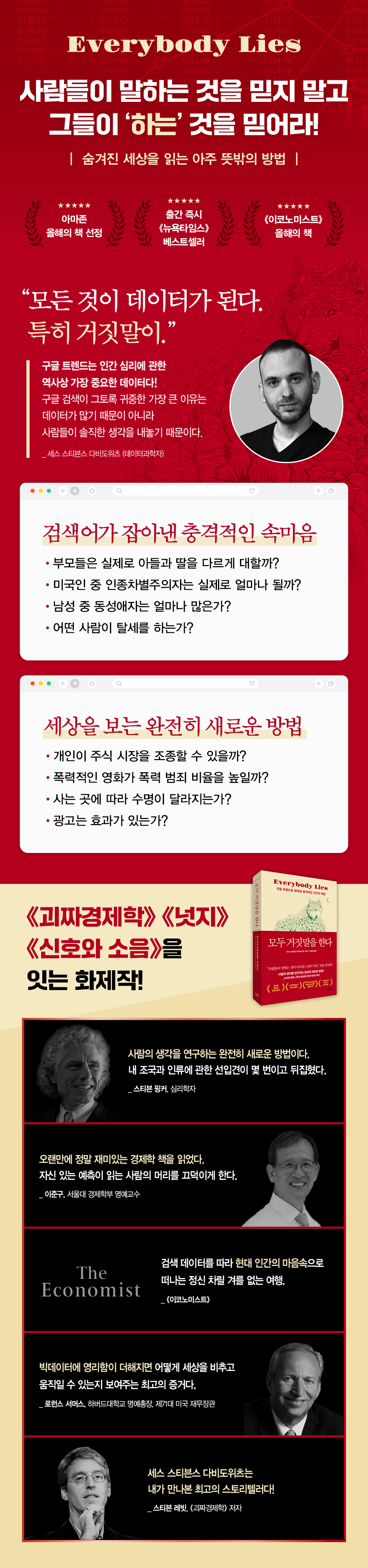
Believe what people 'do', not what they say!
The True Human Mind as Captured by Google Trends
“A completely new way to study human thought!”
_Steven Pinker, author of The Better Angels of Our Nature
“Everything becomes data.
Especially lies.”
A very unexpected way to read the hidden world
While working on his PhD in economics at Harvard University, Seth Stephens-Davidowitz studied Google Trends, which shows trends in specific search terms.
It was a time when Barack Obama was elected as the President of the United States and many experts were saying, “Racism is gone now.”
But the reality captured by the data was completely different.
On the day Obama was elected president, searches for "nigger president" outnumbered those for "first black president" in some states, and white supremacist sites saw a tenfold increase in searches and signups.
His "covert racism" map, created using Google data, provided a critical reassessment of Obama's primary results in late 2008 and was instrumental in explaining Trump's political success in the 2016 US presidential election.
Why did so many Trump supporters remain hidden until after the election? Why is it so difficult to know who voters will "actually" vote for? The reason is simple: people lie.
The True Human Mind as Captured by Google Trends
“A completely new way to study human thought!”
_Steven Pinker, author of The Better Angels of Our Nature
“Everything becomes data.
Especially lies.”
A very unexpected way to read the hidden world
While working on his PhD in economics at Harvard University, Seth Stephens-Davidowitz studied Google Trends, which shows trends in specific search terms.
It was a time when Barack Obama was elected as the President of the United States and many experts were saying, “Racism is gone now.”
But the reality captured by the data was completely different.
On the day Obama was elected president, searches for "nigger president" outnumbered those for "first black president" in some states, and white supremacist sites saw a tenfold increase in searches and signups.
His "covert racism" map, created using Google data, provided a critical reassessment of Obama's primary results in late 2008 and was instrumental in explaining Trump's political success in the 2016 US presidential election.
Why did so many Trump supporters remain hidden until after the election? Why is it so difficult to know who voters will "actually" vote for? The reason is simple: people lie.
- You can preview some of the book's contents.
Preview
index
A completely new study of human thought
Method_Steven Pinker
Introduction: An Overview of the Big Data Revolution
Part 1: Big Data and Small Data
Chapter 1.
Intuition is imperfect
Part 2: The Power of Big Data
Chapter 2.
Was Freud right?
Chapter 3.
A new perspective on data
Body data / Word data / Photo data?
Chapter 4.
Digital confession pill
The truth about sex / The truth about hate and prejudice / The truth about the Internet / The truth about child abuse and abortion / The truth about Facebook friends / The truth about customers / How should we handle the truth?
Chapter 5.
Close-up
What's really happening in our neighborhoods, cities, and towns? / How do we spend our time? / Finding our doppelgangers? / Data tells a story.
Chapter 6.
The whole world is a laboratory
The Basics of A/B Testing / A Cruel but Enlightening Natural Experiment
Part 3 Big Data: Handle with Caution
Chapter 7.
Things that even big data can't do
The Curse of Dimensionality / Excessive Focus on the Measurable
Chapter 8.
What Not to Do with Big Data
Risks from empowered corporations / Risks from empowered governments?
Conclusion: How many people will read the book to the end?
Method_Steven Pinker
Introduction: An Overview of the Big Data Revolution
Part 1: Big Data and Small Data
Chapter 1.
Intuition is imperfect
Part 2: The Power of Big Data
Chapter 2.
Was Freud right?
Chapter 3.
A new perspective on data
Body data / Word data / Photo data?
Chapter 4.
Digital confession pill
The truth about sex / The truth about hate and prejudice / The truth about the Internet / The truth about child abuse and abortion / The truth about Facebook friends / The truth about customers / How should we handle the truth?
Chapter 5.
Close-up
What's really happening in our neighborhoods, cities, and towns? / How do we spend our time? / Finding our doppelgangers? / Data tells a story.
Chapter 6.
The whole world is a laboratory
The Basics of A/B Testing / A Cruel but Enlightening Natural Experiment
Part 3 Big Data: Handle with Caution
Chapter 7.
Things that even big data can't do
The Curse of Dimensionality / Excessive Focus on the Measurable
Chapter 8.
What Not to Do with Big Data
Risks from empowered corporations / Risks from empowered governments?
Conclusion: How many people will read the book to the end?
Detailed image
Into the book
People's search for information itself is information.
When and where they search for facts, quotes, jokes, places, people, things, and help tells us much more about what they really think, what they desire, what they fear, and what they do than any vague guesses.
Not to mention that sometimes people make confessions rather than questions in Google search boxes.
Things like, 'I hate my boss so much', 'I'm totally drunk', 'My dad hit me'.
The everyday act of typing words or phrases into small, square blank spaces leaves behind tiny traces of truth, and when millions of these traces accumulate, a profound reality is revealed.
---From "Introduction: An Overview of the Big Data Revolution"
The biggest reason Google Search is so valuable isn't because there's so much data, but because people are honest about their thoughts.
People lie to friends, lovers, doctors, surveyors, and even to themselves.
But Google shares information about sexless marriages, mental health issues, anxiety, and anti-black hostility that is hard to find elsewhere.
---From "Introduction: An Overview of the Big Data Revolution"
If we rely solely on what we hear or our personal experiences, it's easy to get the wrong idea about how the world works.
Good data science methodologies are intuitive, but the results are often counterintuitive.
Data science is a process of discovering and understanding patterns based on natural and intuitive human behavior.
Then it reinforces this by showing us that the world works in a completely different way than we thought.
---「Chapter 1.
From "Intuition is imperfect"
Big data allows us to see not just what people say they want or are doing, but what people really want and are really doing.
Providing honest data is the second power of big data.
Because there is so much data now, meaningful information exists about even small groups.
For example, we can compare the number of people who dream of cucumbers with the number of people who dream of tomatoes.
The third power of big data is that it allows us to see even small groups in close-up.
Big data has another powerful force (one that wasn't used in my brief study of Freud, but could be used in future studies).
The point is that control experiments can be conducted quickly.
This allows us to confirm not only correlation but also causality.
This type of validation is widely used by businesses today, but it will soon become a powerful tool for social scientists as well.
The feasibility of causal experiments is the fourth power of big data.
---「Chapter 2.
From "Was Freud Right?"
There was a reason why Seider and his team were so fixated on number 85, and it was a very clear reason.
The left ventricle of number 85 was in the 99.61 percentile.
That wasn't all.
All other major organs, including the heart and spleen, were unusually large.
According to Seider's findings, a larger left ventricle is generally better when racing.
However, if the other organs are all small but the left ventricle is this large, it may be a sign of disease.
The American Pharoah had larger than average size in all major organs and a giant left ventricle.
The data was screaming that number 85 was a one in a hundred thousand, or even one in a million horse.
---「Chapter 3.
From “A New Perspective on Data”
Who on earth creates prejudice against girls? It's their parents.
Parents are often excited by the idea that their child has exceptional talent.
It's not surprising.
In fact, the most common phrase that follows every Google search that begins with "My two-year-old is…" is "talented."
However, these questions are not asked equally to boys and girls.
Parents ask, "Is my son talented?" 2.5 times more often than "Is my daughter talented?"
Similar biases arise when using phrases related to intelligence.
For example, it is embarrassing to ask a question like, "Is my son a genius?"
---「Chapter 4.
From "Digital Confession"
In 2003, statistician Nate Silver developed a new model to predict player performance. Called PECOTA, the model proved remarkably accurate.
Silver found the player's doppelganger.
He built a database of every major leaguer, over 18,000 of them.
It included everything known about a player's performance each year, including height, age, position, home runs, batting average, walks, on-base percentage, and strikeouts.
Now, let's find the twenty baseball players whose performance most closely resembles Ortiz's when he was 24, 25, 26, 27, 28, 29, 30, 31, 32, and 33 years old.
Finding a doppelganger who played similarly to him at that age.
And then we check out what these doppelgangers' baseball careers were like.
Finding your doppelganger is another example of data close-up.
(Omitted) Silver predicted Ortiz's performance based on how these doppelgangers ultimately performed.
Silver discovered that they had regained their powers.
While Simmons may be right about age being a turn-off when it comes to other things, Ortiz's doppelgangers have regained their skills with age.
---「Chapter 5.
From "Close-Up"
A/B testing teaches us to be wary of common lessons.
Clark Benson, CEO of news and entertainment site ranker.com, relies heavily on A/B testing to select headlines and site design.
Benson says.
“You can’t assume anything.
“You have to test literally everything.”
---「Chapter 6.
From "The Whole World is a Laboratory"
How can we overcome the curse of dimensionality? We must be humble about our research and not fall in love with our findings.
Further experiments are needed to confirm the results.
Before you bet your life's savings on the 391st coin, you should see how it plays out over the next few years.
Social scientists call this an "out-of-sample" experiment.
The more variables you try, the more humble you have to be.
The more variables you try, the more difficult it becomes to conduct out-of-sample experiments.
It is also important to record every experiment you try.
Only then can we know exactly how likely it is that we will fall victim to this curse and how much skepticism we should have about the outcome.
---「Chapter 7.
From "Things that can't be done even with big data"
Now change will happen.
Every idea I've discussed in this book is backed up by hundreds of other important ideas that are ready to be challenged.
The research discussed here is just the tip of the iceberg, the tiniest of the tiny specks on the surface.
What will happen now?
When and where they search for facts, quotes, jokes, places, people, things, and help tells us much more about what they really think, what they desire, what they fear, and what they do than any vague guesses.
Not to mention that sometimes people make confessions rather than questions in Google search boxes.
Things like, 'I hate my boss so much', 'I'm totally drunk', 'My dad hit me'.
The everyday act of typing words or phrases into small, square blank spaces leaves behind tiny traces of truth, and when millions of these traces accumulate, a profound reality is revealed.
---From "Introduction: An Overview of the Big Data Revolution"
The biggest reason Google Search is so valuable isn't because there's so much data, but because people are honest about their thoughts.
People lie to friends, lovers, doctors, surveyors, and even to themselves.
But Google shares information about sexless marriages, mental health issues, anxiety, and anti-black hostility that is hard to find elsewhere.
---From "Introduction: An Overview of the Big Data Revolution"
If we rely solely on what we hear or our personal experiences, it's easy to get the wrong idea about how the world works.
Good data science methodologies are intuitive, but the results are often counterintuitive.
Data science is a process of discovering and understanding patterns based on natural and intuitive human behavior.
Then it reinforces this by showing us that the world works in a completely different way than we thought.
---「Chapter 1.
From "Intuition is imperfect"
Big data allows us to see not just what people say they want or are doing, but what people really want and are really doing.
Providing honest data is the second power of big data.
Because there is so much data now, meaningful information exists about even small groups.
For example, we can compare the number of people who dream of cucumbers with the number of people who dream of tomatoes.
The third power of big data is that it allows us to see even small groups in close-up.
Big data has another powerful force (one that wasn't used in my brief study of Freud, but could be used in future studies).
The point is that control experiments can be conducted quickly.
This allows us to confirm not only correlation but also causality.
This type of validation is widely used by businesses today, but it will soon become a powerful tool for social scientists as well.
The feasibility of causal experiments is the fourth power of big data.
---「Chapter 2.
From "Was Freud Right?"
There was a reason why Seider and his team were so fixated on number 85, and it was a very clear reason.
The left ventricle of number 85 was in the 99.61 percentile.
That wasn't all.
All other major organs, including the heart and spleen, were unusually large.
According to Seider's findings, a larger left ventricle is generally better when racing.
However, if the other organs are all small but the left ventricle is this large, it may be a sign of disease.
The American Pharoah had larger than average size in all major organs and a giant left ventricle.
The data was screaming that number 85 was a one in a hundred thousand, or even one in a million horse.
---「Chapter 3.
From “A New Perspective on Data”
Who on earth creates prejudice against girls? It's their parents.
Parents are often excited by the idea that their child has exceptional talent.
It's not surprising.
In fact, the most common phrase that follows every Google search that begins with "My two-year-old is…" is "talented."
However, these questions are not asked equally to boys and girls.
Parents ask, "Is my son talented?" 2.5 times more often than "Is my daughter talented?"
Similar biases arise when using phrases related to intelligence.
For example, it is embarrassing to ask a question like, "Is my son a genius?"
---「Chapter 4.
From "Digital Confession"
In 2003, statistician Nate Silver developed a new model to predict player performance. Called PECOTA, the model proved remarkably accurate.
Silver found the player's doppelganger.
He built a database of every major leaguer, over 18,000 of them.
It included everything known about a player's performance each year, including height, age, position, home runs, batting average, walks, on-base percentage, and strikeouts.
Now, let's find the twenty baseball players whose performance most closely resembles Ortiz's when he was 24, 25, 26, 27, 28, 29, 30, 31, 32, and 33 years old.
Finding a doppelganger who played similarly to him at that age.
And then we check out what these doppelgangers' baseball careers were like.
Finding your doppelganger is another example of data close-up.
(Omitted) Silver predicted Ortiz's performance based on how these doppelgangers ultimately performed.
Silver discovered that they had regained their powers.
While Simmons may be right about age being a turn-off when it comes to other things, Ortiz's doppelgangers have regained their skills with age.
---「Chapter 5.
From "Close-Up"
A/B testing teaches us to be wary of common lessons.
Clark Benson, CEO of news and entertainment site ranker.com, relies heavily on A/B testing to select headlines and site design.
Benson says.
“You can’t assume anything.
“You have to test literally everything.”
---「Chapter 6.
From "The Whole World is a Laboratory"
How can we overcome the curse of dimensionality? We must be humble about our research and not fall in love with our findings.
Further experiments are needed to confirm the results.
Before you bet your life's savings on the 391st coin, you should see how it plays out over the next few years.
Social scientists call this an "out-of-sample" experiment.
The more variables you try, the more humble you have to be.
The more variables you try, the more difficult it becomes to conduct out-of-sample experiments.
It is also important to record every experiment you try.
Only then can we know exactly how likely it is that we will fall victim to this curse and how much skepticism we should have about the outcome.
---「Chapter 7.
From "Things that can't be done even with big data"
Now change will happen.
Every idea I've discussed in this book is backed up by hundreds of other important ideas that are ready to be challenged.
The research discussed here is just the tip of the iceberg, the tiniest of the tiny specks on the surface.
What will happen now?
---From "Conclusion: How many people will read the book to the end?"
Publisher's Review
A completely new way to study human thought!
A super bestseller that heralded the dawn of the big data era.
People lie often.
We lie to doctors, friends, lovers, surveyors, and even ourselves.
More than 40 percent of corporate engineers say they are in the top 5 percent of their peers, and more than 90 percent of university professors say they are above average performers.
A quarter of high school graduates consider themselves in the top 1 percent for social skills.
So people lie not only to their friends, lovers, doctors, and surveys, but also to themselves.
In "Everybody Lies," former Google data scientist Seth Stephens-Davidowitz uses search data to explore people's hidden, true desires and thoughts.
The book became a New York Times bestseller immediately after its publication in 2018 and was named a Book of the Year by Amazon.com, The Economist, and PBS NewsHour that year.
This book boldly exposes the shocking nature of human nature across a wide range of topics, including racism, mental illness, sexuality, child abuse, abortion, advertising, religion, and health.
And it shows us that most of what we know about humans and society so far is distorted by lies that even deceive ourselves.
·How much sex do people have?
·How many Americans are actually racist?
·Can an individual manipulate the stock market?
·Do violent movies increase violent crime rates?
·Do parents actually treat their sons and daughters differently?
·How many men are homosexual?
·Who evades taxes?
·Does life expectancy vary depending on where you live?
·Are advertisements effective?
What makes Google search so valuable isn't the sheer volume of data.
Because people are expressing their honest thoughts.
People say things to giant search engines like Google, Naver, and Daum that they wouldn't say to anyone else.
The more things are hidden from the public eye, the more they are revealed, and a representative topic is sex life.
Do you know what the biggest complaint about married life, according to Google, is? It's not having sex.
'Sexless marriage' is searched 3.5 times more often than 'unhappy marriage' and 8 times more often than 'loveless marriage'.
And complaints about spouses who don't want to have sex are 16 times more common than complaints about spouses who don't communicate.
The same goes for unmarried couples.
Couples are 5.5 times more likely to complain about a partner not wanting sex than about a partner not responding to text messages.
And surprisingly, the complaints are twice as many from girlfriends than from boyfriends.
Google also catches people confused about their sexual identity by searching for "gay porn" and "gay test" interchangeably.
These are all aspects that were hidden in traditional surveys.
Everything becomes data.
Especially lies.
Words are data.
Clicks are data.
Links are data.
Typos are data.
The banana in the dream is data.
Tone is data.
Breathing is data.
This is heart rate data.
The size of the spleen is the data.
Photos are also data.
And search terms are data that reveal more than anything else.
Will you continue to be deceived or will you see the truth?
Your most private desires revealed in the search bar
Much of social science research is built on inaccurate reporting by people.
In fact, many people think that physics, biology, and chemistry are true sciences, while psychology, economics, and sociology are not.
One field where data science can be applied infinitely in the future is social science.
Data science makes social science theories testable.
For example, Chapter 2, “Was Freud Right?” examines whether “Freud’s slip of the tongue,” which suggests that unconscious desires (especially sexual desires) are revealed through slips of the tongue, are true.
Freud's theory has been criticized as being like an earring when hung on the ear and a nose ring when hung on the nose.
To test the "Freudian slip of the tongue," which suggests that sexual desires leak out through slips of the tongue, Microsoft researchers compiled a dataset of 40,000 typos and checked whether there was a disproportionately high number of typos that could be interpreted as sexual.
The dataset contained some mistakes, like spelling 'rock' as 'cock' and 'security' as 'sexurity', but also some meaningless mistakes, like spelling 'window' as 'pindow'.
The research team created a robot that changed letters at the same frequency as people and made numerous typos, and confirmed that the mistakes that were interpreted as sexual did not exceed the level that could be attributed to chance.
Questions in social science are difficult to study.
Does the release of violent films increase crime? Are advertisements effective? Is the media biased toward liberals or conservatives? With the ability to gather big data on virtually any topic, a little data science can provide answers.
We no longer have to rely on what people 'say'.
New data—the trail of information billions of people leave on Google, social media, dating apps, and even porn sites—finally reveals the truth.
By analyzing this digital mine, we can understand what people really think, what they really want, and what they really 'do.'
A super bestseller that heralded the dawn of the big data era.
People lie often.
We lie to doctors, friends, lovers, surveyors, and even ourselves.
More than 40 percent of corporate engineers say they are in the top 5 percent of their peers, and more than 90 percent of university professors say they are above average performers.
A quarter of high school graduates consider themselves in the top 1 percent for social skills.
So people lie not only to their friends, lovers, doctors, and surveys, but also to themselves.
In "Everybody Lies," former Google data scientist Seth Stephens-Davidowitz uses search data to explore people's hidden, true desires and thoughts.
The book became a New York Times bestseller immediately after its publication in 2018 and was named a Book of the Year by Amazon.com, The Economist, and PBS NewsHour that year.
This book boldly exposes the shocking nature of human nature across a wide range of topics, including racism, mental illness, sexuality, child abuse, abortion, advertising, religion, and health.
And it shows us that most of what we know about humans and society so far is distorted by lies that even deceive ourselves.
·How much sex do people have?
·How many Americans are actually racist?
·Can an individual manipulate the stock market?
·Do violent movies increase violent crime rates?
·Do parents actually treat their sons and daughters differently?
·How many men are homosexual?
·Who evades taxes?
·Does life expectancy vary depending on where you live?
·Are advertisements effective?
What makes Google search so valuable isn't the sheer volume of data.
Because people are expressing their honest thoughts.
People say things to giant search engines like Google, Naver, and Daum that they wouldn't say to anyone else.
The more things are hidden from the public eye, the more they are revealed, and a representative topic is sex life.
Do you know what the biggest complaint about married life, according to Google, is? It's not having sex.
'Sexless marriage' is searched 3.5 times more often than 'unhappy marriage' and 8 times more often than 'loveless marriage'.
And complaints about spouses who don't want to have sex are 16 times more common than complaints about spouses who don't communicate.
The same goes for unmarried couples.
Couples are 5.5 times more likely to complain about a partner not wanting sex than about a partner not responding to text messages.
And surprisingly, the complaints are twice as many from girlfriends than from boyfriends.
Google also catches people confused about their sexual identity by searching for "gay porn" and "gay test" interchangeably.
These are all aspects that were hidden in traditional surveys.
Everything becomes data.
Especially lies.
Words are data.
Clicks are data.
Links are data.
Typos are data.
The banana in the dream is data.
Tone is data.
Breathing is data.
This is heart rate data.
The size of the spleen is the data.
Photos are also data.
And search terms are data that reveal more than anything else.
Will you continue to be deceived or will you see the truth?
Your most private desires revealed in the search bar
Much of social science research is built on inaccurate reporting by people.
In fact, many people think that physics, biology, and chemistry are true sciences, while psychology, economics, and sociology are not.
One field where data science can be applied infinitely in the future is social science.
Data science makes social science theories testable.
For example, Chapter 2, “Was Freud Right?” examines whether “Freud’s slip of the tongue,” which suggests that unconscious desires (especially sexual desires) are revealed through slips of the tongue, are true.
Freud's theory has been criticized as being like an earring when hung on the ear and a nose ring when hung on the nose.
To test the "Freudian slip of the tongue," which suggests that sexual desires leak out through slips of the tongue, Microsoft researchers compiled a dataset of 40,000 typos and checked whether there was a disproportionately high number of typos that could be interpreted as sexual.
The dataset contained some mistakes, like spelling 'rock' as 'cock' and 'security' as 'sexurity', but also some meaningless mistakes, like spelling 'window' as 'pindow'.
The research team created a robot that changed letters at the same frequency as people and made numerous typos, and confirmed that the mistakes that were interpreted as sexual did not exceed the level that could be attributed to chance.
Questions in social science are difficult to study.
Does the release of violent films increase crime? Are advertisements effective? Is the media biased toward liberals or conservatives? With the ability to gather big data on virtually any topic, a little data science can provide answers.
We no longer have to rely on what people 'say'.
New data—the trail of information billions of people leave on Google, social media, dating apps, and even porn sites—finally reveals the truth.
By analyzing this digital mine, we can understand what people really think, what they really want, and what they really 'do.'
GOODS SPECIFICS
- Publication date: November 15, 2022
- Page count, weight, size: 388 pages | 566g | 148*215*24mm
- ISBN13: 9791140701919
- ISBN10: 1140701916
You may also like
카테고리
korean


korean

![GQ KOREA Mark (Monthly): December [2025]](http://librairie.coreenne.fr/cdn/shop/files/8ef265dbbfbf186523ed75ba7319009d.jpg?v=1765340328&width=3840)


