

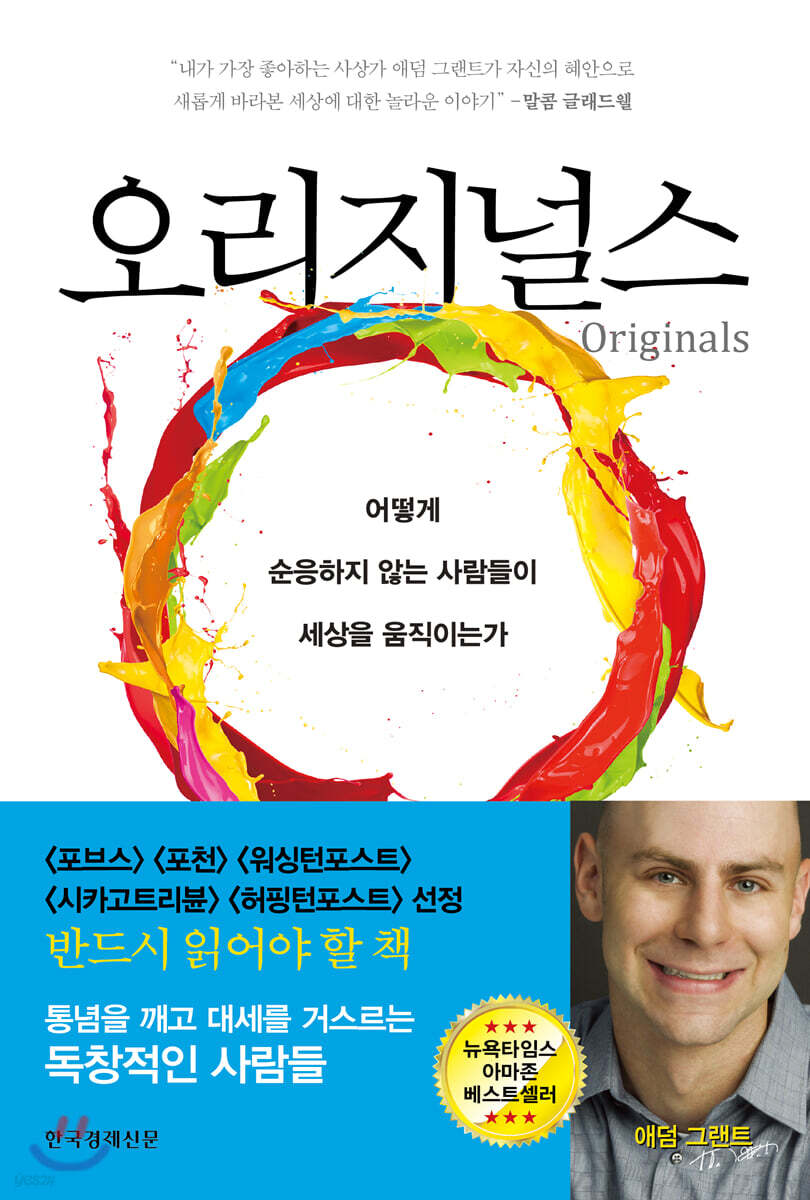
Originals
 |
Description
Book Introduction
Creative people who break convention and go against the grain
“The myth of the original innovator we’ve known so far is all wrong!”
They, too, were anxious that they would fail like us, and they pushed us from the side and forced us to take responsibility.
They are masters of procrastination, barely finishing things when the deadline is approaching.
Steve Jobs, Martin Luther King, Abraham Lincoln…
How do the original leaders who changed the world think and act? What makes them different from us? In his new book, Originals, Adam Grant, Wharton's youngest tenured professor and a leading authority on human resources management, presents a completely new perspective on originality.
Having presented new standards for success for organizations and society in his previous work, "Give and Take," he reveals that anyone can unleash their inner creativity to change their lives and the world.
Everyone has a desire to escape from the current situation and has their own ideas.
If we want to break free from stagnation and evolve, we must be people who challenge the rules, introduce new ideas, and embrace them.
The author refers to creative people who do not conform to the so-called trend, go against the times, and reject outdated traditions as 'originals.'
If you want to change the situation, you have to open your mouth and have the courage to come up with original ideas.
For an organization to grow, its members must be original, free to voice their opinions and challenge the status quo, and its leaders must have the insight to inspire more creativity in their members.
So why do we hesitate?
How can we advocate and implement new ideas and policies without sacrificing our careers, damaging relationships, or tarnishing our reputations? The author explores ways to foster and sustain originality, offering practical solutions for how to gain support from others, how leaders can overcome groupthink, and how parents and teachers can foster independent thinking in children.
Drawing on diverse research findings and case studies from the business, political, and cultural worlds, the author dismantles the stereotype that successful people who buck the trend are natural leaders willing to take risks.
Creative people, just like us, experience fear and doubt about their own ideas.
But what sets them apart is that they don't freeze or become weak when faced with challenges.
They somehow put their thoughts into action.
This book will give readers the knowledge and courage they need to pursue their creative ideas.
“The myth of the original innovator we’ve known so far is all wrong!”
They, too, were anxious that they would fail like us, and they pushed us from the side and forced us to take responsibility.
They are masters of procrastination, barely finishing things when the deadline is approaching.
Steve Jobs, Martin Luther King, Abraham Lincoln…
How do the original leaders who changed the world think and act? What makes them different from us? In his new book, Originals, Adam Grant, Wharton's youngest tenured professor and a leading authority on human resources management, presents a completely new perspective on originality.
Having presented new standards for success for organizations and society in his previous work, "Give and Take," he reveals that anyone can unleash their inner creativity to change their lives and the world.
Everyone has a desire to escape from the current situation and has their own ideas.
If we want to break free from stagnation and evolve, we must be people who challenge the rules, introduce new ideas, and embrace them.
The author refers to creative people who do not conform to the so-called trend, go against the times, and reject outdated traditions as 'originals.'
If you want to change the situation, you have to open your mouth and have the courage to come up with original ideas.
For an organization to grow, its members must be original, free to voice their opinions and challenge the status quo, and its leaders must have the insight to inspire more creativity in their members.
So why do we hesitate?
How can we advocate and implement new ideas and policies without sacrificing our careers, damaging relationships, or tarnishing our reputations? The author explores ways to foster and sustain originality, offering practical solutions for how to gain support from others, how leaders can overcome groupthink, and how parents and teachers can foster independent thinking in children.
Drawing on diverse research findings and case studies from the business, political, and cultural worlds, the author dismantles the stereotype that successful people who buck the trend are natural leaders willing to take risks.
Creative people, just like us, experience fear and doubt about their own ideas.
But what sets them apart is that they don't freeze or become weak when faced with challenges.
They somehow put their thoughts into action.
This book will give readers the knowledge and courage they need to pursue their creative ideas.
index
introduction
Chapter 1 Creative Destruction: The Dangers of Going Against the Natural
Questioning the Status Quo | The Two Faces of Success | The Right Qualities | Manage Risk Like a Stock Portfolio
Chapter 2: Breaking Free from Blind Enthusiasm: The Secret to Spotting Original Ideas
Tightrope Walking of Creativity | Kissing Frogs Until You Find Your Prince | Captives of the Status Quo and Narrow Preferences | Experience is a Double-Edged Sword | The Harm of Intuition: Steve Jobs' Misjudgment | The Trap of Passion | Corrective Lenses for Idea Selection
Chapter 3: Taking Risks: Giving Advice
Power Comes from Position | Emphasizing Our Weaknesses: The Saric Effect | Unfamiliarity Feels Repulsion | If the Mind Leaves Before the Body Leaves | Speaking Out as a Woman and a Double Minority | The Road Not Taken
Chapter 4: Haste Makes Fools: Timing, Strategic Delay, and the First-Mover Disadvantage
Another Da Vinci Code | The Power of Procrastination | Do Your Best and Leave the Rest to Heaven | Pioneers and Settlers | The Life Cycle of Creativity: The Original Genius and the Seasoned Master
Chapter 5: Optimal Balance and the Trojan Horse: Forming and Maintaining Alliances
The stubbornness that cannot let go of petty differences | Moderate radicals and Trojan horses | Better enemies than close enemies | The more familiar you are, the more you like it | The history of the Western Frontier | From conflict to solidarity and cooperation
Chapter 6: Rebellion with a Reason: Siblings, Parents, and Mentors Foster Creativity
A natural rebel | Finding your niche: Competing with siblings, not competing | Strict at first
But Parents Are Getting Tired | The Power of Explanations | Liking Nouns: Why Nouns Are Better Than Verbs | Why Parents Aren't the Best Role Models
Chapter 7: Rethinking Groupthink: The Myth of Power Culture, Cults, and Devil's Advocate
Breaking Free from the Blueprint | Growing Pains: The Double-Edged Sword of a Committed Organizational Culture | A Culture That Encourages Unconventional Thinking | The Devil Within | Finding the Canary in the Coal Mine | When Principles Clash | The Moment of Truth | People with the Power to Change the World
Chapter 8: Regulating and Expressing Emotions: Managing Anxiety, Apathy, Conflicting Emotions, and Anger
The Positive Power of Negative Thinking | Don't Give Up on Faith | Borrowing External Forces to Inspire You | The Power of the Few | A Crisis of Desperation | Unstoppable Progress | Adding Fuel to the Fire
Effective Action Guidelines
Acknowledgements
References
Chapter 1 Creative Destruction: The Dangers of Going Against the Natural
Questioning the Status Quo | The Two Faces of Success | The Right Qualities | Manage Risk Like a Stock Portfolio
Chapter 2: Breaking Free from Blind Enthusiasm: The Secret to Spotting Original Ideas
Tightrope Walking of Creativity | Kissing Frogs Until You Find Your Prince | Captives of the Status Quo and Narrow Preferences | Experience is a Double-Edged Sword | The Harm of Intuition: Steve Jobs' Misjudgment | The Trap of Passion | Corrective Lenses for Idea Selection
Chapter 3: Taking Risks: Giving Advice
Power Comes from Position | Emphasizing Our Weaknesses: The Saric Effect | Unfamiliarity Feels Repulsion | If the Mind Leaves Before the Body Leaves | Speaking Out as a Woman and a Double Minority | The Road Not Taken
Chapter 4: Haste Makes Fools: Timing, Strategic Delay, and the First-Mover Disadvantage
Another Da Vinci Code | The Power of Procrastination | Do Your Best and Leave the Rest to Heaven | Pioneers and Settlers | The Life Cycle of Creativity: The Original Genius and the Seasoned Master
Chapter 5: Optimal Balance and the Trojan Horse: Forming and Maintaining Alliances
The stubbornness that cannot let go of petty differences | Moderate radicals and Trojan horses | Better enemies than close enemies | The more familiar you are, the more you like it | The history of the Western Frontier | From conflict to solidarity and cooperation
Chapter 6: Rebellion with a Reason: Siblings, Parents, and Mentors Foster Creativity
A natural rebel | Finding your niche: Competing with siblings, not competing | Strict at first
But Parents Are Getting Tired | The Power of Explanations | Liking Nouns: Why Nouns Are Better Than Verbs | Why Parents Aren't the Best Role Models
Chapter 7: Rethinking Groupthink: The Myth of Power Culture, Cults, and Devil's Advocate
Breaking Free from the Blueprint | Growing Pains: The Double-Edged Sword of a Committed Organizational Culture | A Culture That Encourages Unconventional Thinking | The Devil Within | Finding the Canary in the Coal Mine | When Principles Clash | The Moment of Truth | People with the Power to Change the World
Chapter 8: Regulating and Expressing Emotions: Managing Anxiety, Apathy, Conflicting Emotions, and Anger
The Positive Power of Negative Thinking | Don't Give Up on Faith | Borrowing External Forces to Inspire You | The Power of the Few | A Crisis of Desperation | Unstoppable Progress | Adding Fuel to the Fire
Effective Action Guidelines
Acknowledgements
References
Into the book
Years ago, psychologists discovered that there are two ways to achieve anything.
There is a way to conform and a way to demonstrate originality.
Conformity means maintaining the status quo by following the crowd ahead on a well-worn path.
Originality means taking the road less traveled, going against the grain, pursuing novel ideas or values, and ultimately creating a better situation.
--- p.22
Employees who used Firefox or Chrome as their web browser stayed on the job 15 percent longer than those who used Internet Explorer or Safari.
Thinking this finding was a coincidence, Houseman conducted the same analysis using employee absence data.
But the same result came out.
Firefox and Chrome users were 19 percent less likely to miss work than Internet Explorer or Safari users.
(…) What set these employees apart was how they acquired their browsers. When you first turn on your PC, Internet Explorer is already built into Windows.
If you use a Mac, Safari is built-in.
Two-thirds of our customer service representatives used the built-in browser, and they didn't even question whether there might be a better one.
If people want to use Firefox or Chrome, they have to resort to some resourcefulness and download another browser.
It's about taking the initiative to find a better option rather than just accepting the built-in features.
It is precisely this initiative, no matter how small, that can be a clue to predicting the ability to perform a task.
--- pp.24~26
If you become curious about the many unsatisfactory current states of affairs in the world, you will realize that most of them have social origins.
Rules and systems are created by people.
And when you become aware of that fact, you gain the courage to change.
“Before women gained the right to vote in America, few people took women’s low status for granted,” says historian Jean Baker.
As the suffrage movement gained momentum, Baker says, “more and more women began to realize that these customs, religious teachings, and laws were actually man-made and therefore changeable.”
--- pp.30~31
Polaroid founder Edwin Land once said:
“To be a founder in one field, you must be emotionally and socially stable, with a firm mind in all other fields except the one in which you are seeking to be a founder.”
--- p.48
A recent study led by Professor Frederic Godard examined the relationship between time spent abroad and creativity.
The research team tracked how buyers and fashion critics evaluated the creativity of collections presented by hundreds of fashion companies over 21 seasons, focusing on the fashion industry.
(…) First, the time they lived abroad was not important.
The time spent working abroad was important.
In other words, whether or not a designer was actively involved in design activities abroad became an indicator of the success of a new collection.
The most creative collections come from directors who have worked in two or three countries.
Second, the more different the foreign culture in which creative directors worked was from their home culture, the more their overseas work experience influenced their creativity.
Americans gained little from working in Canada compared to working in Korea or Japan.
But the fact that I have worked in many different countries with different cultures
was not enough.
The third and most important factor was in-depth experience, that is, how long one had worked abroad.
Short-term assignments have done little for creative directors.
This is because directors did not have enough time to digest new ideas from foreign cultures and integrate them with their own original perspectives.
The study found that directors who had worked abroad for 35 years were most creative.
--- pp.95~96
According to the authoritative work of renowned economist Albert Hirschman, there are four options for resolving an unsatisfactory situation.
When you find yourself in a situation where you are dissatisfied, whether it is at work, in your marriage, or with the government, you have three options: escape, express your dissatisfaction, endure, or ignore.
Escape means to get away from that situation completely.
It's about quitting a miserable job, breaking up with an abusive spouse, and leaving an oppressive country.
Expressing dissatisfaction involves actively trying to improve the situation.
It's about suggesting ideas to your boss that could make your job more rewarding, encouraging your spouse to seek counseling, and becoming a political activist who works to elect a less corrupt government.
Patience is the way to grit your teeth and endure.
It's a suffocating job, but it's a way to work hard, tolerate your spouse, and suppress your resentment toward the government.
Bystandership is a way of leaving the current situation as it is and reducing my efforts.
Work just enough to avoid getting fired, take up a new hobby to spend more time away from your spouse, and don't vote.
--- pp.143~144
Galenson's study of creative individuals found that there are two very different types of innovation.
Conceptual innovators come up with a great idea and then set out to implement it.
Experimental innovators accumulate knowledge and evolve by solving problems through trial and error.
They address specific problems without having a specific solution in mind from the beginning.
Experimental innovators find solutions as they go, rather than planning ahead.
(…) According to Galenson, conceptual innovators are sprinters, while experimental innovators are marathon runners.
Galenson's study of Nobel Prize-winning economists found that conceptual innovators produced their most influential research before the age of 43, on average, while experimental innovators produced their most influential research at the age of 61.
We also analyzed the most frequently cited poems by famous poets and found that conceptual innovators wrote their best work at age 28, while experimental innovators wrote their best work at age 39.
And an independent study analyzing Nobel Prize-winning physicists found that exactly half of the geniuses under 30 were conceptual innovators who had done theoretical work.
Meanwhile, among seasoned masters over 45, 92 percent were found to be experimental innovators who had conducted experimental research.
--- pp.191~192
People instinctively try to end negative relationships and restore love-hate relationships.
However, there is evidence that the opposite should be done.
In other words, you must cut ties with your relatives and try to make your enemies join your side.
When challenging the status quo, creative people tend to ignore their opponents.
The logic is that there is no need to waste time trying to convince people who are resistant to change from the beginning.
The logic is that at that time, I should strengthen my relationship with those who already support me.
But our most important allies are not those who have consistently supported us.
These are people who initially opposed our argument, but then changed their minds and took our side.
Half a century ago, the renowned psychologist Elliot Aronson conducted a series of experiments that revealed that people are far more sensitive to how much respect they have lost or gained than to the level of respect they already have.
When someone always supports us, we tend to take it for granted.
And devalue it.
However, if someone starts out as a rival but becomes an ardent supporter, I consider that person to be truly supportive.
“People tend to like people who become more favorable toward them over time, rather than people who have always been favorable toward them,” Aronson explains, adding:
“People feel more satisfied when someone has had negative feelings toward them and then gradually changes to positive feelings about them than when they have had positive feelings about them from the beginning.”
--- pp.227~228
People believe that older scientists become more conservative and immersed in their beliefs as they age, making younger scientists more receptive to revolutionary ideas.
However, surprisingly, birth order appeared to have a greater influence than age.
"An 80-year-old, who was lower in the birth order, was much more open to evolution than a 25-year-old, who was older," Sulloway said.
He argued that "evolutionary theory became historically real only when later-born children outnumbered first-born children by a ratio of 2.6 to 1."
Overall, later-born children were twice as likely as first-born children to support major scientific innovations.
(…) However, as I looked into research on birth order, I realized that the types shown above are not fixed and unchangeable tendencies.
Being the eldest doesn't mean you have to give up your position as the original person to your younger siblings.
If you raise your children in a way that is primarily applied to children lower in the birth order, you can raise any child to be a much more unique person.
There is a way to conform and a way to demonstrate originality.
Conformity means maintaining the status quo by following the crowd ahead on a well-worn path.
Originality means taking the road less traveled, going against the grain, pursuing novel ideas or values, and ultimately creating a better situation.
--- p.22
Employees who used Firefox or Chrome as their web browser stayed on the job 15 percent longer than those who used Internet Explorer or Safari.
Thinking this finding was a coincidence, Houseman conducted the same analysis using employee absence data.
But the same result came out.
Firefox and Chrome users were 19 percent less likely to miss work than Internet Explorer or Safari users.
(…) What set these employees apart was how they acquired their browsers. When you first turn on your PC, Internet Explorer is already built into Windows.
If you use a Mac, Safari is built-in.
Two-thirds of our customer service representatives used the built-in browser, and they didn't even question whether there might be a better one.
If people want to use Firefox or Chrome, they have to resort to some resourcefulness and download another browser.
It's about taking the initiative to find a better option rather than just accepting the built-in features.
It is precisely this initiative, no matter how small, that can be a clue to predicting the ability to perform a task.
--- pp.24~26
If you become curious about the many unsatisfactory current states of affairs in the world, you will realize that most of them have social origins.
Rules and systems are created by people.
And when you become aware of that fact, you gain the courage to change.
“Before women gained the right to vote in America, few people took women’s low status for granted,” says historian Jean Baker.
As the suffrage movement gained momentum, Baker says, “more and more women began to realize that these customs, religious teachings, and laws were actually man-made and therefore changeable.”
--- pp.30~31
Polaroid founder Edwin Land once said:
“To be a founder in one field, you must be emotionally and socially stable, with a firm mind in all other fields except the one in which you are seeking to be a founder.”
--- p.48
A recent study led by Professor Frederic Godard examined the relationship between time spent abroad and creativity.
The research team tracked how buyers and fashion critics evaluated the creativity of collections presented by hundreds of fashion companies over 21 seasons, focusing on the fashion industry.
(…) First, the time they lived abroad was not important.
The time spent working abroad was important.
In other words, whether or not a designer was actively involved in design activities abroad became an indicator of the success of a new collection.
The most creative collections come from directors who have worked in two or three countries.
Second, the more different the foreign culture in which creative directors worked was from their home culture, the more their overseas work experience influenced their creativity.
Americans gained little from working in Canada compared to working in Korea or Japan.
But the fact that I have worked in many different countries with different cultures
was not enough.
The third and most important factor was in-depth experience, that is, how long one had worked abroad.
Short-term assignments have done little for creative directors.
This is because directors did not have enough time to digest new ideas from foreign cultures and integrate them with their own original perspectives.
The study found that directors who had worked abroad for 35 years were most creative.
--- pp.95~96
According to the authoritative work of renowned economist Albert Hirschman, there are four options for resolving an unsatisfactory situation.
When you find yourself in a situation where you are dissatisfied, whether it is at work, in your marriage, or with the government, you have three options: escape, express your dissatisfaction, endure, or ignore.
Escape means to get away from that situation completely.
It's about quitting a miserable job, breaking up with an abusive spouse, and leaving an oppressive country.
Expressing dissatisfaction involves actively trying to improve the situation.
It's about suggesting ideas to your boss that could make your job more rewarding, encouraging your spouse to seek counseling, and becoming a political activist who works to elect a less corrupt government.
Patience is the way to grit your teeth and endure.
It's a suffocating job, but it's a way to work hard, tolerate your spouse, and suppress your resentment toward the government.
Bystandership is a way of leaving the current situation as it is and reducing my efforts.
Work just enough to avoid getting fired, take up a new hobby to spend more time away from your spouse, and don't vote.
--- pp.143~144
Galenson's study of creative individuals found that there are two very different types of innovation.
Conceptual innovators come up with a great idea and then set out to implement it.
Experimental innovators accumulate knowledge and evolve by solving problems through trial and error.
They address specific problems without having a specific solution in mind from the beginning.
Experimental innovators find solutions as they go, rather than planning ahead.
(…) According to Galenson, conceptual innovators are sprinters, while experimental innovators are marathon runners.
Galenson's study of Nobel Prize-winning economists found that conceptual innovators produced their most influential research before the age of 43, on average, while experimental innovators produced their most influential research at the age of 61.
We also analyzed the most frequently cited poems by famous poets and found that conceptual innovators wrote their best work at age 28, while experimental innovators wrote their best work at age 39.
And an independent study analyzing Nobel Prize-winning physicists found that exactly half of the geniuses under 30 were conceptual innovators who had done theoretical work.
Meanwhile, among seasoned masters over 45, 92 percent were found to be experimental innovators who had conducted experimental research.
--- pp.191~192
People instinctively try to end negative relationships and restore love-hate relationships.
However, there is evidence that the opposite should be done.
In other words, you must cut ties with your relatives and try to make your enemies join your side.
When challenging the status quo, creative people tend to ignore their opponents.
The logic is that there is no need to waste time trying to convince people who are resistant to change from the beginning.
The logic is that at that time, I should strengthen my relationship with those who already support me.
But our most important allies are not those who have consistently supported us.
These are people who initially opposed our argument, but then changed their minds and took our side.
Half a century ago, the renowned psychologist Elliot Aronson conducted a series of experiments that revealed that people are far more sensitive to how much respect they have lost or gained than to the level of respect they already have.
When someone always supports us, we tend to take it for granted.
And devalue it.
However, if someone starts out as a rival but becomes an ardent supporter, I consider that person to be truly supportive.
“People tend to like people who become more favorable toward them over time, rather than people who have always been favorable toward them,” Aronson explains, adding:
“People feel more satisfied when someone has had negative feelings toward them and then gradually changes to positive feelings about them than when they have had positive feelings about them from the beginning.”
--- pp.227~228
People believe that older scientists become more conservative and immersed in their beliefs as they age, making younger scientists more receptive to revolutionary ideas.
However, surprisingly, birth order appeared to have a greater influence than age.
"An 80-year-old, who was lower in the birth order, was much more open to evolution than a 25-year-old, who was older," Sulloway said.
He argued that "evolutionary theory became historically real only when later-born children outnumbered first-born children by a ratio of 2.6 to 1."
Overall, later-born children were twice as likely as first-born children to support major scientific innovations.
(…) However, as I looked into research on birth order, I realized that the types shown above are not fixed and unchangeable tendencies.
Being the eldest doesn't mean you have to give up your position as the original person to your younger siblings.
If you raise your children in a way that is primarily applied to children lower in the birth order, you can raise any child to be a much more unique person.
--- pp.259~260
Publisher's Review
Are creative leaders confident, risk-taking adventurers?
: Timid people who even knock on a stone bridge before crossing it
When starting a business, is it better to stay at your current job or quit? Research results offer a surprising answer to this question.
It's easy to assume that those who take risks and dedicate themselves to starting a business will have an advantage.
But in reality, the opposite is true.
Entrepreneurs who continued to work were 33 percent less likely to fail than those who quit their jobs.
An example is Warby Parker, which ranked first on the list of 'World's Most Innovative Companies' selected by [Fast Company] in 2015.
Four college students came up with a business idea to sell glasses online.
Most people would think that to be successful, you have to drop out of school and pour everything into starting a business.
However, they continued their internships while preparing to start a business and found jobs after graduation.
The author cites this point as the secret to their success.
We often believe that a willingness to take risks is essential for successful entrepreneurs to achieve their goals.
But the founders of Warby Parker succeeded because they did the opposite.
Rather than risking everything, he had prepared a backup plan in case of failure.
There are many more cases like this.
Nike founder Phil Knight continued his career as an accountant for a while after starting his own business.
After inventing the Apple computer, Steve Wozniak co-founded a company with Steve Jobs, but continued to work at his original employer, Hewlett-Packard.
The same goes for Google founders Larry Page and Sergey Brin.
It wasn't until much later, after I figured out how to improve Internet search, that I took a leave of absence from graduate school.
The author explains that this habit of maintaining one's main job is because successful people apply the same method of managing their stock portfolio to their daily lives.
People manage their overall risk level by offsetting the risk by taking risks in one area and being cautious in other areas.
Once you have a sense of stability in one area, you can freely express your creativity in other areas.
In that sense, the best entrepreneurs are actually those who eliminate risk factors rather than those who take risks.
Should you trust your intuition or your analysis?
: Intuition is only valid in areas where experience has been gained.
When people talk about originality, they blame the absence of creativity.
While it would be nice to be able to come up with more novel ideas, the author points out that the biggest obstacle to originality is not idea generation, but idea selection.
In reality, no business or society suffers from a lack of innovative ideas.
Rather, the problem is the lack of people with the ability to identify truly innovative ideas.
So what are the obstacles to idea selection and how can we do it well?
Case 1.
Dean Kamen is a genius inventor who is called the modern-day Thomas Edison.
He holds hundreds of patents and was awarded the Medal of Science and Technology, the highest honor given to inventors, by former President Bill Clinton.
He created an invention that instantly captivated Silicon Valley.
Steve Jobs and Jeff Bezos raved about the prototype as soon as they saw it, and legendary investor John Doerr poured $800 million into the company.
The result? The product sold only 30,000 units over six years, and even ten years after its invention, the company still hadn't broken even.
That product is none other than 'Segway'.
Case 2.
NBC produced a 90-minute special program.
After filming the pilot, a 100-person viewer test was conducted, and the results were a miserable failure.
After many twists and turns, it finally aired, but the response was lukewarm.
Then, an executive from the broadcasting station suggested filming four more episodes.
A year later, it aired again, but it was the same this time.
The broadcaster decided to air the show for only half a season.
Since then, the show has dominated the ratings for a decade and has grossed over $1 billion.
The show is Seinfeld, which has become the most popular program in the United States.
Why did these brilliant business minds misjudge the success or failure of the Segway?
Why were broadcasting executives and audience members in audience testing so inaccurate in evaluating new ideas?
When evaluating ideas, which is more important: intuition or analysis?
So how can we reduce the chances of choosing ideas that will fail?
[Seinfeld] was shunned by network executives because its content was "dramatically unconventional."
Executives were so caught up in the traditional sitcom formula that they failed to recognize the groundbreaking genius of Seinfeld.
The audience evaluation panel, like the management, also feels aversion to anything new or different.
When people accumulate knowledge in a particular field, they tend to become prisoners of existing knowledge.
Unlike Seinfeld, Segway's early investors had limited knowledge of transportation.
To accurately predict the success of a novel idea, someone with a proven track record of creativity in that field is best suited.
This is because people's intuition is only accurate in areas where they have accumulated a lot of experience.
Conversely, non-experts make more appropriate judgments when they conduct thorough analysis.
Jobs was a digital expert, Bezos was an e-commerce guru, and John Doerr was a successful investor in internet companies and software.
They were non-experts in the unfamiliar field of transportation, so they relied on intuition and made a mistake.
Why was Jobs so confident in his intuition despite having no accumulated experience in the field?
This is because people who have been successful in the past tend to be so confident that they are less likely to accept other people's opinions even when the situation is completely different from the one in which they were successful.
How to Get Your Original Ideas Accepted
: Instead of highlighting obvious strengths, highlight weaknesses first and expose them repeatedly.
When Rufus Griscom, founder of the online magazine [Babble], gave a pitch to venture capitalists and then two years later approached Disney to ask if they would be interested in acquiring his company, Griscom did the opposite of what most entrepreneurs do.
He showed a slide that contained reasons why people should not invest in his company.
But Griscom's unconventional approach worked.
In both cases, Griscom pitched his idea to people far more powerful than himself and persuaded them to fund it.
I think most people should highlight their strengths and minimize their weaknesses.
But when we present a novel idea or make a suggestion, the listener is likely to be skeptical.
Investors try to find flaws in the arguments of those introducing a company.
The manager is desperately trying to figure out why your proposal will fail.
In situations like this, it can be effective to highlight the shortcomings of your idea, as Griscom did.
When people recognize that someone is trying to persuade them, they naturally put up a mental defense.
However, the method of presenting a weakness first has the effect of disarming the listener.
Also, being honest about your flaws changes the way your listeners evaluate you.
By highlighting his flaws, Griscom showed people that he was sharp enough to judge them.
Highlighting the shortcomings of your idea also increases its credibility.
Griscom came across as honest and humble as he listed the obstacles he faced in running his business.
Another important thing when proposing an idea is to increase its exposure.
People become so comfortable with their ideas that they underestimate how much exposure a newcomer needs to have to understand and accept them.
Generally, people develop a liking for a particular idea after being exposed to it 10 to 20 times, and for more complex ideas, a slightly higher number of exposures.
It's also best to leave a gap between introducing and evaluating an idea to give people enough time to understand the idea.
Let's say you make a suggestion to your boss.
It's a good idea to give a quick 30-second explanation in the elevator on Tuesday, then give another brief reminder the following Monday, and then ask your boss for his opinion towards the end of that week.
Are the masters remembered by history masters of procrastination?
: Don't rush things, creativity is maximized when deadlines are postponed.
People are constantly being told to take action first, because if they hesitate they will fall behind.
When embarking on an important task, we are advised to complete it ahead of the scheduled date.
When someone comes up with a creative idea to invent a product or start a business, they are encouraged to be a pioneer.
However, some research suggests that procrastination can encourage creativity.
Procrastination can be as much an advantage as a disadvantage.
Originality is not achieved by rushing.
Martin Luther King didn't begin writing his speech until the night before the monumental March on Washington, and Lincoln didn't write his speech until the night before he left for Gettysburg.
Leonardo da Vinci repeatedly started and stopped painting the Mona Lisa, and finally finished it 15 years later, when he was near death.
[The Last Supper] took 15 years to conceive.
Procrastination may decrease productivity, but it can be a source of creativity.
Once a task is finished, people don't think about it anymore.
But if you leave the work unfinished, thoughts about it will keep lingering in your mind.
If you resist the temptation to rush things and postpone them for a while, you can come up with fresh ideas and buy yourself time to mature them.
Let's apply the benefits of procrastination to starting a business.
No one wants to lead, no one wants to follow.
Inventors rush to file patents before their competitors, and entrepreneurs want to start their businesses faster than their competitors.
Being the first to launch new products, services, and technologies allows you to learn faster, occupy the best space, and monopolize customers.
There are clear advantages to acting quickly.
While it's true that the early bird catches the worm, it's also true that the early bird gets eaten.
There are many disadvantages to being a starting runner.
Although pioneers sometimes achieved higher market shares, they also had lower profitability as well as lower survival rates.
There are reasons why those who choose to be latecomers are much better placed to succeed.
Risk-seeking people are drawn to being first and are prone to making impulsive decisions.
However, risk-averse entrepreneurs stay on the sidelines, waiting for the right opportunity and managing their risk portfolios steadily before entering.
Just as procrastination makes us more flexible, delaying market entry allows us to gain new information, develop adaptability, and reduce the risks associated with creativity.
: Timid people who even knock on a stone bridge before crossing it
When starting a business, is it better to stay at your current job or quit? Research results offer a surprising answer to this question.
It's easy to assume that those who take risks and dedicate themselves to starting a business will have an advantage.
But in reality, the opposite is true.
Entrepreneurs who continued to work were 33 percent less likely to fail than those who quit their jobs.
An example is Warby Parker, which ranked first on the list of 'World's Most Innovative Companies' selected by [Fast Company] in 2015.
Four college students came up with a business idea to sell glasses online.
Most people would think that to be successful, you have to drop out of school and pour everything into starting a business.
However, they continued their internships while preparing to start a business and found jobs after graduation.
The author cites this point as the secret to their success.
We often believe that a willingness to take risks is essential for successful entrepreneurs to achieve their goals.
But the founders of Warby Parker succeeded because they did the opposite.
Rather than risking everything, he had prepared a backup plan in case of failure.
There are many more cases like this.
Nike founder Phil Knight continued his career as an accountant for a while after starting his own business.
After inventing the Apple computer, Steve Wozniak co-founded a company with Steve Jobs, but continued to work at his original employer, Hewlett-Packard.
The same goes for Google founders Larry Page and Sergey Brin.
It wasn't until much later, after I figured out how to improve Internet search, that I took a leave of absence from graduate school.
The author explains that this habit of maintaining one's main job is because successful people apply the same method of managing their stock portfolio to their daily lives.
People manage their overall risk level by offsetting the risk by taking risks in one area and being cautious in other areas.
Once you have a sense of stability in one area, you can freely express your creativity in other areas.
In that sense, the best entrepreneurs are actually those who eliminate risk factors rather than those who take risks.
Should you trust your intuition or your analysis?
: Intuition is only valid in areas where experience has been gained.
When people talk about originality, they blame the absence of creativity.
While it would be nice to be able to come up with more novel ideas, the author points out that the biggest obstacle to originality is not idea generation, but idea selection.
In reality, no business or society suffers from a lack of innovative ideas.
Rather, the problem is the lack of people with the ability to identify truly innovative ideas.
So what are the obstacles to idea selection and how can we do it well?
Case 1.
Dean Kamen is a genius inventor who is called the modern-day Thomas Edison.
He holds hundreds of patents and was awarded the Medal of Science and Technology, the highest honor given to inventors, by former President Bill Clinton.
He created an invention that instantly captivated Silicon Valley.
Steve Jobs and Jeff Bezos raved about the prototype as soon as they saw it, and legendary investor John Doerr poured $800 million into the company.
The result? The product sold only 30,000 units over six years, and even ten years after its invention, the company still hadn't broken even.
That product is none other than 'Segway'.
Case 2.
NBC produced a 90-minute special program.
After filming the pilot, a 100-person viewer test was conducted, and the results were a miserable failure.
After many twists and turns, it finally aired, but the response was lukewarm.
Then, an executive from the broadcasting station suggested filming four more episodes.
A year later, it aired again, but it was the same this time.
The broadcaster decided to air the show for only half a season.
Since then, the show has dominated the ratings for a decade and has grossed over $1 billion.
The show is Seinfeld, which has become the most popular program in the United States.
Why did these brilliant business minds misjudge the success or failure of the Segway?
Why were broadcasting executives and audience members in audience testing so inaccurate in evaluating new ideas?
When evaluating ideas, which is more important: intuition or analysis?
So how can we reduce the chances of choosing ideas that will fail?
[Seinfeld] was shunned by network executives because its content was "dramatically unconventional."
Executives were so caught up in the traditional sitcom formula that they failed to recognize the groundbreaking genius of Seinfeld.
The audience evaluation panel, like the management, also feels aversion to anything new or different.
When people accumulate knowledge in a particular field, they tend to become prisoners of existing knowledge.
Unlike Seinfeld, Segway's early investors had limited knowledge of transportation.
To accurately predict the success of a novel idea, someone with a proven track record of creativity in that field is best suited.
This is because people's intuition is only accurate in areas where they have accumulated a lot of experience.
Conversely, non-experts make more appropriate judgments when they conduct thorough analysis.
Jobs was a digital expert, Bezos was an e-commerce guru, and John Doerr was a successful investor in internet companies and software.
They were non-experts in the unfamiliar field of transportation, so they relied on intuition and made a mistake.
Why was Jobs so confident in his intuition despite having no accumulated experience in the field?
This is because people who have been successful in the past tend to be so confident that they are less likely to accept other people's opinions even when the situation is completely different from the one in which they were successful.
How to Get Your Original Ideas Accepted
: Instead of highlighting obvious strengths, highlight weaknesses first and expose them repeatedly.
When Rufus Griscom, founder of the online magazine [Babble], gave a pitch to venture capitalists and then two years later approached Disney to ask if they would be interested in acquiring his company, Griscom did the opposite of what most entrepreneurs do.
He showed a slide that contained reasons why people should not invest in his company.
But Griscom's unconventional approach worked.
In both cases, Griscom pitched his idea to people far more powerful than himself and persuaded them to fund it.
I think most people should highlight their strengths and minimize their weaknesses.
But when we present a novel idea or make a suggestion, the listener is likely to be skeptical.
Investors try to find flaws in the arguments of those introducing a company.
The manager is desperately trying to figure out why your proposal will fail.
In situations like this, it can be effective to highlight the shortcomings of your idea, as Griscom did.
When people recognize that someone is trying to persuade them, they naturally put up a mental defense.
However, the method of presenting a weakness first has the effect of disarming the listener.
Also, being honest about your flaws changes the way your listeners evaluate you.
By highlighting his flaws, Griscom showed people that he was sharp enough to judge them.
Highlighting the shortcomings of your idea also increases its credibility.
Griscom came across as honest and humble as he listed the obstacles he faced in running his business.
Another important thing when proposing an idea is to increase its exposure.
People become so comfortable with their ideas that they underestimate how much exposure a newcomer needs to have to understand and accept them.
Generally, people develop a liking for a particular idea after being exposed to it 10 to 20 times, and for more complex ideas, a slightly higher number of exposures.
It's also best to leave a gap between introducing and evaluating an idea to give people enough time to understand the idea.
Let's say you make a suggestion to your boss.
It's a good idea to give a quick 30-second explanation in the elevator on Tuesday, then give another brief reminder the following Monday, and then ask your boss for his opinion towards the end of that week.
Are the masters remembered by history masters of procrastination?
: Don't rush things, creativity is maximized when deadlines are postponed.
People are constantly being told to take action first, because if they hesitate they will fall behind.
When embarking on an important task, we are advised to complete it ahead of the scheduled date.
When someone comes up with a creative idea to invent a product or start a business, they are encouraged to be a pioneer.
However, some research suggests that procrastination can encourage creativity.
Procrastination can be as much an advantage as a disadvantage.
Originality is not achieved by rushing.
Martin Luther King didn't begin writing his speech until the night before the monumental March on Washington, and Lincoln didn't write his speech until the night before he left for Gettysburg.
Leonardo da Vinci repeatedly started and stopped painting the Mona Lisa, and finally finished it 15 years later, when he was near death.
[The Last Supper] took 15 years to conceive.
Procrastination may decrease productivity, but it can be a source of creativity.
Once a task is finished, people don't think about it anymore.
But if you leave the work unfinished, thoughts about it will keep lingering in your mind.
If you resist the temptation to rush things and postpone them for a while, you can come up with fresh ideas and buy yourself time to mature them.
Let's apply the benefits of procrastination to starting a business.
No one wants to lead, no one wants to follow.
Inventors rush to file patents before their competitors, and entrepreneurs want to start their businesses faster than their competitors.
Being the first to launch new products, services, and technologies allows you to learn faster, occupy the best space, and monopolize customers.
There are clear advantages to acting quickly.
While it's true that the early bird catches the worm, it's also true that the early bird gets eaten.
There are many disadvantages to being a starting runner.
Although pioneers sometimes achieved higher market shares, they also had lower profitability as well as lower survival rates.
There are reasons why those who choose to be latecomers are much better placed to succeed.
Risk-seeking people are drawn to being first and are prone to making impulsive decisions.
However, risk-averse entrepreneurs stay on the sidelines, waiting for the right opportunity and managing their risk portfolios steadily before entering.
Just as procrastination makes us more flexible, delaying market entry allows us to gain new information, develop adaptability, and reduce the risks associated with creativity.
GOODS SPECIFICS
- Publication date: December 22, 2020
- Page count, weight, size: 464 pages | 152*225*30mm
- ISBN13: 9788947546720
- ISBN10: 8947546720
You may also like
카테고리
korean


korean

![GQ KOREA Mark (Monthly): December [2025]](http://librairie.coreenne.fr/cdn/shop/files/8ef265dbbfbf186523ed75ba7319009d.jpg?v=1765340328&width=3840)


