

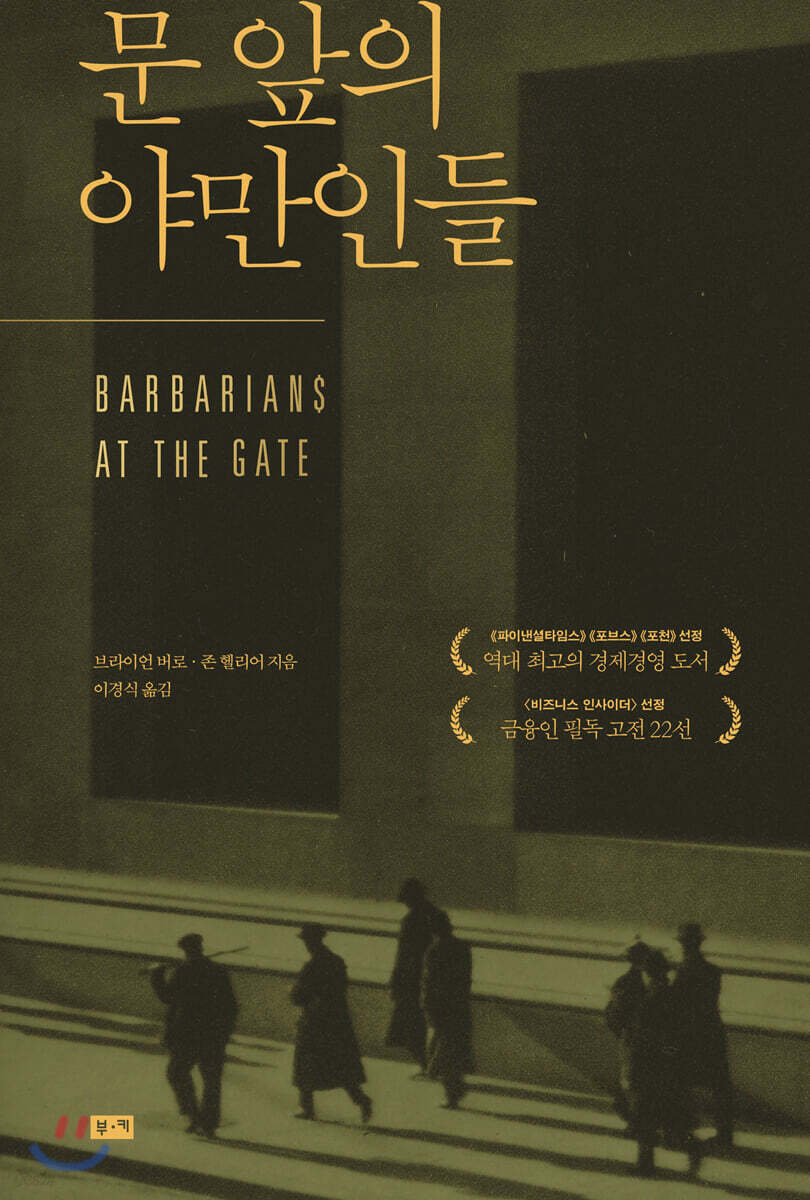
Barbarians at the door
 |
Description
Book Introduction
When and how did the "barbarism" and "getting a piece of the action" in finance emerge?
Learn the secrets of investing and wealth from the biggest takeover war ever!
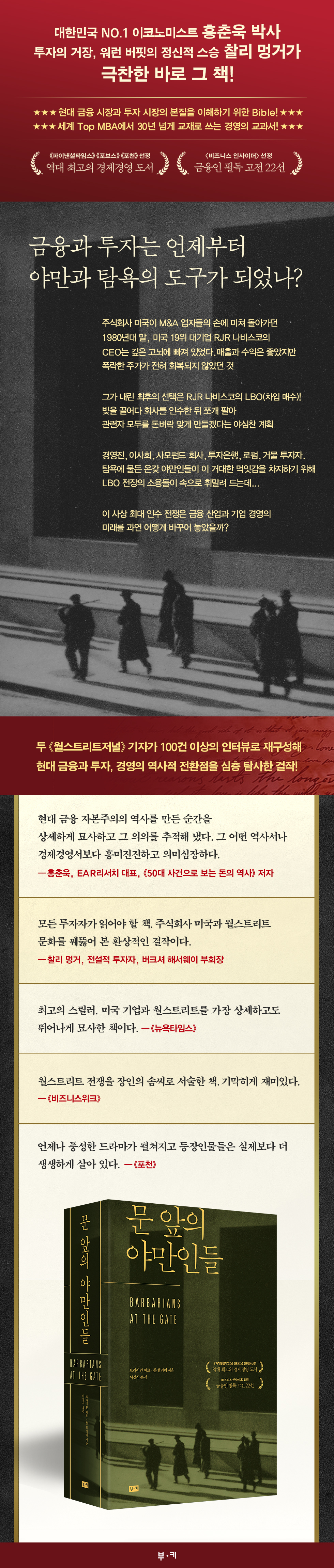
This is a masterpiece by two reporters from the Wall Street Journal, an in-depth investigative report on the entire process of RJR Nabisco's LBO transaction in late 1988, the largest corporate takeover in history.
Ross Johnson, CEO of RJR Nabisco, one of the largest companies in the United States at the time, pursued an LBO, or "leveraged buyout," when the company's plummeting stock price failed to recover.
The plan was to use borrowed money to acquire the company, then sell it in pieces to make everyone rich: shareholders, management, board members, investors, and even related companies such as investment banks and law firms.
The authors reconstruct the entire story of this takeover war, a fiercely contested battle between financial and corporate giants led by KKR, the leading private equity firm in the LBO industry, and trace the dramatic transformation of Wall Street's culture and physiology, corporate management, and the financial industry.
That deal was the pinnacle of the "Roaring 1980s," a decade marked by the emergence of a new breed that prioritized transactions over corporate tradition, a wave of mergers and acquisitions sweeping the corporate and financial worlds, and the heyday of LBOs using junk bonds.
This book is a vivid testimony and profound insight into how finance, investment, and management, following the path pioneered by barbarians like Ross Johnson, reached a historical turning point, marked by rampant "profiteering" and "moral hazard."
Learn the secrets of investing and wealth from the biggest takeover war ever!
This is a masterpiece by two reporters from the Wall Street Journal, an in-depth investigative report on the entire process of RJR Nabisco's LBO transaction in late 1988, the largest corporate takeover in history.
Ross Johnson, CEO of RJR Nabisco, one of the largest companies in the United States at the time, pursued an LBO, or "leveraged buyout," when the company's plummeting stock price failed to recover.
The plan was to use borrowed money to acquire the company, then sell it in pieces to make everyone rich: shareholders, management, board members, investors, and even related companies such as investment banks and law firms.
The authors reconstruct the entire story of this takeover war, a fiercely contested battle between financial and corporate giants led by KKR, the leading private equity firm in the LBO industry, and trace the dramatic transformation of Wall Street's culture and physiology, corporate management, and the financial industry.
That deal was the pinnacle of the "Roaring 1980s," a decade marked by the emergence of a new breed that prioritized transactions over corporate tradition, a wave of mergers and acquisitions sweeping the corporate and financial worlds, and the heyday of LBOs using junk bonds.
This book is a vivid testimony and profound insight into how finance, investment, and management, following the path pioneered by barbarians like Ross Johnson, reached a historical turning point, marked by rampant "profiteering" and "moral hazard."
- You can preview some of the book's contents.
Preview
index
Recommendation_ Hong Chun-wook
How We Wrote This Book
introduction
Main characters
Prologue: Ross Johnson Announces LBO of RJR Nabisco
Chapter 1: The Emergence of a New Race That Trades Better Than Companies
Chapter 2: The Bizarre Merger of the Oreo Cookie Company and the Camel Tobacco Company
Chapter 3: The Emergence of Henry Kravis, the Emperor of Mergers and Acquisitions
Chapter 4: Stock Market Crashes Hurt RJR Nabisco's Chief
Chapter 5: The Growth of Private Equity Fund KKR and the Golden Age of LBOs
Chapter 6 Dreaming of the day when everyone sits on a pile of money
Chapter 7: The Great Whirlwind Caused by RJR Nabisco
Chapter 8: Kravis puts the brakes on Shearson's solo run.
Chapter 9: Postman Joins the LBO War
Chapter 10: KKR and Shearson's Diverging Dreams at the Negotiation Table
Chapter 11 The internal struggles within the camp are becoming increasingly fierce.
Chapter 12: The $20 Billion Peace Agreement Finally Collapses
Chapter 13: The board of directors comes to the forefront, and the media unleashes a barrage of criticism.
Chapter 14: The looming deadline and the climax of chaos and urgency.
Chapter 15 The situation is shaken by First Boston's participation in the bidding.
Chapter 16: Kravis's Smokescreen Tactic and the First Boston's Fierce Struggle
Chapter 17: The winner has been decided, but the fight is not over yet.
Chapter 18: $112 vs. $109, what's the final result of this showdown?
Epilogue: The Decline of LBOs and the End of an Era
Postscript: 20 Years Later: The Barbarians and the World They Created
How We Wrote This Book
introduction
Main characters
Prologue: Ross Johnson Announces LBO of RJR Nabisco
Chapter 1: The Emergence of a New Race That Trades Better Than Companies
Chapter 2: The Bizarre Merger of the Oreo Cookie Company and the Camel Tobacco Company
Chapter 3: The Emergence of Henry Kravis, the Emperor of Mergers and Acquisitions
Chapter 4: Stock Market Crashes Hurt RJR Nabisco's Chief
Chapter 5: The Growth of Private Equity Fund KKR and the Golden Age of LBOs
Chapter 6 Dreaming of the day when everyone sits on a pile of money
Chapter 7: The Great Whirlwind Caused by RJR Nabisco
Chapter 8: Kravis puts the brakes on Shearson's solo run.
Chapter 9: Postman Joins the LBO War
Chapter 10: KKR and Shearson's Diverging Dreams at the Negotiation Table
Chapter 11 The internal struggles within the camp are becoming increasingly fierce.
Chapter 12: The $20 Billion Peace Agreement Finally Collapses
Chapter 13: The board of directors comes to the forefront, and the media unleashes a barrage of criticism.
Chapter 14: The looming deadline and the climax of chaos and urgency.
Chapter 15 The situation is shaken by First Boston's participation in the bidding.
Chapter 16: Kravis's Smokescreen Tactic and the First Boston's Fierce Struggle
Chapter 17: The winner has been decided, but the fight is not over yet.
Chapter 18: $112 vs. $109, what's the final result of this showdown?
Epilogue: The Decline of LBOs and the End of an Era
Postscript: 20 Years Later: The Barbarians and the World They Created
Detailed image
Into the book
Prologue: Ross Johnson Announces LBO of RJR Nabisco
“The only way to realize shareholder value is through an LBO.”
A silence flowed through the conference room, as if cold water had been poured over it.
I couldn't even hear breathing.
Everyone present was well aware of what an LBO was. When an LBO is conducted, a small group of board members, typically in partnership with Wall Street investment firms, borrow heavily to acquire the company from its shareholders. Critics of LBOs argue that this practice steals the company from shareholders and that the debt the company incurs during the LBO process makes it less competitive.
Critics argued that if such practices were to occur on a large scale in the United States, the overseas competitiveness of American companies would be significantly diminished, and companies burdened with massive debt would gradually wither away. Everyone in the room understood that after an LBO, budgets for things like research and development would be slashed, and everything would be sacrificed in the process of paying off debt.
But one thing was clear: the board that pulled off the LBO would reap enormous benefits.
If a company makes a sacrifice through an LBO, the profit they get could be ugly money because it is money made at the expense of the company's sacrifice.
Johnson continued,
“The being loitering at the door is not a wolf.” --- pp.38-39
Chapter 1: The Emergence of a New Race That Trades Better Than Companies
Until the fall of 1988, Ross Johnson's life had been one of adventure.
He not only sought to seize power within the company, but also to wage war against the old corporate order.
Under that old order, large corporations were slow and steady movers.
The top 500 companies selected by Pocheon were influenced by so-called 'company men'.
The mid-level executives who had risen to their positions by dedicating everything they had to a company and the high-ranking executives who acted as stewards of the company were these 'company men.'
They preserved the company and carefully increased its value and capabilities.
Johnson wanted to be the ultimate 'non-company man'.
He shredded traditions, abolished unnecessary and burdensome organizations, and reshaped management policies like crazy.
He was one of a new breed of "non-companymen" who matured in the 1970s and 1980s, nomads driven by deals and results.
This new race declared that their mission was to serve those who invested in the company, not the company's traditions.
They also tended to invest a lot in taking care of themselves.
But of all the 'non-company men', Johnson's personality stood out the most.
He always made the biggest deals, always spoke the loudest, sometimes even boasted the most, and always pursued the greatest pleasure.
He later became a symbol of the so-called 'Roaring 80s'.
And by pursuing the mergers and acquisitions of the century, he pushed the 1980s to the peak of the boom.
But his attempt ends up scattering one of America's largest and most impressive companies to the winds.
--- pp.49-50
“The moment you create an organization, it begins to rot.” --- p.54
“A company is a ship sailing the sea.
“The CEO is the captain of the ship.”
This perspective, which always felt at ease when things went as planned, was an ethic that suited those who were too shocked and frightened by the Great Depression of the 1930s to dare to stir up trouble.
But Johnson, like many of his contemporaries, did not live through the Great Depression, did not fight in a world war, and did not have the courage to acknowledge limitations.
He wasn't a team player in the old sense.
He was like Broadway's Jonah Reggie Jackson.
Like them, he was an iconoclast, a figure of the cool-headed television generation, loyal to its own whims rather than consistent loyalty.
--- p.98
Chapter 2: The Bizarre Merger of the Oreo Cookie Company and the Camel Tobacco Company
In the 1950s, the Reynolds were one big, happy family.
Management never forgot that the factory workers rose from their beds in rural North Carolina each morning, commuted to the factory, and proudly selected the right tobacco for each product, knowing every single machine that packaged the cigarettes.
Before making a critical decision about which new products would sell well or not, we consulted a panel of 250 factory workers.
Winston's blending ratio was also decided upon after workers personally smoked over 250 different prototypes, and the then sales manager, Bowman Gray Jr., personally smoked the final selected prototypes.
“This is it!”
He hit his knee, and that's how Winston was born.
--- pp.118~119
be careful.
“Standard Brands merged with Nabisco, and now there is no Nabisco left.”
Then Chief Planner Paul Bot snorted.
“Nancy, don’t be stupid.
“Is the chairman that easygoing?”
Even the products of the two companies were in an uneasy relationship.
Some people even said that this relationship was unnatural.
Horrigan was furious when he discovered that one of Nabisco's brands, Fleischman's Margarine, had been planning a marketing campaign in partnership with the American Heart Association, a strong anti-smoking campaigner.
In the end, the marketing plan came to nothing.
Of course, Johnson didn't think much of linking the entire Nabisco with Reynolds' "Merchants of Death," so he could chuckle and say:
“Mom and Apple Pie” meets “Skull and Two Crossed Bones”? --- p.154
Chapter 3: The Emergence of Henry Kravis, the Emperor of Mergers and Acquisitions
The person who could communicate well with the people on Wall Street was Johnson.
Of course, we are talking about mergers and acquisitions.
That's a huge deal, a new deal… … .
All the companies Johnson ran were in constant flux, selling off parts of their businesses and buying up parts of other companies.
Johnson continued to reorganize the company.
And that too in the already proven so-called 'Children of Pesket' way.
Johnson's door was always open to discuss any possibility.
Tylee Wilson and Robert Shabel walked through those doors, and so did people with suitcases full of new ideas. When RJR Nabisco's headquarters moved to Atlanta, Georgia, investment bankers flocked to Johnson like mayflies to a light on a hot Georgia June night.
--- pp.184
“Millions of dollars are lost in the flow of time.” --- p.202
The basic logic of LBO was relatively simple, and all three men had some understanding of it.
The logic goes like this: An investment firm like KKR partners with a company's management and acquires it with funds raised from banks or shorting its stock.
And the debt incurred at this time is paid off with the company's operating profits and, as is often the case, by selling off some of the company's business units.
--- p.212
Chapter 4: Stock Market Crashes Hurt RJR Nabisco's Chief
On October 19, 1987, the stock market crashed.
Like everyone else in the financial world, Johnson was shocked by the quatronic figures. RJR Nabisco, which had been trading in the mid-$60s just a week ago, had fallen to the mid-$40s by noon that day.
And for the next few weeks, he continued to look listless along that line.
That was the beginning of Johnson's path to ruin.
Because low stock prices would plague him for months to come.
In December, the company reported a 25 percent increase in revenue.
But stock market investors ignored these disclosures.
Even as food stocks rose that winter, RJR Nabisco was still struggling.
No matter how hard Johnson tried to change the company's image, people still viewed his stock as nothing more than tobacco stock.
Despite the fact that Nabisco and Del Monte accounted for 60 percent of total sales, the public's view of RJR Nabisco remained unchanged.
--- pp.214~215
Even in the spring of 1988, Wall Street was still reeling from the stock market crash of the previous October.
Individual investors fled the market in droves.
Trading volume also decreased.
With orders sluggish, the company has completely lost interest in the new stock offering.
As in other areas of the economy, Wall Street has turned to a single, guaranteed source of income.
It was a merger and acquisition.
Mergers and acquisitions are ultimately a creation of Wall Street.
Because whether they win, lose, or drag it out, the investment bank collects interest and fees.
These fees fueled Wall Street's rapid growth throughout the 1980s, once again boosting stock market profits that spring.
After three months of silence and cold winds following the market crash, January brought an unprecedented wave of takeover activity.
Thanks to the drop in stock prices, trading was brisk regardless of whether it was domestic or foreign companies.
There were a dozen or so mega-mergers, culminating in a $6 billion takeover battle for control of Cincinnati-based Federated Department Stores, a company where Paul Stikt once worked.
The number of mergers and acquisitions attempted in the first half of 1988 alone was greater than in the entire year of 1985, which was a very good year.
Wall Street has become addicted to mergers and acquisitions in a short period of time.
--- pp.224~225
Chapter 5: The Growth of Private Equity Fund KKR and the Golden Age of LBOs
Since the company was acquired primarily using debt, a focus on future earnings and cash flow was crucial to avoiding the pressure of repaying debt later.
To him, a company's balance sheet was a tarot card and its projected cash flow was a crystal ball.
Once Kohlberg got his hands on a company, he focused all his energy on reducing the company's expenses as much as possible and selling off unnecessary business units to pay off debt.
In most cases, he gave his executives incentives in the form of stock options, and he was very strict about this principle because he realized that this allowed them to perform to their full potential and run the company more efficiently.
Therefore, when the company was later sold, its value was bound to be much higher than when it was purchased. LBOs have been conducted in this fundamental manner ever since.
It was the work of the sordid worldly market, and this work was done by Jerome's child, Kravis, who took it upon himself.
--- pp.274~275
This has the Wall Street crowd spinning their heads.
Gibson Greetings became like Sutter's Mill, the catalyst for the gold rush of the past.
Suddenly, everyone was trying to do LBOs without even knowing the principles of LBO.
And then I actually tried it.
Based on the total purchase price of all acquired companies, the LBO phenomenon increased tenfold from 1979 to 1983.
By 1985, just two years after the Gibson Greetings case, there were already 18 LBOs worth around $1 billion.
The total value of LBOs in the five years before Ross Johnson decided to target RJR Nabisco for an LBO was $181.9 billion, compared to only $11 billion in the previous six years.
(…) Junk bonds were what gave wings to these LBOs.
Regardless of the funds raised in any LBO, approximately 60 percent of the collateralized debt is loans from private banks.
And only 10 percent of the total funds were directly invested by the purchaser.
The remaining 30 percent, the meat patties in the burger, come from a handful of large insurance companies, but the problem is that it usually takes several months to attract this money.
So in the mid-1980s, an investment firm called Drexel Burnham Lambert turned to so-called "junk" bonds, which were very risky, rather than time-consuming to raise from insurance companies.
(…)
Thanks to junk bonds, LBO buyers, once considered too slow to compete in a takeover war, could now independently make deals with near-instantaneous speed.
Thus, LBOs suddenly became a viable alternative in all acquisition situations.
(…) The hunters hunt for their prey, and the prey seeks out the LBO company.
The hunters, the prey, and the LBO firm all benefited from the outcome.
The only ones who suffered were the company's bondholders and its employees.
As the company takes on new debt, bond prices fall, and workers are more likely to be laid off as the company restructures to slim down.
But Wall Street just hums and doesn't pay any attention to them.
--- pp.286~287
Chapter 6 Dreaming of the day when everyone sits on a pile of money
By the mid-1980s, competitors like Morgan Stanley and Merrill Lynch had entered the LBO market.
And, hoping to compete with powerful weapons like Drexel's junk bonds, they began lending their own money as temporary acquisition funds, called "bridge loans."
Such loans are usually later rolled over or bridged through the sale of junk bonds.
This trend was generally called 'merchant banking'.
Basically, it's a term that refers to investing one's own money in a place that investment banks have been targeting for years, but it's just a fancy way of saying it to look cool.
--- p.317
If only a $18 billion deal could happen, countless problems could be solved at once.
The fact that Shearson accomplished the largest LBO in history alone puts it in the ranks of top-tier merchant banking firms.
(…) And above all, there was the enormous amount of fees.
'Oh, the fee!'
The combined advisory fees, loan fees, and success fees would have exceeded $200 million.
This alone could have instantly recovered the declining returns.
And it didn't stop there.
In addition to the fees, money would continue to flow into Shearson for many years.
Refinancing fees, advisory fees, all sorts of other fees… If RJR Nabisco's LBO went through, RJR Nabisco would have to devise a plan to spin off and sell off unnecessary business units to repay its debt, and these operations would also incur fees of tens of millions of dollars.
In addition to the fees, there were also returns on investments.
Hill predicted that the annual return would be 40 percent.
The idea was that if you invested $500 million, you would earn $200 million a year.
Even at the very least, it would take five years! --- pp. 324-325
The negotiations were over in less than two hours.
Cohen capitulated, granting virtually all of Bison's demands.
The agreement typed by Sage's secretary that night was as follows:
Johnson's seven-member group owns 8.5 percent of the company.
The funds needed to purchase this stake are provided by Shearson in the form of a tax-free loan.
If Johnson achieves all of his goals, the group of seven's share could rise to 18.5 percent.
If this were to happen, the amount for this portion could be as high as $2.5 billion.
Johnson could distribute his share as he pleased.
According to Stephen Goldstone, his personal 1 percent stake (Horrigan was also guaranteed a 1 percent stake) could have been worth $1 billion in five years.
Johnson was also guaranteed veto power and control of the board.
It was an agreement with unique content that had never been found in any major LBO before.
--- p.359
Chapter 7: The Great Whirlwind Caused by RJR Nabisco
A year after "Black Monday" on October 19, 1987, Wall Street was still reeling from the aftermath.
(…) As the recession dragged on on Wall Street, merchant banking emerged as a new hope for salvation. Windfalls from LBOs and bridge loans were the quickest way to shore up sluggish trading profits.
Moreover, if done well, you could receive up to $50 million in upfront fees with just one transaction.
This was the amount of money a company could earn in four months.
In June, Morgan Stanley reported a pretax gain of $120 million from the sale of a 10 percent stake in a Texas chemical company, compared to $230 million in total profits the company reported for 1987.
Seeing these enormous profits, even the laggards of merchant banking, Goldman Sachs, the giants of securities trading, and even the smaller Dylan Reed scour the market for investment opportunities.
Merchant banking has been spearheaded by mergers and acquisitions.
Almost every investment bank had a mergers and acquisitions department, and the people in that department knew each other well.
(…) In the late 1970s, a new breed of investment bankers emerged as hostile mergers and acquisitions boomed.
(…) To people like Thomas Hill of Shearson and his cousins, the mergers and acquisitions lawyers, all mergers and acquisitions were good and right.
Because every merger and acquisition comes with a fee.
(…)
At the heart of any merger or acquisition are usually a dozen or four key elites who have been friends or competitors for more than a decade.
They simply call themselves 'The Group'.
(…)
In some ways, the battle over mergers and acquisitions in American corporations was a kind of chess game between longtime friends.
(…) “In almost every deal, one of these guys is involved.
As a result, our lives constantly intersect with each other.
“In almost every dance, there is always someone among us.” (…) “Because the group is small, (…) everyone knows what is going on.
“There are no secrets.” This situation contributed to the easy establishment of the ugly crime of insider trading, which was rampant on Wall Street in the late 1980s.
“Everyone who is not in the ‘group’ now is in jail.” --- pp.373~379
Chapter 8: Kravis puts the brakes on Shearson's solo run.
Any investment banker with even a penny to spare has no choice but to rush to the LBO scene.
Over the past five years, the number of competitors has steadily increased and grown stronger, making even Kravis feel discouraged.
Morgan Stanley, Merrill Lynch, and countless other companies you'd never heard of before were just scurrying into the territory you'd carved out.
And this time, even Shearson Lehman showed up. KKR's policy, established when it launched its fund in 1987, was to conduct LBOs on such a scale that no one else would dare interfere.
I had hoped that by doing this I would be able to leave my competitors far behind.
With these expectations in mind, Kravis was paving the way and eyeing RJR Nabisco when Peter Cohen, a man who didn't seem to understand the difference between a loan-based acquisition and a simple acquisition, suddenly showed up and claimed he had the right to do an $18 billion deal, which made Kravis furious.
Kravis simply could not understand such impudence.
I wanted to teach all those shameless people a hard lesson, especially Peter Cohen.
--- p.404
There are thousands of commercial banks around the world.
But in the field of mergers and acquisitions, there are only three.
Citibank, Manufacturers Hanover Trust Company, and Bankers Trust formed a powerful triumvirate, controlling the faucets that pumped billions of dollars into Wall Street to fuel numerous mergers and acquisitions.
Junk bonds, sold by several companies including Drexel Burnham, were also a major means of raising capital.
But without these three giants, the mechanism of mergers and acquisitions would have come to a standstill.
Because their power was so great, they were greedy in lending money to the mergers and acquisitions sector.
So in the late 1980s, they were indiscriminate in their war over mergers and acquisitions.
So, we also provided funding simultaneously to companies competing for the same prey.
Even after doing this, they thought there was nothing wrong with it.
Commercial banks, like their cousins, investment banks, have built a high wall of security around their loans to maintain a strong relationship of trust with each bidding entity.
--- p.412
Chapter 9: Postman Joins the LBO War
Postman believed that Wall Street had been taken over by cartels.
That cartel was junk bonds.
The cartel's top mentor was Michael Milken of Drexel Burnham Lambert, and its most powerful figure was Henry Kravis of KKR.
The cartel was now slowly gaining the upper hand in the fight to take over RJR Nabisco.
The cartel's product, high-yield junk bonds, was used to raise funds in 1988.
Most of the major investors, securities firms, and investment banks specializing in LBOs participated.
Postman believed that junk bonds had not only ruined the LBO industry but also ruined Wall Street.
So Postman didn't use junk bonds.
Postman Little was almost the only major investment bank that did not use junk bonds.
To Postman, junk bonds were like a drug that could give even a small investment firm the power to beat a giant company if taken alone.
This drug has completely changed priorities in the mergers and acquisitions field.
Postman believed that the business model of acquiring a company, taking its management along with it, growing it, and then selling it for a profit after five or seven years, as Postman Little had done, had completely disappeared.
Now, what people in this field value is constantly generating transactions and collecting fees.
Management collected fees by selling off companies, investment bankers collected capital fees, and bond experts collected junk bond fees.
In Postman's view, the entire LBO industry has become a playground for fraudulent technocrats looking for quick, easy gains.
--- pp.456~457
Chapter 10: KKR and Shearson's Diverging Dreams at the Negotiation Table
To Johnson, all of this was like a nightmare.
It felt like the real world had been left behind in Atlanta.
I couldn't shake that feeling.
They escaped the real world by passing through a glass mirror.
In this surreal world, old numbers, old rules, and old financial logic no longer apply.
Money was paper and paper was money.
And people were paid $25 million to lie.
It was such an absurd world.
--- p.480
What worried the head of American Express most was what Wall Streeters commonly called "the makeup of the deal."
From the perspective of the general public, the agreement was absurd.
It was clear that the terms of this agreement would eventually be made public, and at that point, it would be seen as nothing more than greed itself.
It was clear that American Express's corporate image would take a huge hit if it became known to the world that the seven existing executives were happily dividing up the enormous sum of $2 billion after the deal was concluded.
--- pp.487~488
“There was something Cohen didn’t know.
“We never take the enemy prisoner, we just annihilate them.” --- p.493
The topic shifted to cost reduction, one of the key issues that must be overcome for a successful LBO.
Roberts was surprised again when he heard Johnson's words.
Johnson has said he has no intention of swinging the axe of spending cuts.
Johnson explained that cost-cutting itself is an overrated process.
“Even a Neanderthal wielding a stone axe could do that.
So how much can we reduce costs? If there's anyone who can truly prove its effectiveness, please introduce me to them." --- p.499
Chapter 11 The internal struggles within the camp are becoming increasingly fierce.
Since Kravis was offering $90 per share, all assumptions based on a $75 per share offer had to be discarded.
The revision analysis was already underway.
A new corporate split plan is underway, and contacts and discussions are being resumed to secure $15 billion from the bank.
The Shearson people tried to get the bid price as high as possible.
Like people desperately struggling to survive on a sinking ship, Johnson began to throw away his toys.
Thomason Hill recalls the situation at the time as follows:
“The company's planes, luxury homes, premiers, golf course memberships, and even its headquarters building in Atlanta were all subject to attack.” --- p.539
“Jimmy, how much madness will there be?” --- p.543
"Those sons of bitches! Those worthless executives! How can those filthy people steal the company from the shareholders and then stuff it all into their own pockets? That money belongs to the shareholders.
This is completely wrong.
“Something must be done!” --- p.549
“I admit that I only depicted one aspect.
But aren't there certainly cases where people say things like, 'We're going to swallow that company, then we're going to break it up, it's more profitable to break it up and sell it off than to leave it as is, so we're going to run away with the money we've made?' --- p.572
Chapter 12: The $20 Billion Peace Agreement Finally Collapses
The field of LBO requires more thorough examination of the purchase target than when purchasing any product or service.
The success or failure of an LBO depends on how accurately the target company can understand how much debt it can handle, how much it can cut costs, and which business units it can sell to quickly pay off its debt.
To use the analogy of a used car buyer, in an LBO, the buyer must accurately predict and understand even the smallest details, such as how many more kilometers the car will last and how many parts will need to be replaced.
If you're not aware that your engine is nearing the end of its lifespan or that your crankshaft is cracked due to a single mistake, you're on the fast track to ruin. The situation is similar in LBO.
If you make a mistake in your calculations or predictions, both the buyer and the seller could end up in trouble and in debt.
But what if you were Henry Kravis and you didn't allow used car owners to even touch the tires on their cars, let alone show them the engines? --- pp. 583-584
Linda Robinson knew it was all a matter of pride.
She thought she had a special talent for coaxing and cajoling Wall Street clients.
As is often the case on Wall Street, Peter Cohen, Thomas Strauss, Henry Kravis and the rest completely lost sight of their ultimate target, in this case RJR Nabisco.
At some point, RJR Nabisco ceased to be a problem.
What they couldn't agree on wasn't the acquisition price or the various conditions.
The issue was the battle of pride and courage among the macho businessmen of Park Avenue, a group of extremely competitive people.
So she knew that Cohen would never surrender to Kravis, and Kravis would never surrender to Cohen.
And it was clear that Kravis would not negotiate with Strauss.
It was because everyone thought they were the best or would become the best.
--- pp.600~601
The lead bank is listed first—or more accurately, leftmost—in a series of "tombstone ads" that appear in The Wall Street Journal and other financial publications.
Having your name on the far left of a tombstone advertisement carries a powerful symbolic meaning in the world of bond trading.
(…)
“If Drexel had been on the left, people would have seen us as nothing more than a sideshow.”
Ultimately, this issue was the key point.
For someone like Johnson, who was trying to acquire a company, these issues were minor.
It was never an issue important enough to change what had been agreed upon.
Although Salomon was a central partner in Johnson's deals and discussed merchant banking in depth, its primary task wasn't to acquire brands like Oreo, for example.
Salomon was a company that sold bonds.
So, if Drexel, a competitor, were to become a sidekick, it could turn its back on Johnson's interests.
Perhaps it could have sabotaged the deal itself.
--- pp.625~626
Chapter 13: The board of directors comes to the forefront, and the media unleashes a barrage of criticism.
Newspaper articles bashing Johnson followed.
These included a $52.5 million "golden parachute," 526,000 shares of "restricted stock" worth $50 million distributed to friendly RJR executives, and Johnson himself being guaranteed that he would never suffer a loss under any circumstances.
To make matters worse, the press also uncovered all sorts of benefits Johnson bestowed on the board, including 1,500 shares of restricted stock each for each director and hefty consulting fees that the directors were supposed to receive through consulting contracts.
The obviousness of Johnson's outrageous greed and the ugly infighting among the bidders for RJR Nabisco sent shockwaves through American society, already reeling from the unstable environment created by a series of mergers and acquisitions.
--- p.666
Edward Horrigan posted security at his home and issued a statement dismissing the New York Times article as "speculative and uncertain."
Horrigan's statement was parodied, and the parodies were read by more people than the original.
The parody begins with "We decided to take the money and run," and ends with:
“Being CEO of a company full of idiots has been a truly wonderful experience.
I'm so grateful to you for making Ross and me rich.
Without you, we probably wouldn't have been able to do this." --- p.671
Chapter 14: The looming deadline and the climax of chaos and urgency.
What Stewart heard was astonishing.
He overestimated RJR Nabisco's available cash by $450 million.
The 'golden parachute' payment was $300 million, more than he had estimated.
And the worst-case scenario he had feared regarding 'cash for other purposes' came true.
$550 million was being lost, far more than he had planned.
Without even needing to use a calculator, Stewart could see that the $1.3 billion was off the charts.
That was a whopping $6 difference in price per week.
--- pp.745~746
Chapter 15 The situation is shaken by First Boston's participation in the bidding.
Kravis's offer was $94 per share, for a total value of $21.62 billion.
But Johnson outbid Kravis at $100 a share.
The total amount was $23 billion.
It seemed like it would end easily.
At 9 o'clock sharp, Atkins sent the investment bankers away and told the directors that they could probably go home for the day.
And they tentatively decided to meet on Sunday morning and officially declare Johnson the winner.
Meanwhile, on Saturday, representatives from both bidders were called in to explain the securities they were seeking to mobilize.
Both sides were considering large-scale cash-in-kind bonds as part of their funding plans, and it was decided that they needed to prepare in advance so that they could make a definitive assessment of this at the Sunday morning meeting.
Of course, it could have been a formality, but Atkins was determined to make sure everything was done right.
First Boston's proposal was only later presented to Atkins.
He read the proposal carefully.
At first, I thought I'd just laugh this proposal off like the other 'prank calls' and throw it away.
In his view, Ma's proposal was still an unfinished idea.
However, First Boston offered to acquire RJR Nabisco for between $105 and $118 a share, subject to a restructuring plan using Brian Finn's installment plan strategy.
--- p.763
Chapter 16: Kravis's Smokescreen Tactic and the First Boston's Fierce Struggle
An eerie silence hung over Wall Street as bidders returned to life and greeted a new Monday morning.
Financial markets were quiet.
The investment bankers' steps were cautious and slow.
Wall Street's massive merger and acquisition machine has secretly ground to a halt.
The reason was simple: the commercial banks that would (or hoped to) offer $15 billion or more to the ultimate winner of the RJR Nabisco auction were all gearing up for battle, so they had been holding off on any acquisitions other than RJR.
Most deals were put on hold as all eyes turned to RJR Nabisco.
Information-hungry abertrasers (arbitrageurs) also had nothing else to do but watch the situation unfold.
It was a scene similar to a Western movie where the townspeople are rushing to hide inside their houses as the outlaws prepare for their final showdown.
--- p.791
Chapter 17: The winner has been decided, but the fight is not over yet.
Goldstone claimed they had been scammed.
They said their proposal was overturned and they were ultimately robbed of the victory because of the crazy First Boston bid.
He said that since he won first place in the first bid, there was no reason to raise the bid price further.
He said that raising the price further was tantamount to denying one's own legitimacy.
Taking all of this into account, Goldstone argued that one final round of bidding was necessary to ensure a fair overall bidding process.
He paced around the office, where pencil erasers were scattered in disarray, and insisted unwaveringly.
"We're not done yet! Peter, we can bid even higher."
Of course! Where else can you find such a ridiculous auction that starts and ends in an hour? There are no rules to this auction process! We said we could bid higher when we submitted our bid.
You can do that as much as you want.
"What are you going to do? It's not fair to end it like this!" --- p.860
Chapter 18: $112 vs. $109, what's the final result of this showdown?
Johnson was still bewildered and surprised by management's decision to emphasize in-kind payment securities instead of cash.
So he even said this.
"How about we start a new company? Funded entirely with cash-in-kind securities.
I wonder if I could buy a Time ad with this.
“Wouldn’t this be enough to create a company?”
He continued to speak.
“What I mean is, we have discovered a printing press that is better than the American Mint’s printing press.
This killer printing press is now on Wall Street.
But nobody knows.
Even the World Bank probably doesn't know this. With this, we could pay off all the foreign debts of Third World countries.
“This is a whole new money machine.” (…)
“Let’s name the company ‘Payment Securities Co., Ltd.’
And this platform must include the "Three Rules of Wall Street."
Oh, of course I named it.
What are the three rules? Listen.
First, never break the rules.
Second, never pay in cash.
Third, never tell the truth.
"How is it? Isn't it okay?" --- pp.907~908
With the final bid in hand, Roatin and the investment bankers crowded into a small room attached to the conference room.
To non-experts, it was obvious that Johnson's camp, which offered $112, would win over KKR's camp, which offered $109.
But on Wall Street, it's rare for things to be this simple.
Because Cohen and Goodfriend refused to comply with the reset clause, they had to subtract some of the $112.
Investment bankers had to calculate how much to deduct.
A few minutes later, Roatin announced in the boardroom:
“The price offered by both sides is between $108 and $109.
Looking closely, and considering the unprecedentedly large proportion of marketable securities, the prices offered by both sides are essentially identical, in my professional opinion.
From a financial standpoint, there is nothing wrong with either side.
So, it is impossible to say which one is more advantageous.”
It was a draw.
--- p.922
Epilogue: An era ends with the decline of LBOs
“If Ross Johnson hadn’t existed, Wall Street would have created someone just like him.”
In some ways, that's true.
Johnson was a product of his time.
RJ
Just as Reynolds was a product of his time.
The 'Roaring 80s' were a new golden age.
The winner was praised at all costs.
Felix Roatin even coined the term "casino society" for this era.
Investment bankers were both facilitators of the gambling game and alchemists.
They devise outrageous plans, and then use computers to perform complex calculations to rationalize these plans and package them into something plausible.
And finally, in front of the company's executives, he performed what Johnson liked to call "the devil's dance," and flirted with them.
The dance that Johnson started with RJR could be considered the highest or lowest point of that era, depending on your perspective.
It was no coincidence that RJR Nabisco provided that opportunity at the time.
In the last decade before the war, the company was less a giant corporation and more a giant dream-producing machine.
The enormous profits the tobacco industry was making allowed people to run wild and turn all their fantasies into reality.
(…)
The company that was up for auction was a giant prism.
Through this prism, the crowds that lined Wall Street saw their own glory reflected in them.
--- pp.952~953
What on earth does all this have to do with doing business? --- p.954
Postscript: 20 Years Later: The Barbarians and the World They Created
The world has changed. Even LBO specialists like KKR now call themselves "private equity firms."
Postman's eyes widen at this term.
“The so-called junk bond glut of the 1980s was a drop in the bucket compared to what has been happening in the credit markets over the past five or six years.
Banks, you see, will now lend you money no matter what.
As you know, these banks are open from 9 AM to 5 PM.
Until noon, you can still work legally.
But after 4:15 PM, I have other things to do.
You know what? That's what caused this subprime mortgage mess.
Banks lend money even to people who have no ability to repay.
If you ask how that is possible, it is like this.
'It's not a problem at all.
“Because I took something as collateral.” --- pp.987~988
The shockwave of the RJR Nabisco scandal spread throughout the wider world.
The decade of the 1990s was, in its own way, as rough as the decade of the 1980s.
America's CEOs were shocked and horrified when they first saw the barbarians loitering at the gates of their great corporation.
Then he embraced these savages, and finally tried to imitate Ross Johnson.
These people learned from the RJR Nabisco LBO that they could amass enormous wealth if they took advantage of the conditions given to them.
And then they started taking concrete action.
A new generation of windbags, such as Dennis Kurzlowski of Tyco International and Bernie Evers of WorldCom, further developed Johnson's concept of the "CEO who doesn't look out for the company's interests."
They played on a much larger scale.
It was the 1990s, a time when the market was booming and the tech stock bubble was in full swing.
So the stakes were enormous.
Even the so-called "golden parachute" of $53 million set by Ross Johnson was a pittance compared to the money they had made (though they went much further than Johnson and ended up in jail in handcuffs).
In some ways, this book wasn't just about the downfall of one company, RJR Nabisco.
This was the beginning of a trend of "I need to get my piece of the action" that would eventually permeate every corner of American business.
Even accountants at once-reliable accounting firms have come to view themselves as dealers in gambling tables rather than auditors.
Paul Volcker, the chairman of the dying accounting firm Arthur Andersen, says his employees became accomplices to Enron because they envied the enormous wealth enjoyed by such companies and their employees.
Volker explained:
“Accountants thought this way.
'What are we worse than those people?
Besides, we do all the work,' he said.
“There was a widespread belief that the first person to pick up money was the owner.” --- pp.994~995
The period that followed was eerily reminiscent of the early 1990s, just after the RJR Nabisco deal closed, and raises the question:
Did Wall Streeters learn any valuable lessons from the RJR Nabisco deal?
Not at all, says Colin Bladen emphatically.
"When that happens and everyone rushes into markets they don't even know much about, financial markets always overheat. Bubbles similar to RJR Nabisco are everywhere."
“The only way to realize shareholder value is through an LBO.”
A silence flowed through the conference room, as if cold water had been poured over it.
I couldn't even hear breathing.
Everyone present was well aware of what an LBO was. When an LBO is conducted, a small group of board members, typically in partnership with Wall Street investment firms, borrow heavily to acquire the company from its shareholders. Critics of LBOs argue that this practice steals the company from shareholders and that the debt the company incurs during the LBO process makes it less competitive.
Critics argued that if such practices were to occur on a large scale in the United States, the overseas competitiveness of American companies would be significantly diminished, and companies burdened with massive debt would gradually wither away. Everyone in the room understood that after an LBO, budgets for things like research and development would be slashed, and everything would be sacrificed in the process of paying off debt.
But one thing was clear: the board that pulled off the LBO would reap enormous benefits.
If a company makes a sacrifice through an LBO, the profit they get could be ugly money because it is money made at the expense of the company's sacrifice.
Johnson continued,
“The being loitering at the door is not a wolf.” --- pp.38-39
Chapter 1: The Emergence of a New Race That Trades Better Than Companies
Until the fall of 1988, Ross Johnson's life had been one of adventure.
He not only sought to seize power within the company, but also to wage war against the old corporate order.
Under that old order, large corporations were slow and steady movers.
The top 500 companies selected by Pocheon were influenced by so-called 'company men'.
The mid-level executives who had risen to their positions by dedicating everything they had to a company and the high-ranking executives who acted as stewards of the company were these 'company men.'
They preserved the company and carefully increased its value and capabilities.
Johnson wanted to be the ultimate 'non-company man'.
He shredded traditions, abolished unnecessary and burdensome organizations, and reshaped management policies like crazy.
He was one of a new breed of "non-companymen" who matured in the 1970s and 1980s, nomads driven by deals and results.
This new race declared that their mission was to serve those who invested in the company, not the company's traditions.
They also tended to invest a lot in taking care of themselves.
But of all the 'non-company men', Johnson's personality stood out the most.
He always made the biggest deals, always spoke the loudest, sometimes even boasted the most, and always pursued the greatest pleasure.
He later became a symbol of the so-called 'Roaring 80s'.
And by pursuing the mergers and acquisitions of the century, he pushed the 1980s to the peak of the boom.
But his attempt ends up scattering one of America's largest and most impressive companies to the winds.
--- pp.49-50
“The moment you create an organization, it begins to rot.” --- p.54
“A company is a ship sailing the sea.
“The CEO is the captain of the ship.”
This perspective, which always felt at ease when things went as planned, was an ethic that suited those who were too shocked and frightened by the Great Depression of the 1930s to dare to stir up trouble.
But Johnson, like many of his contemporaries, did not live through the Great Depression, did not fight in a world war, and did not have the courage to acknowledge limitations.
He wasn't a team player in the old sense.
He was like Broadway's Jonah Reggie Jackson.
Like them, he was an iconoclast, a figure of the cool-headed television generation, loyal to its own whims rather than consistent loyalty.
--- p.98
Chapter 2: The Bizarre Merger of the Oreo Cookie Company and the Camel Tobacco Company
In the 1950s, the Reynolds were one big, happy family.
Management never forgot that the factory workers rose from their beds in rural North Carolina each morning, commuted to the factory, and proudly selected the right tobacco for each product, knowing every single machine that packaged the cigarettes.
Before making a critical decision about which new products would sell well or not, we consulted a panel of 250 factory workers.
Winston's blending ratio was also decided upon after workers personally smoked over 250 different prototypes, and the then sales manager, Bowman Gray Jr., personally smoked the final selected prototypes.
“This is it!”
He hit his knee, and that's how Winston was born.
--- pp.118~119
be careful.
“Standard Brands merged with Nabisco, and now there is no Nabisco left.”
Then Chief Planner Paul Bot snorted.
“Nancy, don’t be stupid.
“Is the chairman that easygoing?”
Even the products of the two companies were in an uneasy relationship.
Some people even said that this relationship was unnatural.
Horrigan was furious when he discovered that one of Nabisco's brands, Fleischman's Margarine, had been planning a marketing campaign in partnership with the American Heart Association, a strong anti-smoking campaigner.
In the end, the marketing plan came to nothing.
Of course, Johnson didn't think much of linking the entire Nabisco with Reynolds' "Merchants of Death," so he could chuckle and say:
“Mom and Apple Pie” meets “Skull and Two Crossed Bones”? --- p.154
Chapter 3: The Emergence of Henry Kravis, the Emperor of Mergers and Acquisitions
The person who could communicate well with the people on Wall Street was Johnson.
Of course, we are talking about mergers and acquisitions.
That's a huge deal, a new deal… … .
All the companies Johnson ran were in constant flux, selling off parts of their businesses and buying up parts of other companies.
Johnson continued to reorganize the company.
And that too in the already proven so-called 'Children of Pesket' way.
Johnson's door was always open to discuss any possibility.
Tylee Wilson and Robert Shabel walked through those doors, and so did people with suitcases full of new ideas. When RJR Nabisco's headquarters moved to Atlanta, Georgia, investment bankers flocked to Johnson like mayflies to a light on a hot Georgia June night.
--- pp.184
“Millions of dollars are lost in the flow of time.” --- p.202
The basic logic of LBO was relatively simple, and all three men had some understanding of it.
The logic goes like this: An investment firm like KKR partners with a company's management and acquires it with funds raised from banks or shorting its stock.
And the debt incurred at this time is paid off with the company's operating profits and, as is often the case, by selling off some of the company's business units.
--- p.212
Chapter 4: Stock Market Crashes Hurt RJR Nabisco's Chief
On October 19, 1987, the stock market crashed.
Like everyone else in the financial world, Johnson was shocked by the quatronic figures. RJR Nabisco, which had been trading in the mid-$60s just a week ago, had fallen to the mid-$40s by noon that day.
And for the next few weeks, he continued to look listless along that line.
That was the beginning of Johnson's path to ruin.
Because low stock prices would plague him for months to come.
In December, the company reported a 25 percent increase in revenue.
But stock market investors ignored these disclosures.
Even as food stocks rose that winter, RJR Nabisco was still struggling.
No matter how hard Johnson tried to change the company's image, people still viewed his stock as nothing more than tobacco stock.
Despite the fact that Nabisco and Del Monte accounted for 60 percent of total sales, the public's view of RJR Nabisco remained unchanged.
--- pp.214~215
Even in the spring of 1988, Wall Street was still reeling from the stock market crash of the previous October.
Individual investors fled the market in droves.
Trading volume also decreased.
With orders sluggish, the company has completely lost interest in the new stock offering.
As in other areas of the economy, Wall Street has turned to a single, guaranteed source of income.
It was a merger and acquisition.
Mergers and acquisitions are ultimately a creation of Wall Street.
Because whether they win, lose, or drag it out, the investment bank collects interest and fees.
These fees fueled Wall Street's rapid growth throughout the 1980s, once again boosting stock market profits that spring.
After three months of silence and cold winds following the market crash, January brought an unprecedented wave of takeover activity.
Thanks to the drop in stock prices, trading was brisk regardless of whether it was domestic or foreign companies.
There were a dozen or so mega-mergers, culminating in a $6 billion takeover battle for control of Cincinnati-based Federated Department Stores, a company where Paul Stikt once worked.
The number of mergers and acquisitions attempted in the first half of 1988 alone was greater than in the entire year of 1985, which was a very good year.
Wall Street has become addicted to mergers and acquisitions in a short period of time.
--- pp.224~225
Chapter 5: The Growth of Private Equity Fund KKR and the Golden Age of LBOs
Since the company was acquired primarily using debt, a focus on future earnings and cash flow was crucial to avoiding the pressure of repaying debt later.
To him, a company's balance sheet was a tarot card and its projected cash flow was a crystal ball.
Once Kohlberg got his hands on a company, he focused all his energy on reducing the company's expenses as much as possible and selling off unnecessary business units to pay off debt.
In most cases, he gave his executives incentives in the form of stock options, and he was very strict about this principle because he realized that this allowed them to perform to their full potential and run the company more efficiently.
Therefore, when the company was later sold, its value was bound to be much higher than when it was purchased. LBOs have been conducted in this fundamental manner ever since.
It was the work of the sordid worldly market, and this work was done by Jerome's child, Kravis, who took it upon himself.
--- pp.274~275
This has the Wall Street crowd spinning their heads.
Gibson Greetings became like Sutter's Mill, the catalyst for the gold rush of the past.
Suddenly, everyone was trying to do LBOs without even knowing the principles of LBO.
And then I actually tried it.
Based on the total purchase price of all acquired companies, the LBO phenomenon increased tenfold from 1979 to 1983.
By 1985, just two years after the Gibson Greetings case, there were already 18 LBOs worth around $1 billion.
The total value of LBOs in the five years before Ross Johnson decided to target RJR Nabisco for an LBO was $181.9 billion, compared to only $11 billion in the previous six years.
(…) Junk bonds were what gave wings to these LBOs.
Regardless of the funds raised in any LBO, approximately 60 percent of the collateralized debt is loans from private banks.
And only 10 percent of the total funds were directly invested by the purchaser.
The remaining 30 percent, the meat patties in the burger, come from a handful of large insurance companies, but the problem is that it usually takes several months to attract this money.
So in the mid-1980s, an investment firm called Drexel Burnham Lambert turned to so-called "junk" bonds, which were very risky, rather than time-consuming to raise from insurance companies.
(…)
Thanks to junk bonds, LBO buyers, once considered too slow to compete in a takeover war, could now independently make deals with near-instantaneous speed.
Thus, LBOs suddenly became a viable alternative in all acquisition situations.
(…) The hunters hunt for their prey, and the prey seeks out the LBO company.
The hunters, the prey, and the LBO firm all benefited from the outcome.
The only ones who suffered were the company's bondholders and its employees.
As the company takes on new debt, bond prices fall, and workers are more likely to be laid off as the company restructures to slim down.
But Wall Street just hums and doesn't pay any attention to them.
--- pp.286~287
Chapter 6 Dreaming of the day when everyone sits on a pile of money
By the mid-1980s, competitors like Morgan Stanley and Merrill Lynch had entered the LBO market.
And, hoping to compete with powerful weapons like Drexel's junk bonds, they began lending their own money as temporary acquisition funds, called "bridge loans."
Such loans are usually later rolled over or bridged through the sale of junk bonds.
This trend was generally called 'merchant banking'.
Basically, it's a term that refers to investing one's own money in a place that investment banks have been targeting for years, but it's just a fancy way of saying it to look cool.
--- p.317
If only a $18 billion deal could happen, countless problems could be solved at once.
The fact that Shearson accomplished the largest LBO in history alone puts it in the ranks of top-tier merchant banking firms.
(…) And above all, there was the enormous amount of fees.
'Oh, the fee!'
The combined advisory fees, loan fees, and success fees would have exceeded $200 million.
This alone could have instantly recovered the declining returns.
And it didn't stop there.
In addition to the fees, money would continue to flow into Shearson for many years.
Refinancing fees, advisory fees, all sorts of other fees… If RJR Nabisco's LBO went through, RJR Nabisco would have to devise a plan to spin off and sell off unnecessary business units to repay its debt, and these operations would also incur fees of tens of millions of dollars.
In addition to the fees, there were also returns on investments.
Hill predicted that the annual return would be 40 percent.
The idea was that if you invested $500 million, you would earn $200 million a year.
Even at the very least, it would take five years! --- pp. 324-325
The negotiations were over in less than two hours.
Cohen capitulated, granting virtually all of Bison's demands.
The agreement typed by Sage's secretary that night was as follows:
Johnson's seven-member group owns 8.5 percent of the company.
The funds needed to purchase this stake are provided by Shearson in the form of a tax-free loan.
If Johnson achieves all of his goals, the group of seven's share could rise to 18.5 percent.
If this were to happen, the amount for this portion could be as high as $2.5 billion.
Johnson could distribute his share as he pleased.
According to Stephen Goldstone, his personal 1 percent stake (Horrigan was also guaranteed a 1 percent stake) could have been worth $1 billion in five years.
Johnson was also guaranteed veto power and control of the board.
It was an agreement with unique content that had never been found in any major LBO before.
--- p.359
Chapter 7: The Great Whirlwind Caused by RJR Nabisco
A year after "Black Monday" on October 19, 1987, Wall Street was still reeling from the aftermath.
(…) As the recession dragged on on Wall Street, merchant banking emerged as a new hope for salvation. Windfalls from LBOs and bridge loans were the quickest way to shore up sluggish trading profits.
Moreover, if done well, you could receive up to $50 million in upfront fees with just one transaction.
This was the amount of money a company could earn in four months.
In June, Morgan Stanley reported a pretax gain of $120 million from the sale of a 10 percent stake in a Texas chemical company, compared to $230 million in total profits the company reported for 1987.
Seeing these enormous profits, even the laggards of merchant banking, Goldman Sachs, the giants of securities trading, and even the smaller Dylan Reed scour the market for investment opportunities.
Merchant banking has been spearheaded by mergers and acquisitions.
Almost every investment bank had a mergers and acquisitions department, and the people in that department knew each other well.
(…) In the late 1970s, a new breed of investment bankers emerged as hostile mergers and acquisitions boomed.
(…) To people like Thomas Hill of Shearson and his cousins, the mergers and acquisitions lawyers, all mergers and acquisitions were good and right.
Because every merger and acquisition comes with a fee.
(…)
At the heart of any merger or acquisition are usually a dozen or four key elites who have been friends or competitors for more than a decade.
They simply call themselves 'The Group'.
(…)
In some ways, the battle over mergers and acquisitions in American corporations was a kind of chess game between longtime friends.
(…) “In almost every deal, one of these guys is involved.
As a result, our lives constantly intersect with each other.
“In almost every dance, there is always someone among us.” (…) “Because the group is small, (…) everyone knows what is going on.
“There are no secrets.” This situation contributed to the easy establishment of the ugly crime of insider trading, which was rampant on Wall Street in the late 1980s.
“Everyone who is not in the ‘group’ now is in jail.” --- pp.373~379
Chapter 8: Kravis puts the brakes on Shearson's solo run.
Any investment banker with even a penny to spare has no choice but to rush to the LBO scene.
Over the past five years, the number of competitors has steadily increased and grown stronger, making even Kravis feel discouraged.
Morgan Stanley, Merrill Lynch, and countless other companies you'd never heard of before were just scurrying into the territory you'd carved out.
And this time, even Shearson Lehman showed up. KKR's policy, established when it launched its fund in 1987, was to conduct LBOs on such a scale that no one else would dare interfere.
I had hoped that by doing this I would be able to leave my competitors far behind.
With these expectations in mind, Kravis was paving the way and eyeing RJR Nabisco when Peter Cohen, a man who didn't seem to understand the difference between a loan-based acquisition and a simple acquisition, suddenly showed up and claimed he had the right to do an $18 billion deal, which made Kravis furious.
Kravis simply could not understand such impudence.
I wanted to teach all those shameless people a hard lesson, especially Peter Cohen.
--- p.404
There are thousands of commercial banks around the world.
But in the field of mergers and acquisitions, there are only three.
Citibank, Manufacturers Hanover Trust Company, and Bankers Trust formed a powerful triumvirate, controlling the faucets that pumped billions of dollars into Wall Street to fuel numerous mergers and acquisitions.
Junk bonds, sold by several companies including Drexel Burnham, were also a major means of raising capital.
But without these three giants, the mechanism of mergers and acquisitions would have come to a standstill.
Because their power was so great, they were greedy in lending money to the mergers and acquisitions sector.
So in the late 1980s, they were indiscriminate in their war over mergers and acquisitions.
So, we also provided funding simultaneously to companies competing for the same prey.
Even after doing this, they thought there was nothing wrong with it.
Commercial banks, like their cousins, investment banks, have built a high wall of security around their loans to maintain a strong relationship of trust with each bidding entity.
--- p.412
Chapter 9: Postman Joins the LBO War
Postman believed that Wall Street had been taken over by cartels.
That cartel was junk bonds.
The cartel's top mentor was Michael Milken of Drexel Burnham Lambert, and its most powerful figure was Henry Kravis of KKR.
The cartel was now slowly gaining the upper hand in the fight to take over RJR Nabisco.
The cartel's product, high-yield junk bonds, was used to raise funds in 1988.
Most of the major investors, securities firms, and investment banks specializing in LBOs participated.
Postman believed that junk bonds had not only ruined the LBO industry but also ruined Wall Street.
So Postman didn't use junk bonds.
Postman Little was almost the only major investment bank that did not use junk bonds.
To Postman, junk bonds were like a drug that could give even a small investment firm the power to beat a giant company if taken alone.
This drug has completely changed priorities in the mergers and acquisitions field.
Postman believed that the business model of acquiring a company, taking its management along with it, growing it, and then selling it for a profit after five or seven years, as Postman Little had done, had completely disappeared.
Now, what people in this field value is constantly generating transactions and collecting fees.
Management collected fees by selling off companies, investment bankers collected capital fees, and bond experts collected junk bond fees.
In Postman's view, the entire LBO industry has become a playground for fraudulent technocrats looking for quick, easy gains.
--- pp.456~457
Chapter 10: KKR and Shearson's Diverging Dreams at the Negotiation Table
To Johnson, all of this was like a nightmare.
It felt like the real world had been left behind in Atlanta.
I couldn't shake that feeling.
They escaped the real world by passing through a glass mirror.
In this surreal world, old numbers, old rules, and old financial logic no longer apply.
Money was paper and paper was money.
And people were paid $25 million to lie.
It was such an absurd world.
--- p.480
What worried the head of American Express most was what Wall Streeters commonly called "the makeup of the deal."
From the perspective of the general public, the agreement was absurd.
It was clear that the terms of this agreement would eventually be made public, and at that point, it would be seen as nothing more than greed itself.
It was clear that American Express's corporate image would take a huge hit if it became known to the world that the seven existing executives were happily dividing up the enormous sum of $2 billion after the deal was concluded.
--- pp.487~488
“There was something Cohen didn’t know.
“We never take the enemy prisoner, we just annihilate them.” --- p.493
The topic shifted to cost reduction, one of the key issues that must be overcome for a successful LBO.
Roberts was surprised again when he heard Johnson's words.
Johnson has said he has no intention of swinging the axe of spending cuts.
Johnson explained that cost-cutting itself is an overrated process.
“Even a Neanderthal wielding a stone axe could do that.
So how much can we reduce costs? If there's anyone who can truly prove its effectiveness, please introduce me to them." --- p.499
Chapter 11 The internal struggles within the camp are becoming increasingly fierce.
Since Kravis was offering $90 per share, all assumptions based on a $75 per share offer had to be discarded.
The revision analysis was already underway.
A new corporate split plan is underway, and contacts and discussions are being resumed to secure $15 billion from the bank.
The Shearson people tried to get the bid price as high as possible.
Like people desperately struggling to survive on a sinking ship, Johnson began to throw away his toys.
Thomason Hill recalls the situation at the time as follows:
“The company's planes, luxury homes, premiers, golf course memberships, and even its headquarters building in Atlanta were all subject to attack.” --- p.539
“Jimmy, how much madness will there be?” --- p.543
"Those sons of bitches! Those worthless executives! How can those filthy people steal the company from the shareholders and then stuff it all into their own pockets? That money belongs to the shareholders.
This is completely wrong.
“Something must be done!” --- p.549
“I admit that I only depicted one aspect.
But aren't there certainly cases where people say things like, 'We're going to swallow that company, then we're going to break it up, it's more profitable to break it up and sell it off than to leave it as is, so we're going to run away with the money we've made?' --- p.572
Chapter 12: The $20 Billion Peace Agreement Finally Collapses
The field of LBO requires more thorough examination of the purchase target than when purchasing any product or service.
The success or failure of an LBO depends on how accurately the target company can understand how much debt it can handle, how much it can cut costs, and which business units it can sell to quickly pay off its debt.
To use the analogy of a used car buyer, in an LBO, the buyer must accurately predict and understand even the smallest details, such as how many more kilometers the car will last and how many parts will need to be replaced.
If you're not aware that your engine is nearing the end of its lifespan or that your crankshaft is cracked due to a single mistake, you're on the fast track to ruin. The situation is similar in LBO.
If you make a mistake in your calculations or predictions, both the buyer and the seller could end up in trouble and in debt.
But what if you were Henry Kravis and you didn't allow used car owners to even touch the tires on their cars, let alone show them the engines? --- pp. 583-584
Linda Robinson knew it was all a matter of pride.
She thought she had a special talent for coaxing and cajoling Wall Street clients.
As is often the case on Wall Street, Peter Cohen, Thomas Strauss, Henry Kravis and the rest completely lost sight of their ultimate target, in this case RJR Nabisco.
At some point, RJR Nabisco ceased to be a problem.
What they couldn't agree on wasn't the acquisition price or the various conditions.
The issue was the battle of pride and courage among the macho businessmen of Park Avenue, a group of extremely competitive people.
So she knew that Cohen would never surrender to Kravis, and Kravis would never surrender to Cohen.
And it was clear that Kravis would not negotiate with Strauss.
It was because everyone thought they were the best or would become the best.
--- pp.600~601
The lead bank is listed first—or more accurately, leftmost—in a series of "tombstone ads" that appear in The Wall Street Journal and other financial publications.
Having your name on the far left of a tombstone advertisement carries a powerful symbolic meaning in the world of bond trading.
(…)
“If Drexel had been on the left, people would have seen us as nothing more than a sideshow.”
Ultimately, this issue was the key point.
For someone like Johnson, who was trying to acquire a company, these issues were minor.
It was never an issue important enough to change what had been agreed upon.
Although Salomon was a central partner in Johnson's deals and discussed merchant banking in depth, its primary task wasn't to acquire brands like Oreo, for example.
Salomon was a company that sold bonds.
So, if Drexel, a competitor, were to become a sidekick, it could turn its back on Johnson's interests.
Perhaps it could have sabotaged the deal itself.
--- pp.625~626
Chapter 13: The board of directors comes to the forefront, and the media unleashes a barrage of criticism.
Newspaper articles bashing Johnson followed.
These included a $52.5 million "golden parachute," 526,000 shares of "restricted stock" worth $50 million distributed to friendly RJR executives, and Johnson himself being guaranteed that he would never suffer a loss under any circumstances.
To make matters worse, the press also uncovered all sorts of benefits Johnson bestowed on the board, including 1,500 shares of restricted stock each for each director and hefty consulting fees that the directors were supposed to receive through consulting contracts.
The obviousness of Johnson's outrageous greed and the ugly infighting among the bidders for RJR Nabisco sent shockwaves through American society, already reeling from the unstable environment created by a series of mergers and acquisitions.
--- p.666
Edward Horrigan posted security at his home and issued a statement dismissing the New York Times article as "speculative and uncertain."
Horrigan's statement was parodied, and the parodies were read by more people than the original.
The parody begins with "We decided to take the money and run," and ends with:
“Being CEO of a company full of idiots has been a truly wonderful experience.
I'm so grateful to you for making Ross and me rich.
Without you, we probably wouldn't have been able to do this." --- p.671
Chapter 14: The looming deadline and the climax of chaos and urgency.
What Stewart heard was astonishing.
He overestimated RJR Nabisco's available cash by $450 million.
The 'golden parachute' payment was $300 million, more than he had estimated.
And the worst-case scenario he had feared regarding 'cash for other purposes' came true.
$550 million was being lost, far more than he had planned.
Without even needing to use a calculator, Stewart could see that the $1.3 billion was off the charts.
That was a whopping $6 difference in price per week.
--- pp.745~746
Chapter 15 The situation is shaken by First Boston's participation in the bidding.
Kravis's offer was $94 per share, for a total value of $21.62 billion.
But Johnson outbid Kravis at $100 a share.
The total amount was $23 billion.
It seemed like it would end easily.
At 9 o'clock sharp, Atkins sent the investment bankers away and told the directors that they could probably go home for the day.
And they tentatively decided to meet on Sunday morning and officially declare Johnson the winner.
Meanwhile, on Saturday, representatives from both bidders were called in to explain the securities they were seeking to mobilize.
Both sides were considering large-scale cash-in-kind bonds as part of their funding plans, and it was decided that they needed to prepare in advance so that they could make a definitive assessment of this at the Sunday morning meeting.
Of course, it could have been a formality, but Atkins was determined to make sure everything was done right.
First Boston's proposal was only later presented to Atkins.
He read the proposal carefully.
At first, I thought I'd just laugh this proposal off like the other 'prank calls' and throw it away.
In his view, Ma's proposal was still an unfinished idea.
However, First Boston offered to acquire RJR Nabisco for between $105 and $118 a share, subject to a restructuring plan using Brian Finn's installment plan strategy.
--- p.763
Chapter 16: Kravis's Smokescreen Tactic and the First Boston's Fierce Struggle
An eerie silence hung over Wall Street as bidders returned to life and greeted a new Monday morning.
Financial markets were quiet.
The investment bankers' steps were cautious and slow.
Wall Street's massive merger and acquisition machine has secretly ground to a halt.
The reason was simple: the commercial banks that would (or hoped to) offer $15 billion or more to the ultimate winner of the RJR Nabisco auction were all gearing up for battle, so they had been holding off on any acquisitions other than RJR.
Most deals were put on hold as all eyes turned to RJR Nabisco.
Information-hungry abertrasers (arbitrageurs) also had nothing else to do but watch the situation unfold.
It was a scene similar to a Western movie where the townspeople are rushing to hide inside their houses as the outlaws prepare for their final showdown.
--- p.791
Chapter 17: The winner has been decided, but the fight is not over yet.
Goldstone claimed they had been scammed.
They said their proposal was overturned and they were ultimately robbed of the victory because of the crazy First Boston bid.
He said that since he won first place in the first bid, there was no reason to raise the bid price further.
He said that raising the price further was tantamount to denying one's own legitimacy.
Taking all of this into account, Goldstone argued that one final round of bidding was necessary to ensure a fair overall bidding process.
He paced around the office, where pencil erasers were scattered in disarray, and insisted unwaveringly.
"We're not done yet! Peter, we can bid even higher."
Of course! Where else can you find such a ridiculous auction that starts and ends in an hour? There are no rules to this auction process! We said we could bid higher when we submitted our bid.
You can do that as much as you want.
"What are you going to do? It's not fair to end it like this!" --- p.860
Chapter 18: $112 vs. $109, what's the final result of this showdown?
Johnson was still bewildered and surprised by management's decision to emphasize in-kind payment securities instead of cash.
So he even said this.
"How about we start a new company? Funded entirely with cash-in-kind securities.
I wonder if I could buy a Time ad with this.
“Wouldn’t this be enough to create a company?”
He continued to speak.
“What I mean is, we have discovered a printing press that is better than the American Mint’s printing press.
This killer printing press is now on Wall Street.
But nobody knows.
Even the World Bank probably doesn't know this. With this, we could pay off all the foreign debts of Third World countries.
“This is a whole new money machine.” (…)
“Let’s name the company ‘Payment Securities Co., Ltd.’
And this platform must include the "Three Rules of Wall Street."
Oh, of course I named it.
What are the three rules? Listen.
First, never break the rules.
Second, never pay in cash.
Third, never tell the truth.
"How is it? Isn't it okay?" --- pp.907~908
With the final bid in hand, Roatin and the investment bankers crowded into a small room attached to the conference room.
To non-experts, it was obvious that Johnson's camp, which offered $112, would win over KKR's camp, which offered $109.
But on Wall Street, it's rare for things to be this simple.
Because Cohen and Goodfriend refused to comply with the reset clause, they had to subtract some of the $112.
Investment bankers had to calculate how much to deduct.
A few minutes later, Roatin announced in the boardroom:
“The price offered by both sides is between $108 and $109.
Looking closely, and considering the unprecedentedly large proportion of marketable securities, the prices offered by both sides are essentially identical, in my professional opinion.
From a financial standpoint, there is nothing wrong with either side.
So, it is impossible to say which one is more advantageous.”
It was a draw.
--- p.922
Epilogue: An era ends with the decline of LBOs
“If Ross Johnson hadn’t existed, Wall Street would have created someone just like him.”
In some ways, that's true.
Johnson was a product of his time.
RJ
Just as Reynolds was a product of his time.
The 'Roaring 80s' were a new golden age.
The winner was praised at all costs.
Felix Roatin even coined the term "casino society" for this era.
Investment bankers were both facilitators of the gambling game and alchemists.
They devise outrageous plans, and then use computers to perform complex calculations to rationalize these plans and package them into something plausible.
And finally, in front of the company's executives, he performed what Johnson liked to call "the devil's dance," and flirted with them.
The dance that Johnson started with RJR could be considered the highest or lowest point of that era, depending on your perspective.
It was no coincidence that RJR Nabisco provided that opportunity at the time.
In the last decade before the war, the company was less a giant corporation and more a giant dream-producing machine.
The enormous profits the tobacco industry was making allowed people to run wild and turn all their fantasies into reality.
(…)
The company that was up for auction was a giant prism.
Through this prism, the crowds that lined Wall Street saw their own glory reflected in them.
--- pp.952~953
What on earth does all this have to do with doing business? --- p.954
Postscript: 20 Years Later: The Barbarians and the World They Created
The world has changed. Even LBO specialists like KKR now call themselves "private equity firms."
Postman's eyes widen at this term.
“The so-called junk bond glut of the 1980s was a drop in the bucket compared to what has been happening in the credit markets over the past five or six years.
Banks, you see, will now lend you money no matter what.
As you know, these banks are open from 9 AM to 5 PM.
Until noon, you can still work legally.
But after 4:15 PM, I have other things to do.
You know what? That's what caused this subprime mortgage mess.
Banks lend money even to people who have no ability to repay.
If you ask how that is possible, it is like this.
'It's not a problem at all.
“Because I took something as collateral.” --- pp.987~988
The shockwave of the RJR Nabisco scandal spread throughout the wider world.
The decade of the 1990s was, in its own way, as rough as the decade of the 1980s.
America's CEOs were shocked and horrified when they first saw the barbarians loitering at the gates of their great corporation.
Then he embraced these savages, and finally tried to imitate Ross Johnson.
These people learned from the RJR Nabisco LBO that they could amass enormous wealth if they took advantage of the conditions given to them.
And then they started taking concrete action.
A new generation of windbags, such as Dennis Kurzlowski of Tyco International and Bernie Evers of WorldCom, further developed Johnson's concept of the "CEO who doesn't look out for the company's interests."
They played on a much larger scale.
It was the 1990s, a time when the market was booming and the tech stock bubble was in full swing.
So the stakes were enormous.
Even the so-called "golden parachute" of $53 million set by Ross Johnson was a pittance compared to the money they had made (though they went much further than Johnson and ended up in jail in handcuffs).
In some ways, this book wasn't just about the downfall of one company, RJR Nabisco.
This was the beginning of a trend of "I need to get my piece of the action" that would eventually permeate every corner of American business.
Even accountants at once-reliable accounting firms have come to view themselves as dealers in gambling tables rather than auditors.
Paul Volcker, the chairman of the dying accounting firm Arthur Andersen, says his employees became accomplices to Enron because they envied the enormous wealth enjoyed by such companies and their employees.
Volker explained:
“Accountants thought this way.
'What are we worse than those people?
Besides, we do all the work,' he said.
“There was a widespread belief that the first person to pick up money was the owner.” --- pp.994~995
The period that followed was eerily reminiscent of the early 1990s, just after the RJR Nabisco deal closed, and raises the question:
Did Wall Streeters learn any valuable lessons from the RJR Nabisco deal?
Not at all, says Colin Bladen emphatically.
"When that happens and everyone rushes into markets they don't even know much about, financial markets always overheat. Bubbles similar to RJR Nabisco are everywhere."
--- p.999
Publisher's Review
- Economist Hong Chun-wook strongly recommends investment guru Charlie Munger.
- The bible of finance, investment, and management used as a textbook at the world's top MBAs for over 30 years.
- Selected as the "Best Business Book of All Time" by Forbes, Fortune, and the Financial Times
- Selected by Business Insider as one of the "22 Must-Read Classics for Finance Professionals"
- Highly recommended by The New York Times, Business Week, and Fortune
- Original for the HBO movie (1993) and the History Channel documentary (2003)
Why Finance Became a Weapon of Barbarism
In October 1988, Ross Johnson, CEO of RJR Nabisco, the 19th largest conglomerate in the United States, announced that he would pursue a leveraged buyout (LBO).
This company, which was formed in 1985 through the merger of Nabisco Brands, the largest food company in the U.S., and RJ Reynolds, a tobacco company that was competing for the top spot in the industry, had solid profits and sales.
But the problem was that the plummeting stock price was not recovering.
The stock price, which once reached the $70 range, fell to the $40 range and remained motionless.
Johnson argued that pursuing an LBO was the only solution to the problem of a stock price that was grossly undervalued compared to its performance, and that the company should be sold to whoever offered a higher price to realize shareholder value.
"The Barbarians at the Gate" is a masterpiece of in-depth investigative reporting that delves into the full story and significance of the largest LBO in history, initiated by Ross Johnson and involving major financial players such as KKR, American Express, Morgan Stanley, Salomon Brothers, and Goldman Sachs.
The two authors, both reporters for the Wall Street Journal, meticulously reconstruct the dramatic six-week Wall Street war that unfolded in October and November 1988 through over 100 interviews.
The various financial techniques and strategies employed in the takeover war, the fierce bidding war, the careers and inner psychology of the people involved, the history and character of the companies involved, as well as the internal power struggles, the friction between management and board members, the perks and luxurious lifestyles they enjoy, the direction of media and public opinion, and even the current economic situation are vividly reconstructed.
Furthermore, by keenly examining the developments and transformations that have occurred since the "booming 1980s" and how they have led to the prevalence of "barbarism" and "getting a piece of the action" in modern financial and investment markets and corporate management, the book directly addresses the issues of the nature of financial investment and corporate ethics.
Beyond mere exposure and accusation, the authors capture a portrait of an era and a historical turning point in modern finance and management.
This is why this book has been praised as the best business and economics book of all time, has been made into a film and documentary, and has been used as a textbook in major business schools for over 30 years.
The Biggest Takeover War Ever: Who's the Deal for?
The RJR Nabisco acquisition deal, at $25 billion, was the largest LBO in history, a record that stood for 17 years.
The deal was so massive at the time that it ground Wall Street to a halt as banks pulled out of other mergers and acquisitions, and the cash flow was so massive that it temporarily distorted U.S. money supply statistics.
The takeover battle was fought between Ross Johnson's RJR Nabisco management team, the LBO industry leader KKR team, a third team comprised of the two companies, and a special committee of the board of directors.
The lineup of participating companies was impressive, befitting the scale of the deal.
The management team included Shearson Lehman Hutton, a subsidiary of financial giant American Express, and securities trading giant Salomon Brothers.
KKR, led by “the living legend of Wall Street” Henry Kravis, was joined by Drexel Burnham Lambert led by “the king of junk bonds” Michael Milken, the giant investment bank Morgan Stanley & Company, and Wasserstein Perella & Company led by “the greatest mergers and acquisitions tactician” Bruce Wasserstein.
The third camp included the investment bank First Boston Group, the darling of the M&A industry, Postman Little & Company, the only LBO firm that rejected junk bonds and competed with “real money,” and its partner, the Wall Street giant Goldman Sachs.
Here, lawyers from leading law firms and billionaire investors were stationed on each side to provide flanking support.
Companies that lined up with the ultimate winner, KKR, were literally hit with a windfall.
Drexel Burnham made $227 million in bridge loan fees and even more from selling junk bonds.
Merrill Lynch earned $109 million, a consortium of 200 banks earned $325 million, and Morgan Stanley and Wasserstein Perella each earned $25 million. KKR also earned $75 million in fees from investors.
Also, Winston-Salem, which had the largest number of RJR shareholders, became a "city of nouveau riche" with a whopping $2 billion pouring in from stock sales.
With such enormous profits at stake, the bidding competition was a bloody battle filled with collusion, conspiracy, fierce battles of wits and pride, and repeated re-bidding.
The acquisition price ranged from an initial offer of $75 per share to a final offer of $109 per share from KKR to $112 per share from management, with First Boston offering as high as $118.
Meanwhile, Ross Johnson seemed to have lost everything, including the privileges and luxurious lifestyle he enjoyed as CEO, as he left the company after losing the war.
But in reality, that wasn't the case.
Johnson also made a lot of money.
He received a whopping $53 million in retirement compensation, the so-called 'golden parachute'.
In this way, both the hunters and the management and board of directors of the game company benefited from the LBO results.
On the other hand, the company's bondholders and employees were sacrificed.
Bond prices fell as the company took on new debt, and mass layoffs occurred as it restructured.
But Wall Street, blinded by profits, didn't even care about that.
Then, voices began to grow louder, criticizing LBOs, saying that the company would collapse under the weight of debt, that it was “no different from fraud”, and that it was “an idea created by the devil in hell.”
But advocates counter that LBOs play a vital role in helping companies slim down and become more competitive.
The dance of the barbarians, a prism of the times
LBO (leveraged buyout) is, simply put, an M&A technique in which investment firms, such as private equity fund KKR, purchase a company mostly with borrowed money, restructuring it, and then later resell it for a profit.
The debt incurred at this time is repaid with the company's profits and money from the sale of some business units.
During the decade of the 1980s, American business was literally driven mad by ruthless "barbarians": corporate raiders, LBO specialists, and junk bond experts.
In 1982, an investment group bought an $80 million company for just $1 million and then sold it 18 months later for $290 million.
Wall Streeters, blinded by this huge jackpot, rushed into LBOs without hesitation.
What fueled this LBO craze were high-yield, high-risk bonds called "junk bonds." In LBOs, only 10 percent of the funds were direct investments, while 60 percent were loans from private banks.
The remaining 30 percent came from insurance companies, which took a long time to raise.
So, as an alternative, junk bonds were mobilized.
This bond was sold to raise funds quickly.
Junk funds, especially their variants called "payment-in-kind securities," were essentially "new money machines."
A windfall from an LBO or bridge loan not only compensates for poor trading profits, but can also lead to huge commissions from a single transaction if done well.
For example, in 1987, Morgan Stanley's total revenue was $230 million, of which $120 million came from just one deal.
Witnessing these enormous profits, even giants like Goldman Sachs and Salomon Brothers scour the companies for investment opportunities.
This was a new savior, especially for Wall Street, which was suffering from a recession following the global stock market crash of October 19, 1987 ('Black Monday').
Along with these market changes, figures with completely different ideas and values from the past emerged and established themselves as influential figures in the United States.
In the corporate world, a new breed of people emerged in the 1970s and 1980s: the so-called "non-company man."
Unlike the previous 'company men' who devoted everything to the company, the 'non-company men' were nomads who moved in pursuit of deals and results.
They declared that their mission was to serve the people who invested in the company, not the company's traditions, while also generously benefiting themselves.
Meanwhile, in the financial world, a new type of investment banker group was formed in the late 1970s as a result of the hostile merger and acquisition boom.
For these mercenaries and warriors who roamed the battlefield in pursuit of transaction fees, all mergers and acquisitions were good and right.
And above all, he was loyal to himself.
Among them, the core elite were called the 'Group', and almost all of the merger and acquisition battles in American companies were a kind of chess game between them.
The RJR Nabisco takeover war was the culmination of this historical turning point, the golden age of LBO and the emergence of a new generation.
The 'Roaring 80s' were a new golden age, a 'casino society', where winners were praised at any cost.
Investment bankers, who were both gambling dealers and alchemists, devised outrageous schemes, ran complex calculations on computers, packaged them into something believable, and then performed the "devil's dance" in front of company executives to seduce them.
The business model of acquiring a company, growing it, and then reselling it after five or seven years to realize a profit has completely disappeared.
The key was to generate commissions by constantly creating transactions.
Management reaped fees from selling off companies, investment bankers reaped capital fees, and bond experts reaped junk bond fees. The LBO industry has become a playground for fraudulent technocrats seeking quick, easy gains.
America's top executives were initially shocked and terrified by the sight of the barbarians, but soon they became as enthusiastic as the barbarians and actively sought their share.
They embraced the savages and tried to imitate Ross Johnson.
Thus, the 'whoever gets the money first, owns it' mentality and 'I need to get a piece of it too' mentality became widespread throughout the American corporate and financial world, which eventually led to the 'moral hazard' of the 1990s and the 'subprime mortgage' crisis of the 2000s.
To Wall Streeters in the 1980s, RJR Nabisco was less a conglomerate and more a giant dream-producing machine, and the largest LBO in history was a giant prism through which they projected their glory.
Therefore, as the authors point out, this deal, led by barbarians like Ross Johnson, could be said to be either the highest or lowest point of the era, depending on one's perspective.
Yet the authors ask again:
"What on earth does all this have to do with doing business?" "Have Wall Streeters learned any valuable lessons from the RJR Nabisco deal?" he asks, warning that "bubbles" like RJR Nabisco are still rife.
Even now, the barbarians are waiting outside the door, watching for their chance, waiting for the time to come once again.
- The bible of finance, investment, and management used as a textbook at the world's top MBAs for over 30 years.
- Selected as the "Best Business Book of All Time" by Forbes, Fortune, and the Financial Times
- Selected by Business Insider as one of the "22 Must-Read Classics for Finance Professionals"
- Highly recommended by The New York Times, Business Week, and Fortune
- Original for the HBO movie (1993) and the History Channel documentary (2003)
Why Finance Became a Weapon of Barbarism
In October 1988, Ross Johnson, CEO of RJR Nabisco, the 19th largest conglomerate in the United States, announced that he would pursue a leveraged buyout (LBO).
This company, which was formed in 1985 through the merger of Nabisco Brands, the largest food company in the U.S., and RJ Reynolds, a tobacco company that was competing for the top spot in the industry, had solid profits and sales.
But the problem was that the plummeting stock price was not recovering.
The stock price, which once reached the $70 range, fell to the $40 range and remained motionless.
Johnson argued that pursuing an LBO was the only solution to the problem of a stock price that was grossly undervalued compared to its performance, and that the company should be sold to whoever offered a higher price to realize shareholder value.
"The Barbarians at the Gate" is a masterpiece of in-depth investigative reporting that delves into the full story and significance of the largest LBO in history, initiated by Ross Johnson and involving major financial players such as KKR, American Express, Morgan Stanley, Salomon Brothers, and Goldman Sachs.
The two authors, both reporters for the Wall Street Journal, meticulously reconstruct the dramatic six-week Wall Street war that unfolded in October and November 1988 through over 100 interviews.
The various financial techniques and strategies employed in the takeover war, the fierce bidding war, the careers and inner psychology of the people involved, the history and character of the companies involved, as well as the internal power struggles, the friction between management and board members, the perks and luxurious lifestyles they enjoy, the direction of media and public opinion, and even the current economic situation are vividly reconstructed.
Furthermore, by keenly examining the developments and transformations that have occurred since the "booming 1980s" and how they have led to the prevalence of "barbarism" and "getting a piece of the action" in modern financial and investment markets and corporate management, the book directly addresses the issues of the nature of financial investment and corporate ethics.
Beyond mere exposure and accusation, the authors capture a portrait of an era and a historical turning point in modern finance and management.
This is why this book has been praised as the best business and economics book of all time, has been made into a film and documentary, and has been used as a textbook in major business schools for over 30 years.
The Biggest Takeover War Ever: Who's the Deal for?
The RJR Nabisco acquisition deal, at $25 billion, was the largest LBO in history, a record that stood for 17 years.
The deal was so massive at the time that it ground Wall Street to a halt as banks pulled out of other mergers and acquisitions, and the cash flow was so massive that it temporarily distorted U.S. money supply statistics.
The takeover battle was fought between Ross Johnson's RJR Nabisco management team, the LBO industry leader KKR team, a third team comprised of the two companies, and a special committee of the board of directors.
The lineup of participating companies was impressive, befitting the scale of the deal.
The management team included Shearson Lehman Hutton, a subsidiary of financial giant American Express, and securities trading giant Salomon Brothers.
KKR, led by “the living legend of Wall Street” Henry Kravis, was joined by Drexel Burnham Lambert led by “the king of junk bonds” Michael Milken, the giant investment bank Morgan Stanley & Company, and Wasserstein Perella & Company led by “the greatest mergers and acquisitions tactician” Bruce Wasserstein.
The third camp included the investment bank First Boston Group, the darling of the M&A industry, Postman Little & Company, the only LBO firm that rejected junk bonds and competed with “real money,” and its partner, the Wall Street giant Goldman Sachs.
Here, lawyers from leading law firms and billionaire investors were stationed on each side to provide flanking support.
Companies that lined up with the ultimate winner, KKR, were literally hit with a windfall.
Drexel Burnham made $227 million in bridge loan fees and even more from selling junk bonds.
Merrill Lynch earned $109 million, a consortium of 200 banks earned $325 million, and Morgan Stanley and Wasserstein Perella each earned $25 million. KKR also earned $75 million in fees from investors.
Also, Winston-Salem, which had the largest number of RJR shareholders, became a "city of nouveau riche" with a whopping $2 billion pouring in from stock sales.
With such enormous profits at stake, the bidding competition was a bloody battle filled with collusion, conspiracy, fierce battles of wits and pride, and repeated re-bidding.
The acquisition price ranged from an initial offer of $75 per share to a final offer of $109 per share from KKR to $112 per share from management, with First Boston offering as high as $118.
Meanwhile, Ross Johnson seemed to have lost everything, including the privileges and luxurious lifestyle he enjoyed as CEO, as he left the company after losing the war.
But in reality, that wasn't the case.
Johnson also made a lot of money.
He received a whopping $53 million in retirement compensation, the so-called 'golden parachute'.
In this way, both the hunters and the management and board of directors of the game company benefited from the LBO results.
On the other hand, the company's bondholders and employees were sacrificed.
Bond prices fell as the company took on new debt, and mass layoffs occurred as it restructured.
But Wall Street, blinded by profits, didn't even care about that.
Then, voices began to grow louder, criticizing LBOs, saying that the company would collapse under the weight of debt, that it was “no different from fraud”, and that it was “an idea created by the devil in hell.”
But advocates counter that LBOs play a vital role in helping companies slim down and become more competitive.
The dance of the barbarians, a prism of the times
LBO (leveraged buyout) is, simply put, an M&A technique in which investment firms, such as private equity fund KKR, purchase a company mostly with borrowed money, restructuring it, and then later resell it for a profit.
The debt incurred at this time is repaid with the company's profits and money from the sale of some business units.
During the decade of the 1980s, American business was literally driven mad by ruthless "barbarians": corporate raiders, LBO specialists, and junk bond experts.
In 1982, an investment group bought an $80 million company for just $1 million and then sold it 18 months later for $290 million.
Wall Streeters, blinded by this huge jackpot, rushed into LBOs without hesitation.
What fueled this LBO craze were high-yield, high-risk bonds called "junk bonds." In LBOs, only 10 percent of the funds were direct investments, while 60 percent were loans from private banks.
The remaining 30 percent came from insurance companies, which took a long time to raise.
So, as an alternative, junk bonds were mobilized.
This bond was sold to raise funds quickly.
Junk funds, especially their variants called "payment-in-kind securities," were essentially "new money machines."
A windfall from an LBO or bridge loan not only compensates for poor trading profits, but can also lead to huge commissions from a single transaction if done well.
For example, in 1987, Morgan Stanley's total revenue was $230 million, of which $120 million came from just one deal.
Witnessing these enormous profits, even giants like Goldman Sachs and Salomon Brothers scour the companies for investment opportunities.
This was a new savior, especially for Wall Street, which was suffering from a recession following the global stock market crash of October 19, 1987 ('Black Monday').
Along with these market changes, figures with completely different ideas and values from the past emerged and established themselves as influential figures in the United States.
In the corporate world, a new breed of people emerged in the 1970s and 1980s: the so-called "non-company man."
Unlike the previous 'company men' who devoted everything to the company, the 'non-company men' were nomads who moved in pursuit of deals and results.
They declared that their mission was to serve the people who invested in the company, not the company's traditions, while also generously benefiting themselves.
Meanwhile, in the financial world, a new type of investment banker group was formed in the late 1970s as a result of the hostile merger and acquisition boom.
For these mercenaries and warriors who roamed the battlefield in pursuit of transaction fees, all mergers and acquisitions were good and right.
And above all, he was loyal to himself.
Among them, the core elite were called the 'Group', and almost all of the merger and acquisition battles in American companies were a kind of chess game between them.
The RJR Nabisco takeover war was the culmination of this historical turning point, the golden age of LBO and the emergence of a new generation.
The 'Roaring 80s' were a new golden age, a 'casino society', where winners were praised at any cost.
Investment bankers, who were both gambling dealers and alchemists, devised outrageous schemes, ran complex calculations on computers, packaged them into something believable, and then performed the "devil's dance" in front of company executives to seduce them.
The business model of acquiring a company, growing it, and then reselling it after five or seven years to realize a profit has completely disappeared.
The key was to generate commissions by constantly creating transactions.
Management reaped fees from selling off companies, investment bankers reaped capital fees, and bond experts reaped junk bond fees. The LBO industry has become a playground for fraudulent technocrats seeking quick, easy gains.
America's top executives were initially shocked and terrified by the sight of the barbarians, but soon they became as enthusiastic as the barbarians and actively sought their share.
They embraced the savages and tried to imitate Ross Johnson.
Thus, the 'whoever gets the money first, owns it' mentality and 'I need to get a piece of it too' mentality became widespread throughout the American corporate and financial world, which eventually led to the 'moral hazard' of the 1990s and the 'subprime mortgage' crisis of the 2000s.
To Wall Streeters in the 1980s, RJR Nabisco was less a conglomerate and more a giant dream-producing machine, and the largest LBO in history was a giant prism through which they projected their glory.
Therefore, as the authors point out, this deal, led by barbarians like Ross Johnson, could be said to be either the highest or lowest point of the era, depending on one's perspective.
Yet the authors ask again:
"What on earth does all this have to do with doing business?" "Have Wall Streeters learned any valuable lessons from the RJR Nabisco deal?" he asks, warning that "bubbles" like RJR Nabisco are still rife.
Even now, the barbarians are waiting outside the door, watching for their chance, waiting for the time to come once again.
GOODS SPECIFICS
- Publication date: October 20, 2020
- Format: Hardcover book binding method guide
- Page count, weight, size: 1,000 pages | 1,474g | 147*219*40mm
- ISBN13: 9788960518117
- ISBN10: 8960518115
You may also like
카테고리
korean


korean

![GQ KOREA Mark (Monthly): December [2025]](http://librairie.coreenne.fr/cdn/shop/files/8ef265dbbfbf186523ed75ba7319009d.jpg?v=1765340328&width=3840)


