

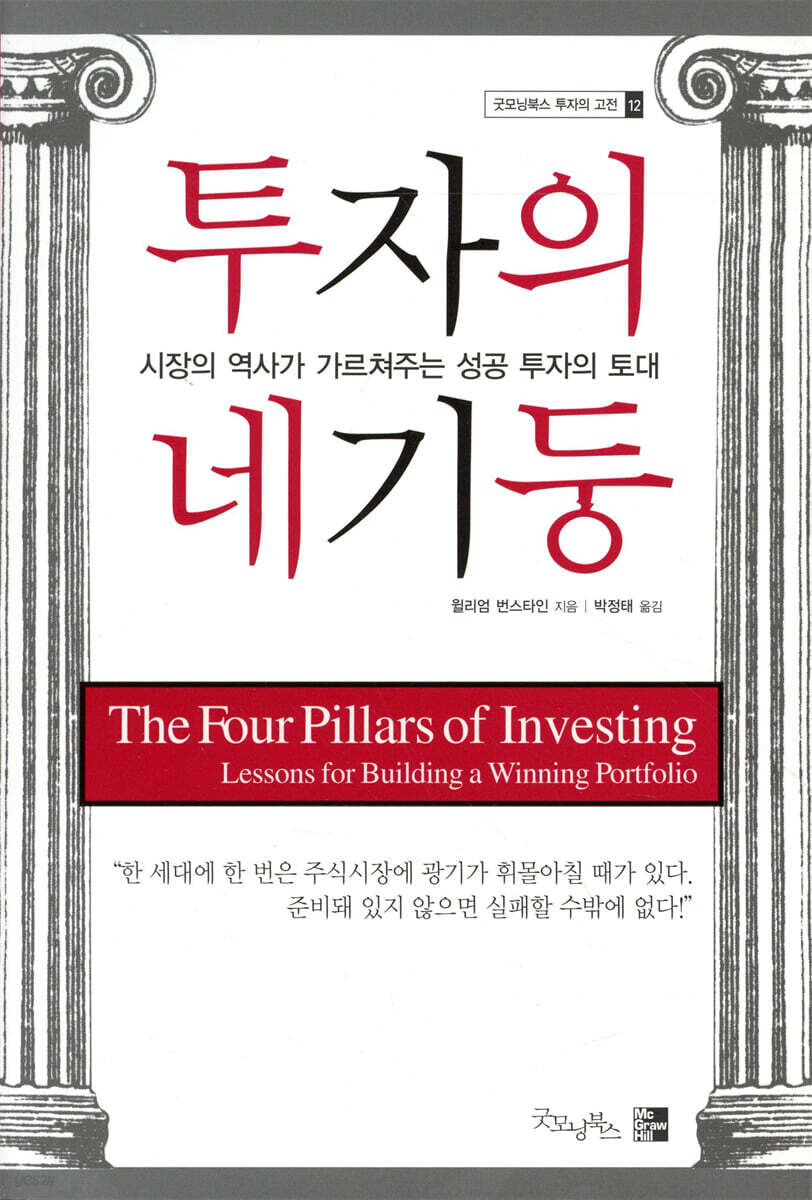
The Four Pillars of Investment
 |
Description
Book Introduction
This is a logically organized commentary on the wisdom of successful investment that you must know to become a wise investor.
In this book, author Dr. William Bernstein shows how individual investors can achieve better investment performance than most professional fund managers, "even without long purse strings and a lot of luck."
Dr. Bernstein, a scientist and physician before being an investment theorist, rationally argues his claims based on extensive statistical data and various materials from centuries of market history.
It is also notable that it completely shatters the conventional wisdom and common sense prevalent in the investment world.
In this book, author Dr. William Bernstein shows how individual investors can achieve better investment performance than most professional fund managers, "even without long purse strings and a lot of luck."
Dr. Bernstein, a scientist and physician before being an investment theorist, rationally argues his claims based on extensive statistical data and various materials from centuries of market history.
It is also notable that it completely shatters the conventional wisdom and common sense prevalent in the investment world.
- You can preview some of the book's contents.
Preview
index
introduction
Pillar One: Investment Theory
1.
No glory without courage
Dreamlike returns that no one has ever enjoyed / Risk and returns throughout human history / Credit risk and interest rate risk / Bond returns in the 20th century / History of stock returns / Comparison of returns on stocks, long-term government bonds, and short-term government bonds / Risk - the second realm / Developed and emerging markets / Large-cap and small-cap stocks / Growth stocks and value stocks / History of returns and risks / The new world order around 1913
2.
Taming the Beast
Dividend Discount Model and Discount Rate / Future Dividend Flows, Long Live / Simple Mathematical Formula / Gordon's Equation / The Relationship Between Discount Rates and Stock Prices / Discount Rates and Individual Stocks / Social Discount Rates and Stock Returns / Return Forecasts / Discrepancies Between Realization and Expectations
3.
The market is smarter than you
Dancing with Statistics / "Can Stock Market Forecasters Predict?" / More Bad News: Market Shocks / The Returns of Big Pension Funds / The Laughable Claim to Be able to Time the Market / Eugene Fama Shouts "Eureka!" / Warren Buffett and Peter Lynch / The Really Bad News / Bill Fouse's Brilliant Idea / What About the Buy-and-Hold Strategy? / Why Index Investing "Fails" and Other Rationalizations
4.
Perfect portfolio
The Key Is in the Portfolio / Step 1: Risky Assets and Risk-Free Assets / Step 2: Global Equity Weighting / Step 3: Size and Value / Step 4: Sector / Real-World Examples
Pillar Two: Investment History
5.
Overheated: A History of Madness
Technological Revolution and Stock Returns / Prerequisites for Bubble Formation / South Sea Bubble / Grand Canal Speculation Mania / Basic Laws of Technology Investment / Railroad Mania / The Great Bubble of the 1920s / Gogo Market and Nifty Fifty / Dot-Com Mania
6.
Market Crashes: Pain and Opportunity
"The Death of Stocks" / Benjamin Graham in Crisis / How to Deal with Panics / Nothing New in This World
Third Pillar: Investor Sentiment
7.
Investment Behavior Errors
Richard Thaler Missed the Basketball Game / Crowd Psychology and Trends / Overconfidence / Recent Preferences and Mean Reversion / "I Want to Have Fun Investing" / Myopic Loss Aversion / Are Great Companies Great Stocks? / The Face Hidden in the Clouds / Mental Accounting / Country Club Syndrome
8.
Prescription for irrational behavior
Break with the crowd / Don't trust your head / Ignore the last 10 years / Dare to be a fool / Look risk straight in the eye / There are no great stocks / Enjoy randomness / Integrate mental accounting / Don't be a "rich bong"
Fourth Pillar: Investment Business
9.
Stockbrokers are not on your side
The Reality of the Securities Industry / Charles Merrill's "Betrayal" / The Sinister Underbelly of Stockbrokers
10.
Mutual funds aren't on our side either.
Road Funds and No-Road Funds / Out in the Sun, But Not Far Behind the Forest / Showcasing Flagship Funds / Investment Firms and Marketing Firms / John Bogle Breaks the Herd
11.
Journalists Meet Wall Street
"Confessions of a Former Mutual Fund Specialist" / Who Should You Listen to? / My Recommended Investment Classics
12.
Final words of advice
References
Translator's Note
Pillar One: Investment Theory
1.
No glory without courage
Dreamlike returns that no one has ever enjoyed / Risk and returns throughout human history / Credit risk and interest rate risk / Bond returns in the 20th century / History of stock returns / Comparison of returns on stocks, long-term government bonds, and short-term government bonds / Risk - the second realm / Developed and emerging markets / Large-cap and small-cap stocks / Growth stocks and value stocks / History of returns and risks / The new world order around 1913
2.
Taming the Beast
Dividend Discount Model and Discount Rate / Future Dividend Flows, Long Live / Simple Mathematical Formula / Gordon's Equation / The Relationship Between Discount Rates and Stock Prices / Discount Rates and Individual Stocks / Social Discount Rates and Stock Returns / Return Forecasts / Discrepancies Between Realization and Expectations
3.
The market is smarter than you
Dancing with Statistics / "Can Stock Market Forecasters Predict?" / More Bad News: Market Shocks / The Returns of Big Pension Funds / The Laughable Claim to Be able to Time the Market / Eugene Fama Shouts "Eureka!" / Warren Buffett and Peter Lynch / The Really Bad News / Bill Fouse's Brilliant Idea / What About the Buy-and-Hold Strategy? / Why Index Investing "Fails" and Other Rationalizations
4.
Perfect portfolio
The Key Is in the Portfolio / Step 1: Risky Assets and Risk-Free Assets / Step 2: Global Equity Weighting / Step 3: Size and Value / Step 4: Sector / Real-World Examples
Pillar Two: Investment History
5.
Overheated: A History of Madness
Technological Revolution and Stock Returns / Prerequisites for Bubble Formation / South Sea Bubble / Grand Canal Speculation Mania / Basic Laws of Technology Investment / Railroad Mania / The Great Bubble of the 1920s / Gogo Market and Nifty Fifty / Dot-Com Mania
6.
Market Crashes: Pain and Opportunity
"The Death of Stocks" / Benjamin Graham in Crisis / How to Deal with Panics / Nothing New in This World
Third Pillar: Investor Sentiment
7.
Investment Behavior Errors
Richard Thaler Missed the Basketball Game / Crowd Psychology and Trends / Overconfidence / Recent Preferences and Mean Reversion / "I Want to Have Fun Investing" / Myopic Loss Aversion / Are Great Companies Great Stocks? / The Face Hidden in the Clouds / Mental Accounting / Country Club Syndrome
8.
Prescription for irrational behavior
Break with the crowd / Don't trust your head / Ignore the last 10 years / Dare to be a fool / Look risk straight in the eye / There are no great stocks / Enjoy randomness / Integrate mental accounting / Don't be a "rich bong"
Fourth Pillar: Investment Business
9.
Stockbrokers are not on your side
The Reality of the Securities Industry / Charles Merrill's "Betrayal" / The Sinister Underbelly of Stockbrokers
10.
Mutual funds aren't on our side either.
Road Funds and No-Road Funds / Out in the Sun, But Not Far Behind the Forest / Showcasing Flagship Funds / Investment Firms and Marketing Firms / John Bogle Breaks the Herd
11.
Journalists Meet Wall Street
"Confessions of a Former Mutual Fund Specialist" / Who Should You Listen to? / My Recommended Investment Classics
12.
Final words of advice
References
Translator's Note
Into the book
No one can time the market.
It's the same for you or anyone else.
As Keynes said, accept the pain of regular losses without complaint.
That is the duty of those who own stock. ---p.173
From the underwater exploration bubble to the dot-com mania, every financial speculative extravaganza should be more than just a fun story.
This is a lesson that any investor should never forget.
When speculative frenzy sweeps the market, even the principles that have been maintained over the years are forgotten.
Heed the warning signs: "displacement factors" like technological innovation and new financial instruments, excessive credit expansion, forgetting about past bubbles, and a flood of new investors who are more inclined to speculative fantasies than to hard math.
If you've discovered these four phenomena, quietly close your wallet and recall John Templeton's famous saying: The four most expensive English words in the world are "This time, it's different." ---p.246
What should investors do when the inevitable market crash arrives? One thing is certain: they should never panic and sell everything.
First of all, keep your cool.
To do that, you need to have a clear asset allocation principle.
In the world of investing, two things separate professionals from amateurs: First, professionals know that even a severe bear market is a part of life and there's no way to escape its effects, while amateurs don't.
Second, even when the market becomes rough, professionals do not deviate from their usual principles.
But amateurs abandon principles and goals.
There are many amateurs who don't even have such principles or goals. ---p.262
It would be foolish to believe that the cycle of madness, panic, and collapse will ever end.
The fact that the market no longer exhibits extreme deviant behavior is like losing the pattern on a tiger's skin.
In that respect, it is also certain that the pessimistic mood that swept the market 30 and 70 years ago will soon return.
It's the same for you or anyone else.
As Keynes said, accept the pain of regular losses without complaint.
That is the duty of those who own stock. ---p.173
From the underwater exploration bubble to the dot-com mania, every financial speculative extravaganza should be more than just a fun story.
This is a lesson that any investor should never forget.
When speculative frenzy sweeps the market, even the principles that have been maintained over the years are forgotten.
Heed the warning signs: "displacement factors" like technological innovation and new financial instruments, excessive credit expansion, forgetting about past bubbles, and a flood of new investors who are more inclined to speculative fantasies than to hard math.
If you've discovered these four phenomena, quietly close your wallet and recall John Templeton's famous saying: The four most expensive English words in the world are "This time, it's different." ---p.246
What should investors do when the inevitable market crash arrives? One thing is certain: they should never panic and sell everything.
First of all, keep your cool.
To do that, you need to have a clear asset allocation principle.
In the world of investing, two things separate professionals from amateurs: First, professionals know that even a severe bear market is a part of life and there's no way to escape its effects, while amateurs don't.
Second, even when the market becomes rough, professionals do not deviate from their usual principles.
But amateurs abandon principles and goals.
There are many amateurs who don't even have such principles or goals. ---p.262
It would be foolish to believe that the cycle of madness, panic, and collapse will ever end.
The fact that the market no longer exhibits extreme deviant behavior is like losing the pattern on a tiger's skin.
In that respect, it is also certain that the pessimistic mood that swept the market 30 and 70 years ago will soon return.
---p.264
Publisher's Review
This book is a very cool-headed investment guide.
Every sentence in this book reveals the unique and witty personality of the author, Dr. William Bernstein.
A representative example is the part where the factors of bubble formation by monetary finance theorist Hyman Minsky are reversed and match the factors of bubble collapse.
The bubble bursts when a new technology that had piqued the public's curiosity loses trust, and the subsequent credit crunch and loss of trust in the new technology have a mutually reinforcing effect.
The author adds that investors often forget that market crashes are usually followed by recoveries, and that they have trouble calculating the value of stocks mathematically when prices are rising, but then calculate them with impunity when prices fall.
This is truly a sharp and poignant analysis.
The four pillars of investment presented by Dr. Bernstein in this book are investment theory, investment history, investment psychology, and investment business.
·Investment theory: Risk and return are inseparable.
You can't expect high returns without taking risks.
You can't beat the market.
But don't be too sad.
Because no one else can do that.
·It would be foolish to believe that the cycle of investment history, from mania to panic to collapse, will ever end.
Once in a generation or so, the market will go crazy.
If you don't prepare in advance, you are bound to fail.
·Investment Psychology Your strongest enemy is yourself.
A brilliant mind alone cannot lead to success in investing.
Let go of your excessive confidence.
The most widely accepted wisdom in today's market is usually wrong.
·The service that investment business securities brokers provide to their customers is similar to the service that bank robbers provide to banks.
Make sure the mutual fund company you're investing in is a genuine investment company or just a marketing firm.
Books about stock investment often feature anecdotes that capture readers' attention, such as "earning thousands of percent in short-term returns" or boasting that "we are revealing for the first time the investment strategies of big players that no one knows about."
However, in this book, you won't find any of the common "secrets to selecting stocks that consistently hit the upper limit" or "secrets to astronomical returns from investment experts," no matter how hard you look.
This book is one that should rather be "thrown away."
We must abandon our greed for a big hit, abandon our excessive confidence, and abandon flashy investment products and high fees.
So what's left for investors? Dr. Bernstein says there's still a lot left.
In fact, there are index funds, various bonds, and all types of commodity assets from all over the world.
There are so many benefits that it's hard to choose.
If I were to summarize Dr. Bernstein's message in this book in a few sentences, it would be this: Forget about trying to hit the jackpot or time the market perfectly.
Say goodbye to superstar fund managers and market strategists.
Investors, you have nothing left to lose but the chains that have entangled you.
Every sentence in this book reveals the unique and witty personality of the author, Dr. William Bernstein.
A representative example is the part where the factors of bubble formation by monetary finance theorist Hyman Minsky are reversed and match the factors of bubble collapse.
The bubble bursts when a new technology that had piqued the public's curiosity loses trust, and the subsequent credit crunch and loss of trust in the new technology have a mutually reinforcing effect.
The author adds that investors often forget that market crashes are usually followed by recoveries, and that they have trouble calculating the value of stocks mathematically when prices are rising, but then calculate them with impunity when prices fall.
This is truly a sharp and poignant analysis.
The four pillars of investment presented by Dr. Bernstein in this book are investment theory, investment history, investment psychology, and investment business.
·Investment theory: Risk and return are inseparable.
You can't expect high returns without taking risks.
You can't beat the market.
But don't be too sad.
Because no one else can do that.
·It would be foolish to believe that the cycle of investment history, from mania to panic to collapse, will ever end.
Once in a generation or so, the market will go crazy.
If you don't prepare in advance, you are bound to fail.
·Investment Psychology Your strongest enemy is yourself.
A brilliant mind alone cannot lead to success in investing.
Let go of your excessive confidence.
The most widely accepted wisdom in today's market is usually wrong.
·The service that investment business securities brokers provide to their customers is similar to the service that bank robbers provide to banks.
Make sure the mutual fund company you're investing in is a genuine investment company or just a marketing firm.
Books about stock investment often feature anecdotes that capture readers' attention, such as "earning thousands of percent in short-term returns" or boasting that "we are revealing for the first time the investment strategies of big players that no one knows about."
However, in this book, you won't find any of the common "secrets to selecting stocks that consistently hit the upper limit" or "secrets to astronomical returns from investment experts," no matter how hard you look.
This book is one that should rather be "thrown away."
We must abandon our greed for a big hit, abandon our excessive confidence, and abandon flashy investment products and high fees.
So what's left for investors? Dr. Bernstein says there's still a lot left.
In fact, there are index funds, various bonds, and all types of commodity assets from all over the world.
There are so many benefits that it's hard to choose.
If I were to summarize Dr. Bernstein's message in this book in a few sentences, it would be this: Forget about trying to hit the jackpot or time the market perfectly.
Say goodbye to superstar fund managers and market strategists.
Investors, you have nothing left to lose but the chains that have entangled you.
GOODS SPECIFICS
- Date of issue: July 15, 2009
- Page count, weight, size: 368 pages | 550g | 153*224*30mm
- ISBN13: 9788991378193
- ISBN10: 8991378196
You may also like
카테고리
korean


korean

![GQ KOREA Mark (Monthly): December [2025]](http://librairie.coreenne.fr/cdn/shop/files/8ef265dbbfbf186523ed75ba7319009d.jpg?v=1765340328&width=3840)


