

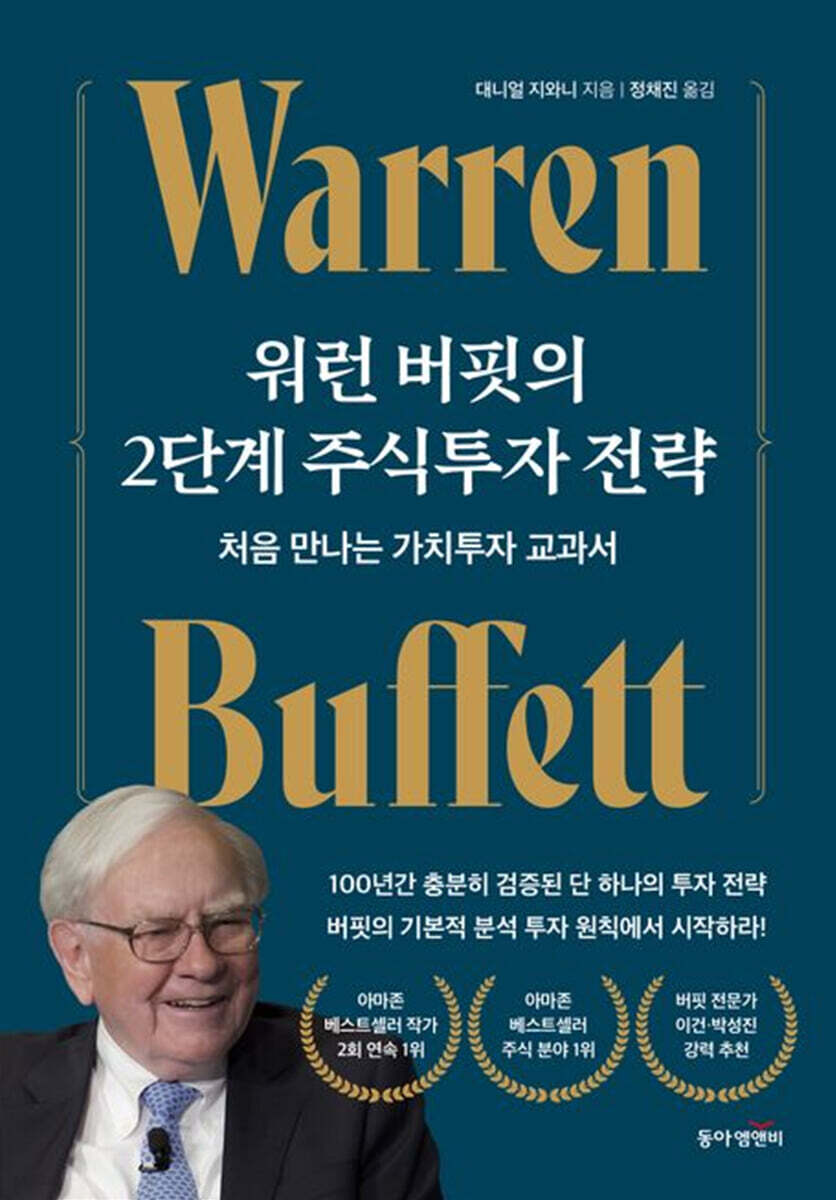
Warren Buffett's Two-Step Stock Investment Strategy
 |
Description
Book Introduction
Warren Buffett's stock investment strategy summarized in two steps!
A textbook for beginner investors, Buffett beginners, and value investors.
“A friendly book that sticks to the basics!”
"The First Book to Read if You Want to Invest Like Buffett"
A stock investment strategy book that explains Warren Buffett's two-step process for deciding which stocks to buy and when, and provides easy-to-follow instructions for individual investors to apply.
We've broken down the process of finding excellent companies and determining the right purchase price into a way that even novice investors can easily understand.
Daniel Ziwani, known as the "youngest investment genius," has written a comprehensive book explaining how he achieved high returns by utilizing the investment principles of "fundamental analysis," which have been thoroughly tested over the past 100 years.
This is a useful stock investment textbook for investors who want to invest like Warren Buffett, beginners in value investing, and beginners in stock investing.
The author considers "free cash flow" to be the most important indicator for finding excellent companies, and explains its concept and calculation process in a very simple way.
This book details the key indicators of fundamental analysis for finding excellent companies, including how to use the income statement, balance sheet, and cash flow statement for analysis, and the three types of economic moats that excellent companies must possess.
The section (Chapter 3) that explains the concept and calculation process of "intrinsic value," which is a key method for finding a fair price, is one of the strengths of this book, and its explanation is exceptionally clear.
This is also used in Chapter 4 dividend investing.
In addition, it thoroughly covers the fundamentals of investing, including diversification, emotional factors investors should be wary of (such as the anchoring effect, Monte Carlo fallacy, and FOMO), market capitalization-based investment methods, and when to sell stocks.
Rich and easy-to-understand examples help with understanding.
The author wrote the preface for the Korean edition for Korean readers who are currently experiencing an unusual bull market as of November 2025.
The translator has added notes to help Korean readers and novice investors understand.
The author is considered an investment genius who has achieved high returns by utilizing the principles of this book in companies such as Apple (450%), Meta (350%), Amazon (120%), and Cheesecake Factory (120%).
He wrote his debut book when he was 17, and it became the #1 bestseller in the stock category on Amazon, receiving praise from legendary investors such as Howard Marks and Bill Ackman.
Domestic Buffett experts also gave favorable reviews, saying, “I am very happy to have finally come across an investment book that is both faithful to the basics and friendly.” (Lee Geon, investment book translator) “If you want to learn about Buffett’s investments, I recommend reading this book first.” (Park Seong-jin, CEO of Ian Investment Consulting)
Overseas media outlets also praised the book, calling it “a book read by billionaires” (The Times) and “one of the 20 best investment introductory books of all time” (Book authority.org).
A textbook for beginner investors, Buffett beginners, and value investors.
“A friendly book that sticks to the basics!”
"The First Book to Read if You Want to Invest Like Buffett"
A stock investment strategy book that explains Warren Buffett's two-step process for deciding which stocks to buy and when, and provides easy-to-follow instructions for individual investors to apply.
We've broken down the process of finding excellent companies and determining the right purchase price into a way that even novice investors can easily understand.
Daniel Ziwani, known as the "youngest investment genius," has written a comprehensive book explaining how he achieved high returns by utilizing the investment principles of "fundamental analysis," which have been thoroughly tested over the past 100 years.
This is a useful stock investment textbook for investors who want to invest like Warren Buffett, beginners in value investing, and beginners in stock investing.
The author considers "free cash flow" to be the most important indicator for finding excellent companies, and explains its concept and calculation process in a very simple way.
This book details the key indicators of fundamental analysis for finding excellent companies, including how to use the income statement, balance sheet, and cash flow statement for analysis, and the three types of economic moats that excellent companies must possess.
The section (Chapter 3) that explains the concept and calculation process of "intrinsic value," which is a key method for finding a fair price, is one of the strengths of this book, and its explanation is exceptionally clear.
This is also used in Chapter 4 dividend investing.
In addition, it thoroughly covers the fundamentals of investing, including diversification, emotional factors investors should be wary of (such as the anchoring effect, Monte Carlo fallacy, and FOMO), market capitalization-based investment methods, and when to sell stocks.
Rich and easy-to-understand examples help with understanding.
The author wrote the preface for the Korean edition for Korean readers who are currently experiencing an unusual bull market as of November 2025.
The translator has added notes to help Korean readers and novice investors understand.
The author is considered an investment genius who has achieved high returns by utilizing the principles of this book in companies such as Apple (450%), Meta (350%), Amazon (120%), and Cheesecake Factory (120%).
He wrote his debut book when he was 17, and it became the #1 bestseller in the stock category on Amazon, receiving praise from legendary investors such as Howard Marks and Bill Ackman.
Domestic Buffett experts also gave favorable reviews, saying, “I am very happy to have finally come across an investment book that is both faithful to the basics and friendly.” (Lee Geon, investment book translator) “If you want to learn about Buffett’s investments, I recommend reading this book first.” (Park Seong-jin, CEO of Ian Investment Consulting)
Overseas media outlets also praised the book, calling it “a book read by billionaires” (The Times) and “one of the 20 best investment introductory books of all time” (Book authority.org).
index
Author's Preface to the Korean Edition
Introduction: The One Investment Strategy That's Been Well-Proven Over the Past 100 Years
Chapter 1: What are the core principles of investing?
Chapter 2 Step 1: How to Find Great Companies?
Chapter 3 Step 2: How to Determine the Right Buy Price?
Chapter 4: How to Properly Use Dividend Investing
Chapter 5: When Diversification Becomes Harmful
Chapter 6: Why Emotions Destroy Profits?
Chapter 7: Market Capitalization and the Nature of Investment Opportunities
Chapter 8: Things to Check Before Investing
Chapter 9 When Should You Sell Stocks?
What are you talking about?
Translator's Note
Introduction: The One Investment Strategy That's Been Well-Proven Over the Past 100 Years
Chapter 1: What are the core principles of investing?
Chapter 2 Step 1: How to Find Great Companies?
Chapter 3 Step 2: How to Determine the Right Buy Price?
Chapter 4: How to Properly Use Dividend Investing
Chapter 5: When Diversification Becomes Harmful
Chapter 6: Why Emotions Destroy Profits?
Chapter 7: Market Capitalization and the Nature of Investment Opportunities
Chapter 8: Things to Check Before Investing
Chapter 9 When Should You Sell Stocks?
What are you talking about?
Translator's Note
Into the book
When purchasing real estate, a smart investor doesn't simply compare the purchase price with the future sale price.
It's fundamental to consider what kind of cash flow the property can actually generate and how reasonable the return is relative to the investment.
The same goes for stocks and other assets.
Buying only to sell at a higher price later is, as Warren Buffett puts it, “a game of finding the next fool to buy at a higher price.”
--- p.27~28
A company with a net profit margin of less than 5% may be considered to have insufficient cushion against rising costs.
Businesses may experience sudden increases in costs due to unexpected external factors, such as rising raw material prices.
For companies that are already barely making a profit, this increase in costs alone can significantly worsen cash flow and put them at risk of turning into a deficit.
--- p.66
To achieve good returns, it's important to invest in companies with an ROIC exceeding 10% and the ability to sustain it over the long term (with the exception of dividend stocks). An ROIC exceeding 10% indicates a company's excellent capital management skills and high profitability.
This also signals that the company has a structure that allows it to effectively utilize significant amounts of capital to generate sustained investment returns.
--- p.75~76
To account for this, when applying the second-year discount factor, we must take into account the fact that the free cash flow occurs two years later.
Therefore, 1.1 (the required rate of return) is squared and used as the discount factor.
Dividing $100 by 1.1 squared, or 1.21, gives us the present value of the free cash flow in year 2, which is $82.64.
In other words, if you invest $82.64 today, you will receive $100 in two years, achieving a compound annual return of 10%.
In fact, if you compound $82.64 annually at 10%, it will be worth about $100 after two years.
--- p.106~107
WACC is commonly used in practice to help management determine whether a new project is worth pursuing.
For example, let's say a restaurant is planning to open a new branch.
To determine whether this investment is viable, management will look at the WACC and compare it to the project's expected return.
For example, let's say a restaurant issues bonds to raise $500,000 and its WACC is 5%.
This means that the cost of financing is 5% per year, which would cost you $25,000 per year.
--- p.
127
When determining whether dividends can continue to increase in the future, one indicator worth considering is the dividend payout ratio.
The dividend payout ratio is an indicator that shows how much of the net profit earned by a company over a year is distributed to shareholders as dividends.
The calculation is simple.
Simply divide the dividend per share by the earnings per share.
For example, if a company's dividend payout ratio is 45%, it means that the company is paying out 45% of its net income as dividends.
This metric allows us to gauge how actively a company is returning profits and how much room there is left to increase dividends in the future.
--- p.159~160
First, to calculate next year's dividend, simply add 6% to the current dividend of $4.04.
That is, multiplying 4.04 by 1.06 gives you the expected dividend for the first year.
The second-year dividend can be calculated by multiplying the first-year dividend by 1.06, and the third-year dividend can be calculated by multiplying the second-year amount by 1.06 in the same way.
The dividend prediction values calculated in this way are summarized in [Table 4-1].
--- p.170~171
For example, let's say you invest $100,000 in an S&P 500 index fund and earn an average annual return of 10%.
After deducting the 0.03% fee, the real return is approximately 9.97%, and if maintained for 50 years, the assets will grow to approximately $11.5 million.
On the other hand, even if you invest in a mutual fund with the same expected return, if the fee is 0.7%, the actual return will be only about 9.3%, and after 50 years, your assets will remain at about $8.5 million.
The difference in assets between the two cases is approximately $3 million, or 30%.
--- p.
202
This error is common in financial markets, especially in trading strategies based on technical analysis.
For example, the 'hammer candle' pattern is often interpreted as a signal of a rebound after a stock price decline.
However, just because there have been cases in the past where stock prices rose after this pattern appeared, it is statistically unconvincing to expect the same results when the same pattern appears again.1 It is a very dangerous approach to assume that the same results will occur in the future simply because a certain result was repeated in the past.
--- p.
218
So, when fear spreads in the market and investors rush to sell, which stocks do people sell first? Most people sell small-cap stocks, which they perceive as volatile.
Therefore, small-cap stocks often experience greater declines than large-cap stocks and trade at greater discounts.
This is precisely the key opportunity when investing in small-cap stocks.
Because deeper discounts can ultimately lead to greater profit potential.
--- p.
239~240
For example, let's say you find a stock that's trading 10% below its intrinsic value and invest in it.
At the time, I thought it was a pretty good price and I would have been happy to invest the money.
But when markets are volatile, better opportunities can present themselves in just a few days or weeks.
For example, you might find shares of a completely different, excellent company trading at a whopping 30% below their intrinsic value.
This stock is a much more attractive investment.
It's fundamental to consider what kind of cash flow the property can actually generate and how reasonable the return is relative to the investment.
The same goes for stocks and other assets.
Buying only to sell at a higher price later is, as Warren Buffett puts it, “a game of finding the next fool to buy at a higher price.”
--- p.27~28
A company with a net profit margin of less than 5% may be considered to have insufficient cushion against rising costs.
Businesses may experience sudden increases in costs due to unexpected external factors, such as rising raw material prices.
For companies that are already barely making a profit, this increase in costs alone can significantly worsen cash flow and put them at risk of turning into a deficit.
--- p.66
To achieve good returns, it's important to invest in companies with an ROIC exceeding 10% and the ability to sustain it over the long term (with the exception of dividend stocks). An ROIC exceeding 10% indicates a company's excellent capital management skills and high profitability.
This also signals that the company has a structure that allows it to effectively utilize significant amounts of capital to generate sustained investment returns.
--- p.75~76
To account for this, when applying the second-year discount factor, we must take into account the fact that the free cash flow occurs two years later.
Therefore, 1.1 (the required rate of return) is squared and used as the discount factor.
Dividing $100 by 1.1 squared, or 1.21, gives us the present value of the free cash flow in year 2, which is $82.64.
In other words, if you invest $82.64 today, you will receive $100 in two years, achieving a compound annual return of 10%.
In fact, if you compound $82.64 annually at 10%, it will be worth about $100 after two years.
--- p.106~107
WACC is commonly used in practice to help management determine whether a new project is worth pursuing.
For example, let's say a restaurant is planning to open a new branch.
To determine whether this investment is viable, management will look at the WACC and compare it to the project's expected return.
For example, let's say a restaurant issues bonds to raise $500,000 and its WACC is 5%.
This means that the cost of financing is 5% per year, which would cost you $25,000 per year.
--- p.
127
When determining whether dividends can continue to increase in the future, one indicator worth considering is the dividend payout ratio.
The dividend payout ratio is an indicator that shows how much of the net profit earned by a company over a year is distributed to shareholders as dividends.
The calculation is simple.
Simply divide the dividend per share by the earnings per share.
For example, if a company's dividend payout ratio is 45%, it means that the company is paying out 45% of its net income as dividends.
This metric allows us to gauge how actively a company is returning profits and how much room there is left to increase dividends in the future.
--- p.159~160
First, to calculate next year's dividend, simply add 6% to the current dividend of $4.04.
That is, multiplying 4.04 by 1.06 gives you the expected dividend for the first year.
The second-year dividend can be calculated by multiplying the first-year dividend by 1.06, and the third-year dividend can be calculated by multiplying the second-year amount by 1.06 in the same way.
The dividend prediction values calculated in this way are summarized in [Table 4-1].
--- p.170~171
For example, let's say you invest $100,000 in an S&P 500 index fund and earn an average annual return of 10%.
After deducting the 0.03% fee, the real return is approximately 9.97%, and if maintained for 50 years, the assets will grow to approximately $11.5 million.
On the other hand, even if you invest in a mutual fund with the same expected return, if the fee is 0.7%, the actual return will be only about 9.3%, and after 50 years, your assets will remain at about $8.5 million.
The difference in assets between the two cases is approximately $3 million, or 30%.
--- p.
202
This error is common in financial markets, especially in trading strategies based on technical analysis.
For example, the 'hammer candle' pattern is often interpreted as a signal of a rebound after a stock price decline.
However, just because there have been cases in the past where stock prices rose after this pattern appeared, it is statistically unconvincing to expect the same results when the same pattern appears again.1 It is a very dangerous approach to assume that the same results will occur in the future simply because a certain result was repeated in the past.
--- p.
218
So, when fear spreads in the market and investors rush to sell, which stocks do people sell first? Most people sell small-cap stocks, which they perceive as volatile.
Therefore, small-cap stocks often experience greater declines than large-cap stocks and trade at greater discounts.
This is precisely the key opportunity when investing in small-cap stocks.
Because deeper discounts can ultimately lead to greater profit potential.
--- p.
239~240
For example, let's say you find a stock that's trading 10% below its intrinsic value and invest in it.
At the time, I thought it was a pretty good price and I would have been happy to invest the money.
But when markets are volatile, better opportunities can present themselves in just a few days or weeks.
For example, you might find shares of a completely different, excellent company trading at a whopping 30% below their intrinsic value.
This stock is a much more attractive investment.
--- p.271
Publisher's Review
Principles Every Stock Investor Must Know
“Education or qualifications do not guarantee investment performance!”
A book has been published that explains the logical and practical principles that investors must know in an easy-to-understand manner.
This is Warren Buffett's Two-Step Stock Investment Strategy by Daniel Ziwani, one of America's youngest investment geniuses.
The author says that he utilized the investment principle of "fundamental analysis," which has been proven to be effective for 100 years, and that it is a strategy actually used by legendary investors such as Warren Buffett.
The author, who achieved returns of hundreds of percent in several stocks, including Apple and Amazon, as a teenager and wrote this book at the age of 17 while still a high school student, stated his goal in writing the book as “to prove that one can achieve sufficient investment performance even without a master’s or doctorate degree or special background knowledge.”
The book unfolds Warren Buffett's famous quote, "Buy excellent companies at fair prices," one by one, over nine chapters.
First, it covers corporate valuation methods, which determine which stocks are good. It explains indicators such as price-to-earnings ratio (PER), net income, operating profit, and free cash flow. Of these, free cash flow is singled out as the most important metric for investment decisions, and is thoroughly explored in chapters 1 and 2.
The advantage is that it is explained clearly so that even novice investors can understand it.
The translator's supplementary explanation helps understanding.
Chapter 3 covers in detail how to buy good stocks found this way at reasonable prices.
We will unravel Warren Buffett's words one by one, who defined intrinsic value as "the present value of all the cash flows that a company can generate over its remaining life."
The time value of money, or present value, and the concept of future cash flows are explained easily through examples and solved with simple formulas.
The formula for calculating intrinsic value is also similar to Warren Buffett's method, which states, "Discount the expected future cash flows to their present value."
The method of calculating the actual intrinsic value, that is, the 'Discounted Cash Flow (DCF) method', is explained step-by-step so that even beginners can follow it.
I think the unique strength of this book is that it explains the theoretical parts that may seem somewhat difficult in a simple and clear way.
Systematic dividend investment, principles of diversification, etc.
It covers all the basic principles of investing!
Chapter 4 systematically explains dividend investing.
We will briefly explain the key indicators of dividend investing, such as dividend yield, dividend growth rate, and dividend payout ratio.
The author has summarized the principles of dividend investment, including his expertise on how to utilize these indicators.
The method for calculating the intrinsic value of stocks explained above can also be applied to dividend investing to more systematically predict dividend payments.
Real-life examples help you understand.
Chapter 5 examines how to properly diversify your portfolio and common mistakes made in diversifying investments.
It systematically explains how to strike a balance between reducing risk and not missing out on profit opportunities, and the range within which you can strike a good balance between diversification and concentration.
For beginner investors, we provide a reference for portfolio diversification ratios.
Chapter 6 deals with 'emotional' issues, one of the things investors should be wary of.
It explains why emotions can lead to poor decisions and how to achieve better investment performance.
The influence of emotions on investment is thoroughly explained, including anchor pricing, the Monte Carlo fallacy (gambler's fallacy), "following the Joneses" or FOMO (following the Joneses) investing by comparing yourself to others, and the tendency to sell early.
Chapter 7 covers the opportunities presented by small-cap investing, why market capitalization is not an absolute criterion for determining investment performance, the fundamental reasons for losses in small-cap stocks, and the background to the evaluation of large-cap stocks as relatively stable investments.
Chapter 8 covers the stress and anxiety that can arise during the investment process, as well as essential factors to consider before investing.
Let's look at debt and emergency funds.
Before investing in stocks, systematically distinguish between debts that need to be resolved and debts that can be maintained.
The difference is made clear through welfare.
Finally, Chapter 9 discusses the question, “When should you sell your stocks?”
We'll look at three situations in which you should sell stocks and explain the fundamental reasons why Warren Buffett rarely sells stocks.
At 284 pages, it's relatively short for an investment book, but it contains all the necessary strategies.
The author adds, "You don't need to know all the various investment theories and strategies," and "In fact, knowing too many strategies can make you confused about which path to take."
He emphasizes that the book's strategies have been "used by many excellent investors and will continue to be used in the future."
"A friendly investment book that sticks to the basics." "If you want to learn about Buffett's investments, read this book first."
The translator, who is always described as “trustworthy and readable,” said, “I am very happy to have come across an investment book that is both faithful to the basics and friendly after a long time,” and Park Seong-jin, CEO of Ian Investment Consulting, who translated famous investment books such as “Michael Mauboussin: The Equation of Luck and Skill,” said, “If you want to learn about Buffett’s investments, I recommend reading this book first.”
The Times said, “It’s time ordinary investors started reading this book that billionaires are reading.” Book authority.org, the world’s largest book recommendation site, called it “one of the 20 best investment introduction books of all time.”
[Continuing with the recommendation]
Jiwani has a unique ability to discover new insights into Warren Buffett's investment philosophy.
I highly recommended this book to my friends too.
▶ Capital Market Developer at Thomson Reuters
Jiwani accurately analyzes Warren Buffett's strategy.
This is an excellent book for investors who want to understand Buffett's stock analysis method.
▶ Asset manager with over 30 years of experience
“Education or qualifications do not guarantee investment performance!”
A book has been published that explains the logical and practical principles that investors must know in an easy-to-understand manner.
This is Warren Buffett's Two-Step Stock Investment Strategy by Daniel Ziwani, one of America's youngest investment geniuses.
The author says that he utilized the investment principle of "fundamental analysis," which has been proven to be effective for 100 years, and that it is a strategy actually used by legendary investors such as Warren Buffett.
The author, who achieved returns of hundreds of percent in several stocks, including Apple and Amazon, as a teenager and wrote this book at the age of 17 while still a high school student, stated his goal in writing the book as “to prove that one can achieve sufficient investment performance even without a master’s or doctorate degree or special background knowledge.”
The book unfolds Warren Buffett's famous quote, "Buy excellent companies at fair prices," one by one, over nine chapters.
First, it covers corporate valuation methods, which determine which stocks are good. It explains indicators such as price-to-earnings ratio (PER), net income, operating profit, and free cash flow. Of these, free cash flow is singled out as the most important metric for investment decisions, and is thoroughly explored in chapters 1 and 2.
The advantage is that it is explained clearly so that even novice investors can understand it.
The translator's supplementary explanation helps understanding.
Chapter 3 covers in detail how to buy good stocks found this way at reasonable prices.
We will unravel Warren Buffett's words one by one, who defined intrinsic value as "the present value of all the cash flows that a company can generate over its remaining life."
The time value of money, or present value, and the concept of future cash flows are explained easily through examples and solved with simple formulas.
The formula for calculating intrinsic value is also similar to Warren Buffett's method, which states, "Discount the expected future cash flows to their present value."
The method of calculating the actual intrinsic value, that is, the 'Discounted Cash Flow (DCF) method', is explained step-by-step so that even beginners can follow it.
I think the unique strength of this book is that it explains the theoretical parts that may seem somewhat difficult in a simple and clear way.
Systematic dividend investment, principles of diversification, etc.
It covers all the basic principles of investing!
Chapter 4 systematically explains dividend investing.
We will briefly explain the key indicators of dividend investing, such as dividend yield, dividend growth rate, and dividend payout ratio.
The author has summarized the principles of dividend investment, including his expertise on how to utilize these indicators.
The method for calculating the intrinsic value of stocks explained above can also be applied to dividend investing to more systematically predict dividend payments.
Real-life examples help you understand.
Chapter 5 examines how to properly diversify your portfolio and common mistakes made in diversifying investments.
It systematically explains how to strike a balance between reducing risk and not missing out on profit opportunities, and the range within which you can strike a good balance between diversification and concentration.
For beginner investors, we provide a reference for portfolio diversification ratios.
Chapter 6 deals with 'emotional' issues, one of the things investors should be wary of.
It explains why emotions can lead to poor decisions and how to achieve better investment performance.
The influence of emotions on investment is thoroughly explained, including anchor pricing, the Monte Carlo fallacy (gambler's fallacy), "following the Joneses" or FOMO (following the Joneses) investing by comparing yourself to others, and the tendency to sell early.
Chapter 7 covers the opportunities presented by small-cap investing, why market capitalization is not an absolute criterion for determining investment performance, the fundamental reasons for losses in small-cap stocks, and the background to the evaluation of large-cap stocks as relatively stable investments.
Chapter 8 covers the stress and anxiety that can arise during the investment process, as well as essential factors to consider before investing.
Let's look at debt and emergency funds.
Before investing in stocks, systematically distinguish between debts that need to be resolved and debts that can be maintained.
The difference is made clear through welfare.
Finally, Chapter 9 discusses the question, “When should you sell your stocks?”
We'll look at three situations in which you should sell stocks and explain the fundamental reasons why Warren Buffett rarely sells stocks.
At 284 pages, it's relatively short for an investment book, but it contains all the necessary strategies.
The author adds, "You don't need to know all the various investment theories and strategies," and "In fact, knowing too many strategies can make you confused about which path to take."
He emphasizes that the book's strategies have been "used by many excellent investors and will continue to be used in the future."
"A friendly investment book that sticks to the basics." "If you want to learn about Buffett's investments, read this book first."
The translator, who is always described as “trustworthy and readable,” said, “I am very happy to have come across an investment book that is both faithful to the basics and friendly after a long time,” and Park Seong-jin, CEO of Ian Investment Consulting, who translated famous investment books such as “Michael Mauboussin: The Equation of Luck and Skill,” said, “If you want to learn about Buffett’s investments, I recommend reading this book first.”
The Times said, “It’s time ordinary investors started reading this book that billionaires are reading.” Book authority.org, the world’s largest book recommendation site, called it “one of the 20 best investment introduction books of all time.”
[Continuing with the recommendation]
Jiwani has a unique ability to discover new insights into Warren Buffett's investment philosophy.
I highly recommended this book to my friends too.
▶ Capital Market Developer at Thomson Reuters
Jiwani accurately analyzes Warren Buffett's strategy.
This is an excellent book for investors who want to understand Buffett's stock analysis method.
▶ Asset manager with over 30 years of experience
GOODS SPECIFICS
- Date of issue: November 30, 2025
- Page count, weight, size: 284 pages | 384g | 145*208*20mm
- ISBN13: 9791163639749
- ISBN10: 1163639745
You may also like
카테고리
korean


korean

![GQ KOREA Mark (Monthly): December [2025]](http://librairie.coreenne.fr/cdn/shop/files/8ef265dbbfbf186523ed75ba7319009d.jpg?v=1765340328&width=3840)


