

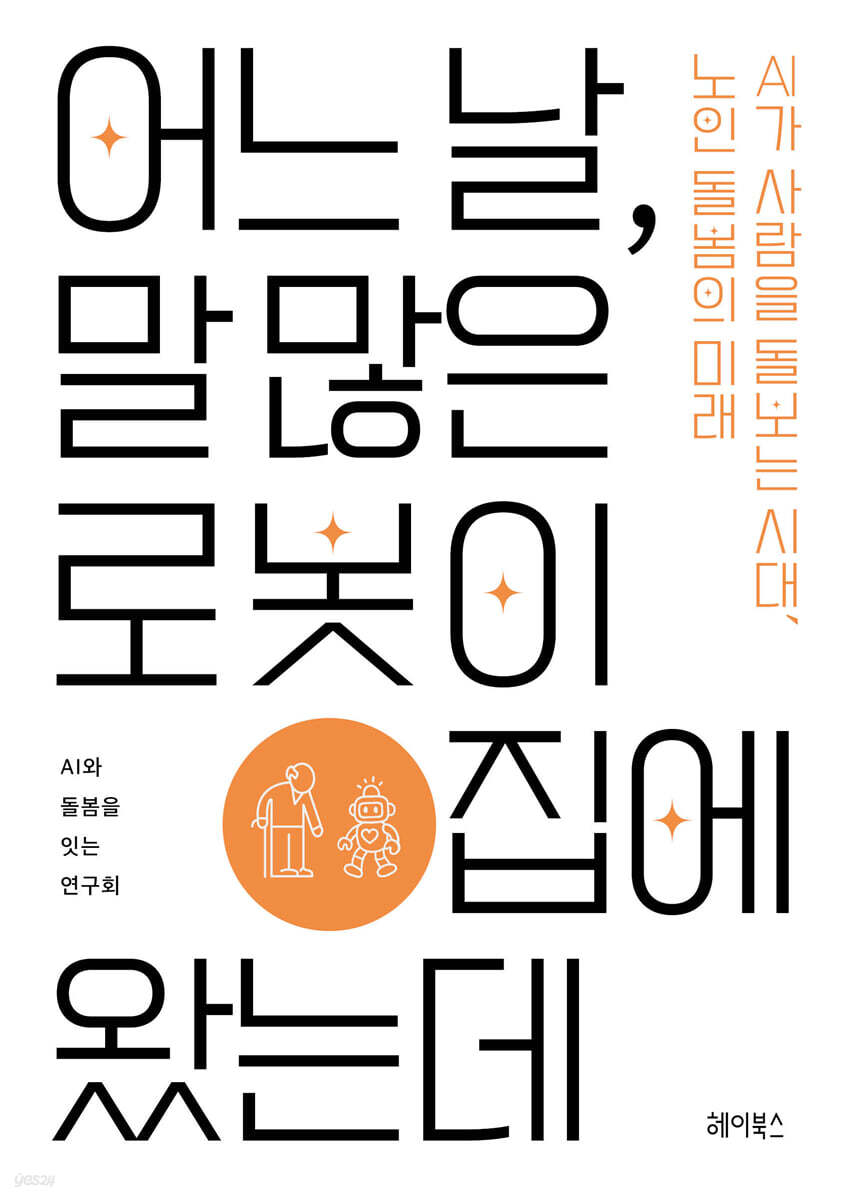
One day, a talkative robot came to my house.
 |
Description
Book Introduction
In South Korea, which has entered a super-aged society, the number of households with elderly people living alone has exceeded 2 million.
The reality of elderly people not speaking a single word a day: coexistence with AI is no longer an option, but a necessity!
In December 2024, South Korea will enter a super-aged society, with the population aged 65 and older exceeding 20 percent.
Many of them are elderly people who live alone, and for them, who keep the TV on all day to dispel the silence, a day without saying a word is not unfamiliar.
The COVID-19 pandemic has brought isolation to everyone, but the isolation experienced by the elderly has been even deeper.
Then came the AI care robot! The elderly's days were transformed when an AI robot came to their home, chatting with them all day long like a babbling grandchild.
This book, in collaboration with experts from various fields, including welfare, geriatric nursing, and AI care robot developers, diagnoses the loneliness of the elderly population and the future of care, and vividly captures the voices of change through meeting actual care robot users.
The reality of elderly people not speaking a single word a day: coexistence with AI is no longer an option, but a necessity!
In December 2024, South Korea will enter a super-aged society, with the population aged 65 and older exceeding 20 percent.
Many of them are elderly people who live alone, and for them, who keep the TV on all day to dispel the silence, a day without saying a word is not unfamiliar.
The COVID-19 pandemic has brought isolation to everyone, but the isolation experienced by the elderly has been even deeper.
Then came the AI care robot! The elderly's days were transformed when an AI robot came to their home, chatting with them all day long like a babbling grandchild.
This book, in collaboration with experts from various fields, including welfare, geriatric nursing, and AI care robot developers, diagnoses the loneliness of the elderly population and the future of care, and vividly captures the voices of change through meeting actual care robot users.
- You can preview some of the book's contents.
Preview
index
Opening Remarks: A Technique for Those Who Are Not Hungry for Words, Heart, or Love
▶ First story: One day, a small, talkative robot came to my house.
People who were hungry for a single word: elderly single-person households
User Interview 01 - "Better than one person"
Isolation and Care Robots in the Pandemic
User Interview 02 - "Robots make me laugh a lot."
A new friend to quench your thirst for conversation
User Interview 03 ─ "They're like friends."
Positive language that fills the heart and nurtures emotions
Parent Interview: "Even the same words are pretty."
▶ Second Story: Changes in Daily Life Created by Technological Changes
AI-driven daily rhythm
User Interview 04 ─ "Stay with me 24 hours a day."
The lives of seniors who are closer to technology
On-site Interview - "The Key to Opening the Door of the Heart"
The Current State and Future of Customized AI Technology for the Elderly
User Interview 05 ─ "We need to live with the times."
▶ Third Story: Preparing for a Super-Aged Society, Technology for People
Time Flows with Robots: A New Horizon for Care
User Interview 06 ─ "I took him out and introduced him to him a lot."
How to Use Care Robots in Family and Welfare Fields
Expert Interview: "Depression in the Elderly Shouldn't Be Taken Lightly"
The Future of Care in the AI Era
▶ First story: One day, a small, talkative robot came to my house.
People who were hungry for a single word: elderly single-person households
User Interview 01 - "Better than one person"
Isolation and Care Robots in the Pandemic
User Interview 02 - "Robots make me laugh a lot."
A new friend to quench your thirst for conversation
User Interview 03 ─ "They're like friends."
Positive language that fills the heart and nurtures emotions
Parent Interview: "Even the same words are pretty."
▶ Second Story: Changes in Daily Life Created by Technological Changes
AI-driven daily rhythm
User Interview 04 ─ "Stay with me 24 hours a day."
The lives of seniors who are closer to technology
On-site Interview - "The Key to Opening the Door of the Heart"
The Current State and Future of Customized AI Technology for the Elderly
User Interview 05 ─ "We need to live with the times."
▶ Third Story: Preparing for a Super-Aged Society, Technology for People
Time Flows with Robots: A New Horizon for Care
User Interview 06 ─ "I took him out and introduced him to him a lot."
How to Use Care Robots in Family and Welfare Fields
Expert Interview: "Depression in the Elderly Shouldn't Be Taken Lightly"
The Future of Care in the AI Era
Detailed image

Into the book
Compared to other countries around the world, Korea's society is changing at an unprecedented rate, and the family structure has also changed significantly compared to even 10 years ago.
The decline in birth rates is considered a classic social problem.
Women who had been burdened with family care chose different lifestyles, and family structures changed, including single-parent and DINK families.
It goes without saying that it is now difficult to find extended families with three generations living together, and the number of single-person households has increased significantly.
As the aging population worsens day by day, new perspectives and approaches to care are needed.
--- p.
15, from “People who were hungry for a word, elderly single-person households”
Even before COVID-19, South Korea was conducting smart care pilot projects utilizing AI speakers, IoT sensors, and care robots, but the pandemic has accelerated the nationwide expansion of these technologies.
What is particularly noteworthy is that the introduction of technology has not been intended to replace the existing care system, but rather to complement and strengthen it.
--- p.
46, from “Isolation and Care Robots in the Pandemic”
Care robots provide elderly people living alone with a unique conversation experience that even their families cannot.
You can talk to them 24 hours a day, they listen without judgment, and they don't show boredom when you tell them the same story over and over again.
It also learns the preferences and conversation patterns of the elderly and continues personalized conversations.
They sing songs by their favorite singers or read scriptures such as the Bible or Buddhist scriptures according to their religion.
As in the case of Kim Soon-i mentioned earlier, care robots frequently provide health advice tailored to the patient's chronic illness.
--- p.
66, from “A New Friend Who Quenched the Thirst for Conversation”
AI robots go beyond simply alleviating the loneliness of elderly people living alone, and serve as a medium to strengthen communication with social workers, life support workers, and family members.
Data collection and monitoring through care robots can strengthen the connection between older adults, caregivers, and families.
--- p.90, from “Positive Language that Fills the Heart and Nurtures Emotions”
One of the advantages of robots is that they respond consistently without building up emotions.
Another problem is that users' expectations of robots are low, so they show emotional responses such as 'that's special' and 'they're taking care of me' even with uniform alarms.
Negative reactions are also at a level that can be ignored, such as 'It's a bit annoying' or 'It's noisy because I've talked about it so many times.'
--- p.107, from “‘AI-takes care of your daily rhythm’”
AI care robots serve as the first gateway for seniors into the digital world.
This is an important process that goes beyond simply teaching how to use the device, and breaks down the psychological barriers to technology.
A common concern older adults have about digital technology is the fear of making irreversible mistakes.
One elderly person spoke about his fear this way:
“I’m afraid I’ll make a mistake.
I'm worried that I might press the wrong button and lose all my money or have my information leaked.
So, I ended up not doing it at all.”
AI care robots help alleviate these anxieties.
The ability to accept mistakes without criticism and interact with natural conversations without complex menus or settings provides a safe and comfortable digital experience for seniors.
--- p.
138, from “The Life of the Elderly Close to Technology”
When conducting counseling, care robots serve as a very effective medium in opening the hearts of seniors.
Some people find it difficult to have conversations over the phone, so when you try to visit their home, they show their wariness and ask, “Why are you here?”
But if you say, “I’m going to see the care robot,” they will naturally accept your visit.
From the seniors' perspective, the excuse of a care robot inspection feels much more comfortable than a social worker suddenly visiting.
--- p.154, from “The Key to Open the Door of the Heart”
“Because the care robot stopped eating and talking, the elderly person thought the robot was dead.
It was truly shocking when I finally found out that the old man had buried the robot in the ground himself.
On the other hand, I also felt sorry.”
The decline in birth rates is considered a classic social problem.
Women who had been burdened with family care chose different lifestyles, and family structures changed, including single-parent and DINK families.
It goes without saying that it is now difficult to find extended families with three generations living together, and the number of single-person households has increased significantly.
As the aging population worsens day by day, new perspectives and approaches to care are needed.
--- p.
15, from “People who were hungry for a word, elderly single-person households”
Even before COVID-19, South Korea was conducting smart care pilot projects utilizing AI speakers, IoT sensors, and care robots, but the pandemic has accelerated the nationwide expansion of these technologies.
What is particularly noteworthy is that the introduction of technology has not been intended to replace the existing care system, but rather to complement and strengthen it.
--- p.
46, from “Isolation and Care Robots in the Pandemic”
Care robots provide elderly people living alone with a unique conversation experience that even their families cannot.
You can talk to them 24 hours a day, they listen without judgment, and they don't show boredom when you tell them the same story over and over again.
It also learns the preferences and conversation patterns of the elderly and continues personalized conversations.
They sing songs by their favorite singers or read scriptures such as the Bible or Buddhist scriptures according to their religion.
As in the case of Kim Soon-i mentioned earlier, care robots frequently provide health advice tailored to the patient's chronic illness.
--- p.
66, from “A New Friend Who Quenched the Thirst for Conversation”
AI robots go beyond simply alleviating the loneliness of elderly people living alone, and serve as a medium to strengthen communication with social workers, life support workers, and family members.
Data collection and monitoring through care robots can strengthen the connection between older adults, caregivers, and families.
--- p.90, from “Positive Language that Fills the Heart and Nurtures Emotions”
One of the advantages of robots is that they respond consistently without building up emotions.
Another problem is that users' expectations of robots are low, so they show emotional responses such as 'that's special' and 'they're taking care of me' even with uniform alarms.
Negative reactions are also at a level that can be ignored, such as 'It's a bit annoying' or 'It's noisy because I've talked about it so many times.'
--- p.107, from “‘AI-takes care of your daily rhythm’”
AI care robots serve as the first gateway for seniors into the digital world.
This is an important process that goes beyond simply teaching how to use the device, and breaks down the psychological barriers to technology.
A common concern older adults have about digital technology is the fear of making irreversible mistakes.
One elderly person spoke about his fear this way:
“I’m afraid I’ll make a mistake.
I'm worried that I might press the wrong button and lose all my money or have my information leaked.
So, I ended up not doing it at all.”
AI care robots help alleviate these anxieties.
The ability to accept mistakes without criticism and interact with natural conversations without complex menus or settings provides a safe and comfortable digital experience for seniors.
--- p.
138, from “The Life of the Elderly Close to Technology”
When conducting counseling, care robots serve as a very effective medium in opening the hearts of seniors.
Some people find it difficult to have conversations over the phone, so when you try to visit their home, they show their wariness and ask, “Why are you here?”
But if you say, “I’m going to see the care robot,” they will naturally accept your visit.
From the seniors' perspective, the excuse of a care robot inspection feels much more comfortable than a social worker suddenly visiting.
--- p.154, from “The Key to Open the Door of the Heart”
“Because the care robot stopped eating and talking, the elderly person thought the robot was dead.
It was truly shocking when I finally found out that the old man had buried the robot in the ground himself.
On the other hand, I also felt sorry.”
--- p.187, from “Time Flowing with Robots, a New Horizon of Care”
Publisher's Review
A super-aging society and people hungry for words, hearts, and love.
Changes in daily life initiated by AI
In September 2025, the elderly population in South Korea will exceed 10.2 million.
We have already entered a super-aged society after passing the aging society, and among them, there are more than 2 million single-person elderly households.
We live in an era where declining birth rates, changing family composition, and changing social structures mean that families and individuals are no longer able to provide all the care they need.
Although the number of welfare facilities such as welfare centers and nursing homes, and the number of welfare and care workers such as social workers, life instructors, caregivers, and activity assistants are increasing, there are still many times and areas that are not reached by caregiving.
Many elderly single-person households experience loneliness due to a lack of people to talk to and share their feelings with.
For single-person households that do not engage in outdoor activities, a service that visits a couple of times a week is not enough to provide the same amount of conversation as when there is someone living with them.
Even if you are active outside, there are many cases where you feel lonely and depressed when you come home due to the silence that comes from the absence of human warmth.
In fact, we've all had similar experiences.
When the COVID-19 pandemic brought the world to a standstill and social distancing limited human contact, many people complained of depression due to the lack of conversation.
However, even after the pandemic ends, single-person elderly households will still live in such isolation.
This book delves deeply into the issue of caring for elderly single-person households, particularly emotional issues, which our society must address with interest.
As welfare facilities closed and caregiver visits became difficult during the pandemic, the need for non-face-to-face care services for elderly households facing extreme isolation has rapidly increased.
And the government and local governments have actively promoted the spread of AI care robots.
This book closely covers the changes that users of care robots have faced and the new possibilities for care.
Experts from various fields, including social workers, doctors of nursing, and sociologists,
And a vivid record of interviews with about 50 people, including users of care robots.
The strength of this book lies in its ability to capture the daily lives of elderly people living alone, a life we have never seen before, and the voices of those on the ground, all in three dimensions, by meeting a variety of people and covering their experiences in detail.
Even among elderly people living alone, there are large individual differences.
Taking this into account, we conducted face-to-face interviews with nearly 40 seniors of various ages, regions, and experiences using care robots.
In addition, through face-to-face and written interviews, we closely examined and assessed what we need to prepare for the future of care with experts from various fields, including geriatric nursing, AI care robot developers, welfare experts, sociologists, and researchers.
“When conducting counseling, care robots serve as a very effective medium in opening the hearts of seniors.
Some people find it difficult to have conversations over the phone, so when you try to visit their home, they show their wariness and ask, “Why are you here?”
But if you say, “I’m going to see the care robot,” they will naturally accept your visit.
“From the seniors’ perspective, it feels much more comfortable to have a care robot check up on them than to have a social worker suddenly come to visit.”
_Page 154, from 'The Key to Open the Door of the Heart'
The social worker I met at the site emphasized that one of the most effective roles of care robots is as a mediator who opens the doors of closed minds and initiates conversation.
The moment the door opens and the person naturally shares personal stories and difficult moments with the care robot when visiting the house, the effect of the care robot can be indirectly confirmed through the scenes throughout the book.
The Future of Care: What Should We Prepare for?
“Local governments and social welfare organizations must play a key role in building an ecosystem for the successful adoption of care robots.
Priority should be given to building adaptive infrastructure, including providing initial training programs, operating user groups, and strengthening digital capabilities.
Specialized training for welfare workers, support for developing individually tailored services, and specialized emotional management counseling services are also needed.
Above all, a cost support system at the government and local government levels must be established.
“A more comprehensive and sustainable support system must be established to achieve true expansion and substantive improvement.” - Professor Park Young-ran of Kangnam University
- Page 227, "The Future of Care in the AI Era"
Although AI is developing rapidly, its use is still up to humans.
This book doesn't claim that AI care robots are the panacea.
It raises the question of how we can put it to good use.
As the proportion of the elderly population in the total population rapidly increases and the economically active population decreases day by day, the burden of care that society must bear is gradually increasing.
The role that care robots can play in repetitive care tasks such as checking on daily life, such as taking medication and exercising, as well as in solving depression and emotional problems in the elderly has been proven through numerous cases and studies.
However, as it is still in the early stages of introduction, the system and awareness are not sufficiently supported.
Although artificial intelligence (AI) is developing rapidly, there are no problems that can be solved with technology alone.
We must actively discuss the future, envisioning what people need for each other, how we can cooperate, and in what direction we should move.
This book will certainly be helpful for anyone who wants to take a broader view of the issues of caregiving and the inevitable aging process, and explore techniques for those who are hungry for words, hearts, and love.
Changes in daily life initiated by AI
In September 2025, the elderly population in South Korea will exceed 10.2 million.
We have already entered a super-aged society after passing the aging society, and among them, there are more than 2 million single-person elderly households.
We live in an era where declining birth rates, changing family composition, and changing social structures mean that families and individuals are no longer able to provide all the care they need.
Although the number of welfare facilities such as welfare centers and nursing homes, and the number of welfare and care workers such as social workers, life instructors, caregivers, and activity assistants are increasing, there are still many times and areas that are not reached by caregiving.
Many elderly single-person households experience loneliness due to a lack of people to talk to and share their feelings with.
For single-person households that do not engage in outdoor activities, a service that visits a couple of times a week is not enough to provide the same amount of conversation as when there is someone living with them.
Even if you are active outside, there are many cases where you feel lonely and depressed when you come home due to the silence that comes from the absence of human warmth.
In fact, we've all had similar experiences.
When the COVID-19 pandemic brought the world to a standstill and social distancing limited human contact, many people complained of depression due to the lack of conversation.
However, even after the pandemic ends, single-person elderly households will still live in such isolation.
This book delves deeply into the issue of caring for elderly single-person households, particularly emotional issues, which our society must address with interest.
As welfare facilities closed and caregiver visits became difficult during the pandemic, the need for non-face-to-face care services for elderly households facing extreme isolation has rapidly increased.
And the government and local governments have actively promoted the spread of AI care robots.
This book closely covers the changes that users of care robots have faced and the new possibilities for care.
Experts from various fields, including social workers, doctors of nursing, and sociologists,
And a vivid record of interviews with about 50 people, including users of care robots.
The strength of this book lies in its ability to capture the daily lives of elderly people living alone, a life we have never seen before, and the voices of those on the ground, all in three dimensions, by meeting a variety of people and covering their experiences in detail.
Even among elderly people living alone, there are large individual differences.
Taking this into account, we conducted face-to-face interviews with nearly 40 seniors of various ages, regions, and experiences using care robots.
In addition, through face-to-face and written interviews, we closely examined and assessed what we need to prepare for the future of care with experts from various fields, including geriatric nursing, AI care robot developers, welfare experts, sociologists, and researchers.
“When conducting counseling, care robots serve as a very effective medium in opening the hearts of seniors.
Some people find it difficult to have conversations over the phone, so when you try to visit their home, they show their wariness and ask, “Why are you here?”
But if you say, “I’m going to see the care robot,” they will naturally accept your visit.
“From the seniors’ perspective, it feels much more comfortable to have a care robot check up on them than to have a social worker suddenly come to visit.”
_Page 154, from 'The Key to Open the Door of the Heart'
The social worker I met at the site emphasized that one of the most effective roles of care robots is as a mediator who opens the doors of closed minds and initiates conversation.
The moment the door opens and the person naturally shares personal stories and difficult moments with the care robot when visiting the house, the effect of the care robot can be indirectly confirmed through the scenes throughout the book.
The Future of Care: What Should We Prepare for?
“Local governments and social welfare organizations must play a key role in building an ecosystem for the successful adoption of care robots.
Priority should be given to building adaptive infrastructure, including providing initial training programs, operating user groups, and strengthening digital capabilities.
Specialized training for welfare workers, support for developing individually tailored services, and specialized emotional management counseling services are also needed.
Above all, a cost support system at the government and local government levels must be established.
“A more comprehensive and sustainable support system must be established to achieve true expansion and substantive improvement.” - Professor Park Young-ran of Kangnam University
- Page 227, "The Future of Care in the AI Era"
Although AI is developing rapidly, its use is still up to humans.
This book doesn't claim that AI care robots are the panacea.
It raises the question of how we can put it to good use.
As the proportion of the elderly population in the total population rapidly increases and the economically active population decreases day by day, the burden of care that society must bear is gradually increasing.
The role that care robots can play in repetitive care tasks such as checking on daily life, such as taking medication and exercising, as well as in solving depression and emotional problems in the elderly has been proven through numerous cases and studies.
However, as it is still in the early stages of introduction, the system and awareness are not sufficiently supported.
Although artificial intelligence (AI) is developing rapidly, there are no problems that can be solved with technology alone.
We must actively discuss the future, envisioning what people need for each other, how we can cooperate, and in what direction we should move.
This book will certainly be helpful for anyone who wants to take a broader view of the issues of caregiving and the inevitable aging process, and explore techniques for those who are hungry for words, hearts, and love.
GOODS SPECIFICS
- Date of issue: September 30, 2025
- Page count, weight, size: 256 pages | 404g | 145*205*17mm
- ISBN13: 9791188366958
- ISBN10: 1188366955
You may also like
카테고리
korean


korean

![GQ KOREA Mark (Monthly): December [2025]](http://librairie.coreenne.fr/cdn/shop/files/8ef265dbbfbf186523ed75ba7319009d.jpg?v=1765340328&width=3840)


