

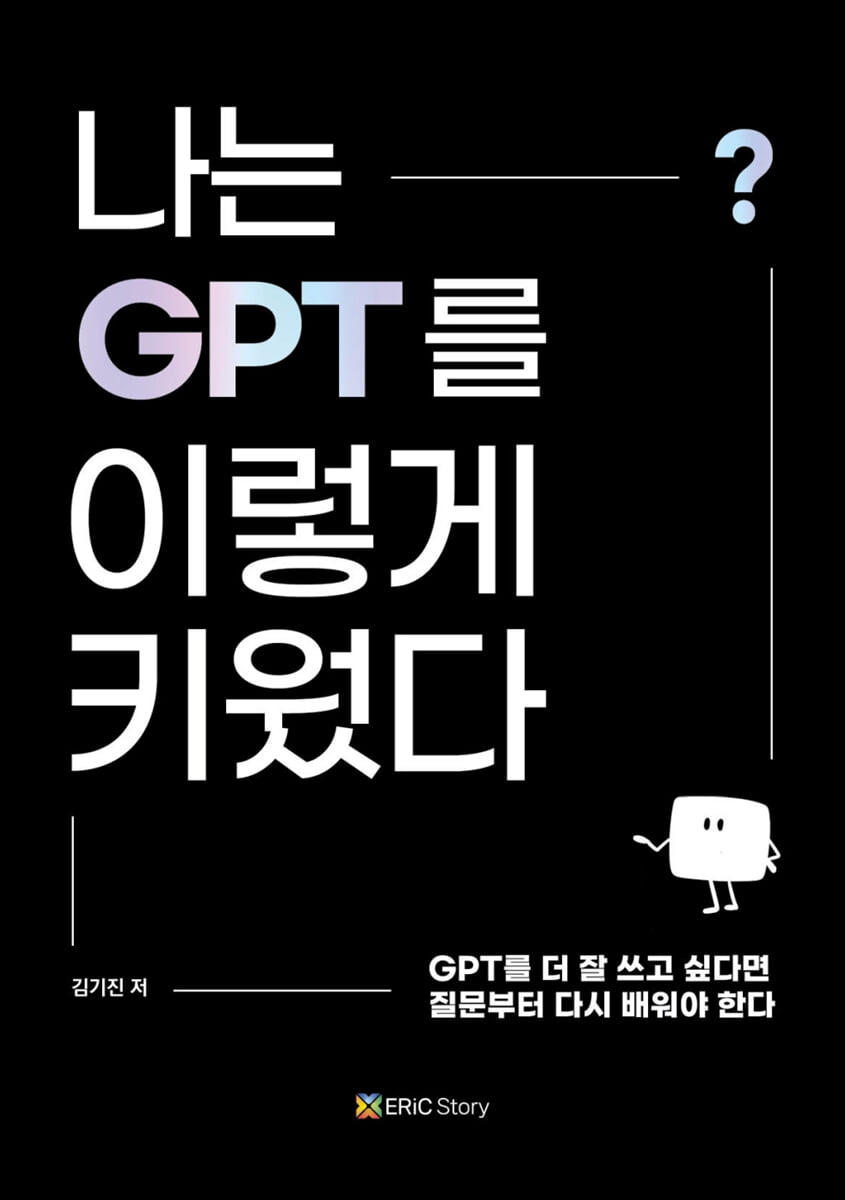
This is how I raised GPT
 |
Description
Book Introduction
“Have you ever been disappointed with GPT?”
Have you ever asked GPT for something and received an unexpected answer? You said, "Analyze this," but the result was awkward and disappointing.
The author says he also experienced the same disappointment.
But what happens next is different.
The author of this book is said to have asked himself this question at that moment:
“I wonder if the question I asked was wrong?”
Have you ever asked GPT for something and received an unexpected answer? You said, "Analyze this," but the result was awkward and disappointing.
The author says he also experienced the same disappointment.
But what happens next is different.
The author of this book is said to have asked himself this question at that moment:
“I wonder if the question I asked was wrong?”
index
· Prologue
― I found the tool and met a colleague.
PART 1.
I didn't know at first
(Empathy Stages: Anticipation and Frustration, Misunderstanding and Discovery)
Chapter 1.
Why do most GPT deployments fail?
- We talked, but it wasn't a conversation.
I was excited at first, but soon disappointed.
The order was given, but there was no context.
If you don't tell them, AI won't know.
AI only understands when spoken to.
As the questions change, so does GPT.
Chapter 2.
The question is GPT's growth energy.
If you want a desired outcome, start by designing the question.
The order of questions changes the results.
Questions are a map that points to your goals.
When your purpose is clear, your GPT becomes clearer too.
Structured questions create flow.
Good questions grow GPT.
Chapter 3. GPT Doesn't Learn on Itself
- I had to teach more than I thought.
AI doesn't act "automatically" like humans.
GPT also knows nothing without information.
I need to fill in the context of GPT.
Once is not enough, repetition is the answer.
GPT grows with repetition
PART 2.
The question is training, and GPT is growing.
(Execution phase: training and experimentation, collaboration and routinization)
Chapter 4. GPTs Need Personality, Too
- Once the persona was created, collaboration began.
Calling its name, the AI became "my person."
When I gave them roles and goals, their reactions changed.
Just changing the tone of voice changed the conversation.
Clear rules are needed, not vague freedom.
The frame is not meant to confine, but to nurture.
Chapter 5.
Input is growth
- GPT changed depending on the data provided.
The more information you input, the more GPT resembles you.
Writing for AI to read is also a skill.
There is a separate language for GPT.
You need to know how to read it to understand it properly.
Delete unnecessary words and give only the main points.
Chapter 6.
Question routines grow GPT
- Repetition creates thinking and develops GPT.
Even thoughts need a frame
Instead of asking every time, let's automate the questioning.
Let's embed question routines into GPTs.
Design your own growth loop with GPT.
My questioning style is my thinking style.
Chapter 7. How to Make AI a "Colleague," Not a "Tool"
- GPT has become a 'working together' colleague.
The moment a single line of meeting minutes becomes a proposal
If you get stuck, try some 'conversation sparring' with GPT.
Don't seek information alone.
Format change, now done by GPT
Optimize your work with GPT
PART 3.
In the end, it was the questions that raised me.
(Stage of Inner Growth: The Power of Questions, Transformation of Being)
Chapter 8. Incorporating GPT into Your Organizational Culture
- GPT grows within organizational culture.
We need to teach GPT our team's language.
Consistency is a strategy, let's design with WRG-CATs.
Designing GPTs together fosters teamwork.
Let's create our own 'GPT training method'
Different cultures lead to different GPTs.
Chapter 9.
In the end, it was the questions that raised me.
- As the questions deepened, I grew along with them.
GPT was a mirror that reflected my questions.
If you change the question, your thoughts will change.
Structure is not a tool to organize answers, but a framework that helps me grow.
I am now a person who works with questions.
The one who changed the most was, in the end, me.
· Epilogue
- Now, it's your turn to ask questions.
Appendix
Let's try 'raising' GPT right now.
Q 1. I used to view GPT only as a 'tool', but now I want to change it into a colleague.
Q 2.
If you rephrase that question, GPT's response changes.
Q 3.
If questions have 'types', how can they be divided?
Q4. GPT also needs personality. Designing your own persona.
Q 5.
If you change the question, GPT's answer will also change.
Q 6.
Let's turn these daily questions into our own routine.
Q7. Let's draw a picture of how you work with GPT.
Q 8.
Organizations with questions also grow GPT.
Q9. I thought I was growing GPT, but I was growing too.
[Special] A Letter to GPT, Who Helped Me Grow
― I found the tool and met a colleague.
PART 1.
I didn't know at first
(Empathy Stages: Anticipation and Frustration, Misunderstanding and Discovery)
Chapter 1.
Why do most GPT deployments fail?
- We talked, but it wasn't a conversation.
I was excited at first, but soon disappointed.
The order was given, but there was no context.
If you don't tell them, AI won't know.
AI only understands when spoken to.
As the questions change, so does GPT.
Chapter 2.
The question is GPT's growth energy.
If you want a desired outcome, start by designing the question.
The order of questions changes the results.
Questions are a map that points to your goals.
When your purpose is clear, your GPT becomes clearer too.
Structured questions create flow.
Good questions grow GPT.
Chapter 3. GPT Doesn't Learn on Itself
- I had to teach more than I thought.
AI doesn't act "automatically" like humans.
GPT also knows nothing without information.
I need to fill in the context of GPT.
Once is not enough, repetition is the answer.
GPT grows with repetition
PART 2.
The question is training, and GPT is growing.
(Execution phase: training and experimentation, collaboration and routinization)
Chapter 4. GPTs Need Personality, Too
- Once the persona was created, collaboration began.
Calling its name, the AI became "my person."
When I gave them roles and goals, their reactions changed.
Just changing the tone of voice changed the conversation.
Clear rules are needed, not vague freedom.
The frame is not meant to confine, but to nurture.
Chapter 5.
Input is growth
- GPT changed depending on the data provided.
The more information you input, the more GPT resembles you.
Writing for AI to read is also a skill.
There is a separate language for GPT.
You need to know how to read it to understand it properly.
Delete unnecessary words and give only the main points.
Chapter 6.
Question routines grow GPT
- Repetition creates thinking and develops GPT.
Even thoughts need a frame
Instead of asking every time, let's automate the questioning.
Let's embed question routines into GPTs.
Design your own growth loop with GPT.
My questioning style is my thinking style.
Chapter 7. How to Make AI a "Colleague," Not a "Tool"
- GPT has become a 'working together' colleague.
The moment a single line of meeting minutes becomes a proposal
If you get stuck, try some 'conversation sparring' with GPT.
Don't seek information alone.
Format change, now done by GPT
Optimize your work with GPT
PART 3.
In the end, it was the questions that raised me.
(Stage of Inner Growth: The Power of Questions, Transformation of Being)
Chapter 8. Incorporating GPT into Your Organizational Culture
- GPT grows within organizational culture.
We need to teach GPT our team's language.
Consistency is a strategy, let's design with WRG-CATs.
Designing GPTs together fosters teamwork.
Let's create our own 'GPT training method'
Different cultures lead to different GPTs.
Chapter 9.
In the end, it was the questions that raised me.
- As the questions deepened, I grew along with them.
GPT was a mirror that reflected my questions.
If you change the question, your thoughts will change.
Structure is not a tool to organize answers, but a framework that helps me grow.
I am now a person who works with questions.
The one who changed the most was, in the end, me.
· Epilogue
- Now, it's your turn to ask questions.
Appendix
Let's try 'raising' GPT right now.
Q 1. I used to view GPT only as a 'tool', but now I want to change it into a colleague.
Q 2.
If you rephrase that question, GPT's response changes.
Q 3.
If questions have 'types', how can they be divided?
Q4. GPT also needs personality. Designing your own persona.
Q 5.
If you change the question, GPT's answer will also change.
Q 6.
Let's turn these daily questions into our own routine.
Q7. Let's draw a picture of how you work with GPT.
Q 8.
Organizations with questions also grow GPT.
Q9. I thought I was growing GPT, but I was growing too.
[Special] A Letter to GPT, Who Helped Me Grow
Publisher's Review
GPT is not a tool, but a being that "grows by feeding on questions."
"This is how I raised GPT" is not a book about how to train GPT.
To be precise, it is closer to a book that trains my questioning skills through GPT.
At first, I just wanted to "try to write well," but I soon realized that as GPT grew, I, the one asking the questions, was also growing.
This book contains a wide range of know-how, from 'How to create a persona', 'How to design a questioning routine', to 'Strategies for using GPT as a team member in an organization'.
But at the heart of all that know-how lies one philosophy.
“Without good questions, GPT doesn’t grow.”
If you are this type of person, it will be even more fun to read.
Anyone who has tried GPT but felt something 'strange'
Practitioners who are at a loss as to how to write prompts
Leaders considering implementing GPT in their organizations
Every office worker who feels they have lost their 'immersion' in their work
This book isn't just a technical guide. It's more like a story about rediscovering our sense of work through conversations with GPT.
In particular, the journey of self-reflection and designing new ways of working through GPT is also an emotional growth story that teaches us how to "grow ourselves, not AI."
After reading this, you may experience changes like this.
You won't be disappointed if GPT gets the answer wrong.
→ Instead, we will redesign the question.
When things get stuck, you won't have to suffer alone.
→ A one-line question to GPT opens up a new path.
The start of the day is different.
→ Become someone who starts the day by asking, “What question should I ask today?”
I thought I was raising GPT, but it ended up raising me.
The author confesses:
"AI wasn't a tool. I was meeting 'colleagues' who worked with me." A single question transformed the way I worked, and a single conversation expanded me.
If you've ever felt like you've lost touch with your GPT, or if you feel like my questions are becoming stale and repetitive, this book might just help you regain that sense.
Now, what questions is your GPT waiting for?
"This is how I raised GPT."
"Have you ever been disappointed by GPT?" I've heard it's so great, so I tried it, but why does my GPT always give me such vague answers? But then I ask, "Could it be that it's not GPT that's at fault, but the questions I'm asking?" At that moment, the game changes. From viewing GPT merely as a "tool," to viewing it as a "colleague" you work with.
To grow GPT
How to create a persona and talk to AI
-The secret to growing every day by planting a question routine
- A strategy to cultivate a GPT culture within the organization and develop the entire team.
All of this is woven into one word: "question." The author states, "Without good questions, even GPT won't grow." Reading this book won't make you angry when GPT gives strange answers. Instead, it'll inspire you to formulate new questions.
When things get stuck, you don't just struggle alone. Instead, you find a "one-liner" question to ask GPT.
And then one day, you suddenly have that amazing moment where you realize, 'I thought I was raising GPT, but I was growing up.'
Has your GPT become nothing more than an "office tool" that simply does what it's told to do? Or is it just asking you the same questions every day? Perhaps by the time you close this book, you'll be asking yourself a different question today.
"This is how I raised GPT" is not a book about how to train GPT.
To be precise, it is closer to a book that trains my questioning skills through GPT.
At first, I just wanted to "try to write well," but I soon realized that as GPT grew, I, the one asking the questions, was also growing.
This book contains a wide range of know-how, from 'How to create a persona', 'How to design a questioning routine', to 'Strategies for using GPT as a team member in an organization'.
But at the heart of all that know-how lies one philosophy.
“Without good questions, GPT doesn’t grow.”
If you are this type of person, it will be even more fun to read.
Anyone who has tried GPT but felt something 'strange'
Practitioners who are at a loss as to how to write prompts
Leaders considering implementing GPT in their organizations
Every office worker who feels they have lost their 'immersion' in their work
This book isn't just a technical guide. It's more like a story about rediscovering our sense of work through conversations with GPT.
In particular, the journey of self-reflection and designing new ways of working through GPT is also an emotional growth story that teaches us how to "grow ourselves, not AI."
After reading this, you may experience changes like this.
You won't be disappointed if GPT gets the answer wrong.
→ Instead, we will redesign the question.
When things get stuck, you won't have to suffer alone.
→ A one-line question to GPT opens up a new path.
The start of the day is different.
→ Become someone who starts the day by asking, “What question should I ask today?”
I thought I was raising GPT, but it ended up raising me.
The author confesses:
"AI wasn't a tool. I was meeting 'colleagues' who worked with me." A single question transformed the way I worked, and a single conversation expanded me.
If you've ever felt like you've lost touch with your GPT, or if you feel like my questions are becoming stale and repetitive, this book might just help you regain that sense.
Now, what questions is your GPT waiting for?
"This is how I raised GPT."
"Have you ever been disappointed by GPT?" I've heard it's so great, so I tried it, but why does my GPT always give me such vague answers? But then I ask, "Could it be that it's not GPT that's at fault, but the questions I'm asking?" At that moment, the game changes. From viewing GPT merely as a "tool," to viewing it as a "colleague" you work with.
To grow GPT
How to create a persona and talk to AI
-The secret to growing every day by planting a question routine
- A strategy to cultivate a GPT culture within the organization and develop the entire team.
All of this is woven into one word: "question." The author states, "Without good questions, even GPT won't grow." Reading this book won't make you angry when GPT gives strange answers. Instead, it'll inspire you to formulate new questions.
When things get stuck, you don't just struggle alone. Instead, you find a "one-liner" question to ask GPT.
And then one day, you suddenly have that amazing moment where you realize, 'I thought I was raising GPT, but I was growing up.'
Has your GPT become nothing more than an "office tool" that simply does what it's told to do? Or is it just asking you the same questions every day? Perhaps by the time you close this book, you'll be asking yourself a different question today.
GOODS SPECIFICS
- Date of issue: August 15, 2025
- Page count, weight, size: 232 pages | 148*210*20mm
- ISBN13: 9791199224636
- ISBN10: 1199224634
You may also like
카테고리
korean


korean

![GQ KOREA Mark (Monthly): December [2025]](http://librairie.coreenne.fr/cdn/shop/files/8ef265dbbfbf186523ed75ba7319009d.jpg?v=1765340328&width=3840)


