![VOSTOK Magazine (bimonthly): Issue 45 [2024]](http://librairie.coreenne.fr/cdn/shop/files/f388977c7a9a03c7c39f7fad10cf1461.jpg?v=1765344490&width=3840)

VOSTOK Magazine (bimonthly): Issue 45 [2024]
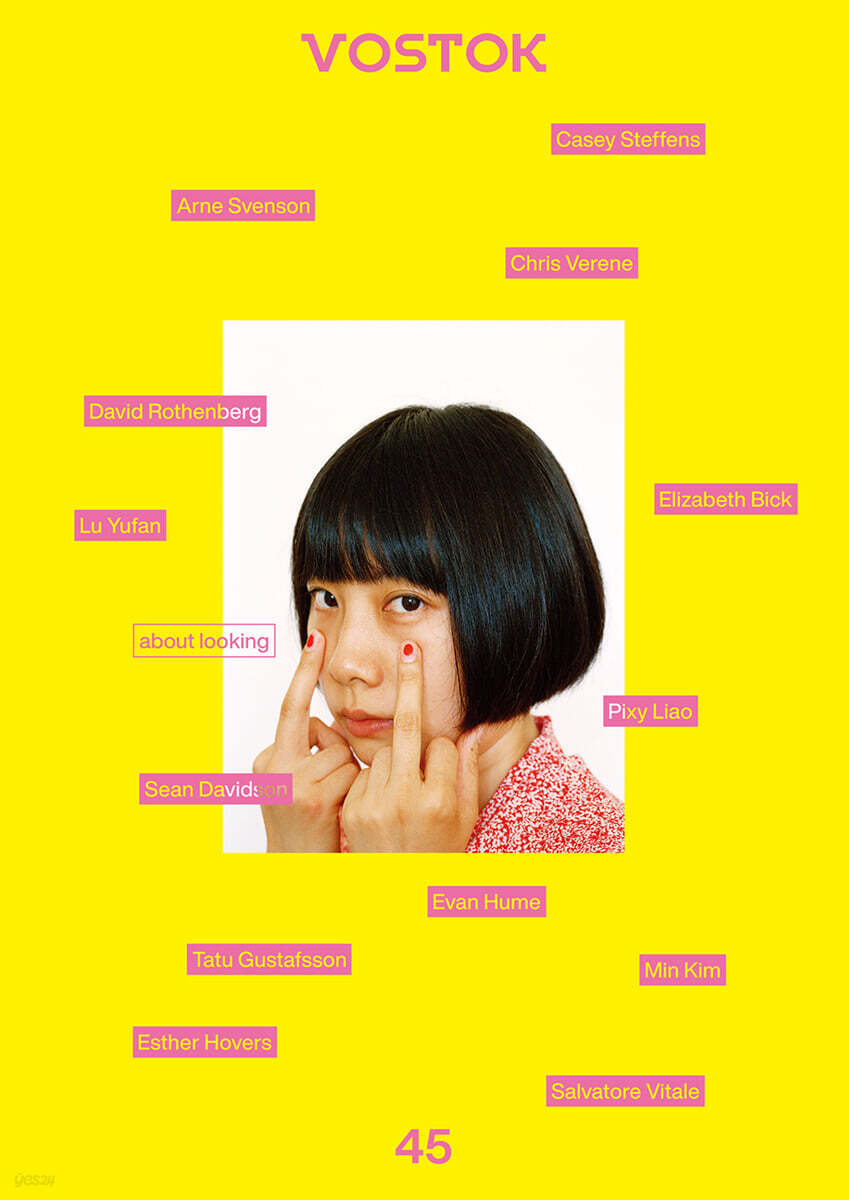 |
Description
Book Introduction
Through photography and cameras
Problems with the gaze that arise
In this issue of Vostok Magazine, the special feature, "On Gaze," examines the issues of gaze that arise between subject, object, and spectator, as divided by photography and the camera.
To this end, we present photographic works that allow us to critically consider the process and meaning of gaze as power, from one-sided and violent gazes to voyeuristic gazes, male-centered gazes, and surveillance systems that control citizens.
And through the writings of several researchers, including Lee Ra-young, Lee Yeon-sook, Kim Ji-hyo, and Kim Shin-sik, we examine how we are exposed to the gaze of ourselves and others at every moment in a visual environment where smartphones, selfies, and social media are intertwined.
Also, through reporter Kim In-jeong's article, we consider together the aspects of the world that are not visible to us when the perspective of the privileged is dominant.
Problems with the gaze that arise
In this issue of Vostok Magazine, the special feature, "On Gaze," examines the issues of gaze that arise between subject, object, and spectator, as divided by photography and the camera.
To this end, we present photographic works that allow us to critically consider the process and meaning of gaze as power, from one-sided and violent gazes to voyeuristic gazes, male-centered gazes, and surveillance systems that control citizens.
And through the writings of several researchers, including Lee Ra-young, Lee Yeon-sook, Kim Ji-hyo, and Kim Shin-sik, we examine how we are exposed to the gaze of ourselves and others at every moment in a visual environment where smartphones, selfies, and social media are intertwined.
Also, through reporter Kim In-jeong's article, we consider together the aspects of the world that are not visible to us when the perspective of the privileged is dominant.
- You can preview some of the book's contents.
Preview
index
May-June 2024 | VOL.
45
Special Feature | On Gaze
001 The Neighbors _ Arne Svenson
014 Airshow Crowds _ Casey Steffens
024 Landing Lights Park _ David Rothenberg
036 Camera Club _ Chris Verene
054 Make Me Beautiful _ Lu Yufan
070 Coda _ Elizabeth Bick
084 Experimental Relationship _ Pixy Liao
098 Becoming a Servant: Is It an Addiction to Power or a Tool of Resistance? _ Lee Ra-young
104 Down, Further Down: Bottomless Infinite Scrolling and the Digital Labor of Viewing _ Lee Yeon-sook
110 The Writers Behind Instagram _ Kim Ji-hyo
116 Thoughts on 'Bitsaek': Research Notes on the Visual Culture of the SNS World from the Perspective of Deletion _ Kim Shin-sik 122 Invisible _ Kim In-jeong
130 Yes We Cam _ Kim Min
148 Casefile001 _ Sean Davidson
160 Weather Camera Self-Portraits _ Tatu Gustafsson
170 False Positives _ Esther Hovers
184 Viewing Distance _ Evan Hume
196 How to Secure a Country _ Salvatore Vitale
210 [Serial: Film Locations] Touching Space: Gestures and Places of Smart Humans _ Yoo Woon-seong
218 [Serial: Pause] Photos and Text, Text and Photos _ Seo Dong-jin
45
Special Feature | On Gaze
001 The Neighbors _ Arne Svenson
014 Airshow Crowds _ Casey Steffens
024 Landing Lights Park _ David Rothenberg
036 Camera Club _ Chris Verene
054 Make Me Beautiful _ Lu Yufan
070 Coda _ Elizabeth Bick
084 Experimental Relationship _ Pixy Liao
098 Becoming a Servant: Is It an Addiction to Power or a Tool of Resistance? _ Lee Ra-young
104 Down, Further Down: Bottomless Infinite Scrolling and the Digital Labor of Viewing _ Lee Yeon-sook
110 The Writers Behind Instagram _ Kim Ji-hyo
116 Thoughts on 'Bitsaek': Research Notes on the Visual Culture of the SNS World from the Perspective of Deletion _ Kim Shin-sik 122 Invisible _ Kim In-jeong
130 Yes We Cam _ Kim Min
148 Casefile001 _ Sean Davidson
160 Weather Camera Self-Portraits _ Tatu Gustafsson
170 False Positives _ Esther Hovers
184 Viewing Distance _ Evan Hume
196 How to Secure a Country _ Salvatore Vitale
210 [Serial: Film Locations] Touching Space: Gestures and Places of Smart Humans _ Yoo Woon-seong
218 [Serial: Pause] Photos and Text, Text and Photos _ Seo Dong-jin
Detailed image

Into the book
On Instagram, where photos are the main medium of communication, ostentatious behavior has become so common that even a little display can now be recognized as communication rather than just showing off.
In the local area, people laugh at the culture of hanging banners to show off their children's college acceptance or promotions as an old-fashioned rural culture, but when you think about the sophisticated way children are bragged about on social media, the banners seem too simple.
Offline banners have simply been replaced by online postings.
The unbearable pride of existence goes back and forth between on and off.
The normalization of boasting creates envy rather than shame.
I need others to admire and others to admire me.
It's a vertical relationship, not a horizontal one.
This is why solidarity is not possible in celebrity and influencer culture.
Celebrity culture, driven by the pursuit of influence, hinders solidarity.
Everyone is the publisher of the daily 'Me'.
Others are subscribers to 'me'.
---From "Irayoung Lee - Becoming a Servant: Is It an Addiction to Power or a Tool of Resistance?"
Our eyes exist not for ourselves, but for recommendation algorithms.
We are extensions and prostheses of our walking smartphones.
We are digital workers who have unknowingly outsourced our vision skills to data analytics firms.
Perhaps the writer who most dramatically foresaw this situation was Philip K.
It must be Dick.
In all his works, advertising appears as little devils that shrink and ruin life.
“And advertising.
What really pushed the boundaries was advertising.
“Everything else was bearable though… and the ads were everywhere.”
---From "Lee Yeon-sook - Down, Further Down: Bottomless Infinite Scrolling and the Digital Labor of Viewing"
SNS has already become another reality space where we live our lives.
So, what if we acknowledge this and talk about why we constantly feel silly and pathetic on Instagram? What if we start by talking about who comes to mind first when our follower count drops? Or what about the moments when we appreciate a friend's post but don't bother to like it? Maybe we could talk about those moments when we feel the urge to unfollow a friend.
How about we talk about how we look at each other, or whether we ignore or fear each other? Let's start by talking about how I imagine you, how you imagine me, the glances we exchange.
---From "Kim Ji-hyo - The Writers Behind Instagram"
In fact, the important thing about Bitsak is not that someone deletes a post at the speed of light, but that there are people who quickly capture the post while someone else is quickly deleting it.
The more famous you are, the more likely you are to notice that your deleted posts are being screenshotted on someone else's smartphone.
People capture the records posted on a celebrity's account with their fingers pressing buttons as if they knew what was going to happen in advance, or even as if they had been watching until it happened.
Like paparazzi waiting for a scoop.
I've also been a paparazzi through Instagram.
---From "Kim Shin-sik - Thoughts on 'Bit-sak'"
Those who can see discrimination are usually the ones who have been discriminated against.
Those who experience inequality, therefore, are constantly burdened with the responsibility of explaining it.
Bearing witness to discrimination in the face of vested interests who cannot see it and therefore insist that it does not exist is not only humiliating, but also a sticky burden for those who must personally prove the nature of the humiliation.
---From "Kim In-jeong - Invisible"
What catches our attention is the way the gestures of the person handling the new medium and the places he traverses are reflected on the screen.
A family chatting in the living room while watching television, students heading to forbidden places with camcorders, hackers wrestling with computers in dark rooms to uncover some secret conspiracy – these were all familiar clichés that once flooded movie screens, just as much as couples sitting side by side watching a movie on screen.
I guess you could say it like this.
20th century cinema invented ways to project these gestures on screen.
Affectionately, comically, dangerously, terrifyingly, horribly, tensely, happily, sadly, and in all sorts of ways.
---From "Yoo Yun-seong - Touching Space: Gestures and Places of Smart Humans"
First, we can recall that today, before we can encounter an image, we must input text related to the image.
To encounter an image, we must guess what the image we are about to see will be and input it as text.
This requires that all images be cognitively segmented and defined in advance.
It's as if the images generated by AI for machine learning are already individually 'tagged', or indexed, image datasets.
…as Joselit says, the meaning of an image may now be determined by the epistemology of search, and through it acquire its own meaning.
But the very claim that this is so new makes us skeptical.
As Roland Barthes once said, a photograph is a complex of coexisting messages.
If we recall that a photograph's meaning changes depending on which newspaper it appears in, and that it can be assigned entirely different meanings depending on which article, title, or caption it is associated with, the idea that the relationship between photograph and text mediates the meaning of a photograph might be said to run parallel to the history of photography.
In the local area, people laugh at the culture of hanging banners to show off their children's college acceptance or promotions as an old-fashioned rural culture, but when you think about the sophisticated way children are bragged about on social media, the banners seem too simple.
Offline banners have simply been replaced by online postings.
The unbearable pride of existence goes back and forth between on and off.
The normalization of boasting creates envy rather than shame.
I need others to admire and others to admire me.
It's a vertical relationship, not a horizontal one.
This is why solidarity is not possible in celebrity and influencer culture.
Celebrity culture, driven by the pursuit of influence, hinders solidarity.
Everyone is the publisher of the daily 'Me'.
Others are subscribers to 'me'.
---From "Irayoung Lee - Becoming a Servant: Is It an Addiction to Power or a Tool of Resistance?"
Our eyes exist not for ourselves, but for recommendation algorithms.
We are extensions and prostheses of our walking smartphones.
We are digital workers who have unknowingly outsourced our vision skills to data analytics firms.
Perhaps the writer who most dramatically foresaw this situation was Philip K.
It must be Dick.
In all his works, advertising appears as little devils that shrink and ruin life.
“And advertising.
What really pushed the boundaries was advertising.
“Everything else was bearable though… and the ads were everywhere.”
---From "Lee Yeon-sook - Down, Further Down: Bottomless Infinite Scrolling and the Digital Labor of Viewing"
SNS has already become another reality space where we live our lives.
So, what if we acknowledge this and talk about why we constantly feel silly and pathetic on Instagram? What if we start by talking about who comes to mind first when our follower count drops? Or what about the moments when we appreciate a friend's post but don't bother to like it? Maybe we could talk about those moments when we feel the urge to unfollow a friend.
How about we talk about how we look at each other, or whether we ignore or fear each other? Let's start by talking about how I imagine you, how you imagine me, the glances we exchange.
---From "Kim Ji-hyo - The Writers Behind Instagram"
In fact, the important thing about Bitsak is not that someone deletes a post at the speed of light, but that there are people who quickly capture the post while someone else is quickly deleting it.
The more famous you are, the more likely you are to notice that your deleted posts are being screenshotted on someone else's smartphone.
People capture the records posted on a celebrity's account with their fingers pressing buttons as if they knew what was going to happen in advance, or even as if they had been watching until it happened.
Like paparazzi waiting for a scoop.
I've also been a paparazzi through Instagram.
---From "Kim Shin-sik - Thoughts on 'Bit-sak'"
Those who can see discrimination are usually the ones who have been discriminated against.
Those who experience inequality, therefore, are constantly burdened with the responsibility of explaining it.
Bearing witness to discrimination in the face of vested interests who cannot see it and therefore insist that it does not exist is not only humiliating, but also a sticky burden for those who must personally prove the nature of the humiliation.
---From "Kim In-jeong - Invisible"
What catches our attention is the way the gestures of the person handling the new medium and the places he traverses are reflected on the screen.
A family chatting in the living room while watching television, students heading to forbidden places with camcorders, hackers wrestling with computers in dark rooms to uncover some secret conspiracy – these were all familiar clichés that once flooded movie screens, just as much as couples sitting side by side watching a movie on screen.
I guess you could say it like this.
20th century cinema invented ways to project these gestures on screen.
Affectionately, comically, dangerously, terrifyingly, horribly, tensely, happily, sadly, and in all sorts of ways.
---From "Yoo Yun-seong - Touching Space: Gestures and Places of Smart Humans"
First, we can recall that today, before we can encounter an image, we must input text related to the image.
To encounter an image, we must guess what the image we are about to see will be and input it as text.
This requires that all images be cognitively segmented and defined in advance.
It's as if the images generated by AI for machine learning are already individually 'tagged', or indexed, image datasets.
…as Joselit says, the meaning of an image may now be determined by the epistemology of search, and through it acquire its own meaning.
But the very claim that this is so new makes us skeptical.
As Roland Barthes once said, a photograph is a complex of coexisting messages.
If we recall that a photograph's meaning changes depending on which newspaper it appears in, and that it can be assigned entirely different meanings depending on which article, title, or caption it is associated with, the idea that the relationship between photograph and text mediates the meaning of a photograph might be said to run parallel to the history of photography.
---From "Seo Dong-jin - Photos and Writing, Writing and Photos"
Publisher's Review
We all take pictures and are taken
Beings who are spectators and objects of spectacle
Who is it? Where is it? These are the questions most often asked when looking at a photo.
Oh, who did you take a picture of?
Oh, where did you take the picture?
Because we try to see 'what' first in the photo.
I quickly lose interest in photos that approach me like a puzzle because something about them is not well understood.
When we can identify who or where something is, when we can identify something that is universally beautiful or memorable, the photograph becomes an acceptable image that is easily and familiarly accessible.
If so, we can also explain why contemporary art photography feels difficult and distant.
Because it's difficult to know what to look for in photos that repeatedly feature unknown people and unknown places.
Even if you vaguely grasp what it is, it doesn't seem like a particularly beautiful or memorable scene.
In these cases, asking “Who are you?” or “Where are you?” and listening to the answer is often of no use.
The important question in this case is “how?”
How does the photographer see? And how does he show?
The photographic work before our eyes now is the scene the photographer encountered.
To show us this, the photographer goes through many considerations and choices within the photographic process to complete the image.
In other words, no matter what is being reproduced, the process of looking and the process of showing overlap in photography.
The process of looking here is connected to the perspective and attitude with which one approaches the subject, and the process of showing is influenced by the level of understanding and skill in the photographic medium.
Ultimately, this boils down to a question of perspective, namely, how the photographer views the world and the photographic medium he or she encounters.
That is why contemporary photographic works are generally focused on revealing the artist's unique perspective, that is, on 'how' to look rather than 'what' to show.
But the issue of gaze isn't just for photographers.
If there is someone who looks, there will be someone who is seen, and if there is someone who takes a picture, there will be someone who is taken.
At the same time, the problem of gaze in photography becomes more complex in many ways as the number of people viewing the photograph increases.
In front of a photograph, we are all beings who take pictures and are taken, who watch and become objects of spectacle.
In front of a photograph, we project our own gaze and desires onto the image, but conversely, we are also beings who are influenced by the gaze and desires written into the image.
In photographs where the process of looking and being seen intersects in a complex way, various problems arise surrounding the gaze.
Sometimes, when we encounter inequality and violence resulting from one-sided perspectives (voyeurism and surveillance, objectification and otherization, discrimination and hatred, etc.), we come to realize the meaning and value of exchanging perspectives on an equal footing.
Beings who are spectators and objects of spectacle
Who is it? Where is it? These are the questions most often asked when looking at a photo.
Oh, who did you take a picture of?
Oh, where did you take the picture?
Because we try to see 'what' first in the photo.
I quickly lose interest in photos that approach me like a puzzle because something about them is not well understood.
When we can identify who or where something is, when we can identify something that is universally beautiful or memorable, the photograph becomes an acceptable image that is easily and familiarly accessible.
If so, we can also explain why contemporary art photography feels difficult and distant.
Because it's difficult to know what to look for in photos that repeatedly feature unknown people and unknown places.
Even if you vaguely grasp what it is, it doesn't seem like a particularly beautiful or memorable scene.
In these cases, asking “Who are you?” or “Where are you?” and listening to the answer is often of no use.
The important question in this case is “how?”
How does the photographer see? And how does he show?
The photographic work before our eyes now is the scene the photographer encountered.
To show us this, the photographer goes through many considerations and choices within the photographic process to complete the image.
In other words, no matter what is being reproduced, the process of looking and the process of showing overlap in photography.
The process of looking here is connected to the perspective and attitude with which one approaches the subject, and the process of showing is influenced by the level of understanding and skill in the photographic medium.
Ultimately, this boils down to a question of perspective, namely, how the photographer views the world and the photographic medium he or she encounters.
That is why contemporary photographic works are generally focused on revealing the artist's unique perspective, that is, on 'how' to look rather than 'what' to show.
But the issue of gaze isn't just for photographers.
If there is someone who looks, there will be someone who is seen, and if there is someone who takes a picture, there will be someone who is taken.
At the same time, the problem of gaze in photography becomes more complex in many ways as the number of people viewing the photograph increases.
In front of a photograph, we are all beings who take pictures and are taken, who watch and become objects of spectacle.
In front of a photograph, we project our own gaze and desires onto the image, but conversely, we are also beings who are influenced by the gaze and desires written into the image.
In photographs where the process of looking and being seen intersects in a complex way, various problems arise surrounding the gaze.
Sometimes, when we encounter inequality and violence resulting from one-sided perspectives (voyeurism and surveillance, objectification and otherization, discrimination and hatred, etc.), we come to realize the meaning and value of exchanging perspectives on an equal footing.
GOODS SPECIFICS
- Date of issue: May 20, 2024
- Page count, weight, size: 224 pages | 170*240*20mm
- ISBN13: 9791170370611
- ISBN10: 1170370616
You may also like
카테고리
korean


korean

![GQ KOREA Mark (Monthly): December [2025]](http://librairie.coreenne.fr/cdn/shop/files/8ef265dbbfbf186523ed75ba7319009d.jpg?v=1765340328&width=3840)


