

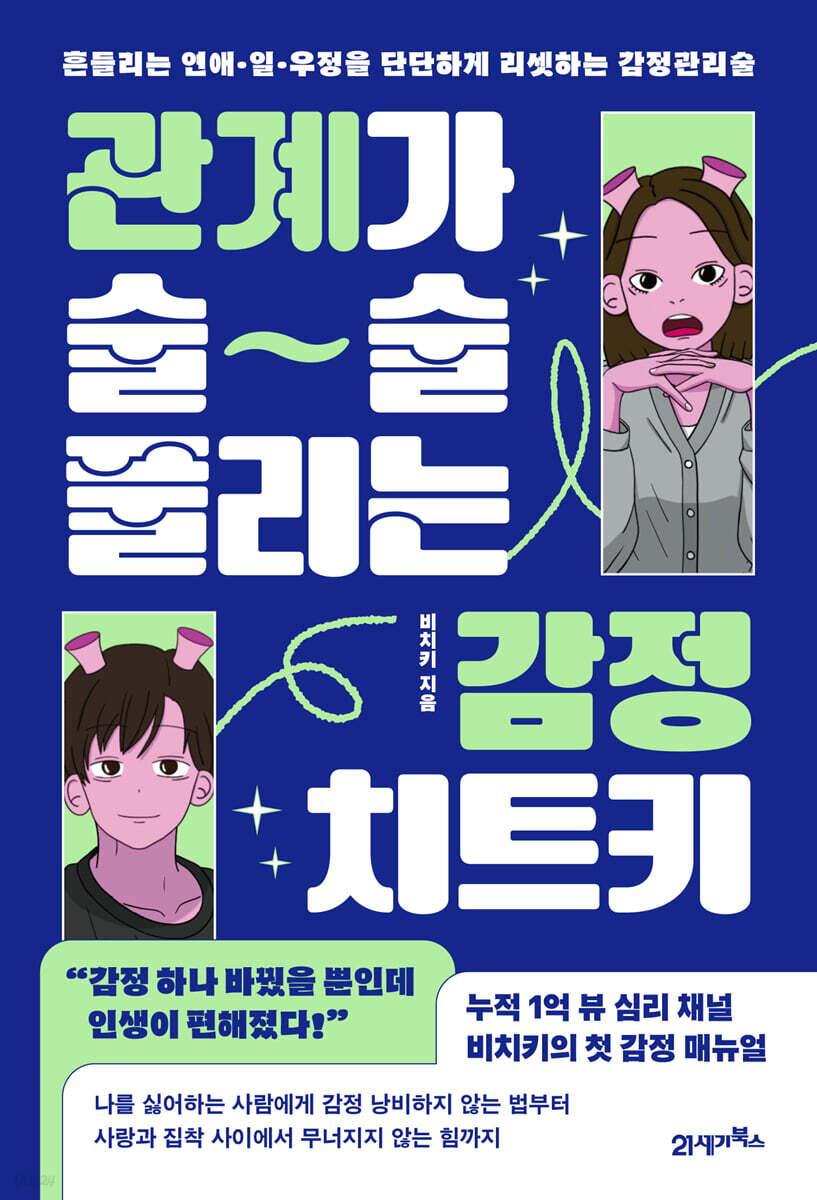
Emotional cheat keys to smooth out relationships
 |
Description
Book Introduction
“I just changed one emotion and my life became easier!”
How to not waste your emotions on someone who hates you
The unwavering strength between love and obsession
The first emotional manual from the psychology channel "Beachy" with 100 million cumulative views and 780,000 YouTube subscribers!
Most ways of dealing with 'emotions' are either control or avoidance.
But 『Emotional Cheat Keys for Smooth Relationships』turns that familiar method on its head.
With over 100 million cumulative views, psychological storyteller Beachy has interpreted emotions like anxiety, jealousy, and anger not as "problems to be suppressed" but as "signals that move relationships" through years of counseling and thousands of cases.
By intersecting the insights of psychology with the perspectives of the humanities, he interprets emotions not as objects of control but as principles that drive relationships.
For Beachy, emotions are not a distraction that clouds reason, but the most delicate language that reads the knots of relationships.
The more we try to push away our emotions, the more lost we become, but when we fully read those emotions, the grammar of relationships opens up to a new order.
This book is a practical guide to emotional literacy that concretizes the reason in everyday scenes.
'When jealousy rises,' 'when anxiety creeps in,' 'when the other person's words hurt,' etc. It presents 'emotional cheat key sentences' that can be used immediately in each of those complex moments, helping readers to design new relationships without having to control their emotions.
Just as hundreds of thousands found comfort in Beachy's videos, readers of this book will gain the power to read their own hearts before others, the emotional grammar that transforms conflict into insight, and an inner balance that remains unshaken in any relationship.
How to not waste your emotions on someone who hates you
The unwavering strength between love and obsession
The first emotional manual from the psychology channel "Beachy" with 100 million cumulative views and 780,000 YouTube subscribers!
Most ways of dealing with 'emotions' are either control or avoidance.
But 『Emotional Cheat Keys for Smooth Relationships』turns that familiar method on its head.
With over 100 million cumulative views, psychological storyteller Beachy has interpreted emotions like anxiety, jealousy, and anger not as "problems to be suppressed" but as "signals that move relationships" through years of counseling and thousands of cases.
By intersecting the insights of psychology with the perspectives of the humanities, he interprets emotions not as objects of control but as principles that drive relationships.
For Beachy, emotions are not a distraction that clouds reason, but the most delicate language that reads the knots of relationships.
The more we try to push away our emotions, the more lost we become, but when we fully read those emotions, the grammar of relationships opens up to a new order.
This book is a practical guide to emotional literacy that concretizes the reason in everyday scenes.
'When jealousy rises,' 'when anxiety creeps in,' 'when the other person's words hurt,' etc. It presents 'emotional cheat key sentences' that can be used immediately in each of those complex moments, helping readers to design new relationships without having to control their emotions.
Just as hundreds of thousands found comfort in Beachy's videos, readers of this book will gain the power to read their own hearts before others, the emotional grammar that transforms conflict into insight, and an inner balance that remains unshaken in any relationship.
- You can preview some of the book's contents.
Preview
index
Introduction_ I never knew emotional management could be this easy
Chapter 1: Why Modern People Need to Practice Emotion Management
How to Avoid Jealousy in an Emotional Overload Era
Your emotional moments that ruin your relationship
Emotion management techniques to improve work efficiency
Managing your emotions can change your day, your year, your life.
Chapter 2: How the Always Popular Person Manages Their Emotions
How to Stop Making Repeated Mistakes in Relationships
Don't waste your precious emotions on someone who hates you.
An inner strength that attracts people even when ordinary
3 Techniques for Creating Conversations Without Regrets
How to convey your sincerity without being unfairly criticized
Why did that person suddenly become distant?
Chapter 3 The Illusion of Rationality
What if your emotions were hindering your success?
The scammers' method of swaying emotions rather than logic.
The Secret of Intuition: A Sense Faster Than Reason
The price of ignoring your emotions
Chapter 4: Why We Should Embrace Both Negative and Positive Emotions
People can cry and laugh: Understand the duality of emotions.
To you who are stuck in a happy past
How to avoid being swept away by waves of emotion
Habits of people who are not swayed by emotions
Chapter 4: Why We Should Embrace Both Negative and Positive Emotions
People can cry and laugh: Understand the duality of emotions.
To you who are stuck in a happy past
How to avoid being swept away by waves of emotion
Habits of people who are not swayed by emotions
Chapter 5: Learning Words to Express Emotions
Two Ways to Meet True Feelings
The sea doesn't overflow when it rains: Why people with a broad perspective are better communicators.
A strong heart that protects me without feeling sorry
How to say everything you want to say without being hated
Chapter 6: Dealing with Emotions Internally
The Secret of People Who Are Not Trapped by the Past
Confidence is an Emotion: The Ultimate Secret of Success
How to escape the emotional vortex
To you who misses love because you lack courage
The wisdom of looking at the world from a step back
Chapter 7: Resolving Emotions and the External Environment
How Tidying Up Heals Your Mind
A strong heart that does not give in to shabbiness
How to Control Your Mind When You're Feeling Depressed for No Reason
Chapter 1: Why Modern People Need to Practice Emotion Management
How to Avoid Jealousy in an Emotional Overload Era
Your emotional moments that ruin your relationship
Emotion management techniques to improve work efficiency
Managing your emotions can change your day, your year, your life.
Chapter 2: How the Always Popular Person Manages Their Emotions
How to Stop Making Repeated Mistakes in Relationships
Don't waste your precious emotions on someone who hates you.
An inner strength that attracts people even when ordinary
3 Techniques for Creating Conversations Without Regrets
How to convey your sincerity without being unfairly criticized
Why did that person suddenly become distant?
Chapter 3 The Illusion of Rationality
What if your emotions were hindering your success?
The scammers' method of swaying emotions rather than logic.
The Secret of Intuition: A Sense Faster Than Reason
The price of ignoring your emotions
Chapter 4: Why We Should Embrace Both Negative and Positive Emotions
People can cry and laugh: Understand the duality of emotions.
To you who are stuck in a happy past
How to avoid being swept away by waves of emotion
Habits of people who are not swayed by emotions
Chapter 4: Why We Should Embrace Both Negative and Positive Emotions
People can cry and laugh: Understand the duality of emotions.
To you who are stuck in a happy past
How to avoid being swept away by waves of emotion
Habits of people who are not swayed by emotions
Chapter 5: Learning Words to Express Emotions
Two Ways to Meet True Feelings
The sea doesn't overflow when it rains: Why people with a broad perspective are better communicators.
A strong heart that protects me without feeling sorry
How to say everything you want to say without being hated
Chapter 6: Dealing with Emotions Internally
The Secret of People Who Are Not Trapped by the Past
Confidence is an Emotion: The Ultimate Secret of Success
How to escape the emotional vortex
To you who misses love because you lack courage
The wisdom of looking at the world from a step back
Chapter 7: Resolving Emotions and the External Environment
How Tidying Up Heals Your Mind
A strong heart that does not give in to shabbiness
How to Control Your Mind When You're Feeling Depressed for No Reason
Detailed image

Into the book
Emotions are more logical than thoughts.
Anxiety is a signal that 'you need security', and jealousy is a signal that 'I want to grow in that direction too'.
Anger is a warning that 'my boundaries are being violated,' and sadness is evidence that 'this relationship was important to me.'
That is, emotions are always data with a rational purpose.
It's just that we haven't learned the language to read that data.
The purpose of this book is to train that language.
As we learn to read, speak, and tune in, our emotions cease to be storms that shake us and become rhythms that stabilize our relationships.
The term 'emotional cheat key' was born in that sense.
A cheat key is a core algorithm that solves complex problems in one go.
The emotional cheat keys in this book are not theories, but phrases and routines that can be applied immediately.
--- p.
5~6
There are many times when there is no particular reason why a certain person dislikes me, even though I have done nothing wrong.
These people are like 'scorpions'.
Just as the scorpion in the old tale stung the frog even though it knew it would kill him, some people have an instinctive tendency to make others uncomfortable or dislike them for no particular reason.
They are just born that way, and it is difficult to change that tendency.
So, instead of stressing out over someone who dislikes you for no reason, just accept that they are a "scorpion".
Accepting that it's just their nature to sting me and not because I did something wrong can reduce unnecessary emotional drain.
--- p.53~54
People who are ordinary but particularly attractive know how to give "help without helping," genuinely trying to solve problems together without causing psychological burden to others. They also have an "unswerving" mind that cleanly acknowledges their weaknesses but doesn't devalue themselves because of them, and focuses on areas where they can improve.
Those who have the courage to accept their own imperfections and limitations as they are will also have the psychological space to be tolerant of the weaknesses of others.
Because if you can stop blaming or criticizing yourself, you can stop being so harshly critical of others.
--- p.66~67
Feeling strong can be uncomfortable and uncertain, but it is ultimately an instinctive signal to protect ourselves.
We often ignore this warning because we think, 'It's embarrassing to suspect someone based on feelings alone.'
But as violence safety expert Gavin de Becker emphasizes, this intuition is a crucial survival skill, and ignoring it exposes you to unnecessary risk.
If you have a 'stiff feeling' that makes you uncomfortable, don't simply ignore it.
It may be an instinctive alarm to protect you.
--- p.109
Paradoxical intention is the act of relieving psychological burden by deliberately choosing situations that one wishes to avoid.
Just as thinking, "I'm going to fail anyway," helps you relax, thinking, "I'm going to make mistakes anyway," actually helps you make fewer mistakes.
True strength isn't the absence of tension.
Instead of forcing yourself to be nervous and saying, "I absolutely cannot be nervous," accept your anxiety as it is by saying, "Okay, just be more nervous! So what if I make a mistake?"
People who know how to use their negative emotions in this way are truly strong and peaceful people.
--- p.137
Growing people develop flexibility by setting 'super goals' and 'sub goals' to overcome these problems.
This is a method of placing multiple sub-goals under one upper goal.
Subgoals to achieve a higher goal can be replaced at any time.
If you try it once and it doesn't work, just keep setting different sub-goals until you find a more efficient method.
There's no need to give up everything and get frustrated by small discrepancies.
Because even if one sub-goal collapses, the whole thing doesn't fall apart.
As we move towards the higher goal (a fresh start without regrets), the lower goal (the habit of wearing a ring) can be flexibly replaced.
Anxiety is a signal that 'you need security', and jealousy is a signal that 'I want to grow in that direction too'.
Anger is a warning that 'my boundaries are being violated,' and sadness is evidence that 'this relationship was important to me.'
That is, emotions are always data with a rational purpose.
It's just that we haven't learned the language to read that data.
The purpose of this book is to train that language.
As we learn to read, speak, and tune in, our emotions cease to be storms that shake us and become rhythms that stabilize our relationships.
The term 'emotional cheat key' was born in that sense.
A cheat key is a core algorithm that solves complex problems in one go.
The emotional cheat keys in this book are not theories, but phrases and routines that can be applied immediately.
--- p.
5~6
There are many times when there is no particular reason why a certain person dislikes me, even though I have done nothing wrong.
These people are like 'scorpions'.
Just as the scorpion in the old tale stung the frog even though it knew it would kill him, some people have an instinctive tendency to make others uncomfortable or dislike them for no particular reason.
They are just born that way, and it is difficult to change that tendency.
So, instead of stressing out over someone who dislikes you for no reason, just accept that they are a "scorpion".
Accepting that it's just their nature to sting me and not because I did something wrong can reduce unnecessary emotional drain.
--- p.53~54
People who are ordinary but particularly attractive know how to give "help without helping," genuinely trying to solve problems together without causing psychological burden to others. They also have an "unswerving" mind that cleanly acknowledges their weaknesses but doesn't devalue themselves because of them, and focuses on areas where they can improve.
Those who have the courage to accept their own imperfections and limitations as they are will also have the psychological space to be tolerant of the weaknesses of others.
Because if you can stop blaming or criticizing yourself, you can stop being so harshly critical of others.
--- p.66~67
Feeling strong can be uncomfortable and uncertain, but it is ultimately an instinctive signal to protect ourselves.
We often ignore this warning because we think, 'It's embarrassing to suspect someone based on feelings alone.'
But as violence safety expert Gavin de Becker emphasizes, this intuition is a crucial survival skill, and ignoring it exposes you to unnecessary risk.
If you have a 'stiff feeling' that makes you uncomfortable, don't simply ignore it.
It may be an instinctive alarm to protect you.
--- p.109
Paradoxical intention is the act of relieving psychological burden by deliberately choosing situations that one wishes to avoid.
Just as thinking, "I'm going to fail anyway," helps you relax, thinking, "I'm going to make mistakes anyway," actually helps you make fewer mistakes.
True strength isn't the absence of tension.
Instead of forcing yourself to be nervous and saying, "I absolutely cannot be nervous," accept your anxiety as it is by saying, "Okay, just be more nervous! So what if I make a mistake?"
People who know how to use their negative emotions in this way are truly strong and peaceful people.
--- p.137
Growing people develop flexibility by setting 'super goals' and 'sub goals' to overcome these problems.
This is a method of placing multiple sub-goals under one upper goal.
Subgoals to achieve a higher goal can be replaced at any time.
If you try it once and it doesn't work, just keep setting different sub-goals until you find a more efficient method.
There's no need to give up everything and get frustrated by small discrepancies.
Because even if one sub-goal collapses, the whole thing doesn't fall apart.
As we move towards the higher goal (a fresh start without regrets), the lower goal (the habit of wearing a ring) can be flexibly replaced.
--- p.170
Publisher's Review
“I never knew emotional management could be this easy!”
Turning emotional turmoil into insight and relationship fatigue into recovery
Realistic emotional class
We walk through the rubble of emotions every day.
A word you overheard in a meeting can ruin your day, and seeing someone else's achievements on social media can make you feel inexplicably jealous.
The problem is not the emotion, but the inability to interpret the emotion.
In an age where reactions are faster than interpretation, the ability to read emotions can quickly become the power to restore relationships.
Psychological storyteller Beachy says:
“When emotions explode, what we lose is not reason, but language.” 『Emotional Cheat Keys for Smooth Relationships』 is a book that deals with the restoration of that very language.
Emotions are not storms to be suppressed, but maps that reveal the structure of relationships.
Through thousands of consultations and stories, Beachy offers a fresh understanding of the nature of emotions like anxiety, jealousy, anger, and sadness.
Anxiety is a signal that “security is needed,” jealousy is a “compass that shows the direction of desire,” anger is a “warning sound of a violated boundary,” and sadness is evidence that “the relationship was still important.”
The moment you suppress your emotions, the relationship becomes rigid, but the moment you read the signals, the relationship flows again.
Beachy doesn't treat emotions as variables in a laboratory.
For him, emotions are the language through which humans connect with others, and the grammar through which the mind interprets the world.
This book elevates emotions from 'control' to 'understanding', translating the complex mind into the language of order.
This book, which analyzes the circuits of emotions while maintaining the warmth of its sentences, shows that interpreting emotions is the same as understanding oneself.
“The miracle of untying the knot in a relationship through emotional management!”
Emotional management techniques to solidify and reset shaky relationships, work, and friendships.
An office worker was always at odds with his coworkers because of 'petty jealousy'.
Beachy interprets the feeling as 'disguised anxiety'.
“Jealousy is not an emotion directed at others, but an alarm that arises when one’s self-efficacy is shaken.” The moment he understood this sentence, he stopped suppressing his jealousy and began to examine himself, creating much more stable relationships than before.
A couple fought repeatedly because they were hurt by each other's 'insensitivity'.
Beachy says.
“Emotions are a language that reveals what kind of relationship I want, rather than trying to change the other person.” With this sentence at the center, the cracks in my relationship began to heal, and my emotions, instead of scattering, began to find direction.
This book moves emotions from the level of 'knowing' to the level of 'action'.
Each of the seven chapters covers a different face of emotion, and the "Psychological Cheat Key" box provides routines and phrases you can put into practice immediately.
Chapter 1 addresses jealousy, comparison, and anxiety, and provides practical training such as “no multitasking” and “discard emotional waste immediately.”
Chapter 2 reveals the unconsciousness of emotions, that is, defense mechanisms and attachment patterns, through 'How to not waste your emotions on someone who hates you' and 'How to stop repeating mistakes.'
As the story progresses, it expands into a process of learning language to express emotions and developing emotional strength to escape the emotional turmoil and restore the mind.
The 'emotional cheat key' that Beachy talks about is an emotional algorithm that solves complex problems in one go.
The art of redesigning relationships is to learn how to read emotions without suppressing them.
His words are not comforting, but practical, and they fundamentally change the way we manage our emotions.
While countless books on emotions have taught us how to calm our minds, this book elevates emotions to the level of "the art of reading and translating."
"Emotional Cheat Keys for Smooth Relationships" is a rare attempt to deal with emotions through "language, logic, and patterns," and an intellectual adventure to relearn human relationships through emotions.
Emotions are no longer vague feelings.
It is an order that aligns relationships, and a language of thought that rebuilds one's inner self.
Through this book, readers will experience the power to design their emotions rather than being swayed by them, the emotional strength to understand their own hearts before others' words, and the transformation to rewrite the order of relationships themselves.
Turning emotional turmoil into insight and relationship fatigue into recovery
Realistic emotional class
We walk through the rubble of emotions every day.
A word you overheard in a meeting can ruin your day, and seeing someone else's achievements on social media can make you feel inexplicably jealous.
The problem is not the emotion, but the inability to interpret the emotion.
In an age where reactions are faster than interpretation, the ability to read emotions can quickly become the power to restore relationships.
Psychological storyteller Beachy says:
“When emotions explode, what we lose is not reason, but language.” 『Emotional Cheat Keys for Smooth Relationships』 is a book that deals with the restoration of that very language.
Emotions are not storms to be suppressed, but maps that reveal the structure of relationships.
Through thousands of consultations and stories, Beachy offers a fresh understanding of the nature of emotions like anxiety, jealousy, anger, and sadness.
Anxiety is a signal that “security is needed,” jealousy is a “compass that shows the direction of desire,” anger is a “warning sound of a violated boundary,” and sadness is evidence that “the relationship was still important.”
The moment you suppress your emotions, the relationship becomes rigid, but the moment you read the signals, the relationship flows again.
Beachy doesn't treat emotions as variables in a laboratory.
For him, emotions are the language through which humans connect with others, and the grammar through which the mind interprets the world.
This book elevates emotions from 'control' to 'understanding', translating the complex mind into the language of order.
This book, which analyzes the circuits of emotions while maintaining the warmth of its sentences, shows that interpreting emotions is the same as understanding oneself.
“The miracle of untying the knot in a relationship through emotional management!”
Emotional management techniques to solidify and reset shaky relationships, work, and friendships.
An office worker was always at odds with his coworkers because of 'petty jealousy'.
Beachy interprets the feeling as 'disguised anxiety'.
“Jealousy is not an emotion directed at others, but an alarm that arises when one’s self-efficacy is shaken.” The moment he understood this sentence, he stopped suppressing his jealousy and began to examine himself, creating much more stable relationships than before.
A couple fought repeatedly because they were hurt by each other's 'insensitivity'.
Beachy says.
“Emotions are a language that reveals what kind of relationship I want, rather than trying to change the other person.” With this sentence at the center, the cracks in my relationship began to heal, and my emotions, instead of scattering, began to find direction.
This book moves emotions from the level of 'knowing' to the level of 'action'.
Each of the seven chapters covers a different face of emotion, and the "Psychological Cheat Key" box provides routines and phrases you can put into practice immediately.
Chapter 1 addresses jealousy, comparison, and anxiety, and provides practical training such as “no multitasking” and “discard emotional waste immediately.”
Chapter 2 reveals the unconsciousness of emotions, that is, defense mechanisms and attachment patterns, through 'How to not waste your emotions on someone who hates you' and 'How to stop repeating mistakes.'
As the story progresses, it expands into a process of learning language to express emotions and developing emotional strength to escape the emotional turmoil and restore the mind.
The 'emotional cheat key' that Beachy talks about is an emotional algorithm that solves complex problems in one go.
The art of redesigning relationships is to learn how to read emotions without suppressing them.
His words are not comforting, but practical, and they fundamentally change the way we manage our emotions.
While countless books on emotions have taught us how to calm our minds, this book elevates emotions to the level of "the art of reading and translating."
"Emotional Cheat Keys for Smooth Relationships" is a rare attempt to deal with emotions through "language, logic, and patterns," and an intellectual adventure to relearn human relationships through emotions.
Emotions are no longer vague feelings.
It is an order that aligns relationships, and a language of thought that rebuilds one's inner self.
Through this book, readers will experience the power to design their emotions rather than being swayed by them, the emotional strength to understand their own hearts before others' words, and the transformation to rewrite the order of relationships themselves.
GOODS SPECIFICS
- Date of issue: November 5, 2025
- Page count, weight, size: 216 pages | 342g | 128*188*17mm
- ISBN13: 9791173575679
- ISBN10: 1173575677
You may also like
카테고리
korean


korean

![GQ KOREA Mark (Monthly): December [2025]](http://librairie.coreenne.fr/cdn/shop/files/8ef265dbbfbf186523ed75ba7319009d.jpg?v=1765340328&width=3840)


