

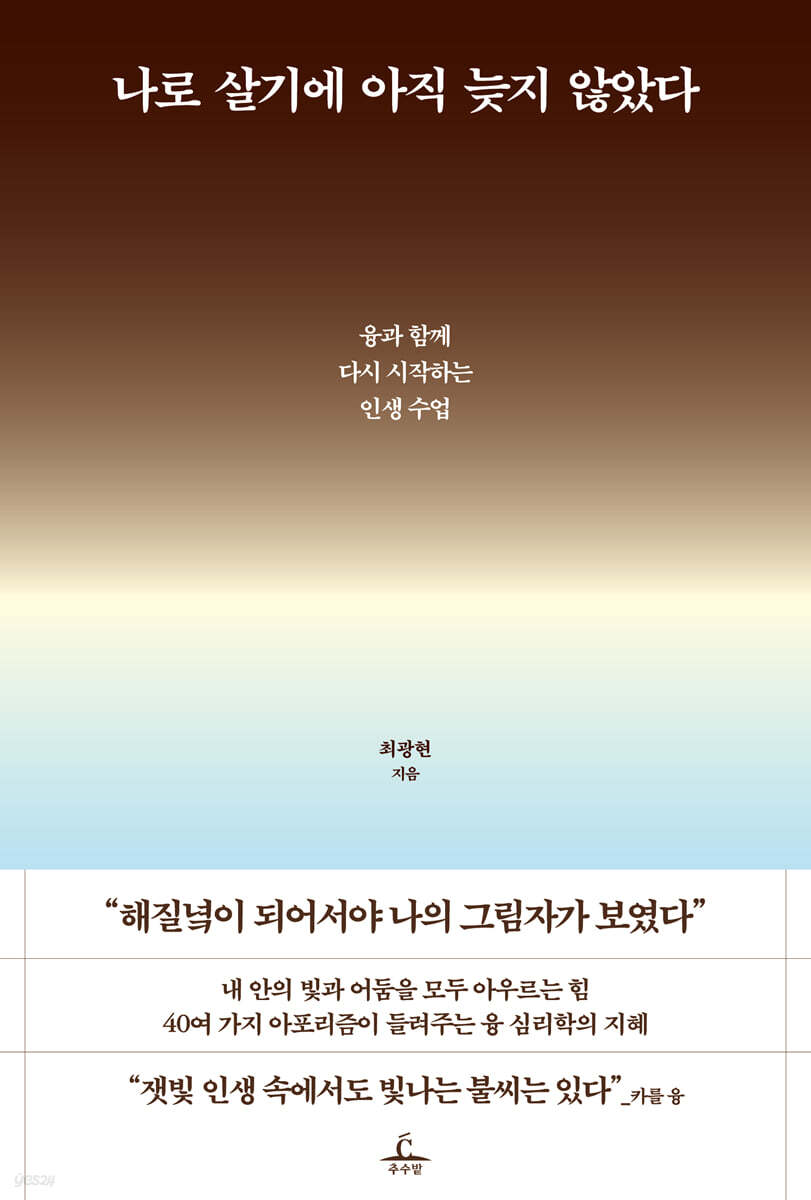
It's not too late to live as myself
 |
Description
Book Introduction
Life wisdom from Carl Jung, a leading psychologist for middle-aged people.
Based on some 40 aphorisms left behind by Jung and his disciples, it addresses the challenges of the "opposite" that must be faced after the age of forty.
Embracing the countless love and hate, joy and sorrow, happiness and unhappiness that come and go in life, it explores what true self-realization is and how to begin a 'second life'.
The author, who has counseled various family members and middle-aged and older people for decades, synthesizes his counseling cases as well as his own experiences and daily reflections to unravel the essence of Jungian psychology.
If you calmly contemplate the meaning of aphorisms along with elegant masterpieces placed in appropriate places, you will be able to reach the 'true self' and 'secrets of life' that your subconscious tells you.
Based on some 40 aphorisms left behind by Jung and his disciples, it addresses the challenges of the "opposite" that must be faced after the age of forty.
Embracing the countless love and hate, joy and sorrow, happiness and unhappiness that come and go in life, it explores what true self-realization is and how to begin a 'second life'.
The author, who has counseled various family members and middle-aged and older people for decades, synthesizes his counseling cases as well as his own experiences and daily reflections to unravel the essence of Jungian psychology.
If you calmly contemplate the meaning of aphorisms along with elegant masterpieces placed in appropriate places, you will be able to reach the 'true self' and 'secrets of life' that your subconscious tells you.
- You can preview some of the book's contents.
Preview
index
Prologue: I am disappointed in my life, yet I am not disappointed.
Chapter 1: There Was Another Me Inside Me
ㆍWhen I was around forty, my inner self began to swirl.
Love and hate are one
ㆍA child and an adult coexist within me.
As the light gets brighter, the shadows get bigger.
First, acknowledge the duality within yourself.
ㆍOnly when you face your shadow can you see your true self.
ㆍAt forty, women become men, and men become women.
Healthy men are feminine, healthy women are masculine.
Be careful not to get swallowed by the mask.
Being abandoned is an opportunity to discover a new self.
ㆍEgo inflation ends in tragedy.
Chapter 2 I See Myself in Others
There are no eternal enemies or eternal friends.
Don't ignore your feelings of inferiority; deal with them wisely.
People can be this way or that way
The wisdom of empathy that transforms conflict into reconciliation
ㆍWhen I find my shadow in others
Contempt for oneself creates contempt for others.
To understand your complex, explore your dissatisfaction.
ㆍGreek creativity required hardship.
ㆍThe power of the archetype that moves culture and the times
The contrast between order and disorder fosters change.
Chapter 3: The Unconscious Knows the Secrets of Life
Everyone has a caveman inside them.
We are not the masters of our own lives.
The unconscious demands balance in life.
ㆍIn middle age, the unconscious counterattack begins.
ㆍMyth is the personified unconscious.
ㆍMythology is the oldest healing method.
The collective unconscious drives our lives.
Self-realization is achieved when you confront the unconscious.
The world is connected without us even knowing it.
Chapter 4: The Beginning of a Second Life
ㆍYou have to experience downhill to know your limits.
Self-realization begins only when we are confused.
ㆍIf you give up what you have, you will receive
ㆍA time of sudden change of direction is coming.
Strengths become weaknesses, and weaknesses become strengths.
Self-actualization cannot be achieved without change.
ㆍThere is healing in extreme pain.
The greatest virtue for middle-aged people is self-reflection.
ㆍAcknowledge the animalistic nature within you.
ㆍSuffering always turns into joy.
Epilogue: My destiny is neither mine nor yours.
Chapter 1: There Was Another Me Inside Me
ㆍWhen I was around forty, my inner self began to swirl.
Love and hate are one
ㆍA child and an adult coexist within me.
As the light gets brighter, the shadows get bigger.
First, acknowledge the duality within yourself.
ㆍOnly when you face your shadow can you see your true self.
ㆍAt forty, women become men, and men become women.
Healthy men are feminine, healthy women are masculine.
Be careful not to get swallowed by the mask.
Being abandoned is an opportunity to discover a new self.
ㆍEgo inflation ends in tragedy.
Chapter 2 I See Myself in Others
There are no eternal enemies or eternal friends.
Don't ignore your feelings of inferiority; deal with them wisely.
People can be this way or that way
The wisdom of empathy that transforms conflict into reconciliation
ㆍWhen I find my shadow in others
Contempt for oneself creates contempt for others.
To understand your complex, explore your dissatisfaction.
ㆍGreek creativity required hardship.
ㆍThe power of the archetype that moves culture and the times
The contrast between order and disorder fosters change.
Chapter 3: The Unconscious Knows the Secrets of Life
Everyone has a caveman inside them.
We are not the masters of our own lives.
The unconscious demands balance in life.
ㆍIn middle age, the unconscious counterattack begins.
ㆍMyth is the personified unconscious.
ㆍMythology is the oldest healing method.
The collective unconscious drives our lives.
Self-realization is achieved when you confront the unconscious.
The world is connected without us even knowing it.
Chapter 4: The Beginning of a Second Life
ㆍYou have to experience downhill to know your limits.
Self-realization begins only when we are confused.
ㆍIf you give up what you have, you will receive
ㆍA time of sudden change of direction is coming.
Strengths become weaknesses, and weaknesses become strengths.
Self-actualization cannot be achieved without change.
ㆍThere is healing in extreme pain.
The greatest virtue for middle-aged people is self-reflection.
ㆍAcknowledge the animalistic nature within you.
ㆍSuffering always turns into joy.
Epilogue: My destiny is neither mine nor yours.
Detailed image

Into the book
“Therefore, even though I am disappointed in my life, I am not disappointed.”
This can be said to be what Jung realized at the end of his life as he synthesized his research and the meaning of life.
Although he feels foolish and regretful for ignoring the advice of those around him and stubbornly pursuing his goals, he also achieves his academic goals thanks to it.
The countless mistakes and failures we experience throughout life bring about regret and reflection, but thanks to them, we also receive unexpected gifts from life.
Life does not run in a straight line in one direction, but always has two opposing sides.
--- From the "Prologue"
I would like to say that after forty, when middle age begins in earnest, change is not a choice but a necessity and survival itself.
At first glance, the midlife crisis appears to be a problem intertwined with changes in economic and social status.
But there is a more fundamental problem than these environmental factors.
It is a problem that arises from within oneself.
It is necessary to reflect on how you have maintained relationships with the outside world, such as your family, school, and work, and how you have managed your inner world.
This is something you must do to prepare for the changes that will occur within you.
--- From "When I was about forty, my inner self began to swirl"
When a person develops his or her ego well, he or she becomes more rational, reasonable, and moral.
Then it is easy to think that the dark, impulsive, and instinctive parts have been eliminated or overcome.
But Jung didn't see it that way.
I thought that humans were not beings that could be ruled by just one characteristic.
Just because the bright side (light) grows doesn't mean the dark side (shadow) disappears, it just means it's hidden in the damp, dark depths, not revealed.
The problem is that as the light gets brighter, the shadows also get darker, and if the opportunity arises, they can explode and be revealed.
So even if a person appears moral and rational on the outside, the shadow hidden inside can cause greater danger.
--- From "As the light grows brighter, the shadows grow bigger"
The positive anima (the feminine in a man) is expressed in caring, emotional expression, patience, and above all, a warm and considerate attitude.
Positive animus (masculine nature within a woman) manifests as strength, logical thinking, drive to act, and energy.
Those who, by middle age, accept and integrate the opposites of their unconscious personalities into their lives will live happy lives.
So we often see middle-aged men who are gentle and empathetic, and middle-aged women who influence those around them with their drive and strong energy.
If we have looked upon such people with envy, understanding why they were able to become that way can be the beginning of change.
--- From "A healthy man is feminine, a healthy woman is masculine"
When you confine yourself to one persona, other personalities that have been suppressed deep inside you suddenly burst out.
While they may appear to be exemplary people in society, they can become tyrannical once they get home, venting their frustration and anger on their family.
When there is a difference between how a person is at home and how they are outside the home, family members call that person a "split personality" or a "narcissist" and try to distance themselves from the relationship.
As there are significant differences between inside and outside the home, there are also extreme differences in attitudes toward family members, which leads to conflict.
As a result, he develops neurotic symptoms such as depression, lethargy, anxiety, fear, and physical weakness, or these symptoms occur in his family.
All of these symptoms are warning signs that middle-aged people are moving away from their 'self', the center of their minds.
--- From "Abandonment is an opportunity to discover a new me"
In a competitive society, no one can avoid feeling inferior.
Therefore, rather than being careful or preventing yourself from feeling inferior, what is important is how you deal with your inferiority complex.
The first step to dealing with inferiority complex is to acknowledge it within yourself.
If I try hard to deny the fact that I feel inferior, the inferiority complex will become my complex and dominate me.
Then my emotions and actions will be driven by my inferiority complex rather than my will.
Simply put, realizing that 'I am currently suffering from an inferiority complex' is the starting point for dealing with inferiority complex.
--- From "Don't ignore your inferiority complex, deal with it wisely"
The work Younghee had to do to recover from her trauma was to recognize that the wounds of abandonment from her childhood still existed within her, and that she was constantly on guard against being hurt again.
This realization was uncomfortable and difficult to accept, but it was also an important insight.
As Younghee reflected on the experience, she realized that the trauma and anxiety of her childhood had made her more sensitive and cherishing of family relationships, and that it had also made her a more careful mother to ensure that her children would not suffer the same trauma.
--- From "Contempt for myself creates contempt for others"
This was the most important task that Jung addressed in psychotherapy.
Because we have lost the myths handed down from our ancestors, we face a problem of mental opposites, and to resolve this, we must summon the mythical beings hidden in our unconscious and actively engage with them again.
Jung believed that if we understand and accept the worldview of mythology, we can experience life from within rather than from without, and recover our true selves.
--- From "Myth is the oldest healing method"
Self-realization and individualization are challenges that one faces not in youth but in middle age.
The so-called 'midlife crisis' is something that people who are facing the task of self-realization experience.
If everything is comfortable and everything is going well, there is no reason to embark on a journey of self-realization or individualization.
But if you are a middle-aged person who is suffering from wounds and pain, the process of self-realization has already begun.
This can be said to be what Jung realized at the end of his life as he synthesized his research and the meaning of life.
Although he feels foolish and regretful for ignoring the advice of those around him and stubbornly pursuing his goals, he also achieves his academic goals thanks to it.
The countless mistakes and failures we experience throughout life bring about regret and reflection, but thanks to them, we also receive unexpected gifts from life.
Life does not run in a straight line in one direction, but always has two opposing sides.
--- From the "Prologue"
I would like to say that after forty, when middle age begins in earnest, change is not a choice but a necessity and survival itself.
At first glance, the midlife crisis appears to be a problem intertwined with changes in economic and social status.
But there is a more fundamental problem than these environmental factors.
It is a problem that arises from within oneself.
It is necessary to reflect on how you have maintained relationships with the outside world, such as your family, school, and work, and how you have managed your inner world.
This is something you must do to prepare for the changes that will occur within you.
--- From "When I was about forty, my inner self began to swirl"
When a person develops his or her ego well, he or she becomes more rational, reasonable, and moral.
Then it is easy to think that the dark, impulsive, and instinctive parts have been eliminated or overcome.
But Jung didn't see it that way.
I thought that humans were not beings that could be ruled by just one characteristic.
Just because the bright side (light) grows doesn't mean the dark side (shadow) disappears, it just means it's hidden in the damp, dark depths, not revealed.
The problem is that as the light gets brighter, the shadows also get darker, and if the opportunity arises, they can explode and be revealed.
So even if a person appears moral and rational on the outside, the shadow hidden inside can cause greater danger.
--- From "As the light grows brighter, the shadows grow bigger"
The positive anima (the feminine in a man) is expressed in caring, emotional expression, patience, and above all, a warm and considerate attitude.
Positive animus (masculine nature within a woman) manifests as strength, logical thinking, drive to act, and energy.
Those who, by middle age, accept and integrate the opposites of their unconscious personalities into their lives will live happy lives.
So we often see middle-aged men who are gentle and empathetic, and middle-aged women who influence those around them with their drive and strong energy.
If we have looked upon such people with envy, understanding why they were able to become that way can be the beginning of change.
--- From "A healthy man is feminine, a healthy woman is masculine"
When you confine yourself to one persona, other personalities that have been suppressed deep inside you suddenly burst out.
While they may appear to be exemplary people in society, they can become tyrannical once they get home, venting their frustration and anger on their family.
When there is a difference between how a person is at home and how they are outside the home, family members call that person a "split personality" or a "narcissist" and try to distance themselves from the relationship.
As there are significant differences between inside and outside the home, there are also extreme differences in attitudes toward family members, which leads to conflict.
As a result, he develops neurotic symptoms such as depression, lethargy, anxiety, fear, and physical weakness, or these symptoms occur in his family.
All of these symptoms are warning signs that middle-aged people are moving away from their 'self', the center of their minds.
--- From "Abandonment is an opportunity to discover a new me"
In a competitive society, no one can avoid feeling inferior.
Therefore, rather than being careful or preventing yourself from feeling inferior, what is important is how you deal with your inferiority complex.
The first step to dealing with inferiority complex is to acknowledge it within yourself.
If I try hard to deny the fact that I feel inferior, the inferiority complex will become my complex and dominate me.
Then my emotions and actions will be driven by my inferiority complex rather than my will.
Simply put, realizing that 'I am currently suffering from an inferiority complex' is the starting point for dealing with inferiority complex.
--- From "Don't ignore your inferiority complex, deal with it wisely"
The work Younghee had to do to recover from her trauma was to recognize that the wounds of abandonment from her childhood still existed within her, and that she was constantly on guard against being hurt again.
This realization was uncomfortable and difficult to accept, but it was also an important insight.
As Younghee reflected on the experience, she realized that the trauma and anxiety of her childhood had made her more sensitive and cherishing of family relationships, and that it had also made her a more careful mother to ensure that her children would not suffer the same trauma.
--- From "Contempt for myself creates contempt for others"
This was the most important task that Jung addressed in psychotherapy.
Because we have lost the myths handed down from our ancestors, we face a problem of mental opposites, and to resolve this, we must summon the mythical beings hidden in our unconscious and actively engage with them again.
Jung believed that if we understand and accept the worldview of mythology, we can experience life from within rather than from without, and recover our true selves.
--- From "Myth is the oldest healing method"
Self-realization and individualization are challenges that one faces not in youth but in middle age.
The so-called 'midlife crisis' is something that people who are facing the task of self-realization experience.
If everything is comfortable and everything is going well, there is no reason to embark on a journey of self-realization or individualization.
But if you are a middle-aged person who is suffering from wounds and pain, the process of self-realization has already begun.
--- From "Self-realization begins only when you are confused"
Publisher's Review
“Life’s healing begins in the most painful moments.”
Beyond momentary comfort, with wisdom that provides insight into life.
Jung's final alchemy: turning wounds into jewels
“True life begins at forty.”
The Psychology of Discovering a New You in Middle Age
At some point, the age of forty starts to feel like a burden.
I thought life would become easier and more comfortable as I gained experience and years of experience, but instead, waves of confusion began to crash down on me.
A body that gets sick and tired easily, emotions that go from one extreme to the next throughout the day, excessive hysteria directed at those around you, extreme anxiety and sleep disturbances…
I read psychology books and go to counseling centers, hoping that my mental symptoms will be cured just like doctors do, but my problems are not easily solved and life only becomes more difficult.
Have I been living completely wrong all this time? Is it really too late to live as myself?
But “real life begins at forty.
“Until then, it is just research,” said Carl Jung.
Just as the sun burns brighter at sunset, a midlife crisis can be an opportunity to change the life you've been living and create a new turning point in your life.
When life feels like nothing but regret, when you don't know who you are, when you feel lost about the challenges life has given you, Jungian psychology provides wisdom that goes beyond individual responses to various symptoms and allows you to see and gain insight into your entire life.
"It's Not Too Late to Live as Me" easily explains Jung's "psychology of opposites" necessary for middle age through about 40 aphorisms.
Embracing the countless love and hate, joy and sorrow, happiness and unhappiness that come and go in life, it explores what true self-realization is and how to begin a 'second life'.
The author, who has counseled various family members and middle-aged and older people for decades, synthesizes his counseling cases as well as his own experiences and daily reflections to unravel the essence of Jungian psychology.
If you calmly contemplate the meaning of aphorisms along with elegant masterpieces placed in appropriate places, you will be able to reach the 'true self' and 'secrets of life' that your subconscious tells you.
“There was another me inside me, and you.”
The solution to relationships is revealed when you unravel the thread called "I."
Although Carl Jung is known today as a pioneer who contributed to the development of the MBTI model, he was not actually interested in categorizing each person's personality into a single category.
Rather, he focused on the differences between a person's inner and outer character.
We explored why many people appear extroverted (introverted) on the outside but are introverted (extroverted) on the inside, and what wisdom we can gain from such contradictions.
Chapter 1 of this book explores the various problems caused by the "other self" within us, from Faust's inner conflict to everyday marital fights, through the concepts of Jungian psychology.
First, I recommend that you acknowledge your conflicting aspects by facing your "shadow," the dark personality within your unconscious, and find balance in your life by talking to your opposite sexual personality, the anima (femininity in a man) and animus (masculinity in a woman).
In addition, it presents the tasks of 'mature self' required in middle age, such as recognizing the social personality, persona (mask), discovering a new self through abandonment, and not falling into ego inflation.
Chapter 2 explains what kind of 'wisdom in dealing with people' is required in various situations.
It examines how projecting one's own shadow onto others can lead to feelings of hostility and inferiority, while emphasizing the insight that "there are no eternal enemies or friends in human relationships," and conveys methods of empathy by putting oneself in the other person's shoes.
In addition, we examine the various aspects of human history created by the contrast between order and disorder, and reflect on the life challenges that today's era demands of middle-aged individuals.
“The unconscious demands change in midlife.”
How to Develop the Life "Capacity" to Respond to Any Wave
The 'collective unconscious' proposed by Carl Jung is considered a difficult concept, but Chapter 3 of this book explains it in an easy way using examples such as 'poop dreams', 'dog dreams', and 'mythical heroes'.
The dung symbolizes important fertilizer and cash, and the dog symbolizes a life centered on loyalty and cooperation.
Things that seem awkward in reality acquire significant meaning in dreams, and this can be a decisive hint that directs a change in direction in life.
Additionally, it introduces the concept of 'Numinose', an experience of empathizing with the heroes of mythology, and emphasizes that we too can have the strength to overcome extreme suffering, just like those who fought against demonic beings and ultimately won.
Chapter 4 presents the concept of 'Enantiodromia', which signifies a dramatic reversal in life, as the final life tasks of middle age: 'change' and 'response'.
If life has been driven in only one direction (competition, selfishness, survival, fierceness), it emphasizes that recognizing and embracing the challenges of life on the other side (cooperation, altruism, coexistence, leisure) is the way to achieve balance in life.
For those who are going downhill, it offers the comfort of "all that's left is to go up," and for those on the road to success, it offers the caution of "you can go down at any time," guiding them to cultivate the "capacity" in life to respond appropriately to all moments of change.
A truly authentic life seeks balance, depth, and wisdom.
A philosophy for today's middle-aged people seeking a turning point in their lives.
The author takes readers into the situations Carl Jung actually found himself in.
Even amidst the horrific circumstances of World War II, Jung maintained a healthy daily life with his family, and he emphasized that such external hardships allowed him to internally realize the precious meaning of life.
In an age where people insist that only firmly asserting one's own position is the "life that is true to oneself," Jung's "psychology of self-realization" provides the "wisdom of adults" that embraces the various aspects of life, which can be this way or that way.
Jung's alchemy, which goes beyond simply wrapping up wounds and involves confronting the dark side of one's personality and attempting to change direction from it, will serve as a philosophy for today's middle-aged people seeking a turning point in their lives.
Beyond momentary comfort, with wisdom that provides insight into life.
Jung's final alchemy: turning wounds into jewels
“True life begins at forty.”
The Psychology of Discovering a New You in Middle Age
At some point, the age of forty starts to feel like a burden.
I thought life would become easier and more comfortable as I gained experience and years of experience, but instead, waves of confusion began to crash down on me.
A body that gets sick and tired easily, emotions that go from one extreme to the next throughout the day, excessive hysteria directed at those around you, extreme anxiety and sleep disturbances…
I read psychology books and go to counseling centers, hoping that my mental symptoms will be cured just like doctors do, but my problems are not easily solved and life only becomes more difficult.
Have I been living completely wrong all this time? Is it really too late to live as myself?
But “real life begins at forty.
“Until then, it is just research,” said Carl Jung.
Just as the sun burns brighter at sunset, a midlife crisis can be an opportunity to change the life you've been living and create a new turning point in your life.
When life feels like nothing but regret, when you don't know who you are, when you feel lost about the challenges life has given you, Jungian psychology provides wisdom that goes beyond individual responses to various symptoms and allows you to see and gain insight into your entire life.
"It's Not Too Late to Live as Me" easily explains Jung's "psychology of opposites" necessary for middle age through about 40 aphorisms.
Embracing the countless love and hate, joy and sorrow, happiness and unhappiness that come and go in life, it explores what true self-realization is and how to begin a 'second life'.
The author, who has counseled various family members and middle-aged and older people for decades, synthesizes his counseling cases as well as his own experiences and daily reflections to unravel the essence of Jungian psychology.
If you calmly contemplate the meaning of aphorisms along with elegant masterpieces placed in appropriate places, you will be able to reach the 'true self' and 'secrets of life' that your subconscious tells you.
“There was another me inside me, and you.”
The solution to relationships is revealed when you unravel the thread called "I."
Although Carl Jung is known today as a pioneer who contributed to the development of the MBTI model, he was not actually interested in categorizing each person's personality into a single category.
Rather, he focused on the differences between a person's inner and outer character.
We explored why many people appear extroverted (introverted) on the outside but are introverted (extroverted) on the inside, and what wisdom we can gain from such contradictions.
Chapter 1 of this book explores the various problems caused by the "other self" within us, from Faust's inner conflict to everyday marital fights, through the concepts of Jungian psychology.
First, I recommend that you acknowledge your conflicting aspects by facing your "shadow," the dark personality within your unconscious, and find balance in your life by talking to your opposite sexual personality, the anima (femininity in a man) and animus (masculinity in a woman).
In addition, it presents the tasks of 'mature self' required in middle age, such as recognizing the social personality, persona (mask), discovering a new self through abandonment, and not falling into ego inflation.
Chapter 2 explains what kind of 'wisdom in dealing with people' is required in various situations.
It examines how projecting one's own shadow onto others can lead to feelings of hostility and inferiority, while emphasizing the insight that "there are no eternal enemies or friends in human relationships," and conveys methods of empathy by putting oneself in the other person's shoes.
In addition, we examine the various aspects of human history created by the contrast between order and disorder, and reflect on the life challenges that today's era demands of middle-aged individuals.
“The unconscious demands change in midlife.”
How to Develop the Life "Capacity" to Respond to Any Wave
The 'collective unconscious' proposed by Carl Jung is considered a difficult concept, but Chapter 3 of this book explains it in an easy way using examples such as 'poop dreams', 'dog dreams', and 'mythical heroes'.
The dung symbolizes important fertilizer and cash, and the dog symbolizes a life centered on loyalty and cooperation.
Things that seem awkward in reality acquire significant meaning in dreams, and this can be a decisive hint that directs a change in direction in life.
Additionally, it introduces the concept of 'Numinose', an experience of empathizing with the heroes of mythology, and emphasizes that we too can have the strength to overcome extreme suffering, just like those who fought against demonic beings and ultimately won.
Chapter 4 presents the concept of 'Enantiodromia', which signifies a dramatic reversal in life, as the final life tasks of middle age: 'change' and 'response'.
If life has been driven in only one direction (competition, selfishness, survival, fierceness), it emphasizes that recognizing and embracing the challenges of life on the other side (cooperation, altruism, coexistence, leisure) is the way to achieve balance in life.
For those who are going downhill, it offers the comfort of "all that's left is to go up," and for those on the road to success, it offers the caution of "you can go down at any time," guiding them to cultivate the "capacity" in life to respond appropriately to all moments of change.
A truly authentic life seeks balance, depth, and wisdom.
A philosophy for today's middle-aged people seeking a turning point in their lives.
The author takes readers into the situations Carl Jung actually found himself in.
Even amidst the horrific circumstances of World War II, Jung maintained a healthy daily life with his family, and he emphasized that such external hardships allowed him to internally realize the precious meaning of life.
In an age where people insist that only firmly asserting one's own position is the "life that is true to oneself," Jung's "psychology of self-realization" provides the "wisdom of adults" that embraces the various aspects of life, which can be this way or that way.
Jung's alchemy, which goes beyond simply wrapping up wounds and involves confronting the dark side of one's personality and attempting to change direction from it, will serve as a philosophy for today's middle-aged people seeking a turning point in their lives.
GOODS SPECIFICS
- Date of issue: November 19, 2025
- Page count, weight, size: 264 pages | 440g | 142*210*16mm
- ISBN13: 9791155402603
- ISBN10: 115540260X
You may also like
카테고리
korean


korean

![GQ KOREA Mark (Monthly): December [2025]](http://librairie.coreenne.fr/cdn/shop/files/8ef265dbbfbf186523ed75ba7319009d.jpg?v=1765340328&width=3840)


