

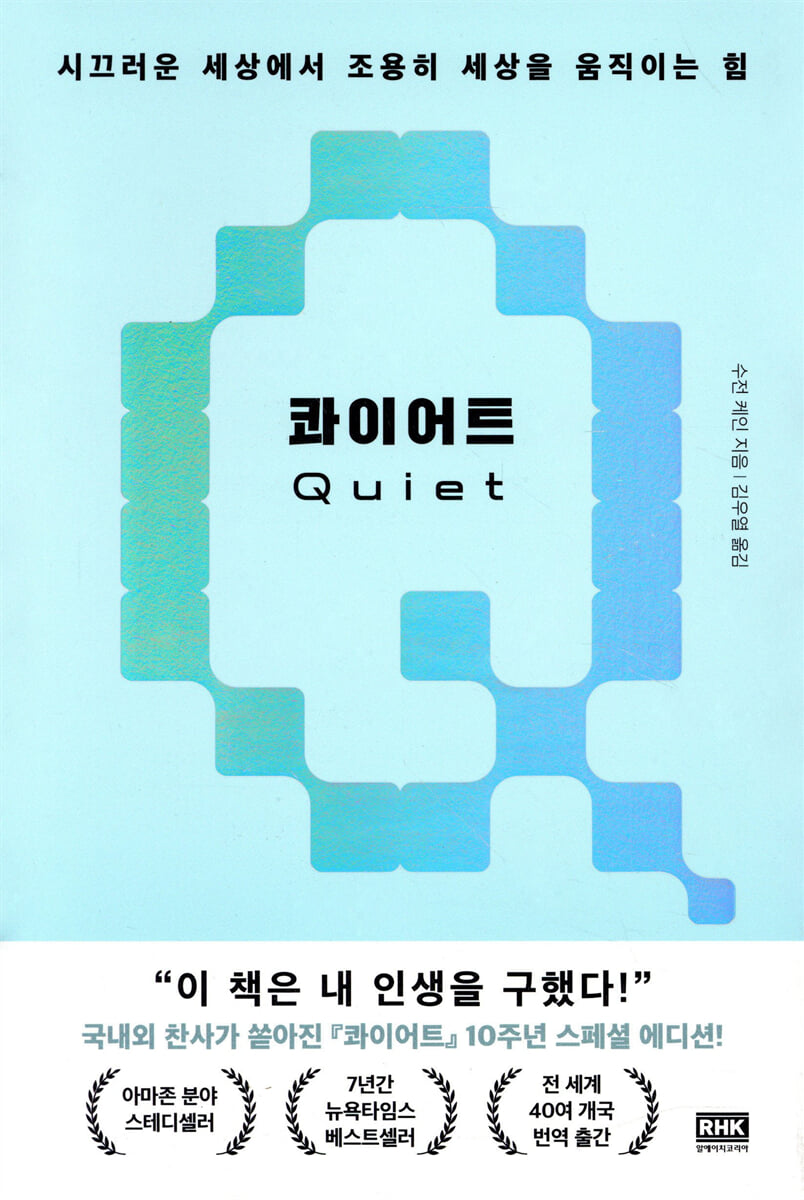
Quiet (10th Anniversary Special Edition)
 |
Description
Book Introduction
The 10th Anniversary Special Edition of "Quiet," the Bible of Personality Types that has garnered countless accolades.
『Quiet』, which caused a worldwide sensation immediately after its publication, is now available in a special edition to commemorate its 10th anniversary.
Even though 10 years have passed, the feedback from those who have encountered 『Quiet』 is beyond imagination.
There are still many people who confide in me about their constant questions about themselves and their constant struggles in relationships.
"Ten years can change even a river," they say, but what about people? To the point where phrases like "When people change, they die" and "You can't rewrite people," many people simply assume "people don't change" or "can't change," and instead give up on relationships rather than repair them.
This book challenged the 'idealism' that only extroversion can move the world.
Thus, through various academic studies and experiments in anthropology, brain science, psychology, genetics, etc., he discovered surprising real-life episodes and new perspectives on introverts, and emphasized that introverts can also be remembered as the best in this world.
Are you insecure? Are you timid? Are you submissive? It doesn't matter. "Quiet" encourages these introverts to ultimately have the power to quietly move the world.
Now, let's accept myself as I am and discover myself taking one step at a time.
『Quiet』, which caused a worldwide sensation immediately after its publication, is now available in a special edition to commemorate its 10th anniversary.
Even though 10 years have passed, the feedback from those who have encountered 『Quiet』 is beyond imagination.
There are still many people who confide in me about their constant questions about themselves and their constant struggles in relationships.
"Ten years can change even a river," they say, but what about people? To the point where phrases like "When people change, they die" and "You can't rewrite people," many people simply assume "people don't change" or "can't change," and instead give up on relationships rather than repair them.
This book challenged the 'idealism' that only extroversion can move the world.
Thus, through various academic studies and experiments in anthropology, brain science, psychology, genetics, etc., he discovered surprising real-life episodes and new perspectives on introverts, and emphasized that introverts can also be remembered as the best in this world.
Are you insecure? Are you timid? Are you submissive? It doesn't matter. "Quiet" encourages these introverts to ultimately have the power to quietly move the world.
Now, let's accept myself as I am and discover myself taking one step at a time.
- You can preview some of the book's contents.
Preview
index
Praise for this book… … 4
Note… … 14
Prologue: The South and the North of the Temperament… … 16
Part 1: A World Where Extroversion is the Role Model
Chapter 1 A friend I really like
How did extroversion become an ideal in our culture? … … 44
Chapter 2 The Myth of Charismatic Leadership
"Personality Culture" Takes Place After 100 Years... ...68
Chapter 3: When Collaboration Kills Creativity
The Emergence of a New Groupthink and the Power of "Working Alone"… … 129
Part 2 Personality inherited from parents vs.
My current personality
Chapter 4: Is temperament an unchangeable destiny?
Nature, Nurture, and the Orchid Hypothesis… … 170
Chapter 5: Overcoming Temperament
The Role of Free Will and Speaking Skills for Introverts… … 198
Chapter 6 Eleanor was Franklin's conscience
Why "Coolness" Is Overrated... ... 222
Chapter 7: Why Warren Buffett is Doing Well Even When Wall Street Crashes
How do introverts and extroverts think differently? … … 262
Part 3 Do all cultures favor extroversion?
Chapter 8 The Power of Gentleness
The wind howls, but the mountain remains silent… … 302
Part 4 How to love and how to work?
Chapter 9 Becoming more extroverted than I originally was
When is the moment to act? … … 340
Chapter 10: The Communication Gap
How to talk to people of the opposite sex? … … 372
Chapter 11: The Question of Becoming a Cobbler or a General
How to Raise a Quiet Child in a Noisy World? … … 402
Conclusion: Why Lewis Carroll's "Wonderland" Could Be Born... 441
Regarding the words introvert and extrovert… … 446
In lieu of a tribute… … 450
Later... 454
Note… … 14
Prologue: The South and the North of the Temperament… … 16
Part 1: A World Where Extroversion is the Role Model
Chapter 1 A friend I really like
How did extroversion become an ideal in our culture? … … 44
Chapter 2 The Myth of Charismatic Leadership
"Personality Culture" Takes Place After 100 Years... ...68
Chapter 3: When Collaboration Kills Creativity
The Emergence of a New Groupthink and the Power of "Working Alone"… … 129
Part 2 Personality inherited from parents vs.
My current personality
Chapter 4: Is temperament an unchangeable destiny?
Nature, Nurture, and the Orchid Hypothesis… … 170
Chapter 5: Overcoming Temperament
The Role of Free Will and Speaking Skills for Introverts… … 198
Chapter 6 Eleanor was Franklin's conscience
Why "Coolness" Is Overrated... ... 222
Chapter 7: Why Warren Buffett is Doing Well Even When Wall Street Crashes
How do introverts and extroverts think differently? … … 262
Part 3 Do all cultures favor extroversion?
Chapter 8 The Power of Gentleness
The wind howls, but the mountain remains silent… … 302
Part 4 How to love and how to work?
Chapter 9 Becoming more extroverted than I originally was
When is the moment to act? … … 340
Chapter 10: The Communication Gap
How to talk to people of the opposite sex? … … 372
Chapter 11: The Question of Becoming a Cobbler or a General
How to Raise a Quiet Child in a Noisy World? … … 402
Conclusion: Why Lewis Carroll's "Wonderland" Could Be Born... 441
Regarding the words introvert and extrovert… … 446
In lieu of a tribute… … 450
Later... 454
Detailed image

Into the book
Harvard Business School's teaching style leans subtly toward certainty: CEOs may not know the best way, but they must act anyway.
Students had to take turns expressing their opinions.
Ideally, the student who just presented the case should already be prepared to discuss the case with the "learning team" and explain the best option for the protagonist.
After the student finishes his presentation, the professor asks other students to share their opinions.
More than half of a student's grades and social standing depend on how much they engage in these debates.
If a student speaks out frequently and forcefully, he or she will become a leader; if not, he or she will remain on the periphery.
--- p.87
Jim Collins wasn't trying to talk about quiet leadership.
When he began his research, all he wanted to know was what characteristics made a particular company stand out from its competitors.
He selected 11 outstanding companies and dug deep into them.
In the beginning, the leadership aspect was completely ignored.
Because I wanted to avoid a simple answer.
But when I analyzed the commonalities of the top-performing companies, the personality of the CEO stood out.
“All of those companies were led by people as unvarnished as Darwin Smith.” People who worked with these leaders described them in these words.
'Quiet, humble, plain, reserved, shy, dignified, gentle, self-effacing, restrained'.
Jim Collins said:
“The lesson is clear.
It doesn't take a giant to change a company.
“What we need are leaders who grow the businesses they run, not their own egos.”
--- p.102~103
Psychologists discuss the difference between 'temperament' and 'personality'.
Temperament is an innate, biologically based pattern of behavior and emotion that emerges during infancy and early childhood.
Personality is a complex phenomenon that emerges from a mixture of cultural influences and personal experiences.
Some people say that temperament is the foundation and character is the building on top of it.
Kagan's research is useful for linking specific temperaments in toddlers to personality types in adolescents, such as Tom or Ralph.
--- p.176
Evolutionary biologist David Sloan Wilson asked what would happen if "fast" and "slow" animals had a party.
“Some fast individuals will bore others with their loud conversations, while others will mutter into their beer that no one respects them.
Slow individuals can best be described as being of a numberless and delicate type.
They don't show off, but they are observant and can notice things that the bad guys can't.
They are the writers and artists of the party, leading interesting conversations far enough away that the villains' voices cannot be heard.
“They are inventors who discover new behavior patterns, but villains copy their actions and steal their patents.”
--- p.246
Everyone has an old brain.
But just as the amygdala of a high-reactivity person is more sensitive to novelty than that of an average person, extroverts seem to succumb to the old brain's desire for reward more easily than introverts.
In fact, some scientists have begun to explore the idea that reward sensitivity is not only an interesting trait of extroversion, but that it's what makes extroverts extroverts.
In other words, extroversion can be characterized as a tendency to seek rewards, ranging from top status to sexual pleasure and money.
Extroverts have been shown to be more ambitious than introverts in terms of money, politics, and pleasure.
According to this view, even their sociability is said to be due to this reward sensitivity.
Extroverts socialize with people because it is inherently satisfying.
--- p.269
Warren Buffett, the legendary investor and world's richest man, has utilized the very characteristics we will explore in this chapter.
Through intelligent perseverance, careful thinking, and acting on warning signs, he has created billions of dollars for himself and the shareholders of his company, Berkshire Hathaway.
Buffett is known for being cautious when others around him are excited.
“Success in investing has nothing to do with IQ.
“Once you have average intelligence, what you need is a temperament to suppress the impulses that get people into trouble.”
Students had to take turns expressing their opinions.
Ideally, the student who just presented the case should already be prepared to discuss the case with the "learning team" and explain the best option for the protagonist.
After the student finishes his presentation, the professor asks other students to share their opinions.
More than half of a student's grades and social standing depend on how much they engage in these debates.
If a student speaks out frequently and forcefully, he or she will become a leader; if not, he or she will remain on the periphery.
--- p.87
Jim Collins wasn't trying to talk about quiet leadership.
When he began his research, all he wanted to know was what characteristics made a particular company stand out from its competitors.
He selected 11 outstanding companies and dug deep into them.
In the beginning, the leadership aspect was completely ignored.
Because I wanted to avoid a simple answer.
But when I analyzed the commonalities of the top-performing companies, the personality of the CEO stood out.
“All of those companies were led by people as unvarnished as Darwin Smith.” People who worked with these leaders described them in these words.
'Quiet, humble, plain, reserved, shy, dignified, gentle, self-effacing, restrained'.
Jim Collins said:
“The lesson is clear.
It doesn't take a giant to change a company.
“What we need are leaders who grow the businesses they run, not their own egos.”
--- p.102~103
Psychologists discuss the difference between 'temperament' and 'personality'.
Temperament is an innate, biologically based pattern of behavior and emotion that emerges during infancy and early childhood.
Personality is a complex phenomenon that emerges from a mixture of cultural influences and personal experiences.
Some people say that temperament is the foundation and character is the building on top of it.
Kagan's research is useful for linking specific temperaments in toddlers to personality types in adolescents, such as Tom or Ralph.
--- p.176
Evolutionary biologist David Sloan Wilson asked what would happen if "fast" and "slow" animals had a party.
“Some fast individuals will bore others with their loud conversations, while others will mutter into their beer that no one respects them.
Slow individuals can best be described as being of a numberless and delicate type.
They don't show off, but they are observant and can notice things that the bad guys can't.
They are the writers and artists of the party, leading interesting conversations far enough away that the villains' voices cannot be heard.
“They are inventors who discover new behavior patterns, but villains copy their actions and steal their patents.”
--- p.246
Everyone has an old brain.
But just as the amygdala of a high-reactivity person is more sensitive to novelty than that of an average person, extroverts seem to succumb to the old brain's desire for reward more easily than introverts.
In fact, some scientists have begun to explore the idea that reward sensitivity is not only an interesting trait of extroversion, but that it's what makes extroverts extroverts.
In other words, extroversion can be characterized as a tendency to seek rewards, ranging from top status to sexual pleasure and money.
Extroverts have been shown to be more ambitious than introverts in terms of money, politics, and pleasure.
According to this view, even their sociability is said to be due to this reward sensitivity.
Extroverts socialize with people because it is inherently satisfying.
--- p.269
Warren Buffett, the legendary investor and world's richest man, has utilized the very characteristics we will explore in this chapter.
Through intelligent perseverance, careful thinking, and acting on warning signs, he has created billions of dollars for himself and the shareholders of his company, Berkshire Hathaway.
Buffett is known for being cautious when others around him are excited.
“Success in investing has nothing to do with IQ.
“Once you have average intelligence, what you need is a temperament to suppress the impulses that get people into trouble.”
--- p.296
Publisher's Review
★★★Amazon's Longest-Running Bestseller★★★
★★★New York Times Bestseller for 7 Years★★★
★★★Translated and published in over 40 countries worldwide★★★
“This book finally allowed me to accept myself.
“I’m just an introvert!”
“This book taught me more about myself than I ever knew before.”
“I've read so far about 'Introvert vs.
"One of the best books on the subject of 'extroversion'!"
“This book explained a lot about me.”
“A must-read for introverts.”
“Susan Cain changed my life.”
My true personality, temperament, and tendencies in relationships have always been a source of curiosity, like a Pandora's box that remains unopened from the cradle to the grave.
These concerns aren't just mine; they're keywords that everyone in the country, though perhaps exaggerated, is curious about. From the moment we are born to the moment we die, we constantly connect with each other, from the small things like family to the broader things like work and business relationships.
You may have thought at least once about what kind of people feel fatigue or happiness in this social structure, why they feel this way, and why they are labeled as socially maladjusted if they feel fatigued in many relationships.
As the old joke goes, "A dirty world that only remembers number one," how do you live in this biased society where those who appear more outgoing, active, and assertive are remembered as the best and most wonderful? Are you living a life that you endure rather than the life you want, mindful of the world's every whim? Are you living a quiet and timid life, hearing your parents sigh? But do you know that this is also your true self, and that this, too, can be remembered as number one? "Quiet" answers that question.
★★★New York Times Bestseller for 7 Years★★★
★★★Translated and published in over 40 countries worldwide★★★
“This book finally allowed me to accept myself.
“I’m just an introvert!”
“This book taught me more about myself than I ever knew before.”
“I've read so far about 'Introvert vs.
"One of the best books on the subject of 'extroversion'!"
“This book explained a lot about me.”
“A must-read for introverts.”
“Susan Cain changed my life.”
My true personality, temperament, and tendencies in relationships have always been a source of curiosity, like a Pandora's box that remains unopened from the cradle to the grave.
These concerns aren't just mine; they're keywords that everyone in the country, though perhaps exaggerated, is curious about. From the moment we are born to the moment we die, we constantly connect with each other, from the small things like family to the broader things like work and business relationships.
You may have thought at least once about what kind of people feel fatigue or happiness in this social structure, why they feel this way, and why they are labeled as socially maladjusted if they feel fatigued in many relationships.
As the old joke goes, "A dirty world that only remembers number one," how do you live in this biased society where those who appear more outgoing, active, and assertive are remembered as the best and most wonderful? Are you living a life that you endure rather than the life you want, mindful of the world's every whim? Are you living a quiet and timid life, hearing your parents sigh? But do you know that this is also your true self, and that this, too, can be remembered as number one? "Quiet" answers that question.
GOODS SPECIFICS
- Publication date: April 9, 2021
- Page count, weight, size: 508 pages | 750g | 141*210*30mm
- ISBN13: 9788925588971
- ISBN10: 8925588978
You may also like
카테고리
korean


korean

![ELLE 엘르 스페셜 에디션 A형 : 12월 [2025]](http://librairie.coreenne.fr/cdn/shop/files/b8e27a3de6c9538896439686c6b0e8fb.jpg?v=1766436872&width=3840)


