

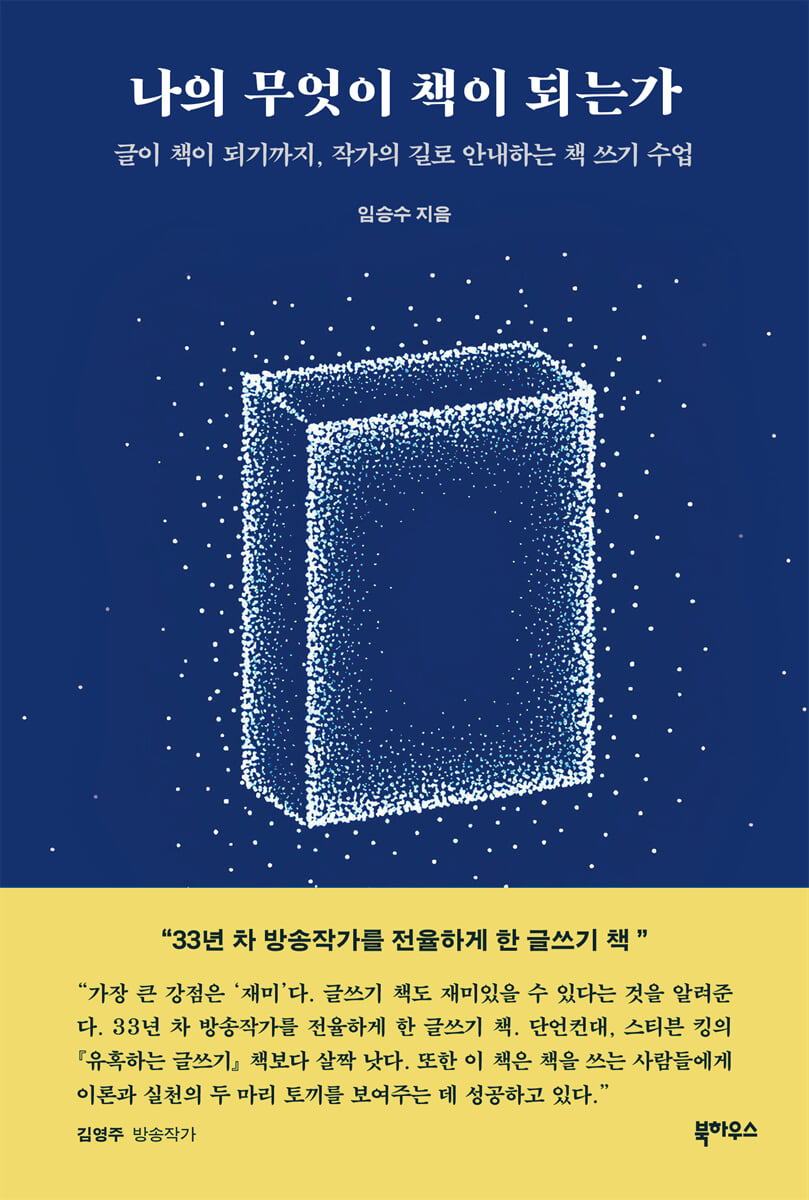
What Makes Me a Book
 |
Description
Book Introduction
'If you ever want to publish a book in this world!'
"Writing to Become a Writer" is packed with practical advice, not pretense.
“This book is filled with both sweet and bitter tips for writing a book.”
From how to write good sentences to selecting a topic, submitting, signing a contract, and publishing.
The raw, unvarnished secrets of book writing, learned firsthand by full-time author Seungsu Lim.
A writing book for those who want to become writers.
This book is the definitive edition of a writing book that contains the 20 years of writing know-how that author Seungsu Lim has acquired while writing in various fields.
As a writer who started out as a freelance writer and became a full-time writer, I reveal the core secrets I learned through my own experience while making a living through writing.
From how to write good sentences to selecting a topic, submitting a book, signing a contract, and publishing it overseas, we will cover only the most essential parts of writing a book.
It also contains interesting episodes about specific methods for completing a book, such as naming it, tips for appealing to publishers, and promoting a book, which is more difficult than writing it.
This book peels back the romanticism of writing to reveal the real life of a living writer and the vivid publishing scene, without embellishment.
Between the ideal of writing and the reality of publishing, the author breaks through with honesty and without pretense.
The worries and trials and errors that anyone who dreams of publishing will inevitably face are captured in a humorous style.
A practical guide to writing for anyone who wants to grow as a writer.
This book is a book that kills two birds with one stone: fun and usefulness, and is filled with witty advice on how to become a writer.
"Writing to Become a Writer" is packed with practical advice, not pretense.
“This book is filled with both sweet and bitter tips for writing a book.”
From how to write good sentences to selecting a topic, submitting, signing a contract, and publishing.
The raw, unvarnished secrets of book writing, learned firsthand by full-time author Seungsu Lim.
A writing book for those who want to become writers.
This book is the definitive edition of a writing book that contains the 20 years of writing know-how that author Seungsu Lim has acquired while writing in various fields.
As a writer who started out as a freelance writer and became a full-time writer, I reveal the core secrets I learned through my own experience while making a living through writing.
From how to write good sentences to selecting a topic, submitting a book, signing a contract, and publishing it overseas, we will cover only the most essential parts of writing a book.
It also contains interesting episodes about specific methods for completing a book, such as naming it, tips for appealing to publishers, and promoting a book, which is more difficult than writing it.
This book peels back the romanticism of writing to reveal the real life of a living writer and the vivid publishing scene, without embellishment.
Between the ideal of writing and the reality of publishing, the author breaks through with honesty and without pretense.
The worries and trials and errors that anyone who dreams of publishing will inevitably face are captured in a humorous style.
A practical guide to writing for anyone who wants to grow as a writer.
This book is a book that kills two birds with one stone: fun and usefulness, and is filled with witty advice on how to become a writer.
- You can preview some of the book's contents.
Preview
index
prolog
Chapter 1: Becoming a Writer
Why I Became a Writer
The Real Reason Authors Look Forward to Book Publication
What can become a book about me?
Writing comes from a life that is "lived," not a life that is "lived."
The miraculous moment when an idea comes to mind
How the writer's time and the reader's time meet
Chapter 2: Writing that Becomes a Book
Ultimately, writing is something that is meant to be read by others.
So, what is good writing?
Writing comes from a love of beauty.
The Secret to Writing That Moves People's Hearts
The secret to writing with personality
How on earth do you write such long texts?
The stark process of writing from beginning to completion
Sentence Strengthening Tips for Double Readability
Writing with AI
Chapter 3: For a book to come into the world
Killing it all: How to Use OhmyNews
How to Submit Your Work to Increase Your Chances of Being Selected by a Publisher
Even professional writers get hurt by submitting "blindly."
What's in a publishing contract?
When naming a book, you must become a disciple of Jesus.
The editor is a film director, I am a screenwriter
Selling a book is much more difficult than writing one.
The Amazing Story of a Book That Barely Got Published in the United States
The writer's writing is completed through the reader.
Epilogue
Chapter 1: Becoming a Writer
Why I Became a Writer
The Real Reason Authors Look Forward to Book Publication
What can become a book about me?
Writing comes from a life that is "lived," not a life that is "lived."
The miraculous moment when an idea comes to mind
How the writer's time and the reader's time meet
Chapter 2: Writing that Becomes a Book
Ultimately, writing is something that is meant to be read by others.
So, what is good writing?
Writing comes from a love of beauty.
The Secret to Writing That Moves People's Hearts
The secret to writing with personality
How on earth do you write such long texts?
The stark process of writing from beginning to completion
Sentence Strengthening Tips for Double Readability
Writing with AI
Chapter 3: For a book to come into the world
Killing it all: How to Use OhmyNews
How to Submit Your Work to Increase Your Chances of Being Selected by a Publisher
Even professional writers get hurt by submitting "blindly."
What's in a publishing contract?
When naming a book, you must become a disciple of Jesus.
The editor is a film director, I am a screenwriter
Selling a book is much more difficult than writing one.
The Amazing Story of a Book That Barely Got Published in the United States
The writer's writing is completed through the reader.
Epilogue
Detailed image

Into the book
These days, there are many people who want to write books.
Whether you're looking to organize your work life experiences, document a turning point in your life, share your expertise, or simply want to publish a book, this is the place to start.
Although their motivations are different, they all have one thing in common: the hope that their story will reach someone.
--- p.5
Yes, that's right.
The writer is generally of the type whose love of values and ideals overpowers his love of bread.
This group has a 'desperate' desire to convey to people what they consider valuable through writing, even if it means facing some difficulties.
If we were to express the abstract word 'urgent' concretely, it would be as follows:
The manuscript writing period can take several months, or even more than a year.
Even if you put so much effort into writing it, there is no guarantee that a publisher will publish it.
Even if you are lucky enough to sign a publishing contract, the expected royalties are unlikely to exceed several million won, even if you make a generous estimate.
Is there something you desperately want to say, even if it means enduring "all these circumstances"? If you have that level of "urgency," you have the makings of a writer.
If all of this seems like a waste of opportunity cost, then it's better not to choose the life of a writer.
--- p.21
As a typical science and engineering student who believes in 1+1=2, I was really bad at writing from childhood through adolescence and into adulthood.
How difficult it is to fill a single sheet of A4 paper.
It seems like my head is overflowing with ideas and brilliant thoughts, but when it comes to putting them into words, there are countless instances where they don't even add up to five lines.
To be honest, I never had any desire to write well.
So there was no reason to envy people who were good at writing.
'Pfft! Are you good at writing? I'm good at math and physics.'
It was in the early to mid 1990s, when I was a college student, and I was teaching math at a cram school as a part-time job.
I confided my concerns to an older literature teacher who taught Korean at the same academy.
“I have a lot of thoughts in my head, but when I actually write something, the amount is too small.
“Even though I have so many ideas and so many interesting stories, why can’t I write more than five lines?” he said coldly and firmly.
“Mr. Seungsu, I have a lot to think about, but it’s not that I can’t write.
“Mr. Seungsu only has so much in his head that he can write it down.”
--- p.40~41
To move people's hearts, I must stimulate the reader's senses with my writing.
Wouldn't the reader's heart be moved if we showed them a little more, told them a little more, and let them experience the flavor a little more?
The amazing thing is that everything I've said so far is something everyone in the country has already learned in middle school.
How could that be? It's so unfamiliar? Those with a keen eye will have already figured it out.
It is 'imagination'.
Show me in words? A visual image.
Tell me in words? Auditory imagery.
Let me smell the words? Olfactory imagery.
Give a taste of words? Gustatory imagery.
Give your writing a tactile experience? Tactile imagery.
Stimulate multiple senses simultaneously with text? Synesthetic imagery.
This cannot but be a negative aspect of Korean education, where students are so fixated on finding the right answer to multiple choice questions that it is difficult to learn the true meaning of knowledge.
--- p.99
People are surprised that an author who has published several books can write a book-length piece.
Authors seem to think that they write books by simply piling up sentences one by one on a blank sheet of paper, but the reality is different.
Can a house be built properly by an architect just laying bricks one by one without a blueprint?
The same goes for writing.
--- p.112
Differentiating factors.
Publishers always ask:
"If there's already a similar book, why bother publishing this one?" This is the place to answer that question.
Simply saying 'it's different' is not enough.
You need to be able to explain specifically what, how, and why is better, and furthermore, prove that this difference can lead to a purchase by the reader.
Differentiation may arise from the depth of content, the tone of writing, the range of target readers, or the formal structure of the writing.
If existing books were academic and difficult to understand, the strength of this book is that it can explain things more easily and clearly.
Moreover, while existing books only list superficial information, this book's strength lies in its rich case studies and in-depth analysis, which fundamentally resolve readers' curiosity.
In other cases, the author's unique background is what sets him apart.
For example, if the authors of existing classical music appreciation books are all enthusiasts, a book written by a professional musician can provide the refreshing feeling of an “insider’s perspective.”
--- p.197~198
But ironically, this intense self-consciousness creates challenges when working with editors.
When an editor offers advice like, “This part might be difficult for the reader,” “The flow isn’t smooth,” or “The explanations are lacking,” the writer, who views the manuscript as an extension of himself, often feels a bruise to his pride.
What on earth is there to fix? Are you trying to pick a fight with me? If this continues, an invisible wall will form between writer and editor.
What editor in the world would want the book they've worked on to fail? Just as a writer cherishes their manuscript, an editor is just as attached to the books they edit.
Since we have a common goal of making the book a success, wouldn't it be better for the author and editor to maintain a cooperative relationship?
To do this, it is necessary to have a clear understanding of the editor's work and respect its scope.
Whether you're looking to organize your work life experiences, document a turning point in your life, share your expertise, or simply want to publish a book, this is the place to start.
Although their motivations are different, they all have one thing in common: the hope that their story will reach someone.
--- p.5
Yes, that's right.
The writer is generally of the type whose love of values and ideals overpowers his love of bread.
This group has a 'desperate' desire to convey to people what they consider valuable through writing, even if it means facing some difficulties.
If we were to express the abstract word 'urgent' concretely, it would be as follows:
The manuscript writing period can take several months, or even more than a year.
Even if you put so much effort into writing it, there is no guarantee that a publisher will publish it.
Even if you are lucky enough to sign a publishing contract, the expected royalties are unlikely to exceed several million won, even if you make a generous estimate.
Is there something you desperately want to say, even if it means enduring "all these circumstances"? If you have that level of "urgency," you have the makings of a writer.
If all of this seems like a waste of opportunity cost, then it's better not to choose the life of a writer.
--- p.21
As a typical science and engineering student who believes in 1+1=2, I was really bad at writing from childhood through adolescence and into adulthood.
How difficult it is to fill a single sheet of A4 paper.
It seems like my head is overflowing with ideas and brilliant thoughts, but when it comes to putting them into words, there are countless instances where they don't even add up to five lines.
To be honest, I never had any desire to write well.
So there was no reason to envy people who were good at writing.
'Pfft! Are you good at writing? I'm good at math and physics.'
It was in the early to mid 1990s, when I was a college student, and I was teaching math at a cram school as a part-time job.
I confided my concerns to an older literature teacher who taught Korean at the same academy.
“I have a lot of thoughts in my head, but when I actually write something, the amount is too small.
“Even though I have so many ideas and so many interesting stories, why can’t I write more than five lines?” he said coldly and firmly.
“Mr. Seungsu, I have a lot to think about, but it’s not that I can’t write.
“Mr. Seungsu only has so much in his head that he can write it down.”
--- p.40~41
To move people's hearts, I must stimulate the reader's senses with my writing.
Wouldn't the reader's heart be moved if we showed them a little more, told them a little more, and let them experience the flavor a little more?
The amazing thing is that everything I've said so far is something everyone in the country has already learned in middle school.
How could that be? It's so unfamiliar? Those with a keen eye will have already figured it out.
It is 'imagination'.
Show me in words? A visual image.
Tell me in words? Auditory imagery.
Let me smell the words? Olfactory imagery.
Give a taste of words? Gustatory imagery.
Give your writing a tactile experience? Tactile imagery.
Stimulate multiple senses simultaneously with text? Synesthetic imagery.
This cannot but be a negative aspect of Korean education, where students are so fixated on finding the right answer to multiple choice questions that it is difficult to learn the true meaning of knowledge.
--- p.99
People are surprised that an author who has published several books can write a book-length piece.
Authors seem to think that they write books by simply piling up sentences one by one on a blank sheet of paper, but the reality is different.
Can a house be built properly by an architect just laying bricks one by one without a blueprint?
The same goes for writing.
--- p.112
Differentiating factors.
Publishers always ask:
"If there's already a similar book, why bother publishing this one?" This is the place to answer that question.
Simply saying 'it's different' is not enough.
You need to be able to explain specifically what, how, and why is better, and furthermore, prove that this difference can lead to a purchase by the reader.
Differentiation may arise from the depth of content, the tone of writing, the range of target readers, or the formal structure of the writing.
If existing books were academic and difficult to understand, the strength of this book is that it can explain things more easily and clearly.
Moreover, while existing books only list superficial information, this book's strength lies in its rich case studies and in-depth analysis, which fundamentally resolve readers' curiosity.
In other cases, the author's unique background is what sets him apart.
For example, if the authors of existing classical music appreciation books are all enthusiasts, a book written by a professional musician can provide the refreshing feeling of an “insider’s perspective.”
--- p.197~198
But ironically, this intense self-consciousness creates challenges when working with editors.
When an editor offers advice like, “This part might be difficult for the reader,” “The flow isn’t smooth,” or “The explanations are lacking,” the writer, who views the manuscript as an extension of himself, often feels a bruise to his pride.
What on earth is there to fix? Are you trying to pick a fight with me? If this continues, an invisible wall will form between writer and editor.
What editor in the world would want the book they've worked on to fail? Just as a writer cherishes their manuscript, an editor is just as attached to the books they edit.
Since we have a common goal of making the book a success, wouldn't it be better for the author and editor to maintain a cooperative relationship?
To do this, it is necessary to have a clear understanding of the editor's work and respect its scope.
--- p.229~230
Publisher's Review
'If you ever want to publish a book in this world!'
"Writing to Become a Writer" is packed with practical advice, not pretense.
“This book is filled with the sweet and bitter flavors of book writing know-how.”
From how to write good sentences to selecting a topic, submitting, signing a contract, and publishing.
The raw, unvarnished secrets of book writing, learned firsthand by full-time author Seungsu Lim.
From a memoirist to a bestselling author, 20 years of writing know-how in one book
A book on writing for those who want to become writers.
This book is the definitive edition of a writing book that contains the 20 years of writing know-how that author Seungsu Lim has acquired while writing in various fields.
As a writer who started out as an engineering student and then became a full-time writer, I reveal the core secrets I learned through writing and experiencing it firsthand.
As you immerse yourself in the witty and readable writing, you'll find yourself picturing the big picture of book publishing in your head.
From how to write good sentences to choosing a topic, submitting a book, signing a contract, and promoting the book, we will cover only the most essential parts of writing a book.
When you peel back the romanticism of writing, you can experience the real life of a writer and the publishing scene in vivid language.
In this book, the author talks about the process of bringing a book into the world based on 'experience' rather than 'theory'.
It vividly tells the story of the feeling of being overwhelmed and thrilled when writing, the despair of submitting a manuscript and the excitement of signing a contract, the trials and errors of the publishing process, and the joys and sorrows of promoting a book, all through realistic episodes.
This book covers everything you need to know about publishing a book, from the specific methods of completing a book by filling 70 to 100 pages of A4 paper, to titles, tips for appealing to publishers, and even book promotion, which is more difficult than writing a book.
Why do people write books? Some might say.
Because I want to spread the word about what only I know.
Someone else might say:
Because I want to make money and make my name known.
But can you actually make money and gain recognition by publishing a book? Trapped between the ideals of writing and the realities of publishing, the author of this book breaks through with honesty and no pretense.
For example, if the list price of a book is 18,000 won, it coldly calculates how much the author's profit will be based on the number of copies sold, and it analyzes in detail the embarrassing cases that occur when an interesting piece of writing loses its original purpose.
As if revealing a trade secret, he does not hesitate to reveal what goes on in the writer's mind until a piece is completed.
It's full of questions you want to ask but have nowhere to ask, questions you're too embarrassed to ask, and advice that will help you resolve those questions.
Chapter 1, “Becoming a Writer,” delves into what it actually means to “become a writer.”
Writing is a process of asking yourself, "Why do I write?" over and over again.
I explore what motivates me to continue writing even in difficult circumstances, how my experiences and thoughts can become books, and what attitude I should have before my readers.
Before embarking on a full-fledged writing project, this chapter addresses fundamental questions that aspiring writers cannot avoid.
Chapter 2, “Writing That Becomes a Book,” covers the actual skills of writing.
Even if you have an abundance of ideas, your thoughts must ultimately take the form of writing.
It points out the conditions for writing that touches the reader's heart, how to infuse your own perspective into sentences, and how to design the structure of a book.
It also provides an unvarnished look at the criteria for using artificial intelligence, methods for strengthening sentences that can be read without hesitation, and the actual work routines and trial and error of professional writers.
Chapter 3, “For a Book to Be Published,” highlights the practical issues that must be overcome before a manuscript can be completed as a book.
The completion of the manuscript is only the starting point of publishing a book, not the end point.
It outlines how to increase the likelihood of a publisher accepting your manuscript, key terms of a publishing contract that authors should pay attention to, and how to establish a relationship with an editor.
Here, we capture the landscape of the process a book must endure to be published, including how the title persuades readers and the reality of having to 'sell' the book after publication.
This book is a practical guide to writing for anyone who wants to grow as a writer.
This book can be said to be a 'writing to become a writer' book filled with realistic and witty advice written in its raw form without embellishment.
Aspiring writers dreaming of publishing will find realistic answers to the various concerns and trials they will face in the process of publishing a book in this book.
A book on writing that is both fun and practical, with both 'realism' and 'humor'.
"Writing to Become a Writer" is packed with practical advice, not pretense.
“This book is filled with the sweet and bitter flavors of book writing know-how.”
From how to write good sentences to selecting a topic, submitting, signing a contract, and publishing.
The raw, unvarnished secrets of book writing, learned firsthand by full-time author Seungsu Lim.
From a memoirist to a bestselling author, 20 years of writing know-how in one book
A book on writing for those who want to become writers.
This book is the definitive edition of a writing book that contains the 20 years of writing know-how that author Seungsu Lim has acquired while writing in various fields.
As a writer who started out as an engineering student and then became a full-time writer, I reveal the core secrets I learned through writing and experiencing it firsthand.
As you immerse yourself in the witty and readable writing, you'll find yourself picturing the big picture of book publishing in your head.
From how to write good sentences to choosing a topic, submitting a book, signing a contract, and promoting the book, we will cover only the most essential parts of writing a book.
When you peel back the romanticism of writing, you can experience the real life of a writer and the publishing scene in vivid language.
In this book, the author talks about the process of bringing a book into the world based on 'experience' rather than 'theory'.
It vividly tells the story of the feeling of being overwhelmed and thrilled when writing, the despair of submitting a manuscript and the excitement of signing a contract, the trials and errors of the publishing process, and the joys and sorrows of promoting a book, all through realistic episodes.
This book covers everything you need to know about publishing a book, from the specific methods of completing a book by filling 70 to 100 pages of A4 paper, to titles, tips for appealing to publishers, and even book promotion, which is more difficult than writing a book.
Why do people write books? Some might say.
Because I want to spread the word about what only I know.
Someone else might say:
Because I want to make money and make my name known.
But can you actually make money and gain recognition by publishing a book? Trapped between the ideals of writing and the realities of publishing, the author of this book breaks through with honesty and no pretense.
For example, if the list price of a book is 18,000 won, it coldly calculates how much the author's profit will be based on the number of copies sold, and it analyzes in detail the embarrassing cases that occur when an interesting piece of writing loses its original purpose.
As if revealing a trade secret, he does not hesitate to reveal what goes on in the writer's mind until a piece is completed.
It's full of questions you want to ask but have nowhere to ask, questions you're too embarrassed to ask, and advice that will help you resolve those questions.
Chapter 1, “Becoming a Writer,” delves into what it actually means to “become a writer.”
Writing is a process of asking yourself, "Why do I write?" over and over again.
I explore what motivates me to continue writing even in difficult circumstances, how my experiences and thoughts can become books, and what attitude I should have before my readers.
Before embarking on a full-fledged writing project, this chapter addresses fundamental questions that aspiring writers cannot avoid.
Chapter 2, “Writing That Becomes a Book,” covers the actual skills of writing.
Even if you have an abundance of ideas, your thoughts must ultimately take the form of writing.
It points out the conditions for writing that touches the reader's heart, how to infuse your own perspective into sentences, and how to design the structure of a book.
It also provides an unvarnished look at the criteria for using artificial intelligence, methods for strengthening sentences that can be read without hesitation, and the actual work routines and trial and error of professional writers.
Chapter 3, “For a Book to Be Published,” highlights the practical issues that must be overcome before a manuscript can be completed as a book.
The completion of the manuscript is only the starting point of publishing a book, not the end point.
It outlines how to increase the likelihood of a publisher accepting your manuscript, key terms of a publishing contract that authors should pay attention to, and how to establish a relationship with an editor.
Here, we capture the landscape of the process a book must endure to be published, including how the title persuades readers and the reality of having to 'sell' the book after publication.
This book is a practical guide to writing for anyone who wants to grow as a writer.
This book can be said to be a 'writing to become a writer' book filled with realistic and witty advice written in its raw form without embellishment.
Aspiring writers dreaming of publishing will find realistic answers to the various concerns and trials they will face in the process of publishing a book in this book.
A book on writing that is both fun and practical, with both 'realism' and 'humor'.
GOODS SPECIFICS
- Date of issue: November 28, 2025
- Page count, weight, size: 272 pages | 380g | 135*200*16mm
- ISBN13: 9791164053452
You may also like
카테고리
korean


korean

![GQ KOREA Mark (Monthly): December [2025]](http://librairie.coreenne.fr/cdn/shop/files/8ef265dbbfbf186523ed75ba7319009d.jpg?v=1765340328&width=3840)


