

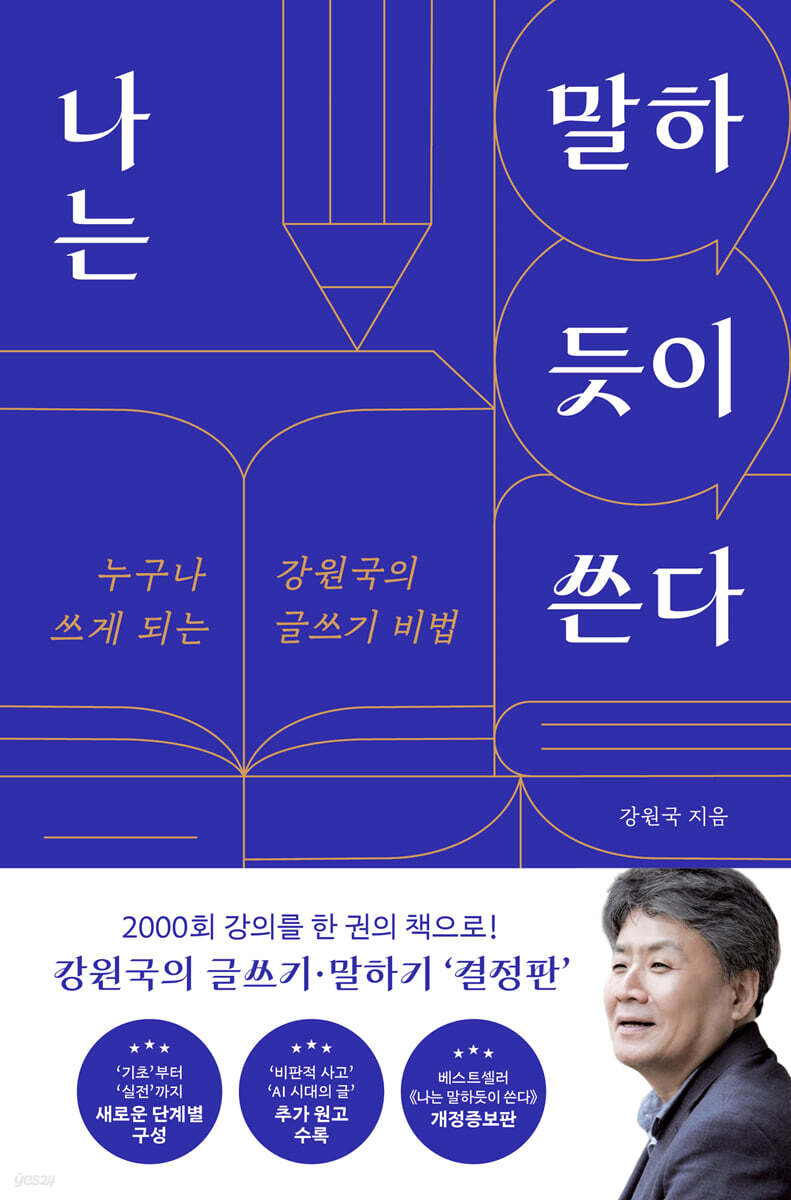
I write as I speak
 |
Description
Book Introduction
At school, at meetings, at work, and even on social media
Applicable 'always' and feasible 'for everyone'
All-rounder Writing Book
Excellent words and writing steal people's hearts and take control of situations.
Conversely, poor speech and writing create conflict and waste opportunities.
We see and experience this all the time in our homes, schools, and workplaces.
Every day, we see people who become famous on social media or in communities with just one post.
In other words, these days, words and writing are more important than any ‘specs’.
So people ask:
“How can I become a good speaker?” “I want to become a good writer, what should I prepare?” The author of this book summarizes the secret in one word.
“You just have to not separate speech and writing.” This means that if you want to speak well, you have to prepare your speech through writing, and if you want to write as you speak, you have to speak a lot.
This is because speech and writing are a pair and complement each other.
Anyone who is not good at writing or speaking can follow this book from the basics to practical use, and writing any kind of text will become much easier.
If you don't have time to read everything, you can just read the prescriptions that suit your taste.
It's literally an 'all-rounder writing book', so it doesn't matter which one you read first.
In particular, in this revised edition, which was published after five years, the table of contents and main text were reorganized in the order of 'basics-tools-training-practice', and examples were supplemented.
New manuscripts, "Critical Thinking" and "How to Live Most Humanly in the AI Age," help readers understand writing, and are available in a new, collectible cover and format.
The author, who started out as an ordinary office worker, becomes the chairman's speech secretary, and then the president's speech secretary, and then grows into a best-selling author, are also some of the key points to watch in this book.
The courage to believe that I can become an author is what will give me the strength to overcome my fear of writing.
Applicable 'always' and feasible 'for everyone'
All-rounder Writing Book
Excellent words and writing steal people's hearts and take control of situations.
Conversely, poor speech and writing create conflict and waste opportunities.
We see and experience this all the time in our homes, schools, and workplaces.
Every day, we see people who become famous on social media or in communities with just one post.
In other words, these days, words and writing are more important than any ‘specs’.
So people ask:
“How can I become a good speaker?” “I want to become a good writer, what should I prepare?” The author of this book summarizes the secret in one word.
“You just have to not separate speech and writing.” This means that if you want to speak well, you have to prepare your speech through writing, and if you want to write as you speak, you have to speak a lot.
This is because speech and writing are a pair and complement each other.
Anyone who is not good at writing or speaking can follow this book from the basics to practical use, and writing any kind of text will become much easier.
If you don't have time to read everything, you can just read the prescriptions that suit your taste.
It's literally an 'all-rounder writing book', so it doesn't matter which one you read first.
In particular, in this revised edition, which was published after five years, the table of contents and main text were reorganized in the order of 'basics-tools-training-practice', and examples were supplemented.
New manuscripts, "Critical Thinking" and "How to Live Most Humanly in the AI Age," help readers understand writing, and are available in a new, collectible cover and format.
The author, who started out as an ordinary office worker, becomes the chairman's speech secretary, and then the president's speech secretary, and then grows into a best-selling author, are also some of the key points to watch in this book.
The courage to believe that I can become an author is what will give me the strength to overcome my fear of writing.
- You can preview some of the book's contents.
Preview
index
To the revised and expanded edition 04
Introduction: Words and Writing Are One Body 07
1 The Seven Forces That Underlie Speech and Writing
Question: A little shameless, a little brave 17
Observation: Using your eyes well improves your speech and writing 26
Empathy: Communication is about connecting hearts 35
Insight: 44 Great Benefits for Less Effort
Critical Thinking: 50 Steps to Living a Self-Reliant Life
Sense and Emotion: When You Become a Proud "Pro-Inconvenience" 56
Imagination: Words and Writing Grow Through Fun 63
How to Speak Like You Write Part 1 Discussion: Even Arguments Require 'Manners' 71
? How to Speak Like You Write Part 2 Discussion: The Miracle of the 25-Minute Meeting 75
2 Fundamentals: Attitudes that Create a Writing Body and Mind
Speak as you write, speak as you write 083
The Fear of the "First Sentence" 091
My Writing Routine 098
107 Things You Can Gain When Copying
Who are your readers 114
If I make time my ally, 120
How to Speak Like You Write 3 Relationships: Speak to Become Close 125
How to Speak Like You Write 4 Sincerity: Apologies, Congratulations, Comfort, and Heart-Warming Words 130
3 Tools: The Best Ingredients to Bring Out Your Writing
Data Collection: What to Find and How to Find It 139
Curation: 6 Steps to Writing with Knowledge 145
Note: Thought-Gathering Habit 151
Reading: Input that Affects Output Quality 157
Thinking Muscles: Does Exercise Make You a Better Writer? 169
Experience: The Conditions of Living, Breathing Writing 175
? How to Speak Like You Write 5 Explanations: The Basics Always Work 186
? Suggestion 6: How to Speak Like You Write: “Ask.
Then he will give it to you” 200
4. Training: Words beget words, and writing begets writing.
Even writing requires maturation and fermentation. 207
Go straight for 'one sentence' 211
To reduce or to increase, that is the question 215
Drawing a Book with One Picture 220
The Ease of Prefabricated Writing 226
If you organize it well, it's easy to read 231
? How to Speak Like You Write, Lesson 7: Captivating First Words 239
? How to Speak Like You Write 8 Report: If You Have a "Secretary Mindset" 244
5. Practice: From Outline to Final Review, Writing a Book
Summary: Does Haruki Murakami write like me? 257
Beginnings and Endings: Writing that Makes a Good First Impression, Writing that Leaves a Lasting Impression 262
Details: The Microscope in My Head 267
Logic Check: Small Errors Hurt Your Writing 273
Infusing Emotion: Writing Has Expressions, Too 280
Retreat: Writing from the "Bread Spot" 290
? How to Speak Like You Write 9 Crisis: "Opportunity Comes Dressed as a Crisis" 297
? How to Speak Like You Write 10 Conflict: Words That Create Discord, Words That Resolve It 302
6. Why speech and writing are becoming increasingly important
Writing Changes Your Life 309
How to Live Most Humanly in the AI Age 314
One wrong word can send you down the drain. 320
Even invisible people have a presence 330
How to Speak Like You Write 11 Listening: How to Speak in Silence 334
? How to Speak Like You Write 12 Encouragement and Encouragement: The Miracle of Words That Make Work Fun 344
Outgoing Writing: The Healing Power of Words and Writing 350
Introduction: Words and Writing Are One Body 07
1 The Seven Forces That Underlie Speech and Writing
Question: A little shameless, a little brave 17
Observation: Using your eyes well improves your speech and writing 26
Empathy: Communication is about connecting hearts 35
Insight: 44 Great Benefits for Less Effort
Critical Thinking: 50 Steps to Living a Self-Reliant Life
Sense and Emotion: When You Become a Proud "Pro-Inconvenience" 56
Imagination: Words and Writing Grow Through Fun 63
How to Speak Like You Write Part 1 Discussion: Even Arguments Require 'Manners' 71
? How to Speak Like You Write Part 2 Discussion: The Miracle of the 25-Minute Meeting 75
2 Fundamentals: Attitudes that Create a Writing Body and Mind
Speak as you write, speak as you write 083
The Fear of the "First Sentence" 091
My Writing Routine 098
107 Things You Can Gain When Copying
Who are your readers 114
If I make time my ally, 120
How to Speak Like You Write 3 Relationships: Speak to Become Close 125
How to Speak Like You Write 4 Sincerity: Apologies, Congratulations, Comfort, and Heart-Warming Words 130
3 Tools: The Best Ingredients to Bring Out Your Writing
Data Collection: What to Find and How to Find It 139
Curation: 6 Steps to Writing with Knowledge 145
Note: Thought-Gathering Habit 151
Reading: Input that Affects Output Quality 157
Thinking Muscles: Does Exercise Make You a Better Writer? 169
Experience: The Conditions of Living, Breathing Writing 175
? How to Speak Like You Write 5 Explanations: The Basics Always Work 186
? Suggestion 6: How to Speak Like You Write: “Ask.
Then he will give it to you” 200
4. Training: Words beget words, and writing begets writing.
Even writing requires maturation and fermentation. 207
Go straight for 'one sentence' 211
To reduce or to increase, that is the question 215
Drawing a Book with One Picture 220
The Ease of Prefabricated Writing 226
If you organize it well, it's easy to read 231
? How to Speak Like You Write, Lesson 7: Captivating First Words 239
? How to Speak Like You Write 8 Report: If You Have a "Secretary Mindset" 244
5. Practice: From Outline to Final Review, Writing a Book
Summary: Does Haruki Murakami write like me? 257
Beginnings and Endings: Writing that Makes a Good First Impression, Writing that Leaves a Lasting Impression 262
Details: The Microscope in My Head 267
Logic Check: Small Errors Hurt Your Writing 273
Infusing Emotion: Writing Has Expressions, Too 280
Retreat: Writing from the "Bread Spot" 290
? How to Speak Like You Write 9 Crisis: "Opportunity Comes Dressed as a Crisis" 297
? How to Speak Like You Write 10 Conflict: Words That Create Discord, Words That Resolve It 302
6. Why speech and writing are becoming increasingly important
Writing Changes Your Life 309
How to Live Most Humanly in the AI Age 314
One wrong word can send you down the drain. 320
Even invisible people have a presence 330
How to Speak Like You Write 11 Listening: How to Speak in Silence 334
? How to Speak Like You Write 12 Encouragement and Encouragement: The Miracle of Words That Make Work Fun 344
Outgoing Writing: The Healing Power of Words and Writing 350
Detailed image
.jpg)
Into the book
If you want to speak well, you must prepare your speech in writing.
If you want to write like you speak, you have to talk a lot.
Those who do not challenge themselves with words cannot write well.
Speaking with all your heart, writing down what you said, and writing to speak again.
This is all I can do to become a good writer and speaker.
A daily routine where preparation for speaking becomes writing practice, and then that becomes speaking again.
A virtuous cycle of life where writing is enjoyable because it allows you to practice speaking, and speaking is enjoyable because it makes you want to write.
The secret to speaking and writing well is a life where words and writing go hand in hand.
--- From the "Introductory Note"
Let's write with a question.
You can either fill out a questionnaire or ask questions directly, but you can do either one.
Make a list of things you're curious about about the topic you want to write about.
Once the questionnaire is created, the answers can be found.
The answer is on the internet and in my head, and if you don't know, just ask someone who knows.
If you can ask 50 questions about any topic, you can write a book.
--- From "Question: A Little Shameless, A Little Brave"
The most common reason for being afraid of writing is because of the ‘first sentence.’
The scariest moment is before I write the first sentence.
Just as it is darkest before dawn, the brain makes its final effort just before writing.
I try my best not to use it.
The way to beat your brain is to take it by surprise and start writing blindly.
You have to start writing first to avoid getting caught up in the process.
Well begun is definitely half the battle.
It's hard before I start studying, but once I sit down at my desk, I feel at ease.
This is especially true for writing.
--- From "Write as you speak, speak as you write"
I lived for a long time without knowing what a memo was.
I took dictation.
To do well in the work assigned to you, you must be good at taking dictation.
It's also the same for studying well at school.
But this is not a note.
I started taking notes after writing “The President’s Writing.”
At first, it was difficult to even write one a day.
Then, I started using about three of them a day, like eating three meals.
At some point, there started to be days when I would write fifteen at a time.
I used 1700 of them over nearly 3 years.
As soon as I thought that I could write a book, I wanted to write a book.
And the book was written.
That is how 『Kangwon-guk's Writing』 came into the world.
Eventually, the notes became a book.
You can write a book by taking about 1,000 notes on any topic.
--- From "Memo: The Habit of Gathering Thoughts"
Summary is reading and listening.
Reading a book and listening to a teacher are both summaries.
We are used to summarizing because we do it so often.
It's easier than creating something from nothing.
So, you can just write it as a summary.
In fact, writing itself is an act of summarizing.
A diary is a summary of a day, a book report and a travelogue are summaries of a book and a trip, respectively, and an autobiography is a summary of a life.
Here's how to write a summary:
First, pour out what you want to write or what you know in a random manner.
It's about transferring what's in my head onto paper or a monitor.
Many people try to organize their thoughts in their head and then write them down.
Instead of doing that, let's just write down our unorganized thoughts.
--- From "Drawing a Book with a Picture"
How to make a good outline.
I recommend looking at the table of contents of the book.
I think the table of contents of a book is the essence of an outline.
It's also a good idea to read the text while getting an overview.
It's about 'backtracking' to see what kind of outline the writer has created.
Haruki Murakami is also said to write without an outline.
That's why the fun of writing lies in not knowing where the story will go or how it will end.
If you know the ending and write it, writing a novel can't be fun.
In this respect, I resemble Haruki.
--- From "Summary: Does Haruki write like me?"
The same goes for our relationship with artificial intelligence.
People who can speak and write their own words using AI's reading and listening functions are independent.
If you speak and write as artificial intelligence tells you, you are living a dependent life.
I also use artificial intelligence when writing.
But the content provided by artificial intelligence cannot be my words and writing.
It's just data.
It is nothing more than the material I need to write and speak.
I take that raw material, process it, write, and speak.
I finally live as the master of my own life.
If you want to write like you speak, you have to talk a lot.
Those who do not challenge themselves with words cannot write well.
Speaking with all your heart, writing down what you said, and writing to speak again.
This is all I can do to become a good writer and speaker.
A daily routine where preparation for speaking becomes writing practice, and then that becomes speaking again.
A virtuous cycle of life where writing is enjoyable because it allows you to practice speaking, and speaking is enjoyable because it makes you want to write.
The secret to speaking and writing well is a life where words and writing go hand in hand.
--- From the "Introductory Note"
Let's write with a question.
You can either fill out a questionnaire or ask questions directly, but you can do either one.
Make a list of things you're curious about about the topic you want to write about.
Once the questionnaire is created, the answers can be found.
The answer is on the internet and in my head, and if you don't know, just ask someone who knows.
If you can ask 50 questions about any topic, you can write a book.
--- From "Question: A Little Shameless, A Little Brave"
The most common reason for being afraid of writing is because of the ‘first sentence.’
The scariest moment is before I write the first sentence.
Just as it is darkest before dawn, the brain makes its final effort just before writing.
I try my best not to use it.
The way to beat your brain is to take it by surprise and start writing blindly.
You have to start writing first to avoid getting caught up in the process.
Well begun is definitely half the battle.
It's hard before I start studying, but once I sit down at my desk, I feel at ease.
This is especially true for writing.
--- From "Write as you speak, speak as you write"
I lived for a long time without knowing what a memo was.
I took dictation.
To do well in the work assigned to you, you must be good at taking dictation.
It's also the same for studying well at school.
But this is not a note.
I started taking notes after writing “The President’s Writing.”
At first, it was difficult to even write one a day.
Then, I started using about three of them a day, like eating three meals.
At some point, there started to be days when I would write fifteen at a time.
I used 1700 of them over nearly 3 years.
As soon as I thought that I could write a book, I wanted to write a book.
And the book was written.
That is how 『Kangwon-guk's Writing』 came into the world.
Eventually, the notes became a book.
You can write a book by taking about 1,000 notes on any topic.
--- From "Memo: The Habit of Gathering Thoughts"
Summary is reading and listening.
Reading a book and listening to a teacher are both summaries.
We are used to summarizing because we do it so often.
It's easier than creating something from nothing.
So, you can just write it as a summary.
In fact, writing itself is an act of summarizing.
A diary is a summary of a day, a book report and a travelogue are summaries of a book and a trip, respectively, and an autobiography is a summary of a life.
Here's how to write a summary:
First, pour out what you want to write or what you know in a random manner.
It's about transferring what's in my head onto paper or a monitor.
Many people try to organize their thoughts in their head and then write them down.
Instead of doing that, let's just write down our unorganized thoughts.
--- From "Drawing a Book with a Picture"
How to make a good outline.
I recommend looking at the table of contents of the book.
I think the table of contents of a book is the essence of an outline.
It's also a good idea to read the text while getting an overview.
It's about 'backtracking' to see what kind of outline the writer has created.
Haruki Murakami is also said to write without an outline.
That's why the fun of writing lies in not knowing where the story will go or how it will end.
If you know the ending and write it, writing a novel can't be fun.
In this respect, I resemble Haruki.
--- From "Summary: Does Haruki write like me?"
The same goes for our relationship with artificial intelligence.
People who can speak and write their own words using AI's reading and listening functions are independent.
If you speak and write as artificial intelligence tells you, you are living a dependent life.
I also use artificial intelligence when writing.
But the content provided by artificial intelligence cannot be my words and writing.
It's just data.
It is nothing more than the material I need to write and speak.
I take that raw material, process it, write, and speak.
I finally live as the master of my own life.
--- From "How to Live Most Humanly in the AI Era"
Publisher's Review
You also 'speak' as you think
You will be able to write as you speak!
How many people in the world can truly express their thoughts and write what they say? This book doesn't attempt to address such a difficult question.
The author emphasizes that you should first speak as you speak and then write as you speak.
Whether speaking or writing, they are both means of expressing one's thoughts.
“There is no one who cannot speak.
As the author says, “Anyone can do it, even if they are not good at it,” we can speak.
So, let's recite it out loud and write it down.
This is the insight and know-how that the author, who wrote 'Writing for Speaking', gained while writing 'Speaking for Writing'.
The book first outlines five reasons why you should speak up.
First, get an idea.
Second, your thoughts become organized.
Third, you can predict the reaction in advance.
Fourth, you can gauge the rhythm and rhythm of the text.
Fifth, the more you do it, the more content you have.
Articles written like this are popular with readers.
Because it is based on colloquial language, it is easy to read, only the content that has a good response is left, and so it goes straight to the core rather than being embellished.
Some might say that the method of writing as it is said is applicable only to short texts.
But if you talk 'a lot', it becomes a book.
The author is a living witness.
He did not write a book called “The President’s Writing.”
“I just said it for five years,” he recalls.
After the Roh Moo-hyun administration, I came out into society and was asked by countless people about my life in the Blue House, but my thoughts gradually became organized and became a book.
They say that you can talk about the military all night long without getting tired of it.
Everyone has a story like this.
Whether at work or at home, with your pets, with your friends, or even with your own experiences, they are all 'stories'.
If you can become an 'author' just by writing, as they say, there is no reason to hesitate.
"I Write as I Speak" is the "friendliest guide" for anyone struggling with writing.
For writing that reads 'smoothly' as the saying goes.
From 'warm-up' to 'actual',
2000 lectures condensed into one book!
Unlike other writing guides, this book doesn't focus on writing strategies, but rather on the "power behind speech and writing."
This is a light 'warm-up' designed by the author to prevent you from being scared and giving up.
So, what are the powers that underpin writing? Questioning, observing, empathizing, gaining insight, thinking critically, introspecting, and imagining—these seven are the senses we naturally use in our daily lives, and they are the core elements that form the foundation of speech and writing.
The author explains how each skill extends to writing and offers specific ways to practice it.
For example, the decisive question becomes the 'topic' of the writing, observation is the ability to find 'subject matter', and empathy plays an important role in creating a 'connection' with the reader.
The most important thing is to realize that everyone already has these seven powers.
If you start with a warm-up like this, the moment when words become writing will come much closer.
The book progresses step by step, from warm-up to basics, from using writing tools to training methods, and finally to actual book writing, all at a beginner's pace.
Create your own writing routine by following the author's example and choose a book to emulate.
When a brilliant idea comes to you while you're walking down the street or taking a shower, write it down in a note.
Let's write in a haphazard manner, following the crucial questions that we are curious about, and arrange them here and there.
Meanwhile, readers experience a magical moment where writing, something they had been afraid of, becomes easier.
Of course, this book is not just for beginners in writing.
Even if you are a good writer, when you are in a slump, when you can write but cannot speak well, it is helpful to read only the necessary parts.
The author was an ordinary office worker
Until I grew up to be the President's Speech Secretary,
The 'Secrets of Life Writing' Learned and Mastered
The best part of this book is that the author's experience is reflected in every explanation.
It's easy to think of the author as someone special because of his impressive career as a secretary to the chairman of a large corporation and a speechwriter for the president, but he was actually an ordinary office worker who suddenly found himself tasked with writing.
Like most Koreans, I lived a life accustomed to listening to and following what others said, and never even had the opportunity to try to put my thoughts into writing.
“Writing speeches for the president or chairman is not within the realm of writing.
This is the reading and listening section.
… I just accepted it.” This ‘ordinariness’ makes it easier for readers to read the book and become more immersed in it.
Of course, it's not entirely ordinary.
After leaving the Blue House, the author became unemployed and by chance began to live a life where he could speak and write as he pleased.
It's about living a life where you don't care what others think, do what you want to do, and don't do what you don't want to do.
In the past, I tried to be better than 'someone', but now 'yesterday's me' is the object of comparison.
“Today’s writing is better than yesterday’s writing.
The person who writes and speaks is the subject, and the person who reads and listens is the object.
So I speak and write.” This very ‘specialness’ is a good motivation for readers.
There are many advantages to writing as you speak.
But why didn't we write it like that?
Because I didn't get a chance to speak.
Our society is accustomed to listening and following.
The author himself confesses that he did the same.
But, if you try hard to talk to yourself, your speech and writing will improve.
So, starting today, let's practice speaking our minds.
By speaking, writing down what you've said, and speaking it again, you will live a virtuous cycle of words and writing, a life that truly "writes as you speak."
You will be able to write as you speak!
How many people in the world can truly express their thoughts and write what they say? This book doesn't attempt to address such a difficult question.
The author emphasizes that you should first speak as you speak and then write as you speak.
Whether speaking or writing, they are both means of expressing one's thoughts.
“There is no one who cannot speak.
As the author says, “Anyone can do it, even if they are not good at it,” we can speak.
So, let's recite it out loud and write it down.
This is the insight and know-how that the author, who wrote 'Writing for Speaking', gained while writing 'Speaking for Writing'.
The book first outlines five reasons why you should speak up.
First, get an idea.
Second, your thoughts become organized.
Third, you can predict the reaction in advance.
Fourth, you can gauge the rhythm and rhythm of the text.
Fifth, the more you do it, the more content you have.
Articles written like this are popular with readers.
Because it is based on colloquial language, it is easy to read, only the content that has a good response is left, and so it goes straight to the core rather than being embellished.
Some might say that the method of writing as it is said is applicable only to short texts.
But if you talk 'a lot', it becomes a book.
The author is a living witness.
He did not write a book called “The President’s Writing.”
“I just said it for five years,” he recalls.
After the Roh Moo-hyun administration, I came out into society and was asked by countless people about my life in the Blue House, but my thoughts gradually became organized and became a book.
They say that you can talk about the military all night long without getting tired of it.
Everyone has a story like this.
Whether at work or at home, with your pets, with your friends, or even with your own experiences, they are all 'stories'.
If you can become an 'author' just by writing, as they say, there is no reason to hesitate.
"I Write as I Speak" is the "friendliest guide" for anyone struggling with writing.
For writing that reads 'smoothly' as the saying goes.
From 'warm-up' to 'actual',
2000 lectures condensed into one book!
Unlike other writing guides, this book doesn't focus on writing strategies, but rather on the "power behind speech and writing."
This is a light 'warm-up' designed by the author to prevent you from being scared and giving up.
So, what are the powers that underpin writing? Questioning, observing, empathizing, gaining insight, thinking critically, introspecting, and imagining—these seven are the senses we naturally use in our daily lives, and they are the core elements that form the foundation of speech and writing.
The author explains how each skill extends to writing and offers specific ways to practice it.
For example, the decisive question becomes the 'topic' of the writing, observation is the ability to find 'subject matter', and empathy plays an important role in creating a 'connection' with the reader.
The most important thing is to realize that everyone already has these seven powers.
If you start with a warm-up like this, the moment when words become writing will come much closer.
The book progresses step by step, from warm-up to basics, from using writing tools to training methods, and finally to actual book writing, all at a beginner's pace.
Create your own writing routine by following the author's example and choose a book to emulate.
When a brilliant idea comes to you while you're walking down the street or taking a shower, write it down in a note.
Let's write in a haphazard manner, following the crucial questions that we are curious about, and arrange them here and there.
Meanwhile, readers experience a magical moment where writing, something they had been afraid of, becomes easier.
Of course, this book is not just for beginners in writing.
Even if you are a good writer, when you are in a slump, when you can write but cannot speak well, it is helpful to read only the necessary parts.
The author was an ordinary office worker
Until I grew up to be the President's Speech Secretary,
The 'Secrets of Life Writing' Learned and Mastered
The best part of this book is that the author's experience is reflected in every explanation.
It's easy to think of the author as someone special because of his impressive career as a secretary to the chairman of a large corporation and a speechwriter for the president, but he was actually an ordinary office worker who suddenly found himself tasked with writing.
Like most Koreans, I lived a life accustomed to listening to and following what others said, and never even had the opportunity to try to put my thoughts into writing.
“Writing speeches for the president or chairman is not within the realm of writing.
This is the reading and listening section.
… I just accepted it.” This ‘ordinariness’ makes it easier for readers to read the book and become more immersed in it.
Of course, it's not entirely ordinary.
After leaving the Blue House, the author became unemployed and by chance began to live a life where he could speak and write as he pleased.
It's about living a life where you don't care what others think, do what you want to do, and don't do what you don't want to do.
In the past, I tried to be better than 'someone', but now 'yesterday's me' is the object of comparison.
“Today’s writing is better than yesterday’s writing.
The person who writes and speaks is the subject, and the person who reads and listens is the object.
So I speak and write.” This very ‘specialness’ is a good motivation for readers.
There are many advantages to writing as you speak.
But why didn't we write it like that?
Because I didn't get a chance to speak.
Our society is accustomed to listening and following.
The author himself confesses that he did the same.
But, if you try hard to talk to yourself, your speech and writing will improve.
So, starting today, let's practice speaking our minds.
By speaking, writing down what you've said, and speaking it again, you will live a virtuous cycle of words and writing, a life that truly "writes as you speak."
GOODS SPECIFICS
- Date of issue: April 23, 2025
- Page count, weight, size: 352 pages | 572g | 145*215*23mm
- ISBN13: 9791171714070
- ISBN10: 1171714076
You may also like
카테고리
korean


korean

![ELLE 엘르 스페셜 에디션 A형 : 12월 [2025]](http://librairie.coreenne.fr/cdn/shop/files/b8e27a3de6c9538896439686c6b0e8fb.jpg?v=1766436872&width=3840)


