

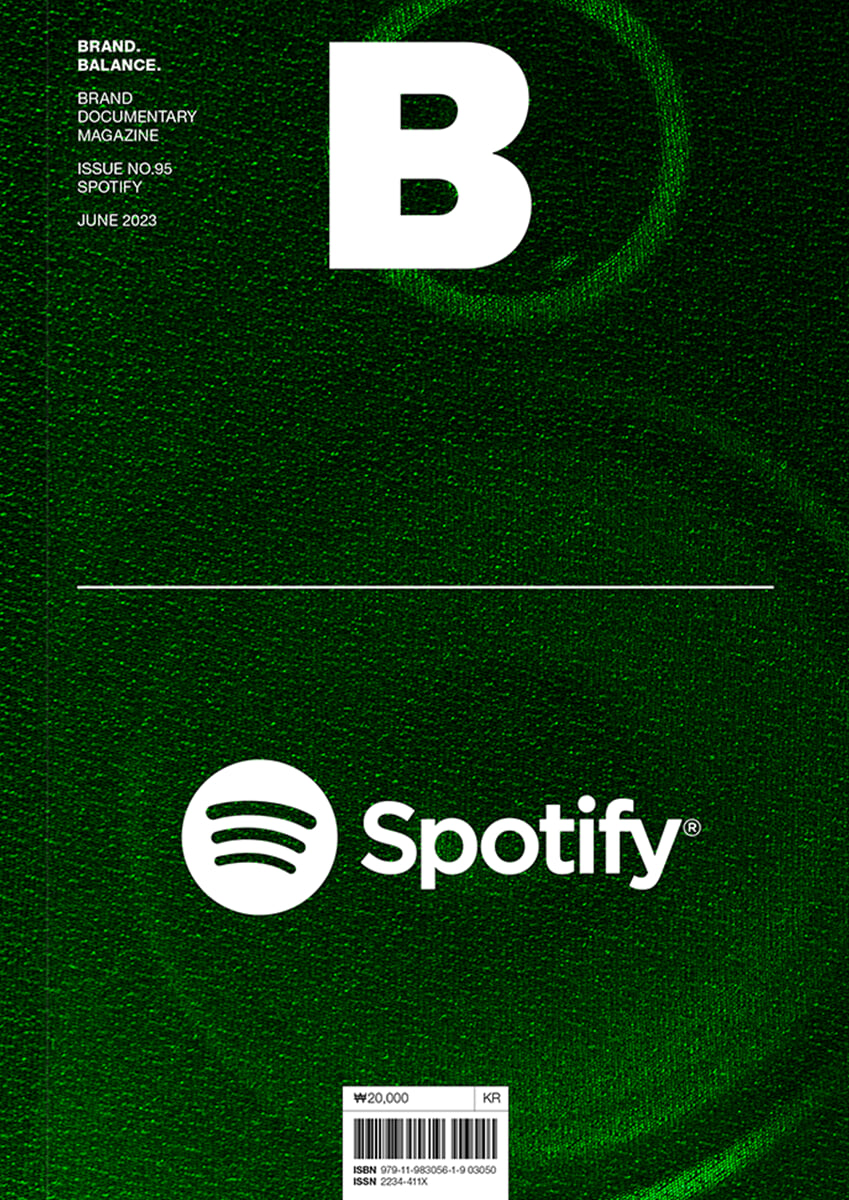
Magazine B: No. 95 Spotify Korean Edition
 |
Description
Book Introduction
It is a brand documentary magazine that introduces one balanced brand per issue.
Anyone interested in the brand can easily see it, as it contains the brand's philosophy, hidden stories, emotions, and even culture in a sensuous manner.
Founded in November 2011, it has introduced over 90 brands to the world, covering fashion, lifestyle, tech, and urban areas.
(www.magazine-b.com)
Anyone interested in the brand can easily see it, as it contains the brand's philosophy, hidden stories, emotions, and even culture in a sensuous manner.
Founded in November 2011, it has introduced over 90 brands to the world, covering fashion, lifestyle, tech, and urban areas.
(www.magazine-b.com)
index
02 INTRO
08 EDITOR'S LETTER
12 GAME CHANGER
Media Reactions to the Spotify Launch
16 CRITIC
Three media professionals discuss the changing music listening environment and the future of the music market.
20 OPINION: GREG OGAN
Greg Ogan, an associate professor at Berklee College of Music who has worked on various music creation projects, talks about the positive changes in the music industry brought about by Spotify.
26 VIBRANT OFFICE
A look at the work environment at Spotify's Stockholm, Sweden, headquarters and launchpad.
32 SPOTIFIERS
Twelve Spotify employees share their thoughts on Spotify's fun and enjoyable corporate culture and atmosphere.
36 ESSENTIALS
Key features and services that help you understand Spotify's core competencies as a music platform
42 ADVANCEMENT
Spotify's innovative results, which include nimbly identifying problems and finding optimal solutions.
48 CUSTOMIZATION
A two-week Spotify trial reveals Spotify's unique personalized recommendation service.
54 THE FOUNDER: DANIEL EK
Spotify's DNA and vision as told by Spotify founder and CEO Daniel Ek.
60 BRAND STORY
The growth story of Spotify, which has served as a conduit for experiencing new music under the keywords of "discovery and exploration."
66 THROWBACK
The story behind the four original members who dreamed of "democratizing music" and put their heads together to create Spotify.
70 INTERVIEW
Co-President Alex Norstrom, Chief HR Officer Katarina Berg, and VP and Head of Markets and Subscriber Growth Gustav Gillenhammer share Spotify's core strategy and corporate culture.
76 NOTES
Changes and phenomena within the Spotify platform, according to music industry experts.
80 MUSIC IS EVERYWHERE
Four artists continue to experiment with music, using Spotify to experience music and connect with fans.
98 PLAYGROUND
Stream on-site, an offline event that offers a glimpse into the brand's vision of becoming the optimal platform for audio content creators.
104 AUDIO GENERATION
Spotify's practical efforts to establish itself as a comprehensive audio platform and its flagship podcast and video programs
112 OPINION: PUJA PATEL
Pooja Patel, editor-in-chief of Pitchfork, a music criticism media outlet, shares her insights on how the music industry should move forward.
118 MUSIC VOYAGER
Spotify users who have creative capabilities and have deeply explored their own unique musical world.
126 IN SPACE
Several spaces have created their own unique identities by leveraging Spotify's playlists.
134 IMPACT
Spotify's diverse collaborations spanning various areas of life and music programs designed to enhance the value of diversity.
140 DIGEST
Significant figures and various information that can confirm the brand's influence.
143 OUTRO
08 EDITOR'S LETTER
12 GAME CHANGER
Media Reactions to the Spotify Launch
16 CRITIC
Three media professionals discuss the changing music listening environment and the future of the music market.
20 OPINION: GREG OGAN
Greg Ogan, an associate professor at Berklee College of Music who has worked on various music creation projects, talks about the positive changes in the music industry brought about by Spotify.
26 VIBRANT OFFICE
A look at the work environment at Spotify's Stockholm, Sweden, headquarters and launchpad.
32 SPOTIFIERS
Twelve Spotify employees share their thoughts on Spotify's fun and enjoyable corporate culture and atmosphere.
36 ESSENTIALS
Key features and services that help you understand Spotify's core competencies as a music platform
42 ADVANCEMENT
Spotify's innovative results, which include nimbly identifying problems and finding optimal solutions.
48 CUSTOMIZATION
A two-week Spotify trial reveals Spotify's unique personalized recommendation service.
54 THE FOUNDER: DANIEL EK
Spotify's DNA and vision as told by Spotify founder and CEO Daniel Ek.
60 BRAND STORY
The growth story of Spotify, which has served as a conduit for experiencing new music under the keywords of "discovery and exploration."
66 THROWBACK
The story behind the four original members who dreamed of "democratizing music" and put their heads together to create Spotify.
70 INTERVIEW
Co-President Alex Norstrom, Chief HR Officer Katarina Berg, and VP and Head of Markets and Subscriber Growth Gustav Gillenhammer share Spotify's core strategy and corporate culture.
76 NOTES
Changes and phenomena within the Spotify platform, according to music industry experts.
80 MUSIC IS EVERYWHERE
Four artists continue to experiment with music, using Spotify to experience music and connect with fans.
98 PLAYGROUND
Stream on-site, an offline event that offers a glimpse into the brand's vision of becoming the optimal platform for audio content creators.
104 AUDIO GENERATION
Spotify's practical efforts to establish itself as a comprehensive audio platform and its flagship podcast and video programs
112 OPINION: PUJA PATEL
Pooja Patel, editor-in-chief of Pitchfork, a music criticism media outlet, shares her insights on how the music industry should move forward.
118 MUSIC VOYAGER
Spotify users who have creative capabilities and have deeply explored their own unique musical world.
126 IN SPACE
Several spaces have created their own unique identities by leveraging Spotify's playlists.
134 IMPACT
Spotify's diverse collaborations spanning various areas of life and music programs designed to enhance the value of diversity.
140 DIGEST
Significant figures and various information that can confirm the brand's influence.
143 OUTRO
Detailed image

Publisher's Review
This is the ninety-fifth magazine, “B.”
Before writing the editor's letter for the Spotify issue, I took a moment to consider how many streaming services I personally use.
There are four music streaming apps, including a dedicated radio service, and seven video streaming apps, including a sports broadcasting app.
To make the most of these services, you'd need to be "streaming" all the time, except during work and sleep hours. Listening to music, in particular, is generally considered multitasking, so it's possible for it to occupy most of your time during the day.
These days, even videos are often consumed as audio content.
As wireless earphones become more popular, various sounds will be constantly playing in each of our ears.
The degree of immersion is not important, whether you listen intently or intently.
This is probably what Spotify founder Daniel Ek wants.
Music, and more broadly, audio content, is a constant presence in the background of all life.
In fact, he wanted Spotify to be perceived as a soundtrack supply chain rather than a record store.
When discussing Spotify's innovations since its founding in 2006, the first thing that comes to mind is that it has established a "legitimate" business model that provides "free" access to music from around the world.
At a time when the music industry was shifting its core foundation from physical albums to digital files, it pioneered a new market that satisfied creators, suppliers, and consumers alike.
In addition, streaming technology, which allows you to listen to music whenever you want without owning it, was an idea that changed the nature of music.
The origins of streaming technology are well depicted in the TV series "Playlist," which tells the story of Spotify's founding.
In Sweden, a social democratic country, sharing music is linked to the values of 'equality and freedom'.
It's no exaggeration to say that the invention of streaming as a product was a kind of social movement that believed that "music should not be a luxury, but like water and food, which everyone needs."
Even now, more than a decade after its launch, Spotify remains focused on lowering barriers to and accessibility to music across many strategic aspects of its service.
When I first signed up for Spotify, the thing that surprised me the most was their various efforts focused on 'convenience.'
Rather than organizing your library around albums and artists, what's most impressive is how you treat playlists that fit your mood, taste, and situation as if they were a single album.
It was a passage that strongly showed the will to shorten the time and effort required to explore and experience music.
If we use a restaurant analogy, it would be like suggesting a themed course for those who have difficulty choosing what to eat from the numerous menus.
But while Spotify recommends music on a playlist-by-play basis, it doesn't assert hierarchy or authority.
Rather than providing data from credible charts or guidance from music experts, we connect people like me around the world to the music they listen to.
In this way, the media describes Spotify, which exerts enormous influence on the music industry, as a service that “satisfies all types of music listening scenarios.”
Another way to interpret this is that Spotify is focused on filling the passageways connecting each destination with music, rather than focusing on music itself as the destination.
When Daniel Ek was a middle school student, making a name for himself as a coding prodigy and sharing his programming skills with a friend, something he said felt like a premonition of what Spotify is today.
“At some point, I suddenly realized that everything is connected.” Just as he said over 20 years ago, the music of today may be a ‘flow’ that connects people to people, time to time, and space to space.
So, how will we define the future of music? I'm curious to see if Spotify can redefine it once again.
Editor-in-Chief Park Eun-seong
Before writing the editor's letter for the Spotify issue, I took a moment to consider how many streaming services I personally use.
There are four music streaming apps, including a dedicated radio service, and seven video streaming apps, including a sports broadcasting app.
To make the most of these services, you'd need to be "streaming" all the time, except during work and sleep hours. Listening to music, in particular, is generally considered multitasking, so it's possible for it to occupy most of your time during the day.
These days, even videos are often consumed as audio content.
As wireless earphones become more popular, various sounds will be constantly playing in each of our ears.
The degree of immersion is not important, whether you listen intently or intently.
This is probably what Spotify founder Daniel Ek wants.
Music, and more broadly, audio content, is a constant presence in the background of all life.
In fact, he wanted Spotify to be perceived as a soundtrack supply chain rather than a record store.
When discussing Spotify's innovations since its founding in 2006, the first thing that comes to mind is that it has established a "legitimate" business model that provides "free" access to music from around the world.
At a time when the music industry was shifting its core foundation from physical albums to digital files, it pioneered a new market that satisfied creators, suppliers, and consumers alike.
In addition, streaming technology, which allows you to listen to music whenever you want without owning it, was an idea that changed the nature of music.
The origins of streaming technology are well depicted in the TV series "Playlist," which tells the story of Spotify's founding.
In Sweden, a social democratic country, sharing music is linked to the values of 'equality and freedom'.
It's no exaggeration to say that the invention of streaming as a product was a kind of social movement that believed that "music should not be a luxury, but like water and food, which everyone needs."
Even now, more than a decade after its launch, Spotify remains focused on lowering barriers to and accessibility to music across many strategic aspects of its service.
When I first signed up for Spotify, the thing that surprised me the most was their various efforts focused on 'convenience.'
Rather than organizing your library around albums and artists, what's most impressive is how you treat playlists that fit your mood, taste, and situation as if they were a single album.
It was a passage that strongly showed the will to shorten the time and effort required to explore and experience music.
If we use a restaurant analogy, it would be like suggesting a themed course for those who have difficulty choosing what to eat from the numerous menus.
But while Spotify recommends music on a playlist-by-play basis, it doesn't assert hierarchy or authority.
Rather than providing data from credible charts or guidance from music experts, we connect people like me around the world to the music they listen to.
In this way, the media describes Spotify, which exerts enormous influence on the music industry, as a service that “satisfies all types of music listening scenarios.”
Another way to interpret this is that Spotify is focused on filling the passageways connecting each destination with music, rather than focusing on music itself as the destination.
When Daniel Ek was a middle school student, making a name for himself as a coding prodigy and sharing his programming skills with a friend, something he said felt like a premonition of what Spotify is today.
“At some point, I suddenly realized that everything is connected.” Just as he said over 20 years ago, the music of today may be a ‘flow’ that connects people to people, time to time, and space to space.
So, how will we define the future of music? I'm curious to see if Spotify can redefine it once again.
Editor-in-Chief Park Eun-seong
GOODS SPECIFICS
- Date of issue: June 26, 2023
- Page count, weight, size: 152 pages | 170*240*20mm
- ISBN13: 9791198305619
- ISBN10: 1198305614
You may also like
카테고리
korean


korean

![GQ KOREA Mark (Monthly): December [2025]](http://librairie.coreenne.fr/cdn/shop/files/8ef265dbbfbf186523ed75ba7319009d.jpg?v=1765340328&width=3840)


