

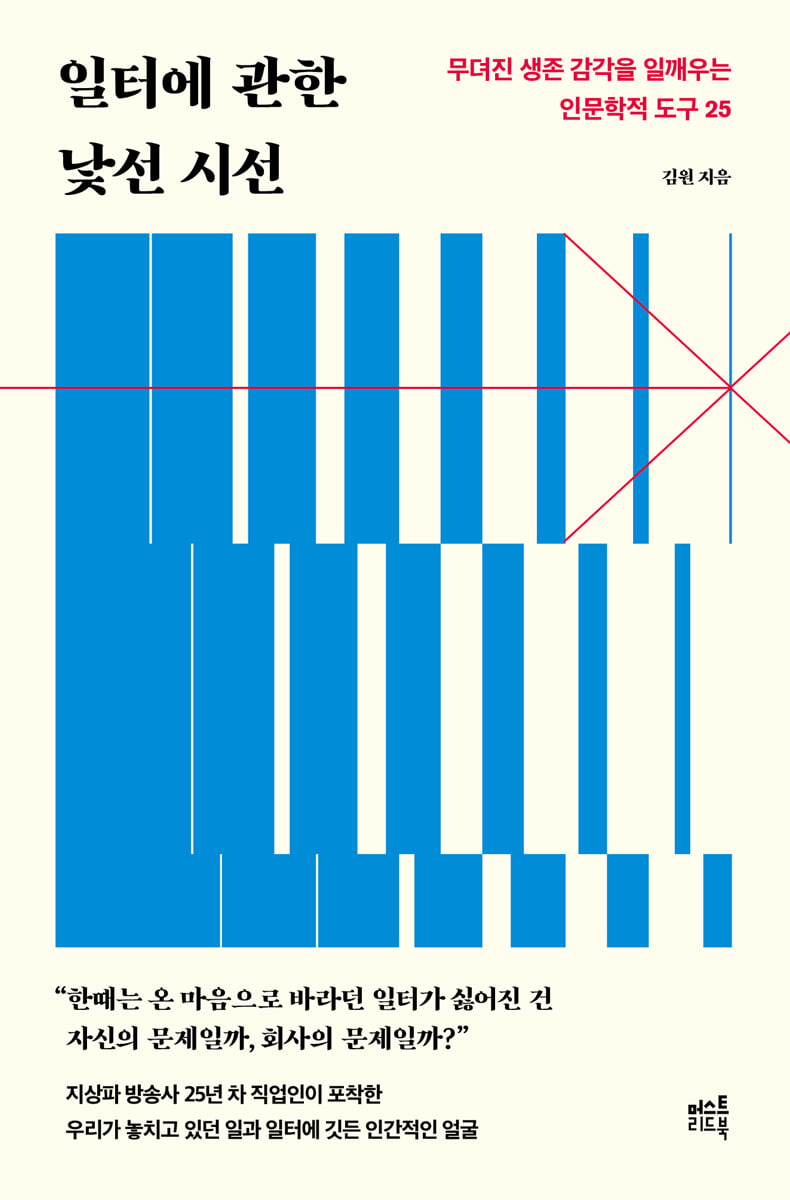
An unfamiliar perspective on the workplace
 |
Description
Book Introduction
The human face of work and the workplace, captured by a 25-year veteran of a terrestrial broadcasting company.
“It was hard work, but I also had fun!”
Are you exhausted and tired from demanding work and difficult interpersonal relationships? Is that really true? Will moving to a better job, or even quitting altogether, truly bring happiness? A professional who has worked in various roles at a terrestrial broadcaster for 25 years, from public relations to programming and planning, combines his keen observation skills with a liberal education in literature, philosophy, film, and art to share tips for enjoying life without being consumed by the futility and despair of the workplace.
The explanation is that work that is paid for inherently involves pain, so we must fill our workdays with memories of autonomous, unusual, and creative play so that they do not remain as painful memories.
In a society that condemns rest and demands only sincerity and hard work, this book will be a turning point that will invigorate the lives of all working professionals who are struggling in the workplace and help them get back on their feet.
“It was hard work, but I also had fun!”
Are you exhausted and tired from demanding work and difficult interpersonal relationships? Is that really true? Will moving to a better job, or even quitting altogether, truly bring happiness? A professional who has worked in various roles at a terrestrial broadcaster for 25 years, from public relations to programming and planning, combines his keen observation skills with a liberal education in literature, philosophy, film, and art to share tips for enjoying life without being consumed by the futility and despair of the workplace.
The explanation is that work that is paid for inherently involves pain, so we must fill our workdays with memories of autonomous, unusual, and creative play so that they do not remain as painful memories.
In a society that condemns rest and demands only sincerity and hard work, this book will be a turning point that will invigorate the lives of all working professionals who are struggling in the workplace and help them get back on their feet.
- You can preview some of the book's contents.
Preview
index
prolog.
Various thoughts on making money
Chapter 1.
Getting started
─If you meet a warm person in a cold workplace
Is joining a company a defining moment in life?
What makes a good company?
Preparing for a job is a constant cycle of self-reproach.
No matter how you look at it, it's a strange company
A hero is a hero even if he returns empty-handed.
Professionals with great personas
About social distancing at work
The difference between a good-looking person and a good person
The power of a reputation as a fun and nice person
Chapter 2.
Enjoy
─I worked hard, but I also had fun.
Is there no place as fun as work?
Slump, a true work companion and colleague
Wounds from the workplace are healed through play.
Start studying how to build your center of gravity
I look at myself in the many mirrors of the universe.
Living well in a world full of evil people
When to step back and when to fight back
A fast-acting pain reliever that relieves the pain of work
Returning to routine at a company with no vacations
Chapter 3.
Go forward
─Sharing similarities beyond differences
Becoming a Leader in an Unbossed Society
Social Life Tips for People Who Are More Sensitive Than Others
The Persistent Worker and the Strange Retirement Debate
The feeling of relying on your labor
How to Find a Job You Enjoy
Finding a balance between mind and body, work and play
Everyone owes each other's labor
This is a decent commute
Epilogue.
Long-term employment by chance
Acknowledgements
References
Various thoughts on making money
Chapter 1.
Getting started
─If you meet a warm person in a cold workplace
Is joining a company a defining moment in life?
What makes a good company?
Preparing for a job is a constant cycle of self-reproach.
No matter how you look at it, it's a strange company
A hero is a hero even if he returns empty-handed.
Professionals with great personas
About social distancing at work
The difference between a good-looking person and a good person
The power of a reputation as a fun and nice person
Chapter 2.
Enjoy
─I worked hard, but I also had fun.
Is there no place as fun as work?
Slump, a true work companion and colleague
Wounds from the workplace are healed through play.
Start studying how to build your center of gravity
I look at myself in the many mirrors of the universe.
Living well in a world full of evil people
When to step back and when to fight back
A fast-acting pain reliever that relieves the pain of work
Returning to routine at a company with no vacations
Chapter 3.
Go forward
─Sharing similarities beyond differences
Becoming a Leader in an Unbossed Society
Social Life Tips for People Who Are More Sensitive Than Others
The Persistent Worker and the Strange Retirement Debate
The feeling of relying on your labor
How to Find a Job You Enjoy
Finding a balance between mind and body, work and play
Everyone owes each other's labor
This is a decent commute
Epilogue.
Long-term employment by chance
Acknowledgements
References
Detailed image

Into the book
Why are companies so strange? There are many reasons, but the most reasonable explanation seems to be that they're an unfamiliar world, far removed from our everyday lives.
While our daily lives revolve around ourselves, companies are driven by bizarre goals like profit.
The process of leaving one's daily life and entering the unfamiliar world of a company is similar to entering a jungle and surrendering oneself to an unknown tribe.
The jungle is a dangerous place full of poisonous plants, insects, and wild animals that are hard to find near people.
The tribe living there has placed danger signs on every road that only they can recognize.
It is a kind of rule and law for survival.
After reading these signs, we arrive at an unknown tribal village with difficulty, where an eccentric chief lives.
There are also shamans with names like 'future', 'planning', and 'strategy'.
They often get angry out of the blue or yell about how everything is wrong, and for an outsider unfamiliar with the tribal culture, it can be difficult to understand why they are always angry.
--- p.42~43
Society is a fiercely competitive arena, full of people trying to rise above each other.
Living in it, we only see bad people and cannot recognize the good people who protect us.
As a result, even when a bird of pure relationship comes to visit, they make the mistake of waving their hand without thinking or chasing it away because they think they are on good terms.
“Be kind to good people, and don’t worry about bad people.” This is a lesson about human relationships learned while living in society.
We often waste energy trying to win the hearts of evil people who ignore or despise us.
Like a hunter trying to catch all the birds with a small piece of lead, you become greedy and end up experiencing the failure of relationships where good people leave and only bad people surround you.
If you find a bird that you are in a pure relationship with, you should pay close attention to notice even the smallest changes in the other person.
They say out of sight, out of mind.
If you meet less often, it's not that the relationship becomes distant, but rather that you become distant because you can't adapt to the person's changes.
--- p.73
Corporate people start to show off their masks as if they were their own faces and start performing, not playing.
If you look closely, you will see that their hands and feet are entangled with fishing lines of duty and desire.
Instead of the fun created by surprise and chance, they present obedience disguised as spontaneity.
Living as a puppet for production, dancing on stage and shouting creepy lines at others.
"Treat work like play! That's how you get results!" Followers of power and industrial society instinctively dislike play and laughter.
Because play threatens the existing system with freedom and unproductivity as weapons, and laughter dispels fear of those in power.
That is why in Umberto Eco's novel The Name of the Rose, there is a setting in which Aristotle's Poetics, Book 2, Comedy, which deals with laughter, is poisoned to prevent people from approaching laughter.
Power is always afraid of play and laughter.
--- p.93~94
Kindness can save the world and yourself without the effort of self-flagellation or self-reflection.
Saying a kind word to a new employee who is hesitant and left out of the conversation, asking a colleague if they are having a hard time, or being the first to talk with a smile…
These things may seem trivial to you, but they can be a great help to others. Could there be a more rewarding business than this? We inevitably encounter evil people in life.
Sometimes I feel afraid of a world full of sociopaths and villains, or it feels like living like them is the smart thing to do.
But there is no need to worry that the world will be filled with evil people.
Kant's moral imagination teaches us that a society or group in which everyone lies or commits evil deeds can never last.
A world full of evil people cannot logically exist.
Above all, human history shows that society has an inherent energy that restores balance by adjusting the steadily increasing proportion of evildoers.
--- p.138~139
When I was a newbie, there were times when I wondered where the team leader could get such rotten apples.
Among them, there were many apples that were so bad that they were completely inedible.
One day, I went into a business meeting in place of the team leader who was out of the office, and that's when I learned about the structure of apple picking.
For example, the boss opens a bundle and spreads ten apples on the table.
After the meeting, our division executives brought four of them.
The director throws three apples to the team leader, excluding the ones that can be eaten slowly over time.
The team leader brings one or two of them, excluding the ones that are already damaged.
In this system, we have come to accept that it is difficult to not choose apples at all.
It's not right to be too greedy and accept all the apples that are offered, but as a team leader, sometimes you have no choice but to accept those kinds of apples.
I also learned that the role of a good team leader is to skillfully select good apples, cut out the rotten parts, and bring only the good parts.
--- p.172~173
I stopped by a convenience store late at night.
I felt grateful to the part-time worker there, knowing that I could buy snacks and a cold cola to fill my stomach when I was out and about.
As I was walking along the street at night, I saw that a garbage truck had already arrived and was busy hauling away the trash.
Thanks to the cleaning workers, the surroundings became cleaner.
The peaceful sight of a dog walking down a dark, cherry-blossom-lined street is thanks to the police officers, firefighters, and medical staff who work with their lights on even at night.
I come home, eat a warm hot dog, and watch YouTube content on my phone.
I was also grateful to the sausage factory workers, mobile phone company employees, and creators who helped me experience small but certain happiness.
When we become a society that appreciates each other's labor, when respect and awe for each other's professions are revived, labor regains its sacred power to sustain society.
The distinction between noble and base occupations is fading away, and everyone has the freedom to choose an occupation that suits their abilities and preferences.
While our daily lives revolve around ourselves, companies are driven by bizarre goals like profit.
The process of leaving one's daily life and entering the unfamiliar world of a company is similar to entering a jungle and surrendering oneself to an unknown tribe.
The jungle is a dangerous place full of poisonous plants, insects, and wild animals that are hard to find near people.
The tribe living there has placed danger signs on every road that only they can recognize.
It is a kind of rule and law for survival.
After reading these signs, we arrive at an unknown tribal village with difficulty, where an eccentric chief lives.
There are also shamans with names like 'future', 'planning', and 'strategy'.
They often get angry out of the blue or yell about how everything is wrong, and for an outsider unfamiliar with the tribal culture, it can be difficult to understand why they are always angry.
--- p.42~43
Society is a fiercely competitive arena, full of people trying to rise above each other.
Living in it, we only see bad people and cannot recognize the good people who protect us.
As a result, even when a bird of pure relationship comes to visit, they make the mistake of waving their hand without thinking or chasing it away because they think they are on good terms.
“Be kind to good people, and don’t worry about bad people.” This is a lesson about human relationships learned while living in society.
We often waste energy trying to win the hearts of evil people who ignore or despise us.
Like a hunter trying to catch all the birds with a small piece of lead, you become greedy and end up experiencing the failure of relationships where good people leave and only bad people surround you.
If you find a bird that you are in a pure relationship with, you should pay close attention to notice even the smallest changes in the other person.
They say out of sight, out of mind.
If you meet less often, it's not that the relationship becomes distant, but rather that you become distant because you can't adapt to the person's changes.
--- p.73
Corporate people start to show off their masks as if they were their own faces and start performing, not playing.
If you look closely, you will see that their hands and feet are entangled with fishing lines of duty and desire.
Instead of the fun created by surprise and chance, they present obedience disguised as spontaneity.
Living as a puppet for production, dancing on stage and shouting creepy lines at others.
"Treat work like play! That's how you get results!" Followers of power and industrial society instinctively dislike play and laughter.
Because play threatens the existing system with freedom and unproductivity as weapons, and laughter dispels fear of those in power.
That is why in Umberto Eco's novel The Name of the Rose, there is a setting in which Aristotle's Poetics, Book 2, Comedy, which deals with laughter, is poisoned to prevent people from approaching laughter.
Power is always afraid of play and laughter.
--- p.93~94
Kindness can save the world and yourself without the effort of self-flagellation or self-reflection.
Saying a kind word to a new employee who is hesitant and left out of the conversation, asking a colleague if they are having a hard time, or being the first to talk with a smile…
These things may seem trivial to you, but they can be a great help to others. Could there be a more rewarding business than this? We inevitably encounter evil people in life.
Sometimes I feel afraid of a world full of sociopaths and villains, or it feels like living like them is the smart thing to do.
But there is no need to worry that the world will be filled with evil people.
Kant's moral imagination teaches us that a society or group in which everyone lies or commits evil deeds can never last.
A world full of evil people cannot logically exist.
Above all, human history shows that society has an inherent energy that restores balance by adjusting the steadily increasing proportion of evildoers.
--- p.138~139
When I was a newbie, there were times when I wondered where the team leader could get such rotten apples.
Among them, there were many apples that were so bad that they were completely inedible.
One day, I went into a business meeting in place of the team leader who was out of the office, and that's when I learned about the structure of apple picking.
For example, the boss opens a bundle and spreads ten apples on the table.
After the meeting, our division executives brought four of them.
The director throws three apples to the team leader, excluding the ones that can be eaten slowly over time.
The team leader brings one or two of them, excluding the ones that are already damaged.
In this system, we have come to accept that it is difficult to not choose apples at all.
It's not right to be too greedy and accept all the apples that are offered, but as a team leader, sometimes you have no choice but to accept those kinds of apples.
I also learned that the role of a good team leader is to skillfully select good apples, cut out the rotten parts, and bring only the good parts.
--- p.172~173
I stopped by a convenience store late at night.
I felt grateful to the part-time worker there, knowing that I could buy snacks and a cold cola to fill my stomach when I was out and about.
As I was walking along the street at night, I saw that a garbage truck had already arrived and was busy hauling away the trash.
Thanks to the cleaning workers, the surroundings became cleaner.
The peaceful sight of a dog walking down a dark, cherry-blossom-lined street is thanks to the police officers, firefighters, and medical staff who work with their lights on even at night.
I come home, eat a warm hot dog, and watch YouTube content on my phone.
I was also grateful to the sausage factory workers, mobile phone company employees, and creators who helped me experience small but certain happiness.
When we become a society that appreciates each other's labor, when respect and awe for each other's professions are revived, labor regains its sacred power to sustain society.
The distinction between noble and base occupations is fading away, and everyone has the freedom to choose an occupation that suits their abilities and preferences.
--- p.201~202
Publisher's Review
Why do I hate the workplace I wanted with all my heart?
Adult life is mostly filled with memories of work.
As members of society, we grit our teeth and go to work every day to prove our worth through our labor.
Then, after some time has passed and you get used to life, you start to hate your job and workplace again as if it were natural.
Is it my fault, or is it the company's, that I'm starting to dislike the workplace I once loved with all my heart? This book, "An Unfamiliar Perspective on the Workplace," is a collection of essays by professionals that capture the human face of work and the workplace we've been missing.
For professionals struggling in the physical and mental confinement of the company, we offer tips on how to enjoy life without being consumed by it.
The author, who has worked in various fields from public relations to programming and planning for 25 years at a terrestrial broadcasting station, says that work that is paid for labor is inherently accompanied by pain.
A blank face that rarely shows emotion or an attitude of being cowered to avoid getting hurt are representative scars left behind by the workplace.
The explanation is that we must fill our workdays with memories of autonomous, unusual, and creative play so that they do not remain as painful memories.
‘Refreshing daily life with metaphors’, ‘Reflecting yourself in various mirrors’, ‘Developing your own sense of distance’, ‘Becoming a person who plays’, etc.
By combining his keen observation of life with his knowledge of literature, philosophy, film, and art, he offers small ideas that can breathe life into dull work life and human relationships.
This book encourages us to break away from a life that demands only finished products and dream of a life where we savor the joy of the process. It will be a turning point for all professionals living in a society that condemns rest and demands only sincerity and hard work, injecting vitality into their lives and helping them rise again.
Work-life balance is not a balance between work and rest, but a balance between work and play!
To regain balance in life, we must freely express ourselves through enjoyable and spontaneous activities.
From the moment you turn off the alarm and go to work every morning, the life of a working person becomes miserable.
Commuting to and from work while seeing the same scenery every time is tiring and lonely.
We feel frustrated, like people who have suffered a calamity without even knowing the cause of their suffering.
"Is this job not a good fit? Are my interpersonal relationships lacking? Is my low salary causing me to feel dissatisfied?" I try to find the cause of my suffering, but all that remains is a sharp sensation of pain.
Where on earth does this suffering come from? The author argues that while many people, exhausted by demanding work and difficult interpersonal relationships, point to the workplace as the root of all evil, we need to be more precise and careful in identifying what we despise and need to change.
The idea is that, as you get used to a new workplace and new environment, pain can return, so perhaps the root of all evil is not work, but the familiar and boring routine.
Originally, work and play were one, but with the advent of modern industrialization, play became separated, and work became pure suffering.
To regain the balance in your life, he advises that you should devote as much time to play as you devote to work, giving your suffering self a chance to breathe.
The work-play balance the author speaks of doesn't simply mean working moderately and resting moderately.
It refers to the act of increasing life satisfaction by finding and carrying out autonomous and creative activities after completing one's work to earn a living.
It means that we should freely express ourselves through activities that are purely enjoyable and spontaneous, not to meet the standards of others, to produce something, or to please someone.
He emphasizes that if work for a living and work for play work together like a big wheel and a small wheel, the quality of life will improve and we will be able to focus on more creative and productive work.
From "social distancing" to "learning how to take painkillers safely."
A self-directed lifestyle that enables a healthy social life while protecting one's self.
Companies race to achieve outlandish goals that individuals might not even consider: increased sales, budget savings, and improved customer satisfaction.
From planning to progress and reporting of results, work is systematically managed, and there are rewards and punishments accordingly.
Even minor mistakes that might be dismissed as "that could happen" in a personal matter are being evaluated as damaging to brand value, making everyone nervous as everything is converted into money.
Living within it naturally, we wear expressionless masks and treat each other in a businesslike manner.
The author attempts to fundamentally shift perspectives on jobs and the workplace, moving away from the traditional view of labor in terms of money and suffering, in an era of job-hopping and retirement.
Beginning with the simple question, "How can I live more enjoyably as a professional commuting worker?", this book explores the essence of work, the principles necessary for living an enjoyable career, and ultimately, the secret to a happy life. This book introduces humanistic methods to revive your dulled sense of survival and bring joy back to work.
'Distance from work', which involves finding the distance that maximizes efficiency between what the company demands and what one can do, is the virtue most necessary for us now, as we spend more than eight hours a day immersed in work (p. 58).
Rather than being immersed in the single universe of a company, experiencing various worlds such as hobbies, studies, certifications, volunteer work, and sports, and looking at yourself in a three-dimensional way by “reflecting yourself through various mirrors” can help you discover your own value and increase your self-esteem (p. 126).
When you are tired and exhausted, refer to 'Learning to Take Harmless Painkillers' and try to give meaning to the pain you are experiencing rather than analyzing its cause (page 148).
Then, let's get through the day by taking various painkillers that relieve the pain of work, from economic compensation to physical care and soul-replenishing.
Labor is essentially an act for one's own survival, but also an act for others.
The labor philosophy that 'humans must prove themselves through labor and work diligently as if they were ascetics' has been presented as the proper path for modern people to follow and the ideal life.
In our society, too, the sayings “If you want to be a good human being, you have to work hard” and “You can lie down as much as you want once you’re in the coffin” have often been circulated.
Because of this, we had no time to think about the value of work or our own tastes, and as soon as we graduated from school, we had to go straight to work as if possessed by something and focus solely on work.
The author argues that because of this polluted myth of labor, opportunities to think about the rewards of work have disappeared, labor productivity has declined, and workplaces are filled with people who only have an attitude of sincerity and enthusiasm.
In a society where labor is consumed mechanically, no one feels satisfaction from work, and people only end up dominating and exploiting each other.
The author emphasizes that we must be consciously awake to break free from the myth of polluted labor that condemns rest and demands only sincerity and hard work.
The explanation is that familiarity tires us, and the essence of work is to owe labor to one another and live by repaying that debt.
I have worked for my loved ones and my family, and I have also worked for you.
Adult life is mostly filled with memories of work.
As members of society, we grit our teeth and go to work every day to prove our worth through our labor.
Then, after some time has passed and you get used to life, you start to hate your job and workplace again as if it were natural.
Is it my fault, or is it the company's, that I'm starting to dislike the workplace I once loved with all my heart? This book, "An Unfamiliar Perspective on the Workplace," is a collection of essays by professionals that capture the human face of work and the workplace we've been missing.
For professionals struggling in the physical and mental confinement of the company, we offer tips on how to enjoy life without being consumed by it.
The author, who has worked in various fields from public relations to programming and planning for 25 years at a terrestrial broadcasting station, says that work that is paid for labor is inherently accompanied by pain.
A blank face that rarely shows emotion or an attitude of being cowered to avoid getting hurt are representative scars left behind by the workplace.
The explanation is that we must fill our workdays with memories of autonomous, unusual, and creative play so that they do not remain as painful memories.
‘Refreshing daily life with metaphors’, ‘Reflecting yourself in various mirrors’, ‘Developing your own sense of distance’, ‘Becoming a person who plays’, etc.
By combining his keen observation of life with his knowledge of literature, philosophy, film, and art, he offers small ideas that can breathe life into dull work life and human relationships.
This book encourages us to break away from a life that demands only finished products and dream of a life where we savor the joy of the process. It will be a turning point for all professionals living in a society that condemns rest and demands only sincerity and hard work, injecting vitality into their lives and helping them rise again.
Work-life balance is not a balance between work and rest, but a balance between work and play!
To regain balance in life, we must freely express ourselves through enjoyable and spontaneous activities.
From the moment you turn off the alarm and go to work every morning, the life of a working person becomes miserable.
Commuting to and from work while seeing the same scenery every time is tiring and lonely.
We feel frustrated, like people who have suffered a calamity without even knowing the cause of their suffering.
"Is this job not a good fit? Are my interpersonal relationships lacking? Is my low salary causing me to feel dissatisfied?" I try to find the cause of my suffering, but all that remains is a sharp sensation of pain.
Where on earth does this suffering come from? The author argues that while many people, exhausted by demanding work and difficult interpersonal relationships, point to the workplace as the root of all evil, we need to be more precise and careful in identifying what we despise and need to change.
The idea is that, as you get used to a new workplace and new environment, pain can return, so perhaps the root of all evil is not work, but the familiar and boring routine.
Originally, work and play were one, but with the advent of modern industrialization, play became separated, and work became pure suffering.
To regain the balance in your life, he advises that you should devote as much time to play as you devote to work, giving your suffering self a chance to breathe.
The work-play balance the author speaks of doesn't simply mean working moderately and resting moderately.
It refers to the act of increasing life satisfaction by finding and carrying out autonomous and creative activities after completing one's work to earn a living.
It means that we should freely express ourselves through activities that are purely enjoyable and spontaneous, not to meet the standards of others, to produce something, or to please someone.
He emphasizes that if work for a living and work for play work together like a big wheel and a small wheel, the quality of life will improve and we will be able to focus on more creative and productive work.
From "social distancing" to "learning how to take painkillers safely."
A self-directed lifestyle that enables a healthy social life while protecting one's self.
Companies race to achieve outlandish goals that individuals might not even consider: increased sales, budget savings, and improved customer satisfaction.
From planning to progress and reporting of results, work is systematically managed, and there are rewards and punishments accordingly.
Even minor mistakes that might be dismissed as "that could happen" in a personal matter are being evaluated as damaging to brand value, making everyone nervous as everything is converted into money.
Living within it naturally, we wear expressionless masks and treat each other in a businesslike manner.
The author attempts to fundamentally shift perspectives on jobs and the workplace, moving away from the traditional view of labor in terms of money and suffering, in an era of job-hopping and retirement.
Beginning with the simple question, "How can I live more enjoyably as a professional commuting worker?", this book explores the essence of work, the principles necessary for living an enjoyable career, and ultimately, the secret to a happy life. This book introduces humanistic methods to revive your dulled sense of survival and bring joy back to work.
'Distance from work', which involves finding the distance that maximizes efficiency between what the company demands and what one can do, is the virtue most necessary for us now, as we spend more than eight hours a day immersed in work (p. 58).
Rather than being immersed in the single universe of a company, experiencing various worlds such as hobbies, studies, certifications, volunteer work, and sports, and looking at yourself in a three-dimensional way by “reflecting yourself through various mirrors” can help you discover your own value and increase your self-esteem (p. 126).
When you are tired and exhausted, refer to 'Learning to Take Harmless Painkillers' and try to give meaning to the pain you are experiencing rather than analyzing its cause (page 148).
Then, let's get through the day by taking various painkillers that relieve the pain of work, from economic compensation to physical care and soul-replenishing.
Labor is essentially an act for one's own survival, but also an act for others.
The labor philosophy that 'humans must prove themselves through labor and work diligently as if they were ascetics' has been presented as the proper path for modern people to follow and the ideal life.
In our society, too, the sayings “If you want to be a good human being, you have to work hard” and “You can lie down as much as you want once you’re in the coffin” have often been circulated.
Because of this, we had no time to think about the value of work or our own tastes, and as soon as we graduated from school, we had to go straight to work as if possessed by something and focus solely on work.
The author argues that because of this polluted myth of labor, opportunities to think about the rewards of work have disappeared, labor productivity has declined, and workplaces are filled with people who only have an attitude of sincerity and enthusiasm.
In a society where labor is consumed mechanically, no one feels satisfaction from work, and people only end up dominating and exploiting each other.
The author emphasizes that we must be consciously awake to break free from the myth of polluted labor that condemns rest and demands only sincerity and hard work.
The explanation is that familiarity tires us, and the essence of work is to owe labor to one another and live by repaying that debt.
I have worked for my loved ones and my family, and I have also worked for you.
GOODS SPECIFICS
- Date of issue: November 21, 2025
- Page count, weight, size: 248 pages | 312g | 135*205*16mm
- ISBN13: 9791193228067
- ISBN10: 1193228069
You may also like
카테고리
korean


korean

![GQ KOREA Mark (Monthly): December [2025]](http://librairie.coreenne.fr/cdn/shop/files/8ef265dbbfbf186523ed75ba7319009d.jpg?v=1765340328&width=3840)


